learners. This device helps the learner to be competent enough to think critically and share their views among their peers.
3. Teacher-student interaction is one of the patterns of classroom interaction, out of two patterns, occurred between the teacher and the students which is initiated and dominated by the teacher as the source of teaching learning process.
II. FRAME OF THEORIES
In this chapter the researcher uses some concepts to this research. They are concept of language learning, concept of classroom interaction, teacher talk,learner talk, classroom interaction in language teaching, pattern of classroom interaction, classroom interaction analysis, and supporting factors in classroom interaction including the effect of gender. Classified like the following.
2.1 Concept of Language Learning
Language learning is a process. A child learns his first language step by step. Since he does not go to school at his age, he does not learn his first language by studying the rules formally, but through experience. Concept development of language goes along with the experience.
depend on the effort as of changing both the teacher and the learners. If the teacher uses appropriate methods in teaching, it will be easier for the learners to study the materials. In this case of learning, the learners study the material consciously and practice it in order to get good results.
From the explanation above, it can be inferred that learning:
1. is acquiring or getting knowledge;
2. is getting information or skill;
3. involves active and conscious efforts, inside or outside of the classroom; 4. is relatively permanent, but subject to forgetting;
5. involves some form of practice, perhaps reinforced practice;
6. is a change in behavior.
2.2 Teacher Talk
Observation of many different classes, both in content area subjects and in language instruction, consistently shows that teachers typically do between one half and three quarters of the talking done in classrooms. Talk is one of the major ways that teachers convey information to learners, and it is also one of the primary means of it will be useful to ask what our talk is like.
It has been said before that teacher and learner talks are the factors that establish classroom interaction. Both of them must be in balance. Too much teacher talk will make the students passive and static; they cannot improve their English acquisition. It will be also bad if the teacher has too little talk, the students will not get enough knowledge from him. But it is wrong to judge or assess teacher talk only by reference to its quantity. It is just as important to assess its quality.
There are three major aspect of teacher talk, they are:
1. Physiological aspect
This aspect related to the voice produced by the teacher. The teacher has to be able to control his voice during, he speaks in the classroom.
2. Interpersonal aspect
This aspect related to how the teacher speaks with utterances which is structured appropriately with the situation to the students so it can make a classroom climate.
3. Pedagogical aspect
From the statement above, it can be known that the teacher have to be able to make his talk balance with students talk, situation and context because it can affect students' language acquisition. As William Ayers says that the focus of teacher talk is curriculum, instruction and evaluation-the content of conduct of teaching, so that the teacher's ability to combine and apply the three aspects in his talk is really needed.
2.3 Learner Talk
According to Halliday, children have language development when they learn language (Halliday, 1986:16). It is the same with when they learn foreign language in the classroom. Firstly they imitate the teacher talk and they need more time to record every teacher's talk that it's called 'silent period', then start to express their own idea, having discussion, and finally can get their communicative competence.
Student talk can be said as student's speech when he imitates his teacher's examples, expresses his idea or gives comments and criticism about something in the classroom, because Prabhu said that learners have effort in the language classroom (Prabhu, 1991: 49), but teacher's role cannot be separated from their effort. A good classroom climate will support the students' effort.
Student talk can be said as student’s speech when he imitates his teacher’s examples, expresses his idea or gives comments and criticism about something in the classroom.
Talk by students in response to teacher. Teacher initiates the contact or solicits student statement.
2. Student talk-initiation
Talk by students which they initiate. If 'calling on' student is only to indicate who may talk next, observer must decide whether student wanted to talk. If he did, use this category.
3. Silence or confusion
Pauses, short periods of silence and periods of confusion in which communication cannot be understood by the observer.
2.4 Concept of Classroom Interaction
Classroom interaction is the action performed by the teacher and the students during instruction interrelated. They interact with one another for a number of different reason and on a continued basis throughout the school day. Classroom interaction covers classroom behaviours such as turn-taking, questioning and answering, negotiation of meaning and feedback (Chaudron, 1988: 10)
“Interaction between students and teacher is fundamental to the learning process”.
(Willson, http:// www.aare.edu.au/ ggpap/ will99741. htm)
Interaction in language classroom will lead the learners to better learning, and will activate their competence (Malamah-Thomas,1987:45). As the students’ interest is aroused, their anxiety, fear or even fatigue in the classroom will gradually diminish; if not completely disappear, and as a result they will actively involve in the classroom interaction.
Psychologically, students cannot be well motivated when they are involved in a less interesting language activities or materials, which will consequently decrease their understanding toward the learning material being learnt. Likewise, when they have intrinsic, motivation increasingly driven, it will be easier for them to comprehend the material gradually.
other by imparting thoughts, feelings, or ideas. The interaction should be a communication should be meaningful enough for the concerned people, if it is not, there could be a communication barrier. In a classroom interaction, therefore, it is important that meaningful communication be created and fostered.
River (1970:4-5) states through interaction students can increase their language store as they listen to or read authentic linguistic material. In interaction, students can use all of their possession of the language-all they have learned or casually absorbed-in real life exchanges. Interaction involves not only expression of one’s own ideas but also comprehensions. One listens to other, one responds (either directly or indirectly), other listen and respond.
2.5 Classroom Interaction in Language Teaching
Bishop (2000) stated that students will not get enough practice just by talking to the instructor, and very little by just listening to the instructor. Furthermore he said that
students develop competency and become critical thinkers in classroom that provides opportunities for intensive, structured interaction among students.
1987) it means that the teacher can use non verbal cues to encourage students speaking interaction, for example, smile expectantly and nod as students talk.
When we talk about different interaction in class, we mean the issue of who is speaking to whom. Edge (2001:69) divided classroom interaction into 6 types of interaction:
1. Teacher – students interaction where teacher gives obstruction to the whole class (T-Ss)
2. Teacher-students interaction where there is an exchange between the teacher and
the whole class such as question and answer (Ss-T)
3. Teacher-student interaction where teacher initiates the interaction with an
individual of students. The teacher asks a student to answer question, repetition, confirmation and so on (T-S)
4. Student-teacher interaction where the communication with the teacher stated by student. The student initiated himself to question the teacher, giving opinion, complaining, eliciting in form of information and many others (S-T).
5. Teacher-student-student interaction where the teacher tells one student to say something to another (T-S-S).
2.6 Pattern of Classroom Interaction
Interaction refers to any sort of interaction, student-students or teacher student discussion, group discussion, and any type of classroom participation (Long and Sato, 1983). The proportion of student-student interaction in classroom ideally should be larger than teacher-student interaction that is student-centeredness’. The longer students interact with each other, the better they understand what they experience and learn something in the classroom.
In order to gain meaningful learning activity, there should be classroom interaction. According Sardiman (1987:204-205), there are two pattern of interaction in the teaching and learning process, namely an interaction between teacher and students, and interaction among students. He further points out four advantages of the classroom interaction as described below:
1. Classroom interaction makes the teaching learning process more alive
2. The teacher would able to know his students’ wants, interest, attention,
behaviors, weakness, and faults.
3. The teacher would be able to recognize his own weakness and fault based on the teaching and learning process that has taken place.
4. The teacher would be able to develop the students’ ability by making contact with his students.
teaching. The method or technique can be applied in a more or less flexible way. If any inappropriateness caused by the method or technique being applied may distort the classroom interaction, the teacher obliged to modify or change it abruptly. Since a teacher’s major duty is how to make the students learn, not merely to teach them. And this idea is often, commonly, neglected by most of the teachers at the moment.
The current theories of communicative competence are essentially interactive nature of communication. Most meaning, in semantic sense, is a product of negotiation, of give and take, as interlocutor attempt to communicate. Thus, the communicative purpose of language compels us to create opportunities for genuine interaction in the classroom.
Interactive classes will most likely be found:
1. Doing a significant amount of pair work or group work. 2. Receiving authentic language input in real-world contexts. 3. Producing language for genuine, meaningful communication.
4. Performing classroom tasks that prepare them for actual communication.
5. Practicing oral communication through the give and take and spontaneity of
actual conversation
6. Writing to and for real audiences, not contrived ones.
Brown (2001:165), that from the very beginning of the language study, classroom should be interactive.
2.7 Classroom Interaction Analysis
Flanders' Interaction Analysis is a system of classroom interaction analysis. The Flanders' Interaction Analysis Categories (FIAC) consists of ten categories of communication which are said to be inclusive of all communication possibilities. There are seven categories used when the teacher is talking and two categories when the learner is talking. In his pioneering work, Flanders used the term Interaction Analysis for his ten-category observation schedule that he had designed for general educational purposes, to be relevant to a variety of lessons rather than for any subject in particular. In his work, he combined a politically powerful idea with a very practical simplicity. The powerful idea was that the teaching was more or less effective depending on how “directly” or “indirectly” teachers influence learner behaviour.
TEACHER TALK
INDIRECT INFLUENCE
1. ACCEPTS FEELING: accepts and clarifies the feeling tone of the students in a non-threatening manner. Feelings may be positive or negative. Predicting or recalling feelings are included.
2. PRAISES OR ENCOURAGES: praises or encourages students’ action or behaviour. Jokes that release tension, not at the expense of another individual, nodding head or saying, “um hm?” or “go on” are included.
3. ACCEPTS OR USES IDEAS OF STUDENT: clarifying, building, or developing ideas suggested by a student. As a teacher brings more of his own ideas into a play, shift a category five.
4. ASKS QUESTIONS: asking a question about content or procedure with the intent that a student answers.
INFLUENE questions.
6. GIVING DIRECTIONS: directions, commands, or orders to which a student is expected to comply.
7. CRITICIZING OR JUSTIFYING AUTHORITY: statements intended to change student behaviour from non-acceptable to acceptable pattern; bawling someone out; stating why is the teacher doing what he is doing; extremely self-reference.
8. STUDENTS TALK-RESPONSE: a student makes a predictable response to teacher. Teacher initiates the contact or solicits student statement and sets limits to what the student says.
9. STUDENT TAK-INITIATION: talk by students which they initiate. Unpredictable statements in response to teacher. Shift from 8 to 9 as students introduces own ideas.
10. SILENCE OR CONFUSION: pauses, short periods of silence, and periods of confusion in which communication cannot be understood by observer.
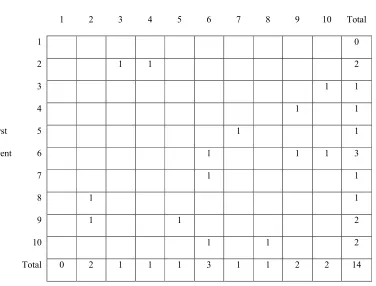
To obtain a complete descriptive picture of what behaviours are used during a lesson, a trained observer tallies every time a different category is used and when the same category is repeated for a consecutive period of time, he records this category every three seconds. The tallies are entered into a ten by ten matrix, resulting in a graphic picture of the lesson. The matrix preserves the general time sequence of interaction by illustrating which behaviours immediately preceded or followed others. By studying the matrix, teaching patterns can be discovered and analyzed.
Portugal is from Iberian Peninsula” (category 2). “Who has the answer to the next question?” (category 4). A pupil raises his hand and says, “I don’t where we are” (category 9). The teacher remarks, “We are on page 160, the second question under exercise I (category 5), and if you had been paying attention, you would have known where we are” (category 7). ‘Martha, continue by reading your answer to the second question and be very careful to watch your pronunciation as you read” (The observer records two 6’s in a row because the length of the statement is longer then 3 seconds). But Martha asks the teacher a question instead: “They don’t pronounce the ‘h’ in Spanish or in French, do they?” (category 9), and the teacher responses, “That’s right, Marta (category 2), ‘h’ is a silent letter in both of those languages” (category 3).
Observations automatically begin and end with category 10. An observer, therefore,
would have tallied the above interaction in a column in the following way:
10-6-10-8-2-4-9-5-7-6-6-9-2-3-10.
Every number except the first and last 10 is then entered into the matrix twice, which is
how the sequence of even is preserved. Each of the 100 cells in the matrix contains an
event and what happen directly afterwards. If the behaviours just described are entered
into a matrix, they would be paired in this way first:
1st pair (10
6) 2nd pair
3rd pair (10
8) 4th pair
5th pair (2
7th pair (9
5) etc.
7
The rows in the matrix designate the first event; the columns are the second event. A
tally is placed for each pair of numbers in the corresponding cell at the intersection of
the appropriate column and row. The first pair above to be entered will go in the 10-6
(read “ten-six”) cell. The second will be placed in the 6-10 cell; the third, in the 10-8
cell; the fourth in the 8-2 cell; and so on. When all of the tallies for an observation are
entered into the matrix the columns and the rows are each totalled. The totals for the
columns and the rows are identical, i.e., the total for column 1 will be the same as the
total for row 1. Figure 2 illustrates where the above tallies will be placed on a matrix;
the totals for the columns and the rows are also indicated.
When the matrix is complete, percentages for each category are calculated as well as the
percentages of teacher talk, student talk and silence or confusion. Ratios of the amount
of indirect to direct behaviours the teachers used are also determined. There are 9 of
these ratios, which are referred to as I.D. ratios, each focusing on a different
Figure 2
Sample Matrix for Recording Interaction Analysis
Second event
1 2 3 4 5 6 7 8 9 10 Total
1 0
2 1 1 2
3 1 1
4 1 1
First 5 1 1
Event 6 1 1 1 3
7 1 1
8 1 1
9 1 1 2
10 1 1 2
Total 0 2 1 1 1 3 1 1 2 2 14
(Moskowitz 1968: 219-22, quoting Flanders 1960)
From the matrix a teacher may find out many specific things about his teaching. A few
of these are:
1. What percentage of the class time does the teacher talk?
2. What percentage of the class time do the pupils talk?
3. Does the teacher use more indirect or direct influence during a lesson?
4. Is the teacher more indirect or direct in the way he motivates or controls the
5. What kind of immediate feedback does the teacher give to pupils after they
respond?
6. To what extend do pupils participate for extended periods of time?
7. What behaviours does the teacher use to elicit pupil response in the class?
8. To what extend are pupil responses which are called for by the teacher narrow,
predictable ones and to what extent are pupils given the opportunity to bring in
their own ideas?
9. What behaviours does the teacher use more extensively in communicating?
2.8 Supporting Factors In Classroom Interaction
Teacher–student interaction is very important in the teaching and learning process because students benefit from this interaction at both the social and academic level (Beyazkurk & Kesner, 2005). Such interaction will be referred to in this research as ‘classroom interaction’ and is defined as ‘the process of face-to-face action’ (Robinson, 1994). This research investigates the types and frequency of interactions initiated by students and students in the seventh grade in SMPN 4 Bandar Lampung. The reasons for initiating classroom interactions are also examined in this research.
2.8.1 Importance of Interaction
behaviour in the classroom (Sahlstrom, 2001). Although teachers engage in a great deal of interaction with their students while in the classroom, most teachers have difficulty remembering these interactions (Good & Brophy, 1994). However, teachers could make ‘mental notes’ to record which students interact more, interact less or do not interact at all. Such mental notes will help teachers to encourage students to interact appropriately and improve learning (Willson, 1999).
2.8.2 Classroom Interaction and Achievement
Willson's (1999) and Younger and Warrington's (1996) findings regarding the relationship between interaction and achievement revealed that high-achieving students initiated more interactions than low-achieving ones. The study also found that the nature of interactions among high achievers differed from those of low achievers. High achievers initiated interactions to volunteer answers, whereas low achievers interacted primarily to seek help.
2.8.3 Classroom Interaction and Gender
When examining interaction by gender, previous research results have been inconsistent. The questions that arise here and remain an issue in the classroom interaction process are: Who gets the teacher's attention? Who dominates classroom interactions? While Younger, Warrington and Williams (1999) found that more girls than boys take the opportunity to initiate questions, seek clarification on work-related matters, make best use of the support of the teacher, Pavlidou (2003) and Shomoossi, Amouzadeh and Ketabi (2008) indicated that girls participated less in class than boys and took less verbal initiative in their interaction with the teacher. They are more ‘passive’ than boys in the classroom and less persistent than them in their non-compliance with the teacher. Kramer (1985) indicated that high-achieving girls avoided answering teachers' questions in class and offered comments less frequently than boys. Others have found that boys do not dominate classroom talk and teacher time (Swann & Graddol, 1988; Myhill, 2002).
seemed important to investigate the relationship between gender and classroom interaction in Indonesia, particularly in Bandar Lampung.
This study investigated the frequency and types of classroom interaction initiated by students with high and low academic achievement in bilingual classes and by students in regular classes. It also investigated gender in relation to the frequency and types of initiated interaction. The reasons for initiating classroom interaction were also examined. The frequency and types of teachers' initiated interaction with all students in both regular and special education classrooms were also investigated.
The results of this study will show that students interacted more often than evidenced in other studies. The differences may be due to cultural factors, learning experience or gender and teaching style (Willson, 1999). In Indonesian culture, students usually become enthusiastic about interacting with the teacher in the classroom, raising their hands and shouting, begging the teacher to call upon them. Some students do this even if they do not know the answer to the question asked; a common interpretation of this behaviour is that they want to act like the other students.
Basic Theoretical Assumptions of Interaction Analysis:
1. Predominance of verbal communication. 2. Higher reliability of verbal behaviour. 3. Consistency of verbal statements. 4. Teacher’s influence.
6. Relation between social climate and productivity. 7. Relation between class-room climate and learning. 8. Use of observational technique.
9. Role of feedback.