Investigating the Effect of Teaching Experience on
Teacher Knowledge
Sylvester Donkoh
Science Department, Foso College of Education, Assin Foso, Ghana
Abstract- The assumption associated with teaching experience is that, increased teaching experience leads to increased teacher knowledge. To find out it this assumption is true for Junior High School integrated science teachers, and also determine whether not the effect of teaching experience on teacher knowledge varies in deprived and non-deprived areas, 57 Junior High School integrated science teachers from deprived and non-deprived areas were sampled from 83 Junior High School integrated science teachers. In the survey, the sampled teachers were asked to complete a 30 item test meant to assess their knowledge of Junior High School integrated science. The study found that teaching experience influences Junior High School integrated science teachers’ knowledge. Junior High School integrated science teachers’ knowledge showed a graphical variation with the number of years they have spent teaching. The effect of experience on Junior High School integrated science teachers’ knowledge in deprived and non-deprived areas was as diverse as the location themselves.
Index Terms- Junior High School, integrated science, teachers’ knowledge, deprived, non-deprived areas, teaching experience
I. INTRODUCTION
eachers possess knowledge about the subjects they teach. This knowledge is the teachers’ subject-matter content knowledge. Teachers teaching, Junior High School integrated science may have varied levels of conception, and therefore, their knowledge of the integrated science will differ. It is the different levels of conception that make some Junior High School integrated science teachers more effective than others. Effective teachers must, according to [16], possess good understanding of “the content of the subjects they teach, including: knowledge of central facts, concepts, theories and procedures within a given field, knowledge of explanatory frameworks that organize and connect ideas; and knowledge of the rules of evidence and proof” (n. p). Teachers who possess good subject-matter content knowledge are able to teach for better understanding, generate and sustain the interest of students in lessons, recognize misconceptions of students and clear them, understand the needs of the students at any moment, ask question and deal with students’ questions appropriately, and select appropriate materials and methodologies for different topics. To be certain that teachers possess subject-matter content knowledge of integrated science, Ghana Education Service ensures applicants seeking teaching appointments and graduate of universities and Colleges of Education, who are absorbed directly into the teaching service, have the minimum teaching qualification.
As defined by [1], teaching qualification is any one of the academic and professional certificates that is required for teacher registration. In Ghana, teaching qualification includes Teachers’ Certificate ‘A’, which has been phased out, Diploma in Basic Education, Bachelor of Education, Master of Education, Master of Philosophy (with education), Doctor of Education and Doctor of Philosophy. Due to the low teacher status, remuneration and general conditions of service, holder of Master of Philosophy (with education), Doctor of education, and Doctor of Philosophy prefer to be in second cycle and tertiary institutions, where conditions of service are relatively better. The teaching profession is the last option for most Ghanaian youth. Worse still the attrition rate for Ghanaian basic school teachers is very high, creating a shortfall in professional basic school teachers ([4]; [22]). Because of the vacancies in the basic schools, people who do not possess any of the teaching qualifications mentioned are allowed to practice as non-professional teachers. Such individuals use academic qualification beginning from, West African Senior Secondary Certificate (WASSCE) or Senior Secondary School Certificate Examination (SSSCE).
Teachers’ with a particular qualification have received the same training, yet some will possess better subject-matter content knowledge than others. This has already been attributed to differences in intelligence and teacher credentials, but it is too general an explanation. According to [15], teachers gain subject-matter content knowledge from various sources. Some of the sources have been identified by [6]are teachers own primary and secondary learning experiences, experiences from professional and teacher education programs, and the teachers’ teaching experience.
Other than qualification, experience is a factor that accounts for variations in teachers’ salaries ([9]). Just like many employers, Ghana Education Service, understands teaching experience makes a good teacher and so teachers with long service are motivated to stay on the job. As teachers continue to work with the Ghana Education Service, they are promoted to higher ranks, depending on their success in promotion interviews. These higher ranks come with corresponding higher salaries. In other words, long service leads to increased salaries because long service is seen as a predictor of teacher quality. Who would want to part with a quality teacher?
Experienced teachers will continue to receive higher salaries, because the experienced teachers have a better chance of understanding the content they teach, the behavior and attitude of students and the selection and application of methodologies.
According to [24], experienced teachers, usually, tend to have a better knowledge of the subject-matter content they teach, and generally acts and behave professionally in their teaching and assessment practices. Such teachers are more confident in their ability to manage classes and prevent incidences and disruptions that can potentially make the teaching and learning process difficult. They are more tolerant and patient than their colleagues with few years of teaching. Novice teachers continue to develop subject-matter content knowledge, and classroom management and teaching skills, required to make them expert teachers. They spend a lot of time learning, trying to understand fully, teaching as a profession. The novice teachers would spend years building the rich store of knowledge the experienced teacher has already gained.
More experienced teachers are usually, relatively, better teachers than their inexperienced colleagues. The experienced teachers have obtained extra training and have also, through direct experience, gained additional subject-matter content knowledge required to be effective in the discharge of their professional responsibilities. The training of teachers does not end after teacher trainees have graduated. After graduation, they attend conferences, workshops, and seminars. Ghana Education Service in collaboration with international organizations like Department for International Development (DFID), United States Agency for International Development (USAID), and local and international non-governmental organizations provides in-service training for basic school teachers. These give them the chance and exposure to refresh their memories of the things they have learned at the initial teacher training level and learn emerging teaching methods. Such workshops, seminars, and conferences, add mostly to teachers’ pedagogical content knowledge. The subject matter content knowledge may not be substantial as [15] wrote, but there are still be some gains, even if small.
The other advantage those who have more years of teaching have over the inexperienced teachers is that, they have come across more occasions that lead to the development of content knowledge and skills required to become successful teachers through direct, and indirect experiences. In other words, they have faced challenging situations which offered them the opportunity to improve their knowledge of integrated science. Whether the teachers could or could not overcome these challenging situations or not, is not of the essence. Because if a teacher encounters a situation in his/her class, he/she learns something from it. If he/she is able to solve it, he/she get to know how to solve it the next time. Otherwise, suggestions from co-teachers and the teacher’s own reflections guides how to approach same or similar situations.
To think that the ‘inexperienced teachers’ do not possess subject-matter content knowledge is erroneous. There has been reported cases where the novice teachers hold knowledge close to or as much knowledge as their experienced colleagues. Obviously, there will still be certain gains the experienced teachers have that the inexperienced teachers are yet to have. For example, a teacher who has prepared students for Basic Education Certificate Examination (BECE) have had the opportunity of solving several integrated science questions than the teacher who has just been posted to teach integrated science and as result has better understanding of integrated science concepts. According to the [7]’s model, inexperienced teachers strive to have an impact on their students learning and so learn subject-matter content knowledge as quickly as they can. The other reason is that, in places where there are induction and mentoring programs, the novice teachers are given the opportunity to learn the subject matter as fast as they can. Because of this, if the teacher’s knowledge of subject matter content knowledge is not measured in the first few days of starting their career, the novice teacher would be seen to possess much subject-matter content knowledge
According to [11], back in 1969, Frances Fuller developed a model that goes to support the idea that even the inexperienced teachers hold subject matter content knowledge. As mentioned by [11], “Frances Fuller identified a stage-related and concerns-based model of teacher development” (p. 98). [7]’s view was that through pre-service to the first few years of teaching, the teacher goes through three stages of development. At the first stage the student teacher is concerned about himself. That is, how to learn so that he/she is not thrown out of training due to non-performance. At this stage their concern is not about teaching but rather their own progress as students. The second stage emerges when the teacher begins to have field experiences. The field experiences lead primarily to concerns relating to how to survive as a teacher and then later the field experience lead to the concern of actual performance as teachers. At the last stage, which suggests the inexperienced teachers too have much subject-matter content knowledge, the teacher is concerned with making a positive and meaningful impact on their students’ learning. This shows that in the early years of teaching, the inexperienced teachers learn as much content and pedagogy as possible, so as to be able to teach students to understand and use knowledge. By so doing, they build a store of knowledge they will need later in their career.
The novice teacher makes so much impact where there is induction and mentoring programs to augment the teacher’s desire to positively influence students’ learning. Initial teacher training programs are not sufficient to equip the new teacher with all the skills and knowledge need for successful teaching. According to [14], a large part of the subject-matter content knowledge the teacher needs to be effective is acquired while the teacher is on the job, and so by creating a school climate in which new teachers are able to “learn the craft and survive and succeed as teacher” (p. 205), new teachers acquire the subject-matter content knowledge within a short period. Teachers who are supported by such programs can match, to some extent, the subject-matter content knowledge of those who have taught for several years. In such cases, the new teachers are able to influence students’ learning just like their experienced colleagues. This explains why some research findings suggest that inexperienced teacher hold the same subject-matter content knowledge as experienced one.
teaching on junior high school integrated science teachers’ knowledge integrated science vary with deprived and non-deprived areas. Deprived and non-deprived areas is a classification used by Ghana Education Service. Ghana Education Service uses two factors; the community in which the school is located and general conditions and facilities available in the school, to classify an area as deprived or non-deprived. A deprived area is one that has the following characteristics; not easily accessible, poor general living conditions, high teacher-pupil ratio, poor school population, poor infrastructure, and inadequate teaching and learning resources. The converse of these characteristics is true for non-deprived areas. Though teacher characteristics like qualification, coupled with years of teaching can influence teacher knowledge of integrated science, the study investigated what happens to teacher knowledge of integrated science as the teachers stay on the job, teaching in their respective schools.
II. LITERATURE REVIEW
Studies on teaching experience and teacher knowledge have reported mixed findings. While some studies have reported that teacher knowledge increases over few years ([3]; [17]; [21]) and stagnates, others as indicated by [5] have reported no difference in teacher knowledge between novice teachers and experienced teachers. These mixed reports violate the expected idea that in all cases, teacher knowledge grows with years of teaching. For the rest of this section, a number of such studies have been reviewed.
In a state-wide survey, [17] sort to determine whether gains to teaching experiences differ across schools and individual teachers, and whether teachers in schools with supportive environments improve better than those in less supportive environments. The return to teaching experiences mentioned by [17] was students’ grades at their end-of-grade examination. Though not explicitly mentioned, [17] were studying the effect of experience on teacher knowledge, using test scores. Hence, they matched students’ grades to teachers based on their teaching experience in order to determine whether differences exist in teacher knowledge with respect to their individual teachers’ years of experience and whether the teachers in schools improve in their effectiveness over time. Like this study, [17] sort to find out whether school environment produces variations in the effect of years of teaching on teachers’ knowledge using test scores. However, [17], considered individual teachers instead of an experience profile.
According to [17], they examined the relationship between teacher effectiveness and teacher experience using an education production function in which they modelled student achievement as a function of prior test scores, student and teacher demographics, and school characteristics (p. 484). Since determinants of teacher effectiveness such as certification and motivation were fixed over the period the only variable they measured was the effect of experience on teacher knowledge. They measured this variable for individual teachers on two different occasions and then compared the two results to find out whether they were homogenous or heterogeneous. That is to say whether some teachers do improve rapidly than others in their teacher knowledge over time.
The findings of [17], supported the widely-held view that teacher knowledge improves with time. They found that there were substantial differences in individual teacher knowledge across the teachers and across schools. Relative to each teachers’ initial teacher knowledge, some teachers improved much more than others. On the whole those who improved significantly over time were the novice teachers. But within the novice teachers, some improved more than others. Also, teachers in some schools showed greater improvements than teachers in some other schools. All these improvements, according to [17], ceased after 10 years of teaching. In other words, teacher knowledge improves with time only up to the 10th year and then gains in teacher knowledge stops.
[3], offers an explanation to [17] finding about the stagnation of teacher knowledge after 10 years. The fact that learning is continuous suggests that there is something wrong with [17], assertion that teacher knowledge does not improve after the 10th year, but [3] says the gains in teacher knowledge, including teachers’ subject-matter content knowledge are made only within the first two years of teaching and explained why such phenomena.
[3] used students’ achievement as a measure of teacher effectiveness. They determined students’ achievements and matched them with teacher characteristics such as teaching experience, teacher test scores, and qualification. Of interest to this study is the result they obtained, regarding teaching experience. In their study, [3] found that “most of the gains in achievement associated with teacher experience occur in the first two years of teaching with an effect size of 0.0503” (p. 19). According to [3], although their estimated coefficients rose to 0.0617 for the teachers who have taught for 21 to 27 years, “none of the coefficients for additional years of experience differ statistically from the coefficient for 1-2 years” (p. 19). The conclusion, from this, is that, inexperienced teachers used in the study were less effective than those with some experience. However, after the first two years, teachers with more experience are no more effective than those who had been teaching for about two years. This suggests that either no learning or very little learning occurs after the first few years of teaching. The findings also may be due to the high attrition rate in the teaching service. It could be that teachers learn on the job continually, however, due to high attrition rate, teachers who are less effective remain on the job while those who are more effective leave, and so teachers with more years of teaching who remain are not more effective than the teachers with few years of teaching. These interpretations could account for the rapid gain of teacher knowledge only in the first few years of practicing as teachers.
According to [23], a “repeated measures ANOVA yielded significant differences for two of the four groups of teachers” (p. 262). That is to say, teachers with less than 8 years of teaching, and those with more than seven years of teaching possessed just about the same degree of teacher knowledge. Like [3] found back in 2007, teachers with 4 years of experience would have just about the same knowledge as those with more than ten years of experience, [23] found that, respondents with between 8 to 29 years and those with more than 30 years did not differ in teacher knowledge. As noted earlier, teacher knowledge appears to increase rapidly, only within the first two years, it was therefore not surprising that all three groups had about the same teacher knowledge.
Unlike [3] and [23], [2] found that teachers’ knowledge depreciates as they become more experience. This finding is contrary to commonly held notion that at worse, teacher knowledge would stagnate after some years of teaching. However, like [3], [12]) and [23], [2] found that teacher knowledge increases over the first few years of teaching. While [23] confirmed that teacher knowledge is better among inexperienced teachers, their finding disproved the generally held view that experienced teachers have superior knowledge.
According to [2] in order to estimate a teacher’s knowledge, they estimated “the gain or value-added in student performance over the previous year for those students who were in that teacher’s classroom that year” (p. 14). They made an extract containing observations of each student in Florida, who took the state assessment from 1999 to 2009 and their teachers’ demographic characteristics from Florida’s Education Data Warehouse (EDW). The test scores included Florida Comprehensive Assessment Test (FCAT), and the Stanford Achievement Test, which according to [2] is a national norm-referenced test taken by students in addition to the FCAT till 2008 school year. They linked the students to their respective courses and the corresponding teacher and used the students’ scores to measure teacher knowledge of subject matter in reading and mathematics.
The result of the study was somewhat unexpected. They found that there is an initial bump in teachers’ subject-matter content knowledge of mathematics and reading. This suggests that when teachers begin their career they learn a lot within the first few years as reported by [3] and [23] and so they gain much subject-matter content knowledge. Then the teacher knowledge-experience profile begins to diverge after that. For mathematics, they found that knowledge-experience profile diverges only after the first few years while for reading it begins to diverge after 15 years. This suggests that the knowledge-experience relationship becomes negative after a few years in mathematics and after 15 years in reading. This seemingly unexpected result of declined in teacher knowledge was reported seven years earlier by [10].
The majority of literature on the effect of experience on teachers’ knowledge agree, there is a positive correlation between the two. The issue of contention is whether the effect is perpetual or terminate at some point. The positive correlation of experience-teacher content knowledge occurs only in the first few years of teaching. Though many of the studies reviewed were not directly on teachers’ subject-matter content knowledge, their use of test scores in predicting teacher knowledge, findings, and the fact that they investigated the effect of teaching experience on teacher knowledge were relevant to this study.
III. METHODOLOGY
The design used for the study was cross-sectional survey design. The design was used to investigate the effect of experience on Junior High School integrated science teachers’ knowledge of Junior High School integrated science in the Assin North municipality. There are 83 public schools in Assin North municipality. Of these, approximately 29% were in deprived areas with the remaining 59 schools in non-deprived areas. In each school, there was one integrated science teacher, hence there were 24 science teachers in deprived areas and 59 in non-deprived areas. These 83 junior high school integrated science teachers constituted the population for the study.
In this survey, 57 out of 83 Junior High School integrated science teachers from deprived and non-deprived areas in Assin North Municipal, Ghana, were sampled using stratified random sampling. Of the 57 Junior High School integrated science teachers, 17 were teaching in deprived areas. The teachers in the sample were categorized into three, based on their self-reported years of teaching. For the first group, the teachers had taught for less than five years. Group two consisted of those who had taught from 5 to 9 years and the last group is those who had taught for more than nine years. Of the three groups, those who had taught for more than 9 years were classified as the most experience and the first group of teachers constituted the inexperience.
IV. RESULTS
[image:5.612.33.579.140.282.2]The respondents were asked to write the number of years they have been teaching. The self-reported year of teaching were put into three groups. Those who have taught for four years or less, between four and 10 years and above 9 years. The mean scores for each of the groups was determined and used as bases for assessing whether or there are differences in means and whether or not these differences are statistically significant.
Table 1: Mean Score for Respondents Based on Teaching Experience
N Mean Std. Deviation Minimum Maximum Less than 5 17 25.2353 2.81801 21.00 30.00 5 to 9 years 30 23.2333 4.68809 13.00 29.00 Above 9 10 26.7000 3.16403 22.00 30.00
Total 57 24.4386 4.14047 13.00 30.00
According to Table 1 the minimum score of 13 was obtained by a teacher who had a teaching experience between 4 to 10 years. None of the 30 respondents from this group could obtain the maximum score of 30. It is this group that gave the most varied responses. Without considering, the relatively high standard deviation of almost 5, the minimum and maximum values for respondents who have taught for a period of five to nine years attest to this variation. They had the least minimum value and the least maximum value, and as one would expect had the least mean score, about 2 less than the novice teachers.
[image:5.612.33.579.450.617.2]The mean scores for the 17 respondents who had taught for four or less years and the nine very experienced teachers were quite good. Though inexperienced, they had a mean score higher than those who have taught for between 4 and 10 years and a shade lower that those who have taught for 10 or more years. Their scores were relatively clustered just like that of the very experienced teachers. These two extreme groups had at least a respondent getting all questions correct and their means were above that of the total mean for all respondents put together. The mean score for respondents in deprived areas and non-deprived areas were computed to see if any of the two groups contributed to the respondents who had taught for less than 5 years getting a high mean than those who have taught for between 4 and 10 years.
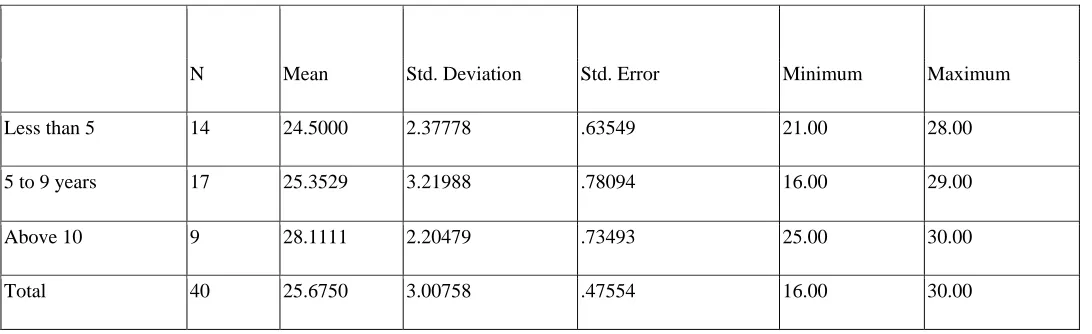
Table 2: Mean Scores for Respondents in Non-deprived areas with Respect to Teaching Experience
N Mean Std. Deviation Std. Error Minimum Maximum Less than 5 14 24.5000 2.37778 .63549 21.00 28.00
5 to 9 years 17 25.3529 3.21988 .78094 16.00 29.00
Above 10 9 28.1111 2.20479 .73493 25.00 30.00
Total 40 25.6750 3.00758 .47554 16.00 30.00
Responses of respondent in the deprived areas did not follow that of those in the non-deprived areas. It was seen in Table 2 that the respondents in non-deprived areas who have taught for between 4 and 10 years had the least minimum score of 16. However; their maximum and mean scores were higher than that of those who had taught for less than 5 years. The same cannot be said of respondents in deprived areas who have taught for between 4 and 10 years. They had the least mean, the least minimum value and maximum score that is less than that of respondents who have taught for less than five years. It is the mean score of this group that brought the mean score of those who have taught for between 4 and 10 years below those who have not taught for five years and beyond in Table 1. The values can be seen in Table 3
Table 3: Mean Scores for Respondents in Deprived areas with Respect to Teaching Experience
N Mean Std. Deviation Std. Error Min Max Less than 5 3 28.6667 2.30940 1.33333 26.00 30.00
5 to 9 years 12 19.8333 4.60895 1.33049 13.00 27.00 Above 10 2 22.0000 .00000 .00000 22.00 22.00
Total 17 21.6471 5.19544 1.26008 13.00 30.00
[image:6.612.33.572.424.539.2]In deprived schools, Junior High School integrated science teachers’ knowledge of Junior High School integrated science dwindles as teaching experience increases. The maximum and minimum scores of the teachers who had taught for more than 10 years was 22, that is, eight less than the inexperienced teachers. However, it was possible to check whether there was a statically significant difference between the mean scores of the three groups when all respondents are put together. To do that, it was first checked to see if significant differences really exist in the mean scores among the three groups a one-way ANOVA was conducted to ascertain the groups that differed in teacher knowledge of integrated science.
Table 4: Test for Differences between Groups Teachers Based on Teaching Experience
Sum of Squares Df Mean Square F Sig. Between Groups 124.001 2 62.001 3.959 .025
Within Groups 829.981 53 15.660
Total 953.982 55
As shown in Table 4, there is a statistical significant difference in the mean scores of the three groups of categories of respondents at p < 0.05, based on their years of teaching: F (57) = (3.959), p = 0.025. The result shows that years of teaching have an impact on teacher knowledge, because the different groups showed differences in their level of knowledge of Junior High School integrated science. The difference in mean across the groups was moderate. The effect size calculated using eta squared was 0.11 (11%). However, it is not clear where the differences lie. A test of homogeneity was run in order to know the kind of post-hoc analysis to run.
Table 5: Test of Homogeneity of Variances of Groups Based on Years of Teaching for all Respondents
Levene Statistic df1 df2 Sig.
[image:6.612.32.573.651.708.2]Table 5 shows that the test of homogeneity was violated, p < 0.05, since the sig value is 0.022. Equal variances were not assumed, and so a post-hoc comparison was done using Games-Howell.
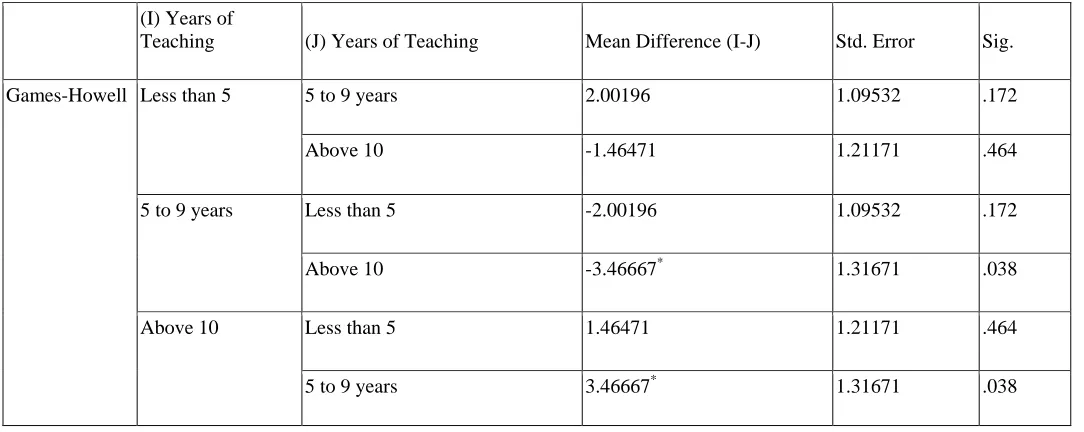
Table 6: Post-hoc Analysis of Mean Scores of all Teachers Based on Years of Teaching
(I) Years of
Teaching (J) Years of Teaching Mean Difference (I-J) Std. Error Sig. Games-Howell Less than 5 5 to 9 years 2.00196 1.09532 .172
Above 10 -1.46471 1.21171 .464
5 to 9 years Less than 5 -2.00196 1.09532 .172
Above 10 -3.46667* 1.31671 .038
Above 10 Less than 5 1.46471 1.21171 .464
5 to 9 years 3.46667* 1.31671 .038
From Table 6, the post-hoc comparison conducted using Games-Howell test indicated that the mean score of respondents who had taught for less than five years (M =25.2353, SD = 2.81801) was not significantly different from the mean score of respondents who had taught for between 4 and 10 years (M =23.2333, SD = 4.68809) and the those who had taught for more than 10 years (M
=26.7000, SD = 3.16403). The mean score of respondents who had taught for between 4 and 10 years (M =23.2333, SD = 4.68809) was not statistically different from the mean score of respondents who had taught for less than five years (M =25.2353, SD = 2.81801) was significantly different from those who had taught for more than 10 years (M =26.7000, SD = 3.16403). This implies that teacher knowledge of teachers who have taught for four or less years and teachers who have taught for 10 or more years are about the same, teacher knowledge of teachers who have taught for four or less years and teachers who have taught for between four and nine years are also the same. However, teacher knowledge of junior high integrated science of teachers who have taught for between five and 10 years is lower than those who have taught for 10 or more years.
V. DISCUSSION
Professional teacher training institutions in Ghana admit Senior High School graduates into their 3-year Diploma in Basic Education (DBE) or 4-year Bachelor of Education programs. The Colleges of Education run only DBE program in which students spend two years in the colleges and one year in a basic school under the direct supervision of mentors and lead mentors, while the universities run both DBE and Bachelor of Education programs with, at least, 4 weeks of practicum in a basic school. These programs equip pre-service teachers with the subject-matter content knowledge required to be effective as basic school integrated science teachers. When students graduate, training in the area of subject-matter content knowledge almost ceases. In-service training focuses on pedagogical content knowledge. With time, High School integrated science teachers’ knowledge of integrated science become limited to the examples, definitions and explanations provided in the Junior High School integrated science textbook, and so the Junior High School integrated science teachers’ knowledge of integrated science diminishes with time. While this may hold true for the diminishing Junior High School integrated science teachers’ knowledge of integrated, it does not explain why after 9 years, teachers regain their knowledge.
status, poor conditions of service and high attrition rate on the other, may account for the differences in Junior High School integrated science teachers’ knowledge of integrated science observed in Tables 1 and 6.
A number reasons have been attributed to the disparity in knowledge of teachers in deprived and non-deprived areas. [8] blamed inexperience teachers, [13] says it is because teachers teach multiple classes as a result of teacher shortage, [20] mentioned general conditions of rural areas leading to [19]’s poor job satisfaction, and [18] blamed it on high poverty rates among students in deprived areas. A good number of the teachers in deprived areas who took part in the study had taught for between four to 10 years. Only three had taught for less than five years. These teachers cannot be described as inexperience besides and so [8]’s reason would not apply to this sample. None of the teachers used in this sample was teaching more than two subjects. The teachers, were, therefore, not overloaded, implying the schools were not understaffed. [13]’s reason too, would not hold. Teachers’ qualification, too, would not hold because the sample had similar qualification. The only factors left are those related to the general conditions in the environment mentioned by [20]. The disparity is caused by general condition in and around the deprived schools. In other words, the environment, and not teacher demography (like qualification, and age) nor remuneration, that cause the disparity in teacher knowledge.
The general conditions in deprived areas, explains, partly, the reason why Junior High School integrated science teachers’ knowledge decreases with increasing years of teaching deprived areas. While investigating the effect of years of teaching, in order words, experience, the effect of teaching experience on teachers in deprived areas was looked at. First, the mean scores presented in Table 3 revealed that teachers begin their teaching career in the deprived areas with very good knowledge of integrated science. However, as the years of teaching increase, their knowledge of integrated science depreciates. This is rather contrary to common sense and what other researchers like [17] found. This finding is inconsistent with [3] and [23]’s finding that the effect of teaching experience on teacher knowledge becomes insignificant after some years of teaching. It is rather consistent with [2] findings that experience-teacher knowledge relationship turns negative after some years and inconsistent with [2] claim that the negative turn is perpetual. If teachers come in with very good knowledge but that knowledge dwindle with time, then the only factor that could account for it is the general conditions of the school in which the teachers are. The analysis of variance indicates that the downward trend is not perpetual but end after 9 years of teaching by which time they had become accustomed to the conditions.
VI. CONCLUSION
Teaching experience influences Junior High School integrated science teachers’ knowledge. Junior High School integrated science teachers’ knowledge shows a graphical variation with the number of years they have spent teaching. Junior High School integrated science teachers’ knowledge of integrated science dips after the fourth year of teaching and then becomes strong again after the ninth year. Because of this, efforts at improving teacher quality in Junior High Schools should not only target novice teachers but the supposedly experienced teachers too. The effect of teaching experience on Junior High School integrated science teachers’ knowledge is dependent on the location of the school in which the Junior High School integrated science teachers teach. The effect of experience on Junior High School integrated science teachers’ knowledge in deprived and non-deprived areas is as diverse as the location themselves.
REFERENCES
[1] T. O. Abe &Adu, E. I. (2013). Influence of qualification on development and assessment of computer programmed instructional package on energy concept in upper basic technology in Ekiti State, international Journal of Science and Technolology, Vol 3 no. 6 pp 611-618.
[2] Chingos, M. M., & Peterson, P. E. (2011). It's easier to pick a good teacher than to train one: Familiar and new results on the correlates of teacher effectiveness.
Economics of Education Review, 30(3), 449-465.
[3] Clotfelter, C. T., Ladd, H. F., & Vigdor, J. L. (2007). Teacher credentials and student achievement in high school: A cross-subject analysis with student fixed effects. Working Paper 11. National Center for Analysis of Longitudinal Data in Education Research.
[4] Cobbold, C. (2015). Solving the Teacher Shortage Problem in Ghana: Critical Perspectives for Understanding the Issues. Journal of Education and Practice, 6(9), 71-79.
[5] Fendler, J., & Gläser-Zikuda, M. (2013). Teaching experience and the “Shift from teaching to learning “. Zeitschrift für Hochschulentwicklung ZFHE Jg, 8(3). [6] Friedrichsen, P. J., Abell, S. K., Pareja, E. M., Brown, P. L.,Lankford, D. M., & Volkmann, M. J. (2009). Does teaching experience matter? Examining biology
teachers’ prior knowledge for teaching in an alternative certification program. Journal of Research in Science Teaching, 46, 357-383. [7] Fuller, F. F. (1969). Concerns of teachers: A developmental conceptualization. American Educational Research Journal, 6(2), 207–226.
[8] Goodpaster, K. P., Adedokun, O. A., & Weaver, G. C. (2012). Teachers' perceptions of rural STEM teaching: implications for rural teacher retention. Rural Educator, 33(3), 9-22.
[9] Hanushek, E. A., & Rivkin, S. G. (2006). Teacher quality. Handbook of the Economics of Education, 2, 1051-1078.
[10] Harris, D. N., & Sass, T. R. (2011). Teacher training, teacher quality and student achievement. Journal of public economics, 95(7), 798-812.
[11] He, Y., & Cooper, J. (2011). Struggles and strategies in teaching: voices of five novice secondary teachers. Teacher Education Quarterly, 38(2), 97-116. [12] Hill, H. C., Rowan, B., & Ball, D. L. (2005). Effects of teachers’ mathematical knowledge for teaching on student achievement. American Educational Research
Journal, 42(2), 371-406.
[13] Hudson, P. B., & Hudson, S. M. (2008). Changing preservice teachers' attitudes for teaching in rural schools. Australian Journal of Teacher Education 33(4), 67-77.
[14] Ingersoll, R. M., & Strong, M. (2011). The impact of induction and mentoring programs for beginning teachers a critical review of the research. Review of educational research, 81(2), 201-233.
[16] Koehler, M. (2011). Content knowledge. retrieved fromhttp://mkoehler.educ.msu.edu /tpack/content-knowledge-ck/
[17] Kraft, M. A., & Papay, J. P. (2014). Can professional environments in schools promote teacher development? Explaining heterogeneity in returns to teaching experience. Educational Evaluation and Policy Analysis, 36(4), 476-500.
[18] Lichter, D. T., & Johnson, K. M. (2007). The changing spatial concentration of America's rural poor population. Rural Sociology, 72(3), 331-358.
[19] Mahmood, A., Nudrat, S., Asdaque, M. M., Nawaz, A. & Haider, N. (2011). Job satisfaction of secondary school teachers: A comparative analysis of gender, urban and rural schools. Asian Social Science, 7(8), 203 - 208.
[20] Oppong-Sekyere, D., Oppong-Sekyere, F., & Akpalu, M. M. (2013). Some factors influencing the academic performance of Junior High School pupils in English Language: The case of Assin North Municipality, Ghana. International Journal of English and Literature, 4(5), 226-235.
[21] Rockoff, J. E., Jacob, B. A., Kane, T. J., & Staiger, D. O. (2011). Can you recognize an effective teacher when you recruit one?. Education, 6(1), 43-74.
[22] Sam, F. K., Effah, B., & Osei-Owusu, B. (2014). Exploring issues of teacher retention and attrition in Ghana: A case study of Public Senior High Schools in Kwabre East district of Ashanti region-Ghana. Journal of Education and Practice 5(1), 83 – 89.
[23] Samad, A., & Nurusus, E. (2015). The Influence of Teaching Experience, School Location and Academic Background on Teachers’ Beliefs in Teaching Grammar. Asian Social Science, 11(15), 257 - 266.
[24] Wolters, C. A., & Daugherty, S. G. (2007). Goals structures and teachers’ sense of efficacy: their relation and association to teaching experience and academic level. Journal of Educational Psychology, 99 (1), 181-193.
AUTHOR
Sylvester Donkoh, Doctor of Philosophy (Education Sciences),Foso College of Education, Assin Foso, Ghana,