ScholarWorks @ Georgia State University
Business Administration Dissertations Programs in Business Administration
Spring 4-2018
Higher Education Pricing: Effects of Tuition
Pricing on Nontraditional Student Persistence
Moderated by Demographics.
Katherine Crowell Spradley
Follow this and additional works at:https://scholarworks.gsu.edu/bus_admin_diss
This Dissertation is brought to you for free and open access by the Programs in Business Administration at ScholarWorks @ Georgia State University. It has been accepted for inclusion in Business Administration Dissertations by an authorized administrator of ScholarWorks @ Georgia State University. For more information, please [email protected].
Recommended Citation
Spradley, Katherine Crowell, "Higher Education Pricing: Effects of Tuition Pricing on Nontraditional Student Persistence Moderated by Demographics.." Dissertation, Georgia State University, 2018.
PERMISSION TO BORROW
In presenting this dissertation as a partial fulfillment of the requirements for an advanced degree from Georgia State University, I agree that the Library of the University shall make it available for inspection and circulation in accordance with its regulations governing materials of this type. I agree that permission to quote from, copy from, or publish this dissertation may be granted by the author or, in her absence, the professor under whose direction it was written or, in his absence, by the Dean of the Robinson College of Business. Such quoting, copying, or
publishing must be solely for scholarly purposes and must not involve potential financial gain. It is understood that any copying from or publication of this dissertation that involves potential gain will not be allowed without written permission of the author.
NOTICE TO BORROWERS
All dissertations deposited in the Georgia State University Library must be used only in accordance with the stipulations prescribed by the author in the preceding statement.
The author of this dissertation is:
Katherine Crowell Spradley
J. Mack Robinson College of Business Georgia State University
Atlanta, Georgia 30303
The director of this dissertation is:
Wesley Johnston
J. Mack Robinson College of Business Georgia State University
Higher Education Pricing: Effects of Tuition Pricing on Nontraditional Student Persistence
Moderated by Demographics.
by
Katherine Crowell Spradley
A Dissertation Submitted in Partial Fulfillment of the Requirements for the Degree
Of
Executive Doctorate in Business
In the Robinson College of Business
Of
Georgia State University
GEORGIA STATE UNIVERSITY
ROBINSON COLLEGE OF BUSINESS
Copyright by
ACCEPTANCE
This dissertation was prepared under the direction of the KATHERINE CROWELL
SPRADLEY Dissertation Committee. It has been approved and accepted by all members of that
committee, and it has been accepted in partial fulfillment of the requirements for the degree of
Doctor of Philosophy in Business Administration in the J. Mack Robinson College of Business
of Georgia State University.
Richard Phillips, Dean
DISSERTATION COMMITTEE
Dr. Wesley J. Johnston (Chair)
Dr. Patricia G. Ketsche
ACKNOWLEDGEMENTS
The support of many individuals has been key during the preparation of this dissertation.
A very special thank you to the University that assisted in providing the data making this
dissertation possible and meaningful. Although the University wishes to remain anonymous,
their contributions to this process have been invaluable. It is my hope that they reap the expected
benefits and more as a result of their gracious participation and support in this study. Thank you
to Georgia State University for allowing me the opportunity to be challenged as a part of their
doctorate program and providing a robust learning experience.
A tremendous thank you to my dissertation committee for their guidance, assistance, and
confidence during this process. Thank you to Dr. Wesley Johnston, my chair and advisor, for his
patience and counsel that was crucial to the success of this study. Thank you to Dr. Patricia
Ketsche for the extra assistance with the technical aspects of modeling and analysis, and Dr.
Danny Bellinger for the valuable suggestions and encouragement that helped move this study to
completion. Thank you to Shalini Gopalkrishnam and Lowell Thomas Ferguson for their
assistance with the data analysis and review.
Thank you to my professors in the doctorate program and my colleagues for challenging
me to reach new depths of understanding and abilities, providing both the tools and
encouragement to complete this program and dissertation. Thank you to my classmates and
fellow alumni who have made the journey through this program invaluable from the networking
opportunities, friendships, and guidance shared. Thank you to my friends, near and far, that
supported me, inspired me, lifted me up, and pushed me during this journey. Your steadfast
prayers and unwavering faith in my abilities mean the world to me.
Thank you to Seth Spradley, as the sacrifices that you made for our family to support the
Your emotional support gave me the strength to handle the delicate balance of working two jobs,
taking care of our family, and finishing this milestone. Thank you to my children, Henry,
Charles, and Nev, as you were my inspiration to push harder, fueling my heart with strength
needed to make you proud. Thank you to my parents, Frank and Deanne Crowell, for the love,
time spent with our children, and support throughout my educational journey. To my family as a
whole, thank you for believing in me and supporting my aspirations without once allowing doubt
TABLE OF CONTENTS
ACKNOWLEDGEMENTS ... iv
LIST OF TABLES ... viii
LIST OF FIGURES ... ix
I INTRODUCTION ... 1
I.1 Research Domain ... 1
I.2 Research Perspective ... 5
I.3 Summary ... 5
II LITERATURE REVIEW ... 8
II.1Elasticity Theory ... 8
II.2Tuition Elasticity Theory ... 8
II.3Models ... 11
II.3.1 The Tuition Elasticity and Net Earning Projections (TENEP) model ... 15
III RESEARCH METHODOLOGY AND DESIGN ... 17
III.1 Method Analysis ... 17
III.2 Variance Model and Theory ... 18
IV DATA COLLECTION AND ANALYSIS AND RESULTS ... 20
IV.1 Data Collection ... 20
IV.2 Data Description ... 20
IV.3 Data Analysis Strategy ... 21
IV.4 Hypotheses Testing ... 22
IV.4.1 Tuition Effects on Persistence for Nontraditional Students ... 23
IV.4.2 Tuition Effects on Persistence for Nontraditional Online Students ... 24
IV.4.4 Tuition Effects on Persistence for Nontraditional Female Students ... 25
IV.4.5 Tuition Effects on Persistence for Nontraditional Minority Students ... 26
V FINDINGS ... 27
V.1 Hypotheses and Results ... 27
V.2 Linear Regression Model Selection and Justification ... 28
V.3 Effect of Tuition Increase on Nontraditional Persistence ... 30
V.4 Effect of Tuition Increase on Nontraditional Persistence by Demographic ... 31
V.4.1 Moderated by Online ... 33
V.4.2 Moderated by Military Status ... 33
V.4.3 Moderated by Gender ... 33
V.4.4 Moderated by Race ... 34
VI DISCUSSION ... 35
VIICONTRIBUTIONS ... 41
VII.1 Contributions to Practice ... 41
VII.2 Contributions to Theory ... 42
VIII CONCLUSION ... 44
VIII.1 Limitations ... 44
VIII.2 Future Research ... 45
VIII.3 Summary ... 46
REFERENCES ... 48
LIST OF TABLES
Table 1 Summary of Traditional Student Elasticities ... 10
Table 2 Models in Tuition Pricing ... 14
Table 3 Selected Military Pay Grades and Base Ranges per Month ... 25
Table 4 Summary of Hypotheses and Results ... 28
Table 5 Summary of Mean Variables ... 29
Table 6 Summary of Persistence ... 31
Table 7 Summary of Nontraditional Persistence by Demographic ... 32
LIST OF FIGURES
Figure 1 Shifting Focus from Traditional Students to Nontraditional Students ... 13
Figure 2 Portion of the TENEP MODEL ... 16
ABSTRACT
Higher Education Pricing: Effects of Tuition Pricing on Nontraditional Student Persistence
Moderated by Demographics.
by
Katherine Crowell Spradley
August 2018
Chair: Wesley Johnston
Major Academic Unit: Executive Doctorate in Business
Higher education pricing models have focused heavily on traditional student population
analysis, net earnings, financial aid, and enrollment projections or unduplicated headcount. As
the population of students shifts to a nontraditional majority, research of the effect of tuition
price on nontraditional population segments is needed with a focus on persistence (the likelihood
of re-enrollment in the next semester for a given student) rather than overall enrollment levels. It
becomes prudent to re-evaluate pricing models and the associated coefficients from tuition
pricing changes on persistence to more effectively serve the nontraditional population as
nontraditional students rely less on financial aid and progress through their curriculum at
individualized pace consistent with their needs. The nontraditional population is, on average,
older, with more professional experience, often with military affiliations (active duty, veteran,
reservist, or family member), and education in progress. Using a quantitative longitudinal
empirical case study, the researcher utilized student level data from a private, nonprofit
university in the Commission on Colleges of the Southern Association of Colleges and Schools
student (age 25+) persistence. The data was analyzed using a linear regression interaction model
in STATA.
The researcher found statistical significance, with the counterintuitive finding that the
effect of a 1 percent tuition increase for all students was an increase in persistence by 2.01
percent with a clear explanation for this finding of the overall tuition effect on persistence.
Consistent with theory, this research finds that nontraditional students only increased their
persistence by 0.62 percent, persisting less than traditional students. For every 1 percent increase
in tuition, nontraditional online students are decreasing their persistence by 0.9 percent,
persisting less than face-to-face students. These findings are important, as they provide
contributions to Elasticity Theory, Tuition Elasticity Theory, and practice including application
for higher education institutions, administrators and advisors in higher education, and customer
relationship management software as service companies targeting students utilizing variations of
predictive analytics to estimate persistence of different populations, estimate and understand
tuition price increase effects on different populations, set recruiting and enrollment goals based
upon expected attrition, and design customized communication plans to facilitate more in-depth
relationships with those less likely to persist in an effort to overcome this statistic. These findings
are also the first portion of exploring elasticities as they apply toward developing a pricing model
for nontraditional student populations using the framework established by the TENEP model
(Bryan & Whipple, 1995).
INDEX WORDS: higher education, tuition pricing, tuition elasticity theory, elasticity theory,
I INTRODUCTION
I.1 Research Domain
Since 1967, the pricing of higher education institutions has been studied (Campbell &
Siegal, 1967). From a sociological and economic perspective, “low-income and minority
students’ under-investment in higher education may lead to a widening gap in college
participation and a reduction in socioeconomic mobility, a solid understanding of the role of
price responsiveness in student demand for college is critical to help maintain the enrollments of
underrepresented students.” (Kim, 2010). From a finance and accounting perspective, pricing
allows institutions to maximize profits by delicately balancing expenses and revenues without
negatively impacting enrollment and retention.
Higher education pricing models focus on the traditional student population attending
brick and mortar institutions utilizing face-to-face instruction with a focus on taxpayer dollars
funding a portion of the tuition bill (Fethke & Policano, 2013). Until recently, the traditional
student population (referring to institutions serving 18-24 year olds) has been the majority of the
population of students attending college/university classes; however, over the last six years this
majority has shifted to nontraditional students (with the distinguishing factor being age 25+)
(Jenkins, 2012) as the majority of students attending college/university classes both face-to-face
and online. During this same timeframe, shift in the amount of taxpayer funding [both Federal
and State] to student funding of tuition also occurred (Fethke, 2014). In fact, state support shows
an overall decline since 2005 from 61.7% to 51.1% in 2014, while national funding shows an
overall decline since 2001 of 26.9% (SHEEO, 2014).
The expense of administering programs to nontraditional student populations varies from
cost of human resources (faculty and staff), real estate (building lease), and student life offerings
(intramural sports, student center activities, etc.). In the nontraditional student population other
expenses may be realized including the expense of delivering classes and programs online.
“Some schools’ administrators discovered that online programs were more costly than they had
expected, and so they retrenched” (Smith & Mitry, 2008). Thus, while some may assume that
nontraditional programs are less expensive to administer, many times this could not be further
from reality. The expense variable is a large part of the pricing model employed by many higher
education institutions. With expenses differing between traditional student populations and
nontraditional student populations, this further strengthens the argument for differentiated
pricing models for each student population.
Retention has historically been measured by higher education institutions as the students’
ability to enroll year after year as a first-time, full-time student to graduation within a set
timeframe by IPEDS definitions (NCES, 2017); however, in the online and nontraditional sectors
this measurement is often referred to as persistence. There has been little to no research on effect
of the tuition price model on persistence for nontraditional students; however, there has been
quite a bit of research on enrollment (unduplicated headcount) and thus it is assumed that since
students are price responsive to enrollment decisions, that they also must be price responsive to
persistence decisions. This study assumes that an increase in tuition dollars will have an effect on
nontraditional student populations’ likelihood of persisting utilizing the rationale that tuition
dollars have an effect on traditional student populations’ likelihood of enrollment. Further,
research shows differences in the tuition effect on the likelihood of traditional student
populations enrollment by demographics suggesting that the same research should be conducted
Higher education tuition pricing model research, through tuition elasticity effects on
nontraditional students by demographic, determining the importance of the tuition pricing
between nontraditional and traditional student populations, is needed to help identify if price
differentiation is warranted for nontraditional students from traditional students in maintaining
persistence. In 2011 Hemelt and Marcotte noted that elasticities had not changed since studies
conducted in the 1980s and 1990s (Hemelt & Marcotte, 2011). This is not surprising given that
the majority of the student population studied is from the traditional student population of 18 to
24 year old. This concept will be explored as this study seeks to determine the effect of a tuition
increase on persistence as a component of tuition pricing and elasticity as the first stepping stone
to determining if differentiated tuition pricing models for nontraditional student populations is
warranted.
Several private, nonprofit institutions in the Commission on Colleges of the Southern
Association of Colleges and Schools regional accreditation area offer varied pricing models to
nontraditional students from that of their traditional student population profile. The question is
raised, what effect does the tuition pricing have on nontraditional student persistence by
segmented population? At one particular private, nonprofit University, a struggle exists in
knowing whether to differentiate pricing for nontraditional students from traditional students,
across multiple campuses and instructional methods. In order to effectively evaluate this
dilemma, the effect of tuition price must be studied in the nontraditional student population as a
first step to solving the dilemma. In order to effectively evaluate the effects of tuition price
increases, the focus was on net tuition (St. John, 1994) as the University itself did not provide
any institutional financial aid to the students attending the campuses studied. The studied
population and became the subject of this case study due to the availability of data and interest of
administration applying theory to practice. Although the courses offered at this University are
identical for the traditional and nontraditional populations, the programs and instructional
methods vary by location and the overhead expenses of administering those programs varies by
instructional method (online or face-to-face instruction), setting the stage for price differentiation
by nontraditional student population segment.
Variables that will be considered in this research include: demographics (the age of the
student, gender of the population, race of the population, instructional method of the student,
veteran status of the student, active duty status of the student) and student type (undergraduate).
Additional considerations must be given to per credit hour charges, tuition discounting, merit
scholarships, rate locking, military benefits, and lower/upper tier pricing variables by program
(Fethke, 2014). These factors will not be utilized in this research as several including tuition
discounting are no applicable and data for others such as governmental financial aid was not
available at the time of this study. Additional questions that may be answered by reviewing these
variables include if the effect of an increase in tuition affect certain demographic persistence
rates differently.
Because of the variables that must be considered, some assumptions about the research
must be made:
1. There are four types of four-year institutions (private for-profit, public for-profit,
private nonprofit, and public nonprofit). This research will only be focused on private, nonprofit
institutions, although the research may be applied to other institutions including for-profit and
2. Location is assumed to be in-state institutions so as to not introduce the variable
of in-state versus out-of-state tuition. Location will not be considered, although the University
selected for review is a member of the Commission on Colleges of the Southern Association of
Colleges and Schools accreditation region.
I.2 Research Perspective
Through the lens of an empirical longitudinal case study utilizing the foundational
constructs from Price Elasticity Theory of Demand and Tuition Elasticity Theory, the researcher
will seek to answer the question of what is the effect of a tuition increase on nontraditional
student population persistence and, additionally, the effect by segmented nontraditional student
population. This type of research helps investigate the evidence-based knowledge that either
confirms the success of moving toward differentiated tuition pricing models as it relates to
nontraditional student persistence or provides reasons for the exploration of alternative solutions
through learned knowledge that helps create new models if needed through direct and indirect
observation and experience. To begin constructing and analyzing the models, the effect of an
increase in tuition on nontraditional student persistence must first be understood.
I.3 Summary
This research study is organized as follows:
Chapter 2: Literature Review
This chapter reviews the previous research in the tuition pricing as it relates to Elasticity
Theory and Tuition Elasticity Theory. In addition, it provides a brief overview of the
terminology involved in this study including higher education aid and expenses, retention,
persistence, and traditional versus nontraditional students. This chapter also explores several
describes the reasons for needing to study the effect of an increase in tuition on nontraditional
persistence as a component of pricing models.
Chapter 3: Research Methodology and Design
Chapter 3 describes the research methodology and approach that this study utilizes to
answer the “what” question in regard to the effects of tuition increases on nontraditional
persistence using a quantitative approach. What effects does a tuition dollar increase have on
persistence of nontraditional students and, further, what are the effects specific to certain
demographics for nontraditional student populations. This longitudinal panel data linear
regression study examines these effects on persistence at a student level.
Chapter 4: Data Collection and Analysis and Results
Chapter 4 elaborates on the data collection, analysis, and results of the study data
spanning a period of five academic years for a total of four persistence observations per student
using a student level data set from a private, nonprofit institution of higher learning.
Chapter 5: Findings
This chapter reviews the findings of the effects of a tuition increase on nontraditional
students then focusing on the moderating effect of online and face-to-face delivery, military
affiliations, gender, and race of nontraditional student populations developing a linear regression
model applicable to nontraditional student populations showing statistical significance with
nontraditional and online populations.
Chapter 6: Discussion
This chapter discusses the findings in view of the literature review of traditional student
populations of what was known and what is known now about the nontraditional student
the problem of solving the dilemma of differentiated pricing models for nontraditional student
populations.
Chapter 7: Contributions
This chapter reviews the four major contributions to theory and practice including the
utilization of the findings by higher education institutions and administrators, researchers, and
customer relationship management software companies targeting educational institutions.
Chapter 8: Conclusion
This chapter highlights the limitations of this study as it relates to the institution studied
and the validity, reliability, and availability of student data from the source. The chapter
emphasizes the generalizability of the data as well as the opportunities for future research
including additional demographic populations, elasticities, expenses, and pricing model
II LITERATURE REVIEW
II.1 Elasticity Theory
Price Elasticity Theory of Demand is to first “show (1) how elasticity changes along the
function and (2) how these elasticities are related to total expenditure at alternate prices and
quantities” (Houck, 1967). This theory is used to classify a market as elastic, meaning demand is
highly responsive to small pricing changes or as inelastic, meaning demand is not responsive or
not very responsive to pricing changes. As this field was applied to higher education, the Theory
of Tuition Elasticity was developed.
II.2 Tuition Elasticity Theory
Tuition prices have long been the discussion of many administrators in academia second
to return on investment of education (Leslie & Brinkman,1987). The need to balance increasing
expenses with adequate revenue is a constant struggle for many in academia seeking to optimize
enrollment while maximizing profit for both traditional (on campus) students as well as
nontraditional online students. A focus on tuition elasticity of nontraditional students can help
design this model beginning by exploring the effect of a tuition increase on nontraditional
student persistence.
One issue affecting elasticity is the availability of the good or service. The more
substitutes or alternatives to which a student has access, results in a higher elasticity for the good
or service. In 2010, Kim notes that, “When competing institutions are considered as substitutes
for other institutions, the cross-price elasticity of demand for enrollment relates the percentage
change in enrollment to the percentage change in the tuition charged by the competing
institution is considered to be a substitute for the services provided by a competing institution.”
(Kim, 2010).
The literature surrounding tuition elasticity focuses on the 18-24 year old population
completing a four-year degree bringing to light two issues (Leslie & Brinkman,1987). The first
issue is the majority of students attending post-secondary education has shifted from the
traditional population (age 18-24) to the nontraditional student population becoming the majority
(Jenkins, 2012). Secondly, quite a few studies reviewed by Leslie and Brinkman concentrated on
freshman enrollment. While this focus is great for studying enrollment, it neglects to consider
that traditional upperclassmen students are less likely to be impacted by tuition increases. It was
also noted that tuition declines had significantly greater impact than tuition increases (Leslie &
Brinkman,1987).
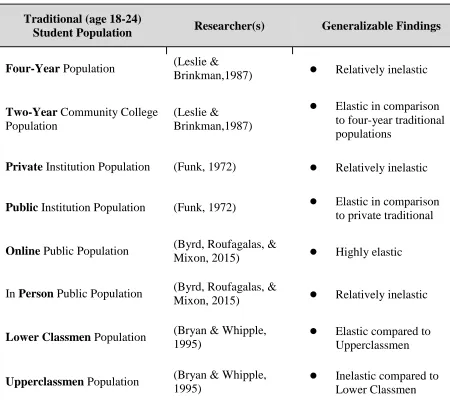
In the studied traditional student population, four-year tuition elasticity is said to be
relatively inelastic as compared to two-year tuition elasticity due to two-year institutions
targeting and appealing more to lower income and older student populations (Leslie &
Brinkman,1987). This finding that lower income populations tended to be more elastic than
higher income populations was further supported by Kane in 1995. In fact, the difference pointed
out by Heller noted that the increase in tuition of two-year institutions, “resulted in a drop of total
public enrollment of 3.5 percentage points. Similarly, an increase at the four-year colleges
resulted in a total enrollment decrease of only 1.4 percentage points” (Heller, 1997, p628). This
research may indicate that nontraditional student populations and lower income students will be
more sensitive to tuition dollar increases. Furthermore, in 1972, Funk noted that tuition elasticity
tended to be more inelastic for private institutions versus public institutions due to the fact that
the observations from Leslie and Brinkman that lower income students appear to be more
sensitive to tuition dollar increases. In 2015, Byrd, Roufagalas, and Mixon estimated the
elasticity of tuition for public four-year online students to be highly elastic in comparison to
public four-year face-to-face traditional students, who were inelastic. On an interesting note, the
review of more than twenty-five studies on tuition elasticity resulted in the suggestion that
perhaps each institution needs its own elasticity model (Leslie & Brinkman,1987) further
supporting differentiated pricing in the higher education market. See Table 2.2 for a Summary
[image:24.612.76.526.315.717.2]of Traditional Student Elasticities.
Table 1 Summary of Traditional Student Elasticities
Traditional (age 18-24)
Student Population Researcher(s) Generalizable Findings
Four-Year Population (Leslie &
Brinkman,1987)
●
Relatively inelasticTwo-Year Community College Population
(Leslie & Brinkman,1987)
●
Elastic in comparison to four-year traditional populationsPrivate Institution Population (Funk, 1972)
●
Relatively inelasticPublic Institution Population (Funk, 1972)
●
Elastic in comparison to private traditionalOnline Public Population (Byrd, Roufagalas, &
Mixon, 2015)
●
Highly elasticIn Person Public Population (Byrd, Roufagalas, &
Mixon, 2015)
●
Relatively inelasticLower Classmen Population (Bryan & Whipple, 1995)
●
Elastic compared to UpperclassmenUpperclassmen Population (Bryan & Whipple, 1995)
II.3 Models
One of the issues facing the studied University is the fact that the setting of tuition price
is not using any specific model as a determinate for the nontraditional student population. At
some locations, tuition has increased each year regardless of the revenue, expense, or possible
retention implications. Each year the revenue and expenses are analyzed but are not used in such
a way that will create a model for establishing the equilibrium price for nontraditional students.
The model, or lack thereof, is being used to determine the the nontraditional rate for students.
Although the revenue and expenses are analyzed, a method of incorporating the revenue,
expenses, persistence, instructional method, demographics, student type, and funding sources
must be developed as part of a pricing model. The model used (or lack thereof) by the University
is not a sustainable model, and at some point, the University may price itself out of the market
with regard to tuition pricing, miss opportunities for increases in tuition pricing ensuring profit
maximization, or may negatively impact nontraditional student persistence. Although economic
conditions will certainly impact persistence, this study seeks to research increased tuition effect
on persistence probability in a static environment considering differentiated population segments
and demographics as a small portion of building a differentiated pricing model for nontraditional
student populations.
Tuition pricing models must include expense and revenue inputs so that an evaluation can
be completed based upon projected net earnings (Bryan & Whipple, 1995) coupled with tuition
elasticity. With varying expenses, University administrators may find it prudent to differentiate
in their tuition pricing strategy for nontraditional students to better reflect the expenses and
revenue of each sector including instructional method without significantly impacting
persistence. Additionally, the effect of the tuition pricing on persistence must be evaluated
Is the pricing model so high that it causes attrition or causes certain demographics of
nontraditional students not to persist? That is to be determined.
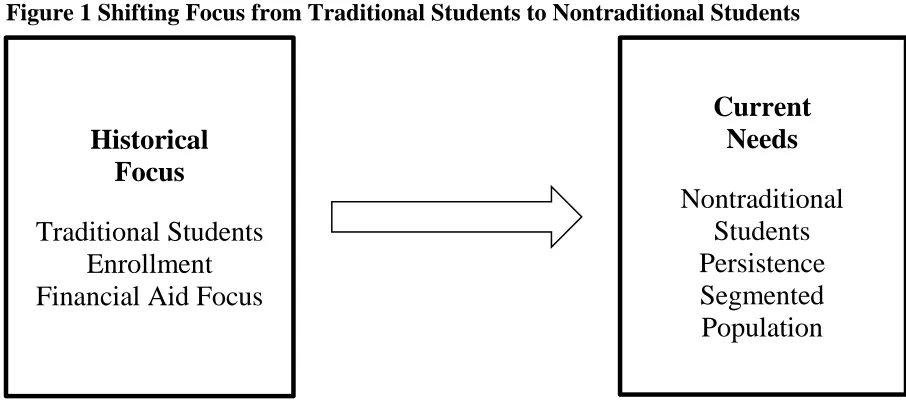
Much of the current literature focuses on financial aid as a factor in determining a tuition
pricing model. “Analysts have argued that ready access to Pell Grants and federal loans prop up
college prices.” (Parry, 2012) This may be true for the traditional on campus student population;
however, it has yet to be studied strictly in the nontraditional online population, which, at this
University tends to have a higher average age (35+), more military personnel, and students that
attend the institution part-time while they are employed. Should the tuition pricing model focus
on financial aid, since the model is shifting from less government funding to more individual
funding (Fethke, 2014)? Although financial aid can certainly add a variable worth investigating
for this research, it will not be a focus of this model and research as the University studied does
not offer institutional financial aid to the nontraditional student population.
This empirical case study will focus on the theory of elasticity applied to tuition referring
to this as Tuition Elasticity Theory coupled with segmented pricing strategies focusing on the
tuition increase or decrease effect on specific population segments: specifically nontraditional
students by instructional method, gender, military status, and race (as reported to IPEDS). This
theory applied to the analysis of two distinct segments should yield a coefficient predicting
probability of persistence based on the data observed and analyzed. Additionally, the application
to other nontraditional student populations by demographic should yield distinct coefficients
predicting the probability of persistence relative to a tuition increase. These coefficients can be
utilized in further research to estimate elasticities adding data points for different segments to
Figure 1 Shifting Focus from Traditional Students to Nontraditional Students
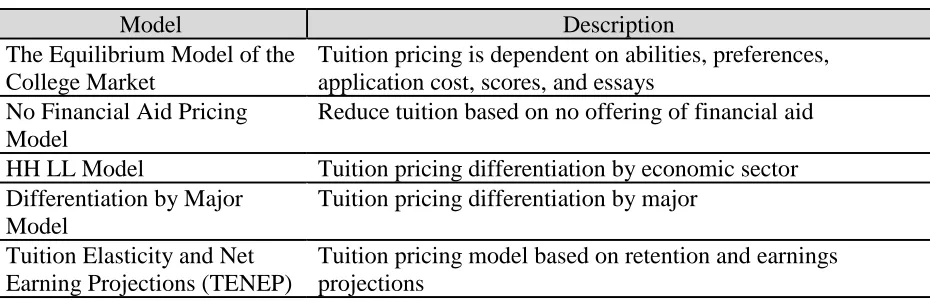
Multiple models are recognized in academia as methods for tuition price modeling.
Several models reviewed for the purpose of beginning the research and synthesis for tuition
pricing models suggest that there are quite a few ways to develop tuition pricing models
depending on the variables that the institution wants to consider for tuition elasticity purposes
(See Table 2.3 Models in Tuition Pricing). The Equilibrium Model of the College Market
suggests that there are multiple inputs to tuition price modeling including ability to pay,
preferences, application cost, scores, and essays (Choa, 2014). The No Financial Aid pricing
model described by Parry explores setting tuition so low that students do not have to borrow to
attend but, rather, students pay monthly prices similar to a car payment to take as many classes
as possible. (Parry, 2012). The HH LL Model suggests that price differentiation should occur
between economic classes to enable lower income students to be able to receive more aid, thus
increasing affordability and enrollment (Curs & Singell, 2010). Another model considers
competitive tuition price modeling taking into consideration the human capital input (Rothschild
& White, 1995) and yet another suggests differentiation by major as a variable of the tuition
pricing model (Shin & Milton, 2008). While these models are helpful for predicting enrollment,
Historical
Focus
Traditional Students
Enrollment
Financial Aid Focus
Current
Needs
Nontraditional
Students
Persistence
Segmented
revenue and expenses, these models do not take into consideration the effect on enrollment,
[image:28.612.75.540.149.300.2]retention, or persistence, nor specifically take into consideration nontraditional students.
Table 2 Models in Tuition Pricing
Model Description
The Equilibrium Model of the College Market
Tuition pricing is dependent on abilities, preferences, application cost, scores, and essays
No Financial Aid Pricing Model
Reduce tuition based on no offering of financial aid
HH LL Model Tuition pricing differentiation by economic sector
Differentiation by Major Model
Tuition pricing differentiation by major
Tuition Elasticity and Net Earning Projections (TENEP)
Tuition pricing model based on retention and earnings projections
The concept of enrollment is often considered the gold standard for developing tuition
pricing models; however, including only enrollment in the model neglects the bigger picture of
retention and persistence as a needed influence on tuition pricing models. The concept of
retention/persistence must be considered in higher education when developing pricing models for
tuition. Retention is often used as a term to describe the percentage of traditional full-time
students taking courses in a residential program who are retained until graduation either at a
four-year or six-year reporting interval. Persistence is a year to year figure that is used to
describe the percentage of students (nontraditional students) that continue year to year in their
program of study without regard to a graduation timeline. These figures are important to
administrators in education as it helps them estimate revenue and expenses more accurately
based upon those students that will be returning (St. John, 1990).
Bryan and Whipple suggest that the elasticity of the tuition will vary from lower
classmen to upperclassmen as the risk associated with transferring increases (Bryan & Whipple,
nontraditional students typically are older (average age of 35), part-time or full-time employed or
have military obligations and/or families. The demographics of the nontraditional student
population may influence the decision of the student to enroll just as the tuition pricing model
influences the decision.
II.3.1 The Tuition Elasticity and Net Earning Projections (TENEP) model
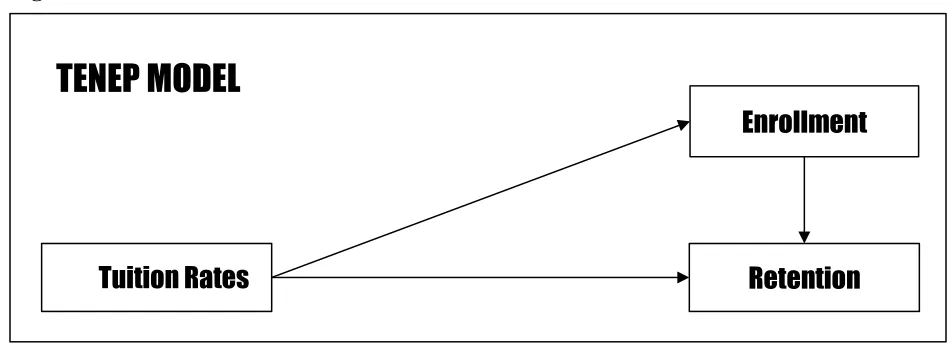
The Tuition Elasticity and Net Earning Projections (TENEP) model, shown in Figure 2.3,
is a tuition pricing model that begins to explore the effects of retention as it relates to the
traditional students taking classes on campus (Bryan & Whipple, 1995). Using this model, tuition
pricing models are explored, demonstrating the effects of different tuition pricing models on
retention. While this model does not specifically address the nontraditional student population,
its usefulness could be applied to the nontraditional population with relative accuracy with an
established rate of elasticity for nontraditional students. As the model is applied to retention, it
can be assumed that this would also apply to persistence.
Bryan and Whipple state that, “When tuition is increased, three of the possible scenarios
for the current student population are: (1) high retention and a major tuition revenue increase; (2)
moderate retention and a net increase in tuition revenues; or (3) low retention and a severe tuition
revenue decrease.” Focusing on the TENEP model, Bryan and Whipple completed an analysis on
various tuition rates and enrollment numbers hypothetically estimating elasticity functions. The
resulting research found that the retention rates were negatively impacted as tuition rates were
Figure 2 Portion of the TENEP MODEL
Adapted from Bryan & Whipple, 1995
When establishing a tuition pricing model, “Price determination is a difficult decision;
one that should establish a tuition that retains current students, attracts new students, and
provides adequate revenues to cover costs,” (Bryan & Whipple, 1995). Persistence rates will
vary by student demographics but will be affected by the tuition pricing models no matter the
model chosen. Models must be carefully constructed to take into consideration the persistence
rates rather than just the enrollment rates as students that do not persist become part of the
attrition rate resulting in lost tuition dollars for the University. Tuition pricing models that focus
on enrollment, focus simply on those students that enroll for one semester. The TENEP model
does not take into consideration those that do not persist. This case study seeks to analyze the
persistence rates in place of enrollment using a portion of the TENEP model to study the effect
of tuition dollars on nontraditional student populations.
Enrollment
Retention
Tuition Rates
III RESEARCH METHODOLOGY AND DESIGN
This quantitative empirical case study uses data from a private, nonprofit university in the
SACSCOC regional area with four campuses with differentiated tuition rates serving
nontraditional students. Data is secondary, non-identifying data from the student information
system of the private, nonprofit university.
The effects of a tuition increase on persistence of nontraditional students is measured
using the following variables from the fields in the student information system; tuition increase
by percent; absolute tuition per credit hour; rates by campus; enrollment history for each student
used to calculate persistence for each academic year; age bracketed by traditional and
nontraditional; gender male or female; race as defined by IPEDS; and military status including
active duty, former military, national guard reserves, dependent, civilian, or unknown. This study
uses the TENEP model studying persistence rates in place of enrollment as the dependent
variable as a modification of the tuition pricing model to work toward establishing a tuition
pricing model that focuses on retaining nontraditional students. This case study will not address
the net earnings portion of the TENEP model (expenses and revenues) as access to budgetary
data was not openly available for use at the time of this study.
III.1 Method Analysis
A fixed effects linear regression analysis of the effect of tuition on nontraditional student
persistence over the last five academic years and persistence periods of four years, moderated by
demographics (online or face-to-face, age, military status, gender, and race) is used to determine
if a model that challenges the current tuition pricing model focusing on enrollment and financial
III.2 Variance Model and Theory
A variance model was chosen with the independent variable construct of tuition price
increase percent, moderated by student demographics including instructional method (online or
face-to-face), gender, race, and military status to allow for exploration of the effect of tuition on
nontraditional student persistence as the dependent variable. A process model was not selected as
the sequence of events is not in question.
Literature has shown that tuition pricing models affect enrollment with higher tuition
prices traditionally leading to lower enrollment but not necessarily disproportionately.
Unfortunately, in this sector of research most of the research is conducted at public institutions
utilizing aggregated data or survey data; however, the research has included liberal arts higher
education institutions resulting in some ability to use results with private liberal arts higher
education institutions (Hemelt & Marcotte, 2011). This research leads to the questions:
• Does the same decline occur for private higher education institutions?
• Does tuition affect retention and persistence rin the same way?
• Does empirical student level data yield more reliable and valid results than
aggregate national databases and survey data?
Tuition pricing models form the basis for how higher education institutions establish
tuition rates based on the Theory of Tuition Elasticity. Nontraditional student persistence is the
percentage of nontraditional students who decide to continue their education with the higher
education institution year after year. Student demographics include the age of the student
(traditional or nontraditional age student), gender of the population, race of the population,
location and instructional method of the student, veteran status of the student, and active duty
student (Fethke, 2014) and this University does not utilize institutional financial aid for the
nontraditional student population, it was an easy decision to exclude financial aid as a moderator
or construct for this study. As revenues and expenses were not available for use at the time of
this study, it was also an easy decision to focus on the persistence and tuition price constructs.
The literature synthesis highlighted the lack of uniformity in tuition pricing models and
the large variances in the major contributors including enrollment, revenue, expenses, financial
aid, student demographics, and student types. The literature synthesis showed that there was not
a model that focused on student persistence as a major consideration in tuition pricing models as
it pertained to tuition elasticity. This variance model will focus on highlighting the effects of
tuition increases on nontraditional student persistence moderated by the student demographics to
build models and to strengthen the literature in this area of research building upon existing
IV DATA COLLECTION AND ANALYSIS AND RESULTS
IV.1 Data Collection
This study uses five years of enrollment history data from the years 2013 through 2017
with information contained at the student level obtained from the student information system of
the University studied. For each observation in the data, the student persistence from one
academic year to the next is calculated using the term enrollment history to determine in the
student persisted the following academic year as evidenced by enrollment in at least one term
during that following academic year. This simplified approach considers that various campuses
have different term and semester structures and allows the study to ignore the variances in
structure and focus on persistence by academic year. Two models were tested utilizing
persistence as a dichotomous variable (persisted1 1=yes, 0=no) and as a continuous variable
(persistedterms) to determine which model had the highest explained variance by the model.
IV.2 Data Description
The researcher gathered one data set from the student information system of the
University including full enrollment history for the four campuses by each term or semester by
student. The non-identifying data set includes demographic information including age, gender,
race, ethnicity, campus, instructional method, military status, military branch at the student level.
For the sake of this study, the age was treated as time invariant and calculated as of the date of
the receipt of the student file. The age was used to split the file into traditional students (<25
years of age) and nontraditional students (>24 years of age) to account for the age construct.
Important for this analysis is that tuition rates and changes were across campuses and years.
IV.3 Data Analysis Strategy
Data was cleansed and appropriate quantitative techniques were followed to identify and
remove null records such as those students who had enrolled but dropped or withdrew before
completing any coursework, students that had graduated, and those students who had not yet
enrolled in at least two academic years for the purposes of being able to observe persistence.
Those students who were observed to have not persisted were removed after the academic year
of observing non-persistence. The data set contained 8,805 face-to-face observations for
nontraditional students and 2,296 online observations for nontraditional students with 7,419
observations for nontraditional students between the ages of 25-38, 3,505 observations for
nontraditional students between the ages of 39-66, and 177 observations for nontraditional
students over the age of 66. Females accounted for 4,265 nontraditional student observations
while males accounted for 6,604 nontraditional student observations and 232 nontraditional
student observations choosing to not disclose gender. Of the students in the data set 5,755
nontraditional student observations were civilians, 2,696 active duty, 1,892 former military, 391
national guard or reserves, 326 dependents (spouse or child), and 41 unknown service members
(categorized by use of tuition assistance or veterans assistance). Of the students in the data set,
3,478 nontraditional student observations were classified as White, 1,797 as African
American/Black, 168 as Asian, 1,355 as Hispanic, 146 as Native Hawaiian or Pacific Islander,
75 as American Indian or Alaskan Native, 167 electing 2 or more races, and 3,915 undisclosed
races.
Data was organized into four persistence observation periods with 12,047 observations
for 4,097 students at four campuses with differentiated pricing. Each student record contained a
field entitled term enrollment history with each term of enrollment history listed in an aggregate
each term in order to allow the persistence field to be calculated based on the number of terms
enrolled each academic year. In Model 1, if the student registered for at least one term during the
following academic year, the student was coded with a 1 for persistence utilizing the variable
persisted1. If the student did not register for at least one term during the following academic
year, the student was coded with a 0 for persistence. This created four different observation
periods for students for persistence. In Model 2, if the student registered for at least one term
during the following academic year, the students enrolled terms for that following academic year
was used to populate the variable persistedterms. As tuition prices were only changed at the
beginning of each academic year (fall), the effect of tuition prices on persistence was studied
academic year to academic year rather than term to term or semester to semester for uniformity.
IV.4 Hypotheses Testing
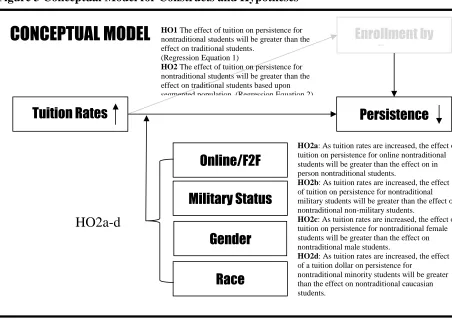
The effect of tuition prices on nontraditional student persistence is studied utilizing a
portion of the research model, adapted from the TENEP model. Figure 4.4, depicts the over all
model and hypotheses developed for this study based upon research of the Tuition Elasticity
Figure 3 Conceptual Model for Constructs and Hypotheses
IV.4.1 Tuition Effects on Persistence for Nontraditional Students
Price Elasticity Theory of Demand is to first “show (1) how elasticity changes along the
function and (2) how these elasticities are related to total expenditure at alternate prices and
quantities” (Houck, 1967) and thus this theory can be applied to higher education as tuition and
enrollment are studied. The Tuition Elasticity Theory is calculated by dividing a percentage
change in enrollment by the percentage change in tuition. As each resulting coefficient from the
change in tuition dollars will result in some effect on the probability of persistence, it is rational
to assume that different populations will respond to tuition price changes differently. In this data
set the average age is 38 among the nontraditional students. In 1987, Leslie and Brinkman noted
the elastic nature of two-year higher education institutions as compared to four-year institutions
with traditional aged populations. These institutions, such as community colleges and technical
Enrollment by
Hours
Persistence
Tuition Rates
CONCEPTUAL MODEL
Online/F2F
Military Status
Gender
Race
HO1 The effect of tuition on persistence for nontraditional students will be greater than the effect on traditional students.
(Regression Equation 1)
HO2 The effect of tuition on persistence for nontraditional students will be greater than the effect on traditional students based upon segmented population. (Regression Equation 2)
HO2a-d
HO2a: As tuition rates are increased, the effect of tuition on persistence for online nontraditional students will be greater than the effect on in person nontraditional students.
HO2b: As tuition rates are increased, the effect of tuition on persistence for nontraditional military students will be greater than the effect on nontraditional non-military students.
HO2c: As tuition rates are increased, the effect of tuition on persistence for nontraditional female students will be greater than the effect on nontraditional male students.
HO2d: As tuition rates are increased, the effect of a tuition dollar on persistence for
schools, target and are more appealing to lower income and older populations (Leslie &
Brinkman,1987). Using this research that states that older populations and lower income
populations appear to be more elastic than traditional aged populations coupled with the average
age of 38 of this data set, resulted in the hypothesis:
HO1 The effect of tuition on persistence for nontraditional students will be greater than
the effect on traditional students.
IV.4.2 Tuition Effects on Persistence for Nontraditional Online Students
With Price Elasticity Theory of Demand establishing that price increases can result in
varied decisions, additional research to establish the effects of online versus face-to-face
instructional methods was necessary. In 2015, Byrd, Roufagalas, & Mixon noted that in the
higher education industry, public online institutions with traditional aged populations were
highly elastic as compared to public face-to-face instruction at institutions with traditional aged
populations. With this observation made of traditional aged populations combined with the
suggested research that older populations are also more elastic than younger populations, the
following hypothesis resulted:
HO2a: As tuition rates are increased, the effect of tuition on persistence for online
nontraditional students will be greater than the effect on nontraditional face to face students.
IV.4.3 Tuition Effects on Persistence for Nontraditional Military Students
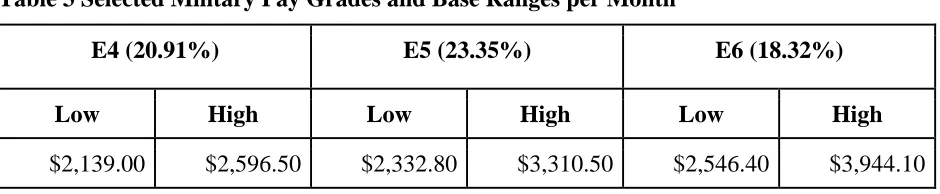
In the data set studied, military pay grades ranged from E1-E9, O1-O8, and W1-W5. Of
the nontraditional population in this data set, 62.58% of the military population ranked as an E4,
E5, or E6. According to the 2018 “Base Pay PDF” published by the U.S. Department of
Homeland Security, the following pay ranges apply to these pay grades depending on years of
Table 3 Selected Military Pay Grades and Base Ranges per Month
E4 (20.91%) E5 (23.35%) E6 (18.32%)
Low High Low High Low High
$2,139.00 $2,596.50 $2,332.80 $3,310.50 $2,546.40 $3,944.10
Intuitive rationale supports that as prices increase, fewer students will be able to afford
the higher tuition rates. In the nontraditonal military student population, it is reasonable to
assume that this rationale would apply because the majority of this population fall into a lower
income category. Utilizing previous research supporting higher elasticity with lower income
populations with the knowledge of the limited tuition assistance provided by the military,
rationale would support the hypothesis:
HO2b: As tuition rates are increased, the effect of tuition on persistence for
nontraditional military students will be greater than the effect on nontraditional nonmilitary
students.
IV.4.4 Tuition Effects on Persistence for Nontraditional Female Students
According to the U.S. Census Bureau (2016a), in 2016 women earned $0.805 cents to
every dollar of male earnings. With almost 20% less income than males, it can be assumed that
the expendable income of females is less than males; thus, rationale would support that females
would be more likely to fall in the category of lower income than males and the following
hypothesis would apply:
HO2c: As tuition rates are increased, the effect of tuition on persistence for
IV.4.5 Tuition Effects on Persistence for Nontraditional Minority Students
In 2016, the U.S. Census published, Real Median Household Income by Race and
Hispanic Origin: 1967 to 2016 which showed a national median salary of $59,039 of all races.
Hispanic and Black races were shown with median incomes less than the national median salary
of $47,675 and $39,490 respectively (U.S. Census Bureau, 2016b). Additionally, Cameron and
Heckman (2001) acknowledge the racial and ethnic disparities of enrollment in post-secondary
education which may or may not be caused by financial disparities. With the two majority
minorities (totaling 24.45% of the 29.23% minorities in the data set) in this data set being
Hispanic (9.12%) and Black or African American (15.33%), rationale would support that
minorities, with typically lower than national median wages than Caucasians $65,041-especially
Hispanic and African American or Black races would have less access to financial resources and
family support (Semega, Fontenot, & Kollar, 2017) and thus:
HO2d: As tuition rates are increased, the effect of tuition on persistence for
nontraditional minority students will be greater than the effect on nontraditional Caucasian
V FINDINGS
This quantitative study focuses on statistical significance where the focus will be on
explained p value with a set alpha of .05 or less using the linear regression equation models to
test the two sets of hypotheses with student level data provided by a private nonprofit higher
education institution.
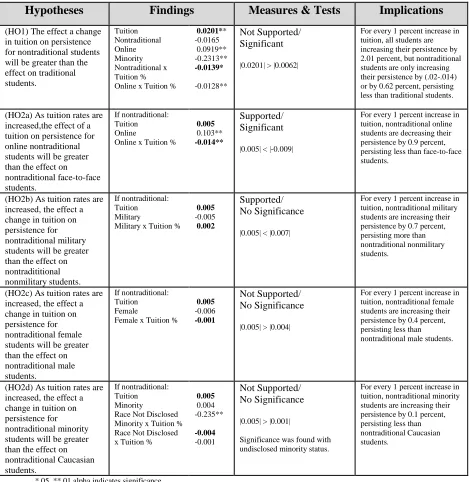
V.1 Hypotheses and Results
A summary of the outcomes from each hypothesis suggests that the model and
contributions to practice and theory are partially supported by the research and the research can
be used as a helpful guide for higher education institutions and customer relationship
management softwares targeting higher education institutions.
The research suggests the following:
● Cross-price elasticity suggest that this institution is considered a substitute good for other
institutions
● For every 1 percent increase in tuition, nontraditional online students are decreasing their
persistence by 0.9 percent
● Tuition increases result in nontraditional students persisting less than traditional students
● Tuition increases result in nontraditional online students persisting less than
nontraditional face-to-face students
● Tuition increases result in nontraditional female students persisting less than
nontraditional male students
● Tuition increases result in nontraditional minority students persisting less than
Table 4 Summary of Hypotheses and Results
Hypotheses Findings Measures & Tests Implications
(HO1) The effect a change in tuition on persistence for nontraditional students will be greater than the effect on traditional students. Tuition Nontraditional Online Minority Nontraditional x Tuition %
Online x Tuition %
0.0201** -0.0165 0.0919** -0.2313** -0.0139* -0.0128** Not Supported/ Significant
|0.0201| > |0.0062|
For every 1 percent increase in tuition, all students are increasing their persistence by 2.01 percent, but nontraditional students are only increasing their persistence by (.02-.014) or by 0.62 percent, persisting less than traditional students.
(HO2a) As tuition rates are increased,the effect of a tuition on persistence for online nontraditional students will be greater than the effect on nontraditional face-to-face students.
If nontraditional: Tuition Online
Online x Tuition % 0.005 0.103** -0.014** Supported/ Significant
|0.005| < |-0.009|
For every 1 percent increase in tuition, nontraditional online students are decreasing their persistence by 0.9 percent, persisting less than face-to-face students.
(HO2b) As tuition rates are increased, the effect a change in tuition on persistence for nontraditional military students will be greater than the effect on nontradititional nonmilitary students.
If nontraditional: Tuition Military
Military x Tuition %
0.005 -0.005 0.002
Supported/ No Significance
|0.005| < |0.007|
For every 1 percent increase in tuition, nontraditional military students are increasing their persistence by 0.7 percent, persisting more than nontraditional nonmilitary students.
(HO2c) As tuition rates are increased, the effect a change in tuition on persistence for nontraditional female students will be greater than the effect on nontraditional male students.
If nontraditional: Tuition Female
Female x Tuition %
0.005 -0.006 -0.001
Not Supported/ No Significance
|0.005| > |0.004|
For every 1 percent increase in tuition, nontraditional female students are increasing their persistence by 0.4 percent, persisting less than nontraditional male students.
(HO2d) As tuition rates are increased, the effect a change in tuition on persistence for nontraditional minority students will be greater than the effect on nontraditional Caucasian students.
If nontraditional: Tuition Minority
Race Not Disclosed Minority x Tuition % Race Not Disclosed x Tuition %
0.005 0.004 -0.235** -0.004 -0.001 Not Supported/ No Significance
|0.005| > |0.001|
Significance was found with undisclosed minority status.
For every 1 percent increase in tuition, nontraditional minority students are increasing their persistence by 0.1 percent, persisting less than nontraditional Caucasian students.
*.05, **.01 alpha indicates significance
V.2 Linear Regression Model Selection and Justification
Two models were tested utilizing persistence as a dichotomous variable (persisted1
1=yes, 0=no) and as a continuous variable (persistedterms) to determine which model had the
highest explained variance (R2) and lowest errors (Root MSE) by the model. The dichotomous
in probability of student populations persisting can be explained by variation in the independent
variables taken together and the 26.23% of the variation in probability of nontraditional student
populations persisting can be explained by the variation in the independent variables taken
together. Lower errors as shown in the Root MSE for all hypotheses also resulted from the use
of the dichotomous variable as discussed further in the findings. A summary of the variables
[image:43.612.73.526.259.646.2]studied are listed in Table 5.2, Summary of Mean Variables.
Table 5 Summary of Mean Variables
Full Sample
Traditional (18-24 yrs)
NonTraditional
(25+ yrs) p value
N by observation 12,496 1,395 11,101
Variable Label
Share Persisted* 0.580 0.612 0.576 0.0112
Mean Terms Persisted/AY** 1.607 1.5309 1.6161 0.0727
Mean Tuition per Credit Hour $289.92 $283.84 $290.68 0.0002
Mean Tuition % Increase 1.857 1.466 1.906 0.0000
Share Online 0.209 0.224 0.207 0.1286
Share Military 0.493 0.375 0.508 0.0000
Share Female 0.390 0.438 0.384 0.0001
Share Reporting Minority 0.292 0.354 0.285 0.6028
Share Race Not Disclosed 0.440 0.232 0.466 0.0000
N by Year (Controls)
2015 1,985 137 1,848
2016 2,864 264 2,600
2017 3,703 454 3,249
2018 3,944 540 3,404
State Tuition % Increase (Control) 4.140% 4.274% 4.125% 0.0000
*Model 1 **Model 2
(HO1) Persistence=β0 + β1Tuition + β2Nontrational +β3Online + β4Military + β5Gender + β6Race + β7(Tuition x Nontraditional) +β8(Tuition x Online) + β9(Tuition x Military) + β10(Tuition x Gender) + β11(Tuition x Race) + Ɛ
V.3 Effect of Tuition Increase on Nontraditional Persistence
HO1 The effect of tuition increase on persistence for nontraditional students will be
greater than the effect on traditional students.
Two models were tested utilizing persistence as a dichotomous variable (persisted1
1=yes, 0=no) and as a continuous variable (persistedterms) to determine which model had the
highest explained variance and lowest error. The dichotomous variable provided a higher
explained variance for HO1 resulting in an R2 of 25.04% explained variance as opposed to the
continuous variable with an R2 of 10.63% explained variance. For the two models the errors
were higher in Model 2 with a root MSE of 1.69 as compared to a root MSE of 0.427 in Model 1.
A control was entered into the model controlling for the University’s state four-year private
school tuition average price increase; however, as this introduced multicollinearity the results
were omitted due to collinearity and thus the model was run without the control variable. Model
1 was utilized to observe through a linear regression model that the effect of a 1 percent tuition
increase on persistence for all students increased their persistence by 2.01 percent, but
nontraditional students only increased their persistence by (.02-.014) or by 0.62 percent,
persisting less than traditional students. An alpha of .025 indicates this finding is of statistical
significance; however, because of the unique nature of the finding, the hypothesis would be
considered not supported even though nontraditional student persist less than traditional students.
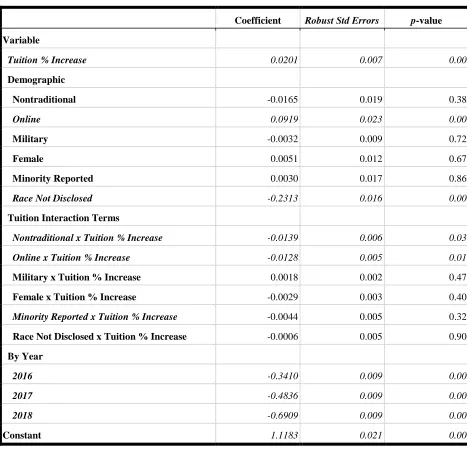
Table 5.3, Summary of Persistence, contains a summary of the findings for the linear regression
Table 6 Summary of Persistence
Coefficient Robust Std Errors p-value
Variable
Tuition % Increase 0.0201 0.007 0.00
Demographic
Nontraditional -0.0165 0.019 0.38
Online 0.0919 0.023 0.00
Military -0.0032 0.009 0.72
Female 0.0051 0.012 0.67
Minority Reported 0.0030 0.017 0.86
Race Not Disclosed -0.2313 0.016 0.00
Tuition Interaction Terms
Nontraditional x Tuition % Increase -0.0139 0.006 0.03
Online x Tuition % Increase -0.0128 0.005 0.01
Military x Tuition % Increase 0.0018 0.002 0.47
Female x Tuition % Increase -0.0029 0.003 0.40
Minority Reported x Tuition % Increase -0.0044 0.005 0.32
Race Not Disclosed x Tuition % Increase -0.0006 0.005 0.90
By Year
2016 -0.3410 0.009 0.00
2017 -0.4836 0.009 0.00
2018 -0.6909 0.009 0.00
Constant 1.1183 0.021 0.00
(HO1) Persistence=β0 + β1Tuitionpercent + β2Nontrational +β3Online + β4Military + β5Gender + β6Race + β7(Tuitionpercent x Nontraditional) +β8(Tuitionpercent x Online) + β9(Tuitionpercent x Military) + β10(Tuitionpercent x Gender) + β11(Tuitionpercent x Race) + Ɛ
V.4 Effect of Tuition Increase on Nontraditional Persistence by Demographic
A linear regression was calculated to predict persistence based on tuition prices
moderated by demographics including online or face-to-face, military status, gender, and race. A
significant regression equation was found (F(14, 3541)=449.84, p<0.0000), with an R2 of 0.2623