S T U D Y P R O T O C O L
Open Access
Relating therapy for voices (the R2V study): study
protocol for a pilot randomized controlled trial
Mark Hayward
1*, Clara Strauss
2and Leanne Bogen-Johnston
2Abstract
Background:Evidence exists for the effectiveness of cognitive behaviour therapy for psychosis with moderate effect sizes, but the evidence for cognitive behaviour therapy specifically for distressing voices is less convincing. An alternative symptom-based approach may be warranted and a body of literature has explored distressing voices from an interpersonal perspective. This literature has informed the development of relating therapy and findings from a case series suggested that this intervention was acceptable to hearers and therapists.
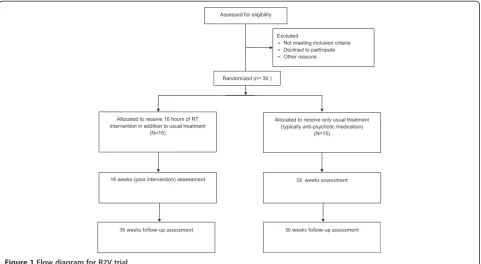
Methods/Design:An external pilot randomized controlled trial (RCT) comparing outcomes for 15 patients receiving 16 hours (weekly sessions of one hour) of relating therapy and their usual treatment with 15 patients receiving only their usual treatment. Participants will be assessed using questionnaires at baseline, 16 weeks (post-intervention), and 36 weeks (follow-up).
Discussion:Expected outcomes will include a refined study protocol and an estimate of the effect size to inform the sample size of a definitive RCT. If evidence from a fully powered RCT suggests that relating therapy is effective, the therapy will extend the range of evidence-based psychological therapies available to people who hear distressing voices.
Trial registration: Current Controlled Trials ISRCTN registration number 44114663. Registered on 13 June 2013.
Keywords:Auditory hallucinations, Voices, Interpersonal, Relationship, CBT, Psychosis
Background
The experience of hearing voices (verbal‘auditory halluci-nations’) is one of the prominent features of schizophrenia in current systems of diagnostic classification [1]. Voice hearing is reported to occur in approximately 70% of pa-tients with this diagnosis [2], although the experience is also common in other mental health conditions such as post-traumatic stress disorder and borderline personality disorder [3]. National Institute for Health and Care Excel-lence (NICE) guidance in the UK recommends that psy-chological therapy in the form of cognitive behavioral therapy (CBT) should be offered to all patients who have a diagnosis of schizophrenia [4]. Although this is appropri-ate in the case of psychosis more broadly, where an evi-dence base exists for moderate effects [5], the impact of CBT for psychosis specifically on distressing voices is less convincing [6]. Therefore, consistent with a
symptom-based approach [7], a voice-specific approach may be war-ranted. A recent review [6] was conducted of 16 published randomized controlled trials (RCTs) of CBT for psychosis that have reported at least one psychometrically validated outcome measure specifically related to voice hearing. The review found that the majority of studies failed to show a significant effect of CBT on voice hearing, and most of those that reported significant effects did so in the context of methodological weaknesses. Only one study reported an effect using a robust methodology. Interestingly, this was the only study that focused ex-clusively on voice hearing [8]. A factor that may have limited the effect of CBT upon voice hearing concerns outcome measurement - early trials used measures of voice frequency and severity, despite CBT not focusing upon the eradication of voices. The authors conclude by calling for more robustly designed RCTs of CBT aimed specifically at distressing voices. They draw attention to the potential for the integration of other psycho-therapeutic techniques that have shown early promise
* Correspondence:[email protected]
1School of Psychology, University of Sussex, BN1 9RH Brighton, UK Full list of author information is available at the end of the article
for assisting voice hearers. In particular, the approach of trying to understand and adapt the interpersonal-like relationships that can develop with voices (see [9,10] for a review).
There is an evolving body of literature that has explored the experience of hearing voices from an interpersonal per-spective, examining the interaction that can occur between the hearer and the voice(s) that is heard. Findings suggest that hearers, regardless of diagnosis, can have integrated, personally coherent relationships with their voices [11]. Two studies using social rank theory found marked differ-entials of power and social rank between the hearer and the voice, which place the voice in a dominant position, and mirror perceptions of self in relation to significant social others [12,13]. However, whilst there has been a focus on dominance, research has paid less attention to the role of intimacy and closeness within relationships with voices. If relationships with voices do mirror relationships in the so-cial world, they are likely to be imbued with all the com-plexity and idiosyncrasy of social relationships. Relating theory [14] proposes that relating occurs on two axes: a ver-tical‘power’axis characterized at each polar end by‘upper’ and ‘lower’(analogous to power differentials), and a hori-zontal ‘proximity’axis characterized at each polar end by ‘close’and‘distant’. Studies that have explored voice hearing experiences through the lens of relating theory report that distressing voices are perceived as relating dominantly and intrusively [15-17], and are responded to through distant relating from the hearer. Mirroring has also been found be-tween proximity styles of relating to voices and those of the hearers within their social relationships [18].
Collectively, this body of research suggests that voi-ces can be understood within interpersonal frameworks. This conceptualization has given rise to a new gener-ation of therapeutic approaches that seek to modify the hearer-voice relationship. A pilot RCT [8] that looked at a therapeutic approach to address the power dynamic with voices that issue commands (cognitive therapy for command hallucinations [CTCH]) found significant re-ductions in compliance behaviour within the therapy group, and this finding has been replicated in a definitive trial [19]. A therapeutic focus upon closeness and intimacy has been developed by Haywardet al. [16] in the form of relating therapy (RT) which aims to re-balance the hearer-voice relationship with regard to both power and prox-imity. Findings from a case series suggested that RT was acceptable to hearers who experienced persistent and dis-tressing voices [16,20]. Consistent with the call for evalua-tions of effectiveness to be methodologically rigorous [6], RT should now be evaluated within an RCT design.
Research objectives and hypotheses
The main objective of the study will be to inform the de-velopment of a phase III definitive trial [21]. Specifically,
this external pilot RCT will establish recruitment, reten-tion, and follow-up rates to the trial, assess levels of adher-ence with the treatment, and establish treatment effect size relative to treatment-as-usual. This information will be used to finalize the design of the therapy protocol and the study protocol for the phase III trial.
This external pilot RCT is, by definition, underpow-ered to detect statistically significant effects. Voice-related distress, rather than voice activity (such as loudness or frequency) or voice attributions (such as beliefs about the origin of voices), is the primary target of the therapy. Therefore, the primary hypothesis for the definitive trial is that RT added to treatment-as-usual will reduce the distress associated with voice hearing compared with treatment-as-usual on its own.
Secondary hypotheses for the definitive trial are that RT will lead to: 1) Reductions in voice-related distress relative to the control condition that will be maintained over at least three months; 2) Reductions in voice-related distress that will be mediated by improvements in relating to and/or by voices (improvements in relat-ing defined as reductions in voice dominance and intru-siveness, and hearer distance - measured by the Voice and You [VAY]questionnaire); 3) Improvements in re-covery (measured by the Choice of outcome in CBT for psychoses [CHOICE] questionnaire), relating to people in the social world (measured by the shorter version of the Persons Relating to Others Questionnaire [PROQ3]), and mood and anxiety (measured by the Hospital Anxiety and Depression Scale [HADS]); and 4) Improvements in relating to people in the social world will be associated with improvements in relating to and/or by voices (improvements in relating defined as reductions in voice dominance and intrusiveness, and hearer distance - measured by the Voice and You [VAY] questionnaire).
Methods/Design
Participants
The study aims to recruit approximately 30 patients from an NHS mental health trust in the south of the UK. Allowing for attrition from the study, there will be at least 12 completer participants per condition, in line with rec-ommendations for pilot RCTs [22]. Inclusion criteria re-quire that participants have been hearing distressing voices for at least one year, irrespective of diagnosis, and score 3 or above on either the intensity of distress item or the amount of distress item on the Psychotic Symptoms Rating Scale - Auditory Hallucinations Scale (PSYRATS-AHRS) [23] at the time of consent. People will be ex-cluded on the grounds of organic illness, a primary diag-nosis of substance misuse, or are currently receiving psychological therapy for distressing voices. Each partici-pant will give informed consent before entering the trial.
Planned intervention
The intervention will consist of a maximum of 16 hours (weekly sessions of one hour) of individual RT. The ther-apy protocol consists of three phases:
Phase 1: socialization to RT and its implications for the interrelating between hearer and voice. Use of chapter 3 from Overcoming Distressing Voices [24] to guide discus-sions about relationships in terms of power and proximity, and linking this discussion to participant’s experiences of relating to people and distressing voices. Consideration of the typical ways of responding to negative relating (giving in, fighting back, and trying to escape). Introduction of the possibility of relating differently to voices.
Phase 2: exploration of themes within the relational history of the hearer and their experience of relation-ships with voices, and interpersonal relating within the family and social environment (identifying any promin-ent themes, such as abuse, disempowermpromin-ent, or rivalry). Development of connections across all forms of relating. If appropriate and desired, generating formulation(s) that link past and present forms of relating.
Phase 3: exploration and development of assertive ap-proaches to relating (to the voice and socially). Selection of a relationship to be the focus of intervention. Use of chap-ter 7 from Overcoming Distressing Voices[24] to explore current utterances of chosen voice or person, responses to these utterances, identifying responses as passive, aggres-sive, or assertive and generation of assertive responses to chosen voice or other. Experiential role plays are a critical part of Phase 3 and are used to explore the motives of the voice (and other people) and to practice relating in an as-sertive manner.
The intervention will be offered by five therapists. Two of the therapists (including the first author) are fa-miliar with the therapy, having previously delivered it within the case series [16,20]. The three remaining ther-apists are experienced in the delivery of psychological therapy for psychotic experiences within trials, and will receive training from the first author.
Treatment-as-usual
All participants will be receiving treatment-as-usual from an NHS mental health service. This will include
[image:3.595.58.540.89.353.2]psychotic medication and regular contact with a member of their clinical team. Participants will be required to have no definite plan to receive psychological therapy for voices at the time of consenting to the study. There are no other requirements for previous or future therapy.
Measures
Primary measure
Psychotic Symptoms Rating Scale (PSYRATSAHRS) -an 11-item rating scale designed to measure the severity of different dimensions of the voice hearing experience [23]. Items include frequency, duration, loudness, intensity of distress, and controllability and are grouped together in four factors [25]; distress (negative content, distress, and control), frequency (frequency, duration, and disruption), attribution (location and origin of voices), and loudness (loudness item only). The authors report excellent psycho-metric properties [23].
Secondary measures
Choice of outcome in CBT for psychoses (CHOICE) – CHOICE is a 21-item self-report questionnaire developed with service users to assess goals for CBT for psychosis that are relevant to recovery, including self confidence, ways of dealing with unpleasant feelings and emotions, positive ways of relating to people, knowing they are not the only person who has unusual experiences, and a posi-tive purpose and direction in life [26]. CHOICE has been found to be reliable and valid.
Voice and You (VAY) - the VAY is a 28-item measure of interrelating between the hearer and their predomin-ant voice [15]. Relating is measured across four scales: two concerning the hearer’s perception of the relating of the voice (voice dominance and voice intrusiveness), and two concerning the relating of the hearer (hearer dis-tance and hearer dependence). The VAY has good in-ternal consistency (α>0.80 for all scales) and acceptable test-retest reliability (r >0.7 for all scales).
The Shorter version of the Persons Relating to Others Questionnaire (PROQ3) - the PROQ3 is a 40-item ques-tionnaire that assesses relating across eight scales which correspond to the relating positions within Birtchnell’s Interpersonal Octagon [27]. The PROQ3 has acceptable internal consistency (α>0.70 for all scales) and its eight-factor structure is supported by eight-factor analysis and multidimensional scaling analysis.
Hospital anxiety and depression scale (HADS) - the HADS is a 16-item measure of symptoms of anxiety and depression that has well-established psychometric pro-perties [28].
Analysis
The aim of this pilot study is to establish: 1) Recruitment, retention, and follow-up rates to the trial. This will be
recorded as: (a) the number of research assistant hours required to obtain consent for one participant, (b) the percentage of participants who complete the Time 1 as-sessment, and (c) the percentage of participants who complete the Time 2 assessment; 2) Level of adherence with the treatment. This will be recorded as the percent-age of participants who complete at least eight RT sessions (50% of the maximum of 16 sessions); 3) Treatment effect size relative to treatment-as-usual. A mixed one way ana-lysis of variance (ANOVA) with post-hoc tests, where ap-propriate, will be conducted in order to calculate the group (two levels: RT + TAU or TAU) by time (three levels: T0, T1 and T2), interaction effect size, and its 95% confidence interval on the PSYRATS-AHRS; 4) Minimally clinically important difference. Taking a reduction of 1.0 on a PSYRATS-AHRS item as having clinical meaning, a difference of 5 in change scores (T0-T1 and T0-T2) be-tween the two groups for the 5-item distress subscale will represent a minimally clinically important difference and be contained within the 95% confidence interval for the effect size.
This information will be used to refine the therapy protocol and to design the definitive trial. The group by time effect size on the PSYRATS-AHRS will be used for the power calculation for the definitive trial whilst taking into account the minimum clinically important diffe-rence on the PSYRATS-AHRS.
Research governance
The study is sponsored by Sussex Partnership NHS Foundation Trust. NHS ethics (reference number 12/LO/ 2045) and R&D approval were sought before the com-mencement of the trial. Medical Research Council Guide-lines on Good Clinical Practice in Clinical Trials [29] informed the constitution of the Trial Steering Commit-tee, which includes an independent chair, two independ-ent experts, and a lay person.
Discussion
to inform the sample size calculation for a phase III trial. If evidence from a definitive RCT suggests that RT is effective, this will extend the range of evidence-based psychological therapies available to people who hear distressing voices.
Trial status
Recruitment to the trial commenced in June 2013. At present, recruitment and data collection will continue until February 2015.
Abbreviations
CBT:Cognitive behavioral therapy; CTCH: Cognitive therapy for command hallucinations; NICE: National institute for health and care excellence; RCT: Randomized controlled trial; RT: Relating therapy; TAU: Treatment-as-usual.
Competing interests
The authors declare that they have no competing interests.
Authors’contributions
MH took the main responsibility for drafting the study protocol. MH is the main lead of the trial. CS has the main responsibility for data analysis. LBJ is the trial coordinator. MH provides the supervision and training for the trial therapists and research workers. All authors contributed to the design of the trial and approved the final manuscript.
Acknowledgements
Gratitude is due to Theresa Dorey and Cassie Hazell for their roles in the provision of therapy and data collection, and to Ruth Chandler for offering a lived experience perspective to the design of the therapy protocol. The study is funded by grants from Sussex Partnership NHS Foundation Trust and the British Academy.
Author details
1School of Psychology, University of Sussex, BN1 9RH Brighton, UK.2Research & Development Department, Sussex Partnership NHS Foundation Trust, Nevill Avenue, BN3 7HZ Hove, UK.
Received: 10 March 2014 Accepted: 29 July 2014 Published: 16 August 2014
References
1. American Psychiatric Association:Diagnostic and Statistical Manual of Mental Disorders (fifth edition).Arlington, VA: APA; 2013.
2. Thomas P, Mathur P, Gottesman II, Nagpal R, Nimgaonkar VL, Deshpande SN:
Correlates of hallucinations in schizophrenia: A cross-cultural evaluation.
Schizophr Res2007,9:41–49.
3. Sommer IE, Koops S, Blom JD:Comparison of auditory hallucinations across different disorders and syndromes.Neuropsychiatry2012,2:1–12. 4. National Institute for Health and Clinical Excellence (NICE):Schizophrenia:
the NICE Guideline on Core Interventions in the Treatment and Management of Schizophrenia in Adults in Primary and Secondary Care–Updated Edition. National Clinical Guideline Number 82.London: National Collaborating Centre for Mental Health; 2010.
5. Wykes T, Steel C, Everitt B, Tarrier N:Cognitive behaviour therapy for schizophrenia: effect sizes, clinical models, and methodological rigor.
Schizophr Bull2008,34:523–527.
6. McCarthy-Jones S, Thomas N, Dodgson G, Fernyhough C, Brotherhood E, Wilson G, Dudley R:What have we learnt about the ability of cognitive behavioural therapy to help with voice-hearing?In Psychological Approaches to Understanding and Treating Auditory Hallucinations: From Theory to Therapy.Edited by Hayward M, Strauss C, McCarthy-Jones S. Hove: Routledge; 2014.
7. Bentall RP:Madness explained: why we must reject the Kraepelinian paradigm and replace it with a complaint-orientated approach to understanding mental illness.Med Hypotheses2006,66:220–233.
8. Trower P, Birchwood M, Meaden A, Byrne S, Nelson A, Ross K:Cognitive therapy for command hallucinations: randomized controlled trial.Br J Psych2004,184:312–320.
9. Hayward M, Berry K, Ashton A:Applying interpersonal theories to the understanding of and therapy for auditory hallucinations: A review of the literature and directions for further research.Clin Psychol Rev2011,
31:1313–1323.
10. Hayward M, Berry K, McCarthy-Jones S, Strauss C, Thomas N:Beyond the omnipotence of voices: further developing a relational approach to auditory hallucinations.Psychosis2013, doi:10.1080/17522439.2013.839735. 11. Benjamin LS:Is chronicity a function of the relationship between the
person and the auditory hallucination?Schizophr Bull1998,15:291–310. 12. Birchwood M, Meaden A, Trower P, Gilbert P, Plaistow J:The power and
omnipotence of voices: Subordination and entrapment by voices and significant others.Psychol Med2000,30:337–344.
13. Birchwood M, Gilbert P, Gilbert J, Trower P, Meaden A, Hay J, Murray E, Miles JNV:Interpersonal and role-related schema influence the relationship with the dominant‘voice’in schizophrenia: a comparison of three models.
Psychol Med2004,34:1571–1580.
14. Birtchnell J:How Humans Relate: A New Interpersonal theory.Hove: Psychology Press; 1996.
15. Hayward M, Denney J, Vaughan S, Fowler D:The voice and you: development and psychometric evaluation of a measure of relationships with voices.Clin Psychol Psychother2008,15:45–52.
16. Hayward M, Overton J, Dorey T, Denney J:Relating Therapy for people who hear voices: a case series.Clin Psycho Psychother2009,16:216–227. 17. Sorrell E, Hayward M, Meddings S:Interpersonal processes and hearing
voices: a study of the association between relating to voices and distress in clinical and non-clinical hearers.Beh Cog Psychother2010,38:127–140. 18. Hayward M:Interpersonal relating and voice hearing: to what extent
does relating to the voice reflect social relating.Psycho Psychother2003,
76:369–383.
19. Birchwood M, Michail M, Meaden A, Tarrier N, Lewis S, Wykes T, Davies L, Dunn G, Peters E:Cognitive behaviour therapy to prevent harmful compliance with command hallucinations (COMMAND): a randomized controlled trial.Lancet Psychiatry2014,1:23–33.
20. Hayward M, Fuller E:Relating therapy for people who hear voices: perspectives from clients, family members, referrers and therapists.
Clin Psychol Psychother2010,17:363–373.
21. Medical Research Council:A Framework for the Development and Evaluation of RCTs for Complex Interventions to Improve Health.London: MRC; 1998. 22. Julious SA:Sample size of 12 per group rule of thumb for a pilot study.
Pharm Stat2005,4:287–291.
23. Haddock G, McCarron J, Tarrier N, Faragher EB:Scales to measure dimensions of hallucinations and delusions: the psychotic symptom rating scales (PSYRATS).Psychol Med1999,29:879–889.
24. Hayward M, Strauss C, Kingdon D:Overcoming Distressing Voices.London: Constable and Robinson; 2012.
25. Woodward T, Jung K, Hwang H, Yin J, Taylor L, Menon M, Peters E, Kuipers E, Waters F, Lecomte T, Sommes IE, Daalman K, van Lutterveld R, Hubl D, Kindler J, Homan P, Badcock J, Chhabra S, Cella M, Keedy S, Allen P, Mechelli A, Preti A, Siddi S, Erickson S:Symptom dimensions of the Psychotic Symptoms Rating Scale in Psychosis: A multisite study.
Schizophr Bull2014,Suppl 4:S265–S264.
26. Greenwood K, Sweeney A, Williams S:CHoice of Outcome In Cbt for psychosEs (CHOICE): the development of a new service user-led outcome measure of CBT for psychosis.Schizophr Bull2010,36:126–135.
27. Birtchnell J, Hammond S, Horn E, De Jong C, Argyroula K:A cross national comparison of a shorter version of the person’s relating to others questionnaire.Clin Psychol Psychother2013,20:36–48.
28. Zigmund AS, Snaith RP:The hospital anxiety and depression scale.
Acta Psych Scand1983,67:361–370.
29. Medical Research Council:Guidelines for Good Clinical Practice in Clinical Trials.London: MRC; 1998.
doi:10.1186/1745-6215-15-325
Cite this article as:Haywardet al.:Relating therapy for voices (the R2V study): study protocol for a pilot randomized controlled trial.Trials