Superconductivity and Superfluidity-Part II:
Superconductivity as a Consequence of Ordering
of Zero-point Oscillations in Electron Gas
Boris V.Vasiliev
∗Corresponding Author: [email protected]
Copyright c⃝2014 Horizon Research Publishing All rights reserved.
Abstract
Currently there is a common belief that the explanation of superconductivity phenomenon lies in understanding the mechanism of the formation of electron pairs. Paired electrons, however, cannot form a superconducting condensate spontaneously. These paired electrons perform disorderly zero-point oscillations and there are no force of attraction in their ensemble. In order to create a unified ensemble of par-ticles, the pairs must order their zero-point fluctuations so that an attraction between the particles appears. As a result of this ordering of zero-point oscillations in the electron gas, superconductivity arises. This model of condensation of zero-point oscillations creates the possibility of being able to obtain estimates for the crit-ical parameters of elementary superconductors, which are in satisfactory agreement with the measured data. On the another hand, the phenomenon of superfluidity in He-4 and He-3 can be similarly explained, due to the ordering of zero-point fluctuations. It is therefore established that both related phenomena are based on the same physical mechanism.Keywords
Superconductivity SuperfluidityZero-point Oscillations
1
Superconductivity as a
conse-quence of ordering of
zero-point oscillations
Superfluidity and superconductivity, which can be garded as the superfluidity of the electron gas, are re-lated phenomena. The main feature of these phenomena can be seen in a fact that a special condensate in super-conductors as well as in superfluid helium is formed from particles interconnected by attraction.
This mutual attraction does not allow a scattering of in-dividual particles on defects and walls, if the energy of this scattering is less than the energy of attraction. Due to the lack of scattering, the condensate acquires ability to move without friction.
Superconductivity was discovered over a century ago,
and the superfluidity about thirty years later.
However, despite the attention of many scientists to the study of these phenomena, they have been the great mysteries in condensed matter physics for a long time. This mystery attracted the best minds of the twentieth century.
The mystery of the superconductivity phenomenon has begun to drop in the middle of the last century when the effect of magnetic flux quantization in superconduct-ing cylinders was discovered and investigated. This phe-nomenon was predicted even before the WWII by broth-ers F. London and H. London, but its quantitative study were performed only two decades later.
By these measurements it became clear that at the formation of the superconducting state, two free elec-trons are combined into a single boson with zero spin and zero momentum.
Around the same time, it was observed that the sub-stitution of one isotope of the superconducting element to another leads to a changing of the critical temperature of superconductors: the phenomenon called an isotope-effect [1], [2]. This isotope-effect was interpreted as the direct proof of the key role of phonons in the formation of the superconducting state.
Following these understandings,
L. Cooper proposed the phonon mechanism of electron pairing on which base the microscopic theory of super-conductivity (so called BCS-theory) was built by N. Bo-golyubov and J. Bardeen, L. Cooper and J. Shrieffer (probably it should be named better the Bogolyubov-BCS-theory).
However the B-BCS theory based on the phonon mechanism brokes a hypothetic link between supercon-ductivity and superfluidity as in liquid helium there are no phonons for combining atoms.
Something similar happened with the description of superfluidity.
de-pendence of the superfluid phase density, the existence of the second sound, etc. But it does not gave an an-swer to the question which physical mechanism leads to the unification of the atoms in the superfluid condensate and what is the critical temperature of the condensate, i.e. why the ratio of the temperature of transition to the superfluid state to the boiling point of helium-4 is almost exactly equals to 1/2.
On the whole, the description of both super-phenomena, superconductivity and superfluidity, to the beginning of the
twenty first century induced some feeling of dissatisfac-tion primarily due to the fact that a common mechanism of their occurrence has not been understood.
More than fifty years of a study of the B-BCS-theory has shown that this theory successfully describes the general features of the phenomenon, but it can not be developed in the theory of superconductors. It explains general laws such as the emergence of the energy gap, the behavior of specific heat capacity, the flux quantization, etc., but it can not predict the main parameters of the individual superconductors: their critical temperatures and critical magnetic fields. More precisely, in the B-BCS-theory, the expression for the critical temperature of superconductor obtains an exponential form which exponential factor is impossible to measure directly and this formula is of no practical interest.
Recent studies of the isotopic substitution showed that zero-point oscillations of the ions in the metal lattice are not harmonic. Consequently the isotopic substitution affects the interatomic distances in a lattice, and as the result, they directly change the Fermi energy of a metal [3].
Therefore, the assumption developed in the middle of the last century, that the electron-phonon interaction is the only possible mechanism of superconductivity was proved to be wrong. The direct effect of isotopic substi-tution on the Fermi energy gives a possibility to consider the superconductivity without the phonon mechanism.
Furthermore, a closer look at the problem reveals that the B-BCS-theory describes the mechanism of electron pairing, but in this theory there is no mechanism for combining pairs in the single super-ensemble. The nec-essary condition for the existence of superconductivity is formation of a unique ensemble of particles. By this mechanism, a very small amount of electrons are com-bined in super-ensemble, on the level 10 in minus fifth power from the full number of free electrons. This fact also can not be understood in the framework of the B-BCS theory.
An operation of the mechanism of electron pairing and turning them into boson pairs is a necessary but not sufficient condition for the existence of a supercon-ducting state. Obtained pairs are not identical at any such mechanism. They differ because of their uncorre-lated zero-point oscillations and they can not form the condensate at that.
At very low temperatures, that allow superfluidity in helium and superconductivity in metals, all movements of particles are freezed except for their zero-point os-cillations. Therefore, as an alternative, we should con-sider the interaction of super-particles through electro-magnetic fields of zero-point oscillations. This approach
was proved to be fruitful. At the consideration of super-phenomena as consequences of the zero-point oscillations ordering, one can construct theoretical mechanisms en-abling to give estimations for the critical parameters of these phenomena which are in satisfactory agreement with measurements.
As result, one can see that as the critical temperatures of (type-I) superconductors are equal to about 10−6from
the Fermi temperature for superconducting metal, which is consistent with data of measurements. At this the de-struction of superconductivity by application of critical magnetic field occurs when the field destroys the coher-ence of zero-point oscillations of electron pairs. This is in good agreement with measurements also.
A such-like mechanism works in superfluid liquid he-lium. The problem of the interaction of zero-point os-cillations of the electronic shells of neutral atoms in the s-state, was considered yet before the World War II by F.London. He has shown that this interaction is respon-sible for the liquefaction of helium. The closer analysis of interactions of zero-point oscillations for helium atomic shells shows that at first at the temperature of about 4K only, one of the oscillations mode becomes ordered. As a result, the forces of attraction appear between atoms which are need for helium liquefaction. To create a sin-gle quantum ensemble, it is necessary to reach the com-plete ordering of atomic oscillations. At the comcom-plete ordering of oscillations at about 2K, the additional en-ergy of the mutual attraction appears and the system of helium-4 atoms transits in superfluid state. To form the superfluid quantum ensemble in Helium-3, not only the zero-point oscillations should be ordered, but the mag-netic moments of the nuclei should be ordered too. For this reason, it is necessary to lower the temperature be-low 0.001K. This is also in agreement with experiment. Thus it is possible to show that both related super-phenomena, superconductivity and superfluidity, are based on the single physical mechanism: the ordering of zero-point oscillations.
The roles of zero-point oscillations in formation of the superconducting state have been previously considered in papers [4]-[6].
2
The electron pairing
J.Bardeen was first who turned his attention toward a possible link between superconductivity and zero-point oscillations [7].
The special role of zero-point vibrations exists due to the fact that at low temperatures all movements of electrons in metals have been frozen except for these oscillations.
Superconducting condensate formation requires two mechanisms: first, the electrons must be united in bo-son pairs, and then the zero-point fluctuations must be ordered (see Fig.(1)).
The energetically favorable pairing of electrons in the electron gas should occur above the critical temperature. Possibly, the pairing of electrons can occur due to the magnetic dipole-dipole interaction.
Figure 1. The schematic representation of the energy levels of conducting electrons in a superconducting metal
about 10K, the distance between these particles must be small enough:
r <(µ2B/kTc)1/3≈aB, (1)
whereaB= ~
2
mee2 is the Bohr radius.
That is, two collectivized electrons must be localized in one lattice site volume. It is agreed that the supercon-ductivity can occur only in metals with two collectivized electrons per atom, and cannot exist in the monovalent alkali and noble metals.
It is easy to see that the presence of magnetic moments on ion sites should interfere with the magnetic combina-tion of electrons. This is confirmed by the experimental fact: as there are no strong magnetic substances among superconductors, so adding of iron, for example, to tra-ditional superconducting alloys always leads to a lower critical temperature.
On the other hand, this magnetic coupling should not be destroyed at the critical temperature. The energy of interaction between two electrons, located near one lattice site, can be much greater. This is confirmed by experiments showing that throughout the period of the magnetic flux quantization, there is no change at the transition through the critical temperature of supercon-ductor [8], [9].
The outcomes of these experiments are evidence that the existence of the mechanism of electron pairing is a necessary but not a sufficient condition for the existence of superconductivity.
The magnetic mechanism of electronic pairing pro-posed above can be seen as an assumption which is con-sistent with the measurement data and therefore needs a more detailed theoretic consideration and further re-finement.
On the other hand, this issue is not very important in the grander scheme, because the nature of the mech-anism that causes electron pairing is not of a signifi-cant importance. Instead, it is important that there is a mechanism which converts the electronic gas into an ensemble of charged bosons with zero spin in the con-sidered temperature range (as well as in a some range of temperatures aboveTc).
If the temperature is not low enough, the electronic pairs still exist but their zero-point oscillations are dis-ordered.
Upon reaching the Tc, the interaction between zero-point oscillations should cause their ordering and there-fore a superconducting state is created.
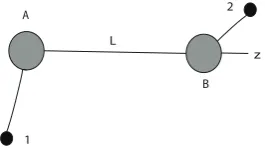
Figure 2. Two ions placed on the distanceLand centers of their electronic clouds.
3
The
condensate
of
ordered
zero-point oscillations of
elec-tron gas
3.1
The interaction of zero-point
oscilla-tions
The principal condition for the superconducting state formation is the ordering of zero-point oscillations. It is realized because the paired electrons obeying Bose-Einstein statistics attract each other.
The origin of this attraction can be explained as fol-lows.
Let two ion A and B be located on the z axis at the distance L from each other. Two collectivized electrons create clouds with centers at points 1 and 2 in the vicin-ity of each ions (Figure2). Let r1 be the radius-vector
of the center of the first electronic cloud relative to the ion A and r2 is the radius-vector of the second electron
relative to the ion B.
Following the Born-Oppenheimer approximation, slowly oscillating ions are assumed fixed. Let the tem-perature be low enough (T → 0), so only zero-point fluctuations of electrons would be taken into considera-tion.
In this case, the Hamiltonian of the system can be written as:
H =H0+H′
H0=− ~
2
4me
( ∇2
1+∇22
) − −4e2
r1 −
4e2
r2
H′= 4Le2 +4re2
12−
4e2
r1B −
4e2
r2A
(2)
Eigenfunctions of the unperturbed Hamiltonian describes two ions
surrounded by electronic clouds without interactions between them. Due to the fact that the distance between the ions is large compared with the size of the electron clouds L ≫ r , the additional term H′
characterizing the interaction can be regarded as a perturbation.
[image:3.595.63.260.56.144.2]H′= 4Le2
{
1 +
[
1 +2(z2−z1)
L + +(x2−x1)2+(y2−y1)2+(z2−z1)2
L2
]−1/2
−
−(1−2z1
L + r2
1
L2 )−1/2
− −(1 +2z2
L + r2
2
L2
)−1/2}
.
(3)
After combining the terms in this expression, we get:
H′ ≈4e
2
L3 (x1x2+y1y2−2z1z2). (4)
This expression describes the interaction of two dipoles
d1andd2, which are formed by fixed ions and electronic
clouds of the corresponding instantaneous configuration. Let us determine the displacements of electrons which lead to an attraction in the system .
Let zero-point fluctuations of the dipole moments formed by ions with their electronic clouds occur with the frequency Ω0, whereas each dipole moment can
be decomposed into three orthogonal projection dx =
ex, dy =eyand dz =ez, and fluctuations of the second clouds are shifted in phase onφx, φy and φz relative to fluctuations of the first.
As can be seen from Eq.(4), the interaction of z-components is advantageous at in-phase zero-point os-cillations of clouds, i.e., whenφz= 2π.
Since the interaction of oscillating electric dipoles is due to the occurrence of oscillating electric field gener-ated by them, the phase shift on 2πmeans that attract-ing dipoles are placed along the z-axis on the wavelength Λ0:
Lz= Λ0=
c
2πΩ0
. (5)
As follows from (4), the attraction of dipoles at the in-teraction of the x and y-component will occur if these oscillations are in antiphase, i.e. if the dipoles are sepa-rated along these axes on the distance equals to half of the wavelength:
Lx,y= Λ0
2 =
c
4πΩ0
. (6)
In this case
H′=−4e2 (
x1x2
L3
x
+y1y2
L3
y
+ 2z1z2
L3
z
)
. (7)
Assuming that the electronic clouds have isotropic oscil-lations with amplitudea0for each axis
x1=x2=y1=y2=z1=z2=a0 (8)
we obtain
H′ = 576π3e
2
c3Ω 3
0a20. (9)
3.2
The zero-point oscillations
ampli-tude
The principal condition for the superconducting state formation, that is the ordering of zero-point oscillations, is realized due to the fact that the paired electrons,
which obey Bose-Einstein statistics, interact with each other.
At they interact, their amplitudes, frequencies and phases of zero-point oscillations become ordered.
Let an electron gas has density ne and its Fermi-energy be EF. Each electron of this gas can be con-sidered as fixed inside a cell with linear dimensionλF:1
λ3F = 1
ne
(10) which corresponds to the de Broglie wavelength:
λF = 2π~
pF
. (11)
Having taken into account (11), the Fermi energy of the electron gas can be written as
EF =
p2F
2me
= 2π2e
2a
B
λ2
F
. (12)
However, a free electron interacts with the ion at its zero-point oscillations. If we consider the ions system as a positive background uniformly spread over the cells, the electron inside one cell has the potential energy:
Ep≃ −
e2 λF
. (13)
As zero-point oscillations of the electron pair are quan-tized by definition, their frequency and amplitude are related
mea20Ω0≃~
2. (14)
Therefore, the kinetic energy of electron undergoing zero-point oscillations in a limited region of space, can be written as:
Ek ≃ ~
2
2mea20
. (15)
In accordance with the virial theorem [10], if a par-ticle executes a finite motion, its potential energy Ep should be associated with its kinetic energyEk through the simple relation |Ep|= 2Ek.
In this regard, we find that the amplitude of the zero-point oscillations of an electron in a cell is:
a0≃
√
2λFaB. (16)
3.3
The condensation temperature
Hence the interaction energy, which unites particles into the condensate of ordered zero-point oscillations
∆0≡H′= 18π3α3
e2a
B
λ2
F
, (17)
1Of course, the electrons are quantum particles and their
whereα=1371 is the fine structure constant.
Comparing this association energy with the Fermi en-ergy (12), we obtain
∆0
EF
= 9πα3≃1.1·10−5. (18) Assuming that the critical temperature below which the possible existence of such condensate is approxi-mately equal
Tc≃ 1 2
∆0
k (19)
(the coefficient approximately equal to 1/2 corresponds to the experimental data, discussed below in the section (4.6)).
After substituting obtained parameters, we have
Tc≃5.5·10−6TF (20)
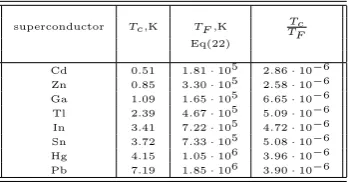
The experimentally measured ratios Tc
TF for I-type
su-perconductorsaregivenin Table(1)andinFig.(3). The straight line on this figure is obtained from Eq.(20), which as seen defines an upper limit of criti-cal temperatures of I-type superconductors.
4
The condensate of zero-point
oscillations and type-I
super-conductors
4.1
The critical temperature of type-I
superconductors
In order to compare the critical temperature of the condensate of zero-point oscillations with measured crit-ical temperatures of superconductors, at first we should make an estimation on the Fermi energies of supercon-ductors. For this we use the experimental data for the Sommerfeld‘s constant through which the Fermi energy can be expressed:
γ=π
2k2n
e 4EF
= 1 2·
(π
3
)2/3(k
~
)2
men1e/3 (21) So on the basis of Eqs.(12) and (21), we get:
kTF(γ) =
p2
F(γ) 2me
≃ (
12
k2
)2(
~2
2me
)3
γ2. (22)
On base of these calculations we obtain possibility to relate directly the critical temperature of a supercon-ductor with the experimentally measurable parameter: with its electronic specific heat.
Taking into account Eq.(20), we have:
∆0≃Θγ2, (23)
where the constant Θ≃31π
2
k [
α~2
kme
]3
≃6.65·10−22K
4cm6
erg . (24)
[image:5.595.298.473.82.173.2]The comparison of the calculated parameters and measured data ([12],[11]) is given in Table (1)-(2) andinFig.(3)and(8).
Table 1. The comparison of the calculated values of
supercon-ductors critical temperatures with measured Fermi temperatures
superconductor Tc,K TF,K Tc TF Eq(22)
[image:5.595.297.491.213.290.2]Cd 0.51 1.81·105 2.86·10−6 Zn 0.85 3.30·105 2.58·10−6 Ga 1.09 1.65·105 6.65·10−6 Tl 2.39 4.67·105 5.09·10−6 In 3.41 7.22·105 4.72·10−6 Sn 3.72 7.33·105 5.08·10−6 Hg 4.15 1.05·106 3.96·10−6 Pb 7.19 1.85·106 3.90·10−6
Table 2. The comparison of the calculated values of
supercon-ductors critical temperatures with measurement data
super- Tc, γ, Tc,K con- (measur) erg
cm3K2 (calc) Tc (calc) Tc(meas) ductors K Eq.(23)
Cd 0.517 532 0.77 1.49 Zn 0.85 718 1.41 1.65 Ga 1.09 508 0.70 0.65 Tl 2.39 855 1.99 0.84 In 3.41 1062 3.08 0.90 Sn 3.72 1070 3.12 0.84 Hg 4.15 1280 4.48 1.07 Pb 7.19 1699 7.88 1.09
4.2
The relation of critical parameters of
type-I superconductors
The phenomenon of condensation of zero-point oscil-lations in the electron gas has its characteristic features. There are several ways of destroying the zero-point oscillations condensate in electron gas:
Firstly, it can be evaporated by heating. In this case, evaporation of the condensate should possess the prop-erties of an order-disorder transition.
Secondly, due to the fact that the oscillating electrons carry electric charge, the condensate can be destroyed by the application of a sufficiently strong magnetic field. For this reason, the critical temperature and critical magnetic field of the condensate will be interconnected. This interconnection should manifest itself through the relationship of the critical temperature and critical field of the superconductors, if superconductivity occurs as result of an ordering of zero-point fluctuations.
Let us assume that at a given temperature T < Tc the system of vibrational levels of conducting electrons consists of only two levels:
[image:5.595.327.493.632.774.2]firstly, basic level which is characterized by an anti-phase oscillations of the electron pairs at the distance Λ0/2, and
Figure 3. The comparison of critical temperaturesTc of type-I
superconductors with their Fermi temperaturesTF. The straight
secondly, an excited level characterized by in-phase oscillation of the pairs.
Let the population of the basic level beN0 particles
and the excited level hasN1particles.
Two electron pairs at an in-phase oscillations have a high energy of interaction and therefore cannot form the condensate. The condensate can be formed only by the particles that make up the difference between the populations of levelsN0−N1. In a dimensionless form,
this difference defines the order parameter: Ψ = N0
N0+N1
− N1
N0+N1
. (25)
In the theory of superconductivity, by definition, the order parameter is determined by the value of the energy gap
Ψ = ∆T/∆0. (26)
When taking a counting of energy from the levelε0, we
obtain ∆T ∆0
= N0−N1
N0+N1 ≃
e2∆T/kT −1
e2∆T/kT + 1 =th(2∆T/kT). (27)
Passing to dimensionless variablesδ≡ ∆T
∆0 ,t≡
kT kTc and
β≡ 2∆0
kTc we have
δ= e βδ/t−1
eβδ/t+ 1 =th(βδ/t). (28)
This equation describes the temperature dependence of the energy gap in the spectrum of zero-point oscillations. It is similar to other equations describing other physi-cal phenomena, that are also characterized by the exis-tence of the temperature dependence of order parame-ters [13],[14]. For example, this dependence is similar to temperature dependencies of the concentration of the su-perfluid component in liquid helium or the spontaneous magnetization of ferromagnetic materials. This equation is the same for all order-disorder transitions (the phase transitions of 2nd-type in the Landau classification).
The solution of this equation, obtained by the itera-tion method, is shown in Fig.(4).
This decision is in a agreement with the known tran-scendental equation of the BCS, which was obtained by the integration of the phonon spectrum, and is in a sat-isfactory agreement with the measurement data.
After numerical integrating we can obtain the averag-ing value of the gap:
⟨∆⟩= ∆0
∫ 1
0
δdt= 0.852 ∆0 . (29)
To convert the condensate into the normal state, we must raise half of its particles into the excited state (ac-cording to Eq.(27), the gap collapses under this condi-tion). To do this, taking into account Eq.(29), the unit volume of condensate should have the energy:
ET ≃ 1
2n0⟨∆0⟩ ≈ 0.85
2
( m
e 2π2α~2
)3/2
∆50/2, (30) On the other hand, we can obtain the normal state of an electrically charged condensate when applying a mag-netic field of critical valueHcwith the density of energy:
EH=
H2
c
[image:6.595.321.542.53.247.2]8π. (31)
Figure 4. The temperature dependence of the value of the gap
[image:6.595.335.509.297.440.2]in the energetic spectrum of zero-point oscillations calculated on Eq.(28).
Figure 5. The comparison of the critical energy densities ET
(Eq.(30)) andEH (Eq.(31)) for the type-I superconductors.
As a result, we acquire the condition: 1
2n0⟨∆0⟩=
H2
c
8π. (32)
This creates a relation of the critical temperature to the critical magnetic field of the zero-point oscillations con-densate of the charged bosons.
The comparison of the critical energy densitiesET and
EH for type-I superconductors are shown in Fig.(5). As shown, the obtained agreement between the energiesET (Eq.(30)) andEH(Eq.(31)) is quite satisfactory for type-I superconductors [11],[12]. A similar comparison for type-II superconductors shows results that differ by a factor two approximately. The reason for this will be considered below. The correction of this calculation, has not apparently made sense here. The purpose of these calculations was to show that the description of super-conductivity as the effect of the condensation of ordered zero-point oscillations is in accordance with the avail-able experimental data. This goal is considered reached in the simple case of type-I superconductors.
4.3
The critical magnetic field of
super-conductors
!
"# $%
& !''#()*+
[image:7.595.64.262.52.236.2]!
Figure 6. The comparison of the calculated energy of
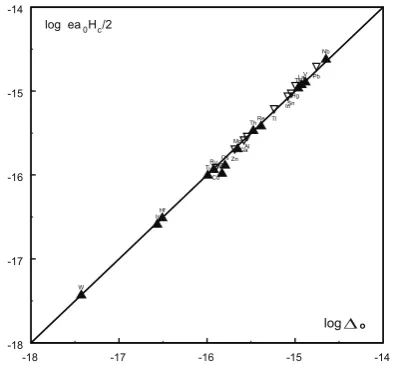
super-conducting pairs in the critical magnetic field with the value of the superconducting gap. Here, the following key applies: filled triangles - type-II superconductors, empty triangles - type-I su-perconductors. On vertical axis - logarithm of the product of the calculated value of the oscillating dipole moment of an electron pair on the critical magnetic field is plotted.On horizontal axis -the value of -the gap is shown.
too weak to disrupt the dipole-dipole interaction of two paired electrons:
µBHc≪kTc. (33)
In order to violate the superconductivity, the ordering of the electron zero-point oscillations must be destroyed. For this the presence of relatively weak magnetic field is required.
At combing of Eqs.(32),(30) and (16), we can express the gap through the critical magnetic field and the mag-nitude of the oscillating dipole moment:
∆0≈
1
2 e a0 Hc. (34)
The properties of the zero-point oscillations of the elec-trons should not be dependent on the characteristics of the mechanism of association and also on the condition of the existence of electron pairs. Therefore, we should expect that this equation would also be valid for type-I superconductors, as well as for II-type superconductors (for II-type superconductorHc=Hc1is the first critical
field)
An agreement with this condition is illustrated on the Fig.(6).
4.4
The density of superconducting
car-riers
Let us consider the process of heating the electron gas in metal. When heating, the electrons from levels slightly below the Fermi-energy are raised to higher lev-els. As a result, the levels closest to the Fermi level, from which at low temperature electrons were forming bosons, become vacant.
At critical temperatureTc, all electrons from the lev-els of energy bands fromEF −∆ to EF move to higher levels (and the gap collapses). At this temperature su-perconductivity is therefore destroyed completely.
This band of energy can be filled byN∆ particles:
N∆= 2
∫ EF
EF−∆
F(E)D(E)dE. (35)
WhereF(E) = 1
eE−τµ+1
is the Fermi-Dirac function and
D(E) is number of states per an unit energy interval, a deuce front of the integral arises from the fact that there are two electron at each energy level.
To find the density of states D(E), one needs to find the difference in energy of the system atT = 0 and finite temperature:
∆E=
∫ ∞
0
F(E)ED(E)dE − ∫ EF
0
ED(E)dE. (36)
For the calculation of the density of states D(E), we must note that two electrons can be placed on each level. Thus, from the expression of the Fermi-energy Eq.(12) we obtain
D(EF) = 1 2 ·
dne
dEF = 3ne
4EF
= 3γ
2k2π2, (37)
where
γ= π
2k2n
e 4EF
=1 2 ·
(π
3
)3/2(k
~
)2
men1e/3 (38)
is the Sommerfeld constant2.
Using similar arguments, we can calculate the number of electrons, which populate the levels in the range from
EF−∆ toEF. For an unit volume of material, Eq.(35) can be rewritten as:
n∆= 2kT·D(EF)
∫ 0
−∆0 kTc
dx
(ex+ 1). (39) By supposing that for superconductors ∆0
kTc = 1.86, as
a result of numerical integration we obtain
∫ 0
−∆0 kTc
dx
(ex+ 1) = [x−ln(e x+ 1)]0
−1.86≈1.22. (40)
Thus, the density of electrons, which throw up above the Fermi level in a metal at temperature T =Tc is
ne(Tc)≈2.44
(
3γ k2π2
)
kTc. (41)
Where the Sommerfeld constantγ is related to the vol-ume unit of the metal.
From Eq.(6) it follows
L0≃
λF
πα (42)
and this forms the ratio of the condensate particle den-sity to the Fermi gas denden-sity:
n0
ne = λ
3
F
L3 0
≃(πα)3≃10−5. (43)
2It should be noted that because on each level two electrons can
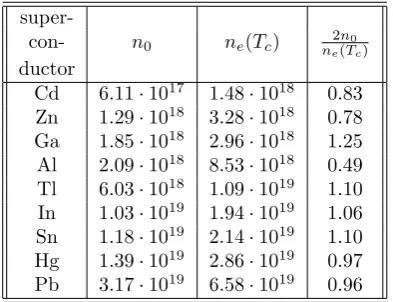
[image:7.595.298.541.300.391.2]Table 3. The comparison of the superconducting carriers density at T = 0 with the density of thermally activated electrons at
T =Tc
super-con- n0 ne(Tc) n2n0
e(Tc)
ductor
Cd 6.11·1017 1.48·1018 0.83 Zn 1.29·1018 3.28·1018 0.78 Ga 1.85·1018 2.96·1018 1.25 Al 2.09·1018 8.53·1018 0.49 Tl 6.03·1018 1.09·1019 1.10
In 1.03·1019 1.94·1019 1.06
Sn 1.18·1019 2.14·1019 1.10
Hg 1.39·1019 2.86·1019 0.97
Pb 3.17·1019 6.58·1019 0.96
When using these equations, we can find a linear dimen-sion of localization for an electron pair:
L0=
Λ0
2 ≃ 1
πα(ne)1/3
. (44)
or, taking into account Eq.(16), we can obtain the rela-tion between the density of particles in the condensate and the value of the energy gap:
∆0≃2π2α
~2
me
n20/3 (45)
or
n0=
1
L3 0
=
( m
e 2π2α~2∆0
)3/2
. (46)
It should be noted that the obtained ratios for the zero-point oscillations condensate (of bose-particles) dif-fer from the corresponding expressions for the bose-condensate of particles, which can be obtained in many courses (see eg [13]). The expressions for the ordered condensate of zero-point oscillations have an additional coefficientαon the right side of Eq.(45).
The de Broglie wavelengths of Fermi electrons ex-pressed through the Sommerfelds constant
λF = 2π~ pF(γ)
≃π
3 ·
k2m
e
~2γ (47)
areshowninTab.3.
In accordance with Eq.(42), which was obtained at the zero-point oscillations consideration, the ratio λF
Λ0 ≃
2.3·10−2.
In connection with this ratio, the calculated ratio of the zero-point oscillations condensate density to the den-sity of fermions in accordance with Eq.(43) should be near to 10−5.
It can be therefore be seen, that calculated estima-tions of the condensate parameters are in satisfactory agreement with experimental data of superconductors. Based on these calculations, it is interesting to com-pare the density of superconducting carriersn0atT = 0,
which is described by Eq.(46), with the density of normal carriersne(Tc), which are evaporated on levels aboveEF atT =Tc and are described by Eq.(41).
Table 4. The ratios λF
Λ0 and n0
ne for type-I superconductors
super- λF, Λ0, λFΛ0 n0 ne=
(
λF Λ0
)3
con- 10−8 cm 10−6 cm -ductor Eq(47) Eq(6)
Cd 3.1 1.18 2.6·10−2 1.8·10−5 Zn 2.3 0.92 2.5·10−2 1.5·10−5 Ga 3.2 0.81 3.9·10−2 6.3·10−5 Tl 1.9 0.55 3.4·10−2 4.3·10−5 In 1.5 0.46 3.2·10−2 3.8·10−5 Sn 1.5 0.44 3.4·10−2 4.3·10−5 Hg 1.3 0.42 3.1·10−2 2.9·10−5 Pb 1.0 0.32 3.1·10−2 2.9·10−5
Figure 7. The comparison of the number of superconducting
carriers atT= 0 with the number of thermally activated electrons atT =Tc.
This comparison is shown in Table (3) and Fig.7. (Data has been taken from the tables [11], [12]).
From the data described above, we can obtain the con-dition of destruction of superconductivity, after heating for superconductors of type-I, as written in the equation:
ne(Tc)≃2n0 (48)
4.5
The sound velocity of the zero-point
oscillations condensate
The wavelength of zero-point oscillations Λ0 in this
model is an analogue of the Pippard coherence length in the BCS. As usually accepted [12], the coherence length
ξ= ~vF
4∆0. The ratio of these lengths, taking into account
Eq.(20), is simply the constant: Λ0
ξ ≈8π
2α2≈ ·10−3. (49)
The attractive forces arising between the dipoles lo-cated at a distance Λ0
2 from each other and vibrating in
opposite phase, create pressure in the system:
P ≃ d∆0
dV ≃
d2 Ω
L6 0
. (50)
In this regard, sound into this condensation should prop-agate with the velocity:
cs≃
√
1 2me
dP dn0
[image:8.595.87.284.91.242.2]Table 5. The value of ratio ∆0/kTcobtained experimentally for
type-I superconductors
superconductor Tc,K ∆0,mev kT∆0
c
Cd 0.51 0.072 1.64
Zn 0.85 0.13 1.77
Ga 1.09 0.169 1.80
Tl 2.39 0.369 1.79
In 3.41 0.541 1.84
Sn 3.72 0.593 1.85
Hg 4.15 0.824 2.29
Pb 7.19 1.38 2.22
After the appropriate substitutions, the speed of sound in the condensate can be expressed through the Fermi velocity of electron gas
cs≃
√
2π2α3v
F ≃10−2vF. (52) The condensate particles moving with velocitycShave the kinetic energy:
2mec2s≃∆0. (53)
Therefore, by either heating the condensate to the crit-ical temperature when each of its volume obtains the energy E ≈ n0∆0, or initiating the current of its
par-ticles with a velocity exceeding cS, can achieve the de-struction of the condensate. (Because the condensate of charged particles oscillations is considered, destroying its coherence can be also obtained at the application of a sufficiently strong magnetic field. See below.)
4.6
The relationship
∆
0/kT
cFrom Eq.(48) and taking into account Eqs.(23),(41) and (46), which were obtained for condensate, we have:
∆0
kTc ≃
1.86. (54)
This estimation of the relationship ∆0/kTc obtained for condensate has a satisfactory agreement with the measured data [11], for type-I superconductors as listed in Table (5).3
5
The estimation of properties of
type-II superconductors
In the case of type-II superconductors the situation is more complicated.
In this case, measurements show that these metals have an electronic specific heat that has an order of value greater than those calculated on the base of free electron gas model.
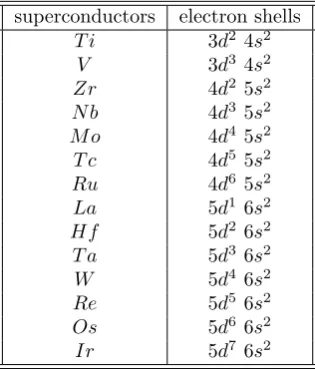
The peculiarity of these metals is associated with the specific structure of their ions. They are transition met-als with unfilled inner d-shell (see Table 6).
[image:9.595.337.495.82.267.2]It can be assumed that the increase in the electronic specific heat of these metals should be associated with a
Table 6. The external electron shells of elementary type-II su-perconductors
superconductors electron shells
T i 3d2 4s2
V 3d3 4s2
Zr 4d2 5s2
N b 4d3 5s2
M o 4d4 5s2
T c 4d5 5s2
Ru 4d6 5s2
La 5d1 6s2
Hf 5d2 6s2
T a 5d3 6s2
W 5d4 6s2
Re 5d5 6s2
Os 5d6 6s2
Ir 5d7 6s2
characteristic interaction of free electrons with the elec-trons of the unfilled d-shell.
Since the heat capacity of the ionic lattice of metals is negligible at low temperatures, only the electronic sub-system is thermally active .
AtT = 0 the superconducting careers populates the energetic level EF −∆0. During the destruction of
su-perconductivity through heating, an each heated career increases its thermal vibration. If the effective velocity of vibration is vt, its kinetic energy:
Ek=
mv2
t
2 ≃∆0 (55)
Only a fraction of the heat energy transferred to the metal is consumed in order to increase the kinetic energy of the electron gas in the transition metals.
Another part of the energy will be spent on the mag-netic interaction of a moving electron.
At contact with the d-shell electron, a freely moving electron induces onto it the magnetic field of the order of value:
H ≈ e
r2
c
v
c. (56)
The magnetic moment of d-electron is approximately equal to the Bohr magneton. Therefore the energy of the magnetic interaction between a moving electron of conductivity and a d-electron is approximately equal to:
Eµ≈
e2
2rc
v
c. (57)
This energy is not connected with the process of destruc-tion of superconductivity.
Whereas, in metals with a filled d-shell (type-I su-perconductors), the whole heating energy increases the kinetic energy of the conductivity electrons and only a small part of the heating energy is spent on it in transi-tion metals:
Ek
Eµ+Ek ≃
mvt
h aB. (58)
So approximately
Ek
Eµ+Ek
≃ aB
L0
. (59)
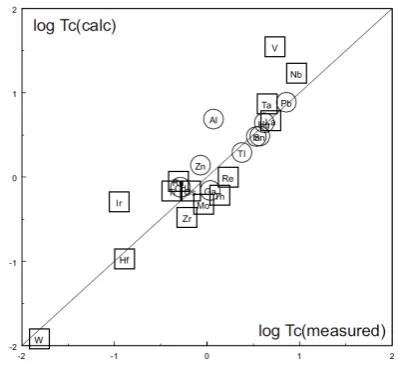
Figure 8. The comparison of the calculated values of critical temperatures of superconductors with measurement data. Circles relate to type-I superconductors, squares show type-II supercon-ductors. On the abscissa, the measured values of critical tem-peratures are plotted, on ordinate, the calculated estimations are plotted. The calculations of critical temperatures for type-I su-perconductors were made by using Eq.(23) and the estimations for type-II superconductors was obtained by using Eq.(60).
Therefore, whereas the dependence of the gap in type-I superconductors from the heat capacity is defined by Eq.(23), it is necessary to take into account the relation Eq.(59) in type-II superconductors for the determination of this gap dependence. As a result of this estimation, we can obtain:
∆0≃Θγ2
( Ek
Eµ+Ek
) ≃Θγ2
( aB
L0
)
1
2, (60) where 1/2 is the fitting parameter.
The comparison of the results of these calculations with the measurement data (Fig.(8)) shows that for the majority of type-II superconductors the estimation Eq.(60) can be considered quite satisfactory.4
6
Alloys and high-temperature
superconductors
In order to understand the mechanism of high tem-perature superconductivity, it is important to establish whether the high-Tc ceramics are the I or II-type su-perconductors, or whether they are a special class of superconductors.
In order to determine this, we need to look at the above established dependence of critical parameters from the electronic specific heat and also consider that 4The lowest critical temperature was measured for Mg. It is
approximately equal to 1mK. Mg-atoms in the metallic state are given two electrons into the electron gas of conductivity. It is confirmed by the fact that the pairing of these electrons, which manifests itself in the measured value of the flux quantum [9], is observed above Tc. It would seem that in view of this metallic
Mg-ion must have electron shell like the Ne-atom. Therefore it is logical to expect that the critical temperature of Mg can be calculated by the formula for I-type superconductors. But actually in order to get the value ofTc≈1mK, the critical temperature of
Mg should be calculated by the formula (60), which is applicable to the description of metals with an unfilled inner shell. This suggests that the ionic core of magnesium metal apparently is not as simple as the completely filled Ne-shell.
!"#
$ %
[image:10.595.345.516.51.222.2]
Figure 9. The comparison of the calculated parameter Θγ2with
the measurement of the critical temperatures of elementary super-conductors and some superconducting compounds.
the specific heat of superconductors I and II-types are differing considerably.
There are some difficulties by determining the answer this way: as we do not precisely know the density of the electron gas in high-temperature superconductors. However, the densities of atoms in metals do not dif-fer too much and we can use Eq.(23) for the solution of the problem of the I- and II-types superconductors distinguishing.
If parameters of type-I superconductors are inserted into this equation, we obtain quite a satisfactory esti-mation of the critical temperature (as was done above, see Fig.8). For the type-II superconductors‘ values, this assessment gives an overestimated value due to the fact that type-II superconductors’ specific heat has aditional term associated with the magnetization of d-electrons.
This analysis therefore, illustrates a possibility where we can divide all superconductors into two groups, as is evident from the Fig.(9).
It is generally assumed that we consider alloysN b3Sn
andV3Sias the type-II superconductors. This
assump-tion seems quite normal because they are placed in close surroundings of Nb. Some excess of the calculated criti-cal temperature over the experimentally measured value for ceramics T a2Ba2Ca2Cu3O10 can be attributed to
the measured heat capacity that may have been created by not only conductive electrons, but also
non-superconducting elements (layers) of ceramics. It is already known that it, as well as ceramicsY Ba2Cu3O7,
belongs to the type-II superconductors. However, ce-ramics (LaSr)2Cu4, Bi-2212 and Tl-2201, according to
this figure should be regarded as type-I superconductors, which is unusual.
7
About the London penetration
depth
7.1
The magnetic energy of a moving
electron
magnetic field. This magnetic energy is composed of energy from a penetrating external magnetic field and magnetic energy of moving electrons.
By using of the standard formulas of electrodynamics [15], let us estimate the ratio of the magnetic and kinetic energy of the electron (the charge ofeand the massme) while moving rectilinearly with a velocityv≪c.
The density of the electromagnetic field momentum is expressed by the equation:
g= 1
4πc[EH] (61)
While moving with a velocity v, the electric charge carrying the electric field with intensityEcreates a mag-netic field
H= 1
c[Ev] (62)
with the density of the electromagnetic field momentum (atv≪c)
g= 1
4πc2[E[vE]] =
1 4πc2
(
vE2−E(v·E)) (63) As a result, the momentum of the electromagnetic field of a moving electron
G=∫VgdV = = 1
4πc2 (
v∫V E2 dV −∫
V EE v cosϑ dV
) (64)
The integrals are taken over the entire space, which is oc-cupied by particle fields, andϑis the angle between the particle velocity and the radius vector of the observation point. By calculating the last integral in the condition of the axial symmetry with respect tov, the contributions from the components of the vectorE, which is perpen-dicular to the velocity, cancel each other for all pairs of elements of the space (if they located diametrically op-posite on the magnetic force line). Therefore, according to Eq.(64), the component of the field which is collinear tov
E cosϑ·v
v (65)
can be taken instead of the vector E. By taking this information into account, going over to the spherical co-ordinates and integrating over angles, we can obtain
G= v
4πc2
∫ ∞
r
[image:11.595.306.499.639.724.2]E2·4πr2 dr (66)
If we limit the integration of the field by the Compton electron radiusrC =m~
ec,
5thenv≪c, we can obtain:
G= v
4πc2
∫ ∞
rC
E2·4πr2 dr= v
c2
e2
rC
. (67)
In this case by taking into account Eq.(62), the magnetic energy of a slowly moving electron pair is equal to:
E =vG 2 =
v2
c2
e2
2rC
=αmev
2
2 . (68)
5Such effects as the pair generation force us to consider the
ra-dius of the ”quantum electron” as approximately equal to Comp-ton radius [16].
7.2
The magnetic energy and the
Lon-don penetration depth
The energy of external magnetic field into volumedv:
E =H
2
8πdv. (69)
At a density of superconducting carriers ns, their mag-netic energy per unit volume in accordance with (68):
EH ≃αns
m2v2
2 =α
mejs2 2nse
, (70)
where js = 2ensvsis the density of a current of super-conducting carriers.
Taking into account the Maxwell equation rotH=4π
c js, (71)
the magnetic energy of moving carriers can be written as
EH≃
e
Λ2
8π(rotH)
2, (72)
where we introduce the notation
e
Λ =
√ α mec
2
4πnse2
=√αΛL. (73)
In this case, part of the free energy of the superconduc-tor connected with the application of a magnetic field is equal to:
FH= 1 8π
∫
V
(
H2+Λe2(rotH)2
)
dv. (74)
At the minimization of the free energy, after some simple transformations we obtain
H+Λe2rotrotH= 0, (75)
thus Λ is the depth of magnetic field penetration intoe the superconductor.
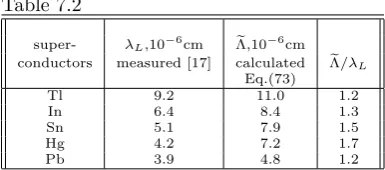
In view of Eq.(46) from Eq.(73) we can estimate the values of London penetration depth (see table (7.2)). The consent of the obtained values with the measure-ment data can be considered quite satisfactory.
Table 7.2
super- λL,10−6cm Λ,10e −6cm
conductors measured [17] calculated eΛ/λL
Eq.(73) Tl 9.2 11.0 1.2 In 6.4 8.4 1.3 Sn 5.1 7.9 1.5 Hg 4.2 7.2 1.7 Pb 3.9 4.8 1.2
8
Three words to experimenters
8.1
Why
a
creation
of
room-temperature
superconductors
are
hardly probably?
The understanding of the mechanism of the supercon-ducting state should open a way towards finding a so-lution to the technological problem. This problem was just a dream in the last century - the dream to fabricate a superconductor that was easily produced (in the sense of ductility) and had high critical temperature.
In order to move towards achieving this goal, it im-portant to firstly understand the mechanism that limits of the critical properties of superconductors.
Let us consider a superconductor with a large limiting current. The length of their localisation determines the limiting momentum of superconducting carriers:
pc≃ 2π~
L0
. (76)
Therefore, by using the Eq.(53), we can compare the critical velocity of superconducting carriers with the sound velocity:
vc =
pc 2me
≃cs (77)
and both these velocities are about a hundred times smaller than the Fermi velocity.
The sound velocity in the crystal lattice of metal vs, in accordance with the Bohm-Staver relation [19], has approximately the same value:
vs≃
kTD
EF
vF ≃10−2vF. (78)
This therefore, makes it possible to consider supercon-ductivity being destroyed as a superconducting carrier overcomes the sound barrier. That is, if they moved without friction at a speed that was less than that of sound, after it gained speed and the speed of sound was surpassed, it then acquire a mechanism of friction.
Therefore, it is conceivable that if the speed of sound in the metal latticevs< cs, then it would create a re-striction on the limiting current in the superconductor. If this is correct, then superconductors with high criti-cal parameters should have not only a high Fermi energy of their electron gas, but also have a high speed of sound in their lattice.
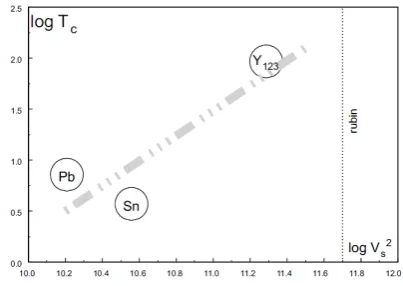
It is in agreement with the fact that ceramics have higher elastic moduli compared to metals and alloys and also poss much higher critical temperatures (Fig.10).
The dependence of the critical temperature on the square of the speed of sound [18] is illustrated in Fig.(10).
This figure, which can be viewed only as a rough esti-mation due to the lack of necessary experimental data, shows that the elastic modulus of ceramics with a crit-ical temperature close to room temperature should be close to the elastic modulus of sapphire, which is very difficult to achieve.
[image:12.595.329.531.54.197.2]In addition, such ceramics would be deprived of yet an other important quality - their adaptability. Indeed,
Figure 10. The schematic representation of the dependence of
critical temperature on the speed of sound in superconductors. On the ordinate, the logarithm of the critical temperature of super-conductor is shown. On the abscissa, the logarithm of the square of the speed of sound is shown (for Sn and Pb - the transverse velocity of sound is shown, because it is smaller. The speed of sound in a film was used for yttrium-123 ceramics. The dashed line shows the value of the transverse velocity of sound in sapphire, as some estimation of the limit of its value. It can be seen that this estimation leads to the restriction on the critical temperature in the range of 0oC - the dot-dashed line.
in order to obtain a thin wire, we require a plastic su-perconductor.
A solution of this problem would be to find a material that possesses an acceptably high critical temperature (above 80K) and also experiences a phase transition at an even higher temperature of heat treatment. It would be possible to make a thin wire from a superconductor near the point of phase transition, as the elastic modules are typically not usually very strong at this stage.
8.2
Magnetic electron pairing
This considered formation of mechanism for the su-perconducting state provides a possibility of obtaining the estimations of the critical parameters of supercon-ductors, which in most cases is in satisfactory agreement with measured data. For some superconductors, this agreement is stronger, and for other, such as Ir, Al, V (see Fig.(8)), it is expedient to carry out further theoret-ical and experimental studies due to causes of deviations. The mechanism of magnetic electron pairing is also of fundamental interest in order to further clarify this.
As was found earlier, in the cylinders made from cer-tain superconducting metals (Al[8] and Mg[9]), the ob-served magnetic flux quantization has exactly the same period aboveTcand that belowTc. The authors of these studies attributed this to the influence of a special ef-fect. It seems more natural to think that the stability of the period is a result of the pairing of electrons due to magnetic dipole-dipole interaction continuing to exist at temperatures above Tc, despite the disappearance of the material’s superconducting properties. At this tem-perature the coherence of the zero-point fluctuations is destroyed, and with it so is the superconductivity.
The pairing of electrons due to dipole-dipole inter-action should be absent in the monovalent metals. In these metals, the conduction electrons are localized in the lattice at very large distances from each other.
of a superconductor, such as Mg, above Tc the quanti-zation period is equal to 2π2e~c. In the same cylinder of a noble metal (such as gold), the sampling period should be twice as large.
8.3
The effect of isotopic substitution on
the condensation of zero-point
oscil-lations
The attention of experimentalists could be attracted to the isotope effect in superconductors, which served as a starting point of the BCS theory. In the ’50s it had been experimentally established that there is a depen-dence of the critical temperature of superconductors due to the mass of the isotope. Because the effect depends on the ion mass, this is considered to be because of the fact that it is based on the vibrational (phonon) process. The isotope effect for a number of I-type supercon-ductors - Zn, Sn, In, Hg, P b - can be described by the relationship: √
MiTc=const, (79)
where Mi - the mass of the isotope, Tc is the critical temperature. The isotope effect in other superconduc-tors can either be described by other dependencies, or is absent altogether.
In recent decades, however, the effects associated with the replacement of isotopes in the metal lattice have been studied in detail. It was shown that the zero-point oscillations of ions in the lattice of many metals are non-harmonical. Therefore, the isotopic substitution can di-rectly affect the lattice parameters, the density of the lattice and the density of the electron gas in the metal, on its Fermi energy and on other properties of the elec-tron subsystem.
The direct study of the effect of isotopic substitution on the lattice parameters of superconducting metals has not been carried out.
The results of measurements made on Ge, Si, dia-mond and light metals, such asLi ([3],[20])(researchers prefer to study crystals, where the isotope effects are large and it is easier to carry out appropriate measure-ments) show that there is square-root dependence of the force constants on the isotope mass, which was required by Eq.(79). The same dependence of the force constants on the mass of the isotope has been found in tin [21].
Unfortunately, no direct experiments of the effect of isotopic substitution on the electronic properties (such as the electronic specific heat and the Fermi energy), on metals of interest to us have so far been conducted.
Let us consider what should be expected in such mea-surements. A convenient choice for the superconductor is mercury, as it has many isotopes and their isotope ef-fect has been carefully measured back in the 50s of the last century as aforementioned.
The linear dependence of the critical temperature of a superconductor on its Fermi energy (Eq.(20)) and also the existence of the isotope effect suggests the depen-dence of the ion density in the crystal lattice from the mass of the isotope. Let us consider what should be expected in such measurements.
Even then, it was found that the isotope effect is de-scribed by Eq.(79) in only a few superconductors. In
others, it displays different values, and therefore in a general case it can be described by introducing of the parametera:
MiaTc=Const. (80)
At taking into account Eq.(20), we can write
Tc∼ EF ∼n2e/3. (81)
The parameter l which characterizes the ion lattice obtains an increment ∆l with an isotope substitution:
∆l
l =−
a 2·
∆Mi
Mi
, (82)
where Mi and ∆Mi are the mass of isotope and its in-crement.
It is generally accepted that in an accordance with the terms of the phonon mechanism, the parameter a ≈ 12 for mercury. However, the analysis of experimental data [1]-[2] (see Fig.(Part I-4)) shows that this parameter is actually closer to 1/3. Accordingly, one can expect that the ratio of the mercury parameters is close to:
(∆l
l
) (
∆Mi
Mi
) ≈ −1
6. (83)
REFERENCES
[1] Maxwell E. : Phys.Rev.,78,p 477(1950). [2] Serin et al : Phys.Rev.B,78,p 813(1950).
[3] Inyushkin A.V. : Chapter 12 in ”Isotops” (Editor Baranov V.Yu), PhysMathLit, 2005 (In Russian). [4] Vasiliev B.V. : Superconductivity as a consequence
of an ordering of the electron gas zero-point oscil-lations, Physica C,471,277-284 (2011)
[5] Vasiliev B.V. : Superconductivity and condensa-tion of ordered zero-point oscillacondensa-tions, Physica C, 471,277-284 (2012)
[6] Vasiliev B.V. : ”Superconductivity, Superfluidity and Zero-Point Oscillations” in ”Recent Advances in Superconductivity Research” , pp.249-280, Nova Publisher,NY(2013)
[7] Bardeen J.: Phys.Rev.,79,p. 167-168(1950). [8] Shablo A.A. et al: Letters JETPh, v.19,
7,p.457-461 (1974)
[9] Sharvin D.Iu. and Sharvin Iu.V.: Letters JETPh, v.34, 5, p.285-288 (1981)
[10] Vasiliev B.V. and Luboshits V.L.:
Physics-Uspekhi,37, 345, (1994)
[11] Pool Ch.P.Jr : Handbook of Superconductivity, Academic Press, (2000)
[13] Landau L.D. and Lifshits E.M.: Statistical Physics, 1, 3rd edition, Oxford:Pergamon, (1980)
[14] Kittel Ch. : Introduction to Solid State Physics, Wiley (2005)
[15] Abragam-Becker : Teorie der Elektizit¨at, Band 1, Leupzig-Berlin, (1932)
[16] Albert Messiah: Quantum Mechanics (Vol. II), North Holland, John Wiley and Sons. (1966) [17] Linton E.A. : Superconductivity, London:
Math-uen and Co.LTDA, NY: John Wiley and Sons Inc., (1964)
[18] Golovashkin A.I. : Preprint PhIAN, 10, Moscou, 2005 (in Russiian).
[19] Ashcroft N.W., Mermin N.D.: Solid state physics, v 2., Holt,Rinehart and Winston, (1976)
[20] Kogan V.S.: Physics-Uspekhi, 78579 (1962) [21] Wang D.T. et al : Phys.Rev.B,56,N 20,p.