warwick.ac.uk/lib-publications
Original citation:
Iglesias, Marco A., Lin, Kui, Lu, Shuai and Stuart, A. M. (2017) Filter based methods for statistical linear inverse problems. Communications in Mathematical Sciences, 15 (7). pp. 1867-1896.
Permanent WRAP URL:
http://wrap.warwick.ac.uk/96049
Copyright and reuse:
The Warwick Research Archive Portal (WRAP) makes this work by researchers of the University of Warwick available open access under the following conditions. Copyright © and all moral rights to the version of the paper presented here belong to the individual author(s) and/or other copyright owners. To the extent reasonable and practicable the material made available in WRAP has been checked for eligibility before being made available.
Copies of full items can be used for personal research or study, educational, or not-for-profit purposes without prior permission or charge. Provided that the authors, title and full
bibliographic details are credited, a hyperlink and/or URL is given for the original metadata page and the content is not changed in any way.
Publisher’s statement:
© 2017 International Press http://dx.doi.org/10.4310/CMS.2017.v15.n7.a4
A note on versions:
The version presented here may differ from the published version or, version of record, if you wish to cite this item you are advised to consult the publisher’s version. Please see the ‘permanent WRAP URL’ above for details on accessing the published version and note that access may require a subscription.
Filter Based Methods For
Statistical Linear Inverse Problems
Marco A. Iglesias
∗Kui Lin
†Shuai Lu
‡Andrew M. Stuart
§December 8, 2015
Abstract
Ill-posed inverse problems are ubiquitous in applications. Under-standing of algorithms for their solution has been greatly enhanced by a deep understanding of the linear inverse problem. In the applied communities ensemble-based filtering methods have recently been used to solve inverse problems by introducing an artificial dynamical sys-tem. This opens up the possibility of using a range of other filtering methods, such as 3DVAR and Kalman based methods, to solve inverse problems, again by introducing an artificial dynamical system. The aim of this paper is to analyze such methods in the context of the ill-posed linear inverse problem.
Statistical linear inverse problems are studied in the sense that the observational noise is assumed to be derived via realization of a Gaussian random variable. We investigate the asymptotic behavior of filter based methods for these inverse problems. Rigorous convergence rates are established for 3DVAR and for the Kalman filters, including minimax rates in some instances. Blowup of 3DVAR and a variant of its basic form is also presented, and optimality of the Kalman filter is discussed. These analyses reveal a close connection between (it-erative) regularization schemes in deterministic inverse problems and
∗School of Mathematical Sciences, University of Nottingham, UK,
†School of Mathematical Sciences, Fudan University, China, [email protected]
‡School of Mathematical Sciences, Fudan University, China, [email protected]
§Mathematics Institute, University of Warwick, UK, [email protected]
filter based methods in data assimilation. Numerical experiments are presented to illustrate the theory.
1
Introduction
In many geophysical applications, in particular in the petroleum industry and in hydrology, distributed parameter estimation problems are often solved by means of iterative ensemble Kalman filters [15]. The basic methodology is to introduce an artificial dynamical system, to supplement this with observa-tions, and to apply the ensemble Kalman filter. The methodology is described in a basic, abstract form, applicable to a general, possibly nonlinear, inverse problem in [9]. In this basic form of the algorithm regularization is present due to dynamical preservation of a subspace spanned by the ensemble dur-ing the iteration. The paper [10] gives further insight into the development of regularization for these ensemble Kalman inversion methods, drawing on links with the Levenberg-Marquardt scheme [7]. In this paper our aim is to further the study of filters for the solution of inverse problems, going beyond the ensemble Kalman filter to encompass the study of other filters such as 3DVAR and the Kalman filter itself – see [13] for an overview of these filter-ing methods. A key issue will be the implementation of regularization with the aim of deriving optimal error estimates.
We focus on the linear inverse problem
y=Au†+η, (1)
where A is a compact operator acting between Hilbert spaces X and Y. The exact solution is denoted by u† ∈ X and η is a noise polluting the observations. We will consider two situations: Data Model1 where multiple observations are made in the form 1; and Data Model 2 where a single observation is made. For modelling purposes we will assume that the noise η
is generated by the GaussianN(0, γ2I), independently in the case of multiple
observations. In each case we create a sequence {yn}n≥0; for Data Model 1
the elements of this sequence are i.i.d. N(Au†, γ2I) whilst for Data Model
2 they are yn ≡ y, with y a single draw from N(Au†, γ2I). The case where
considering multiple instances with correlated observational noise, by means of similar filtering-based techniques.
The artificial, partially observed linear dynamical system that underlies our methodology is as follows:
un=un−1,
yn=Aun+ηn.
(2)
In deriving the filters we apply to this dynamical system, it is assumed that the {ηn}n≥0 are i.i.d. from N(0, γ2I). Note, however, that whilst the data
sequence {yn}n≥0 we use in Data Model 1 is of this form, the assumption is
not compatible with Data Model 2; thus for Data Model 2 we have a form of model error ormodel mis-specification [13].
By studying the application of filtering methods to the solution of the linear inverse problem our aim is to open up the possibility of employing the filtering methodology to (static) inverse problems of the form 1, and nonlinear generalizations. We confine our analysis to the linear setting as experience has shown that a deep understanding of this case is helpful both because there are many linear inverse problems which arise in applications, and because knowledge of the linear case guide methodologies for the more general nonlinear problem [6]. The last few decades have seen a comprehen-sive development of the theory of linear inverse problems, both classically and statistically – see [2, 6] and the references therein. Consider the Tikhonov-Phillips regularization method
argminu 1
2γ2ky−Auk 2
Y +
α
2ku−u0k
2
E
.
This can be reformulated from a probabilistic perspective as the MAP esti-mator for Bayesian inversion given a Gaussian smoothness prior, with mean
u0 and Cameron-Martin space E compactly embedded into X, and a
Gaus-sian noise model as defined above; this connection is eludicated in [11, 5]. We note that from the point of view of Tikhonov-Phillips regularization only the parameter αγ2 is relevant, but that each of α andγ have separate
The recent paper [9] opens up the prospect for a statistical explanation of iterative regularization methods in the form of
un=un−1+Kn(y−Aun−1)
with a general Kalman gain operatorKn. In this paper, we establish the
con-nection between iterative regularization methods (c.f. [6,8]) and filter based methods [13] with respect to an artificial dynamic system. More precisely, for a linear inverse problem, we verify that the iterative Tikhonov regularization method
un=un−1+A∗(AA∗+αI)−1(y−Aun−1) (3)
is closely related to filtering methods such as 3DVAR and the Kalman fil-ter when applied to the partially observed linear dynamical system 2. The similarity between both schemes provides a probabilistic interpretation of iterative regularization methods, and allows the possibility of quantifying uncertainty via the variance. On the other hand, we will employ techniques from the convergence analysis arising in regularization theories [6] to shed light on the convergence of filter based methods, especially when the linear observation operator is ill-posed.
The paper is organized as follows. We first introduce filter based methods for the artificial dynamics 2 in Section 2. Section 3 describes some general useful formulae which are relevant to all the filters we study, and lists our main assumptions on the inverse problem of interest. In Sections 4 and 5
respectively, detailed asymptotic analyses are given for the Kalman filter method and 3DVAR, for both data models. The final Section 6 presents numerical illustrations confirming the theoretical predictions.
2
Filters For The Artificial Dynamics
2.1
Filter Definitions
Recall the artificial dynamics (2), where the observation operator A also defines the inverse problem (1), and {ηn}n≥0 is an i.i.d. sequence with η1 ∼ N(0, γ2I). The aim of filters is to estimate u
n given the data {yj}nj=1. In
particular, probabilistic filtering aims to estimate the probability distribution of the conditional random variable un|{yj}nj=1.
If we assume that u0 ∼ N(m0, C0) then the desired conditional random
assumed Gaussian structure of the noise sequence{ηn}n≥0. Furthermore the
independence of the elements of the noise sequence means that the Gaussian can be updated sequentially in a Markovian fashion. If we denote by mn the
mean, and by Cn the covariance, then we obtain the Kalman filter updates
for these two quantities:
Kn = Cn−1A
∗
ACn−1A∗+γ2I−1 (4a)
mn = mn−1+Kn(yn−Amn−1) (4b)
Cn = (I −KnA)Cn−1. (4c)
The operatorKn is known as theKalman gain and the inverse of the
covari-ance, the precision operator Cn−1, may be shown to satisfy
Cn−1 =Cn−−11+ 1
γ2A
∗
A. (5)
All of these facts concerning the Kalman filter may be found in Chapter 4 of [13]. Expression (5) requires careful justification in infinite dimensions, and this is provided in [1] in certain settings. However we will only use (5) as a quick method for deriving useful formulae, not expressed in terms of precision operators, which can be justified directly under the assumptions we make.
A simplification of the Kalman filter method is the 3DVAR algorithm [13] which is not, strictly speaking, a probabilistic filter because it does not attempt to accurately track covariance information. Instead the covariance is fixed in time at
Cn−1 =
γ2
αΣ0 (6)
for some fixed positive and self-adjoint operator Σ0. The parameter α is a
scaling constant the inverse of which measures the relative size of the fixed co-variance of the filter relative to that of the data. Imposing this simplification on equations (4a), (4b) gives
Kn ≡ K:= Σ0A∗(AΣ0A∗+αI)
−1
(7a)
ζn = ζn−1+K(yn−Aζn−1). (7b)
It is also helpful to define, from (4c),
C ≡ γ 2
Notice [6,14] that the iteration (7b) looks like a stationary iterative Tikhonov
method (3) withA replaced by AΣ
1 2
0.
Throughout the paper (Kn, mn, Cn) stands for Kalman gain, updated
mean and updated covariance for the Kalman filter method and (K, ζn,C) is
the related sequence of quantities for 3DVAR.
2.2
Asymptotic Behaviour of Filters
We will view the filters as methods for reconstructing the truth u†; in par-ticular we will study the proximity of mn (for the Kalman filter) and ζn (for
3DVAR) to u† for various large n asymptotics. Although the assumption in the derivation of the filters is that yn is an i.i.d. sequence of the form
N(Au†, γ2I), we will not always assume that the data available is of this form; to be precise Data Model 1 is compatible with this assumption whilst Data Model 2 is not.
Recall that Data Model 1 refers to the situation where the data used in the Kalman and 3DVAR filters has the form yn =Au†+ηn, where theηn are
i.i.d. N(0, γ2I). Given such a data sequence we can generate an auxiliary
element
¯
y= 1
n
n
X
j=1
yj =Au†+
1
n
n
X
j=1
ηj
with ¯η = n1 Pn
j=1ηj and ¯η∼ N(0,
γ2
√
nI). The law of large numbers and central
limit theorem thus allows us to consider an inverse problem of the form (1) with noise level reduced by a factor of √n. We will study, in the sequel, whether the Kalman or 3DVAR filters are able to automatically exploit the decreased uncertainty inherent in an i.i.d. data set of this form.
For Data Model 2 we simply assume that the data used in the filters is of the form yn ≡ y where y is given by (1) with η ∼ N(0, γ2I). From
the discussion in the preceding paragraph, we clearly expect less accurate reconstruction in this case. For this data model we may view 3DVAR as a stationary iterative Tikhonov regularization, whilst the Kalman filter is an alternative iterative non-stationary regularization scheme, since Kn is
This uncertainty quantification perspective provides additional motivation for the filtering approaches considered herein.
In this paper our primary focus is the asymptotic largen behavior of the Kalman filter method and 3DVAR. More precisely, we are interested in the accurate recovery of the true state u† when the noise variance vanishes, i.e.
γ2 →0 for Data Models 1 and 2, or as n → ∞for Data Model 1 (by the law of large numbers/central limit theorem discussion above).
To highlight the difficulties inherent in ill-posed inverse problems in this regard, we note the following which is a straightforward consequence of The-orem 4.10 in [13] when specialized to linear problems. Here, and in what follows, k · k denotes both the norm on X and the operator norm from X
into itself.
Proposition 2.1. Consider the 3DVAR algorithm with {yn}n≥1. Assume
that there exists a constantLsuch thatkI−KAk ≤L <1and thatkKk<∞.
Then, for Data Model 2, it yields
lim sup
n→∞
kζn−u†k ≤
kKkkηk
1−L .
Note however, that if the observation operatorA is compact or the inversion is ill-posed, the assumption L <1 in the preceding proposition cannot hold. More precisely, the operator I− KA is no longer contractive since the spec-trum of the operator KA clusters at the origin. Our focus in the remainder of the paper will be on such ill-posed inverse problems.
3
Main Assumptions and General Properties
of Filters
3.1
Assumptions
Recall that k · k denotes both the norm on X and the operator norm from
X into itself. Throughout C will denote a generic constant, independent of the key limiting quantities γ and n. Our main assumption is:
Assumption 1. For both the Kalman filter and the 3DVAR filter, we assume
(i) the variance C0 = γ
2
αΣ0 and R(Σ
1/2
(ii) the forward operator A satisfies
C−1kΣ
a 2
0xk ≤ kAxk ≤CkΣ
a 2
0xk (9)
on X for some constants a >0 and 1≤C < ∞;
(iii) the initial mean satisfies m0 −u† ∈ D
Σ−
s 2
0
(or ζ0−u† ∈ D
Σ−
s 2
0
) with 0≤s≤a+ 2;
(iv) the operator Σ0 in item (i) is trace class on X.
We briefly comment on these items. Item (i) allows a well defined operator
B0 :=AΣ
1/2
0 (10)
which is essential in carrying out our analysis. Item (ii) is often called the
link condition and it connects both operators A and Σ0 (or C0). The third
item (iii) is the source condition (regularity) of the true solution [6]. The final item (iv) makes C0 a well-defined covariance operator on X [3].
Item (ii) in the preceding assumption is automatically satisfied ifA∗Aand Σ0 have the same eigenfunctions and certain decaying singular values. Item
(iii) can then be expressed in this eigenbasis. When studying the Kalman filter we will, in some instances, employ the following specific form of items (ii), (iii). Comparison of Assumptions1and2we see that they are identical if a = 1+22p and s= 1+22β.
Assumption 2. Let the variance C0 = γ
2
αΣ0. The operators Σ0 and A
∗A
have the same eigenfunctions {ei} with their eigenvalues {λi} and {κ2i}
sat-isfying
λi =i−1−2, C−1i−p ≤κi ≤Ci−p
for some >0, p > 0and C ≥1. Furthermore, by choosing the initial mean
m0 = 0, the true solution u† with its coordinates{u†,i} in the basis{ei}obeys
P∞
i=1(u
†,i)2i2β <∞.
3.2
Filter Properties
We start by deriving properties of the Kalman filter method under Data Model 1. Other cases can be simply derived from minor variants of this setting. Recall from (4b)
and note that
u†= (I−KnA)u†+KnAu†.
Under Data Model 1 we have yn = Au† + ηn and hence the total error
en :=mn−u† satisfies
en = (I −KnA)en−1+Knηn
=
n
Y
j=1
(I−KjA)e0+
n−1
X
j=1
n−1
Y
i=n−j
(I−Ki+1A)
!
Kn−jηn−j +Knηn (11)
:=J1+J2.
Here
J1 =
n
Y
j=1
(I−KjA)e0 and
J2 =
n−1
X
j=1
n−1
Y
i=n−j
(I−Ki+1A)
!
Kn−jηn−j+Knηn.
To establish a rigorous convergence analysis, the mean squared error (MSE) Ekmn−u†k2 is of particular interest. Since u† is deterministic and
eachηnis i.i.d Gaussian we obtain a bias-variance decomposition of the MSE:
Ekmn−u†k2 =kJ1k2+EkJ2k2. (12)
To proceed further, both termsJ1 andJ2need to be calibrated more carefully.
We consider the operatorI−KnAwhich appears in both terms. By (4c),
we obtain
Cn = (I−KnA)Cn−1 =
n
Y
j=1
(I −KjA)C0,
which is equivalent to
n
Y
j=1
(I−KjA) = CnC0−1. (13)
Notice that (5) yields
Cn−1 =Cn−−11+ 1
γ2A
∗
A=C0−1+ n
γ2A
∗
By (13) and (14) we obtain
n
Y
j=1
(I−KjA) =CnC0−1 = (C
−1 0 +nA
∗A/γ2)−1C−1 0
=C 1 2
0γ2(γ2I+nC
1 2
0A
∗
AC 1 2
0)
−1C−12
0 . (15)
We will use this expression (which is well-defined in view of Assumption 1
(i)) and the labelled equations preceding it in this subsection, frequently in what follows.
4
Asymptotic Analysis of the Kalman Filter
In this section we investigate the asymptotic behaviour of the Kalman filter (4a)-(4c), under Assumption1. In particular, we are interested in whether we can reproduce the minimax convergence rate. This minimax rate is achieved by adopting Assumption 1 in the diagonal form of Assumption2.
4.1
Kalman Filter and Data Model
1
We present the main results in current subsection.
Theorem 1. Let Assumption 1 hold. Then the Kalman filter method
(4a)-(4c) yields a bias-variance decomposition of the MSE
Ekmn−u†k2 ≤C
α
n
a+1s
+ γ
2
αtr(Σ0)
for the Data Model 1. Setting α = Ns+as+1 and stopping the iteration when n =N then gives
EkmN −u†k2 ≤ C+γ2tr(Σ0)
N−s+sa+1. (16)
Theorem 2. Let Assumption 2 hold. Then the Kalman filter method
(4a)-(4c) yields a bias-variance decomposition of the MSE
Ekmn−u†k2 ≤C
α
n
1+22β+2p
+γ2n−1+22+2pα−
1+2p
for the Data Model 1. Setting α=N1+22(β−β+2)p and stopping the iteration when n =N then gives the following minimax convergence rate:
EkmN −u†k2 ≤CN
− 2β
1+2β+2p.
Remark 4.1. • (i) Under the Assumption2we prove unconditional
con-vergence of the Kalman filter method for any fixed α > 0 and γ > 0, noticing that both the bias and variance vanish when n goes to infinity. The key ingredient which leads to this unconditional convergence, in comparison with Assumption 1, is that the rate of decay of the eigen-values of the variance operator Σ0 is made explicit under Assumption 2; this is to be contrasted with the weaker assumptiontr(Σ0)<∞made in Assumption 1 (iv).
• (ii) By choosing α depending on the update step N, again with fixed
γ, both Theorems 1 and 2 yield convergence rates in the MSE sense. Indeed in the second case, where we use Assumption 2, the minimax rate of N−1+22ββ+2p is achieved. This minimax rate may also be achieved
from the Bayesian posterior distribution with appropriate tuning of the prior in terms of the (effective) noise size √N [12]; the tuning of the prior is identical to the tuning of the initial condition for the covariance
C0, via choice of α. ♦
Proof of Theorems1and 2is straightforward by means of a bias-variance decomposition. Let Assumption 1 (i) hold, noting that then B0 :=AΣ
1/2 0 is
well-defined. We thus obtain, by (15),
n
Y
i=1
(I−KiA) = Σ
1 2
0α(αI +nB
∗
0B0)−1Σ
−12
0 = Σ
1 2
0r1,αn(B∗0B0)Σ
−12
0 , (17)
where
r1,αn(λ) :=
α n α n +λ
= α
α+nλ. (18)
The operator-valued function r1,αn (18) has been verified to be powerful in
the convergence analysis of deterministic regularization schemes – see [14, Ch.2]. In that context the following inequality is useful:
|λtr1,α
n(λ)| ≤
α
n
t
Following these ideas we obtain the next two lemmas describing the bias and variance error bounds. We leave the proofs of both lemmas to the Ap-pendix. Theorems 1 and 2 are consequences, by choosing the parameter α
appropriately.
Lemma 1 (Bias for Kalman filter). Let Assumption 1 (i)-(iii) hold. Then
the Kalman filter method (4a)-(4c) yields
kJ1k2 ≤C
α
n
a+1s
.
Furthermore, if Assumption 2 is valid, the bias obeys
kJ1k2 ≤C
α
n
1+22β+2p
.
Lemma 2 (Variance for Kalman filter – Data Model 1). Let Assumption 1
(i), (iv) hold and{ηn} in (2) be an i.i.d sequence with η1 ∼ N(0, γ2I). Then the Kalman filter method (4a)-(4c) yields
EkJ2k2 ≤
γ2
αtr(Σ0).
Furthermore, if Assumption 2 is valid, the variance obeys
EkJ2k2 ≤γ2n
− 2
1+2+2pα−
1+2p
1+2+2p.
4.2
Kalman Filter and Data Model
2
The key difference between Data Model 2 and Data Model 1 is that, in the case 2, the noisesηnappearing in the expression for the termJ2 are identical,
rather than i.i.d. mean zero as in case 1. This results in a reduced rate of convergence in case 2 over case 1, as seen in the following two theorems:
Theorem 3. Let Assumption 1 hold. Then the Kalman filter method
(4a)-(4c) yields a bias-variance decomposition of the MSE
Ekmn−u†k2 ≤C
α
n
a+1s
+nγ
2
α tr(Σ0)
for the Data Model 2. Fix α = 1 and assume that the noise variance γ2 =
N−a+a+1s+1. If the iteration is stopped at n=N then the following convergence
rate is valid:
EkmN −u†k2 ≤(C+ tr(Σ0))N−
s
Theorem 4. Let Assumption 2 hold. Then the Kalman filter method (4a)-(4c) yields a bias-variance decomposition of the MSE
Ekmn−u†k2 ≤C
α
n
1+22β+2p
+γ2n α
1+21+2+2pp
for the Data Model 2. Fix α = 1 and assume that the noise variance γ2 =
N−1+21+2β+2+2pp.If the iteration is stopped atn=N then the following convergence
rate is valid:
EkmN −u†k2 ≤CN
− 2β
1+2+2p.
Both convergence rates in Theorems3 and 4 are of the same order since the variance has been tuned to scale in the same way as the bias by choosing to stop the iteration atN, depending onγ 1, appropriately. In comparison with the convergence rates in Theorems1and2, the ones in this section under Data Model 2 require small noise γ; those in the preceding subsection do not because multiple observations, with additive independent noise, are made of
Au†.Proof of the two preceding theorems is straightforward: the J1 terms is
analyzed as in the preceding subsection and the J2 term must be carefully
analyzed under the assumptions of Data Model 2. The key new result is stated in the following lemma, whose proof may be found in the Appendix.
Lemma 3 (Variance for Kalman filter method – Data Model 2). Let
As-sumption 1 hold and each observation yn ≡ y be fixed. Then the Kalman
filter method (4a)-(4c) yields
EkJ2k2 ≤
nγ2
α tr(Σ0).
Furthermore, if Assumption 2 is valid, the variance obeys
EkJ2k2 ≤γ2
n
α
1+21+2+2pp .
5
Asymptotic Analysis of 3DVAR
5.1
Classical 3DVAR
The mean of the 3DVAR algorithm is given by (7b) and has the form
Furthermore
u†= (I − KA)u†+KAu†.
If we define εn=ζn−u† then we obtain, sinceyn=Au†+ηn,
εn= (I− KA)εn−1+Kηn
= (I− KA)nε0+
n−1
X
j=0
(I− KA)jKηn−j
with ε0 :=ζ0−u†. We further derive
(I− KA)n= Σ
1 2
0(α(αI +B
∗
0B0)−1)nΣ
−1 2
0 = Σ
1 2
0rn,α(B0∗B0)Σ
−1 2
0 ,
by inserting the definition of the Kalman gain (7a), and by assuming As-sumption 1 (i). The operator-valued function rn,α(·) is defined
rn,α(λ) :=
α
α+λ
n
.
Similarly to the analysis of the Kalman filter, we derive
εn= (I − KA)nε0+
n−1
X
j=0
(I− KA)jKηn−j (21)
= Σ
1 2
0rn,α(B0∗B0)Σ
−1 2
0 ε0+
n−1
X
j=0
(I− KA)jKηn−j
:=I1+I2.
Thus, the MSE takes the bias-variance decomposition form
Ekζn−u†k2 =Ekεnk2 =kI1k2+EkI2k2.
This leads to the following two theorems:
Theorem 5. Let Assumption 1 hold. Then 3DVAR filter (7a)-(7b) yields a
bias-variance decomposition of the MSE
Ekζn−u†k2 ≤C
α
n
a+1s
+Cγ
2lnn
α tr(Σ0)
for the Data Model 1. Setting α = Ns+as+1 and stopping the iteration when n =N then gives
Ekζn−u†k2 ≤C 1 +γ2tr(Σ0)
Theorem 6. Let Assumption 2 hold. Then 3DVAR filter (7a)-(7b) yields a bias-variance decomposition of the MSE
Ekζn−u†k2 ≤C
α
n
1+22β+2p
+Cγ2α−1+21+2+2pp
for the Data Model 1. Setting α = N1+2+22ββ+2p and stopping the iteration
when n =N then gives
EkζN −u†k2 ≤C 1 +γ2
N−1+2+22ββ+2plnN.
Remark 5.1. The decay rate at the end of the preceding Theorem is the
same as that in Theorem 5 if a = 1+22p and s = 1+22β. This is the setting in which Assumptions 1 and 2 are identical.
The preceding two theorems show that, under Data Model 1 and for any fixed α, the (bound on the) MSE of the 3DVAR filter blows up logarithmically as n → ∞ under Assumption 1, and is asymptotically bounded for Assump-tion 2. In contrast, for the Kalman filter method the MSE is asymptotically bounded or unconditionally converges in n under the same assumptions – see Theorems 1 and 2.
With optimal choice of α in terms of the stopping time of the iteration at n = N, comparison of the convergence rates in Theorems 1 and 5 (or Theorems 2 and 6) shows that the Kalman filter outperforms 3DVAR, but only by a logarithmic factor (or a H¨older factor). For simplicity we only analyze and discuss Data Model 1 for 3DVAR filter under the additional Assumption 2; as for Data Model 2 one can derive consequences similar to those in the preceding section in an analogous manner. ♦
We now study Data Model 2 and 3DVAR. We consider only Assumption
1; however the reader may readily extend the analysis to include Assumption
2. In the case of Data Model 2, both the Kalman and 3DVAR filters have the same error bounds:
Theorem 7. Let Assumption 1 hold. Then the 3DVAR algorithm (7a)-(7b)
yields a bias-variance decomposition of the MSE
Ekζn−u†k2 ≤C
α
n
a+1s
+nγ
2
for the Data Model 2. Fix α = 1 and assume that the noise variance γ2 =
N−a+a+1s+1. If the iteration is stopped at n=N then the following convergence
rate is valid:
Ekζn−u†k2 ≤(C+ tr(Σ0))N−
s
a+1. (23)
The preceding three theorems can be proved by the bias-variance decom-position and application of the following three lemmas, whose proofs are left to the Appendix. However the proof of Theorem 6 is not as straightforward as the others and we present details in the Appendix.
Lemma 4 (Bias for 3DVAR). Let Assumption1(i)-(iii)hold. Then 3DVAR
(7) yields
kI1k2 ≤C
α
n
a+1s
.
Furthermore, if Assumption 2 is valid, the bias obeys
kI1k2 ≤C
α
n
1+22β+2p
.
Lemma 5 (Variance for 3DVAR - Data Model 1). Let Assumption 1(i),(iv)
hold and each noise ηn in (2) i.i.d. generated by N(0, γ2I). Then 3DVAR
(7) yields
EkI2k2 ≤C
γ2lnn
α tr(Σ0)
for Data Model 1. Furthermore, if Assumption 2 is valid, the variance obeys
EkI2k2 ≤Cγ2α
− 1+2p
1+2+2p
and simultaneously
EkI2k2 ≤C
γ2lnn
α .
Lemma 6 (Variance for 3DVAR - Data Model 2). Let Assumption 1 hold
and each observation yn ≡y be fixed. Then 3DVAR (7) yields
EkI2k2 ≤
nγ2
α tr(Σ0)
5.2
Variant of 3DVAR for Data Model
1
Recall that the 3DVAR iteration (7b) looks like a stationary iterative Tikhonov
method (3) [6, 14], with A replaced by AΣ
1 2
0 and with a fixed parameter α.
The non-stationary iterative Tikhonov regularization, with varying α, has been proven to be powerful in deterministic inverse problems [8]. We gen-eralize this method to the 3DVAR setting. Furthermore we demonstrate that, for Data Model 1, it is possible to see blow-up phenomena with this algorithm.
Starting from the classical form of the 3DVAR filter as given in (7a), (7b), (8) we propose a variant method in which α varies with n. We obtain
Kn := Σ0A∗(AΣ0A∗+αnI)
−1
(24a)
vn := vn−1+Kn(yn−Avn−1) (24b)
Cn := γ
2
αn
(I− KnA)Σ0. (24c)
If we definen =vn−u†then we obtain, analogously to the derivation of
(11) and (21), the bias-variance decomposition as follows:
n = (I− KnA)n−1+Knηn
=
n
Y
j=1
(I− KjA)0+
n−1
X
j=1
n−1
Y
i=n−j
(I− Ki+1A)
!
Kn−jηn−j+Knηn
:=I1+I2
with
0 =v0−u†;
I1 =
n
Y
j=1
(I− KjA)0;
I2 =
n−1
X
j=1
n−1
Y
i=n−j
(I − Ki+1A)
!
Kn−jηn−j+Knηn.
By calibrating both termsI1, I2 carefully, we obtain the following
Theorem 8. Let Assumption 1 hold and let αn be a sequence satisfying
1
αn ≤ ˜cσn−1, with constant ˜c, for σn :=
Pn
j=1 1
αj. Then the variant EnKF
method (24a)-(24c) yields a bias-variance decomposition of the MSE
Ekvn−u†k2 ≤C
σ−
s
a+1
n +γ2tr(Σ0)σn
for Data Model 1. In particular, the geometric sequence αn := αqn−1 with
α >0 and 0< q <1 yields
Ekvn−u†k2 ≤C
qa+1s n+γ2tr(Σ0)q−n
.
6
Numerical Illustrations
In this section we provide numerical results which display the capabilities of 3DVAR and Kalman filter for solving linear inverse problems of the type described in Section 1. In addition, we verify numerically some of the theo-retical results from Section 4and Section 5.
6.1
Set-Up
We consider the two-dimensional domain Ω = [0,1]2and define the operators
A= (−4)−1, Σ0 =A2 (25)
with
D(4) = nv ∈H2(Ω) | ∇v ·n= 0 on∂Ω, Z
Ω
v = 0o.
With this domain −4 is positive, self-adjoint and invertible.Note that (9) from Assumption 1 is satisfied with a = 1 and C = 1. In the following sub-sections we produce synthetic data from a true function u† that we generate as a two-dimensional random field drawn from the Gaussian measureN(0,Σ) with covariance
Σ = −4+ 1 10I
−(2s+1)
(26)
length into the true function. Furthermore, for simplicity we considerm0 = 0
and note [5] that the given selection of u† yieldsu† ∈ Ht for all 0< t <2s.
Therefore, for discussion of the present experiments we simply assume that
u†−m0 ∈ D(Σ
−s/2
0 ) = H2s. Consequently, in order to satisfy Assumption 1
(iii) we need s such that 0 < s ≤ a+ 2 = 3. Note that operator Σ0 in (25)
satisfies Assumption 1 (iv).
The numerical generation ofu† is carried out by means of the Karhunen-Loeve decomposition ofu†in terms of the eigenfunctions of Σ which, from the definition of D(Σ), are cosine functions. We recall that for the application of the Kalman Filter and 3DVAR with Data Model 1 we need to generate
N instances of synthetic data {yn}Nn=1 where N is the maximum number of
iterations of the scheme. Below we discuss the selection of such N. The aforementioned synthetic data are generated by means of yn ≡ Au† +ηn
with ηn ∼ N(0, γ2I) and γ specified below. For Data Model 2 we produce
synthetic data simply by setting yn ≡ y = Au†+η with η ∼ N(0, γ2I). In
order to avoid inverse crimes [11], all synthetic data used in our experiments are generated on a finer grid (120×120 cells) than the one (of 60×60 cells) used for the inversion. We use splines to interpolate synthetic data on the coarser grid that we use for the application of the filters.
For both 3DVAR and Kalman filter with Data Model 1, we fix the number of iterationsN for the scheme and consider the selectionα=Ns+1+s a stated in
Theorem1and Theorem5. Provided that the filters are stopped according to
n =N, these theorems ensure the convergence rates in (16) and (22) that we verify numerically in the following subsection. For Data Model 2, Theorem
3 and Theorem 7 suggest that convergence rates (20) and (23) are satisfied for α = 1 and provided that γ2 = N−a+a+1s+1
. The latter equality provides an expression for the number of iterations N = N(γ) that we may use as stopping criteria for these filtering algorithms applied to Data Model 2. In Algorithm 1 we summarize the Kalman filter and 3DVAR schemes applied to both data models.
Algorithm 1. Kalman Filter/3DVAR (Data Model 1/Data Model2)
Let
N =
(
fix integer selected a priori for Data Model 1
and
α=
Ns+1+s a for Data Model1
1 for Data Model2
For n= 1, . . . , N, update mn−1 and Cn−1 as follows
mn = mn−1+Kn(yn−Amn−1)
Cn =
(I−KnA)Cn−1, for Kalman Filter
Cn−1, for 3DVAR
where
Kn=Cn−1A
∗
ACn−1A∗+γ2I−1.
and where we recall that
yn =
Au†+ηn for Data Model 1
y for Data Model 2
Note that for Data Model1we need at least N independent instances of data.
6.2
Using Kalman Filter and 3DVAR for solving linear
inverse problems
In this subsection we demonstrate how the filters under consideration in the iterative framework described in Algorithm 1 can be used, with Data Model 1 and Data Model 2, to solve the linear inverse problem presented in Section
1. Let us consider the truth u† displayed in Figure 1 (top) generated, as described in subsection 6.1, from a Gaussian measure with covariance (26) and s = 1. Synthetic data are generated as described above with three different choices of γ that yield noise levels of approximately 1%, 2.5%, and 5% of the norm of the noise free data (i.e. Au†).
iterations. In the left column of Figure 2 we display the plots of the error w.r.t the truth of the estimator mn as a function of the iterations, i.e.
E(mn)≡ kmn− Pu†k
where Pu† denotes the interpolation of u† on the coarse grid used for the inversion. Note that the error w.r.t. the truth of the estimates produced by both schemes decreases monotonically. Interestingly, the value at the final iteration displayed in these figures is approximately the same for all these experiments independently of the noise level. Moreover, the stability of the scheme does not seem to depend on the early termination of the scheme. In addition, we note that both Kalman filter and 3DVAR exhibit very similar performance in terms of reducing the error w.r.t the truth. However, for larger noise levels we observe small fluctuations in the error obtained with 3DVAR.
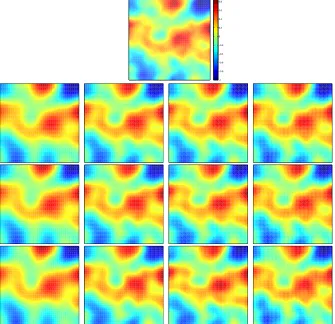
In Figure 1 we display the estimates mn obtained with 3DVAR with
Data Model 1 at iterations n = 1,10,20,30 for noise levels (determined by the choice ofγ) of 1% (top-middle), 2.5% (middle-bottom) and 5% (bottom). We can visually appreciate from Figure 1that the estimates obtained at the final iteration n = 30 are indeed similar one to another even though the one in the bottom row was computed by inverting data five times noisier than the one in the first row. Similar estimates (not shown) were obtained with the Kalman filter for Data Model 1.
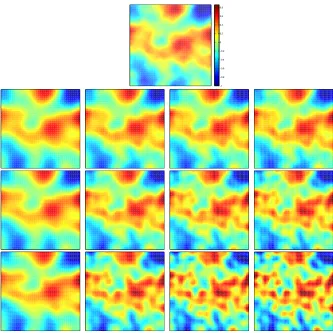
For Data Model 2, the selection of γ corresponding to noise levels of 1%, 2.5%, and 5% yields a maximum number of iterations N = 20,6,3 respectively. Clearly, for Data Model 2, smaller observational noise results in schemes that can be iterated longer, presumably achieving more accurate estimates. Similarly to Data Model 1, we are required to stop the algorithm at the iteration n = N. However, for the purpose of this study we iterate until n = 30. In the right column of Figure 2 we display the plots of the error w.r.t the truth ofmn. In contrast to Data Model 1, we observe that the
error w.r.t the truth increases for n > N. In other words, the Kalman filter and 3DVAR, when applied to Data Model 2, need to be stopped at n =N
in order to stabilize the scheme and obtain accurate estimates of the truth. Moreover, stopping the scheme atn =N results in estimates whose accuracy increases with smaller noise levels. Clearly, in the small noise limit, both data models tend to exhibit similar behaviour. In Figure 3 we display mn
for data with noise levels of 1% (top-middle), 2.5% (middle-bottom) and 5% (bottom). Similar estimates (not shown) were obtained with the Kalman Filter for Data Model 2.
It is clear indeed, that for Data Model 1, the application of Kalman filter and 3DVAR results in more accurate and stable estimates when the noise level in the data is not sufficiently small. The results from this subsection show that the reduction in the variance of the noise due to the law of large numbers and central limit theorem effect in Data Model 1 produces more accurate algorithms. Although Data Model 1 requires multiple instances of the data, in some applications such as in EIT [4], the data collection can be repeated multiple times in order to obtain these data.
6.3
Numerical verification of convergence rates
In this subsection we test the convergence rates from Theorems1,5,3, and7. For the verification of each of these rates we let Σ := Σsdenote the covariance
from (26), and we consider 20 experiments corresponding to different truths
u†generated fromN(0,Σs) with the four selections ofs= 1,2,3,4. Note that
Assumption 1 (iii) is satisfied only for s ≤ 3. Again, for Data Model 1 we generate synthetic data for each of the truths and for as many iterations used for the application of both schemes. Inverse crimes are avoided as described in subsection 6.1.
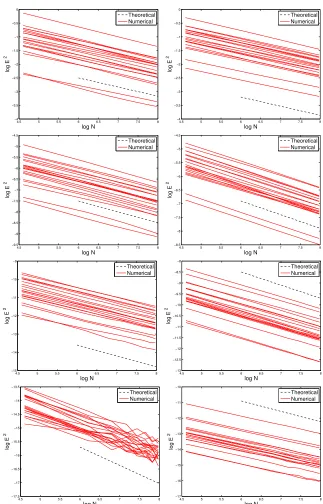
The verification of Theorem1and Theorem5by means of Algorithm1in the case of Data Model 1 is straightforward. For each of the set of synthetic data associated to each of the 20 truths u† previously mentioned, we fix
γ = 5×10⁻⁴. For each N (with N ={100, . . . ,3000}) we run Algorithm 1,
stop the schemes at n=N and record the value of kζN −u†k2. In the right
(resp. left) Figure 4we display a plot ofkζN−u†k2 vs logN for the Kalman
filter (resp. 3DVAR) for each of the set of 20 experiments associated to different truths (red solid lines) generated as described above with (from top to bottom) s = 1,2,3,4. From Theorem 1 we note that the corresponding slopes of the convergence rates should be approximately given by − s
s+1+a.
For Theorem 5 there is an additional term of logN, but this is of course negligible compared to the algebraic decay and we ignore it for the purposes of this discussion. For comparison, a line (black dotted) with slope − s
s+1+a
is displayed in Figure 4.
−1 −0.8 −0.6 −0.4 −0.2 0 0.2 0.4 0.6 0.8
5 10 15 20 25 30 0.5
1 1.5 2 2.5 3 3.5
iterations
log (E)
1% noise level
KF Model 1 3DVAR Model 1
5 10 15 20 25 30
0.5 1 1.5 2 2.5 3 3.5
iterations
log (E)
1% noise level
KF Model 2 3DVAR Model 2
5 10 15 20 25 30
0.5 1 1.5 2 2.5 3 3.5
iterations
log (E)
2.5% noise level
KF Model 1 3DVAR Model 1
5 10 15 20 25 30
0.5 1 1.5 2 2.5 3 3.5
iterations
log (E)
2.5% noise level
KF Model 2 3DVAR Model 2
5 10 15 20 25 30
0.5 1 1.5 2 2.5 3 3.5
iterations
log (E)
5% noise level
KF Model 1 3DVAR Model 1
5 10 15 20 25 30
0.5 1 1.5 2 2.5 3 3.5
iterations
log (E)
5% noise level
[image:25.612.153.455.182.551.2]KF Model 2 3DVAR Model 2
−1 −0.8 −0.6 −0.4 −0.2 0 0.2 0.4 0.6 0.8
Figure 3. Top: truth u†. Top-middle, bottom-middle and bottom: Estimates obtained with 3DVAR and Data Model 2 at iterations (from left to right) 1, 10, 20, 30) for noise levels of 1% (top-middle), 2.5% (bottom-middle) and 5% (bottom)
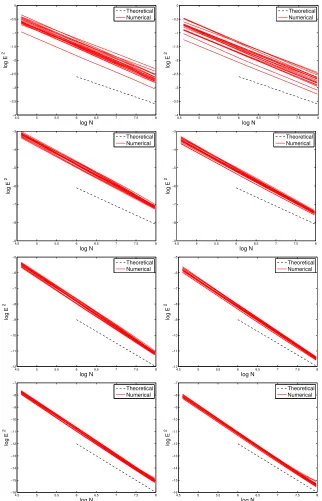
small noise γ, in order to obtain convergence. However, for the purpose of the verification of the aforementioned convergence rates we define γ in terms of N by means of the same expressions. In other words, for each N
(N ={100, . . . ,3000}) we produce synthetic data (or each of the 20 truths)
with η∼N(0, γ2) andγ =N−a2(+as+1)+1. We then run Algorithm 1and stop the
schemes at n = N. In the right (resp. left) Figure 5 we display a plot of
kζN −u†k2 vs logN for the Kalman filter (resp. 3DVAR) for each of the set
of 20 experiments associated to different truths (red solid lines) generated as before with (from top to bottom)s= 1,2,3,4. We again include a line (black dotted) with slope of − s
a+1 which is the asymptotic behavior predicted by
Theorems 3 and 7.
We can clearly appreciate that, for s satisfying Assumption 1 (iii) (i.e.
0< s ≤3), the numerical convergence rates fit very well the ones predicted
by the theory. Note that the higher the regularity of the truth (i.e. the larger the s), the smaller the error. w.r.t the truth in the estimates. We note that fors= 4, the aforementioned assumption is violated and, in the case of Data Model 1, the slopes of the numerical convergence rates are slightly smaller than the theoretical ones. In this case (s = 4) there are also fluctuations of the error w.r.t. the truth obtained with 3DVAR. These fluctuations may be associated with the fact that since for the error w.r.t. the truth is very small for sufficiently large iterations and for Data Model 1 the noise level is fixed a priori (recall γ = 5×10⁻⁴). However, for the Kalman filter these
fluctuations are not so evident; presumably updating the covariance has a stabilizing effect. For Data Model 2, as N increases, the corresponding γ
decreases and so these fluctuations in the error are non existent.
7
Conclusions
• We have presented filter based algorithms for the linear inverse problem, based on introduction of an artificial dynamic. This results in meth-ods which are closely related to iterative Tikhonov-type regularization. Two data scenarios are considered, one (Data Model 1) involving mul-tiple realizations of the data, with independent noise; the other (Data Model 1) involving a single realization of the data; both are relevant in applications.
algo-rithms in the two data scenarios. For multiple realizations of the noisy the convergence is induced by the inherent averaging present in the iterative method, and the link to the law of large numbers and central limit theorem. For the single instance of data the small observational noise limit must be considered.
• For both Data Model 1 and Data Model 2 the Kalman Filter and 3DVAR produced very similar results for relatively smallN (N <100). In practice it is clear that 3DVAR is preferable as the Kalman filter requires covariance updates which may be impractical for large scale models. However, updating the covariance in the Kalman filter seems to have an stabilizing effect in the error w.r.t the truth.
• For Data Model 1 the level of accuracy of the estimator is independent of the noise level. Moreover, the stability of the scheme is not condi-tioned to the early termination of the scheme. In contrast, for Data Model 2 we need to stop atn =N to avoid an increase in the error w.r.t the truth. Again, this illustrates that, whenever multiple instances of the data are available, Data Model 1 offers a more stable and accurate framework for solving the inverse problems under consideration.
• The theoretical results from this work are verified numerically whenever the assumptions of the theory are satisfied.
Acknowledgements
4.5 5 5.5 6 6.5 7 7.5 8 −4 −3.5 −3 −2.5 −2 −1.5 −1 −0.5 0 log N log E 2 Theoretical Numerical
4.5 5 5.5 6 6.5 7 7.5 8
−4 −3.5 −3 −2.5 −2 −1.5 −1 −0.5 0 log N log E 2 Theoretical Numerical
4.5 5 5.5 6 6.5 7 7.5 8
−9.5 −9 −8.5 −8 −7.5 −7 −6.5 −6 −5.5 −5 −4.5 log N log E 2 Theoretical Numerical
4.5 5 5.5 6 6.5 7 7.5 8
−8.5 −8 −7.5 −7 −6.5 −6 −5.5 −5 −4.5 log N log E 2 Theoretical Numerical
4.5 5 5.5 6 6.5 7 7.5 8
−15 −14 −13 −12 −11 −10 −9 log N log E 2 Theoretical Numerical
4.5 5 5.5 6 6.5 7 7.5 8
−13 −12.5 −12 −11.5 −11 −10.5 −10 −9.5 −9 −8.5 −8 log N log E 2 Theoretical Numerical
4.5 5 5.5 6 6.5 7 7.5 8
−17.5 −17 −16.5 −16 −15.5 −15 −14.5 −14 −13.5 log N log E 2 Theoretical Numerical
4.5 5 5.5 6 6.5 7 7.5 8
[image:29.612.143.466.120.624.2]−17 −16 −15 −14 −13 −12 −11 −10 log N log E 2 Theoretical Numerical
Figure 4. Convergence rates for 3DVAR (Left) and Kalman Filter (Right) with Data Model 1 and synthetic data generated from 20 different truths with regularity
4.5 5 5.5 6 6.5 7 7.5 8 −4 −3.5 −3 −2.5 −2 −1.5 −1 −0.5 0 log N log E 2 Theoretical Numerical
4.5 5 5.5 6 6.5 7 7.5 8
−4 −3.5 −3 −2.5 −2 −1.5 −1 −0.5 0 log N log E 2 Theoretical Numerical
4.5 5 5.5 6 6.5 7 7.5 8
−9 −8 −7 −6 −5 −4 −3 log N log E 2 Theoretical Numerical
4.5 5 5.5 6 6.5 7 7.5 8
−9 −8 −7 −6 −5 −4 −3 log N log E 2 Theoretical Numerical
4.5 5 5.5 6 6.5 7 7.5 8
−12 −11 −10 −9 −8 −7 −6 −5 log N log E 2 Theoretical Numerical
4.5 5 5.5 6 6.5 7 7.5 8
−12 −11 −10 −9 −8 −7 −6 −5 log N log E 2 Theoretical Numerical
4.5 5 5.5 6 6.5 7 7.5 8
−16 −15 −14 −13 −12 −11 −10 −9 −8 −7 log N log E 2 Theoretical Numerical
4.5 5 5.5 6 6.5 7 7.5 8
[image:30.612.145.467.124.625.2]−16 −15 −14 −13 −12 −11 −10 −9 −8 −7 log N log E 2 Theoretical Numerical
Figure 5. Convergence rates for 3DVAR (left) and Kalman Filter (right) with Data Model 2 and synthetic data generated from 20 different truths with regularity
References
[1] Agapiou S.; Larsson S. and Stuart A. M.: Posterior contraction rates for the bayesian approach to linear ill-posed inverse problems, Stochastic Process. Appl. 123 (2013), no. 10, 3828–3860.
[2] Bissantz N.; Hohage T.; Munk A. and Ruymgaart F.: Convergence rates of general regularization methods for statistical inverse problems and ap-plications, SIAM J. Numer. Anal., 45 (2007), 2610,C2636.
[3] Bogahcev V. I.: Gaussian Measures, vol. 62 ofMathematical Surveys and Monographs. American Mathematical Society, (1998).
[4] Borcea L, Electrical impedance tomography., Inverse Problems Series 18(6), 2002
[5] Dashti M; and Stuart A. M.: The Bayesian Approach To Inverse Prob-lems. To appear in The Handbook of Uncertainty Quantification, Editors R. Ghanem, D. Higdon and H. Owhadi, Springer, 2016. arXiv:1302.6989
[6] Engl H. W.; Hanke M. and A. Neubauer: Regularization of Inverse Prob-lems, Mathematics and its Applications, vol. 375, Kluwer Academic Pub-lishers Group, Dordrecht, 1996.
[7] Hanke M.: A regularizing Levenberg-Marquardt scheme, with applications to inverse groundwater filtration problems. Inverse Problems, 13 (1997), 79–95.
[8] Hanke M. and Groetsch C. W.: Nonstationary iterated tikhonov regu-larization, Journal of Optimization Theory and Applications 98 (1998), no. 1, 37–53.
[9] Iglesias M. A.; Law K. J. and Stuart A. M.: Ensemble Kalman methods for inverse problems, Inverse Problems 29 (2013), no. 4, 045001.
[10] Iglesias M. A.: A regularizing iterative ensemble Kalman method for PDE-constrained inverse problems. To apper in Inverse Problems. arXiv:1505.03876.
[12] Knapik B. T.; Van Der Vaart A. W. and Van Zanten J. H.: Bayesian inverse problems with Gaussian priors, The Annals of Statistics 39 (2011), no. 5, 2626–2657.
[13] Law K. J.; Stuart A. M. and Zygalakis K.C.: Data Assimilation: A Mathematical Introduction, Springer, 2015.
[14] Lu S. and Pereverzev S. V., Regularization theory for ill-posed problems. Selected topics., Inverse and Ill-posed Problems Series, vol. 58, Walter De Gruyter, Berlin, 2013.
[15] Oliver D.; Reynolds A., and Liu N.: Inverse Theory for Petroleum Reservoir Characterization and History Matching. Cambridge Univ Pr, 2008.
Appendix:
Proof of Lemma 1. The proof follows the classic arguments on Tikhonov regularization with Hilbert scales, c.f. [6, Ch8.4]. We recall (9) in Assumption
1 (ii) and rewrite it in the form
c1kΣ
a+1
2
0 xk ≤ kAΣ
1 2
0xk ≤c2kΣ
a+1
2
0 xk.
Notice that the definition of B0 in (10) gives, sinceX is a Hilbert space, and
using Assumption 1 (i) to ensure that B0 and B0∗ are well-defined bounded
linear operators,
kAΣ
1 2
0xk=kB0xk=k(B0∗B0)
1
2xk.
Combining the two preceding displays we obtain
c1kΣ
a+1
2
0 xk ≤ k(B
∗
0B0)
1
2xk ≤c2kΣ
a+1
2
0 xk
and a duality argument yield
c−21kΣ−
a+1
2
0 xk ≤ k(B
∗
0B0)−
1
2xk ≤c−1
1 kΣ
−a+1 2
0 xk
for any x ∈ R(Σ
a+1
2
0 ). Let θ ∈ [−1,1]. Then the inequality of Heinz [6,
Ch.8.4, pp. 213] and an additional duality argument gives
c1kΣ
θ(a+1)
2
0 xk ≤ k(B
∗
0B0)
θ
2xk ≤c
2kΣ
θ(a+1)
2
which yields R(B0∗B0) θ 2 =D Σ−
θ(a+1)
2
0
.
Let Assumption1(iii) be valid withm0−u†∈ D
Σ− s 2 0
, and definez† :=
Σ−
1 2
0 (m0−u†)∈ D
Σ− s−1 2 0
. Sinces−1∈[−1, a+ 1], and consequentlyθ=
s−1
a+1 ∈ (−1,1], we obtain from (27) that z
† ∈ R((B∗
0B0)
s−1
2(a+1)). Furthermore
there exists a υ ∈X such that
z†= (B0∗B0)
s−1
2(a+1)υ.
Noting that a+11 ∈ (0,1), and employing (27) with θ = a+11 , together with (17) and (19), we have
kJ1k2 =kΣ
1 2
0r1,α
n(B
∗
0B0)Σ
−1 2
0 (m0 −u†)k2
=k(B0∗B0)
1
2(a+1)r
1,αn(B0∗B0)z†k2
=k(B0∗B0)
1
2(a+1)r
1,α
n(B
∗
0B0)(B0∗B0)
s−1
2(a+1)υk2
=k(B0∗B0)
s
2(a+1)r
1,αn(B0∗B0)υk2
≤α
n
a+1s
kυk2.
In case of Assumption 2we insert a= 1+22p and s= 1+22β.
Proof of Lemma2. Notice that
Kn =Cn−1A∗(ACn−1A∗ +γ2I)−1
=C 1 2
n−1C
1 2
n−1A
∗ (AC
1 2
n−1C
1 2
n−1A
∗
+γ2I)−1
=C 1 2
n−1(C
1 2
n−1A
∗
AC 1 2
n−1 +γ 2
I)−1C
1 2
n−1A
∗
and
Cn = (I−KnA)Cn−1 =γ2C
1 2
n−1(C
1 2
n−1A
∗
AC 1 2
n−1+γ 2
I)−1C
1 2
n−1.
Thus we obtain
By virtue of (13) and (28) we derive
J2 =
n−1
X
j=1
n−1
Y
i=n−j
(I −Ki+1A)
!
Kn−jηn−j +Knηn
=
n−1
X
j=0
CnCn−−1jKn−j
ηn−j
=
n−1
X
j=0
CnA∗/γ2
ηn−j
=
n−1
X
j=0
C0−1+nA
∗A
γ2
−1
A∗/γ2
!
ηn−j.
We denote F :=C0−1+nAγ∗2A
−1
A∗/γ2 and obtain
EkJ2k2 =
n−1
X
j=0
EkF ηn−jk2 =nγ2tr(F F∗).
By the definition of F and Assumption1 (i), (iv) we obtain
F =
C0−1+nA
∗A
γ2
−1
A∗/γ2
= Σ
1 2
0(αI +nB
∗
0B0)−1B0∗
and consequently derive
tr(F F∗) = tr
Σ
1 2
0(αI+nB
∗
0B0)−1B0∗ B0(αI+nB0∗B0)−1Σ
1 2
0
= tr((αI+nB0∗B0)−2B0∗B0Σ0) ≤ k(αI +nB0∗B0)−2B0∗B0ktr(Σ0)
= 1
α2kr2,αn(B
∗
0B0)B0∗B0ktr(Σ0)
≤ 1
α2
α
ntr(Σ0) =
1
with the operator-valued function r2,αn(λ) :=
α
n α
n+λ
2
= α+αnλ2. Such an observation then yields
EkJ2k2 =nγ2tr(F F∗)≤
γ2
αtr(Σ0).
Concerning Assumption 2, we further estimate, by exploiting [12, Lemma 8.2],
tr(F F∗) = 1
α2
∞
X
i=1
i−(1+2+2p)−(1+2)
1 + nαi−(1+2+2p)2
= 1
n
∞
X
i=1
n α2i
−4−2p−2
1 + nαi−2−2p−12
1
nα
n
α
−1+22+2p
and
EkJ2k2 γ2n−
2
1+2+2pα−
1+2p
1+2+2p.
Proof of Lemma3. Notice that for Data Model 2, we derive
J2 =
n−1
X
j=1
n−1
Y
i=n−j
(I −Ki+1A)
!
Kn−jηn−j +Knηn
=
n−1
X
j=0
C0−1+nA
∗A
γ2
−1
A∗/γ2
!
ηn−j
=nF η
which yields
EkJ2k2 =n2γ2tr(F F∗).
The remainder of the proof follows Lemma 2.
Proof of Theorem6. As for the other theorems, the proof rests, of course, on the bias variance decomposition, and then use of Lemmas 4 and 5. This yields
Ekζn−u†k2 ≤C
α
n
1+22β+2p
+Cγ2α−1+21+2+2pp
and simultaneously
Ekζn−u†k2 ≤C
α
n
1+22β+2p
+Cγ
2lnn
α .
Choosingα =N1+22ββ+2p for the former inequality and α=N
2β
1+2+2β+2p for the
latter inequality, we conclude that, by stopping the iteration when n=N,
EkζN −u†k2 ≤CN
−1+2+22pβ+2p lnN.
Proof of Lemma 4. Analogously to the proof of Lemma 1, it may be shown that
kI1k2 = kΣ
1 2
0rn,α(B0∗B0)Σ
−1 2
0 (u
†−
m0)k2
≤ k(B∗0B0)
1
2(a+1)r
n,α(B0∗B0)z†k2
= k(B∗0B0)
1
2(a+1)r
n,α(B0∗B0)(B0∗B0)
s−1
2(a+1)υk2
= k(B∗0B0)
s
2(a+1)r
n,α(B0∗B0)υk2
≤ α
n
a+1s
kυk2.
The final inequality follows from the asymptotic behavior of rn,α(λ),
estab-lished, for example. in [14, Ch.2, pp. 63]. In the case of Assumption 2 we insert a= 1+22p and s = 1+22β.
Proof of Lemma5. We denoteFj = (I− KA)jK and obtain
I2 =
n−1
X
j=0
Furthermore, we derive
EkI2k2 =
n−1
X
j=0
EkFjηn−jk2 =γ2 n−1
X
j=0
tr(FjFj∗)
and
n−1
X
j=0
tr FjFj∗
=
n−1
X
j=0
tr(I− KA)jKK∗ (I− KA)∗j
= 1
α2
n−1
X
j=0
trΣ
1 2
0r2j+2,α(B0∗B0)B0∗B0Σ
1 2 0 ≤ 1 α2
n−1
X
j=0
kr2j+2,α(B0∗B0)B0∗B0ktr(Σ0)
≤ tr(Σ0)
α2
n−1
X
j=0
α
2j+ 2
Cln(n)tr(Σ0)
α .
Thus,
EkI2k2 ≤C
ln(n)γ2
α tr(Σ0).
For Assumption 2we need to estimate tr(FjFj∗) carefully. We substitute the
given decay rate of the different eigenvalues, to obtain
tr(FjFj∗) =
1
α2tr
Σ
1 2
0r2j+2,α(B0∗B0)B0∗B0Σ
1 2 0 = 1 α2 ∞ X i=1
i−2−4−2p
1 + 1
αi
−1−2−2p2j+2
≤ 1
α2
∞
X
i=1
i−2−4−2p
1 + j+1α i−1−2−2p2.
By arguments similar to those used in the proof of Lemma 2(or [12, Lemma 8.2]), we further estimate
1
α2
∞
X
i=1
i−2−4−2p
1 + j+1α i−1−2−2p2
1
j+ 1
1+1+22+2p
and
EkI2k ≤Cγ2α
− 1+2p
1+2+2p
n−1
X
j=0
1
j+ 1
1+1+22+2p
where the summation term in the right-hand side is bounded. On the other hand, we can also estimate
tr(FjFj∗) =
1
α2tr
Σ
1 2
0r2j+2,α(B0∗B0)B0∗B0Σ
1 2
0
= 1
α2
∞
X
i=1
i−2−4−2p
1 + α1i−1−2−2p2j+2
≤ 1
α2
∞
X
i=1
i−2−4−2p
1 + 2(jα+1)i−1−2−2p
< 1
2(j + 1)α
∞
X
i=1
i−1−2
≤C 1
(j+ 1)α
and
EkI2k ≤C
γ2lnn
α .
Proof of Lemma6. Sinceηn =η in this case, we derive
I2 =
n−1
X
j=0
(I− KA)jKη
and by operator-valued calculation we obtain
n−1
X
j=0
(I− KA)jK= 1
αΣ
1 2
0
n−1
X
j=0
α(αI+B0∗B0)−1
j+1
B0∗
= Σ
1 2
where qn,α(λ) := λ1
1− αn
(α+λ)n
. Thus we obtain, by the asymptotic behav-ior of qn,α(λ) derived in [14, Ch.2, pp. 64],
EkI2k2 =γ2tr Σ
1 2
0qn,α(B0∗B0)B0∗B0qn,α(B0∗B0)Σ
1 2
0
≤γ2kqn,α(B0∗B0)(B0∗B0)
1
2k2tr(Σ0)
≤ nγ 2
α tr(Σ0).
Proof of Theorem 8. Similar to the Kalman filter method and 3DVAR, by Assumption 1 (i)-(iii), we obtain the bias error estimate
kI1k ≤
Σ10/2
n
Y
j=1
αjI
B0∗B0+αjI
Σ10/20
2 ≤ n Y j=1
αjI
B∗
0B0+αjI
(B0∗B0)
s
2(a+1)υ
2 .
Now we need upper bounds of the following operator-valued function
fn,v(λ) =λv
n
Y
j=1
αj
λ+αj
, λ ∈(0,∞), n > v >0. (29)
Define σn:=
Pn
j=1 1
αj and assume the sequence {αj}
n
j=1 satisfying
1
αn
≤cσ˜ n−1 (30)
with a constant ˜c. Then the results in [8] yield
kI1k ≤Cσ
− s
a+1
n , n >1.
It remains to estimate theI2 term. Define
Fj : = n−1
Y
i=n−j
(I− Ki+1A)Kn−j
= Σ10/2
n−1
Y
i=n−j
αi+1I
B∗
0B0+αi+1I
1
B∗
0B0+αn−jI
Then we obtain
I2 =
n−1
X
j=1
Fjηn−j+Knηn
which yields
EkI2k2 =γ2
n−1
X
j=1
tr(FjFj∗) +γ
2tr(K
nKn∗).
Notice that for any j ≥1
FjFj∗ =
1
α2
n−j
Σ10/2
n−1
Y
i=n−j
αi+1
B0∗B0+αi+1I
2
αn−j
B0∗B0+αn−jI
2
B0∗B0Σ
1/2 0
we derive,
tr(FjFj∗)≤
tr(Σ0)
α2
n−j
n−1
Y
i=n−j
αi+1
B0∗B0+αi+1I
2
αn−j
B0∗B0+αn−jI
2
B0∗B0
≤ tr(Σ0)
α2
n−j
αn−j
B0∗B0+αn−jI
2
B0∗B0
≤ 1
2αn−j
tr(Σ0)
and
tr(KnKn∗)≤
1 2αn
tr(Σ0).
A rough variance estimate for the variant method is
Ekvn−u†k2 =kI1k2+EkI2k2 ≤Cσ−
s
a+1
n +γ2tr(Σ0)σn
.
The first term vanishes but the second term blows up when n → ∞ and
To further investigate the blow up, we consider a special geometric se-quence αn =αqn−1 with 0< q <1. Thus, we have
σn =α−1q1−n
1−qn
1−q ≥α
−1
q1−n=q/αn+1
and (30) is satisfied with ˜c= 1/q. Actually, we derive
1
αn−j
+σn−σn−j =
1
αn−j
+ 1
αn−j+1
+. . .+ 1
αn
=α−1q1−n1−q
j+1
1−q ≥α
−1
q1−n=q/αn+1.
Thus the results in [8] refine, by the asymptotic behavior of (29),
tr(FjFj∗)≤
tr(Σ0)
α2
n−j
n−1
Y
i=n−j
αi+1
B0∗B0+αi+1I
2
αn−j
B0∗B0+αn−jI
2
B0∗B0
≤ 1
α2n−j
1
αn−j
+σn−σn−j
−1
tr(Σ0)
=α−1q1+j−n
1 +q−j1−q
j
1−q
−1
tr(Σ0)
≤α−1q1+2j−ntr(Σ0)
and we derive
EkI2k2 ≤
qγ2tr(Σ
0)
α q
−n n−1
X
j=1
q2j + 1
!
.
Summing up, for the geometric sequence, we obtain
Ekvn−u†k2 ≤C
qa+1s n+γ2tr(Σ0)q−n
.
The second term blows up exponentially when n goes to infinity.