Constraining Pseudorandom Functions Privately
Dan Boneh, Kevin Lewi, and David J. Wu
Stanford University
{dabo,klewi,dwu4}@cs.stanford.edu
Abstract
In a constrained pseudorandom function (PRF), the master secret key can be used to derive constrained keys, where each constrained keyk is constrained with respect to some Boolean circuit C. A constrained key k can be used to evaluate the PRF on all inputs x for which
C(x) = 1. In almost all existing constrained PRF constructions, the constrained keykreveals its constraintC.
In this paper we introduce the concept of privateconstrained PRFs, which are constrained PRFs with the additional property that a constrained key does not reveal its constraint. Our main notion of privacy captures the intuition that an adversary, given a constrained key k
for one of two circuitsC0 andC1, is unable to tell which circuit is associated with the key k.
We show that constrained PRFs have natural applications to searchable symmetric encryption, cryptographic watermarking, and much more.
To construct private constrained PRFs we first demonstrate that our strongest notions of privacy and functionality can be achieved using indistinguishability obfuscation. Then, for our main constructions, we build private constrained PRFs for bit-fixing constraints and for puncturing constraints from concrete algebraic assumptions.
1
Introduction
A pseudorandom function (PRF) [GGM86] is a (keyed) function F :K × X → Y with the property that, for a randomly chosen keymsk∈ K, the outputs of F(msk,·) look indistinguishable from the outputs of a truly random function from X to Y. Constrained PRFs1, proposed independently
by Boneh and Waters [BW13], Boyle, Goldwasser, and Ivan [BGI14], and Kiayias, Papadopoulos, Triandopoulos and Zacharias [KPTZ13], behave just like standard PRFs, except that the holder of the (master) secret keymsk∈ K for the PRF is also able to produce a constrained key skC for a
Boolean circuitC. This constrained keyskC can be used to evaluate the PRFF(msk,·) on all inputs x∈ X whereC(x) = 1, butskC reveals nothing aboutF(msk, x) whenC(x) = 0. Constrained PRFs
have found many applications, for example, in broadcast encryption [BW13] and in the “punctured programming” techniques of Sahai and Waters [SW14].
The Goldreich-Goldwasser-Micali (GGM) PRF [GGM86] is a puncturable PRF, that is, a constrained PRF for the special class of puncturing constraints. In a puncturable PRF, each constrained keykis associated with an inputx0∈ X, and the constrained key enables the evaluation
1
at all points x6=x0 while revealing no information about F(msk, x0). It is not difficult to see that
the constrained keyk completely reveals the point x0.
Boneh and Waters [BW13] show how to use multilinear maps [GGH13a, CLT13, GGH15, CLT15] to construct constrained PRFs for more expressive classes of constraints, including bit-fixing constraints as well as general circuit constraints (of a priori bounded depth). Subsequent works in this area have focused on achieving adaptive notions of security [HKKW14, HKW15], developing schemes with additional properties such as verifiability [CRV14], and constructing (single-key) circuit-constrained PRFs from standard lattice-based assumptions [BV15].
Constraining privately. In this work, we initiate the study ofprivate constrained PRFs, which are a natural extension of constrained PRFs with the additional property that the constrained keys should not reveal their constraints.
Our definition of privacy requires that an adversary, given a single constrained key sk for one of two possible circuits C0 and C1, cannot tell which circuit was used as the constraint forsk. We
also generalize this definition to the setting where the adversary obtains multiple constrained keys. Since the adversary can compare the outputs from multiple constrained keys, some information is necessarily leaked about the underlying constraints. In this setting, our privacy property ensures that the adversary learns the minimum possible. We formally define our privacy notion in Section 2.
For the special case of a puncturable PRF (where the adversary only has access to a single constrained key), the privacy requirement is that for any two adversarially-chosen points x0, x1∈ X,
the adversary cannot distinguish a secret key punctured at x0 from one punctured at x1. In
particular, this means that using a secret key punctured at the inputx to evaluate the PRF on
x must return a value that is unpredictableto the adversary, as opposed to a fixed constant value or⊥as is done in existing (non-private) constrained PRF constructions.
While privacy is a very simple requirement to impose on constrained PRFs, it is not clear how to adapt existing schemes to satisfy this property, even just for puncturing. As a first attempt to constructing private puncturable PRFs, let the PRF input spaceX be {0,1}n, and consider the
GGM tree-based PRF [GGM86], where the outputs are computed as the leaf nodes of a binary tree with the PRF secret key occupying the root node. To puncture the GGM PRF at an input x, the puncturing algorithm reveals the secret keys of all internal nodes that are adjacent2 to the path from the root to the leaf node corresponding with x. Certainly then, the GGM construction is not private—given the punctured key, an adversary can easily reconstruct the path from the root to the punctured leaf node, and hence, recover the inputx.
However, the GGM PRF is a private constrained PRF for the class of length-`prefix constraints, for an integer `≤n. This class refers to the family of constraints described by a prefixs∈ {0,1}`,
where an input satisfies the constraint if its first `bits matchs. To constrain the GGM PRF on a prefixs, the constrain algorithm reveals the secret key for the internal node associated withsin the GGM tree. Then, to evaluate an input x using the constrained key, the evaluator discards the first
`bits of xand, beginning with the node associated with the constrained key, uses the remaining bits ofx to traverse down the GGM tree, outputting the value associated with the resulting leaf node. Privacy follows from the fact that, without the original root of the GGM tree, the secret key for the internal node forsappears to be distributed uniformly and independently of s.
While the GGM PRF provides an efficient solution to privately constraining PRFs under fixed-length prefix constraints, this is insufficient for the applications we have in mind. Instead, we
construct private constrained PRFs for more general classes of constraints: puncturing and general circuit constraints.
1.1 Applications of Private Constrained PRFs
To illustrate the power of private constrained PRFs we first describe a few natural applications, including private constrained MACs, watermarkable PRFs, and searchable encryption. In Section 6.2, we also describe an application to symmetric deniable encryption.
Private constrained MACs. Constrained MACs are the secret-key variant of constrained signatures, which were first introduced by Boyle et al. [BGI14]. In a constrained MAC, the holder of the master secret key can issue constrained secret keys to users. Given a constrained key, a user can only generate MACs for messages that conform to some pre-specified constraint. Here, we consider private constrained MACs, where the constraint is also hidden from the user. Just as a secure PRF implies a secure MAC, a private constrained PRF yields a private constrained MAC.
As a concrete example, suppose a company would like to enforce spending limits on its employees. For business reasons, they do not want employees to be able to learn their precise spending limit, which might reveal confidential information about their position and rank within the company. For example, an employee Alice might only be allowed to create spending requests for at most $500. In this case, Alice’s company could issue a constrained key to Alice that restricts her to only being able to compute MACs for messages which contain her name and whose spending requests do not exceed $500. If Alice attempts to create a MAC for a spending request that either exceeds $500 or is not bound to her name, then the computed MAC will not pass verification. Moreover, privacy of the constrained key ensures that Alice cannot tell if the MAC she constructed is valid or not with respect to the master verification key. Hence, without interacting with the verifier, Alice learns nothing about her exact spending limit. A key advantage in this scenario is that the verifier, who is issued a constrained key3 from the offline key distributor, is able to verify Alice’s requests without
knowing or learning anything about her spending limits.
Watermarking PRFs. A watermarking scheme for programs [HMW07, BGI+12, CHV15, NW15, CHN+16] consists of a marking algorithm, which takes as input a program and embeds a “mark” in it, and a verification algorithm that takes an arbitrary program and determines whether it has been marked. The requirement is that a marked program should preserve the functionality of the original program on almost all inputs, but still be difficult for an adversary to remove the watermark without destroying the functionality. As discussed in [HMW07, BGI+12, CHN+16], the marking algorithm can be extended to embed a string into the program; correspondingly, the verification algorithm would extract the embedded string when run on a watermarked program. We say such schemes are message-embedding [CHN+16].
Hopper, Molnar, and Wagner [HMW07] first introduced the formal notion of a secretly-verifiable watermarking scheme, which was then discussed and adapted to the setting of watermarking cryptographic programs in Barak et al. [BGI+12]. In a secretly-verifiable scheme, only the holder of a secret key can test if a program is watermarked. More recently, Cohen et al. [CHN+16] showed how to construct publicly-verifiable watermarking for puncturable PRFs from indistinguishability
3
obfuscation. In the publicly-verifiable setting, anyone with the public parameters is able to test whether a program is watermarked or not. Moreover, Cohen et al. noted that watermarkable PRFs have applications in challenge-response authentication and traitor tracing. We survey more related work in Section 6.1.
In our work, we show that starting with a privateprogrammablePRF, we obtain a watermarkable family of PRFs, where the associated watermarking scheme is secretly-verifiable and supports message embedding. Intuitively, a programmable PRF is a puncturable PRF, except with the property that the holder of the master secret key can additionally specify the value the constrained key evaluates to at the punctured point. The privacy requirement stipulates that a programmed key hides the point which was “reprogrammed.” We give the formal definitions of this concept and a concrete construction based on indistinguishability obfuscation in Appendices C and E, respectively.
We now give an overview of our construction of a watermarkable PRF. For simplicity, we describe our construction without message embedding. To mark a key msk for a private programmable PRFF, the marking algorithm first evaluates F(msk,·) at several (secret) pointsz1, . . . , zd ∈ X
to obtain values t1, . . . , td. The marking algorithm then derives a pseudorandom pair (x, y) from
the valuest1, . . . , td, and outputs a programmed key formsk with the value at x replaced byy. To
test whether a circuitC is marked or not, the verification algorithm applies the same procedure as the marking algorithm to obtain a test point (x0, y0). The test algorithm then outputs “marked” if
C(x0) =y0 and “unmarked” otherwise. Privacy is crucial here because if the adversary knew the “reprogrammed” point x, it can trivially remove the watermark by producing a circuit that simply changes the value atx. We show in Section 6.1 that this simple construction not only satisfies our notion of secretly-verifiable watermarking, but can also be easily extended to support embedding arbitrary messages as the watermark.
Although our current constructions of private programmable PRFs rely on indistinguishability obfuscation, we stress that advances in constructing private programmable PRFs from weaker assumptions or with improved efficiency would have implications in constructing watermarkable PRFs as well.
Searchable encryption. In searchable symmetric encryption (SSE) [SWP00, Goh03, CGKO06, CK10, BCLO09], a server holds a set of encrypted documents and a client wants to retrieve all documents that match its query. For simplicity, suppose each document is tagged, and the client wants to retrieve all documents with a particular tag. One of the simplest SSE approaches is to compute and store an encrypted index on the server. Specifically, fix a PRF F and a key msk. For each tagt, the encrypted index maps the tokenF(msk, t) onto an encrypted list of document indices that match the tag. To search for a tag t, a user who holds the PRF key msk can issue a query
F(msk, t). The server returns the encrypted list of matching documents.
privacy ensures that an employee cannot tell if a search came back empty because she was not allowed to search for a particular tag, or if there are actually no documents that match the tag. Privacy also ensures that unauthorized employees cannot infer the name of the secret project from their search keys.
By instantiating F with a private constrained PRF, we easily obtain a restrictable SSE system. The construction is collusion resistant: if several employees who individually cannot search for the tag tcombine their search keys, they still cannot search for t. However, it does become possible for them to test whether a certain tag is in the intersection of their restricted sets.
Online/offline2-server private keyword search. In private keyword search [CGN98, FIPR05, OI05], a server holds a database D={w1, . . . , wn} of keywords, and a client wants to determine
whether a specific keyword is in the database without revealing the keyword to the server. This setting differs from searchable encryption in that the server learns nothing about the client’s query, whereas in the searchable encryption framework, information about the client’s query (such as whether or not there are any matching results) could be leaked.
In the 2-server variant of this problem [GI14, BGI15], the database is shared among two servers. The client can send queries to each server independently, and then combine the results of the queries to obtain the answer. We assume moreover that the two servers are non-colluding. Recently, Boyle, Gilboa and Ishai [GI14, BGI15] gave a secure solution for the the 2-server variant of the problem that is more efficient than the solutions for 1-server private keyword search, and relies on weaker cryptographic assumptions.
Using a private puncturable PRF, we can construct an online/offline version of the 2-server keyword-search protocol. In an online/offline 2-server private keyword search protocol, there is an “offline” server and an “online” server. The offline server can process the search query before the client has decided its query (for instance, the offline computation can be preformed in a separate setup phase). When the client issues a search query, it only communicates with the online server. The client then combines the response from both servers to learn the result of the query. Our protocol can be seen as a hybrid between the 1-server and 2-server protocols. In the 1-server setting, there is no offline setup component in the protocol, while in the 2-server setting, we require both servers to be online during the query phase.
To implement online/offline 2-server private keyword search using private puncturable PRFs, during the offline (setup) phase, the client generates a master secret key msk for the private puncturable PRF, and sends mskto the offline server. Let {0,1}m be the range of the PRF. For
each word wi ∈D, the offline server computes si = F(msk, wi), and returns s = Lni=1si to the
client. Note that all computation in the offline phase isindependent of the client’s search query. In the online phase, after the client has determined its search queryw∗, she sends a keyskw∗ punctured
atw∗ to the online server. For each wordwi ∈D, the online server evaluates skw∗ onwi to obtain a
valueti. Finally, the online server returns the value t=Lni=1ti. To learn the result of the keyword
search, the client tests whetherz=s⊕tis the all-zeros string 0m or not. If z= 0m, then the client concludesw∗ ∈/D; otherwise, the client concludes thatw∗ ∈D. To see why, consider the case where
w∗ ∈/D, sow∗6=wi for all i. By correctness of the punctured PRF, si=ti for all i, in which case z= 0m. Conversely, ifw∗=wi∗ for some i∗, then for all i6=i∗,si =ti. Moreover, security of the
PRF implies thatsi∗ 6=ti∗ with high probability, and so z6= 0m.
bits. For single-server private keyword search, Ostrovsky and Skeith [OI05] show how to construct a private keyword search protocol, using homomorphic encryption and a private information retrieval (PIR) protocol. Instantiating the PIR protocol with the scheme of Gentry and Ramzan [GR05] results in a 1-server private keyword search withO(λ+ logN) communication, which is optimal. We remark that although our current constructions do not result in a more efficient private keyword search protocol, improved constructions of private puncturable PRFs would have direct implications for the online/offline 2-server variant of private keyword search.
1.2 Constructing Private Constrained PRFs
We formally define our notion of privacy in Section 2. In this section, we briefly outline our constructions of private constrained PRFs. As a warmup, we begin with a construction from indistinguishability obfuscation, and then we give an overview of our two constructions from concrete assumptions on multilinear maps for bit-fixing constraints and puncturing constraints.
A construction from indistinguishability obfuscation. Indistinguishability obfuscation (iO) [BGI+12, GGH+13b, BGK+14, SW14, GLSW15, Zim15, AB15] is a powerful primitive that has enabled a number of new constructions in cryptography [SW14, BZ14, GGH+13b]. Informally, an indistinguishability obfuscator is a machine that takes as input a program and outputs a second program with the identical functionality, but at the same time, hides some details on how the original program works.
We first show how indistinguishability obfuscation can be used to construct a private constrained PRF for general circuit constraints. Suppose F : K × X → Y is a PRF with master secret key
msk ∈ K. We use F in conjunction with iO to construct a private circuit-constrained PRF. We
describe the constrain algorithm. On input a circuitC, the constrain algorithm samples another secret keysk∈ Kand outputs the obfuscation of the following program P:
“On input x, ifC(x) = 1, outputF(msk, x). Otherwise, outputF(sk, x).”
In the above program, note thatC, msk, and skare all hard-coded into the program. Let ˆP be the obfuscated program. Evaluation of the PRF using the constrained key corresponds to evaluating the program ˆP(x). We see that on all inputsx whereC(x) = 1, ˆP(x) =F(msk, x), so correctness is immediate.
At a high level, the constrain algorithm generates a “fake” PRF key sk, and the constrained key is just a program that either evaluates the “real” PRF or the fake PRF, depending on the value ofC(x). Since the adversary cannot distinguish between the outputs under the real PRF key from those under the fake PRF key, the adversary cannot simply use the input-output behavior of the obfuscated program to learn anything about C. Moreover, in Section 3, we show that if the underlying PRF F is puncturable (not necessarily privately), the indistinguishability obfuscation of the program does in fact hide the constraining circuit C. We note though that for general circuits, our security reduction requires subexponential hardness ofiO(and one-way functions). For restricted classes of circuits, such as puncturing, however, we can obtain security from polynomially-hardiO
(and one-way functions).
constrained PRFs. For our two main constructions, we build private constrained PRFs for more restrictive classes of constraints based on concrete assumptions over multilinear maps.
Multilinear maps [BS03, GGH13a, CLT13, GGH15, CLT15] have been successfully applied to many problems in cryptography, most notably in constructing indistinguishability obfusca-tion [GGH+13b, BGK+14, AGIS14, GLSW15, Zim15, AB15]. Unfortunately, a number of recent attacks [CHL+15, BWZ14, CGH+15, CLLT15, HJ16, CFL+16] have invalidated many of the basic assumptions on multilinear maps. However, indistinguishability obfuscation is an example of a setting where the adversary often does not have the necessary information to carry out these attacks, and so some of the existing constructions are not known to be broken [GMM+16, FRS16]. In our first construction from multilinear maps, we rely on the Multilinear Diffie-Hellman (MDH) assumption [BS03, GGH13a] over prime-order multilinear maps. In our second construction, we rely on the Subgroup Decision assumption [BGN05, GGH13a] as well as a generalization which we call the Multilinear Diffie-Hellman Subgroup Decision (MDHSD) assumption over composite-order multilinear maps.4 Our assumptions plausibly hold in existing multilinear map candidates, notably the Garg et al. construction in the prime-order setting [GGH13a], and the Coron et al. construction for the composite-order setting [CLT13]. We also note that starting fromiO, it is also possible to construct multilinear maps where the MDH assumption holds [AFH+16].
Using multilinear maps, we give two constructions of private constrained PRFs: one for the class of bit-fixing constraints, and the other for puncturing. A bit-fixing constraint is described by a patterns∈ {0,1,?}n. An input x∈ {0,1}n satisfies the constraint if it matches the pattern—that
is, for each coordinate i, either si = ? or si = xi. Our private bit-fixing PRF builds off of the
Boneh-Waters bit-fixing PRF [BW13] based on prime-order multilinear maps [BS03, GGH13a]. We give the full construction in Section 4. In Section 5, we give the full construction of our privately puncturable PRF from composite-order multilinear maps. Here, security and privacy are based on then-MDHSD and Subgroup Decision assumptions.
1.3 Related Work
Kiayias et al. [KPTZ13] introduced a notion of policy privacy for delegatable PRFs. In a delegatable PRF, a proxy can evaluate the PRF on a subset of its domain by using a trapdoor derived from the master secret key, where the trapdoor (constrained key) is constructed based on a policy predicate (circuit constraint) which determines which values in the domain the proxy is able to compute the PRF on. Here, policy privacy refers to the security property that the trapdoor does not reveal the underlying policy predicate. The notion of policy privacy is conceptually similar to our notion of privacy for constrained PRFs, except that the delegatable PRFs which they construct are for policy predicates that describe a consecutive range of PRF inputs. Moreover, this restriction is reflected in their definition of policy privacy, and hence, their notion of privacy is incomparable to ours. However, we note that their delegatable PRF constructions are GGM-based and, thus, more efficient than our PRF constructions.
As discussed earlier, Boyle et al. [BGI14] introduced the notion of constrained signatures (which they call functional signatures). Here, in addition to the master signing key, there are secondary signing keys for functions f which restrict the signer to only being able to construct valid signatures for a range of messages determined by f. They also proposed the notion of function privacy, which intuitively states that a signature constructed from a secondary signing key should not reveal the
4
function associated with the signing key, nor the message that the function was applied to. However, critically, this notion of privacy does not prevent the secondary signing key itself from revealing the function it corresponds to; in this respect, their notion of function privacy is incomparable to our notion of privacy for constrained PRFs.
In Section 6.1, we also survey the related work on cryptographic watermarking.
Private puncturing and distributed point functions. Recently, Boyle, Gilboa and Ishai introduced the notion of a distributed point function (DPF) [GI14, BGI15], which are closely related to private puncturable PRFs. In a DPF, there are two functions GenandEval. The functionGen
takes as input a pairx, y∈ {0,1}∗ and outputs two keys k0 andk1, andEvalis defined such that
Eval(k0, x0)⊕Eval(k1, x0) = 0|y| ifx06=x, andEval(k0, x)⊕Eval(k1, x) =y. The security of the DPF
stipulates that each of the keys individually appear to be distributed independently ofx and y. A DPF is similar to a private puncturable PRF in that we can viewk0 as the master secret key for a
PRF and k1 as a constrained key punctured atx. However, there are two significant differences:
first, the keysk0 andk1 need not be PRF keys (in the sense thatEval(k0,·) and Eval(k1,·) need not
be pseudorandom),5 and second, the keysk0 andk1 are generatedtogether depending onx, whereas
in a puncturable PRF, the master secret key is generated independentlyof x. We note though that a private puncturable PRF can be used directly to construct a DPF: we simply letk0 be the master
secret key of the PRF andk1 be a key punctured at x.
Subsequent work. Subsequent to this work, Boneh, Kim, and Montgomery [BKM17] showed how to construct private puncturable PRFs from standard lattice assumptions. Concurrent with their work, Canetti and Chen [CC17] showed how to construct a (single-key) private constrained PRF for NC1 constraints, also from lattice assumptions. It remains an open problem to construct private constrained PRFs for all circuits from a standard complexity assumption.
2
Private Constrained PRFs
In this section, we first review some notational conventions that we use throughout the work, along with the definition of a pseudorandom function (PRF). Then, we define constrained PRFs and the notion of privacy.
2.1 Conventions
For an integer n, we write [n] to denote the set {1, . . . , n}. For a finite set S, we write x ←−r S
to denote that x is drawn uniformly at random from S. For two finite sets S and T, we write
Funs(S, T) to denote the set of all (well-defined) functions f :S → T. Hence, iff ←−r Funs(S, T), then for every distinct input a∈S, the value f(a) is distributed uniformly and independently inT. We say a function f(λ) is negligible in the parameterλ, denoted as negl(λ), if f(λ) =o(1/λc) for allc∈N. We say an algorithm is efficient if it runs in probabilistic polynomial time in the length of its input. For two families of distributions D1 and D2, we write D1 ≡ D2 if the two distributions are identical. We writeD1 ≈ Dc 2 if the two distributions are computationally indistinguishable, that is, no efficient algorithm can distinguish D1 from D2, except perhaps with negligible probability.
5
Though this property is not explicitly required by a DPF, in existing constructions [GI14, BGI15], the functions
2.2 Pseudorandom Functions
We first review the definition of a pseudorandom function (PRF) [GGM86]. Unless otherwise noted, we will specialize the domain of our PRFs to {0,1}n and the range to{0,1}m.
Definition 2.1 (Pseudorandom Function [GGM86]). Fix the security parameter λ. A PRF
F :K × {0,1}n→ {0,1}m with key space K, domain {0,1}n, and range{0,1}m is secure if for all
efficient algorithmsA,
Pr
h
k←− Kr :AF(k,·)(1λ) = 1
i
−Pr
h
f ←−r Funs({0,1}n,{0,1}m) :Af(·)(1λ) = 1
i
= negl(λ).
We also review the definition of a constrained PRF [BW13, KPTZ13, BGI14]. Consider a PRF
F : K × {0,1}n → {0,1}m, and let msk be the master secret key for F. In a constrained PRF,
the holder ofmsk can derive keyssk for some circuitC :{0,1}n→ {0,1}, such that givensk, the
evaluator can compute the PRF on all inputsx∈ {0,1}n where C(x) = 1. More precisely, we have
the following definition.
Definition 2.2 (Constrained PRF [BW13, KPTZ13, BGI14]). A constrained PRF for a circuit class C is a tuple of algorithms Π = (cPRF.Setup,cPRF.Constrain,cPRF.ConstrainEval,cPRF.Eval) over the input space {0,1}nand output space {0,1}m, with the following properties:
• cPRF.Setup(1λ)→msk. On input the security parameterλ, the setup algorithm cPRF.Setup
outputs the master secret keymsk.
• cPRF.Constrain(msk, C)→sk. On input the master secret key mskand a circuit C∈ C, the constrain algorithm cPRF.Constrainoutputs a secret key sk for the circuitC.
• cPRF.ConstrainEval(sk, x) → y. On input a secret key sk, and an input x ∈ {0,1}n, the
constrained evaluation algorithm cPRF.ConstrainEvaloutputs an element y∈ {0,1}m.
• cPRF.Eval(msk, x)→ y. On input the master secret key msk and an input x ∈ {0,1}n, the
evaluation algorithmcPRF.Eval outputs an elementy∈ {0,1}m.
Correctness. A constrained PRF is correct for a circuit class C if msk ← cPRF.Setup(1λ), for every circuitC ∈ C and input x∈ {0,1}n such thatC(x) = 1, it is the case that
cPRF.ConstrainEval(cPRF.Constrain(msk, C), x) =cPRF.Eval(msk, x).
Definition 2.3 (ExperimentExptcPRFb ). For the security parameter λ∈N, a family of circuitsC, and a bitb∈ {0,1}, we define the experimentExptcPRFb between a challenger and an adversary A, which can make oracle queries of the following types: constrain, evaluation, and challenge. First, the challenger sets msk←cPRF.Setup(1λ) and samples a function f ←−r Funs({0,1}n,{0,1}m) uniformly
at random. Forb∈ {0,1}, the challenger responds to each oracle query made byA in the following manner.
• Constrain oracle. On input a circuit C ∈ C, the challenger returns a constrained key
sk←cPRF.Constrain(msk, C) toA.
• Evaluation oracle. On input x∈ {0,1}n, the challenger returnsy←cPRF.Eval(msk, x).
• Challenge oracle. On inputx∈ {0,1}n, the challenger returns y←cPRF.Eval(msk, x) toA
ifb= 0, and y←f(x) if b= 1.
Eventually,A outputs a bitb0 ∈ {0,1}, which is also output byExptcPRFb . LetPr[ExptcPRFb (A) = 1] denote the probability thatExptcPRFb outputs 1 withA.
At a high level, we say that a constrained PRF is secure if no efficient adversaries can distinguish
ExptcPRF0 from ExptcPRF1 . However, we must first restrict the set of allowable adversaries. For example, an adversary that makes a constrain query for a circuit C∈ C and a challenge query for a pointx∈ {0,1}n whereC(x) = 1 can trivially distinguish the two experiments. Hence, we first
define an admissibility criterion that precludes such adversaries.
Definition 2.4 (Admissible Constraining). We say an adversary is admissible if the following conditions hold:
• For each constrain query C∈ C and each challenge queryy∈ {0,1}n,C(y) = 0.
• For each evaluation queryx∈ {0,1}nand each challenge query y∈ {0,1}n,x6=y.
Definition 2.5 (Constrained Security). A constrained PRF Π is secure if for all efficient and admissible adversariesA, the following quantity is negligible:
AdvcPRF[Π,A]def=
Pr[Expt
cPRF
0 (A) = 1]−Pr[ExptcPRF1 (A) = 1]
.
Remark 2.6 (Multiple Challenge Queries). In our constructions of constrained PRFs, it will be convenient to restrict the adversary’s power and assume that the adversary makes at most one challenge query. As was noted by Boneh and Waters [BW13], a standard hybrid argument shows that any constrained PRF secure against adversaries that make a single challenge oracle query is also secure against adversaries that makeQchallenge oracle queries while only incurring a 1/Q loss in advantage. Thus, this restricted definition is equivalent to Definition 2.5.
Remark 2.7 (Adaptive Security). We say that a constrained PRF Π is selectivelysecure if for all efficient adversaries A, the same quantityAdvcPRF[Π,A] is negligible, but in the security game, the adversary first commits to its challenge query x∈ {0,1}n at the start of the experiment. If we do
not require the adversary to first commit to its challenge query, then we say that the scheme is
Privacy. Next, we give an indistinguishability-based definition for privacy. In the privacy game, the adversary is allowed to submit two circuits C0, C1 to the challenger. On each such query, it
receives a PRF key constrained toCb for some fixed b∈ {0,1}. The adversary can also query the
PRF at points of its choosing, and its goal is to guess the bit b. We now give the formal definitions.
Definition 2.8(ExperimentExptcprivb ). For the security parameterλ∈N, a family of circuitsC, and a bit b∈ {0,1}, we define the experiment Exptcprivb between a challenger and an adversaryA, which can make evaluation and challenge queries. First, the challenger obtains msk← cPRF.Setup(1λ). Forb∈ {0,1}, the challenger responds to each oracle query type made byAin the following manner.
• Evaluation oracle. On input x∈ {0,1}n, the challenger returnsy←cPRF.Eval(msk, x).
• Challenge oracle. On input a pair of circuits C0, C1 ∈ C, the challenger returns sk ←
cPRF.Constrain(msk, Cb).
Eventually,Aoutputs a bit b0 ∈ {0,1}, which is also output by ExptcPRFb . Let Pr[Exptcprivb (A) = 1] denote the probability thatExptcprivb outputs 1.
Roughly speaking, we say that a constrained PRF is private if no efficient adversary can distinguishExptcpriv0 from Exptcpriv1 . As was the case with constraining security, when formulating the exact definition, we must preclude adversaries that can trivially distinguish the two experiments.
Definition 2.9 (Admissible Privacy). Let C0(i), C1(i)∈ C be the pair of circuits submitted by the adversary on theithchallenge oracle query, and let dbe the total number of challenge oracle queries
made by the adversary. For a circuit C ∈ C, define S(C) ⊆ {0,1}n whereS(C) ={x ∈ {0,1}n : C(x) = 1}. Then, an adversary is admissibleif:
1. For each evaluation oracle query with input x, and for each i ∈ [d], it is the case that
C0(i)(x) =C1(i)(x).
2. For every pair of distinct indices i, j∈[d],
S
C0(i)
∩S
C0(j)
=S
C1(i)
∩S
C1(j)
. (2.1)
Definition 2.10 (d-Key Privacy). A constrained PRF Π is (adaptively) d-key private if for all efficient and admissible adversariesAthat make dchallenge oracle queries, the following quantity is negligible:
Advcpriv[Π,A]def=
Pr[Expt
cpriv
0 (A) = 1]−Pr[Expt
cpriv
1 (A) = 1]
.
Furthermore, we say a constrained PRF is multi-keyprivate if it is d-key private for all d∈N.
Remark 2.11 (Admissibility Requirement). The admissibility requirements in Definition 2.9 are necessary to prevent an adversary from trivially distinguishing the privacy experiments against a secure constrained PRF. To see why, suppose an adversary Amakes two challenge queries (C0, C1)
• First, suppose that for some x, C0(x) = 1 = C00(x), but C1(x) = 1 and C10(x) = 0. The
adversary computesz=cPRF.ConstrainEval(sk, x) and z0 =cPRF.ConstrainEval(sk0, x). When
b= 0, correctness implies that z=z0. Whenb= 1, security of the constrained PRF implies thatz6=z0 with overwhelming probability, which lets the adversary distinguish the two privacy experiments.
• Second, suppose that for somex,C0(x) = 1 =C00(x) and C1(x) = 0 =C10(x). The adversary
again uses skand sk0 to evaluate the PRF atx, and obtainz andz0 as above. When b= 0, correctness implies thatz=z0. Whenb= 1, ifz6=z0 then the adversary can distinguish the two privacy experiments. However, ifz=z0 holds with high probability, then the adversary can issue a third challenge query for (C1, C1) and obtain sk00 in response. Let z00 be the
value of the PRF at x using key sk00. When b= 1, by assumption we know that with high probabilityz0 =z00. However, by security, whenb= 0 we know thatz0 6=z00, with overwhelming probability, which lets the adversary distinguish the two privacy experiments.
The second case above suggests that we can modify the admissibility requirement in Eq. (2.1) to instead require that for every pair of distinct indices i, j∈[d] and all x∈ {0,1}n we have
C0(i)(x) =C0(j)(x) if and only if C1(i)(x) =C1(j)(x). (2.2)
This criterion prevents the adversary from issuing the third query needed in the second case attack above. Constructions that provide privacy under this admissibility requirement must ensure that if
C, C0 ∈ C satisfy C(x) =C0(x) = 0 then cPRF.ConstrainEval(skC, x) =cPRF.ConstrainEval(skC0, x).
For this reason, we call this privacy property consistent privacy. None of our applications require it, and we will not use the resulting privacy notion in this paper.
Remark 2.12 (Weaker Notions of Privacy). In some cases, we also consider a weaker notion of privacy where the adversary is not given access to an evaluation oracle in experiment Exptcprivb . While this can be a weaker notion of privacy (for instance, in the case of d-key privacy for bounded
d), in all of our candidate applications, a scheme that satisfies this weaker notion suffices.
Remark 2.13 (Difficulty with Deterministic Constraining Algorithm). In many existing construc-tions of constrained PRFs [BW13], the constraining algorithm is deterministic. However, when the constraining algorithm is deterministic,d-key privacy ford >1 (as in Definition 2.10) isimpossible
for any circuit family that contains circuitsC1, C2 whereS(C1)(S(C2)—i.e., the set of points that
C1 accepts is a strict subset of the set of points that C2 accepts. To see this, consider the following
2-query adversary. The adversary issues two queries to the challenge oracle: first for (C1, C1) and
then for (C1, C2). This trivially satisfies the admissibility requirement for the privacy game (since
S(C1)∩S(C2) =S(C1)). Whenb= 0, the adversary obtains the same response from the challenge
oracle (since the constraining algorithm is deterministic). Ifb= 1, the two constrained keys the adversary receives are different with overwhelming probability (sinceS(C2)6=S(C1), there exists a
pointx∗ whereC2(x) = 1 whileC1(x) = 0; constrained security then ensures that with overwhelming
probability, the evaluation atx∗ will be different, forcing the received keys to be different). Thus, for any circuit classCthat contains circuitsC1, C2 whereS(C1)(S(C2),d-key for d >1 and multi-key
Puncturable PRFs. A puncturablePRF [SW14, KPTZ13, BW13, BGI14] is a special case of a constrained PRF, where the constraining circuit describes a point function, that is, each constraining circuit Cx∗ is associated with a pointx∗ ∈ {0,1}n, and Cx∗(x) = 1 if and only if x 6= x∗. More
concretely, a puncturable PRF is specified by a tuple of algorithms Π = (cPRF.Setup,cPRF.Puncture,
cPRF.ConstrainEval,cPRF.Eval), which is identical to the syntax of a constrained PRF with the exception that the algorithmcPRF.Constrainis replaced with the algorithmcPRF.Puncture.
• cPRF.Puncture(msk, x) →sk. On input the master secret key msk and an inputx∈ {0,1}n,
the puncture algorithm cPRF.Punctureoutputs a secret key sk.
The correctness and security definitions (for constrained security and privacy) are analogous to those for private constrained PRFs.
Remark 2.14 (Deterministic Puncturing). The family of puncturing constraints does not satisfy the condition in Remark 2.13, so it is possible to construct d-key or multi-key private puncturable PRFs where the puncturing algorithm is deterministic. In the case of a deterministic puncturing algorithm, it suffices to only consider adversaries that make at most one puncture query in the security game (Definition 2.3). After all, any adversary that makes more than one puncture query at distinct points cannot make any admissible challenge queries, and thus, has an advantage of 0. Moreover, since the puncturing algorithm is deterministic, the adversary does not gain any information by querying the puncture oracle on the same punctured point multiple times. This restriction does not apply when the puncturing algorithm is randomized since the adversary can request multiple keys punctured at thesame point.
A similar relaxation can be considered for the privacy game (Definition 2.8) in the case of deterministic puncturing. In this case, it suffices to just consider adversaries that make at most 2 challenge queries. First, if the adversary makes a puncturing challenge query of the form (x, x) for any pointx∈ {0,1}n, then all of the (admissible) queries the adversary can make to the challenge
oracle must be of this form (i.e., the same point is punctured in both the b= 0 case as well as the
b= 1 case). Then, the view of the adversary in this case is distributed independently ofb, and thus, the adversary cannot obtain a non-zero advantage. Instead, suppose an adversary issues a challenge query (x, y) for some x6=y. Then, the only other admissible query the adversary can issue in the puncturing game is (y, x). Thus, when the puncturing algorithm is deterministic, it suffices to only reason about 2-key adversaries for the privacy game.
3
Private Circuit Constrained PRFs from Obfuscation
In this section, we show how multi-key private circuit-constrained PRFs follow straightforwardly from indistinguishability obfuscation and puncturable PRFs (implied by one-way functions [GGM86, BW13, KPTZ13, BGI14]). First, we review the notion of indistinguishability obfuscation introduced by Barak et al. [BGI+12].
Definition 3.1 (Indistinguishability Obfuscation (iO) [BGI+12, GGH+13b]). An indistinguishabil-ity obfuscatoriOfor a circuit class {Cλ}is a uniform and efficient algorithm satisfying the following requirements:
• Correctness. For all security parameters λ∈N, all circuits C ∈ Cλ, and all inputs x, we have that
• Indistinguishability. For all security parameters λ, and any two circuits C0, C1 ∈ Cλ,
if C0(x) = C1(x) for all inputs x, then for all efficient adversaries A, we have that the
distinguishing advantageAdviO,A(λ) is negligible:
AdviO,A(λ) =|Pr[A(iO(C0)) = 1]−Pr[A(iO(C1)) = 1]|= negl(λ).
For general circuit constraints, our construction will require the stronger assumption that the indistinguishability obfuscator and puncturable PRF be secure against subexponential-time adversaries. However, for more restrictive circuit families, such as puncturing, our construction can be shown to be secure assuming the more standard polynomial hardness of iOand the puncturable PRF (Remark D.11). In addition, in Appendix E, we show how to adapt our private circuit-constrained PRF to also obtain a private programmable PRF (formally defined in Appendix C) from (polynomially-hard)iO and one-way functions.
Construction overview. Our starting point is the circuit-constrained PRF by Boneh and Zhandry [BZ14, Construction 9.1]. In the Boneh-Zhandry construction, the master secret keymsk
is a key for a puncturable PRF, and a constrained key for a circuit C : {0,1}n → {0,1} is an
obfuscation of the program that outputs cPRF.Eval(msk, x) if C(x) = 1 and ⊥otherwise. Because the program outputs⊥on inputsxwhereC(x) = 0, simply evaluating the PRF at different pointsx
reveals information about the underlying constraint. In our construction, we structure the program so that on an input x where C(x) = 0, the program’s output is the output of a different PRF. Intuitively, just by looking at the outputs of the program, it is difficult to distinguish between the output of the real PRF and the output of the other PRF. In Theorem 3.3, we formalize this intuition by showing that our construction provides multi-key privacy.
Construction. We now describe our construction of a multi-key private circuit-constrained PRF. Let iO be an indistinguishability obfuscator, and let ΠF = (F.Setup,F.Puncture,F.ConstrainEval,
F.Eval) be any puncturable (but not necessarily private) PRF. Our multi-key private circuit-constrained PRF ΠioPRF = (cPRF.Setup,cPRF.Constrain,cPRF.ConstrainEval,cPRF.Eval) is given as follows:
• cPRF.Setup(1λ). The setup algorithm outputsmsk←F.Setup(1λ).
• cPRF.Constrain(msk, C). First, the constrain algorithm computesmsk0 ←F.Setup(1λ). Then, it outputs an obfuscated programiO P1
C,msk0,msk, whereP1
C,msk0,mskis the following program:6
6
We pad the programP1[C,msk0,msk] to the maximum size of any program that appears in the hybrid experiments
Constants: a circuit C : {0,1}n → {0,1}, and master secret keys msk
0, msk1 for the
puncturable PRF ΠF= (F.Setup,F.Puncture,F.ConstrainEval,F.Eval).
On input x∈ {0,1}n:
1. Letb=C(x). OutputF.Eval(mskb, x).
Figure 1: The program P1[C,msk0,msk1]
• cPRF.ConstrainEval(sk, x). The constrained evaluation algorithm outputs the evaluation of the obfuscated programsk on x.
• cPRF.Eval(msk, x). The evaluation algorithm outputs F.Eval(msk, x).
Correctness. By definition, the programP1[C,msk0,msk] outputsF.Eval(msk, x) on allx∈ {0,1}n
where C(x) = 1. Correctness of ΠioPRF immediately follows from correctness of the indistinguisha-bility obfuscator.
Security. We now state our security and privacy theorems, and give a proof overview of the latter. We defer the formal proofs of both statements to Appendix D.
Theorem 3.2. Suppose iO is an indistinguishability obfuscator and ΠF is a selectively-secure
puncturable PRF. Then, ΠioPRF is selectively secure (Definition 2.5).
Theorem 3.3. Suppose iO is a indistinguishability obfuscator, and ΠF is a selectively-secure
puncturable PRF, both secure against subexponential adversaries. Then, ΠioPRF is multi-key private
(Definition 2.10).
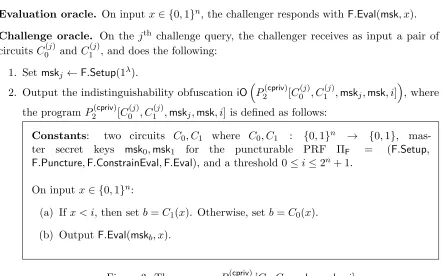
Proof overview. In the (multi-key) privacy game, the adversary makes challenge queries of the form (C0, C1), and the challenger replies with a constrained key for circuit Cb whereb∈ {0,1} is
fixed in the experiment. The constrained key Cb is an obfuscated program that evaluates Cb on
the inputx, and depending on Cb(x), outputs either the real PRF value at x, or that of a different
PRF at x. To show privacy, we show that the obfuscated program with C0 embedded inside is
computationally indistinguishable from that with C1 embedded inside. Our argument consists of a
sequence of hybrid argumentsH0, . . . ,H2n+1, where in hybridHi, the obfuscated program usesC1(x)
to determine which PRF output to use for the first iinputs in the domain (that is, all x < i), and
C0(x) for the remaining inputs. The first and last hybrids are identical to the real experiment where
the challenger constrains to C0, and that where the challenger constrains to C1. The programs
given out in each adjacent pair of hybrids differ on a single point, so using puncturing security, we can show that each adjacent pair of hybrids are also computationally indistinguishable. We give the full proof in Appendix D.2.
We note that Theorem 3.3 only requires subexponentially-secure7 iO if the set of challenge circuits {C0(j)}j∈[d] and {C1(j)}j∈[d] the adversary submits differs on a super-polynomial number
7Specifically, we require that for all efficient adversaries A, the distinguishing advantage Adv
of points. In particular, this implies that ΠioPRF is a private puncturable PRF assuming only polynomial hardness of iOand selective security of ΠF. For more details, see Remark D.11.
4
A Private Bit-Fixing PRF
In this section, we construct a constrained PRF for the class of bit-fixing circuits, a notion first introduced in [BW13]. First, a bit-fixing string sis an element of {0,1,?}n. We say a bit-fixing strings matchesx∈ {0,1}n if for alli∈[n], either s
i =xi orsi = ?. We now define the class of
bit-fixing circuits.
Definition 4.1 (Bit-Fixing Circuits [BW13]). For a circuit C : {0,1}n → {0,1}, a string s ∈
{0,1,?}n is bit-fixing for C if C(x) = 1 on precisely the inputs x ∈ {0,1}n that s matches. The
class of bit-fixing circuitsCbf is the class of all circuitsC:{0,1}n→ {0,1}for which there exists a
bit-fixing string forC.
Our bit-fixing construction uses multilinear maps [BS03], which are a generalization of bilinear maps [MOV93, Mil04, BF01]. While constructing ideal multilinear maps remains an open problem, there have been several recent candidates of graded encodings schemes [GGH13a, CLT13, GGH15, CLT15], which are often a suitable substitute for ideal multilinear maps. For ease of presentation, we describe our constructions using the simpler abstraction of ideal multilinear maps. However, we note that we can easily map our constructions to the language of graded encodings using the same techniques as in [BW13, Appendix B]. We begin by defining multilinear maps over prime-order groups. In Appendix A, we also recall the`-Multilinear Diffie-Hellman assumption [BS03, GGH13a] over prime-order multilinear maps.
Definition 4.2 (Prime-Order Multilinear Map [BS03, GGH13a, CLT13, GGH15, CLT15]). We define a prime-order multilinear map to consist of a setup algorithm MMGen along with a map functione, defined as follows.
• MMGen(1λ,1`). The setup algorithmMMGen takes as input the security parameter λand a positive integer `, and outputs a sequence of groups G~ = (G1, . . . ,G`) each of prime order p
(for aλ-bit primep). The algorithm also outputs canonical generatorsgi ∈Gi for eachi∈[`],
and the group orderp.
• e(ga1 1 , . . . , g
a`
1 ). The map function e : (G1)` → G` takes as input ` elements from G1 and
outputs an element inG` such that, for all a1, . . . , a`∈Zp,
e(ga1 1 , . . . , g
a` 1 ) =g
a1a2···a`
` .
Construction overview. Our starting point is the bit-fixing PRF by Boneh and Waters [BW13]. The Boneh-Waters bit-fixing PRF uses a symmetric multilinear map. To provide context, we give a brief description of the Boneh-Waters construction. Let {0,1}n be the domain of the PRF, and
let G~ = (G1, . . . ,Gn+1) be a sequence of leveled multilinear groups of prime order p. For each
i∈[n+ 1], let gi be a canonical generator of Gi; for notational convenience, we will often write g=g1. In the Boneh-Waters construction, they define the multilinear map in terms of a collection
of bilinear mapsei,j :Gi×Gj →Gi+j for each i, j∈[n] wherei+j≤n+ 1. The master secret key
in the Boneh-Waters PRF consists of exponents α,{di,0, di,1}i∈[n]∈Zp. For an input x∈ {0,1}
the value of the PRF atx isgα Q
i∈[n]di,xi
n+1 . A constrained key for a pattern s∈ {0,1,?}
n consists of
a “pre-multiplied” elementgα Q
i∈Sdi,si
1+|S| , whereS ⊆[n] is the subset of indices where si 6= ?, along
with componentsgdi,b
1 fori /∈S and b∈ {0,1}. While this construction is selectively secure [BW13],
it does not satisfy our notion of privacy. By simply inspecting the constrained key and seeing which elementsgdi,b
1 are given out, an adversary can determine the indices si in the patternswheresi = ?.
A first attempt to make the Boneh-Waters construction private is to publish gα along with a complete set of group elements{gd∗i,0, gd∗i,1}
i∈[n] where d∗i,b =di,b ifsi= ? or si=b, and otherwise,
setd∗i,b←−r Zp. By construction, this only permits evaluation of the PRF at the pointsx that match s. However, this does not yield a secure constrained PRF, since an adversary that sees more than one constrained key can mix and match components from different keys, and learn the value of the PRF at points it could not directly evaluate given any of the individual keys. To prevent mixing and matching attacks in our construction, we rerandomize the elements in the constrained key. We give our construction below.
Construction. For simplicity, we describe the algorithmcPRF.Constrain as taking as input the master secret key msk and a bit-fixing strings∈ {0,1,?}n rather than a circuitC ∈ C. We define
ΠbfPRF = (cPRF.Setup,cPRF.Constrain,cPRF.ConstrainEval,cPRF.Eval) as follows.
• cPRF.Setup(1λ). The setup algorithm runsMMGen(1λ,1n+1) and outputs a sequence of groups
~
G= (G1, . . . ,Gn+1) each of prime orderp, along with generators gi ∈Gi for all i∈[n+ 1].
As usual, we set g=g1. Next, fori∈[n], it samples (di,0, di,1) ←−r Z2p, along with a random
α←−r Zp. It outputs
msk=g, gn+1, α,{di,0, di,1}i∈[n]
. (4.1)
• cPRF.Constrain(msk, s). Letmskbe defined as in Equation (4.1) ands=s1s2· · ·sn. Fori∈[n]
andb∈ {0,1}, the constrain algorithm samplesn random elementsβ1. . . , βn←−r Zp uniformly
and independently, along withnrandom elementsr1, . . . , rn←−r Zp. Defineβ0 = (β1β2· · ·βn)−1.
For eachi∈[n], define
(Di,0, Di,1) =
gdi,0, gri, ifs
i = 0 gri, gdi,1, ifs
i = 1 gdi,0, gdi,1, ifs
i = ? .
It outputs
sk=
(gα)β0,n(D
i,0)βi,(Di,1)βi
o
i∈[n]
. (4.2)
• cPRF.ConstrainEval(sk, x). Write sk = gσ,{gµi,0, gµi,1}
i∈[n]
, and let x = x1x2· · ·xn. The
constrained evaluation algorithm computes and outputsy=e(gσ, gµ1,x1, . . . , gµn,xn).
• cPRF.Eval(msk, x). Let msk be defined as in Equation (4.1), and let x = x1x2· · ·xn. The
evaluation algorithm outputsy=gα Q
i∈[n]di,xi
Correctness and security. We now state the correctness and security theorems for ΠbfPRF, but defer the formal proofs to Appendix F.
Theorem 4.3. The bit-fixing PRF ΠbfPRF is correct.
Theorem 4.4. Under the(n+ 1)-MDH assumption (Definition A.1), the bit-fixing PRF ΠbfPRF is
selectively secure.
Theorem 4.5. The bit-fixing PRF ΠbfPRF is (unconditionally) 1-key private in the model where the
adversary does not have access to an evaluation oracle.
5
A Private Puncturable PRF
Recall from Section 2 that a puncturable PRF is a special class of constrained PRFs where the constraint can be described by a point function that is 1 everywhere except at a single point
s∈ {0,1}n. In this section, we give a construction of a private puncturable PRF using multilinear
maps over a composite-order ring. We give an adaptation of Definition 4.2 to the composite-order setting. In Appendix A, we review the standard Subgroup Decision assumption [BGN05, GGH13a] over composite-order groups, and a new assumption which we call the`-Multilinear Diffie-Hellman Subgroup Decision (MDHSD) assumption. Then, in Appendix B, we show that the `-MDHSD assumption holds in a generic model of composite-order multilinear maps, provided that factoring is hard.
Definition 5.1(Composite-Order Multilinear Map [BS03, CLT13, CLT15]). We define a composite-order multilinear mapto consist of a setup algorithmCMMGenalong with a map functione, defined as follows:
• CMMGen(1λ,1`). The setup algorithmCMMGentakes as input the security parameter λand a positive integer `, and outputs a sequence of groups G~ = (G1, . . . ,G`) each of composite
orderN =pq (wherep, q areλ-bit primes). For each Gi, letGp,i and Gq,i denote the order-p
and order-q subgroups of Gi, respectively. Let gp,i be a canonical generator ofGp,i, gq,i be
a canonical generator ofGq,i, and gi=gp,igq,i. In addition to G~, the algorithm outputs the
generatorsgp,1, . . . , gp,`, gq,1, . . . , gq,`, and the primesp, q.
• e(ga1 1 , . . . , g
a`
1 ). The map function e : (G1)` → G` takes as input ` elements from G1 and
outputs an element inG` such that, for all a1, . . . , a`∈ZN,
e(ga1 1 , . . . , g
a` 1 ) =g
a1a2···a`
` .
Construction overview. Our construction builds on the Naor-Reingold PRF [NR04], and uses composite-order multilinear maps of orderN =pq(Definition 5.1). In our description, we use the same notation for group generators as in Definition 5.1. The master secret key in our construction is a collection of exponents {di,0, di,1}i∈[n] where each di,b for all i∈[n] and b∈ {0,1} is random
overZN. The value of the PRF at a pointx∈ {0,1}n is the elementg Q
i∈[n]di,xi
p,n ∈Gp,n.
Suppose we want to puncture at a point s=s1· · ·sn ∈ {0,1}n. Our constrained key consists
of a collection of points{Di,0, Di,1}i∈[n]. For b6=si, we set Di,b =g
di,b
p,1 ∈Gp,1 to be an element in
the order-psubgroup, and for b=si, we set the element Di,b =g di,b
p,1g
di,b
the full group. To evaluate the PRF at a pointx∈ {0,1}n using the constrained key, one applies
the multilinear map to the componentsDi,xi in the constrained key. By multilinearity and the fact
that the order-p and order-q subgroups are orthogonal, if any of the inputs to the multilinear map lie in theGp,1 subgroup, then the output will be an element of the Gp,n subgroup. Thus, as long
as there exists some indexi∈[n] such thatxi 6=si, the constrained key will evaluate to the real
PRF output. If howeverx=s, then the constrained key onx will evaluate to an element of the full groupGn. We show in Theorem 5.3 that under then-MDHSD assumption, this element hides the
true value of the PRF at x, which gives puncturing security. Moreover, since the constrained key is just a collection of random elements in either Gp,1 or inG1, the scheme is 1-key private under the
Subgroup Decision assumption (Theorem 5.4).
Construction. For simplicity in our description, we describe the cPRF.Constrain algorithm as taking as input the master secret keymsk and a points∈ {0,1} to puncture rather than a circuit
C. We define ΠpuncPRF = (cPRF.Setup,cPRF.Puncture,cPRF.ConstrainEval,cPRF.Eval) as follows.
• cPRF.Setup(1λ). The setup algorithm runsCMMGen(1λ,1n) and outputs a sequence of groups
~
G= (G1, . . . ,Gn), each of composite orderN =pq, along with the factorization ofN, and the
generatorsgp,i, gq,i ∈Gi of the order-pand order-q subgroups ofGi, respectively for alli∈[n].
Let g1=gp,1gq,1 be the canonical generator ofG1. Finally, the setup algorithm samples 2n
random elements (d1,0, d1,1), . . . ,(dn,0, dn,1)←−r Z2N, and outputs the following master secret
keymsk:
msk=
p, q, g1, gp,1, gp,n,{di,0, di,1}i∈[n]
(5.1)
• cPRF.Puncture(msk, s∈ {0,1}n). Write s= s
1s2· · ·sn. Let g1 = gp,1gq,1. For each i ∈ [n],
define
(Di,0, Di,1) =
(
(gdi,0
1 , g
di,1
p,1), ifsi = 0
(gdp,i,01, gd1i,1), ifsi = 1 .
The algorithm then outputs the constrained key sk={Di,0, Di,1}i∈[n].
• cPRF.ConstrainEval(sk, x). Write sk as{Di,0, Di,1}i∈[n], and x=x1x2· · ·xn. The constrained
evaluation algorithm outputsy=e(D1,x1, . . . , Dn,xn).
• cPRF.Eval(msk, x). Let msk be defined as in Equation (5.1), and x = x1x2· · ·xn. The
evaluation algorithm outputsy=g Q
i∈[n]di,xi
p,n .
Correctness and security. We now state the correctness and security theorems, but defer the formal analysis to Appendix G.
Theorem 5.2. The puncturable PRF ΠpuncPRF is correct.
Theorem 5.3. Under the n-MDHSD assumption (Definition A.3), the puncturable PRFΠpuncPRF
is selectively secure.
Theorem 5.4. Under the Subgroup Decision assumption (Definition A.2), the puncturable PRF
ΠpuncPRF is 1-key private in the model where the adversary does not have access to an evaluation
6
Applications
In Section 1.1, we outlined several applications of private constrained PRFs. Several of our applications (private constrained MACs, restrictable SSE, and online/offline 2-server private keyword search) follow readily from our definitions of private constrained PRFs, and so we do not elaborate further on them. In this section, we give a more formal treatment of using private constrained PRFs to build secretly-verifiable message-embedding watermarking of PRFs and symmetric deniable encryption.
6.1 Watermarking PRFs
In this section, we show how to construct watermarkable PRFs from private programmable PRFs.8 The watermarking scheme we give is secretly-verifiable and supports message embedding [CHN+16], where the marking algorithm can embed a string into the program that can later be extracted by the verification algorithm. We first introduce some definitions for unremovability and unforgeability. The unremovability definitions are adapted from the corresponding definition in [CHN+16] while the unforgeability definitions are adapted from that in [CHV15]. We then show how to construct a watermarkable PRF from any private programmable PRF. Finally, we conclude with a survey of related work.
Definition 6.1 (Watermarkable Family of PRFs [CHN+16, adapted]). For the security parameter
λand a message space {0,1}t, a secretly-verifiable message-embedding watermarking scheme for
a PRF with key-spaceK is a tuple of algorithms Π = (WM.Setup,WM.Mark,WM.Verify) with the following properties.
• WM.Setup(1λ)→msk. On input the security parameterλ, the setup algorithm outputs the watermarking secret key msk.
• WM.Mark(msk, m) → (k, C). On input the watermarking secret key msk and a message
m∈ {0,1}t, the mark algorithm outputs a PRF keyk∈ Kand a marked circuit C.
• WM.Verify(msk, C0) → m. On input the master secret key msk and an arbitrary circuit C0, the verification algorithm outputs a string m∈ {0,1}t∪ {⊥}.
Definition 6.2 (Circuit Similarity). Fix a circuit classC onn-bit inputs. For two circuitsC, C0 ∈ C and for a non-decreasing function f :N →N, we write C ∼f C0 to denote that the two circuits
agree on all but an 1/f(n) fraction of inputs. More formally, we define
C ∼f C0 ⇐⇒ Pr
x←−r{0,1}n
[C(x)6=C0(x)]≤1/f(n).
We also write C6∼f C0 to denote that C and C0 differ on at least a 1/f(n) fraction of inputs. Definition 6.3 (Correctness ([CHN+16, adapted])). Fix the security parameterλ. A watermarking scheme for a PRF with key-spaceK and domain{0,1}n iscorrect if for all messagesm∈ {0,1}t,
msk←WM.Setup(1λ), (k, C)←WM.Mark(msk, m), we have that
8
• The keyk is uniformly distributed over the key-spaceK of the PRF.
• C(·)∼f F(k,·), where 1/f(n) = negl(λ).
• Pr[WM.Verify(msk, C) =m] with overwhelming probability.
Watermarking security. We define watermarking security in the context of an experiment
Exptwm between a challenger and an adversary A, which can make marking oracle and challenge oracle queries.
Definition 6.4 (ExperimentExptwm). First, the challenger samplesmsk←WM.Setup(1λ), and the challenger then responds to each oracle query made byA in the following manner.
• Marking oracle. On input a message m∈ {0,1}t, the challenger returns the pair (k, C)←
WM.Mark(msk, m) to A.
• Challenge oracle. On input a message m ∈ {0,1}t, the challenger computes (k, C) ←
WM.Mark(msk, m) but only returnsC toA.
Eventually, Aoutputs a circuit C0, and the challenger computes and outputs WM.Verify(msk, C0), which is also the output of the experiment, denoted as Exptwm(A).
Definition 6.5 (Unremoving Admissibility). An adversary Ais unremoving admissibleifA only queries the challenge oracle once, and C(·)∼f C0(·), whereC is the output of the challenge oracle query, C0 is the output of A, and 1/f(n) = negl(λ).
Definition 6.6 (Unremovability). A watermarking scheme Π isunremovable if for all efficient and unremoving admissible adversariesA, if m∈ {0,1}tis the message submitted by Ato the challenge
oracle inExptwm, the probabilityPr[Exptwm(A)6=m] is negligible.
Definition 6.7 (δ-Unforging Admissibility). We say an adversary Ais δ-unforging admissible if A does not make any challenge oracle queries, and for alli∈[Q],Ci(·)6∼f C0(·), whereQis the total
number of marking queries the adversary makes, Ci is the output of the marking oracle on the ith
query, C0 is the circuit output by the adversary, and 1/f(n)≥δ for all n∈N.
Definition 6.8 (δ-Unforgeability). We say a watermarking scheme Π is δ-unforgeable if for all efficient and δ-unforging admissible adversariesA, the probabilityPr[Exptwm(A)6=⊥] is negligible.
Construction. Fix the security parameter λ, positive integers n, `, t ≥ λ, and a positive real valueδ < 1, such thatd= λ/δ = poly(λ). Let F :K ×({0,1}`× {0,1}t)d → {0,1}n× {0,1}`×
{0,1}t be a PRF, and let Π
pprf = (pPRF.Setup,pPRF.Program,pPRF.ProgramEval,pPRF.Eval) be a programmable PRF with input space {0,1}n and output space {0,1}`× {0,1}t. We construct a
watermarking scheme Πwm= (WM.Setup,WM.Mark,WM.Verify) for the PRF Πpprf as follows:
• WM.Setup(1λ). The setup algorithm chooses k←− Kr and (z1, . . . , zd)←−r ({0,1}n)d uniformly
at random and outputsmsk= (k, z1, . . . , zd).
• WM.Mark(msk, m). The mark algorithm first parsesmsk= (k, z1, . . . , zd). It generatesk0 ←
pPRF.Setup(1λ), and then computes the point (x, y, τ) =F(k,(pPRF.Eval(k0, z1), . . . ,pPRF.Eval(k0, zd)))
and v = m⊕τ. Then, it computes skk ← pPRF.Program(k0, x,(y, v)) and outputs (k0, C),
• WM.Verify(msk, C). The verification algorithm first parses msk = (k, z1, . . . , zd) and then
computes (x, y, τ) =F(k,(C(z1), . . . , C(zd))). It then sets (y0, v) =C(x) and outputs v⊕τ if y=y0, and ⊥otherwise.
We state our correctness and security theorems here, but defer their proofs to Appendices H.1 and H.2.
Theorem 6.9. If F is a secure PRF and Πpprf is a programmable PRF, then the watermarking
scheme Πwm is correct.
Theorem 6.10. If F is a secure PRF and Πpprf is a private programmable PRF, then the
water-marking scheme Πwm is unremovable.
Theorem 6.11. If F is a secure PRF and Πpprf is a programmable PRF, then for δ= 1/poly(λ),
the watermarking scheme Πwm is δ-unforgeable.
Related work. Recently, Cohen et al. [CHN+16] showed how to construct publicly-verifiable watermarking for puncturable PRFs from indistinguishability obfuscation. They pursue the notion of approximate functionality-preserving for watermarking, where the watermarked program agrees with the original program on most inputs. Previously, Barak et al. [BGI+12] showed that assuming
iO, perfectly functionality-preserving watermarking is impossible.
Cohen et al. [CHV15] gave a construction fromiOwhich achieves publicly-verifiable watermarking for relaxed notions of unremovability and unforgeability, namely where the adversary can only query the marking oracle before receiving the challenge program in the unremovability game and moreover, is only allowed to query the challenge oracle once (lunchtime unremovability). In addition, the adversary must submit a forged program which differs on the same set of inputs with respect to all programs submitted to the mark oracle in the unforgeability game.
In a concurrent work to [CHV15], Nishimaki and Wichs [NW15] considered a relaxed notion of watermarking security for message-embedding schemes by considering “selective-message” security, where the adversary must commit to the message to be embedded into the challenge program before interacting with the mark oracle. This limitation is removed in their subsequent work [CHN+16].
Comparison to previous works. In previous constructions of watermarkable PRFs [NW15, CHV15, CHN+16], the authors show how to watermark any family of puncturable PRFs. In contrast, our construction gives a family of watermarkable PRFs from private programmable PRFs. In our construction, we also consider a slightly weaker version of the mark oracle which takes as input a message and outputs a random program that embeds the message. This is a weaker notion of security than providing the adversary access to a marking oracle that take as input an (adversarially-chosen) program and a message and outputs a watermarked program with the embedded message.9 In addition, we consider secretly-verifiable watermarking constructions while Cohen et al. and Nishimaki and Wichs focus on publically-verifiable constructions. However, despite these limitations, we note that the family of watermarkable PRFs we construct are still sufficient to instantiate the motivating applications for watermarkable PRFs by Cohen et al. [CHN+16]. In our model, we are able to achieve full security for unremovability as well as strong unforgeability.
9