TEACHING READING OF NARRATIVE TEXT THROUGH THINK PAIR SHARE TECHNIQUE TO THE TENTH GRADE STUDENTS OF SMAN 1
BANJAR MARGO
(A Script)
By: Agus Budiarte
FACULTY OF TEACHER TRAINING AND EDUCATION UNIVERSITY OF LAMPUNG
ii ABSTRACT
TEACHING READING OF NARRATIVE TEXT THROUGH THINK-PAIR SHARE TECHNIQUE TO THE TENTH GRADE STUDENTS OF
SMAN 1 BANJAR MARGO By
AgusBudiarte
The aim of this study was to find out whether there is a significant improvement of students’ reading comprehension achievement after being taught through Think Pair Share technique. The research was quantitative research which used one group pre-test - post-test design.
The population of this research was the students of SMAN 1 Banjar Margo academic year 2016/2017. The sample of this research was X MIPA 1 which consisted of 30 students. This research was conducted from January 17th to February 16th 2017. The instrument was reading test.
The result of this research showed that there was a siqnificant improvement of students’ reading comprehension after being taught through Think Pair Share technique. It could be seen from the result of the hyphothesis test which showed that at significant level of p<0.05 (p=.000), in which the students’ mean score in pre-test was 57.033 increase to 70.2667 in post test with 13.2334 of gain. The data were analyzed by using t-test in which the siqnificance was determined by p<0.005. It is found that Think Pair Share technique can increase students’ reading comprehension achievement. It seems that Think Pair Share influence students’ learning process.
TEACHING READING OF NARRATIVE TEXT THROUGH THINK-PAIR SHARE TECHNIQUE TO THE TENTH GRADE STUDENTS OF SMAN 1
BANJAR MARGO
By: Agus Budiarte
A Script
Submitted in a Partial Fullfilment of The Requirement for S-1 Degree
in
The Language Arts Department of Teacher Training and Education Faculty
FACULTY OF TEACHER TRAINING AND EDUCATION UNIVERSITY OF LAMPUNG
vii CURRICULUM VITAE
Agus Budiarte was born in Tulang Bawang, on April 8th, 1995. He grew in harmonious and happy family from greatest couple, Nyoman Gantas and Ketut Sariani. He has two beloved brothers Made Sudarme and Nyoman Sudiane.
He attended his elementari school at SDN 1 Penawar Rejo, Tulang Bawang in 2001 and graduated from elementary school in 2007. Then, he continued his study at SMPN 1 Banjar Margo, Tulang Bawang. He graduated from junior high school in 2009. After that, she entered SMAN 1 Banjar Margo, Tulang Bawang and finished his tudy there in 2013.
viii DEDICATION
This paper is proudly dedicated to:
My beloved parents, Mr. Nyoman Gantas and Mrs. Ketut Sariani My brothers, Made Sudarme and Nyoman Sudiane
My sister in law, Ni Wayan Luh Tantri
My beloved nephew and niece, Asita Daivi Vinaya and Ragunata Vidi Darsana My special person who is always supporting me in finishing this study
All my beloved friends
ix MOTTO
“It is far better to discharge one’s prescribed duties, even though faultily, than another’s duties perfectly. Destruction in the course of performing one’s own duty is
x ACKNOWLEDGEMENT
Om Awighnam Astu Namah Sidham. All praise is rendered only to Brahman for His abundant mercy and tremendous blessing that enables the writer to finish her script. This script entitled “Teaching Reading of Narrative Text through Think Pair Share Technique to the Tenth Grade Students of SMAN 1 Banjar Margo” is submitted as a compulsory fulfillment of the of the requirement for S-1 degree at the Language and Arts Education Department of Teacher Training and Education Faculty of University of Lampung.
Gratitude and honor are addressed to all people who have helped and supported the writer until the completion of this research. Since it is necessary to be known that this research would never have come into its existance without any supports, encouragements and assistances by several outstanding people and institutions, the writer would like to express her sincere gratitude and respect to:
1. Dr. Flora Nainggolan, M.Pd., as the first advisor who has contributed and given his invaluable evaluations, comments, and suggestions during the completion of this script.
2. Drs. Huzairin, M.Pd., as the second advisor, for his assistance, ideas, guidance, and carefulness in correcting the writers’ script.
3. Prof. Ag. Bambang Setiyadi, M.A., Ph.D., as the examiner, for his supportive encouragement, ideas, suggestions and in supporting the writer.
xi 6. The writer’s parents (Mr. Nyoman Gantas and Mrs. Ketut Sariani), beloved brothers (Made Sudarme and Nyoman Sudiane), my beloved sister in law ( Ni Wayan Luh Tantri), my beloved nephew and niece ( Asita Daivi Vinaya and Ragunata Vidi Darsana) for their love, support, motivation and prayer.
7. The writer’s special person, for her support, motivation and prayer.
8. The writer’s beloved friend, Tri Andika for being my room-mate, my bestfriend for more than nine years, also for his support and motivation to the writer.
9. The writer’s beloved friend, Nur Kholik for being my bestfriend in this campus. The one who is always being my side in any conditions when I am in this campus.
10.The writer’s beloved friends, Nur Kholik, Rikko Karendra, Yoseph Papuanus Iyai, Agung Putra Mangunsong, Irham Juliyanto, Azmi Alharis, Dio Ferizka, Aldo Saputra, Ricky Oktavianus, Muhammad Fajri Abdilah, Deni Saputra, and Arsyad Algifari. for being my close friend in college and for their support and prayer to the writer.
11.The writer’s KKN friends in Siswo Bangun village, Center Lampung for their support and motivation to the writer.
12.The writer’s friends in UKMH Unila for their support and prayer to the writer. 13.All people who helped the writer that I can not mention one by one.
Finally, the writer believes that her writing is still far from perfection. There may be weakness in this research. Thus, comments and suggestions are always welcome for better research. Somehow, the writer hopes this research can give a positive contribution to the educational development, the readers and those who want to accomplish further research.
Bandar Lampung, June 4th 2017 The Writer
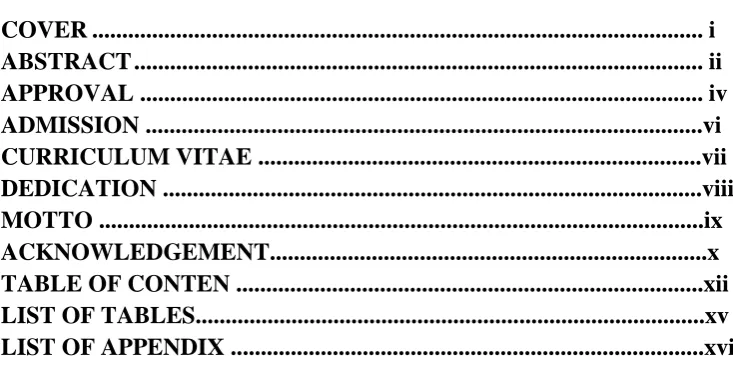
xii TABLE OF CONTENT
COVER ... i
ABSTRACT ... ii
APPROVAL ... iv
ADMISSION ...vi
CURRICULUM VITAE ...vii
DEDICATION ...viii
MOTTO ...ix
ACKNOWLEDGEMENT...x
TABLE OF CONTEN ...xii
LIST OF TABLES...xv
LIST OF APPENDIX ...xvi
I. INTRODUCTION 1.1. Background of the Problem ... 1
1.2. Identifications of the Problem ... 5
1.3. Objectives of the Research ... 5
1.4. Uses of the Research ... 5
1.5. Scope of the Research ... 6
1.6. Definition of Terms ... 6
II. LITERATURE REVIEW 2.1. Concept of Reading ... 7
2.2.Definition of Teaching Reading ... 10
2.3. Definition of Think-Pair-Share (TPS) ... 11
2.4. Think-Pair-Share in Reading ... 12
2.5. Procedures of Teaching Reading Through TPS ... 14
2.6. Advantages of Think-Pair-Share (TPS) Technique... 15
xiii
2.8. Theoretical Assumption ... 19
2.9. Hypothesis ... 19
III. RESEARCH METHODS 3.1. Research Design ... 20
3.2. Population and Sample ... 21
3.3. Instruments ... 21
3.4. Data Collecting Technique ... 21
3.5. Research Procedures ... 22
3.6. Try Out of the Instruments ... 24
3.6.1. Validity ... 24
3.6.2. Realibility ... 25
3.6.3. Level of Dificulty ... 27
3.6.4. Discrimination Power ... 28
3.7. Scoring System ... 29
3.8. Data Analysis ... 29
3.9. Hypothesis Testing ... 30
IV. RESULT AND DISCUSSION 4.1. The results of the research ... 31
4.1.1. The Result of the Pretest ... 31
4.1.2. Result of Post Test... 33
4.1.3. Improvement of Students’ Reading Comprehension of Narrative Text by Using TPS Strategy ... 36
4.1.4. Normality Test... 39
4.1.5. Hypothesis Testing ... 40
4.2. Discussion of Findings ... 42
xiv 5.2. Suggestions ... 50
xv LIST OF TABLES
Table 1. Table Specification of reading Test ... 25
Table 2. Specification of Pre Test ... 31
Table 3. Distribution Frequencies of Pre Test ... 32
Table 4. Pre-test Score ... 32
Table 5. Specification of Post Test ... 34
Table 6. Distribution Frequencies of Post Test ... 34
Table 7. Post-test Score ... 35
Table 8. The Improvement of Each Aspects ... 36
Table 9. Improvement from Pre-test to Post-test ... 39
Table 10. Normality Testing ... 39
Table 11. T-Test Table ... 41
xvi LIST OF APPENDICES
Appendix 1. Research Schedule ... 53
Appendix 2. Try Out Test ... 54
Appendix 3. Key Answer ... 65
Appendix 4.Realibility of the Try Out Test ... 67
Appendix 5.The Reliability Computation of the Data Collecting Instrument .... 69
Appendix 6. Result of Students Score of Pre Test in Experimental Clas ... 70
Appendix 7.Distribution Frequencies of Pre Test ... 71
Appendix 8.Result of Reading Aspects Analysis in Pre Test ... 73
Appendix 9.Result of Students Score of Post Test in Experimental Clas ... 74
Appendix10.Distribution Frequencies of Post Test ... 75
Appendix11.Result of Reading Aspects Analysis in Post Test ... 77
Appendix12.T-Test ... 78
Appendix13.Lesson Plan 1 ... 79
Appendix14.Lesson Plan 2 ... 84
Appendix15.Lesson Plan 3 ... 89
Appendix16.Pre-Test ... 96
Appendix17.Post Test ... 104
Appendix18.Surat Penelitian... 111
Appendix19.Surat Balasan Sekolah ... 112
Appendix20.Students Work Sheet ...113
1
I. INTRODUCTION
This chapter discussed introduction of the research which dealt with several points such as background of the problem, identification of the problem, objectives of the research, uses of the research, scope of the research, and definition of terms. Each of them will be elaborated bellow.
1.1. Background of the Problem
Reading is an interesting language skills. It is known that the ability of reading is necessary to get the knowledge. The purpose of reading is to gather the knowledge and information about the problems/questions faced by the people or something they have not known before. For instance, someone who wants to know about the effect of consuming instant noodle for humans health, he can read an articles on the internet that contains some information into that catalyst.
2
Considering the purpose of reading, Willis (2008) states that by reading, someone can find the information he/she needs with the specific information. Reading helps the reader to get what they want to know. Additionally, by reading we learn something new which we do not know before. We may learn about the meaning of culture, practice and forms of culture.
In common condition, reading a book, an article, or a passage in English for some students is not an easy work to do. Many students get low score in reading section because it is hard to identify the main idea, specific information, inferences, and the word meaning of the text. Moreover, students who learn English are expected to master every single language skill with reading skill as the main skill. Reading is the main skill that students have to master, since in any tests that students faced contains of reading text. There are almost all types of text appear in students final examination even in national examination.
There are some applicable techniques. One of the techniques is Think Pair Share technique. Thin Pair Share is one of the cooperative learning techniques found by Lyman in 1981. Think-pair-share gives the students opportunity to discuss their problem in comprehending a text to another, so they can solve the problem together. There are some researchers who use Think Pair Share technique in order to increase students’ reading comprehension achievement.
3
increase in the control group that used GTM (55.67 to 61.75 point). Based on his finding, he confidently said that think-pair-share technique was able to increase the students’ reading comprehension achievement.
Another opinion was given by Allen (2007: 107). He states that the advantages of Think Pair Share are providing students with think time prior to discuss, permiting for independent and collaborative learning, giving students opportunities to collaborate to refine definitions, giving some more triggers to more equal participation as all students share with one other and then with another pair of students, engaging students in active learning. Supposed if all of the students can get all of those advantages, it will make reading as an enjoying activity. In short, students can obtain the main idea of the text, find the specific information easily, and everything that they need in reading and comprehending the text. If it may be said that it will help their improvement of reading comprehension achievement.
4
increase student reading achievement. Moreover, students may share the idea with their friend to obtain the best answer of the question.
Another research was done by Rohibah (2013). She conducted a research on increasing students’ comprehension through TPS technique in procedure text at the first grade of senior high school. She found that teaching reading through Think Pair Share technique can be used to increase students’ participation in contributing the group work clearly and has a good positive result in teaching learning activities in the class. The students’ relationship within group or pair becomes stronger. Besides, students feel that think pair share technique is enjoyable, simplifies the group work assignment and improves responsibility.
Moreover, Palupi (2013) found that there was a significant difference of students’ reading comprehension after being taught through Think Pair Share (TPS) technique at SMPN 8 Bandar Lampung in recount text. It can be seen from the value of t-ratio is higher than t-table (9.935>2.042) and the significant level is lower than 0.05 (0.000<0.05). It means that H0 was rejected and H1 was accepted. It was also proved from the increase of the students’ mean score in the post-test which was higher than in the pre-test.
5
Narrative Text Through Think-Pair Share Technique at the Tenth Grade Students.”
1.2. Identifications of the Problem
Based on the explaination stated above, the researcher formulated the problem as follows :
1. Is there any significant improvement of students’ reading comprehension after being taught through TPS technique?
2. What aspect of reading that improves the most after being taught through TPS technique?
1.3. Objectives of the Research
By relating to the formulation of the problems, the objectives of the research were as follows:
1. To investigate whether there is any significant improvement of students’ reading comprehension after being taught through TPS technique
2. To investigate aspects of reading that improves the most after being taught through TPS technique.
1.4. Uses of the research
The uses of this research were as follows: 1. Theoretically
Theoretically, this research was to investigate whether there was any significant improvement of student reading comprehension after being taught through TPS technique or not.
6
a. As information for those who wanted to teach reading through Think-Pair-Share technique.
b. To be a reference for the next researchers who would do a research about TPS for their script.
1.5. Scope of the Research
This research was cunducted at the tenth grade of SMAN 1 Banjar Margo. The focus of this research was limited on narrative text.
1.6. Definition of Terms
Some terms defined in order to give basic understanding of the related variables and concept. These were stated below:
1. Reading comprehension means relating to what someone does not know or new information to what he already knows through printed messages being read. It may be regarded as relating aspects of the world around human being including what is being read to the knowledge, intentions, and expectations that are already in readers’ head (Smith, 1982:15)
2. Think-pair-share is a summarization strategy that can be used in any content area before, during, and after a lesson. The activity involves three basic steps, which are thinking, pairing, and sharing (Lyman, 1981).
3. Narrative text is a kind of text to retell the story that in the past. The purpose of the text is to entertain or to amuse the readers or listeners about the story.
7
II. LITERATURE REVIEW
This chapter explained about some theories related to the research. The theories would be the references for the researcher in conducting the research. The theories that would be explained were as follows.
2.1. Concept of Reading
8
says that reading is difficult to analyze because it involves the most intricate working of human mind, it is a genuine cognitive process.
In order to obtain the information, having comprehension ability is needed by the readers. While the readers are in a reading process, actually they attempt to understand what is written through this ability. Comprehension always follows reading because there will be no reading without comprehension. There are three level of reading comprehension according to Smith (1969) and Wayne (1979):
a. Literal comprehension
Literal comprehension is a process of understanding the ideas and information that is explicitly stated in the passage, such as identifying the meaning of the word, recalling direct-stated details, paraphrasing, and understanding the grammatical clues like subjects, verbs, pronouns, conjunction, etc. In this level, the reading comprehension question is factual and detailed.
b. Interpretative comprehension
Interpretative comprehension refers to the understanding of the ideas or information that is not explicitly stated in the passage. It includes the understanding of the author’s tone, purpose, and attitude; inferring the factual information, main ideas, comparisons, cause-effect relationships; and summarizing the story content.
c. Critical comprehension
9
Those three kinds of comprehension are needed in order to understand the texts. The researcher realizes that each of them help the readers to apprehend the texts. Basically the readers are started their interactive process that involves the readers’ background knowledge. But in this research, the researcher was not dealing with those three level of reading comprehension. So that, the researcher only analyzed students’ reading comprehension by analyzing the five aspects of reading. Background knowledge is a knowledge that the reader has known before reading the text. Therefore it can support the reader in order to comprehend the text. There are five reading aspects (Nuttal: 1985) which help the students to comprehend the English text well, i.e. main idea, specific information, references, inference, and vocabulary. These aspects are explained below:
1. Main Idea
Main idea is called the topic sentence. It tells what the rest paragraph is about. In some paragraphs, the main idea is not explicitly stated in any one sentence. It is left to the reader to infer or reason out. So, main idea is the very important idea that the author develops throughout the paragraph.
2. Specific Information
Specific information or supporting sentence develops the topic sentence by giving definitions, examples, facts, an incidents, comparison, analogy, cause and effect statistics and quotation.
3. References
10
4. Inference
Inference is an educational guess or prediction about something unknown based on available facts and information. It is the logical connection that the reader draw between his observes or known and what he does not know.
5. Vocabulary
Vocabulary is the stock of word used by people or even person. Concerning with those statements indeed vocabulary is fundamental for everyone who wants to speak or to produce utterances for reading.
According to the explanation above, there are five aspects of reading. They were main idea, specific information, inference, reference, and vocabulary.
2.2. Definition of Teaching Reading
Hedge (2003) states that reading component of an English language teaching may include a set of learning goals for:
1. Developing the language range goal through independent readers outside EFL/ESL classroom is the most teachers seek in reading English texts.
2. Building knowledge of language which will facilitate reading ability. 3. Building schematic knowledge.
4. Adapting the reading technique according to its reading purposes. 5. Developing an awareness of the structure of written texts in English. 6. Taking a critical stance to the contents of the texts.
11
materials involve three-phase procedure: pre-, while-, and post-reading stages. In pre-reading stage, it is used to activate the relevant scheme, for example, teacher can ask the students some questions that can arouse their interest while previewing the reading text. While-reading stage is an interactive process that can develop students’ ability in doing their tests by developing their linguistics and schematic knowledge. In the last stage, post-reading is used to enhance learning comprehension by using reading comprehension tests such as matching, cloze exercises, cut-up sentence, and comprehension questions.
Basically the purpose of teaching reading is to develop students’ skill of the reading English texts effectively and efficiently. Teaching effectively and efficiently always become the focus of the teaching-learning, especially in reading, that has been put as the basic in choosing the techniques in many various types of texts. Therefore, the teaching technique should be matched with the reading purposes. Suparman (2005:1) states that whether it is for pleasure or for information, reading should be meaningful besides efficient and effective.
The appropriate technique must be applied based on the purpose of reading in order to increase the reading classroom activities. Think-Pair-Share (TPS) is one of the techniques that can be applied in senior high-school students because this technique will provide effective, efficient, independent, and responsible reader before they step into higher education.
2.3. Definition of Think-Pair-Share (TPS)
12
the sharing stage. As Lie (2002:57) states that Think-Pair-Share (TPS) is a technique that gives the opportunity to the students to work alone and also in a group.
Think-Pair-Share (TPS) developed by Frank Lyman and his collages (1981) in Maryland. It gives the students more time to think, to respond, and to help each other. There are three steps of this technique:
1) Thinking
Firstly, the teacher will divide the text into two parts before distributing to the students. Then the teacher will give the students time to think few moments. The students are supposed to think about the text individually.
2) Pairing
After that, the students have to find their pair who has different part of the text. Each of them has to talk about their thinking of the text before. Then they will gather the idea of the text in order to get the whole idea. Both of them will share the text to identify the interpretation of the text.
3) Sharing
In the last step, the students will find the other pair to share the information that they have discussed before in pairing step. Each of them will collect the all information then fix it as the best information.
This technique may be used to increase the class participation that are directed to work both individually and collaborative contribution by giving and taking information from each other
2.4. Think-Pair-Share in Reading
13
Kartika (2013) conducted her research inSMAN 8 Bandar Lampung. She found that there is a significant increase of the students’ reading comprehension in hortatory exposition text achievement after being taught through Think-Pair-Share technique. It can be seen from the increasing score on the pretest and posttest of the experimental class that increased from 50.16 to 84.22 in posttest with the gain was 34.06. There was an increase of the total scores from pretest and posttest from 1605 to 2695, with the gain 1090. On the other hand, determining the features of the form of a text has the highest increase, with the gain score was 45,7 and the lowest was making inference, which was 14.2. Additionally, using Think-Pair-Share technique in teaching Reading is good to increase student reading achievement. Moreover, students may share the idea with their friend to obtain the best answer of the question.
Another research was done by Rohibah (2013). She had a research on increasing students’ comprehension through TPS technique in procedure text at the first grade of senior high school. She found that teaching reading through Think Pair Share technique can be used to increase students’ participation in contributing the group work clearly and has a good positive result in teaching learning activities in the class. The students’ relationship within group or pair becomes stronger. Besides, students feel that think pair share technique is enjoyable, simplifies the group work assignment and improves responsibility.
14
value of t-ratio is higher than t-table (9.935>2.042) and the significant level is lower than 0.05 (0.000<0.05). It means that H0 was rejected and Ha was accepted. It was also proved from the increase ofthe students’ mean score in the post-test which was higher than in the pre-test.
The previous research have invested about teaching reading through TPS technique in hortatory text, recount text, and procedure text. It seems that the previous research have not conduct a research of teaching reading through TPS technique in narrative text. Considering the problems above, the researcher is interested to conduct a research that will complete another research.
2.5. Procedures of Teaching Reading Through Think-Pair-Share (TPS) Palupi (2013) stated that there were some procedures of teaching reading through Think-Pair-Share (TPS):
1) Pre activity In this stage:
a.The teacher divided the text into two parts before distributing them to the students
b.The teacher asked the students to read the text then gave them more time to think about what the text was mainly telling about. In this time, the students should try to comprehend the text individually that represent the thinking step.
2) While Activity
15
b.The teacher asked the students to gather the ideas that two of them have before. The students had to combine the whole text information. Therefore each of them must pay attention to their partner’s explanation.
c.The teacher asked the students to find the other pair to share the information. This exchange information was considered as the sharing step. Each of them would gather the all information to get the best interpretation. In this stage, the information depend on their listening ability.
3) Post Activity
a.The teacher gave the students several question related to the text to check their reading comprehension. This stage was considered as the evaluation activity. b.The teacher asked the students one by one in order to see the result of reading comprehension.
2.6. Advantages of Think-Pair-Share (TPS) Technique
Allen (2007:17) states some benefits of Think-Pair-Share (TPS) as a technique: 1) It provides students time to think to prepare their own information into the discussion with their pair.
2) It allows both independent and collaborative learning. The students have their own time towork by themselves and together with their partner(s).
3) It gives students opportunities to collaborate the refining definition. While they are in the stage of sharing process, they have opportunities to exchange information with their pair.
4) It invites equal participation. Each of students will tell the information that she/he has to their pair.
16
6) It invites students to share their understanding in both kinesthetic and visual modes. While the student is explaining in sharing step, they usually use body language and face-to-face interaction to send their information to their friends. Concerning those benefits, teachers can reach the goal of teaching reading because students can really understand the content of the text. Each of students also has the same opportunity to share their ideas with their friends.
While, here are some advantages of Think-Pair-Share technique according to Johnson and Johnson (2001):
1. Thinking Time Provision
Think-time in Think-Pair-Share allows the students to develop their answer. It because it helps the students to control the first answer that come first in their mind to be more reliable and better answer that is full of justification and reasonable.
2. Making Students Actively Involved
This strategy has power to make all the students get involve in the learning process. Pair and share-time triggers the students to talk and discuss with each other about their own thoughts. They also used to appreciate ones opinion about the problem and the answer. So, it makes the students more actively involve in group discussion and class participation.
3. Resolving Students’ Misunderstandings
Students’ misunderstanding about the topic are resolved during peer-tutoring or
17
4. Easy to Implementing on the spur of the moment
Think-pair-share is easy to be implemented because it does not take much time for the class preparation.
5. As a cooperative Learning Strategy, Think-Pair-Share benefits students in the areas of peer acceptance, peer support, academic achievement and self-esteem.
2.7. Disadvantages of Think-Pair-Share (TPS) Technique
Choosing Think-Pair-Share (TPS) as a technique in teaching reading can solve students’ reading problems but every teaching-learning technique has its own drawbacks. There aresome disadvantages of Think-Pair-Share (TPS) as a technique as follows:
1) This technique spends much time when the process does not run well.
2) While sharing stage, the teacher cannot fully monitor each pair because there are not any specific rules about how long they will speak. It means that the discussion may be dominated by certain students. In order to avoid this problem, teacher should work hard to monitor the process of discussion.
3) The information received by the students is limited to what their friends know.
Besides having some advantages, think-pair-share according to Lyman (1981) also has disadvantages as follow:
1. Time Consuming
18
2. Odd number of students
Problem may appear when the number of students is odd, for example 27. In such case, the teacher may let one a group with odd number, i.e. three students, for the pairing stage (leaving one students alone in pairing process is not preferable and
inconsistent with the procedure of TPS).
3. Domination of Certain Students
Students who are in upper level of knowledge usually have many opportunities to share their idea because they have more ideas in their mind than the lower students. It can create a situation where the upper students try to dominate the process of learning (especially in sharing stage). Therefore, the teacher should always check and monitor the entire process to ensure that such thing does not happen. Students should also be provided an understanding about equal opportunity and participation in classroom learning.
4. Assigning The member of The Groups
Think-pair-share technique allows all of the students to share their ideas one by one. It makes the teacher should assigned every students in order to monitor their participation. It will be hard because the teacher will work harder to remember and recognize the students who are good or not in the process of learning in the classroom.
5. Limited Information
19
elaborate their ideas, so the information given only rotate in the same place or not elaborate well and not so many information that studentsget from their friends.
2.8. Theoretical Assumption
Reading was considered as one of skills that the students need to master. Reading was not only a process of seeing from one symbol to the other. The readers were supposed to understand about what the writer wants to talk about. By having an ability to comprehend the text, the reader hopefully would not only read but also got the information which written in the text. Therefore, appropriate technique was really needed to help the students in order to get the information. Think-Pair-Share (TPS) technique might be the solution. This technique had three steps that the researcher assumes that TPS technique was an effective technique in improving students’ reading comprehension achievement.
2.9. Hypothesis
The hypotheses which were proposed to be formulated in this research was below: 1. There is an increase of students’ reading comprehension achievement after
being taught by using think-pair-share technique.
20
III. RESEARCH METHODS
This chapter discussed about research design, population and sample,instrument, data collecting technique, research procedure, try out of the instrument, scoring system, data analysis, and hypothesis testing.
3.1. Research Design
In conducting this research, the researcher used experimental method. The researcher used the one group pretest post test design, in which there was one group as the sample (Setiyadi, 2006). The class got the treatment from the researcher and also got pre-test and post-test. In order to see whether think-pair-share could be used improving the students’ reading comprehension achievement was determined by the difference scores of pre-test and post-test. This research design was represented as follows:
T1 X T2
Which are : T1 : Pre-test
X : Three Times Treatment
21
3.2. Population and Sample
The samples of this research were the students in SMAN 1 Banjar Margo. There were six classes 2016/2017 academic year and had almost the same age from 15 until 16 years old. The class that I used as a sample consist of 30 students. Most of them were not able to write, to speak clearly, or to read. In this research, the researcher only took one class as the sample of the research and one class as the try out class. The sample was taken randomly by using lottery.
3.3. Instrument
Instruments in this research, the researcher used an instrument for conducting the research. The instrument was tested by using reading test. The instrument used was objective reading test of narrative text that was used for tryout, pre-test, and post-test. Those tests were in form of multiple choices that consists of four options (A, B, C and D). The multiple choice test was used since its marking is rapid, simple and most importantly reliable, not subjective or influenced by the marker’s judgment (Heaton, 1975).
3.4. Data Collecting Technique
For collecting the data, the researcher gave pre-test and post test of reading. The test as given before and after the treatment as follows :
1.Pre-test
22
The material was given based on 2013 curriculum of senior high school, which consider suitable vocabulary, grammar, and structure.
2. Post-test
The post-test was given to the students after the treatments to find out the significant difference between the score of the students’ reading comprehension achievement after being taught through Think Pair Share technique in narrative text. The result of post-test was compared with the result of pre-test. The test consisted of 30 multiple choices items consisting of four options (A, B, C, and D). That was the explanation about the data collecting technique.
3.5. Research Procedures
This research would be conducted based on the followng procedures: 1. Determining the Sample
The reseacher took one clas in the first year of SMA Negeri 1 Banjar Margo. The sample was taken randomly by using lottery.
2. Conducting the Pretest
The pretest was administrated in order to measure the students’ reading skill achievement before being taught through TPS. The pretest was in form of reading test which is in multiple choice and matching all in 30 items in 60 minutes.
3. Selecting the Material
23
4. Treatment
It this research, treatment was down in three meetings with 90 minutes in every meeting. The chosen class was taught by TPS. The procedure was as follows: Pre Activity
Whilst Activity Post Activcity
5. Administering Posttest
The post-test was given to the students in experimental class after the treatment of teaching reading comprehension achievement through Think Pair Share technique, to know whether the students’ reading comprehension achievement increase or not. It took 60 minutes and used 30 items of multiple choice tests with four options (A, B, C and D).
6. Analyzing Data
After conducting pre-test and post-test, the researcher analyzed the data by using T-test. It was used to know whether Think Pair Share is able to increase students’ reading comprehension achievement in narrative text or not. It was computed through SPSS.
24
3.6. Try Out of the Instrument
In doing the research and proving whether the test items were applicable or not, the researcher tried out the test to find out the validity, reliability, or level of difficulty, and discrimination power of the test. It was conducted in order to determine whether the 50 items had a good quality or not before being given for the pretest and the post-test. There were four criteria of a good test that should be met: validity, reliability, level of difficulty, and discrimantion power.
3.6.1. Validity
Hatch and Farhady (1982) stated that a test is considered valid if the test measures the object to be measured and suitable with the criteria. They claim that there were two basic types of validity: conten validity and construct validity.
A. Conten Validity
Hatch and Farhady (1982) claim conten validity was the extend to which a test measure a representative sample of the subject matter content, the focus of content validity was adequacy of the sample and simply on the appereance of the test. The procedure for determining content validity was to compare the test content with the universe of content or behaviours supposedly being measured.
B. Construct Validity
25
[image:41.595.134.515.323.450.2]conclude that construct validity wass to measure or pointing on the constistency of the test and the theory used.If a scale had represented all idea or concept which was going to be measured, this scale had fulfilled this aspect of validity. This test had fulfilled all idea and concept which was going to be measured. Inter-rater was used when the type of the question of the test were independently estimated by two or more judges or raters. It meant that there was another person who the question of the test besides the writer himself, that was the student of English education department student of Lampung University.
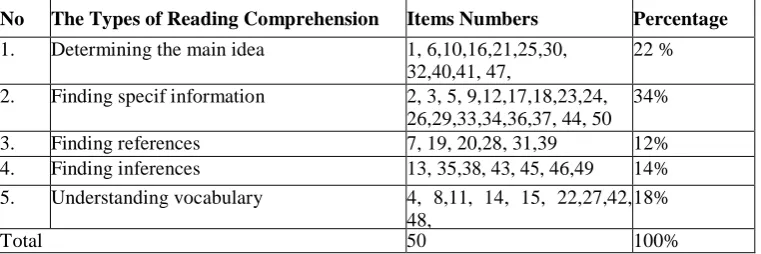
Table 1. Table Specification of reading Test
No The Types of Reading Comprehension Items Numbers Percentage
1. Determining the main idea 1, 6,10,16,21,25,30, 32,40,41, 47,
22 %
2. Finding specif information 2, 3, 5, 9,12,17,18,23,24, 26,29,33,34,36,37, 44, 50
34%
3. Finding references 7, 19, 20,28, 31,39 12%
4. Finding inferences 13, 35,38, 43, 45, 46,49 14%
5. Understanding vocabulary 4, 8,11, 14, 15, 22,27,42, 48,
18%
Total 50 100%
3.6.2. Reliability
Reliability was a measure of accuracy, consistency, dependability, or fairnes of score resulting. Setiyadi (2006) says that reliability was a consistency of a measurements or how far that measurments can be measured the similar subjects in different time but showed the same result. To measure the coeffecient of the realibility between odd and even group,in this research used the person product moment formula as follows:
√( )( )
26
After getting the reliability of half test, the researcher then used Spearman Brown’s Phrophecy formula (Hatchy and Farhady, 1982) to determine the reliability of the whole test as follows
Where:
The criteria of the reliability are: 0.90-1.00 : High
0.50-0.89 : Moderate
-.49 : Low
27
consistent result when administered under similar condition to the same participant and in different time (Hatch and Farhady, 1982:244).
3.6.3. Level of Difficculty
The level of difficulty and discrimination of power of this instrument were also analyzed. After analyzing the data, the researcher got 28 items were good with the criteria 0.30 – 0.70 (average), 9 items should be revised, and 13 items were bad and be dropped. Finally, the researcher took 30 items as the instrument for pre-test and post-test.
To see the level difficulty, the researcher used the following formula:
LD : Level of difficulty
R : the number of students who answer correctly N : the number of students who join the test The Criteria are:
28
3.6.4. Discrimination Power
The discrimination power was used to discrimnate between weak and strong examinees in the ability being tested. The students of try out class divided into two group upper and lower students. The upper students were students answer the question correctly and the lower students are students answer the question incorrectly. To determine the discriminiation power, the researcher used the following formula:
Where:
DP :discrimination power
U :the proportion of upper group students L :the proportion of lower group students N :total number of students
The criteria of discrimination power are: 0.00 – 0.19 : poor
0.20 – 0.39 : satisfactory 0.30 – 0.69 : good 0.70 – 1.00 : excellent
29
From the try out test, there are 13 items less than 0.20 (<0.20). it indicated that items are poor and could not differentiate the upper and lower students well. It also found that 17 items scored 0.20 – 0.40 that is stated as statisfied items, 19 items scored 0.41 – 0.70 that is stated as good items.
3.7. Scoring System
Before getting the score, the researcher determined the procedure or technique to be used in scoring the students’ work. In order to do that, the researcher will use Arikunto’s formula (1989:271). The ideal highest score is 100. The scores of pretest and postttestis calculated by using following formula:
Where:
S: The score of the test R: The total of right answer N: the total.
That is the formula of scoring system that will be used in this research.
3.8. Data Analysis
After conducting pretest and posttest, the researcher analyzed the data. It was used to know whether there was improvement of the student’s reading comprehension after being taught through TPS. The researcher examined the students score by using following steps:
30
2. Calculating the total correct answer of pretest and posttest.
3. Tabulating the score of the student’s reading comprehensiontest results using t-test.
4. Drawing conclusion from the tabulated result of the pretest posttest, that is statistically analyzed by using Repeated Measure t-test of SPSS (Statistical Program for Social Sciences) in order to examine whether increase of the students gain is significant or not.
3.9. Hypothesis Testing
The hypothesis testing which showed that there was any improvement of reading comprehension achievement approved at the significant level of 0.05 in which α<0.05 (Setiyadi, 2006:97). To determine whether the first hypothesis accepted or rejected, the following criteria acceptance would be used:
H1 : There is a significant improvement of students’ reading comprehension
achievement when they are taught by using think-pair-share technique.
H0 : There is no a significant improvement of students’ reading comprehension
achievement when they are taught by using think-pair-share technique.
The criteria are:
H1 will be accepted if alpha level is lower than 0.05 (α<0.05).
H0 will be accepted if alpha level is higher than 0.05 (α>0.05).
49
V. CONCLUSIONS AND SUGGESTIONS
In this chapter, the researcher presents conclusion and suggestions. The suggestions are proposed for teacher and for other researcher who are going to conduct any similar research.
5.1. Conclusions
Drawing the analysis of the findings and discussion, the conclusion of the research are:
1. There is a significant improvement of students’ reading comprehension after being taught through Think Pair Share technique. Think-Pair-Share is a technique that combines both between individual learning and also collaborative learning. This technique provided the students the three basic steps that facilitated them in developing their mind. Think Pair Share technique can make students more active and creative in the class.
50
5.2. Suggestions
Based on the conclusions above, the writer proposes some suggestions concerning the research findings as follow:
1. For the teacher
After having research, the researcher suggests the English teacher to implement Think Pair Share technique in teaching reading. There must be good preparation and time allocation, because the materials have to be explained and delivered to the students clearly. The teachers also have to make a clear regulation in order to control the class, to make sure that the students can follow the instruction and focus to the material. Moreover, the teachers should ask the students who are smarter among the others to be the leader of the group in order to help their friends during the learning process.
2. For further research
51
REFERENCES
Ahyarudin, D. A. 2008. A comparative study of students’ reading
comprehensiontaught TPS technique and GTM at MA Al Fatah, South Lampung.Unpublished script. Bandar Lampung: University of
Lampung.
Allen, E. D. and R.M.1997.Classroom Technique: Foreign Languageand English as a Second Language. Atlanta: Hardcort Brace Jovanich, Inc.
Alyousef, H.S.2006. “ Teaching Reading Comprehension to ESL/EFL Learners”.
Journal of Language and Learning, Volume 5.
Dallman, R. L. 1982. Teaching of Reading. Washington: CBS Collage Publishing. Faradiaswita. 2012. The implementation of think-pair-share technique
inimproving students’ reading comprehension at MTSN 1
TanjungKarang(unpublished research report). Bandar Lampung: Lampung University.
Hatch, E & Farhady, H. 1982. Research Design and Statistic for Applied Linguistics. Massachusets: Newbury House Publisher.
Heaton, J. B. 1991. Writing English languageTesting. New York: Longman. Inc. Hedge, T. 2003. Teaching and Learning in the Language Classroom. UK: OUP. Johnson, D ., Johnson, R., & Holubec, E. 1993. Cooperation in the
classroom.Edina, MN: Interaction Book Company
Lie, A. 2002. Cooperative Learning; Mempraktikan Cooperative Learning diRuang-Ruang Kelas. Jakarta: Grasindo.
Lyman, F. 1981. Strategies for reading comprehension:
think-pair-share.http://www.readingquest.org/strat/tps.html. (Retrieved 2016, October2)
52
Slavin, R. 1995. Cooperative learning: theory, research, and practice.Massachusetts: Allyn and Bacon.
Smith, F. 1995. Understanding reading 2nd edition. New York: Holt Renehart and Winston.
Setiyadi, Ag. B. 2006. Metode penelitian untuk pengajaran bahasa asing.Yogyakarta: Graha Ilmu.
Shohamy, E. 1985. A Practical Handbook in Language Testing for The SecondLanguage Teacher. Tel Aviv: Tel Aviv University.
Simanjuntak, E.G.1988. A Practical Handbook In Language Testing For The Second Language Teachers. Tel-Aviv: Tel-Aviv University
Suparman, U. 2005. Understanding and Developing Reading
Comprehension.Bandar Lampung: Lampung University. Suparman, U. 2007. Reading Strategies of English as a Foreign Language
(EFL).Tangerang: Mata Baca.
Willis, D. 2008. Reading for information: Motivating learners to read efficiently.Retrieved 27 October