Materials Tracking Practices for Inventory
Management in Construction Projects
Siti Radziah Liwan
1, Narimah Kasim
2, Rozlin Zainal
3Department of Construction Management1, Faculty of Technology Management & Business,
Universiti Tun Hussein Onn Malaysia (UTHM), 86400 Parit Raja, Batu Pahat, Johor
Department of Construction Management2, Faculty of Technology Management & Business,
Universiti Tun Hussein Onn Malaysia (UTHM), 86400 Parit Raja, Batu Pahat, Johor
Department of Construction Management3, Faculty of Technology Management & Business,
Universiti Tun Hussein Onn Malaysia (UTHM), 86400 Parit Raja, Batu Pahat, Johor
Abstract— Inventory is important especially in construction project as the proper amount of inventory will ensure that all construction activities will be able to carry out according to the planned schedules. Inadequate amount of inventory will result in job stoppage due to materials required for conducting the work could not be specified at time they are needed, waste of labour working hours, and schedule delays. Material tracking is important especially in managing inventory as construction materials contribute to major part of the total project costs. However, materials tracking in construction projects were bound with several issues that contribute difficulties in managing inventory. Therefore, this paper seeks to identify several problems on current materials tracking for inventory management practices in construction projects. Several case studies which involved semi-structured interviews with the main contractors specifically site managers, site engineers and site supervisors has been carried out to identify current material tracking problems which bound Malaysian construction projects. The case study data was analysed using Matrix Table in order to make it clear and easy to be interpreted. The findings reveal that construction projects in Malaysia are using manual material tracking practices which has many drawbacks. The main problems within Malaysian construction projects regarding material tracking practices are excessive paper-based report, lack of up-to-date information regarding the status of materials, theft and labour intensive processes. Thus, there is a need for the application of sophisticated technology such as RFID to improve materials tracking practices for the purpose of inventory management in construction projects.
Keywords—Construction Projects; Inventory Management; Materials Tracking.
I.
Introduction
Inventory refers to materials or components on hand; which was kept by contractors for the smooth functioning of construction process. Inventory also referred
to as the list of materials or components which was kept at the site storage area for future use in construction activities. Inventory is important in business because of several factors [1]: (1) to control unpredictability, (2) fluctuations in demand, (3) unreliability of supply, (4) price protection, (5) quantity discounts, and (6) lower ordering costs. Adequate amount of inventory in construction could ensure that all construction works will be able to carry out on time and according to the planned schedules.
Material tracking and locating at construction jobsites are the most important problems related to construction materials and inventory management [2]. Materials tracking and locating is important to ensure that materials are available at the right time, in the right place and at the right quantity. Materials tracking and locating also enable for effective and efficient management of inventory, thus; firm’s inventory could be managed easily.
As material tracking is important for inventory management in construction projects, it is essential to reveal several problems regarding the current material tracking practices. Thus, this paper seeks to identify several problems regarding current material tracking practices for inventory management in Malaysian construction projects.
II.
Materials Tracking for
considered important in managing inventory is materials tracking.
Material tracking is important because of two reasons. Firstly, it provides timely information on materials availability to enhance crew-level work planning and improve labour productivity. Secondly, it enables real-time on-site measurement of project performance indicators that provide the project management with feedback information for controlling project [5].
Findings from previous study found that there are several problems regarding material tracking for inventory management in construction projects. Materials tracking in construction projects were bound with incomplete and lack of up-to-date information regarding on-site stock [6]. The lack and incomplete of up-to-date information regarding on-site stock were caused by the poor tracking and locating of materials in construction sites. Besides that, current material tracking method used in construction industry has clear limitations. The traditional-manual method of materials tracking contributes to many other problems [7][8][9].
Current material tracking practices are using manual method of collecting and recording data related to tracking activities which is labour intensive [10]. In addition, traditional materials tracking method is labour intensive, inaccurate and subjected to error prone which further leads to waste and surplus of materials, schedule delays, and decrease in productivity [6]. The manual process is labour intensive and data collected is not reliable as they are much dependent on workers motivations and skills to track materials [11].
The collected information is also unreliable or complete due to reluctance of workers to monitor and record the flow of large quantities of materials in construction projects. Furthermore, data collected through manual method usually kept and transferred in paper-based format; which is difficult to be traced and accessed for future use. Thus, some information ends up being unavailable to the parties who need access to them in a timely manner; for the decision making process [11]. Furthermore, current material tracking practices is time consuming, results in late deliveries, lead to mislocated components and incorrect installations [12].
As the current method of material tracking practices has many drawbacks and contributes many other problems, thus; it is important for construction project to shift from manual practices into more sophisticated approach of material tracking which using technology.
III.
Applications of Technology
in Materials Tracking for
Inventory Management
Information and Communication Technology (ICT) implementation in construction has ability to expedite theprocess of data transfer [13] and facilitate the effective and efficient control over materials on-site [14]. According to [15], ICT plays an important role in construction; in which to make the sector more efficient and customer oriented.
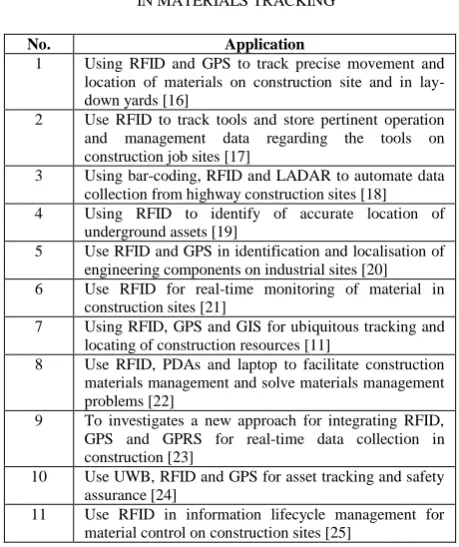
TABLE I shows previous research regarding successful applications of technologies such as Radio Frequency Identification (RFID), bar-coding, Global Positioning System (GPS), Geographic Information System (GIS), Ultra-Wide Bands (UWB), Personal Digital Assistant (PDA), and General Packet Radio Service (GPRS), Laser Distance and Ranging (LADAR) and others in various field of application in construction especially in materials tracking.
TABLE I SEVERAL APPLICATIONS OF TECHNOLOGY IN MATERIALS TRACKING
No. Application
1 Using RFID and GPS to track precise movement and location of materials on construction site and in lay-down yards [16]
2 Use RFID to track tools and store pertinent operation and management data regarding the tools on construction job sites [17]
3 Using bar-coding, RFID and LADAR to automate data collection from highway construction sites [18] 4 Using RFID to identify of accurate location of
underground assets [19]
5 Use RFID and GPS in identification and localisation of engineering components on industrial sites [20] 6 Use RFID for real-time monitoring of material in
construction sites [21]
7 Using RFID, GPS and GIS for ubiquitous tracking and locating of construction resources [11]
8 Use RFID, PDAs and laptop to facilitate construction materials management and solve materials management problems [22]
9 To investigates a new approach for integrating RFID, GPS and GPRS for real-time data collection in construction [23]
10 Use UWB, RFID and GPS for asset tracking and safety assurance [24]
11 Use RFID in information lifecycle management for material control on construction sites [25]
As technology application could expedite and facilitate effective and efficient control over materials, it is also important to apply technology in materials tracking. Technology applications could facilitate materials tracking process while at the same time reduce drawbacks caused by manual method of materials tracking practices.
IV.
Methodology
[image:2.595.322.552.229.503.2]registered with Construction Industry Development Board (CIDB) grade G7.Those companies are selected based on their experience involved in multi-million construction projects in which on-site management are the main concern. Respondents are those responsible in inventory management
and overall site management such as the project manager, site engineer and the site supervisor. Those respondents are chosen because of their broad experience in managing construction project and in overall site management.
TABLE II BACKGROUND OF THE PROJECT AND RESPONDENTS
Case Type of Project Respondent Experience
(Years) Project Cost (RM)
Project Duration (months)
1 Condominium
Development Project Manager 25 46.3 million 20 2 Residential Project Site Supervisor 1 9.3 million 30 3 Public Infrastructure Project Manager 12 14.6 million 17 4 Residential Project Project Manager 22 40.2 million 22
Background information of the projects and respondents involved in case studies was presented in TABLE II. Each interview session lasts about 30 minutes to one hour. The interview data was transcribed verbatim, while the data analysis involved cross-case analysis which is presented in Matrix Table. Cross-case analysis was used to make comparison between each embedded unit of analysis across the various case studies [27]. Besides that, it covers broader issues than simply analyse the single case study.
The study is based on four construction projects as the ‘unit of analysis’ with two ‘embedded units of analysis’. The embedded unit of analysis is designed to reach the research objective. The embedded units of analysis are:
Embedded Unit of Analysis 1: Material tracking
problems, and
Embedded Unit of Analysis 2: Material tracking
method/system
V.
Analysis and Discussions
Findings from the case studies undertaken (TABLE III) shows that all construction projects are using manual material tracking method which has many drawbacks. According to Case 1, ‘The persons in charge will check the delivered materials one-by-one based on the Delivery Order (DO).’ ‘Workers will count and check materials one-by-one whether it is according to the DO or not’ (Cases 2, 3 and 4). The above statements proved that all respondents are using manual material tracking method.
TABLE III MATERIAL TRACKING PROBLEMS
Case Material Tracking Problems Material Tracking Method/System
1 Excessive paper-based recording and reporting
Lack of up-to-date information regarding the status of materials
Lost of materials due to theft
Manual
TABLE III MATERIAL TRACKING PROBLEMS (CONTINUED)
Case Material Tracking Problems
Material Tracking Method/System
2 Inadequate site storage space
Excessive paper-based recording and reporting
Labour intensive
Waste of labour working hours
Lack of up-to-date information regarding the status of materials
Lost of materials due to theft
Manual
3 Lack of up-to-date information regarding the status of materials
Labour intensive
Waste of labour working hours
Excessive paper-based recording and reporting
Lost of materials due to theft
Fails to record the movement of materials at the storage
Manual
4 Labour intensive and tedious work
Lack of up-to-date information regarding the status of materials
Excessive paper-based recording and reporting
Fails to order materials due to improper materials record
Manual
will check and update the inventory information once a week’ (Cases 2 and 4). This was supported by Case 3 which states ‘Every material entering the site will be recorded. We also review the inventory records once a month.’ However, Case 1 states that ‘Every material used for construction work will be recorded with referred to DO. So, we will obtain updated information’. It is impossible to get updated inventory level as they update their inventory level once a week or once a month.
In addition, construction materials are also susceptible to theft as it does not have proper identification system that could trigger an alarm as materials were carried out from construction area. Case 1 stated, ‘The theft of materials is normal in construction sites’. Cases 2 and 3 also agreed that ‘Materials missing due to theft is normal. However, it is not frequent.’ Other problems regarding on-site materials tracking is labour intensive and waste of labour working hour. According to Case 2, ‘Site supervisor will monitor the delivery of materials at site. At the same time, two other workers will count and check each material one-by-one to make sure it is according to DO’. However, Cases 3 and 4 states that the site or materials supervisor need to track each material one-by-one at time of their receipt. Although they do not mentioned the process are labour intensive and consume much labour working hour, actually; they did. These problems are basically because of the manual material tracking method used in construction projects. Besides that, as material tracking use the manual method; sometimes the site supervisor fails to record the movement of materials due to work constraint in jobsites. In addition, sometimes they also fail to order materials due to poor material records at the storage.
The above discussions have discussed several problems regarding current material tracking practices in case studies undertaken. From the above discussions, it can be concluded that manual material tracking method has many drawbacks.
VI.
Issues on Materials
Tracking for Inventory
Management
Findings from case studies reveal that the main problems regarding on-site materials tracking in construction projects are excessive paper-based recording, lack of up-to-date information regarding the status of materials and lost of materials due to theft. According to [6], materials tracking in construction projects experienced problem in term of incomplete and lack of up-to-date information regarding on-site stock. Besides that, current materials tracking are labour intensive as it involves human intervention to track and calculate the materials [6][10][11]. From case studies, current material tracking practices were also bound with problems regarding the waste of labour working hours, labour intensive processes, inadequate site
storage space, fails to record the movement of materials, and fails to order materials due to improper materials record at the site storage. These problems were contributed by the manual material tracking method that was practised in all cases. All cases practice manual method of material tracking in which site or materials supervisor will check and track each material, one-by-one based on DO issued by supplier. Thus, with all such problems, current materials tracking practices using manual method are considered ineffective and inefficient which may bring subsequent impact towards negative project performance.
VII.
Conclusion and Further
Works
The paper provides a review on current problems in materials tracking and the application of technology in materials tracking to facilitate the inventory management. This paper presents several case studies undertaken in Malaysian settings to investigate current material tracking practices and problems regarding the current practice. Findings from case studies reveal that Malaysian contractors still implement manual material tracking practices in their projects which has many drawbacks. The main problems regarding materials tracking in Malaysian construction projects are excessive paper-based report, lack of up-to-date information, lost of materials, labour intensive process and waste of labour working hours to track materials. Thus, the research concludes by suggesting that contractors should start implement emerging technologies such as bar-coding, RFID and wireless technology to automate material tracking practices. It is important to shift from manual to automated materials tracking using technology as it can facilitate material tracking for inventory management processes. The next stage of the research will focused on developing a framework for real-time materials tracking process for improving inventory management in construction projects. The framework will be very important as it serves as guideline for contractors to deploy technology in materials tracking process.
Acknowledgment
The authors would like to thank Ministry of Education (MOE), Office of Research, Innovation, Commercialisation and Consultancy (ORICC), UTHM, Johor for supporting this research under the Exploratory Research Grant Scheme (Vote No. 0884).
References
[1] Muller. M. (2011). Essentials of Inventory Management 2nd Edition. American Management Association (AMA), Broadway, NY.
[3] Patel, K. V. & Vyas, C. M. (2011). Construction Materials Management on Project Sites. National Conference on Recent Trends in Engineering & Technology, Gujarat.
[4] Donyavi, S. & Flanagan, R. (2009). The Impact of Effective Material Management on Construction Site Performance for Small and Medium Sized Construction Enterprises. Proc. of the 25th Annual ARCOM Conference, Nottingham, UK.
[5] Song, J. (2005). Tracking the Location of Materials on Construction Projects. University of Texas: PhD Thesis.
[6] Navon, R. & Berkovich, O. (2006). An Automated Model for Materials Management and Control. Journal of Construction Management and Economics, 24, pp. 635-646.
[7] El-Ghazali, Y., Lafebvre, E., & Lafebvre, L. A. (2011). RFID-Enabled Materials Management in the Industrial Construction Supply Chain. Proc. of the 5th WSEAS International Conference on Communications and Information Technology, pp. 79-84.
[8] Kasim, N. B. (2010). Towards a Framework for ICT-Enabled Materials Management in Complex Projects. Journal of Techno-Social.
[9] Jang, W. S. & Skibniewski, M. J. (2008). A Wireless Network System for Automated Tracking of Construction Materials on Project Sites. Journal of Civil Engineering & Management, 14(1), pp. 11-19. [10] Ergen, E. & Akinci, B. (2007). An Overview of
Approaches for Utilizing RFID in Construction Industry. IEEE Xplore Digital Library.
[11] Sardroud, J. M., Limbachiya, M. C., & Saremi, A. A. (2010). Ubiquitous Tracking and Locating of Construction Resource Using GIS and RFID. 6th GIS Conference and Exhibition (GIS 88), Tehran.
[12] Demiralp, G., Guven, G. & Ergen, E. (2012). Analyzing the Benefits of RFID Technology for Cost Sharing in Construction Supply Chains: A Case Study on Prefabricated Precast Components. Journal of Automation in Construction, Vol. 24, pp. 120-129. [13] Kasim, N. B. (2008). Improving Materials
Management on Construction Projects. PhD
Dissertation, Loughborough University.
[14] Kasim, N. B., Anumba, C. J. & Dainty, A. R. J. (2005). Improving Materials Management Practices on Fast-track Construction Projects. 21st Annual ARCOM Conference, 2, 793-802.
[15] Molnar, M., Andersson, R., & Ekholm, A. (2007). Benefits of ICT in the Construction Industry-Characterization of the Present Situation in House-Building Processes. Proceedings of the W78 Conference, Maribor.
[16] Song, J., Haas, C. T., & Caldas, C. H. (2006). Tracking the Location of Materials on Construction Job Sites.
Journal of Construction Engineering and
Management, 132(9), pp. 911-918.
[17] Goodrum, P. M., McLaren, M. A., & Durfee, A. (2006). The Application of Active Radio Frequency Identification Technology for Tool Tracking on Construction Jobsites, Journal of Automation in Construction, 15, pp. 292-302.
[18] Moselhi, O. & El-Omari, S. (2006). Integrating Bar Coding and RFID to Automate Data Collection from Construction Sites. Joint Int. Conf. on Computing and Decision Making in Civil and Building Engineering, pp. 1734-1741.
[19] Dziak, K., Kumar, B. & Sommerville (2006). RFID in the Built Environment: Buried Asset Location Systems. Journal of Intelligent Computing in Engineering and Architecture, 4200, pp. 153-162. [20] Grau, D., Caldas, C. H., Haas, C. T., Goodrum, P. M.,
& Gong, J. (2009). Assessing the Impact of Materials Tracking Technologies on Construction Craft Productivity. Journal of Automation in Construction, 18, pp. 903-911.
[21] Kim, C., Ju, Y. and Kim, J. H. (2009). Resource Management in Civil Construction Using RFID Technologies. The 26th International Symposium on Automation and Robotics in Construction (ISARC). [22] Ren, Z., Anumba, C. J. & Tah, J. (2011).
RFID-facilitated Construction Materials Management (RFID-CMM)- A Case Study of Water-supply Project. Journal of Advanced Engineering Informatics, 25, pp. 198-207.
[23] Sardroud, J. M. (2012). Influence of Technology on Automated Management of Construction Materials and Components. Journal of Science Iranica, 19(3), pp. 381-392.
[24] Nasr, E., Shehab, T. & Vlad, A. (2013). Tracking Systems in Construction: Applications and Comparisons. 49th ASC Annual International Conference Proceedings.
[25] Lee, J. H., Song, J. H., Oh, K. S., & Gu, N. (2013). Information Lifecycle Management with RFID for Material Control on Construction Sites. Journal of Advanced Engineering Informatics, 27, pp. 108-119. [26] Thornhill, A., Saunders, M. & Lewis, P. (2007).
Research Methods for Business Students (4th Edition). Oxford: Prentice Hall.