Effect of School Yard Playgrounds on Development and
School Attachment Levels of Children
Aybuke Dilbil*, Zekiye Basaran
Department of Sport Management, Faculty of Sport Science, Kocaeli University, Turkey
Copyright©2017 by authors, all rights reserved. Authors agree that this article remains permanently open access under the terms of the Creative Commons Attribution License 4.0 International License
Abstract
The aim of this study is to examine the impact of playgrounds drawn in school yards on development and school attachment levels of the children. Sample of the study consisted of 319 students. 164 of them are female students while 155 are male students studying in the 3rd and4th grades in Dr. Ferdi Koçel Elementary School, Yarbay
Refik Cesur Elementary School and Saraybahce Elementary School located in the district of Izmit in Kocaeli. As for data collection tools, personal information questionnaire, school attachment scale (Savi, 2011) and school yard playgrounds questionnaire (Basaran, 2017) were employed. The data obtained from the questionnaires were analysed in the SPSS 18 package program and frequency and percentage distributions. Cronbach Alpha, Paired Sample T-Test and Independent T-Test were used (p<0.05). At the end of the study, statistically significant differences were found between pretest/posttest scores of the school attachment scale, while no statistically significant difference was found in the playgrounds questionnaire. Differences were detected among some items of both scales and between pretest and grade in the playgrounds questionnaire. Diverse colourful drawings in the school yards of all elementary schools will be helpful in terms of development and school attachment in children.
Keywords
Children, Playgrounds, School Attachment1. Introduction
The first phase of human life begins with childhood. There is a special relationship between children and games, and children learn, socialize, grow and develop by playing (Akkülah, 2008). Games are the activities, which are conducted with physical and mental abilities in a specific time and place for a particular purpose in accordance with specific rules, and they entertain and improve social adaptation, intelligence and skills at the same time (Çoban & Nacar, 2015).
Playing games is the most important occupation that
children spend most of their time. They meet activity needs of the children, and through games, organs become stronger without wearing. They enhance attentiveness, courage and agility. They prepare children for social life by helping them adopt good behaviours and habits (Türkan, 2009). Thanks to games, children develop in terms of abstract abilities requiring mental capacity such as thinking, perceiving and mental planning (MEB1, 2016).
Children learn behaviours, information, skills etc. necessary for the life on their own through games. They develop and enhance insights into human relations, cooperation, speaking, obtaining information, gaining habits and experiences, roles in life via games (Çoban & Nacar, 2015).
Playing games with friends enables a child to learn how to cooperate, help each other, share, live in communal life and make distribution of roles and division of labour. A child who socialises and comprehends the concepts of “I” and the “other” through games also learns how to undertake and give authority and responsibility through games. It has been observed that the children who grow by playing games become more socially active and outgoing when compared to those who grow without games (MEB, 2016).
Games stimulate all development areas of children and improve their senses and emotions as much as their skills. During games, children learn many things by experiencing themselves and become skilful (MEB, 2016). This process which starts in family continues in school. In particular, break times in schools are game times for children. These break times enable children to get rid of the impact of the previous lecture, to eliminate mental fatigue and to exercise and also have a significant function by ensuring active participation of children in the following lecture (Özdemir, 2011).
Games that children play with their friends at break times are as influential as lectures and teachers for the children to like the school environment. The games they play in the playground enable children to develop multiple
skills and enhance their school attachment levels. Also, it has been demonstrated that playgrounds have positive impacts on the social, physical, emotional and cognitive development, mobility and creativity of children (Özdemir
and Yılmaz, 2008). School yards are outdoor playgrounds,
are indicators of public health, are socialisation environments for children and are tools for ensuring healthy development and increasing life quality (Algan and Uslu, 2009).
Games played in the open air ensure that children benefit from sunlight and fresh air and facilitate physical development. Games also ensure that toxic wastes are removed out of the body through sweating and children can use the accumulating energy (Külekçi, 2016). Through games, children get relaxed and rest. Social rules and realities are learned during games in the easiest and harmless manner. Lining up and waiting, respecting other people’s rights, directing and being directed, being in harmony and cooperation with the others and undertaking his/her own responsibilities are the skills that can be developed via games. Also, the most effective way of developing such personal and social habits as self-confidence, self-control, prompt decision making, cooperating, integrity and discipline is games (MEB, 2016).
School yards should also be taken into consideration while playgrounds are being designed. School should have a planning to support mental and physical development, to shape the personality of the child and to increase the interest for the surrounding in addition to its instructive features. School and its surrounding should be planned to ensure that the children take pleasure in going to school (Çeliker et al., 2015; Türkan, 2009).
The impact of planning and design of school yards on the life of children have been examined in various studies
(Şişman and Gültürk, 2011; Algan & Uslu, 2009; Özdemir,
2011; Türkan, 2009). School yards are also effective in preventing childhood obesity. It has been determined that the children studying in schools with larger yards have
lower body mass indices (BMI) (Özdemir and Yılmaz,
2008). Games and activities enhance creativeness, sense of responsibility, success, socialisation, physical, psycho-motor, emotional, social and language development, health, cognitive skills, perception-motor capability and coordination (Özdemir, 2011; MEB, 2016), contribute to their socialization, affect their studying skills in a positive manner and increase levels of attachment to
school (Gömleksiz & Özdeş, 2013).
Mengi (2011) defines attachment to school as feeling positive sentiments about the school, having positive connotations about education, attending the school, taking part in extracurricular social activities and spending extra time for school works. Savi (2011) states that there is a positive relationship between children’s levels of attachment and their levels of social, emotional and academic adaptation, and most of the children lacking the feeling of attachment to school are not motivated to study
while Cemalcılar (2010) argues that children with higher
levels of school attachment have better relations with their teachers and friends, have higher levels of self-esteem and generally feel more satisfied about their lives (Bellici, 2015).
In line with the literature, it is known that games have impacts on all features of the children, their lives and whether they like school or not. However, since there is limited literature about this issue, this study aims to examine the impact of school playgrounds on the development and school attachment levels of children.
Problem statement: Colourful playgrounds drawn in school yards have impacts on the development and school attachment levels of the children.
Sub-problems:
Colourful playgrounds drawn in school yards have impacts on development levels of children. Colourful playgrounds drawn in school yards have
impacts on school attachment levels of children.
2. Method
Research Method
In this study, pretest posttest experimental model without control group was used.
Groups Pretest Procedure Posttest 3rd and 4th Grade
Students of
Schools T1
Colourful playground drawings in school
yards T2
This study was conducted between February and April 2017. To implement the study, playgrounds were drawn in the school yards for traditional Turkish child games in consideration of the structures of the school yards. These games included labyrinth, handkerchief grab, push-in-the-corner, tick-tack-toe, jacks, hopscotch (snake, ten, dragging, multiple), duck duck goose and compass.
Population-sample Selection
Study was carried out in the schools affiliated to the Ministry of National Education located in İzmit district of
Kocaeli.
Schools where the study was conducted are: 1) Yarbay Refik Cesur Elementary School 2) Saray Bahçe Elementary School 3) Dr. Ferdi Koçel Elementary School
In these schools, 3rd and 4th grade students were included
in the study. Sample consisted of 319 students in total, 164 of whom were female students and 155 of whom were male students.
Personal Information Questionnaire: This questionnaire was developed by the researcher and includes questions concerning the age, sex and grade information of the participants.
Playgrounds Questionnaire: This questionnaire was prepared by Basaran (2017) in consideration of the curriculum of the Ministry of National Education (MNE). For its validity test, support was received from academicians and teachers and administrators working in the schools affiliated to the MNE. For validity and reliability testing, the questionnaire was first applied to 60 primary school students (.843) and then 60 secondary school students (.841), and Cronbach Alpha reliability coefficients were found. After the questionnaire was finalized, it was applied on the sample. The questionnaire included 21 Likert type questions concerning the opinions of the children on the use of playgrounds.
School Attachment Scale (SAS): This scale (OBÖ-ÇE) was developed by Hill (2006) with the aim of evaluating the school attachment levels of the children and adolescents and consisted of items related to teachers, friends and school attachment. The original version of the scale was a 15-item Likert type scale consisting of five items in each dimension. This scale was adapted to the Turkish students by Savi (2011). Cronbach Alpha internal consistency coefficient of the scale was found as 0.84 while test-retest reliability coefficient was calculated as 0.85 for the whole scale. Final version of the scale consisted of 13 items. A high score from the scale demonstrates a high level of school attachment.
Validity-Reliability Information:
Reliability coefficients for this study are as follows: Playground Game Drawings: , 879
School Attachment: , 887
3. Data Collection
Data were collected through questionnaires. Questionnaires were applied as pretest carried out before the study started and as posttest carried out after the study
was completed. During preparation phase, approvals were received from the Kocaeli Provincial Directorate for National Education and Ethics Board of Kocaeli University. Study was conducted between February and April 2017. Ministry of National Education: 22.03.2017 99332089605.01/ 3849261
KOU Ethics Board: 21.03.2017 / E-23600
Data Analysis:
Data obtained from the scales were analysed through SPSS 21 package program. Frequency and percentage calculations were made for the demographic attributes among the data. Paired Sample T Test was employed to determine the relationship between two dependent variables. Independent T-Test was carried out in order to determine the differences among age, sex and grades in pretest and posttest.
4. Findings
[image:3.595.301.541.391.494.2]This section includes findings obtained at the end of the statistical analysis conducted on the data.
Table 1. Frequency and Percentage Distributions of the Demographic Information of the Participants
Student N %
Sex Female 164 51,4
Male 155 48,6
Age 8 118 36,9
9 201 63,1
Grade 3 118 37,0
4 201 63,0
According to the distribution by sex given in Table 1, the ratio of female students is 51,4 % while the ratio of male students is 48,6 %. When distribution by age is examined, it is seen that the ratio of those aged 8 is 8,8 % while the ratio of those aged 9 is 37,6 %. Lastly, distribution by grades shows that the ratio of the 3rd grades is 37 % while
the ratio of the 4th grades is 63 %.
Table 2. Pretest and Posttest Comparisons of the School Attachment Scale (Paired Sample T-Test)
N Mean S D t p
School Attachment Scale Pretest 319 55,63 10,64 -1,829 0,048
Posttest 319 59,92 7,87
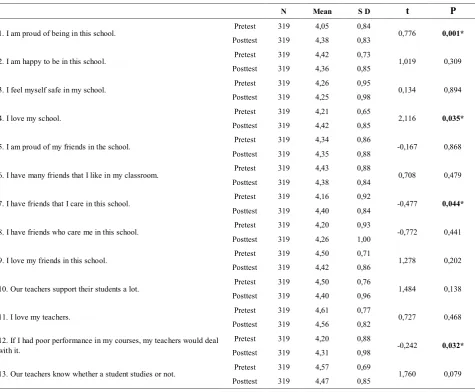
[image:3.595.53.543.614.660.2]Table 3. Pretest and Posttest Comparisons of the Items of the School Attachment Scale (Paired Sample T-Test)
N Mean S D t P
1. I am proud of being in this school. Pretest 319 4,05 0,84 0,776 0,001* Posttest 319 4,38 0,83
2. I am happy to be in this school. Pretest 319 4,42 0,73 1,019 0,309
Posttest 319 4,36 0,85
3. I feel myself safe in my school. Pretest 319 4,26 0,95 0,134 0,894
Posttest 319 4,25 0,98
4. I love my school. Pretest 319 4,21 0,65 2,116 0,035*
Posttest 319 4,42 0,85
5. I am proud of my friends in the school. Pretest 319 4,34 0,86 -0,167 0,868 Posttest 319 4,35 0,88
6. I have many friends that I like in my classroom. Pretest 319 4,43 0,88 0,708 0,479 Posttest 319 4,38 0,84
7. I have friends that I care in this school. Pretest 319 4,16 0,92 -0,477 0,044* Posttest 319 4,40 0,84
8. I have friends who care me in this school. Pretest 319 4,20 0,93 -0,772 0,441 Posttest 319 4,26 1,00
9. I love my friends in this school. Pretest 319 4,50 0,71 1,278 0,202
Posttest 319 4,42 0,86
10. Our teachers support their students a lot. Pretest 319 4,50 0,76 1,484 0,138 Posttest 319 4,40 0,96
11. I love my teachers. Pretest 319 4,61 0,77 0,727 0,468
Posttest 319 4,56 0,82 12. If I had poor performance in my courses, my teachers would deal
with it.
Pretest 319 4,20 0,88
-0,242 0,032* Posttest 319 4,31 0,98
13. Our teachers know whether a student studies or not. Pretest 319 4,57 0,69 1,760 0,079 Posttest 319 4,47 0,85
When Table 3 is examined, statistically significant differences were detected at the level of p<0,05 in the answers given by the students included in the study to the items of “I am proud of being in this school” (0,001), “I like my school” (0,035), I have friends that I care in this school” (0,044), “If I had poor performance in my courses, my teachers would deal with it” (0,032).
Table 4. Pretest and Posttest Comparisons of the Playgrounds Questionnaire (Paired Sample T-Test)
N Mean S D t p
Playgrounds Pretest 319 61,9310 9,68603 -,731 ,465
Posttest 319 62,5423 11,03955
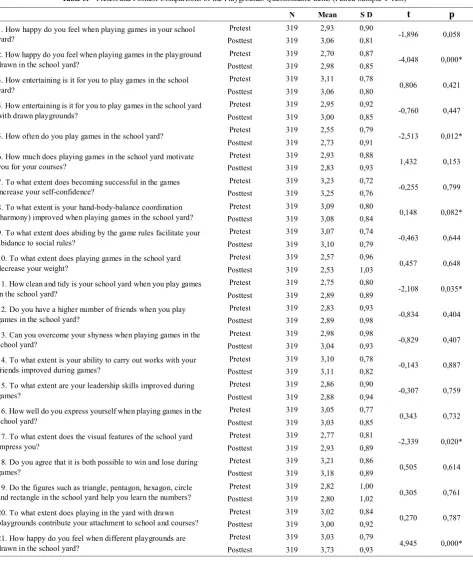
[image:4.595.51.542.554.600.2]Table 5. Pretest and Posttest Comparisons of the Playgrounds Questionnaire Items (Paired Sample T Test)
N Mean S D t p
1. How happy do you feel when playing games in your school yard?
Pretest 319 2,93 0,90
-1,896 0,058 Posttest 319 3,06 0,81
2. How happy do you feel when playing games in the playground
drawn in the school yard? Posttest Pretest 319 319 2,70 2,98 0,87 0,85 -4,048 0,000* 3. How entertaining is it for you to play games in the school
yard?
Pretest 319 3,11 0,78
0,806 0,421 Posttest 319 3,06 0,80
4. How entertaining is it for you to play games in the school yard with drawn playgrounds?
Pretest 319 2,95 0,92
-0,760 0,447 Posttest 319 3,00 0,85
5. How often do you play games in the school yard? Pretest 319 2,55 0,79 -2,513 0,012* Posttest 319 2,73 0,91
6. How much does playing games in the school yard motivate you for your courses?
Pretest 319 2,93 0,88
1,432 0,153 Posttest 319 2,83 0,93
7. To what extent does becoming successful in the games increase your self-confidence?
Pretest 319 3,23 0,72
-0,255 0,799 Posttest 319 3,25 0,76
8. To what extent is your hand-body-balance coordination (harmony) improved when playing games in the school yard?
Pretest 319 3,09 0,80
0,148 0,082* Posttest 319 3,08 0,84
9. To what extent does abiding by the game rules facilitate your abidance to social rules?
Pretest 319 3,07 0,74
-0,463 0,644 Posttest 319 3,10 0,79
10. To what extent does playing games in the school yard decrease your weight?
Pretest 319 2,57 0,96
0,457 0,648 Posttest 319 2,53 1,03
11. How clean and tidy is your school yard when you play games in the school yard?
Pretest 319 2,75 0,80
-2,108 0,035* Posttest 319 2,89 0,89
12. Do you have a higher number of friends when you play games in the school yard?
Pretest 319 2,83 0,93
-0,834 0,404 Posttest 319 2,89 0,98
13. Can you overcome your shyness when playing games in the school yard?
Pretest 319 2,98 0,98
-0,829 0,407 Posttest 319 3,04 0,93
14. To what extent is your ability to carry out works with your
friends improved during games? Posttest Pretest 319 319 3,10 3,11 0,78 0,82 -0,143 0,887 15. To what extent are your leadership skills improved during
games?
Pretest 319 2,86 0,90
-0,307 0,759 Posttest 319 2,88 0,94
16. How well do you express yourself when playing games in the school yard?
Pretest 319 3,05 0,77
0,343 0,732 Posttest 319 3,03 0,85
17. To what extent does the visual features of the school yard impress you?
Pretest 319 2,77 0,81
-2,339 0,020* Posttest 319 2,93 0,89
18. Do you agree that it is both possible to win and lose during games?
Pretest 319 3,21 0,86
0,505 0,614 Posttest 319 3,18 0,89
19. Do the figures such as triangle, pentagon, hexagon, circle and rectangle in the school yard help you learn the numbers?
Pretest 319 2,82 1,00
0,305 0,761 Posttest 319 2,80 1,02
20. To what extent does playing in the yard with drawn playgrounds contribute your attachment to school and courses?
Pretest 319 3,02 0,84
0,270 0,787 Posttest 319 3,00 0,92
21. How happy do you feel when different playgrounds are drawn in the school yard?
Pretest 319 3,03 0,79
4,945 0,000* Posttest 319 3,73 0,93
Table 6. Comparison of the Scores in the Playgrounds Questionnaire by Grades (Independent T-Test)
Playgrounds Grades N Mean Std. Deviation t p
Pretest results 3.Sınıf 118 63,6949 9,30078 2,513
[image:5.595.66.537.664.713.2]When Table 5 is examined, statistically significant differences were detected in the answers given by the students included in the study to the items of How happy do you feel when playing games in the playground drawn in the school yard? (0,000), How often do you play games in the school yard? (0,012), How clean and tidy is your school yard when you play games in the school yard? (0,035), To what extent does the visual features of the school yard impress you? (0,020), How happy do you feel when different playgrounds are drawn in the school yard? (0,000) at the level of p<0.05. No statistically significant difference was found in the other items.
According to the Table 6, a statistically significant different exists between the pretest results and grades (,012) in the playgrounds questionnaire at the level of 0,05. This difference stems from the 3rd grades.
5. Conclusions, Discussion and
Recommendations
In the present study conducted to examine the effect of playgrounds drawn in the school yards on the development and school attachment levels of the children, all the students included in the sample are aged 8 and 9; 51,4% of them are female students while 48,6% of them are male students; and they are 3rd (37%) and 4th (63%) grade
students.
Playgrounds of these children are school yards. Just like sports areas existing in school yards (basketball, volleyball, badminton etc.), the colourful drawings in school yards for such traditional Turkish games as labyrinth, handkerchief grab, push-in-the-corner, tick-tack-toe, jacks, hopscotch (snake, ten, dragging, multiple), duck duck goose and compass affect the visuality of the yard and enable children to have a good time by playing games. Also, they are good for the health of children since they replace passive computer games. In the study, a statistically significant difference could not be found between pretest and posttest by the total score related to the playgrounds drawn in the school yard. This can be attributed to bad weather, which prevented the completion of the drawings as planned and thus, children could not go out and play their games in the school yards. However, increases were observed in the pretest and posttest averages. It might be thought that this result could have been better if the children had had enough opportunity for playing games.
Positive differences were detected in some items of the questionnaire. Statistical differences were found between pretest and posttest for the item expressing that “students feel happy when they are playing games in the school yard and playgrounds”. Akandere (2003) states that children both have fun and learn during playing games, and games, which affect all development areas of children, also function as a mirror reflecting their inner worlds and as a tool of communication with the adults.
A statistically significant difference was found between
pretest and posttest for the item related to the frequency of students to play games in the school yard. According to Arnas (2004), children learn basic social rules such as cooperation, sharing, forming positive relations, respecting other people’s rights and undertaking responsibilities during games they play with their friends. Children develop during games and grow with games. This is not a process but development itself. As a tool for children to learn the life, games are of great importance in terms of physical, emotional, social, mental and language development.
According to Malone and Tranter (2003), school yards should be arranged in a manner to accommodate various games and activities, to enable children to take spontaneous and free actions and to support learning and physical, cognitive and social development in children. In the present study, statistically significant differences were detected between pretest and posttest in the questions related to the impact of cleanliness and tidiness and visual features of the school yard when playing games. Tandoğan
(2016) points out to the necessity of properly arranged school yards where children can play among the essential factors and features of primary school yards in the study
about liveable school yards. Karadağ et al. (2012) detected certain deficiencies while evaluating playgrounds, use of yards and adequacy of playgrounds and equipment while Kaya and Kaya (2014) argues that lack of playgrounds is the main problem in the schools.
Zaks et al. (2001) state that energetic physical activities that students are involved at break times in the playgrounds of the school yards enable them to be more active physically and mentally during the courses while
Gömleksiz and Özdaş (2013) argue that games affect
A statistically significant difference was found between pretest results and grades in the playgrounds questionnaire. This difference results from the 3rd grade students.
Younger children were impressed by the drawings in the playgrounds and playing in these areas much more than the others. However, pretest and posttest results of the school attachment scale did not differ significantly by sex, age and grade. Bellici (2015) found out that the school attachment levels of female secondary school students were higher than the male students. It was determined that school attachment levels decreased as the age and grade of students increased. It was also determined that school attachment levels of the students with higher academic success levels were higher than those with lower
academic success levels. Karaşar and Kapçı (2006) stated
that academic success was not a predictor for school attachment. However, school attachment was found as a predictor for fewer emotional problems. Lastly, attachment to friends predicted fewer peer problems, emotional problems and social behaviour problems.
At the end of this study, it was determined that the playgrounds drawn in the school yards slightly affected the school attachment levels. With respect to the use of playgrounds, positive improvements were observed in such areas as leadership, conducting works with friends, overcoming shyness, socialisation, abidance to rules, self-confidence, motivation for courses and entertainment. These results support our problem and sub-problem statements.
Based on these findings, it can be argued that playgrounds positively affect development and school attachment levels of children.
Accordingly, recommendations of the present study are as follows:
As per the initial plan, this study would be
conducted in 10 primary schools located in İzmit
district of Kocaeli but due to adverse weather conditions, playgrounds could not be drawn in the school yards and thus, the study was confined to 3 schools. This study can be repeated with higher numbers of schools and students.
In this study, the students could find the opportunity of playing games for a limited time, 2 to 3 weeks. Collection of the final data after longer periods might yield better scientific results.
For winter conditions, playgrounds should be drawn in the suitable areas and halls within the school to provide students with the opportunity of playing games.
Organization of game festivals in schools can cause excitement and also enable a higher number of students to take part in garden games and be healthier by reducing their addiction to computer games.
Permanence and diversity in the playground drawings will be useful in terms of the development of the children.
In terms of visuality, drawing colourful figures on the walls as well as the grounds and a proper arrangement for the surrounding will be more impressive.
REFERENCES
[1] Akandere, M. (2013). Eğitici Okul Oyunları. Nobel
Akademik Yayıncılık, ISBN: 9786051333748, Ankara
[2] Akkülah, A.T. (2008). Oyun Alanları Güvenlik Standartlarının Araştırılması ve Nenehatun Parkı Örneğinde İrdelenmesi. Yayımlanmamış Yüksek Lisans Tezi, Selçuk
Üniversitesi, Fen Bilimleri Enstitüsü, Konya.
[3] Algan, H., Uslu, C. (2009). İlköğretim Okul Bahçelerinin
Tasarlanmasına Paydaş Katılımı: Adana Örneği, Akdeniz
Üniversitesi Ziraat Fakültesi Dergisi, 2009, 22(2), 129–140
[4] Arnas, A. Y. (2004). Çukurova Üniversitesi Eğitim Fakültesi
Okul Öncesi Öğretmenliği Ana Bilim Dalı Öğretim Üyesi,
Adana. https://www.trendun.com/cocuk-oyunla-buyur
Erişim tarihi: 23.07.2017
[5] Bellici, N. (2015). Ortaokul Öğrencilerinde Okula
Bağlanmanın Çeşitli Değişkenler Açısından İncelenmesi. Abant İzzet Baysal Üniversitesi Eğitim Fakültesi Dergisi,
15(1), 48-65
[6] Blum, R. (2005). School Connectedness: Improving The Lives of Students. Baltimore: Johns Hopkins Bloomberg School of Public Health.
http://cecp.air.org/download/MCMonographFINAL.pdf (12.04.2017)
[7] Cemalcılar, Z. (2010). Schools As Socialization Contexts:
Understanding the İmpact of School Climate Factors on
Students’ Sense of School Belonging. Applied Psychology: An International Review, 59(2), 243-272
[8] Çeliker, H.D., Tokcan, A., Korkubilmez, S. (2015). Does Motivation Toward Science Learning Affect Scientific Creativity?. Mustafa Kemal University Journal of Social Sciences Institute, 12(30): 167-192, ISSN: 1304-429-X. [9] Çoban, B., Nacar, E. (2015). Ortaokullarda Eğitsel Oyunlar.
Nobel Yayınları, 3.Basım Yayın No: 1157 Eğitim No:247,
Sh. 7, 41, 42, 46 İstanbul.
[10]Gömleksiz, M.N., Özdaş, F. (2013). Teachers’ Views on the
Effectiveness of Free Time Activities Course: A Qualitative
Study. Fırat University Lourrnal of Social Science, 23 (1):
105-188
[11]http://isikilkokulu.meb.k12.tr/meb_iys_dosyalar/05/03/708 776/dosyalar/2014_01/07042149_24105032_gelenekselocu
koyunlariuyumlulukmodu.pdf. Erişim tarihi: 15.07.2017.
[12]Karadağ, A.A., Mutlu, S., Sayın, Ş. (2012). Okul
Bahçelerinin Oyun Alanı Olarak Değeri: Düzce Kenti
Örneği. Ormancılık Dergisi 8(2) (2012) 45-56.
[13]Karaşar, B., Kapçı, E.G. (2016). Lise Öğrencilerinde Okula
Bağlanma ve Akademik Başarının Çeşitli Değişkenler Açısından İncelenmesi. Ankara Üniversitesi Eğitim
[14]Kaya, S., Kaya, F. (2014). The Determinatıon And Solution
of The Problem About Not Having Children Playground in School with Cooperative Problem Solving Method. Anemon,
Muş Alparslan Üniversi̇tesi̇ Sosyal Biilimler Dergisi ISSN:
2147-7655, 2(2): 189-209
[15]Külekçi, E. (2016). Üniversite Öğrencilerinin Sosyal
Sorumluluk Temelli Liderlik Becerilerinin Geliştirilmesine
Yönelik Deneysel Bir Çalışma. IJOESS International
Journal of Eurasia Social Sciences, 7(22): 56-80
[16]Malone, K., & Tranter, P. (2003). Children's Environmental Learning and The Use, Design and Management of Schoolgrounds. Children, Youth and Environments, 13(2), 87-137, ISSN 1546-2250
[17]Mengi, S. (2011). Ortaöğretim 10. Ve 11.Sınıf
Öğrencilerinin Sosyal Destek Ve Özyeterlik Düzeylerinin Okula Bağlılıkları İle İlişkisi. Yayınlanmamış Yüksek Lisans Tezi, Sakarya Üniversitesi, Eğitim Bilimleri
Enstitüsü, Sakarya
[18]Özdemir, A. (2011). Okul Bahçesi Peyzaj Tasarım
Anlayışındaki Değişim Ve Bu Değişimin Uygulamaya Yansımalarının Bartın Kenti Örneğinde İrdelenmesi, Bartın
Orman Fakültesi Dergisi, 13(19): 41-51 Issn: 1302-0943
Eıssn: 1308-5875
[19]Ozdemir, A., Yilmaz, O. (2008). Assessment of Outdoor School Environments and Physical Activity in Ankara’s
Primary Schools. Journal of Environmental Psychology 28, P: 287–300.
[20]Savi, F. (2011). School Attachment Scale for Children and Adolescents: The Study of Validity and Reliability. Elementary Education Online, 10(1), 80-90, 2011.
[21]Şişman, E.E., Gültürk, P. (2011). İlköğretim Okul
Bahçelerinin Peysaj Planlama Ve Tasarım İlkeleri Açısından
İncelenmesi;Tekirdağ Örneği. Journal of Tekirdag
Agricultural Faculty, 8(11): 53-60
[22]Tandoğan, O. (2016). More Livable School Grounds for
Children. MEGARON 2016;11(4):629-637 DOI: 10.5505/megaron.2016.92053
[23]T.C. Millî Eğitim Bakanlığı, Çocuk Gelişimi Ve Eğitimi
Oyun Ve Hareket Etkinlikleri, Ankara, 2016.
[24]http://www.megep.meb.gov.tr/mte_program_modul/modull
er/Oyun%20ve%20Hareket%20Etkinlikleri.pdf Erişim
Tarihi: 23.03.2017
[25]Türkan, E: E. (2009). Investigating Children Playgrounds in Balikesir. Master Thesis, Selçuk University, Institute of Science, Department of Landscape, Konya.