Journal of Chemical and Pharmaceutical Research, 2013, 5(7):335-340
Research Article
CODEN(USA) : JCPRC5
ISSN : 0975-7384
335
Study on removal of lead from aqueous solution using sulphonated inner
powdered skin of Cassava (Manihot esculenta)
Lekshmi Mohan, Divanshu Gupta and Shanthi V.
*Industrial Biotechnology Division, School of Bio Sciences and Technology, VIT University,
Vellore, Tamil Nadu, India
_____________________________________________________________________________________________
ABSTRACT
The increased release of poisonous heavy metals such as Lead (Pb) has severely caused environment as well as public health problems. Thus, the removal of lead by economical and conventional ways is of great importance. This was done by using Sulphonated powder of inner layer of Cassava and the uptake percentage was determined at various pH, time and adsorbent by using AAS . It was found that the amount of lead adsorbed increases with the decrease in the pH and was found to be maximum at pH of 2.0 where there was around 40% removal of the lead. With increase in time, the adsorption increases following the Langmuir model of adsorption isotherm. Also, the concentration of the adsorbent was found to be directly proportional to the amount of lead adsorbed as it increased from 40% at 1g to 51% at 2g keeping the pH of the solution constant.
Key words: Lead, Cassava inner layer, sulphonation, Langmuir adsorption isotherm, AAS, equilibrium time _____________________________________________________________________________________________
INTRODUCTION
Industrial wastewaters are important sources of pollution of heavy metals, which carry severe environment [1] and public health problems [2, 3]. Exposure to soil contaminated with heavy metals may deleteriously affect human health which may occur from inhalation, ingestion, or absorption of these toxins [4, 5, 6]. A metal at a concentration exceeding the tolerance level may be regarded as toxic if it impairs the growth or metabolism of cells [7]. The mechanism of lethal toxicity of a high concentration of heavy metal during a short term exposure may be different in the way that they disrupt the respiratory surface while during a long term exposure, the metal accumulates in the internal organs [8]. The heavy metals enter in to the food chain through bioaccumulation from contaminated water, soil and air and pose a serious threat as they cannot be degraded neither destroyed [9]. In this era of industrialization, the various advancements in the industrial activities has further increased the release of heavy metals to a very high level [2]. Some of the toxic pollutants such as Pb, Cr, Cd, etc. are introduced as wastes from various processes into food [10]. Lead is one of the highly poisonous metal (regardless if inhaled or swallowed), affecting almost every organ and system in the body, the main target being nervous system both in adults and children.
Shanthi V. et al
J. Chem. Pharm. Res., 2013, 5(7):335-340
______________________________________________________________________________
treatment methods for the removal of lead and lead compounds from industrial wastewaters and other aqueous solutions are in practice. Some of these methods being electrolytic deposition, electro dialysis, electrochemical, evaporation, precipitation, ion exchange, reduction, reverse osmosis, etc [2]. However, most of these methods suffer a serious drawback of capital investment as the cost of the instrument as well as the operational costs is very high [2]. Thus, phytoremediation becomes a sustainable method which induces the technology of cleaning the environment from the heavy metals by using plants or plant parts at a low cost level [14, 15, 16, 17]. The sulphonated powder of inner layer of Cassava acts as a phytoremediating agent and helps in the removal of lead with cost effectiveness. In our work, we have used this treated powder as an adsorbent to remove toxic lead compounds from the source.
EXPERIMENTAL SECTION
(i) Preparation of the adsorbent:
The Cassava vegetable was collected from a vegetable shop in Vellore market. First the outer thin crust layer of the vegetable was peeled off and then the inner thick layer was taken. The inner layer was kept for sun dry, and then it was made into powder form by using mortar and pestle. The powder was sulphonated by treating it with 0.75N of sulphuric acid overnight and washing it repeatedly under normal water so as to remove extra traces of acid. The sample was then air dried for 3-4 days [2, 18, 19, 20, 21]. This is the sulphonated powder of inner layer of Cassava.
(ii) Batch adsorption study:
The batch adsorption studies were performed in an orbiteck electrical shaker using 250 ml conical flask having 100 ml of the stock solution (0.01mg/L) with 1 gm of adsorbent at a shaking speed of 200 rpm at room temperature. After the equilibration was achieved, the contents were filtered using Whatmann No. 4 filter paper and the amount of lead in the filtrate was determined by AAS (Atomic Absorption Spectroscopy)
RESULTS AND DISCUSSION
(i) Effect of pH on lead (Pb) uptake:
The effect of pH on the removal of lead from aqueous solution is shown in table 1 and fig 1. The pH of the solution to be tested (test solution) was set in the range from 1 to 5 by using concentrated sulphuric acid (H2SO4) and sodium hydroxide (NaOH) with continuous testing on pH meter. The readings were taken after every hour and % removal of lead was calculated with the help of AAS (Atomic Absorption Spectroscopy) by keeping concentration of the adsorbent as constant. It was found that till pH of 2.0, % removal of lead was increasing and after this pH the % removal of lead was dropping.
Table 1: pH vs. % removal of lead using the inner skin of cassava
pH % removal of lead
1.0 32
2.0 40
3.0 20
4.0 14
337
Fig 1: pH vs. adsorption of lead using the inner skin of cassava
(ii) Effect of time on lead (Pb) uptake
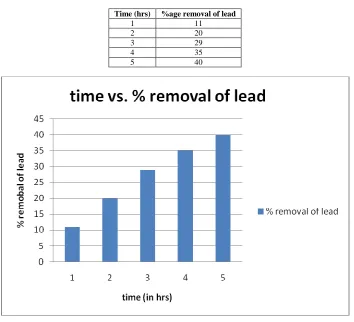
[image:3.595.130.489.68.291.2]The effect of time on removal of lead from the aqueous solution is shown in table 2 and fig. 2. The weight of the adsorbent and pH were kept constant. The pH of the solution was taken as 2.0 where maximum adsorption was inferred from the above result. It was found that with the increase in time, the % removal of lead increased from 11 to 40 %, thereby suggesting that time has a direct impact on the % removal of lead.
Table 2: Time vs. % removal of lead using inner skin of cassava
Time (hrs) %age removal of lead
1 11
2 20
3 29
4 35
5 40
Fig 2: Time vs. % removal of lead using the inner skin of cassava
[image:3.595.131.485.398.720.2]Shanthi V. et al
J. Chem. Pharm. Res., 2013, 5(7):335-340
______________________________________________________________________________
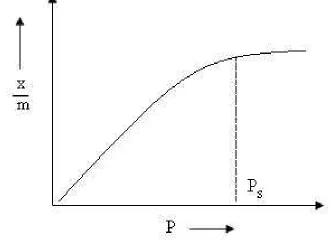
Langmuir model is followed out of all the 5 types of adsorption isotherm models. Fig 3 shows the Langmuir model.
Fig 3: % Removal of lead represented by the Langmuir model adsorption isotherm
where PS is saturation pressure.
Thus giving us a monolayer adsorption graph [22].
(iii) Effect of concentration on the Pb uptake:
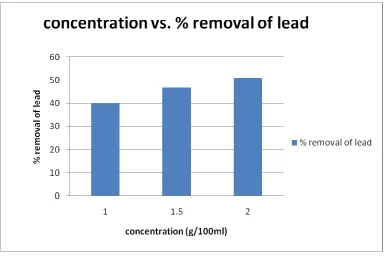
[image:4.595.135.469.191.441.2]The effect of concentration on removal of lead from the aqueous solution is shown in table 3 and fig. 4. To know the effect of the concentration of the adsorbent on the lead uptake, 3 samples were taken having different concentrations of 1, 1.5 and 2g at a constant pH and temperature and were subjected to shaker at a constant rpm. Readings were taken after every hour. It was found that with the increase in the amount of the adsorbent, there was an increase in the % removal of lead from 40 to 51 with 1g increase in the weight of the adsorbent. Thus suggesting that there is a direct impact on the amount of adsorbent for the % removal of lead.
Table 3: Concentration vs. % removal of lead using the inner skin of cassava
S. No. Amount of the adsorbent (g) % removal of lead
1 1 40
2 1.5 47
339
Fig 4: Concentration vs. adsorption of lead using the inner skin of cassava
CONCLUSION
The study was done to investigate the adsorption capabilities of chemically treated Cassava's inner layer by using aqueous solution of lead. It was found that the adsorption highly depends on the pH of the aqueous solution, time and the concentration of the adsorbent. It was concluded that the adsorption percentage of lead heavy metal is maximum at pH 2. Since, the adsorbent was treated with sulphuric acid of 0.75N (approx. pH 2), thus it might be because of this reason that the maximum adsorption is reaching at pH of 2.
Time was also found to have a significant role on the adsorption of lead. It was seen that with increase in time, the % removal of lead increases which shows that there is direct relation between time and adsorption. Also, it follows the basic adsorption isotherm process based on the Le-Chatelier principle and can be represented in the form of Type-1 adsorption isotherm graph out of all 5 types.
The concentration of the adsorbent also plays a significant role in the adsorption phenomena and it was seen that concentration is directly proportional to the % removal of lead from the aqueous solution.
Acknowledgement
The authors express deep sense of gratitude to the management of Vellore Institute of Technology for all the support, assistance and constant encouragements to carry out this work
REFERENCES
[1]. Hazrat Ali; Ezzat Khan; Muhammad Anwar Sajad. Chemosphere, 2013, 91(7), 869-881.
[2]. S Santha Lakshmi; M Gayathri; PN Sudha. Nature Environment and Pollution Technology, 2008, 7 (4), 733-736.
[3]. Q Feng; Q Lin; F Gong; S Sugita; M Shoya. J. Colloid Interf. Sci., 2004, 278(1), 1-8. [4]. S Dudka; WP Miller. Water Air Soil Pollut., 1999, 113, 127–132.
[5]. HJ Albering; SM Leusen; JCE Moonen; JA Hoogewerff; JCS Kleinjans. Environ. Health Perspect., 1999, 107, 37–43.
[6]. EH Larsen; L Moseholm; MM Nielsen. Sci. Total Environ., 1992, 126, 263–275.
[7]. P.C. Madu; G.D Akpaiyo; P. Ikoku Journal of Chemical and Pharmaceutical Research, 2011, 3(1), 467-477. [8]. R Soni; A Gupta, Journal of Chemical and Pharmaceutical Research, 2011, 3(6), 950-960.
[9]. Abbas Sabah Thajeel; M. Mustafa Al-Faize1; A. Z. Raheem Journal of Chemical and Pharmaceutical
Research, 2013, 5(4), 240-250.
[10]. E. Aikpokpodion Paul; O. C. Atewolara-Odule; T. Osobamiro; O. O. Oduwole; S. M. Ademola Journal of
Shanthi V. et al
J. Chem. Pharm. Res., 2013, 5(7):335-340
______________________________________________________________________________
[11]. Chemical Council on Environmental Quality; Chemical Hazards to Human Reproduction, 1981.
[12]. JH Traunfeld; DL Clement, DL Maryland. Cooperative Extention, University of Maryland, Lead in Garden Soils. Home and Garden, 2001.
[13]. The adverse health effects of lead 13 Jun 2004 .
[14]. BV Tangahu; SRS Abdullah; H Basri; M Idris; N Anuar; M Mukhlisin. International Journal of
Phytoremediation, 2013, 15 (7) , 663-676.
[15]. K Cho-Ruk; J Kurukote; P Supprung; S Vetayasuporn. Biotechnology, 2006, 5 (1), 1-4. [16]. LQ Ma; KM Komar; C Tu; W Zhang; Y Cai; ED Kennelley. Nature, 2001, 409, 579.
[17]. EL Arthur; PJ Rice; PJ Rice; TA Anderson; SM Baladi; KLD Henderson; JR Coats. Crit. Rev. Plant Sci., 2005, 24, 109–122.
[18]. WS Wan Ngah; MAKM Hanafiah. Bio-resource Technology, 2008, 99 (10), 3935-3948.
[19]. A Esteghlalian; AG Hashimoto; JJ Fenske; MH Penner. Bioresource Technology, 1997, 59 (2-3), 129-136. [20]. K Grohmann; R Torget; M Himmel. Biotechnology Bioengineering Symposium, 1985, 15 (15), 59-80.
[21]. R Orget; P Werdene; M Himmel; K Grohmann. Applied Biochemistry and Biotechnology, 1990, 24-25, 15-126.