International Journal of Emerging Technology and Advanced Engineering
Website: www.ijetae.com (ISSN 2250-2459, ISO 9001:2008 Certified Journal, Volume 6, Issue 1, January 2016)
178
Image Retrieval Using Wavelet Based Interactive Genetic
Algorithm
M. Padma Priyanka
1, D.Vijayalakshmi
21P.G.Student of Electronics and Communication Engineering, Vignan’s Institute of Engineering for Women, Visakhapatnam 2Assistant Professor in ECE, Vignan’s Institute of Engineering for Women, Visakhapatnam
Abstract—This paper presents content-based image retrieval (CBIR) system using the image features extracted by heuristic variance, wavelet coefficients, entropy, skew, kurtosis, relative smoothness and uniformity. In this work, the mentioned features are computed for all queries to evaluate the proposed algorithm and then compared to the same features of the query image. The results in the experiment have shown an improved performance (higher precision and recall) when compared with other CBIR methods.
Keywords—Image Retrieval, Wavelet coefficients, entropy, heuristic variance, skew, kurtosis, uniformity, relative smoothness.
I. INTRODUCTION
Content-based image retrieval, uses visual contents such as color, texture, shapes to search images from image databases, it has been an active and fast advancing research area since the 1990s.
CBIR system performs two major tasks: The feature extraction of the visual contents of the images and the similarity (distance) measurement among the feature vectors of the query image and all the images in the database. According to the methods used in CBIR, the features can be classified as low-level and search features. We have represented images using two types of features such as texture features extracted by wavelet network and color information features.
Texture is an important feature of natural images. Texture models can be divided into the following classes:
• Statistical methods. • Geometric methods • Model-based methods • Filtering methods
Color is the most widely used visual content for image retrieval. However, image retrieval using color features often gives disappointing results because, in many cases, images with similar colors do not have similar content.
A wide variety of techniques for texture and color combination have been proposed in literatures.
In recent years, wavelet network is used as an alternative for image feature extraction. Wavelet Networks attempt to combine the properties of the wavelet decomposition, along with the characteristics of neural networks. Wavelet Networks are employed in a wide range of applications in engineering, computer science or biology. These may range from classification, to feature extraction or approximation of complex nonlinear functions.
The aim of this work is to propose a new approach to extract a set of image features, based on wavelet which is the main contribution of this work. The reminder of this paper is organized as follows. Section II discusses the wavelet transform. The section III provides a quick overview of interactive genetic algorithm Color information descriptors are presented in section IV. The retrieved results and the conclusions are given in the sections V and VI respectively
II. WAVELET TRANSFORM
Wavelet transform (WT) has been introduced just recently in mathematics, even through the essential ideas that lead to this development have been around for many years. It is a linear transformation, which is more similar to the Fourier transform; however it allows time localization for the various frequency components of a given signal. In the case of the wavelet transform, the analyzing functions are called as wavelets. Wavelets are mathematical functions that divide data into different frequency components, and later analyses each component with a resolution matched to its scale
They have advantages over traditional Fourier methods in analyzing physical situations, where the signal contains discontinuities and sharp spikes.
III. INTERACTIVE GENETICALGORITHM
International Journal of Emerging Technology and Advanced Engineering
Website: www.ijetae.com (ISSN 2250-2459, ISO 9001:2008 Certified Journal, Volume 6, Issue 1, January 2016)
179 The image is divided into sub blocks of size 50x50 with overlapping size of 8x8.The first feature namely variance of the histogram of the hue content, are computed for the all the overlapping sub blocks of the image. This is treated as first part of the feature vector corresponding to the image.
Similarly other features are computed for all the overlapping sub blocks of the image to obtain other parts of the feature vector. All the parts belonging to the individual features are combined to obtain the feature vector corresponding to that particular image.
Thus feature vectors are computed for all the images in the data base.
IV. LIST OF LOW LEVEL FEATURES COMPUTED IN EVERY SUB BLOCKS OF THE IMAGE
1. Variance of the histogram of the hue content of
the particular sub-block is computed. 2. Measurement of uniformity:
P (zi) is the probability of gray value zi in the
particular sub block of the image. The uniformity of sub block of the image is measured using the formula given below.
∑
3. Measurement of Average Entropy:
Average entropy is computed as described below
∑
4. Measurement of Relative smoothness:
Where, σ (z) is the standard deviation of the gray values z in the particular sub block of the image.
5. The image is subjected to discrete wavelet
transformation (DWT) to obtain approximation co-efficient (app), horizontal detail co-efficient (hor), vertical detail co-efficient (ver) and diagonal (both horizontal and vertical) detail co-efficient(dia) The variance of the approximation co-efficient „app‟ is computed and considered as 5th feature.
6. Similarly the variance of the detail co-efficient,
horizontal detail co-efficient (hor) is considered as the sixth feature.
7. Similarly the variance of the detail co-efficient,
vertical detail co-efficient (ver) is considered as
the 7th feature.
8. And the variance of the detail co-efficient,
diagonal detail co-efficient „dia‟ is considered as the 8th feature.
9. Skewness:
The Skewness of the gray values is computed for every sub block of the image as mentioned below.
∑
10. Kurtosis:
The Kurtosis of the gray values is computed for every sub block of the image as mentioned below.
∑
International Journal of Emerging Technology and Advanced Engineering
Website: www.ijetae.com (ISSN 2250-2459, ISO 9001:2008 Certified Journal, Volume 6, Issue 1, January 2016)
180
Flowchart: Algorithm:
Part-1
1. Initially read all the images in the database.
2. Extract the features of every individual image in
database.
3. The features include
a. Heuristic variance
b. Uniformity
c. Entropy
d. Relative smoothness
e. Wavelet transform
f. Skew
g. Kurtosis
4. Save the extracted features for every individual image
in database in seven individual variables respectively and all the variables are saved in a single variable (Z).
Part 2
1. The user is asked to assign the rank for the individual
images. The value ranges from 0 to 40 based on the user‟s interest. (i.e.) User assigns higher rank if user likes that image and expecting the similar images in the next iteration.
2. 4 Images are selected from the 5 images using
Roulette wheel selection
3. In Roulette wheel selection, with user assigned rank
values normalized vector is computed and then cumulative summation of normalized vector is calculated and image is selected randomly.
4. Load the database that is saved in MAT file (Part-1).
5. Then extract the features of selected image in
Roulette wheel.
6. Then perform crossover to obtain the featured vectors
and save into variable (A).
7. Subtract the two variables „A‟ and „Z‟ and save the
difference.
8. Then calculate the mean square value of difference.
9. Then sort the values in ascending order with their
positions respectively.
10. Then display the first 5 images which have the
International Journal of Emerging Technology and Advanced Engineering
Website: www.ijetae.com (ISSN 2250-2459, ISO 9001:2008 Certified Journal, Volume 6, Issue 1, January 2016)
181 For example, the image database consists of different types of images is shown in the figure below. The procedure of obtaining the features of all images in the database is shown in below figure.
Then to obtain the required similar images in database, a query image is selected and its features extracted and the desired result is obtained by comparing it with the features of images in the database is shown in the figure
V. RESULTS
Image database:
International Journal of Emerging Technology and Advanced Engineering
Website: www.ijetae.com (ISSN 2250-2459, ISO 9001:2008 Certified Journal, Volume 6, Issue 1, January 2016)
182
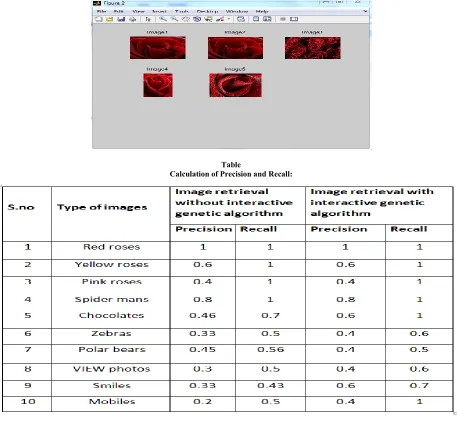
[image:5.612.75.532.152.573.2]Output:
Table
Calculation of Precision and Recall:
VI. CONCLUSION
In our paper, we extracted features are computed for all queries to evaluate the proposed algorithm and then compared to the same features of the Roulette wheel selected images.
The images with similar features are identified and displayed in the output. This interactive genetic algorithm was implemented using MATLAB. The results in the experiment have shown an improved performance (higher precision and recall) when compared with other CBIR methods.
Finally outcome of this proposed method is retrieving speed is increased when compared to previous methods andcontent based image retrieval is a challenging method of capturing relevant images from a large storage space.
REFERENCES
[1] Chih-Chin Lai, and Ying-Chuan Chen, “A User-Oriented Image Retrieval System Based on interactive Genetic Algorithm,” IEEEtransactions on instrumentation and measurement, vol. 60, no. 10, October 2011.
International Journal of Emerging Technology and Advanced Engineering
Website: www.ijetae.com (ISSN 2250-2459, ISO 9001:2008 Certified Journal, Volume 6, Issue 1, January 2016)
183 algorithm,”IEEE Trans. Instrum. Meas., vol. 59, no. 9, pp. 2315– 2327, Sep. 2010.
[3] D. E. Goldberg, Genetic Algorithms in Search, Optimization, and Machine Learning. Reading, MA: Addison-Wesley, 1989.
[4] Gonzalez R.C.Woods R.E: Digital Image Processing, Addison Wesley, 1992.
[5] Interactive Content-Based Image Retrieval Using Laplacian Mixture Model” Inthe Wavelet Domain Tahir Amin and Ling GuanDepartment of Electrical and Computer Engineering Ryerson University, Toronto, Canada
[6] Texture Feature Extraction and Description Using Gabor Wavelet In Content-Based Medical Image Retrieval” Gang Zhang1, 2,
Zong-Min Ma1 1.College of Information Science and Engineering, Northeastern University, China2.School of Software Engineering, Shenyang University of Technology, China
[7] Impact of Feature Selection on the Performance of Content-Based Image Retrieval (CBIR)”SlimaneBenloucif1 and BachirBoucheham 2 Department of Computer Science.
[8] GwenoleeQuellec, Mathieu Lamard, Guy Cazugu “Fast Wavelet-Based ImageCharacterization for Highly Adaptive Image Retrieval “IEEE Transactions on image processing, April 2012
[9] 3.Hamid A. Jalab Ali M. Hasan“mage Retrieval System Based on Wavelet network 2012 IEEE