International Journal of Emerging Technology and Advanced Engineering
Website: www.ijetae.com (ISSN 2250-2459, ISO 9001:2008 Certified Journal, Volume 7, Issue 4, April 2017)
191
Optimal Design of Some of the Rod Systems by the
Random Search Method
George Filatov
Professor, Doctor of Techn. Sciences, Ukrainian State University of Chemical Technology, Ukraine
Abstract − The paper deals with the weight optimization of statically determinate welded I-beam with restrictions on strength on the normal and shear stresses. Adduced the results of the application of random search method to the study of supercritical deformations of compressed flexible rod. In both cases is discussed the efficiency of random search method as compared to other numerical methods.
Keywords -- Optimal Designing, Random Search Method, Rod Systems, Strength of beams, Supercritical Deformations of Compressed Flexible Rod.
I. INTRODUCTION
In the development of an overall theory of optimal designing of constructions the central place belongs to formulation of the problem of determining optimal parameters of design as a mathematical programming problem. The overall problem of search engine optimization as of the multi-stage process of gathering information and making a decision on the base of received information has been formulated as follows: find a vector of control variables
X
*
x
1*,
x
*2,....,
x
n*
, (1) that delivers the extremum of objective function:)
,....,
,
(
)
(
F
x
1x
2x
nF
X
(2)at the performance of restrictions:
(
),
(
),....,
(
)
)
(
X
1X
2X
X
G
g
g
g
m , (3)where restrictions can take the form of:
X
0
i
g
;g
i
X
0
org
i
X
0
.In the problems of structural mechanics, presented by these equations, the vector of control variables, the objective function and restrictions have not the irrelative, but quite specific character, which is stipulated by conditions of work of structure, by its load-bearing capacity, reliability, durability, economic expediency. At this the objective function can be multiextremal, may have discontinuities, saddle points, etc.
Restrictions can be described by complex functions, most often non-linear, curved, which form ravines on the boundary permissible solutions.
An analytical solution of such problems, as a rule, does not exist. To solve such problems are used the numerical methods, one of which is the method of random search. The above random search algorithms in articles [1] are an application to solve the problem of optimal design of rod and continuous systems, as well as to the solution of some variation problems in mechanics at the designing of elements of machines and equipment, for which the optimal criterion is the minimum of potential energy of deformations. Consider the examples of using of the methods of random search to the optimal designing of some rod systems.
II. SHAPE OPTIMIZATION OF CROSS-SECTIONS OF
ELEMENTS OF DESIGNS BY RANDOM SEARCH
METHOD
Consider the bending beam with cross-section in form of welded I-beam (Fig. 1). The wall thickness of I-beam
t
, wall heighth
, flange thickness
and flange widthb
. The maximum bending moment and transversal force acting in the cross section,respectively, equal
M
max
561
,
79
kNm,44
,
481
max
Q
kN. Material beams − steel, with a calculated stresses to flexural and shear respectively150
R
MPa,R
sh
90
MPa. Is required to determine such cross-sectional dimensions of the beam, at which the cross-sectional areaF
th
2
b
would be minimal and would simultaneously performed conditions of strength on the normal and tangential stresses, as well as the technological and design restrictions.
International Journal of Emerging Technology and Advanced Engineering
Website: www.ijetae.com (ISSN 2250-2459, ISO 9001:2008 Certified Journal, Volume 7, Issue 4, April 2017)
192
Introducing the notation
b
x
x
h
x
t
x
1
;
2
;
3
;
2
, we obtain the problem of nonlinear mathematical programming: tofind a non-negative values
x
1,
x
2,
x
3,
x
4, which would minimize the objective function:
F
min
x
1x
2
2
x
3x
4 (4) and would satisfy the restrictions:0
2
2
12
2
12
max 3 2 2 3 2 2 3 4 3 3 2 1
M
x
x
x
x
x
x
x
x
x
R
(5)0
8
2
{
2
12
2
12
max 2 2 1 3 2 4 3 2 3 2 2 3 4 3 1 3 2 1
Q
x
x
x
x
x
x
x
x
x
x
x
x
x
x
R
sh (6)0
6
3 4
x
x
;
20
0
3 4
x
x
;
x
1
k
1
0
;0
2 2
x
k
, (7)Where
k
1
0
,
8
сm;k
2
85
сm.To solve this problem, two random search algorithms were used, which were described, respectively, in discrete adaptation algorithm ADA (Equation (35) in [2]) and the algorithm SGEF (Equations (46)-(52) in [1]).
The calculation results are shown in Table 1. Also given are the results of optimal design of the cross-section I-beam by engineering method and the Monte Carlo method [3]
Таble 1
Results of optimization parameters of cross-section of I-beam by different methods №
п/п Method
Parameters of cross-section
2cm
F
Notest
(сm)h
(сm)
(сm)b
(сm)1
Engineering 1,0 70,0 2,0 20,0 150,0
According to the work [82]
2
Monte-Carlo 0,8 78,6 1,7 22,9 140,7 работы [82] По данным
3 Discrete adaptation [12]
0,8 84,68 1,53 21,79 134,55
4 SGEF [7] 0,8 84,99 1,57 21,11 134,24
As can be seen from Table 1, the results obtained by different methods of random search, were almost identical, and generally were on 10% lower (the objective function) compared with the engineering intuitive approach.
III. THE RESEARCH OF DEFORMATION OF FLEXIBLE
RODS
Flexible or thin is called such straight or curved rods, the transverse dimensions of which are small enough compared to the length and radius of curvature of the rod axis.
It is assumed that the material of the rod obeys Hooke's law [4]. Consider the using of method of random search for research of large elastic displacements of flexible rods.
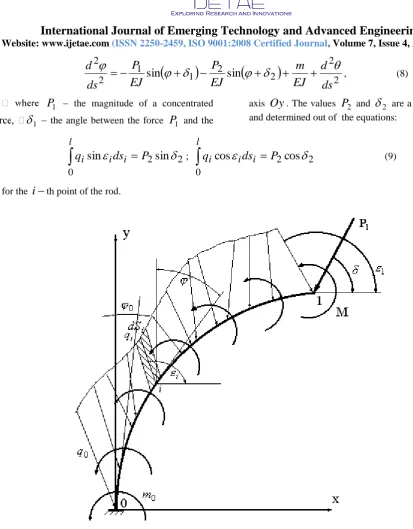
The general differential equation of the elastic line of the flexible rod constant stiffness
EJ
under theInternational Journal of Emerging Technology and Advanced Engineering
Website: www.ijetae.com (ISSN 2250-2459, ISO 9001:2008 Certified Journal, Volume 7, Issue 4, April 2017)
193
2 2 2
2 1 1
2 2
sin
sin
ds
d
EJ
m
EJ
P
EJ
P
ds
d
, (8)1
P
the magnitude of a concentrated1
the angle between the forceP
1 and theaxis
Oy
. The valuesP
2 and
2 are a function ofs
and determined out of the equations:
lq
i ids
i
P
0
2 2
sin
sin
;
l
i i
i
ds
P
q
0
2 2
cos
cos
(9) [image:3.595.80.494.81.611.2]for the
i
th point of the rod.Fig. 2. Estimated scheme of a flexible rod, loaded by an arbitrary load In addition, all loads are assumed continuous along the axis of the rod both in magnitude and direction, i.e.,
q
q
s
;
m
m
s
;
s
Where:
the angle of the tangent to the elastic line of the rod;s
the arc length of the elastic line;
angle of the tangent line to the initial outline of the rod.Equation (5) generally has no closed solution and studied by many authors.
In particular, in [6] for the numerical solution to this problem used the dynamic programming method. In terms of the variation approach, this equation is the Euler-Lagrange equation for the variation problem about of the minimum of functional
lF
ds
E
0
International Journal of Emerging Technology and Advanced Engineering
Website: www.ijetae.com (ISSN 2250-2459, ISO 9001:2008 Certified Journal, Volume 7, Issue 4, April 2017)
194
Where
2
cos
cos
2
1
,
2 2
2 1 1
2
K
K
EI
m
EI
P
EI
P
F
.
(11)
s
R
ds
d
K
1
variable curvature ofThe value of the integral (10) is an expression for the potential energy of the deformed flexible rod different initial curvature under the influence of external forces. [5]
Formulated above deterministic variation problem can be successfully solved one of the methods of random search through the establishment of appropriate probabilistic model.
Let us consider in more detail the case of compressed straight cantilever rod of constant stiffness.
The differential equation of curved axis of the rod (8) in this case
K
0
,
1
0
,
P
2
0
,
m
0
is as follows:
1sin
2 2
EI
P
ds
d
(12)
The solution of this equation can be expressed in terms of elliptic integrals [7]. Potential energy for such load (Fig. 3) is calculated as follows:
P
ds
EI
P
E
k
1 01 1 2
1
0
,
5
cos
(13)Fig. 3. Estimated scheme of compressed flexible rod of constant stiffness Turning to the dimensionless quantities
0
s
1
;
EI
l
P
P
2 1
1
;l
E
E
1
1
and introducing them into the equation (13), we get:
E
P
k
ds
1
0
1 2
1
0
,
5
cos
(14)In order to find a sustainable form of equilibrium
necessary find such function
s
, which minimizes the functional (14) and at the same time satisfies theinitial condition
0
0
.Using a difference approximation, we divide the rod into equal length sections
, so that
n
1
. The derivative in section i is calculated by the formula
i ii
1International Journal of Emerging Technology and Advanced Engineering
Website: www.ijetae.com (ISSN 2250-2459, ISO 9001:2008 Certified Journal, Volume 7, Issue 4, April 2017)
195
If we replace the integral (14) by the sum, then we obtain the desired value of the objective function:
n i i n P f 0 1 2 cos 5 , 0min
(15)Further we decompose the second term of the sum (12) in a row:
n i i n i i n in P N
f 0 4 0 2 0 1 2 .... ! 4 1 ! 2 1 5 , 0
min
(16)Minimizing the objective function (16) is performed using the algorithm of "independent" global search with adaptation of distribution of trials [8] by means of raffling of the vector of angles of turning
1,
2,....,
i,....,
n
Φ
at discrete points of therod. To solve the problem we use the pseudo-code uniformly distributed on the interval [0,1].
The role of vector of control variables X in this task performs the vector of rotation angles
Φ
. Substituting in the formulas (22)−(27) [1] components of the vectorΦ
found at
j
1
step, we calculate at each next stage the value of the angle of rotation of thei
th rodcross-section
imj, corresponding to the minimum ofthe objective function (16) in the
j
stage. The search stops when turning corners at the next stage differ from the current rotation values on the previous step on some small value, i.e., when the second term of the equation (27) [1] tends to zero.Coordinates of section of deformed rod are determined from the equations:
l ii
ds
x
0
sin
;
l ii
ds
y
0
cos
(17)or
n i m i i jx
1sin
; n i m i i j y 1
cos
(18)For an illustration of this approach, consider over than critical deformations of originally straight
cantilever rod of constant stiffness (Fig.4) at
P
20
andn
10
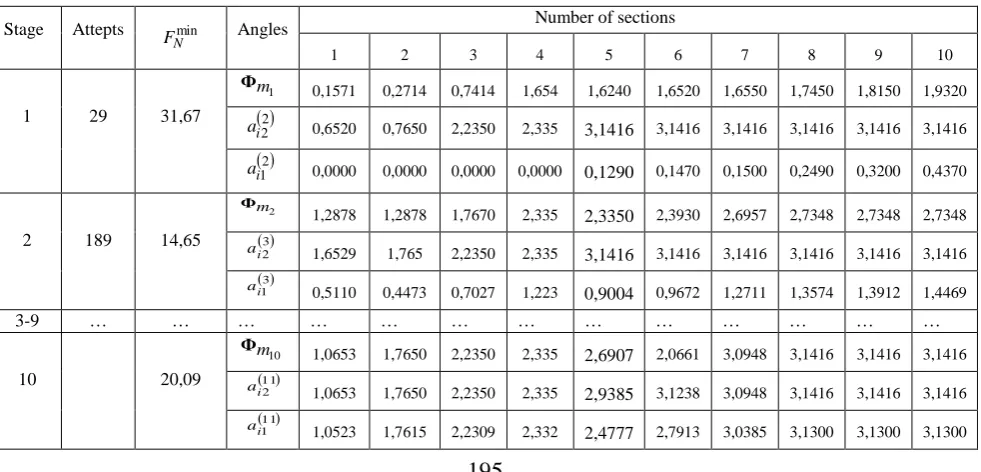
. The searching process is divided into 10 stages, each of which consists of 100 trials. On the first stage the vector of rotation angles corresponding to the minimum of the objective function (16) is sought in the area by means of random busting. These 10 rotation angles then were normalized. On the first stage also were determined the limits of the search area for the second phase, according to (22), (24) [1], taking into account the diminution the side of hyper-parallelepiped and increasing the density of trials according to (25), (26) [1]. [image:5.595.69.560.550.786.2]Similarly performed and the following steps. On the tenth stage of the search the area of search was narrowed to such an extent that the search was discontinued. Table 2 shows the test results for some of the steps (intermediate results to reduce the volume table were omitted).
Table 2
Results of research over than critical deformations of compressed flexible rod
Stage Attepts min
N
F Angles
Number of sections
1 2 3 4 5 6 7 8 9 10
1 29 31,67
1
m
Ф 0,1571 0,2714 0,7414 1,654 1,6240 1,6520 1,6550 1,7450 1,8150 1,9320 2
2
i
a 0,6520 0,7650 2,2350 2,335 3,1416 3,1416 3,1416 3,1416 3,1416 3,1416 2
1
i
a 0,0000 0,0000 0,0000 0,0000 0,1290 0,1470 0,1500 0,2490 0,3200 0,4370
2 189 14,65
2
m Ф
1,2878 1,2878 1,7670 2,335 2,3350 2,3930 2,6957 2,7348 2,7348 2,7348
3 2
i
a 1,6529 1,765 2,2350 2,335 3,1416 3,1416 3,1416 3,1416 3,1416 3,1416
3 1
i
a 0,5110 0,4473 0,7027 1,223
0,9004 0,9672 1,2711 1,3574 1,3912 1,4469
3-9 … … … …
10 20,09
10
m
Ф 1,0653 1,7650 2,2350 2,335
2,6907 2,0661 3,0948 3,1416 3,1416 3,1416
11 2
i
a 1,0653 1,7650 2,2350 2,335
2,9385 3,1238 3,0948 3,1416 3,1416 3,1416
11 1
i
a 1,0523 1,7615 2,2309 2,332
International Journal of Emerging Technology and Advanced Engineering
Website: www.ijetae.com (ISSN 2250-2459, ISO 9001:2008 Certified Journal, Volume 7, Issue 4, April 2017)
[image:6.595.238.411.141.358.2]196
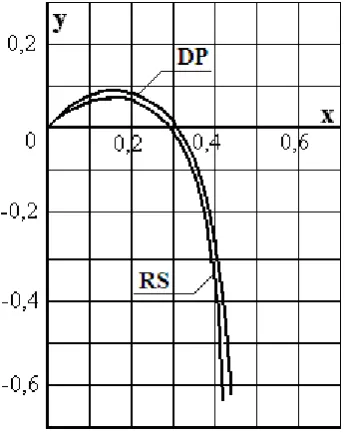
Fig. 4. The view of strained rod obtained by the method of random search (RS) and by the method of dynamic programming (DP) Fig. 4 shows the strained state of rod, obtained by
the method of random search (RS) and by the method of dynamic programming (DP) [4]. The coordinates of the free end of the rod, calculated using the formula (17) are equal
x
10
0
,
4235
;
y
10
0
,
6705
. The corresponding values of coordinates atP
20
obtained in [6], are equal
6519
,
0
і
4471
,
0
1010
y
x
.REFERENCES
[1] Filatov G.V. Random Search as the Method of Nonlinear Programming. Algorithms of Random Search // International Journal of Emerging Technology and Advanced Engineering, Volume 6, Issue 9, September 2016, p.p. 231-247.
[2] Filatov G.V. Pseudo-gradient Algorithms of Random Search with the Information Accumulation Adaptation and Direction of the Working Step // International Journal of Emerging Technology and Advanced Engineering, Volume 7, Issue 3, March, 2017, p.p.121-128.
[3] Golinski J., Lesniak Z.K. Optimales Entwerfev von Konstruktioner mit Hilfe der Monte-Carlo-Methode // “Bautechnik”. –1966. – 43. – № 9. – p.p. 47–54.
[4]
Nauka, 1967,
[5] Baranenko V.A., Pochtman Yu.M. Dynamic programming and nonlinear problems of statics of thin rods // Reports AN USSR. − V 182, Issue 5,
-[6] Baranenko V.A., Pochtman Yu.M. Application of dynamic programming method to the study of large deflections of the compressed cores // Journal of Applied Mechanics. - 1969. - V.5 - -135.
[7] Timoshenko S.P. Stability of elastic systems. - M .: [8] Rastrigin L.A. On optimal accumulation in the process of random search in conditions of interferences // In the book .: Problems of statistical optimization. - Riga: Zinatne. -