International Journal of Emerging Technology and Advanced Engineering
Website: www.ijetae.com (ISSN 2250-2459, ISO 9001:2008 Certified Journal, Volume 4, Issue 2, February 2014)194
Implementing And Comparison of MANET Routing
Protocols Using NS2
M. Swathi
1, B. Pravallika
2, N. V. Muralidhar
31
Assistant professor, 2,3Student, Department of CSE, Lendi Institute of Engineering And Technology, Vizianagaram, India.
Abstract— In the past few years we have seen a hasty inflation in the terrain of mobile computing. Due to upturn of inexpensive, widely available wireless devices, Ad-hoc networks has now become one of the most vibrant and active field of communication and networks. A Mobile Ad-hoc Network (MANET) is a self articulation wireless Ad-hoc network of mobile nodes. Each node has a router or a switch connected by wireless connection. A MANET depends upon the location of nodes, their connectivity, their service discovery capability, and ability to search and route messages using the nearest nodes .We have used NS2 simulator from scalable networks to perform the simulations. NS2 is a discrete event driven packet level network simulator. it support for TCP, routing and multicast protocols over wired and wireless network. This paper provides insight into ad hoc routing protocols (DSDV, AOMDV) and their metrics (Throughput, end to end delay, Packet loss) using NS2.
Keywords—AOMDV, DSDV, MANET, METRICS, NS2.
I. INTRODUCTION
A. MANET:
A mobile ad hoc network (MANET) [1] is a self-articulation infrastructure less network of mobile devices connected by wireless. MANET is a cooperative engagement of a collection of mobile hosts without the required intervention of any centralized AP. Each device in a MANET is free to move independently in any direction, and will therefore change its links to other devices frequently. Each must forward traffic unrelated to its own use, and therefore be a router. The primary challenge in building a MANET is equipping each device to continuously maintain the information required to properly route traffic. Such networks may operate by themselves or may be connected to the larger Internet. MANETs are a kind of Wireless ad hoc network that usually has a routable networking environment on top of a Link Layer ad hoc network. A MANET is a type of ad hoc network that can change locations and configure itself on the fly. All nodes in this network are mobile and they use wireless connections to communicate with various networks. Routing is one of the core problems of networking for delivering data from one node to the other.
Wireless ad-hoc networks are also called Mobile ad-hoc multi-hop networks without predetermined topology or central control. This is because MANETs can be characterized as having a dynamic, multi-hop, potentially rapid changing topology. The aim of such networks is to provide communication capabilities to areas with limited or no existing communication infrastructures.
Some salient characteristics of MANETs [3] are:-
• Dynamic topologies,
• Bandwidth constrained, variable capacity links,
• Energy constrained operation, and
• Limited physical security.
B. MANET applications:
MANET applications encompass the following [2]
Tactical networks
Military communication and operations, Automated battlefields.
International Journal of Emerging Technology and Advanced Engineering
Website: www.ijetae.com (ISSN 2250-2459, ISO 9001:2008 Certified Journal, Volume 4, Issue 2, February 2014)195
Emergency services
Search and rescue operations, Disaster recovery, Replacement of fixed infrastructure in case of environmental Disasters, Policing and fire fighting, Supporting doctors and nurses in hospitals.
Commercial and civilian
E-commerce, Business, Vehicular services, Sports stadiums, trade fairs, shopping malls, Networks of visitors at airports.
Home and enterprise
Home/office wireless networking conferences, Meeting rooms, Personal area
Networks (PAN), Personal networks (PN), Networks at construction sites.
Education
Universities and campus settings, Virtual Classrooms, Ad hoc communications during Meetings or lectures.
Entertainment
Multi-user games, Wireless P2P networking, Outdoor Internet access, Robotic pets, Theme Parks.
Sensor networks
Home applications, Body area networks (BAN), Data tracking of environmental conditions, animal
Movements, chemical/biological detection
Context aware services
Follow-on services, Information services, time dependent services, Infotainment: touristic information
Coverage extension
Extending cellular network access, linking up with the Internet, intranets, etc.
II. ROUTING PROTOCOLS
Routing is a process of exchanging information from one node to another node within the network [8]. Routing mechanism is used to forward packet from source to destination using most efficient path. Efficiency of the path is measured by using various metrics traffic load, delay, packet delivery ratio. Routing will be done due to mobility of nodes.
In packet switching network packet forwarding will be done by intermediate nodes. Intermediate nodes are nothing but routers, bridges, gateways, firewalls, or switches.
Routing is performed for many kinds of networks, including the telephone network (circuit switching), electronic data networks (such as the Internet), and transportation networks.
Classification of routing protocols:
Routing Protocols are a critical aspect to performance in mobile wired and wireless networks. Classification of routing protocols can be done in many ways, but many of these are done depending on routing strategy and structure of the network.
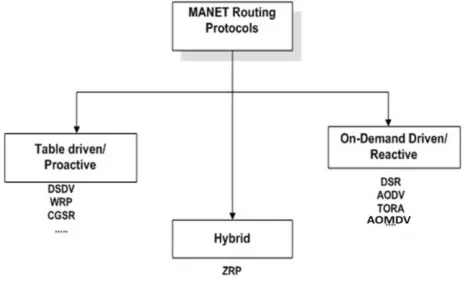
The routing protocols can be categorized as proactive, reactive and hybrid routing protocol
A. Proactive routing protocol:
Proactive is a table driven protocol in this each node maintains a separate routing table. It maintains the list of destinations and their routes by periodically distributing routing tables throughout the network. Each node updates the routing table whenever significant new information is available to maintain the consistency of the routing table with the dynamically changing topology of adhoc networks. Some of the proactive routing protocols are DSDV (Destination Sequenced Distance-Vector), WRP (Wireless Routing Protocol), CGSR (Cluster head Gateway Switch Routing), GSR (Global State Routing), FSR (Fisheye State Routing), HSR (Hierarchical State Routing), ZHLS (Zone based Hierarchical Link State),STAR (Source Tree Adaptive Routing).
B. Reactive routing protocol:
[image:2.612.327.559.314.456.2]International Journal of Emerging Technology and Advanced Engineering
Website: www.ijetae.com (ISSN 2250-2459, ISO 9001:2008 Certified Journal, Volume 4, Issue 2, February 2014)196 A route search is needed for every new destination. Due to these reasons these protocols have higher latency but lower overhead of route maintenance. Some of the examples for reactive protocols are DSR (Dynamic Source Routing), CBR (Cluster Based Routing), AODV (ad hoc On-Demand Distance Vector Routing), and AOMDV (adhoc Multipath Distance Vector Routing).
III. AOMDV
AOMDV means Ad-hoc on-demand multipath distance vector routing.[4],[5] AOMDV is the extension of AODV protocol to discover the multiple paths between source and destination. Multiple paths in the AOMDV are loop-free and disjoint. AOMDV has three benefits when compared to other on demand protocols.
• It does not have high inter-nodal coordination.
• It ensures disarticulation of alternate routes via distributed computation without the use of source routing.
• It computes alternate paths with minimal additional overhead it does this by exploiting already available alternate path.
In AOMDV when a source wants to communicate with the destination first it initiates a route discovery process by sending a RREQ packet. The RREQ packet transmission from the source to destination establishes a multiple reverse paths. The RREQ first sets up a reverse path to the source using the previous hop values of the RREQ. It is the next hop to the node in the reverse path. If the route is valid then the intermediate node generates a route reply packet otherwise RREQ is rebroadcast.
Each entry in the routing table consists of
• All available destinations
• Next hop towards each destination
• No of hops required to reach destination
• A destination sequence number
IV. DSDV
DSDV is a proactive routing protocol it is extension of bellman-ford routing algorithm [6]. In DSDV each node maintains a routing table consists of entries for all the nodes within the network. The routing table updates periodically when the topology changes are detected.[7] Each node sends the broadcasting message to its neighboring nodes and updates the packets. After receiving packet the neighboring node updates their routing table with incrementing the metric by one and it retransmit the update packet to all its neighbors. The will be repeated until all the nodes in the network receives a copy of the update packet with a corresponding metric. The route selection will be done basing on three steps
• The update information will be compared to its own routing table.
• Select route with higher destination sequence no.
International Journal of Emerging Technology and Advanced Engineering
Website: www.ijetae.com (ISSN 2250-2459, ISO 9001:2008 Certified Journal, Volume 4, Issue 2, February 2014)197 V. NETWORK SIMULATOR
Simulator is nothing but giving exogenous inputs to the system and it will study the behaviour of the inputs an d generate the results. Ns2 is discrete event simulator targeted at networking research. It provides generous support for simulation of TCP, UDP, routing and multicast protocols over wired and wireless networks. It consists package of tools to simulate the behaviour of different networks. Now current version of ns is ns-2. It includes scripting languages, new network protocols, evaluate performances much better.
Ns-2 is event driven packet level network simulator. It acts as a simulation tool for Linux journal. It creates network topologies log events that happen under any load and analyse events to understand the network behaviour. Languages used in ns2 are TCL, c, c++. TCL is used as a scripting language where c and c++ as a programming language used for coding purpose. Components used in NS-2 are Network animator (NAM). It is used to observe the behaviour of the network, simulator.
Advantages:
Find sum bugs in advance
Overview: over analytic techniques
Detail: Can simulate system details at arbitrary levels.
Parameter Values
VI. METRICS FOR PEROFORMANCE COMPARISION
MANETS uses a multiple number of metrics to evaluate the performance of protocols in the network. In the paper we have considered many of the metrics to calculate the network performance.
A. Throughput: It is used to calculate the average throughput of the application traffic between the nodes.
Throughput = Total received bytes/Elapsed time
Simply the time taken for a packet to travel from source to destination when it reaches the destination that particular time is said as a throughput.
B. Packet Loss: Amount of packets lost / dropped between the nodes due to traffic congestion and overloading in the network.
Packet loss = Number of loss packets / (Number of lost packet + Number of packets received successfully)
C. End-To-End Delay: The average time taken by a data packet to reach its destination. It also includes the delay triggered by route discovery process and the queue in the data packet transmission. Only the data packets that such victoriously delivered to destinations were counted.
International Journal of Emerging Technology and Advanced Engineering
Website: www.ijetae.com (ISSN 2250-2459, ISO 9001:2008 Certified Journal, Volume 4, Issue 2, February 2014)198 VII. RESULTS AND ANALYSIS
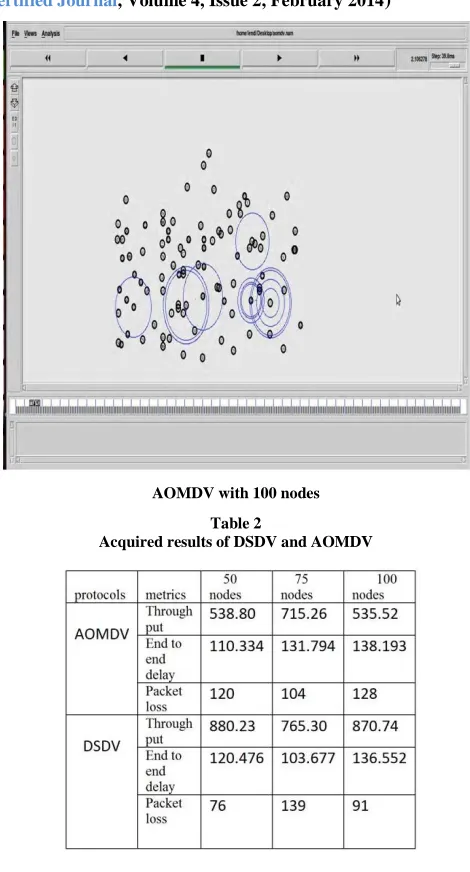
In this paper we analyzed the performance between on-demand and table driven routing protocols namely Destination Sequenced Distance Vector (DSDV) and Ad-hoc On-demand Multipath Distance Vector Routing (AOMDV) by calculating their metrics ( Throughput , End to End delay, Packet loss) .The results are analyzed below with their corresponding graphs.
A. Generated NAM files of DSDV:
DSDV with 50 nodes
DSDV with 75 nodes
DSDV with 100 nodes
International Journal of Emerging Technology and Advanced Engineering
Website: www.ijetae.com (ISSN 2250-2459, ISO 9001:2008 Certified Journal, Volume 4, Issue 2, February 2014)199 B. Generated NAM files of AOMDV:
AOMDV with 50 nodes
AOMDV with 75 nodes
[image:6.612.326.561.125.561.2]AOMDV with 100 nodes
Table 2
Acquired results of DSDV and AOMDV
While performing the analysis of the two Routing protocols DSDV and AOMDV for the metrics End-to-end delay, packet delivery ratio and routing load, the simulations are viewed by considering 50,75 and 100 nodes and their related Xgraphs are generated below.
International Journal of Emerging Technology and Advanced Engineering
Website: www.ijetae.com (ISSN 2250-2459, ISO 9001:2008 Certified Journal, Volume 4, Issue 2, February 2014)200 Throughput:
Figure1: Comparison of throughput in AOMDV and DSDV
Packet loss
Figure2: Comparison of packet loss between AOMDV and DSDV
End to end delay
Figure2: Comparison of End –to-end delay between AOMDV and DSDV
VIII. CONCLUSION
In this paper we have compared two routing protocols AOMDV, DSDV. The simulation of these protocols has been carried out using NS-2 simulator. Three different simulation network parameters are performed to calculate the performance of these routing protocols. Taking the three metrics for comparison we have concluded that in case of packet loss, End-to-End delay and throughput DSDV showed better results than AOMDV.
REFERENCES
[1] http://en.wikipedia.org/wiki/Mobile_ad_hoc_network.
[2] Jeroen Hoebeke, Ingrid Merman, Bart Dhoedt and Piet Demeester ―An Overview of Mobile Ad Hoc Networks: Applications and Challenges‖ session4.
[3] http://ciemcal.org/manet-and-routing-techniques/
[4] Mahesh K. Marina and Samir R. Das ―On-demand Multipath Distance Vector Routing in Ad Hoc Networks‖ Published online in Wiley InterScience (www.interscience.wiley.com). DOI: 10.1002/wcm.432
[5] Vivek B. Kute, M. U. Kharat ―Analysis of Quality of Service for the AOMDV Routing Protocol‖ published on ETASR - Engineering, Technology & Applied Science Research Vol. 3, _o. 1, 2013, 359-362.
[6] http://en.wikipedia.org/wiki/Destination-Sequenced_Distance_Vector_routing
[7] Guoyou He ―Destination-Sequenced Distance Vector (DSDV) Protocol‖