Hydrol. Earth Syst. Sci., 17, 863–871, 2013 www.hydrol-earth-syst-sci.net/17/863/2013/ doi:10.5194/hess-17-863-2013
© Author(s) 2013. CC Attribution 3.0 License.
EGU Journal Logos (RGB)
Advances in
Geosciences
Open Access
Natural Hazards
and Earth System
Sciences
Open AccessAnnales
Geophysicae
Open AccessNonlinear Processes
in Geophysics
Open AccessAtmospheric
Chemistry
and Physics
Open AccessAtmospheric
Chemistry
and Physics
Open Access DiscussionsAtmospheric
Measurement
Techniques
Open AccessAtmospheric
Measurement
Techniques
Open Access DiscussionsBiogeosciences
Open Access Open Access
Biogeosciences
Discussions
Climate
of the Past
Open Access Open Access
Climate
of the Past
Discussions
Earth System
Dynamics
Open Access Open Access
Earth System
Dynamics
DiscussionsGeoscientific
Instrumentation
Methods and
Data Systems
Open Access
Geoscientific
Instrumentation
Methods and
Data Systems
Open Access DiscussionsGeoscientific
Model Development
Open Access Open Access
Geoscientific
Model Development
DiscussionsHydrology and
Earth System
Sciences
Open AccessHydrology and
Earth System
Sciences
Open Access DiscussionsOcean Science
Open Access Open Access
Ocean Science
DiscussionsSolid Earth
Open Access Open Access
Solid Earth
DiscussionsThe Cryosphere
Open Access Open Access
The Cryosphere
Discussions
Natural Hazards
and Earth System
Sciences
Open Access
Discussions
Technical Note: An open source library for processing weather
radar data (wradlib)
M. Heistermann1, S. Jacobi1, and T. Pfaff2
1University of Potsdam, Institute of Earth and Environmental Sciences, Karl-Liebknecht-Str. 24–25, 14476 Potsdam, Germany
2University of Stuttgart, Institut f¨ur Wasser- und Umweltsystemmodellierung, Stuttgart, Germany
Correspondence to: M. Heistermann ([email protected])
Received: 26 October 2012 – Published in Hydrol. Earth Syst. Sci. Discuss.: 2 November 2012 Revised: 18 January 2013 – Accepted: 4 February 2013 – Published: 28 February 2013
Abstract. The potential of weather radar observations for hydrological and meteorological research and applications is undisputed, particularly with increasing world-wide radar coverage. However, several barriers impede the use of weather radar data. These barriers are of both scientific and technical nature. The former refers to inherent measurement errors and artefacts, the latter to aspects such as reading spe-cific data formats, geo-referencing, visualisation. The radar processing library wradlib is intended to lower these barri-ers by providing a free and open source tool for the most important steps in processing weather radar data for hydro-meteorological and hydrological applications. Moreover, the community-based development approach of wradlib allows scientists to share their knowledge about efficient process-ing algorithms and to make this knowledge available to the weather radar community in a transparent, structured and well-documented way.
1 Introduction
The potential of weather radar observations for hydrologi-cal and meteorologihydrologi-cal research and applications is undis-puted (Krajewski and Smith, 2002). Since the emergence of weather radar technology after World War II, research has strived at tapping this potential, particularly in terms of pre-cipitation monitoring and forecasting with high spatiotem-poral resolution and coverage. These features not only make weather radar data useful for severe weather detection and meso-scale flood forecasting, but potentially also for ero-sion studies, preciero-sion agriculture, water harvesting, or urban
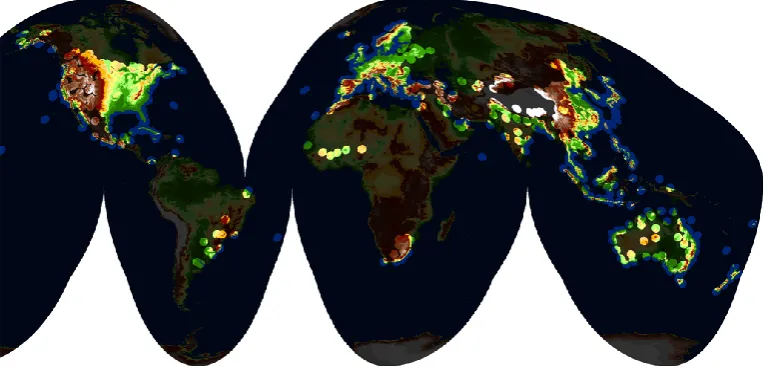
drainage and reservoir control (see e.g. Cruse et al., 2006; Hardegree et al., 2008; Kraemer and Verworn, 2009). The actual availability of radar coverage is no longer a limiting factor in many regions of the world (Fig. 1).
Nonetheless, many challenges remain, particularly from a hydrological perspective. From a scientific point of view, these challenges particularly arise from the multitude of po-tential error sources which are typically inhomogeneous in space and time (Harrison et al., 2000; Germann et al., 2006). These error sources can introduce severe bias in quantita-tive hydrological studies, e.g. (eco-)hydrological modelling and forecasting. Hence, it requires the combination of state-of-the-art correction algorithms to make the data useful for hydrological applications. Although many algorithms have been published in peer-reviewed journals, the level of doc-umentation often is not sufficient for a straightforward re-implementation.
Fig. 1. Current weather radar coverage provided by national weather services (in Goode Homolosine projection). For computing the area illuminated by terrestrial weather radars, we assumed a maximum range of 200 km per radar device. The underlying database was established based on a web search of national weather services’ web pages, web documents, and the WMO radar database http://wwr.dmi.gov.tr (which is quite incomplete, though, in comparison to the results shown in this figure). The sources of information are listed in the Supplement Sect. 1. The figure shows that almost complete coverage is achieved for North and Central America, as well as Western and Central Europe. Good coverage is also available for the Middle East, South, Southeast and East Asia, and Australia. Large parts of Africa and South America remain uncovered, yet, as well as vast parts of Russia (although a new network with about 140 Doppler radars is planned to be established in Russia by 2018).
out-of-the-box spatial visualisation tools outside GIS work-ing environments.
Furthermore, specific users might have specific require-ments to data processing. For example, one user might favour aggressive clutter elimination in order to assimilate the prod-uct to a numerical weather prediction (NWP) model (see e.g. Fornasiero et al., 2006), while another user might pre-fer a more conservative product in order to detect small scale convective features. A single product from a radar operator, even if created with the best methods currently available, will never be able to accommodate all these needs simul-taneously. For many potential users, this trickles down to a take-it-or-leave-it decision. The Hydro-NEXRAD initiative (Krajewski et al., 2011) aims to address this problem by pro-viding a web interface through which the user can specify a limited set of processing options; however, only for the US weather radar network NEXRAD.
Researchers themselves typically hesitate to commit to proprietary software products if they do not have the perspec-tive to modify the software code according to their own best knowledge – which would basically require an open source concept. Until recently, no open source software for weather radar data processing has been available which lead many researchers to develop their own software code. This option often implies reinventing the wheel: writing routines for data I/O, error corrections, geo-referencing and visualisation, try-ing to find relevant literature and to extract algorithms from publications, which, often enough, do not offer all details re-quired for implementation. This takes a lot of time and effort,
which could be used much more efficiently if standard algo-rithms were available in a well- documented and easy to use manner.
In 2012, the situation changed as even two free and open source software products for weather radar data processing were released, one being the BALTRAD software (http:// git.baltrad.eu) and the other being the wradlib library (http: //wradlib.bitbucket.org). This paper aims at introducing the conceptual and technical framework of the wradlib library. In Sect. 2, we will present the design and development goals of wradlib. Section 3 will illustrate the functionality of wradlib based on a set of examples. Section 4 will outline the main future development challenges.
2 Design and development goals
2.1 wradlib is a library
2.2 wradlib is easy to use
Using Python as the main implementation language sub-stantially lowers the barrier to create applications based on wradlib. Python (http://python.org) is an open source, high level interpreted language with an extensive built-in standard library. It has a clear syntax, is well documented and easy to learn. Using Python also allows embedding lower-level pro-gramming languages such as C/C++ or FORTRAN. This option can be used to include external code, but also to opti-mise the performance of selected functions.
2.3 wradlib is platform independent
Building on top of Python makes wradlib platform-independent, provided that package dependencies can be sat-isfied on the respective platform as well. This is straightfor-ward in Linux environments. On windows machines, most dependencies can conveniently be resolved by installing free scientific Python distributions such as Python(x, y) or the En-thought Python Distribution (EPD).
2.4 wradlib is a community project
wradlib is consequently open source and uses the permissive MIT License to ensure that students, researchers or compa-nies who contributed to wradlib may continue to use their work even for commercial purposes. The open source license model not only allows free access to all of wradlib’s process-ing capabilities, but is also a prerequisite to put into action the concept of wradlib as a community-based development and exchange platform. This means that researchers and devel-opers should understand wradlib as an opportunity to share their knowledge with other developers, and on the other hand to benefit from user feedback. Apart from the permissive li-cence model and platform independence, the following two concepts are assumed to foster this kind of exchange:
– Distributed Version Control: version control allows de-velopers to track changes and to integrate code from several developers almost automatically. Distributed version control systems (DVCS) add a new level of cooperation as each developer may work with his or her own repository, having full access to the whole history, merging in changes from others when nec-essary, and pushing out own changes once these are deemed ready for application. wradlib uses the plat-form independent DVCS Mercurial (http://mercurial. selenic.com). The source code is hosted at Bitbucket (http://bitbucket.org/wradlib/wradlib). Apart from host-ing, Bitbucket offers additional services useful for col-laboration and community-building like issue-tracking, RSS feeds and e-mail notifications, or interactive com-ments on changesets. Developers without writing per-missions on the main repository can integrate their own developments into the main wradlib branch by using
the so-called Pull Request mechanism. Corresponding guidance is provided in the tutorials section of the wradlib documentation pages.
– Documentation: it is the belief of the authors that the paramount criterion for the usability of a library is its documentation. Documentation should not only enable the potential user to apply the software, but it should also contain key technical and scientific background in-formation on the functions employed. Documentation is thus a requirement for efficient development coop-eration, and is the main interface between developers and users. This includes documentation of the source code and the application programming interface (API), but also tutorials and code recipes to guide beginners on their first steps as well as to explain more complex applications, which cannot be covered by the individual function or class documentation. wradlib makes exten-sive use of Python’s docstring concept to keep the li-brary documentation as close to the actual code as pos-sible. The docstrings are automatically extracted, incor-porated in higher level documents, and finally converted into presentation formats like html or LaTeX. The re-sulting documentation is made available for download or can be accessed online (http://wradlib.bitbucket.org). Most of these concepts should be taken for granted in sci-entific software development; however, they are not. This is why the significance is stressed so much in this context.
2.5 wradlib is interactive
wradlib enables interactive as well as presentation quality vi-sualisation of data, with and without spatial contexts, and in the same environment that created the data. Together with the interactive features readily available through the Python interpreter or the IPython shell, wradlib may also become a valuable tool for teaching weather radar related topics.
3 Features by example
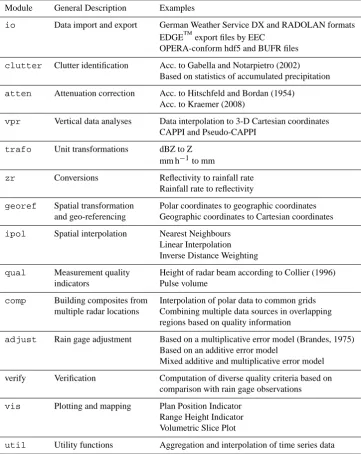
As pointed out above, wradlib covers many aspects of a typ-ical radar data processing chain, with differing levels of ma-turity. While some modules are still experimental, others are already robust enough for operational environments (see Ta-ble 1). A full library reference is availaTa-ble in the wradlib doc-umentation at http://wradlib.bitbucket.org/reference.html.
In the following, we will exemplify some of the features contained in wradlib. The code as well as example data sets are contained in the wradlib distribution under the examples directory.
3.1 Reading common radar data formats
Table 1. Modules in wradlib.
Module General Description Examples
io Data import and export German Weather Service DX and RADOLAN formats EDGE™ export files by EEC
OPERA-conform hdf5 and BUFR files
clutter Clutter identification Acc. to Gabella and Notarpietro (2002) Based on statistics of accumulated precipitation
atten Attenuation correction Acc. to Hitschfeld and Bordan (1954)
Acc. to Kraemer (2008)
vpr Vertical data analyses Data interpolation to 3-D Cartesian coordinates CAPPI and Pseudo-CAPPI
trafo Unit transformations dBZ to Z
mm h−1to mm
zr Conversions Reflectivity to rainfall rate Rainfall rate to reflectivity
georef Spatial transformation Polar coordinates to geographic coordinates and geo-referencing Geographic coordinates to Cartesian coordinates
ipol Spatial interpolation Nearest Neighbours Linear Interpolation Inverse Distance Weighting
qual Measurement quality Height of radar beam according to Collier (1996)
indicators Pulse volume
comp Building composites from Interpolation of polar data to common grids multiple radar locations Combining multiple data sources in overlapping
regions based on quality information
adjust Rain gage adjustment Based on a multiplicative error model (Brandes, 1975) Based on an additive error model
Mixed additive and multiplicative error model
verify Verification Computation of diverse quality criteria based on comparison with rain gage observations
vis Plotting and mapping Plan Position Indicator Range Height Indicator Volumetric Slice Plot
util Utility functions Aggregation and interpolation of time series data
data formats mainly used in Europe, but also world-wide. At the moment, these formats include the OPERA BUFR (Paulitsch et al., 2010) and hdf5 formats (Michelson et al., 2011), NetCDF files generated by the commercial EDGE software, hdf5 files generated by the commercial GAMIC software, as well as the German Weather Services quantita-tive local scan format (DX) and the quantitaquantita-tive composite format (RADOLAN, see German Weather Service, 2004). Other formats will be implemented dependent on demand and availability of documentation. wradlib deals with data in both polar and Cartesian coordinate systems.
The basic data structure used by wradlib is a multi-dimensional numerical array (the numpy.ndarray). It is a very
flexible and powerful container for homogeneous data, and has become the de-facto standard for most scientific Python packages. The wradlib.io module provides functions that load data from files of different formats into numpy.ndarrays. Metadata, if available, are returned as so-called dictionary objects which can be browsed and inspected using keywords. The level and detail of meta-information depends on the data source.
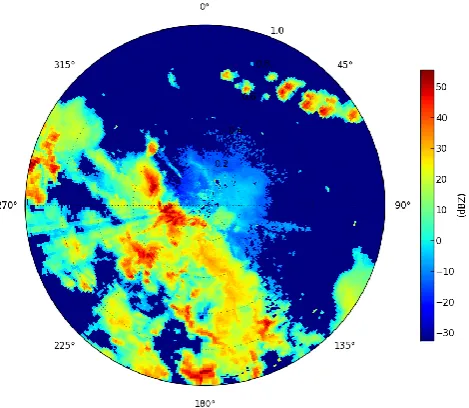
Fig. 2. Simple diagnostic plot of polar reflectivity.
Example 1:
>>>import wradlib
>>>data, metadata=wradlib.io.readDX(’sample.dx’)
>>>wradlib.vis.polar plot(data)
3.2 Error correction
There are several modules dedicated to the correction of the major sources of error in weather radar data. wradlib.clutter implements functions for clutter detection, wradlib.atten and wradlib.vpr deal with attenuation and errors due to the ver-tical profile of reflectivity (algorithms for VPR correction are currently underway). In the following example, a map of clutter signals is identified by using the filter described in Gabella and Notarpietro (2002).
Example 2:
>>>clutter = wradlib.clutter.filter gabella (data, tr1=12, n p=6, tr2=1.1)
The behaviour of this filter can be adjusted to the user’s needs. In this example the three parameters of the filter are set explicitly. If they were not given default values (usually those presented in the respective publication) would have been used.
The Boolean map returned by the function can then be used to correct the original data, for example by interpola-tion from surrounding radar bins:
Example 3:
>>> corrected = wradlib.ipol.interpolate polar (data, clutter)
For attenuation correction several implementations of the re-cursive methods presented by Nicol and Austin (2003) and Kraemer (2008) exist. An implementation of the method pre-sented by Marzoug and Amayenc (1994) is underway as well as methods addressing the vertical profile of reflectivity.
3.3 Data transformation
The wradlib.trafo module contains utility functions to do common unit transformations like converting from and to decibel or transform rainfall intensities to depths depending on the integration interval. Due to the importance and the di-versity of algorithms for Z–R relations, corresponding func-tions are collected in the wradlib.zr module. Currently, the standard power-law relation and the 3-part relation currently in operational use by the German Weather Service accord-ing to German Weather Service (2004) are implemented. For instance, the clutter corrected reflectivity (in dBZ) from Ex-ample 3 can be converted to a 5 min (300 s) rainfall depth using the following code sequence:
Example 4:
>>> Z = wradlib.trafo.idecibel(corrected)
>>> R = wradlib.zr.z2r(Z)
>>> depth = wradlib.trafo.r2depth(R, 300)
An additional configuration can be passed to many func-tions using Python’s keyword mechanism. By default wradlib.zr.z2r uses the parametersa=200 andb=1.6.
3.4 Geo-referencing
Fig. 3. Rainfall accumulation for Metropolitan Manila region, Philippines, from 6–9 August 2012, based on the S-band radar lo-cated near Subic city, using wradlib modules io (reading NetCDF data), georef (geo-referencing), clutter (clutter identification), ipol (gap filling), adjust (for mean field bias adjustment), and vis (for plotting over a map). The orange lines indicate watersheds draining to Manila Metropolitan region. Note that the southern sectors of the radar exhibit significant beam shielding caused by Mount Natib, a volcano and caldera complex located in the province of Bataan. Please note that a corresponding code recipe for this figure has not been added to the wradlib documentation page because the code is part of a more complex application built on wradlib.
Example 5:
>>>range = 100000.
>>>azimuth = 45.
>>>elev = 0.5
>>>radar location = (48.5861, 9.7839, 500.)
>>>lat, lon, alt = wradlib.georef.polar2latlonalt (range, azimuth, elev, radar location)
>>>gk3 = wradlib.georef.create projstr("gk", zone=3)
>>>x, y = wradlib.georef.project(lat, lon, gk3)
Geo-referencing also allows plotting radar data over a map, including arbitrary, user-defined geographical features such as coastlines, borders, cities or catchments, using the wradlib.vis module. A typical result of such a procedure is shown in Fig. 3, containing a four day rainfall accumulation for the Metropolitan Manila region in the Philippines for the disastrous rainfall event in August 2012.
Fig. 4. Composite of a two hours event accumulation of clutter and attenuation corrected data for 2 June 2008, 16:00–18:00 UTC, in-cluding the German Weather Service’s C-band radars Tuerkheim and Feldberg (5 min scan interval, 1◦ angular resolution, 128 km range, and 1 km range resolution). This event caused a disastrous flash flood in the central map region. Get details about the underly-ing code at http://wradlib.bitbucket.org/recipes.html. For two hours of data, the complete workflow takes about 20 s of computation time (on a 32bit Windows machine, using one out of eight threads of an Intel 2.93 GHz Quad-Core processor).
3.5 Interpolation and composition
wradlib provides nearest neighbour, inverse distance weight-ing and linear interpolation. Various Krigweight-ing methods are currently being implemented. All methods have a unified in-terface so that only minimal changes are necessary to switch between different approaches. The interpolation methods are used by several routines like infilling of missing or flagged data, or the transfer from polar to Cartesian representations.
Combining data from several radar locations on one com-mon grid is usually referred to as composition. Creating composites is particularly challenging in areas where several radar circles overlap. In these regions of overlap, wradlib ap-plies criteria related to data quality in order to weight differ-ent radar data sources. Users are free to define quality crite-ria; however, the wradlib.qual module supports the evalua-tion of radar data quality for different criteria such as beam height over ground, or pulse volume. Figure 4 shows the re-sult of a composition based on a weighted combination, using the sampling volume as a quality criterion.
3.6 Gage adjustment
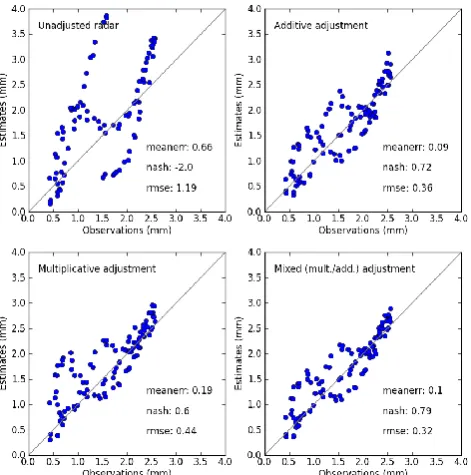
[image:6.595.306.545.62.238.2]Fig. 5. A 1-dimensional example with synthetic data for illustrating different adjustment approaches in wradlib. The true rainfall was generated by combining a sine curve with white noise. Contami-nating the true rainfall with spatially variable additive and multi-plicative error terms yields the unadjusted radar observation. Three adjustment methods are then applied via wradlib.adjust – using the gage observations (grey circles) which are random samples of the true rainfall. See Fig. 6 for a verification of this example adjustment.
Kneis, 2011). The wradlib.adjust module provides different adjustment techniques in order to identify the most effective approach for a specific region and application. At the mo-ment, the implemented adjustment approaches mainly differ with respect to the error model (additive, multiplicative, and a mixed multiplicative and additive approach), and whether the error is assumed to be spatially homogeneous or not. An illustrative one-dimensional example fo different adjustment techniques is given in Fig. 5.
3.7 Verification
[image:7.595.49.284.63.246.2]Typically, radar-based precipitation estimation and the effec-tiveness of the underlying correction and adjustment methods are verified by comparing the results against rain gage obser-vations on the ground (Kneis and Heistermann, 2009). This can be done by cross-validation (in case rain gages were al-ready used for gage adjustment), or by using a set of indepen-dent, high-quality precipitation measurements on the ground. This procedure has been criticized due to the limited spatial representativeness of point observations and the problems re-sulting from a comparison to the volume integrated radar observation (Einfalt et al., 2004; Germann and Joss, 2004; Kitchen and Blackall, 1992; Michelson and Koistinen, 2000; Seed et al., 1996). Indeed, alternatives have been proposed, e.g. based on the hydrological catchment response (Heister-mann and Kneis, 2011). Nonetheless, the use of rain gage ob-servations remains the main verification strategy. Therefore, wradlib.verify provides procedures not only to extract the
Fig. 6. Verification of the adjustment techniques, using the example shown in Fig. 5. The scatter plot and the error metrics were created using wradlib.verify. The metrics are computed by comparing the unadjusted and the adjusted radar observations against the synthetic true rainfall (just a small selection of error metrics is shown here).
radar values at specific gage locations, but also a set of error metrics which are computed from gage observations and the corresponding radar-based precipitation estimates (includ-ing standard metrics such as RMSE, mean error and Nash– Sutcliffe efficiency). wradlib.adjust also contains a standard procedure for leave-one-out cross validation which is appli-cable to each of the available adjustment method. Figure 6 illustrates the verification output for the one-dimensional ex-ample that was provided in Fig. 5.
4 Conclusions and outlook
platform independency might be used to distinguish wradlib from BALTRAD.
Apart from the user’s perspective, wradlib could sup-port radar related research by providing a unified interface to a growing number of standard and research algorithms. Thereby, wradlib could enable extensive comparison studies, and increase the reproducibility of research results. In addi-tion, the open source concept allows public code review of any algorithm provided in the library. It already turned out that, together with the community features and the DVCS concept, errors are rapidly identified and fixed.
In the future, the main development efforts in wradlib will have to be invested in the integration of algorithms related to the use of
– polarimetric radar moments e.g. the classification of hy-drometeors, for the optimisation of Z–R relation param-eters, or the correction of clutter, beam blockage and attenuation (e.g. Matrosov et al., 2007; Friedrich et al., 2007; Lang et al., 2009; Cifelli et al., 2011; Tabary et al., 2011; Vulpiani et al., 2012; and Cao et al., 2012, for a general introduction to weather radar polarimetry); – and 3-dimensional scan information to correct for the
effects of non-homogeneous vertical profiles of reflec-tivity (e.g. Franco et al., 2006; Tabary, 2007; Bouilloud et al., 2010; Kirstetter et al., 2010).
The other wradlib modules also are highly dynamic and of-fer a huge potential for further improvements (e.g. related to interpolation, gage adjustment, quality assessment, and visu-alisation).
5 How to use wradlib?
– Get the wradlib source distribution at http://www. bitbucket.org/wradlib/wradlib;
– see the wradlib documentation at http://www.wradlib. bitbucket.org;
– get community support by joining the mailing list https://groups.google.com/forum/?fromgroups#!forum/ wradlib-users.
Supplementary material related to this article is
available online at: http://www.hydrol-earth-syst-sci.net/ 17/863/2013/hess-17-863-2013-supplement.pdf.
Acknowledgements. The development of wradlib was supported by the University of Stuttgart, the University of Potsdam, and the German Federal Ministry for Education and Research (BMBF) through the PROGRESS project. The example radar data shown in this paper were provided by courtesy of the German Weather
Service, and the Philippine Atmospheric, Geophysical and As-tronomical Services Administration (PAGASA). Until now, the feedback of many wradlib users has already allowed for substantial improvements in the software library. Finally, we would like to thank Hidde Leijnse and an anonymous referee for reviewing the manuscript.
Edited by: R. Uijlenhoet
References
Bouilloud, L., Delrieu, G., Boudevillain, B., and Kirstetter, P. E.: Radar rainfall estimation in the context of post-event analysis of flash-flood events, J. Hydrol., 394, 17–27, 2010.
Brandes, E. A.: Optimizing Rainfall Estimates with the Aid of Radar, J. Appl. Meteorol., 14, 1339–1345, 1975.
Cao, Q., Yeary, M. B., Zhang, G.: Efficient Ways to Learn Weather Radar Polarimetry, IEEE T. Educ., 55, 58–68, 2012.
Cifelli, R., Chandrasekar, V., Lim, S., Kennedy, P. C., Wang, Y., and Rutledge, S. A.: A New Dual-Polarization Radar Rainfall Algo-rithm: Application in Colorado Precipitation Events, J. Atmos. Ocean. Tech., 28, 352–364, 2011.
Collier, C. G.: Applications of weather radar systems: A guide to uses of radar data in meteorology and hydrology, 2nd Edn., John Wiley and Sons, New York, 1996.
Cruse, R., Flanagan, D., Frankenberger, J., Gelder, B., Herzmann, D., James, D., Krajewski, W., Kraszewski, M., Laflen, J., Op-somer, J., and Todey, D.: Daily estimates of rainfall, water runoff, and soil erosion in Iowa, J. Soil Water Conserv., 61, 191–199, 2006.
Einfalt, T., Arnbjerg-Nielsen, K., Golz, C., Jensen, N. E., Quirm-bach, M., Vaes, G., and Vieux, B.: Towards a roadmap for use of radar rainfall data in urban drainage, J. Hydrol., 299, 186–202, 2004.
Fornasiero, A., Bech, J., and Alberoni, P. P.: Enhanced radar pre-cipitation estimates using a combined clutter and beam blockage correction technique, Nat. Hazards Earth Syst. Sci., 6, 697–710, doi:10.5194/nhess-6-697-2006, 2006.
Franco, M., Sanchez-Diezma, R., and Sempere-Torres, D.: Im-provements in weather radar rain rate estimates using a method for identifying the vertical profile of reflectivity from volume radar scans, Meteorol. Z., 15, 521–536, 2006.
Friedrich, K., Germann, U., Gourley, J. J., and Tabary, P.: Effects of radar beam shielding on rainfall estimation for the polarimetric C-band radar, J. Atmos. Ocean. Tech., 24, 1839–1859, 2007. Gabella, M. and Notarpietro, R.: Ground clutter characterization
and elimination in mountainous terrain. In Proceedings of ERAD 2002, Delft, The Netherlands, 305–311, available at: http://www. copernicus.org/erad/online/erad-305.pdf, 2002.
Germann, U. and Joss, J.: Operational measurement of precipita-tion in mountainous terrain, in: Weather Radar: Principles and Advanced Applications, Physics of Earth and Space Environ-ments, edited by: Meischner, P., 52–77, Springer, Berlin, Ger-many, 2004.
Germann, U., Galli, G., Boscacci, M., and Bolliger, M.: Radar pre-cipitation measurement in a mountainous region, Q. J. Roy. Me-teor. Soc., 132, 1669–1692, 2006.
Hilfe von automatischen Bodenniederschlagsstationen, Final Re-port, Offenbach, Germany, available at: http://www.dwd.de/ RADOLAN (last access: February 2013), 2004 (in German). Goudenhoofdt, E. and Delobbe, L.: Evaluation of radar-gauge
merging methods for quantitative precipitation estimates, Hy-drol. Earth Syst. Sci., 13, 195–203, doi:10.5194/hess-13-195-2009, 2009.
Hardegree, S. P., Van Vactor, S. S., Levinson, D. H., and Winstra, A. H.: Evaluation of NEXRAD radar precipitation products for nat-ural resource applications, Rangeland Ecol. Manage., 61, 346– 353, 2008.
Harrison, D. L., Driscoll, S. J., and Kitchen, M.: Improving pre-cipitation estimates from weather radar using quality control and correction techniques, Meteorol. Appl., 7, 135–144, 2000. Heistermann M. and Kneis, D.: Benchmarking quantitative
precip-itation estimation by conceptual rainfall-runoff modeling, Water Res. Resour., 47, W06514, doi:10.1029/2010WR009153, 2011. Hitschfeld, W. and Bordan, J.: Errors inherent in the radar
mea-surement of rainfall at attenuating wavelengths, J. Meteorol., 11, 58–67, 1954.
Kirstetter, P. E., Andrieu, H., Delrieu, G., and Boudevillain, B.: Identification of Vertical Profiles of Reflectivity for Correction of Volumetric Radar Data Using Rainfall Classification, J. Appl. Meteorol. Clim., 49, 2167–2180, 2010.
Kitchen, M. and Blackall, R. M.: Representativeness errors in com-parisons between radar and gauge measurements of rainfall, J. Hydrol., 134, 13–33, 1992.
Kneis, D. and Heistermann, M.: Quality assessment of radar-based precipitation estimates with the example of a small catchment, Hydrol. Wasserbewirts., 53, 160–171, 2009.
Kraemer, S.: Quantitative Radardatenaufbereitung f¨ur die Nieder-schlagsvorhersage und die Siedlungsentw¨asserung. Mitteilun-gen Institut f¨ur Wasserwirtschaft, Hydrologie und Land-wirtschaftlichen Wasserbau Gottfried Wilhelm Leibniz Univer-sit¨at Hannover, Heft 92, ISSN 0343-8090, Hanover, Germany, 2008.
Kraemer, S. and Verworn, H. R.: Improved radar data processing algorithms for quantitative rainfall estimation in real time, Water Sci. Technol., 60, 175–184, 2009.
Krajewski, W. F. and Smith, J. A.: Radar hydrology: rainfall esti-mation, Adv. Water Res., 25, 1387–1394, 2002.
Krajewski, W. F., Kruger, A., Smith, J. A., Lawrence, R., Gunyon, C., Goska, R., Seo, B. C., Domaszczynski, P., Baeck, M. L., Ra-mamurthy, M. K., Weber, J., Bradley, A. A., DelGreco, S. A., and Steiner, M.: Towards better utilization of NEXRAD data in hy-drology: an overview of Hydro-NEXRAD, J. Hydroinform., 13, 255–266, 2011.
Lang, T. J., Nesbitt, S. W., and Carey, L. D.: On the Correction of Partial Beam Blockage in Polarimetric Radar Data, J. Atmos. Ocean. Tech., 26, 943–957, 2009.
Marzoug, M. and Amayenc, P.: A Class of Single-and Dual-Frequency Algorithms for Rain-Rate Profiling from a Space-borne Radar. Part I: Principle and Tests from Numerical Simu-lations, J. Atmos. Ocean. Tech., 11, 1480–1506, 1994.
Matrosov, S. Y., Clark, K. A., and Kingsmill, D. E.: A polarimet-ric radar approach to identify rain, melting-layer, and snow re-gions for applying corrections to vertical profiles of reflectivity, J. Appl. Meteorol. Clim., 46, 154–166, 2007.
Michelson, D. B. and Koistinen, J.: Gauge-radar network adjust-ment for the Baltic Sea Experiadjust-ment, Phys. Chem. Earth Pt. B, 25, 915–920, 2000.
Michelson, D. B., Lewandowski, R., Szewczykowski, M., and Beekhuis, H.: EUMETNET OPERA weather radar informa-tion model for implementainforma-tion with the HDF5 file format, Ver-sion 2.1. OPERA Working Document WD 2008 03, available at: http://www.knmi.nl/opera/opera3/OPERA 2008 03 WP2.1b ODIM H5 v2.1.pdf (last access: February 2013), 2011. Nicol, J. C. and Austin, G. L.: Attenuation correction constraint for
single-polarisation weather radar, Meteorol. Appl., 10, 345–354, 2003.
Paulitsch, H., Fuchsberger, J., and K¨ock, K.: FM94-BUFR En-coding and DeEn-coding Software, User Guidelines Version 1.6 For BUFR Software Version 3, available at: http://www.knmi. nl/opera/bufr/doc/bufr sw desc.pdf, 2010.
Seed, A. W., Nicol, J., Austin, G. L., Stow, C. D., and Bradley, S. G.: The impact of radar and raingauge sampling errors when cal-ibrating a weather radar, Meteorol. Appl., 3, 43–52, 1996. Tabary, P.: The new French operational radar rainfall product. Part
I: Methodology, Weather Forecast., 22, 409–427, 2007. Tabary, P., Boumahmoud, A.-A., Andrieu, H., Thompson, R. J.,