ScholarWorks @ Georgia State University
ScholarWorks @ Georgia State University
Political Science Dissertations Department of Political Science
12-18-2014
The Determinants of the Level of Cooperation and Conflict in
The Determinants of the Level of Cooperation and Conflict in
Cross-Strait Relations after 1990
Cross-Strait Relations after 1990
Pao-wen Li
Follow this and additional works at: https://scholarworks.gsu.edu/political_science_diss
Recommended Citation Recommended Citation
Li, Pao-wen, "The Determinants of the Level of Cooperation and Conflict in Cross-Strait Relations after 1990." Dissertation, Georgia State University, 2014.
https://scholarworks.gsu.edu/political_science_diss/34
This Dissertation is brought to you for free and open access by the Department of Political Science at
STRAIT RELATIONS AFTER 1990
by
PAO-WEN LI
Under the Direction of Andrew H. Wedeman, PhD
ABSTRACT
This dissertation investigates negative or-positive patterns and the behavioral stability of
cross-strait relations with a time-series analysis. It aims to clarify the impacts of these four
factors in cross-strait relations: the Cold War legacy, the Chinese Civil War legacy, economic
interdependence, and Taiwanese domestic politics. The key findings are as follows.
First, most factors suggested by the existing literature only influence the stability, rather
than negative-or-positive patterns, of cross-strait relation. For the Cold War legacy, although the
United States played an important role in the formation of the U.S.-China-Taiwan triangle, the
U.S. influence mainly works on the stability of cross-strait relations in an indirect way.
to Taiwan is the only significant pattern related to the negative-or-positive change of cross-strait
relations, which suggests Taiwan’s special status in China’ policy-making process since 1949.
For economic interdependence and Taiwan’s domestic politics, the decline of economic
interdependence and the approach of Taiwan’ presidential election both create instability rather
than conflict for cross-strait relations. In short, the validity of existing international relations
theories, like the commercial peace theory and “election to fight” mechanisms, is not supported
by the statistical analysis in this dissertation.
Second, the importance of Taiwan is evident, and the conventional wisdom about the
conflictive and instable effects of the pro-independence leadership in Taiwan may be more like a
myth in cross-strait relations. The results in this dissertation show no evidence to support the
presence of a conflictive tendency when Taiwan’s pro-independence leaders are in power. More
importantly, with the evidence of China’s tit-fir-tat response to Taiwan since 1979, building an
environment to induce Taiwan’s persistent cooperation to China is the key to reduce the future
tension in the Taiwan Strait.
Finally, although the impact of leadership change in Taiwan is limited, it still works as a
good proxy to identify the priorities of Taiwan and China’s behaviors in different periods and
synthesize the factors coming from both international and domestic levels.
STRAIT RELATIONS AFTER 1990
by
PAO-WEN LI
A Dissertation Submitted in Partial Fulfillment of the Requirements for the Degree of
Doctor of Philosophy
in the College of Arts and Sciences
Georgia State University
Copyright by Pao-wen Li
STRAIT RELATIONS AFTER 1990
by
PAO-WEN LI
Committee Chair: Andrew H. Wedeman
Committee: Charles R. Hankla
Kim D. Reimann
Electronic Version Approved:
Office of Graduate Studies
College of Arts and Sciences
Georgia State University
DEDICATION
ACKNOWLEDGEMENTS
To complete this dissertation is an interesting but tough process, and I have to thanks
many important people for their helps. My deep gratitude first goes to my dissertation committee
members. Dr. Andrew Wedeman, my supervisor, carefully guided me with patience and kept
reminding me the importance to illustrate the implications of statistical results in the real world.
More importantly, his profound knowledge about Taiwanese politics, which sometimes amazed
me as a Taiwanese student, also provided a great help to figure out the historical context of the
“one China” position in the U.S.-China-Taiwan triangle. Dr. Charles Hankla has been a great
instructor leading me to go into the world of international political economy and statistical
analysis since my first year in this program. His suggestion was crucial for the methodology in
this dissertation. Dr. Kim Reimann helped organize committee members to clarify my research
questions when all of these were only ideas. She also spent a great deal of time on my writing
and provided valuable comments to help me reflect the reasoning process in this dissertation. In
short, this dissertation could not be completed without their guidance and encouragement, and I
appreciate what they have done for me.
Second, my thanks also go to other professors in both Taiwan and the United States. Dr.
John Duffield gave me a sophisticated training in the fields of international relations theory and
international institutions. Dr. Jennifer McCoy’s course furthered my understanding about
democracy and democratization. Their contribution on my understanding in the relevant
literature was also important in the process to formulate hypotheses. I also want to thank Dr.
Ming-Sung Cheng and Dr. Wen-Den Chen in Taiwan. Both of them are experts of econometrics
and helped solve the problems that I encountered in building my time-series model. I am grateful
Third, I appreciate the financial support that I received in these years in the United States
from the Ministry of Education, R.O.C. and the Second Century Initiative Chinese Studies
Program of Georgia State University. I could not complete my study and research without the
fellowships they provided.
Finally, I want to thank my family, and they are always a warm force in my mind during
these years. This dissertation might be a starting point of my academic career, but hope it is also
the end of the separation between a homesick son and aging parents.
Pao-wen Li
TABLE OF CONTENTS
ACKNOWLEDGEMENTS ... v
LIST OF TABLES ... x
LIST OF FIGURES ... xi
CHAPTER 1. INTRODUCTION ... 1
1.1 What Influences Cross-Strait Relations? ... 2
1.2 Theoretical Debates and Questions ... 6
1.3 Organization of This Dissertation ... 11
CHAPTER 2. DATA AND METHOD ... 12
2.1 Data and Measurement ... 12
2.2 Methodology ... 28
CHAPTER 3. THE SPECIAL ROLE OF THE UNITED STATES ... 34
3.1 Literature Review ... 36
3.2 The Formation of the Triangle from a Historical Perspective ... 45
3.3 The Formation of the Triangle from a Statistical Perspective ... 61
3.4 Conclusion ... 79
CHAPTER 4. THE IMPACT OF THE COLD WAR AND TAIWAN’S DEMOCRATIZATION ... 81
4.1 Theoretical Implication about the Two Structural Breaks ... 82
4.3 The Impact of the Cold War and Its End ... 89
4.4 The Impact of Taiwan’s Democratization ... 95
4.5 Conclusion ... 101
CHAPTER 5. THE IMPACT OF ECONOMIC INTERDEPEDENCE AND ELECTION ... 102
5.1 Theoretical Background ... 105
5.2 The Effects of Trade Interdependence and Elections ... 110
5.3 The Effects of Trade Dependence and Elections ... 119
5.4 Conclusion ... 126
CHAPTER 6. THE IMPACT OF LEADERSHIP CHANGE IN TAIWAN ... 128
6.1 Theories and Hypotheses about Leadership Change ... 130
6.2 Method and Variables ... 134
6.3 The Impact of Leadership Change in the Dependence Model ... 135
6.4 Priorities in Different Periods ... 141
6.5 Conclusion ... 144
CHAPTER 7. CONCLUSIONS ... 146
7.1 Findings ... 147
7.2 Contribution ... 151
REFERENCES ... 158
Appendix A The Goldstein Scale and the CAMEO Event Scheme ... 163
LIST OF TABLES
Table 2.1 Descriptive Statistics of State Behavior Variables ... 15
Table 2.2 Descriptive Statistics of Trade Interdependence Variables ... 23
Table 2.3 Results of the ADF Test for State Behavior Variables (1979-2012) ... 30
Table 2.4 Results of the Ljung–Box Test for State Behavior Variables (1979-2012) ... 32
Table 2.5 Results of the LM test for State Behavior Variables (1979-2012) ... 33
Table 3.1 The Voting Record of the Representation of China in the United Nations ... 48
Table 3.2 Results about Negative-or-Positive Patterns in the Triad (1979-2012) ... 66
Table 3.3 The Result of Hypothesis Testing Related to Cross-Strait Relations ... 70
Table 3.4 Results of the Behavioral Stability in the Triad (1979-2012) ... 73
Table 4.1 Summarized Results of the Cold War Model (1979-2012) ... 89
Table 4.2 The Effect of the 1996 Crisis (1979-2012) ... 93
Table 4.3 Summarized Results of the Democratization Model (1979-2012) ... 95
Table 4.4 The Before-After Comparison in the Transition Period ... 97
Table 4.5 The Before-After Comparison in the Consolidation Period ... 99
Table 5.1 Results of the Trade Interdependence Model (1990-2012) ... 113
Table 5.2 The Result of Hypothesis Testing of the Trade Interdependence Model ... 118
Table 5.3 Results of the Dependence Model (1990-2012) ... 122
Table 5.4 The Result of Hypothesis Testing of the Trade Dependence Model ... 124
Table 6.1 Summarized Results about the Effect of Leadership Change in Taiwan ... 135
Table 6.2 Summarized Results of the Before-After Comparison in the Lee Period ... 137
LIST OF FIGURES
Figure 1.1 Research Framework ... 6
Figure 2.1 Taiwan's Behavior toward China (1979-2012)... 17
Figure 2.2 China's Behavior toward Taiwan (1979-2012) ... 18
Figure 2.3 China's Behavior toward the United States (1979-2012) ... 19
Figure 2.4 The U.S. Behavior toward China (1979-2012) ... 20
Figure 2.5 Taiwan's Behavior toward the United States (1979-2012) ... 21
Figure 2.6 The U.S. Behavior toward Taiwan (1979-2012) ... 22
Figure 2.7 The Trade Interdependence between Taiwan and China (1989-2012) ... 24
Figure 2.8 Monthly Growth of Trade Interdependence (1989-2012) ... 25
Figure 3.1 Dittmer's Strategic Triangle Typology ... 41
Figure 3.2 The Independence vs. Unification Trend Distribution in Taiwan ... 51
Figure 3.3 The Great and Small Strategic Triangles in the 1970s ... 57
Figure 3.4 Causal Relations of Negative-or-Positive Patterns in the Triad ... 68
Figure 3.5 Causal Relations about the Behavioral Stability in the Triad ... 75
Figure 4.1 The Before-After Comparison of the Cold War Model ... 92
CHAPTER 1. INTRODUCTION
The goal of this dissertation is to clarify what influences cross-strait relations. Based on
the existing literature in international relations (IR) and the history after World War Two, there
are four factors that can influence cross-strait relations, which are the Cold War legacy, the
Chinese Civil War legacy, economic interdependence, and Taiwan’s domestic politics. The two
main interests of this dissertation are: First, what is the relationship between cross-strait relations
and the triangular relations among the United States (U.S.), China, and Taiwan? Second, how do
the four factors influence cross-strait relations? To answer the questions, I mainly apply the time
series analysis to identify the causal mechanisms in a context of time.
Regarding the first research interest, the goal is to ensure the necessity to include the U.S.
influence when analyzing cross-strait relations. From a perspective of history, the formation of
the current cross-strait relations are a jointly product of the Chinese Civil War and the Cold War
and the Taiwan issue is entangled with the “one Chine” sovereign dispute and the U.S.-Taiwan
security cooperation. The U.S. influence is obvious but how great it is in the real world is seldom
tested empirically and usually taken for granted with no clear clue about its influential patterns.
This dissertation conducts a series of statistical analysis to test the presence of the U.S. influence
in cross-strait relations, and aims to figure out: Is it necessary to consider the U.S. related
behaviors in cross-strait relations? If the answer is yes, the results may help us to specify the U.S.
influential patterns in cross-strait relations. If the answer is no, the result then becomes the
evidence to support the claim that cross-strait relations are pure bilateral affairs between Taiwan
and China, and more importantly, it also means that taking a two-player approach between
As to the second research interest, the war-and-peace aspect is not the only dimension in
cross-strait relations, and behavioral stability is a new dimension that this dissertation attempts to
model. The interest to model instability is to reflect the reality that states’ behavioral patterns are
not always constant. More importantly, the existing literature may provide theories and
hypotheses to explain what leads to conflict and what triggers cooperation, for example the
liberal peace theory and the connection between electoral cycle and war (Doyle 1983; Gaubatz
1991). However, the existing literature does not provide sufficient theories about what leads to
instability. This dissertation hypothesizes that uncertainty leads to instability, and any behavior
disrupting the status quo creates uncertainty for decision-makers and then leads to behavioral
instability for a state. In other words, this dissertation may not only contribute to how the Cold
War legacy, the Chinese Civil War legacy, economic interdependence, and Taiwan’s domestic
politics influences the level of cooperation and conflict of cross-strait relations, but also how and
in what way these factors create uncertainty for decision-makers in Taiwan and China, and then
leads to instability for Taiwan and China’s behaviors toward each other.
1.1 What Influences Cross-Strait Relations?
Cross-strait relations between China and Taiwan have been the topic of a wide and
extensive literature that has focused on several recurring factors. In this dissertation, I investigate
the influence of the Cold War legacy, the Chinese Civil War legacy, economic interdependence,
and Taiwan’s domestic politics on cross-strait relations.
At the international level, the power politics among the United States, China, and Taiwan
and the economic interdependence between Taiwan and China are the most salient international
factors in many works about cross-strait relations. First, the formation of the U.S.-China-Taiwan
War legacy. The most important legacy of the Chinese Civil War is the “one China” principle in
the U.S.-China-Taiwan triangle. Although Taiwan (the Republic of China, ROC) and China (the
People Republic of China, PRC) have been a pair of political rival for decades, their preferences
to hold the “one China” position were identical for a long time.1 In other words, although the
civil war stopped in 1949, the legacy of one China principle remains and enables both Taiwan
and China to directly or indirectly influence each other’s behavior. In the beginning of the 1980s,
the hostility and rivalry started to ease with China’s proposal of peaceful unification and “One
Country, Two Systems.” Taiwan responded in the late 1980s with the liberalization of citizens’
visits to China and more importantly, the official end of the mobilization for suppressing the
communist rebellion in 1991, which had lasted for 44 years. However, the “one China” legacy
continues to this day and shows no signs of vanishing although the political rivalry and hostility
have been mitigated in the 1980s. Thus, in this dissertation, the Chinese Civil War legacy is
operationalized by China’s influence on Taiwan’s behavior toward China and Taiwan’s
influence on China’s behavior to Taiwan. If the Chinese Civil War legacy works, we may expect
to see Taiwan’s behavior toward China is function of China’s behavior to Taiwan, and China’s
behavior to Taiwan is a function of Taiwan’s behavior toward China.
The legacy of the Cold War is, in essence, the import role of the United States in setting
the status quo of the Taiwan Strait. From China’s perspective, the Chinese Civil War stopped
because of U.S. efforts to neutralize the Taiwan Strait with the 7th Fleet after the outbreak of the
Korean War. On the other hand, for U.S. foreign policy and strategy in the first half of the Cold
War, having different regimes on the two sides of the Strait was helpful for building an
anti-communist security system in East Asia. In fact, due to different strategic considerations in
Europe and East Asia, the U.S. strategy to ally in East Asia was to build a set of bilateral security
pacts with several Asian countries, resulting in the so-called “hub and spoke” system in East
Asia.2 In other words, the U.S. strategy in East Asia created a set of triangular relations instead
of the multilateral pattern found in Europe. As a result, Taiwan, China, and the United States
became one of the triangular behavioral networks and Taiwan Strait became a key hot spot in
East Asia. Thus, in this dissertation, the Cold War legacy is operationalized by the U.S. influence
on cross-strait relations. If the Cold War legacy works, we may expect to see that cross-strait
relations are a function of the U.S. related behaviors.
Second, the rapid growth of cross-strait economic independence has become the most
noticeable phenomenon since the late 1980s. Taiwan’s liberalization of investment and trade
toward China started to be legal in the early 1990s. In fact, the liberalization was only to
recognize an already existing situation in which the Kuomintan (KMT) regime in Taiwan had
already lost its capability to totally control and censor all out-going trade flow and investment to
China. At that time, the trade flow and investment to China was like a public secret in Taiwan.
With such a strong level of economic interaction, liberal international relations theory scholars
began suggesting that the economic interdependence between two countries increases the
possibility of cooperation. However, some empirical studies about cross-strait relations also
found that the causal relationship between economic interdependence and political cooperation is
unclear and sometimes spurious.3 In short, the relationship between economic interdependence
2 The strategy to ally in West Europe was multilateralism and the result was the establishment of the North Atlantic Treaty Organization (NATO). For a detailed discussion about the different strategies in these two areas, see Cha (2010).
and cooperation in cross-strait relation still needs a further investigation. In this dissertation, the
economic interdependence is operationalized by trade interdependence. If economic
interdependence plays a role in cross-strait relations, we may expect to see the more
interdependent, the less likely to have conflict between Taiwan and China.
With regard to Taiwan’s domestic politics, the democratization of Taiwan provides an
opportunity for Taiwan’s domestic politics to influence cross-strait relations because the “one
China” position is on longer the only preference that Taiwan may hold. Taiwan’s
democratization is unique because democracy is not the only issue between the ruling and
opposition camps. Since the foundation of KMT’s authoritarian rule in Taiwan is based on the
need to prepare for striking back to mainland China for unification, to democratize equals to
challenge the latent assumption of national unification under the KMT regime. As a result, the
debate about independence and unification becomes the central issue for Taiwan’s domestic
politics. However, Taiwan’s deviation from the “one China” position can impact cross-strait
relations and the U.S.-China-Taiwan triangle profoundly because it challenges the consensus
between the United States and China since 1979 and may lead to military conflict. In short, after
democratization, Taiwan’s domestic politics becomes a crucial factor because Taiwan’s
willingness to stay on the “one China” position is no longer a constant. Thus, due to the
unification-or-independence nature of Taiwanese politics, it is reasonable to take Taiwan’s
electoral cycle and leadership change as indicators to reveal Taiwan’s willingness to stay on the
“one China” position. In general, this dissertation hypothesizes the approach of Taiwanese
elections and Taiwan’s pro-independence leadership leads to a conflictive tendency in
cross-strait relations.
In sum, this dissertation wants to explore how the Cold War legacy, the Chinese Civil
War legacy, economic interdependence, and Taiwan’s domestic politics influence cross-strait
[image:20.612.93.499.167.421.2]relations. The research framework of this dissertation is presented as Figure 1.1.
Figure 1.1 Research Framework
1.2 Theoretical Debates and Questions
The approach of this dissertation is a liberal approach in general because the factors from
the domestic level are included and assumed to influence the decision-making of foreign policy.
More importantly, the liberal approach also helps assess the relative importance of the factors
from both international and domestic levels in cross-strait relations. Therefore, although I take a
liberal approach, the international factors are not excluded and will be treated equally as the
domestic factors in the analysis.
For a long time, what the relative importance of international versus domestic factors is in
neorealist perspective, for pursuing parsimony, assuming states as unitary and rational actors is a
rational choice to see the variance within the international system (Waltz 1979: Ch 6). In this
light, only the power structure at the international level illustrates the basic framework of world
politics. Although factors from the domestic and individual levels may provide some
understanding about the formation of preference in foreign policies, when facing the anarchy
nature at the international level, only security and survival are the first priority to concern for a
state. In other words, the neo-realists assume that states are all alike with a similar preference for
survival, and the position in the international structure is the only factor influencing varying
strategies to survive. Following this logic, polarity and alliances become the most significant
factors to explain foreign behaviors like conflict or trade in many IR studies (Levy 1984;
Mansfield 1994; Siverson & Sullivan 1983; Waltz 1979). If this is correct, cross-strait relations
should be a function of the international power structure, more specifically, the balance of power
among the U.S., China, and Taiwan.
On the other hand, in Moravcsik’s (1997) concept, state behavior is a function of
state-society relations, not a function of the international structure, so state preference may vary with
social ideas, interests and institutions. In other words, all global politics is local, and this liberal
concept challenges the neo-realist assumption that states are unitary actors with similar
preferences. The salience of domestic explanations comes from two interactive parts. First,
domestic politics helps explain the origins of national preference. Thus, factors like the balance
of power among domestic groups, politicians' preferences, and historical memories are
determinants of state preferences that lead to different foreign policies (Fearon 1994; Katzenstein
1996; Rogowski 1987). Second, the political institutions at the domestic level helps explain how
executive-legislative relations, and electoral system, are also important determinants of foreign policy
(Christensen & Snyder 1990; Doyle 1997; Gaubatz 1991). In sum, by relaxing the assumption of
unitary actor, domestic factors help explain the variation of foreign behavior and reveal different
preferences and capacities among states. If this liberal concept is correct, cross-strait relations
should be a function of the domestic politics on each side, and factors like election cycle,
partisanship, and leadership may have a direct impact on cross-strait relations.
However, although domestic politics is important when analyzing foreign policy, the
traditional problem of social science remains, i.e., the problem of “too many variables” (Lijphart
1971). To simply include all factors from the two levels only produces a list of variable without
priority, and may not help with identifying the significant factors. Synthesizing factors and
setting priority are necessary for both decision-makers and IR researchers. In the relevant
literature, there are two ways to synthesize factors from the two levels. The first is the rational
model, which is the two-level-game approach that takes the strategic interactions between the
two levels into account as found in Milner (1997) and Putnam’s (1988) works. The second is the
normative model, which takes values and beliefs at the individual or collective levels as policy
guidelines. At the individual level, leaders’ ideas can work as a road map to determine
preferences or understand the causal relationships in policymaking (J. Goldstein & Keohane
1993), and at the collective level, the consolidation or collapse of a belief system is the key to
predict when a state changes its behavioral patterns (Legro 2005). In sum, both rational and
normative models help clarify the scope of impact for a certain factor and under what condition
In the case of cross-strait relations, it is very likely that both international and domestic
factors contribute to the fluctuation of cross-strait relations. In this case, I will investigate these
topics in the following chapters to clarify how a certain factor influences cross-strait relations.
The first part of this dissertation is to test the significance of the U.S. influence from 1979
to 2012. The question in this part is whether cross-strait relations are a function of the
U.S.-China-Taiwan triangular relations or only a function of the bilateral interactions between Taiwan
and China. In fact, many studies taking the dyadic conflict approach, the bargain game approach,
and the “divided nation” approach all tend to treat cross-strait relations as a pure two-player
interaction (Henderson, Lebow, & Stoessinger 1974; Lo & Lin 1995; Wu 1995). On the other
hand, the strategic triangle approach emphasizes the special role of the United States in the
Taiwan Strait (Dittmer 2011; Wu 2005a). I plan to use statistical analysis to test the necessity to
include the U.S. behaviors when analyzing cross-strait relations.
The second part is to assess the influence of cross-strait economic interdependence from
1990 to 2012. Based on the results of many empirical studies, liberal theories suggest the
trade-promote-peace hypothesis to build a causal relationship between economic interdependence and
the potential for conflict (Keohane & Nye 1977; Oneal & Russett 1999). However, the realist
critiques are also crucial because the trade-promote-peace hypothesis fails to consider the
relative gains problem, the security externality problem, hegemonic stability and alliance
relationships (Gilpin 1981; Gowa 1995; Grieco 1988). In this case, it is necessary to control for
the effect from the real politics before making the causal inference about the economic
interdependence between Taiwan and China. I plan to use the strategic interactions among the
United States, China, and Taiwan to control for the political effects from the international level
importantly, asymmetric dependence can also be a leverage to induce cooperation, as found in
Keohane and Nye’s (1977) concept of vulnerability, so the effect of dependence should also be
considered. In this case, I plan to run another model in the same chapter to compare the different
effects between interdependence and asymmetric dependence.
The third part is to investigate the influence of Taiwan’s elections on cross-strait relations
from 1990 to 2012. Since Taiwan did not have direct and meaningful elections at the central
government level before 1992 and the first direct presidential election was held in 1996, to assess
the effect of direct election starting from 1990 should be appropriate. The main question of this
part is: Whether cross-strait relations are influenced by the timing of election or not. Empirical
studies suggest that the war-prone tendency of democratizing states comes first from the
institutional incapacity to deal with the uprising civil demand and then second from the
candidates’ utilization of nationalist emotion and prestige strategy in elections (Mansfield &
Snyder 1995; 2002; 2005). More specifically, the sequence between Taiwan’s election cycle and
the aggressive policies is a common hypothesis in many Taiwanese scholars’ studies. For
example, Wu (2011) claims that the aggressiveness, mainly on the topic of Taiwan’s sovereignty,
is more likely to take place at the end of election cycle. In other words, it tends to occur with the
approach of the next election. On the other hand, when analyzing military conflicts, Gaubatz’s
(1991) study shows that the aggressiveness tends to occur in the early stage of election cycle,
which means the more distant to the next election, the more likely to have a conflict. Both
empirical works show that election cycles are an important factor when deciding when to initiate
a conflictive behavior. I plan to assess the effect of Taiwanese election cycle and control for the
interactions among the United States, China, and Taiwan at the same time to compare the effect
of domestic politics with the international influence in cross-strait relations.
The fourth part is to investigate the influence of some important events in the
U.S.-China-Taiwan triangle and cross-strait relations. These events are the end of Cold War at the
international level and the changes of Taiwan’s leadership at the domestic level. The main
research question is: How the change of power structure and leadership change in Taiwan
influence state behaviors in the triad. As to power structure, realists have a long tradition in
making inference based on the change of polarity and power disparity (Mearsheimer 1990;
Organski & Kugler 1980; Waltz 1979). As to the alternation of leadership, on the other hand,
some liberal theorists tend to take leaders’ ideas as a proxy to assess the priorities in
policymaking or the guidelines of foreign behavior (J. Goldstein & Keohane 1993). Both realist
and liberal predictions are worth being tested in the case of cross-strait relations. In this
dissertation, I only take the change of Taiwan’s leadership into analysis because only the change
of Taiwan’s leadership leads to the possibility for Taiwan to deviate from the “one China”
position and the positions of China and the United States on the “one China” policy is consistent
so far. Therefore, I plan to create a set of dummy variables based on the date that the change
occurred to assess the impact of these political events on the dynamics in the U.S.-China-Taiwan
triad and cross-strait relations.
1.3 Organization of This Dissertation
Having laid out the research questions and context of the dissertation in this chapter, the
rest chapters are as follows. Chapter 2 presents research method and a summary of main
variables. Chapter 3 examines the presence of the U.S. triangular effects on cross-strait relations
effect of the end of the Cold War and the impact of Taiwan’s democratization on the
U.S.-China-Taiwan triangle. The impact of U.S.-China-Taiwan’s democratization is operationalized by the change of
leadership in Taiwan. Chapter 5 accesses the average effects of the U.S.-China-Taiwan strategic
interactions, economic interdependence across the Taiwan Strait, and the impact of Taiwanese
elections on cross-strait relations from 1990 to 2012. The two concepts of interdependence,
sensitivity and vulnerability, are both tested in this chapter. Chapter 6 investigates the impact of
leadership change in Taiwan on cross-strait relations from 1990 to 2012 and the variance of
policy priorities when different Taiwanese leaders are in power. Chapter 7 is a summary of
findings and conclusion.
CHAPTER 2.DATA AND METHOD
In this dissertation, statistical analysis is the main research method to find out the effects
of the strategic interactions in the U.S.-China-Taiwan triangle, economic interdependence, and
Taiwanese domestic on cross-strait relations. I mainly apply the time series analysis to identify
the causal mechanisms in the context of time. Based on the availability of data, the scope of time
for most variables in this dissertation is from 1990 to 2012, but the state behavior variables have
a greater scope of time starting from 1979 to 2012.
This chapter has two sections. In the first section, I will introduce the measurements of all
variables, the source of data, and a summary of all variables. In the second section, I will explain
my choice to apply the generalized autoregressive conditional heteroscedasticity (GARCH)
model in the following chapters.
2.1 Data and Measurement
The dataset of this dissertation includes: (1) international variables including state
Taiwan; (2) domestic variables likes election cycles in Taiwan. Beside the two groups of
variable, a series of dummy variables are also created to test for the effect of some important
political events like the end of the Cold War and the leadership change in Taiwan.
2.1.1 State Behavior
The interactions among the United States, China, and Taiwan are crucial independent
variables for this dissertation, because this dissertation uses the U.S. related behaviors to denote
the Cold War legacy and Taiwan and China’s behaviors toward each other to denote the Chinese
Civil War legacy. In general, states make cost-benefit analysis based on the memory of its own
and other states’ behavioral patterns, and the same holds true for the three actors in the
U.S.-China-Taiwan triangle. The interactions in the triad are defined as dyadic actions in a
source-target form, so there are six dyadic behaviors in the source-source-target form in the U.S.-China-Taiwan
triad. This dyadic form for recording events has been widely applied to capture the dynamics in
crises or conflicts, and many event databases in this form have been created and have worked
well in the field of foreign policy.4 The basic assumption to apply event data in foreign policy
studies is that an event is not only a result of actions; it is also an international signal with
conflictive or cooperative connotations. Following this assumption, it is reasonable to treat the
current cross-strait relations as a function of the previous interactions among the United States,
China, and Taiwan because all states in the triad make decisions in the environment formed by
the signals with conflictive or cooperative connotations in the earlier time.
The state behavior variables used in this dissertation come from the Global Database of
Events, Language, and Tone (GDELT), which codes state behaviors in a global scale in a
“source-target” from 1979 to 2012 (Leetaru & Schrodt 2013). The GDELT event database is
built by an automatic coding software recording events in global news media reporting.5 There
are two important elements in the work of coding state behaviors. The first is about how to
categorize state behaviors. All state behaviors in the GDELT event database are coded by the
Conflict and Mediation Event Observations (CAMEO) framework, which codes all aspects of
foreign behavior into twenty main categories with subcategories for distinguishing the subtle
difference within a main category (Gerner, Abu-Jabr, Schrodt, & Yilmaz 2002).6 All event codes
of CAMEO are listed in Appendix A. The second is about how to evaluate a certain foreign
behavior. State behaviors have conflictive or cooperative connotations, so Goldstein (1992:
376-77) weights each event code in the WEIS scheme and transformed them into cooperative (above
zero) or conflictive (below zero) scores, which is the Goldstein net-cooperation scale. Therefore,
each behavior has a positive score of cooperation or a negative score of conflict, and Goldstein
further calculated a state’s “net cooperation” score by summing up the total score of cooperative
actions (positive) and the total score of hostile actions (negative) in a certain time period to
capture the intention of a state at a certain time. In this dissertation, I also use the Goldstein scale
to evaluate the level of cooperation for a state toward another state. The relationship between the
Goldstein scale and the CAMEO event scheme is also listed in Appendix A.
The unit of analysis is source-target/month in this dissertation. The unit of time is month,
so the net cooperation score is calculated on a monthly basis. All state behaviors involve two
5 The validity and performance of computer-coding systems have been well examined and confirmed by King and Lowe (2003). The coverage of news source for the GDELT database includes AfricaNews, Agence France Presse, Associated Press Online, Associated Press Worldstream, BBC Monitoring, Christian Science Monitor, Facts on File, Foreign Broadcast Information Service, United Press International, the Washington Post, the New York Times, the Associated Press, Google News, and local domestic sources in English in almost every country. The distribution of news and events from various sources can be found in Leetaru & Schrodt’s (2013: 2-15) paper.
actors, the initiator (source) and the recipient (target), so there are six state behavior variables in
the context of the U.S.-China-Taiwan triangle, Taiwan’s “net cooperation” toward China (TC),
China’s “net cooperation” toward Taiwan (CT), the U.S. “net cooperation” toward China (UC),
China’s “net cooperation” toward the United States (CU), the U.S. “net cooperation” toward
Taiwan (UT), and Taiwan’s “net cooperation” toward the United States (TU). The descriptive
statistics of all state behavior variables is shown as Table 2.1.
Table 2.1 Descriptive Statistics of State Behavior Variables
Variables Mean Std. Dev. Min Max N
TC 200.585 266.571 -285.6 (Mar. 2005) 1380.1 (May, 2008) 402
CT 163.209 250.193 -787.6 (Mar. 1996) 1293.6 (Apr. 2009) 402
CU 435.391 534.390 -281.2 (May, 1999) 2900. (Jan. 2011) 402
TU 98.661 128.376 -127.3 (Jan. 1985) 960.5 (Jan. 2010) 402
UC 443.953 544.513 -437.7 (May, 1999) 3378.6 (Jan. 2011) 402
UT 109.067 140.232 -135.4 (Feb. 1985) 899.7 (Jan. 2010) 402
Source: Leetaru and Schrodt (2013).
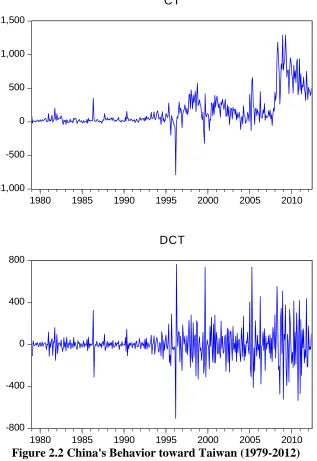
For Taiwan’s behavior toward China (TC), the most hostile time is March 2005 when the
Anti-Secession Law was passed by the National People's Congress of the P.R.C., and the
friendliest time is May 2008 when Ma Ying-jeuo was inaugurated as the President of Taiwan.
For China’s behavior toward Taiwan (CT), the most conflictive time is March 1996, the time of
the third Taiwan Strait Crisis, and the most cooperative time is April 2009 when the World
Health Organization (WHO) invited Taiwan to participate in the World Health Assembly as an
observer with the name of "Chinese Taipei." In fact, this invitation was under the consent of
China. In Figure 2.1 and Figure 2.2, an uprising trend of cooperation is obvious for both sides of
the Taiwan Strait during the Ma period, starting from May 2008.
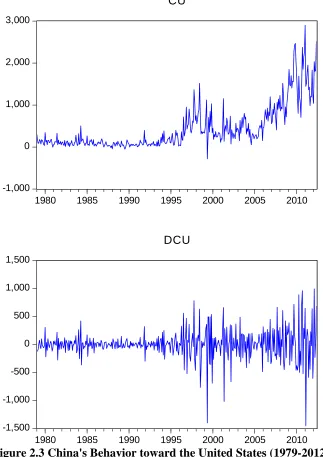
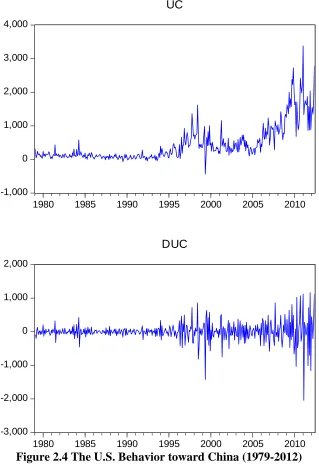
As to China’s behavior toward the United States (CU) and the U.S. behavior toward
China (UC), the time points of the maximum and minimum are identical. The most hostile time
is May 1999 when the United States accidentally bombed the Chinese embassy in Belgrade, and
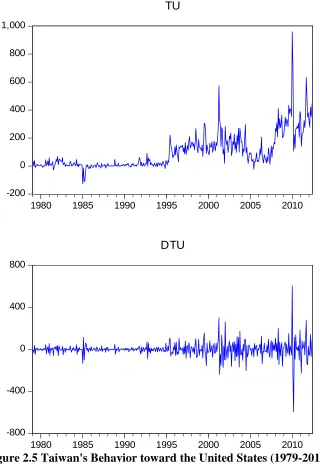
Taiwan’s behavior toward the United States (TU) and the U.S. behavior toward Taiwan (UT),
the time points of the maximum and minimum are almost identical. The most hostile time is
January and February 1985 when Taiwan admitted to get involved in assassinating Henry Liu,
who was the author of the biography of Chiang Ching-kuo and also a US citizen. The friendliest
time is January 2010 when the Obama administration approved an arms sale package worth more
than 6 billion dollars to Taiwan.
In the following pages, I will present the visualization of all six state behavior variables
(TC, CT, CU, UC, TU, UT) and the monthly growth of the net cooperation score of the six state
behaviors (DTC, DCT, DCU, DUC, DTU, and DUT) over time.7
Figure 2.1 Taiwan's Behavior toward China (1979-2012) -400
0 400 800 1,200 1,600
1980 1985 1990 1995 2000 2005 2010 TC
-800 -400 0 400 800 1,200
Figure 2.2 China's Behavior toward Taiwan (1979-2012)
-1,000 -500 0 500 1,000 1,500
1980 1985 1990 1995 2000 2005 2010
CT
-800 -400 0 400 800
1980 1985 1990 1995 2000 2005 2010
Figure 2.3 China's Behavior toward the United States (1979-2012)
-1,000 0 1,000 2,000 3,000
1980 1985 1990 1995 2000 2005 2010
CU
-1,500 -1,000 -500 0 500 1,000 1,500
1980 1985 1990 1995 2000 2005 2010
Figure 2.4 The U.S. Behavior toward China (1979-2012)
-1,000 0 1,000 2,000 3,000 4,000
1980 1985 1990 1995 2000 2005 2010
UC
-3,000 -2,000 -1,000 0 1,000 2,000
1980 1985 1990 1995 2000 2005 2010
Figure 2.5 Taiwan's Behavior toward the United States (1979-2012)
-200 0 200 400 600 800 1,000
1980 1985 1990 1995 2000 2005 2010
TU
-800 -400 0 400 800
1980 1985 1990 1995 2000 2005 2010
Figure 2.6 The U.S. Behavior toward Taiwan (1979-2012)
2.1.2 Economic Interdependence/Dependence
The pacifying effect of economic interdependence is based on the hypothesis that “the
higher the fraction of total output crossing state boundaries, the more costly would be the
interruption of such flows” (Mansfield & Pollins 2003: 12). In this case, it is reasonable for this
dissertation to measure cross-strait economic interdependence as the portion of trade flow
between China and Taiwan represented in the total trade of China (Ctrade) and in the total trade
-200 0 200 400 600 800 1,000
1980 1985 1990 1995 2000 2005 2010
UT
-800 -400 0 400 800
1980 1985 1990 1995 2000 2005 2010
of Taiwan (Ttrade). In other words, the two variables measures Taiwan and China’s dependence
on cross-strait trade flow respectively. However, this measurement only captures the concept of
sensitivity, which is the mutual effect coming from the interdependent relationship but not the
concept of vulnerability, the ability to endure the disruption of the relationship (Keohane & Nye
1977). Therefore, I also construct an indicator of asymmetric dependence as a proxy to capture
the concept of vulnerability to test the logic of “the more dependent, the more vulnerable.” The
asymmetric dependence variable (Dependency) is calculated by subtracting the share of
cross-strait trade flow in China’s foreign trade (Ctrade) from the share of cross-cross-strait trade flow in
Taiwan’s foreign trade (Ttrade), so the positive vale of the dependence variable means that
Taiwan is more dependent on China. In other words, this variable measures the level of Taiwan’s
dependence on China. The sources related to the cross-strait trade are from the monthly trade
statistics of Taiwan and China, and the earliest records start from 1989 and 1990.8 The
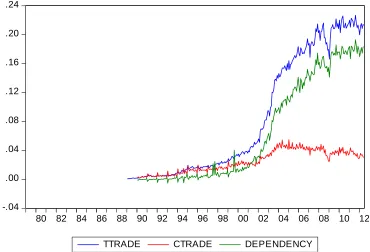
descriptive statistics of trade interdependence variables are listed as Table 2.2. The trends of
trade interdependence variables (Ttrade, Ctrade, and Dependency) are shown as Figure 2.7, and
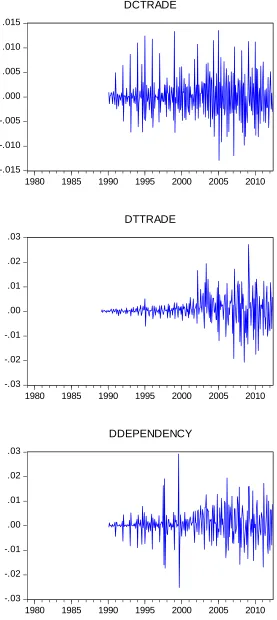
the monthly growth of trade interdependence (DTtrade, DCtrade, and DDependency) is shown as
Figure 2.8.
Table 2.2 Descriptive Statistics of Trade Interdependence Variables
Variables Mean Std. Dev. Min Max N
Ttrade 0.0868 0.0842 0.000528 0.227 282
Ctrade 0.0247 0.0149 0.00192 0.0548 270
Dependency 0.0662 0.0710 -0.00533 0.193 270
Source: Directorate General of Customs Administration (1989-2013) and China Statistical Information and Consultancy Service Centre (1992).
Figure 2.7 The Trade Interdependence between Taiwan and China (1989-2012)
As shown in Figure 2.7, the level of economic interdependence crossing the Strait grows
asymmetrically and Taiwan is in fact more dependent on the strait trade flow. The
cross-strait trade flow keeps lower than 4% in China’s foreign trade amount. More importantly,
Taiwan’s dependence on the cross-strait trade flow grows rapidly, from 4% to 20%, when the
Democratic Progressive Party (DPP) was in power, from 2000 to 2008.
-.04 .00 .04 .08 .12 .16 .20 .24
80 82 84 86 88 90 92 94 96 98 00 02 04 06 08 10 12
Figure 2.8 Monthly Growth of Trade Interdependence (1989-2012)
-.015 -.010 -.005 .000 .005 .010 .015
1980 1985 1990 1995 2000 2005 2010 DCTRADE
-.03 -.02 -.01 .00 .01 .02 .03
1980 1985 1990 1995 2000 2005 2010 DTTRADE
-.03 -.02 -.01 .00 .01 .02 .03
2.1.3 Election Cycle
In this dissertation, I take two Taiwanese election cycles to represent the effect of
Taiwan’s direct election, presidential elections and parliamentary elections (both the Legislative
Yuan elections and the National Assembly elections) after 1990. Thus, there are two election
variables (Election (Pres.) and Election (Parl.)), and each is measured by how close a certain
time point is to the next election. For example, about the presidential election variable, since the
first direct presidential election was held in March 1996, the observation of March 1996 will be
coded as 0. For the same reason, February 1996 will be coded as 1 because after one month, the
election will be held. April 1996 will be coded as 47 because the next presidential election will
come after 4 years. In general, the value of these variables decreases with the approach of the
next election. After 1990, there are five presidential elections in Taiwan, in 1996, 2000, 2004,
2008, 2012.9 Regarding parliamentary elections, this dissertation includes the 1991 and 1996
National Assembly elections and the Legislative Yuan elections in 1992, 1995, 1998, 2001,
2004, 2008, and 2012.10
2.1.4 Dummy Variables for Important Political Events
There are two types of dummy variable in this dissertation. The first is to distinguish the
time before or after the Cold War, and the second is to distinguish the periods of Taiwan’s
presidents. For the first one, the selection about the date to distinguish the Cold War period and
the post-Cold War era needs a further consideration. The idea to treat the end of the Cold War as
a breakpoint is to see whether the loss of common enemy for the United States and China
9 Taiwan’s presidential elections are usually held in March, but, in 2012, the presidential election was held in January in order to combine with the 2012 Legislative Yuan election.
changes their bilateral relationship and then furthers to impact cross-strait relations or not. Since
the end of the Cold War is a process rather than a sudden change, several potential dates can be
considered and I take June 1989 as the date to distinguish the Cold War era and the post-Cold
War era. A further discussion goes as follows.
The first date to be considered is the official end of the Soviet Union, December 1991.
However, many important events that also need to be considered had occurred before December
1991. In 1989, some member states of the Warsaw Pact had started to negotiate with the
opposition and then held general elections, like Poland and Hungary, because the military
support from the Soviet Union had been withdrawn. The Berlin Wall fell in November 1989, and
the unification of Germany occurred in October 1990. In short, starting from 1989, the strategic
role of the Soviet Union in the Cold War was declining. Thus, it is obvious that the date in 1989
or 1990 are more appropriate to capture the end of the Soviet polarity, and the date of the Soviet
dissolution in 1991 is too late.
The second is the date of the Malta Summit, December 1989, because after the summit
the United States and the Soviet Union jointly declared the end of the Cold War. This date was a
symbol for the end of the enduring rivalry between the two countries, but the real test of the
U.S.-China relationship and the improvement of the Soviet-China relationship had occurred
earlier. Therefore, it is necessary to review the time points of earlier symbolic events to capture
the changing point of the U.S.-Chinas strategic nature. In May 1989, Gorbachev visited Beijing
and declared the normalization of the Soviet-China relations with Deng Xiaoping. This event
represents that the constant hostility between China and the Soviet Union is no longer a reality.
On the other hand, the Tiananmen Square protest started in April 1989 and was suppressed by
countries including the United States caused a significant loss for the Chinese economy. This is
the first time that the United States had to face the contradictory interests from both the moral
and realistic aspects in the U.S.-China relations after the anti-Soviet cooperation between the
United States and China was established (Clark 2011: 2-3). More importantly, the changing role
of the Soviet Union from a source of threat to a normal country also led both China and the
United States to reflect the potential contradiction in their bilateral relationship. Since my interest
is to test the effect of the end of the Cold War on the U.S.-China relationship and cross-strait
relations, it is reasonable to select a time which indicates both the change of the U.S-Soviet
relationship and the challenge to the U.S.-China relationship. In this case, June 1989 is a
reasonable choice because it is the beginning of the normalization of the Soviet-China relations
and a tough test for the existing cooperation between the United States and China. More
importantly, at the same time point, the Soviet Union also started to step on its process toward
the dissolution in 1991. In short, June 1989 is the date to distinguish the Cold War era and the
post-Cold War era in this dissertation.
The second part of dummy variable is about Taiwan’s leadership change. There are four
presidents before 2012, Chiang Ching-kuo (from January 1991 to December 1987), Lee
Teng-hui (from January 1988 to May 2000), Chen STeng-hui-bian (from June 2000 to May 2008), Ma
Ying-jeou (from June 2008 till now). Thus, four dummy variable (Chiang, Lee, Chen, Ma) are created
to represent their presidencies.
2.2 Methodology
In this dissertation, the main variables are time series variables, state behavior variables
and economic interdependence variables. All state behavior variables are from the GDELT event
U.S.-China-Taiwan triangle from 1979 to 2012 (the sum of the score of cooperation and the score of
conflict in a month). The six time series state behavior variables are: Taiwan's behavior toward
China (TC), China's behavior toward Taiwan (CT), China's behavior toward the United States
(CU), The U.S. behavior toward China (UC), Taiwan's behavior toward the United States (TU),
and the U.S. behavior toward Taiwan (UT). On the other hand, economic interdependence
variables include the share of the cross-strait trade flow in Taiwan’s total trade amount (Ttrade)
and in China’s total trade amount (Ctrade) on a monthly basis, and the Taiwan’s dependence on
China (Dependency) on a monthly basis. Since the main variables in this dissertation are time
series variables, several methodological issues have to be discussed before making a decision
about which model to be applied.
In general, time series variables usually have these following characteristics that violate
the basic assumptions of ordinary least squares (OLS) method, which are nonstationarity, serial
correlation, and autoregressive conditional heteroskedasticity (ARCH). In the following pages, I
will examine the three characteristics for all state behavior variables from 1979 to 2012, and then
explain the reason to apply an ARIMA(1,1,1)-GARCH(1,1) model in Chapter 3. In the following
chapters, whenever the time period is changed, like the situation in Chapter 5, all tests in this
chapter has to be redone to ensure that the model is not biased by the three problems.11
The first is about whether a variable, or a series, is stationary or not. Stationarity is the
fundamental characteristics in the time series analysis because it implies that a finite variance can
be expected in a series when responding to a shock. If a random shock to a variable only has an
impact for a short time and the impact reverses to the mean level eventually, we can define that
this variable is stationary. In this light, a nonstationary variable implies that the memory of a
shock never dies out, and this characteristic can lead to biased inference easily. Since Nelson and
Plosser’s (1982) study indicates that most economic time series variables are nonstationary, it is
necessary to check the stationarity of all state behavior variables in this dissertation.
To ensure the stationarity for further causal inference, I perform the augmented
Dickey-Fuller (ADF) unit root test for all state behavior variables. The presence of a unit root implies
that the variable is not stationary. When a variable is not stationary, the common strategy is to
transform the variable into a differenced variable. In most situations, time series variables are
difference-stationary. In this dissertation, I take a first-difference strategy, which is to transform
a nonstationary series into a series describing the changes from the last month to this month.12
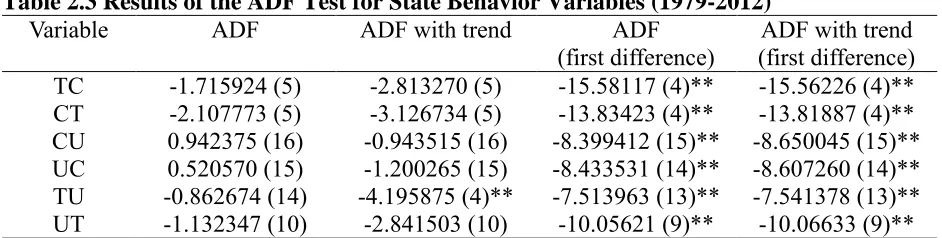
The results of the ADF test for all state behavior variables and all variables after first
[image:44.612.71.542.382.501.2]differencing from 1979 to 2012 are shown as Table 2.3.
Table 2.3 Results of the ADF Test for State Behavior Variables (1979-2012)
Variable ADF ADF with trend ADF
(first difference)
ADF with trend (first difference)
TC -1.715924 (5) -2.813270 (5) -15.58117 (4)** -15.56226 (4)**
CT -2.107773 (5) -3.126734 (5) -13.83423 (4)** -13.81887 (4)**
CU 0.942375 (16) -0.943515 (16) -8.399412 (15)** -8.650045 (15)**
UC 0.520570 (15) -1.200265 (15) -8.433531 (14)** -8.607260 (14)**
TU -0.862674 (14) -4.195875 (4)** -7.513963 (13)** -7.541378 (13)**
UT -1.132347 (10) -2.841503 (10) -10.05621 (9)** -10.06633 (9)**
Note: 1. + p < 0.10, * p < 0.05, ** p < 0.01. 2. The optimal lag length is in the parentheses and is selected based on the Akaike information criteria (AIC). 3. The null hypothesis is that the variable is not stationary. 4. The test is performed by EViews (ver. 7.2).
As Table 2.3 shows, all state behavior variables are not stationary when not including a
trend because all variables fail to reject the null hypothesis of having a unit root. Even when
considering the possibility of trend, most variables still fail reject the null hypothesis. In other
words, both results in the first two columns suggest almost all state behavior variables are not
stationary, which means that with the increase of time, the disturbance does not converge to the
long-term mean and works like a random walk. The policy implication of the nonstationarity in
all state behavior variables in the US-China-Taiwan triad is that all policy innovations or shocks
have a long-term effect and the memory of earlier actions is difficult to die out for the
decision-makers.
For ensuring the stationarity in the statistical analysis, all state behavior variables are
transformed to first-differenced variables that measure the monthly change of the net cooperation
score of the six state behavior variables. The results in the last two columns of Table 2.3 show
that all variables after first differencing are stationary. This means that a shock only has a short
term effect on the monthly change of state behaviors, and the impact declines toward the mean
level with the increase of time. However, Table 2.3 only shows the results of the ADF test for the
state behavior variables from 1979 to 2012, which is the time frame of the model in Chapter 3. In
the following chapters, the ADF test on time series variables has to be performed again when the
time period is changed, like the models in chapter 5, to ensure that the variables are stationary
within a certain period.
The second problem is about serial correlation, which means that the error term in a
regression model depends on its past. The presence of serial correlation in a time series variable
can be detected by the Ljung–Box Q test, and the results of all state behavior variables from
1979 to 2012 are listed as Table 2.4. Since the results of the ADF test have shown that all state
behavior variables are not stationary and need to be differenced, I also include the
first-differenced state behavior variables (DTC, DCT, DCU, DUC, DTU, and DUT) to test for the
Table 2.4 Results of the Ljung–Box Test for State Behavior Variables (1979-2012)
Variable Lags(3) Lags(6) Lags(12) Lags(18)
TC 777.07** 1491.1** 2731.8** 3625.5**
CT 703.78** 1320.6** 2336.0** 2983.2**
CU 830.31** 1510.1** 2736.6** 3904.2**
UC 793.77** 1468.2** 2672.3** 3788.8**
TU 699.89** 1277.2** 2236.9** 2998.1**
UT 588.33** 1081.3** 1880.5** 2528.7**
DTC 57.240** 75.594** 86.956** 97.766**
DCT 64.716** 66.951** 80.518** 88.578**
DCU 53.667** 55.528** 67.726** 70.164**
DUC 79.073** 81.983** 97.704** 113.25**
DTU 44.159** 53.238** 66.448** 84.609**
DUT 61.198** 62.878** 82.322** 93.780**
Note: 1. + p < 0.10, * p < 0.05, ** p < 0.01. 2. The null hypothesis is that there is no serial correlation at a certain lag. 3. This table reports the Ljung–Box Q statistics at a certain lag. 4. The test is performed by STATA (ver. 12).
The results in Table 2.4 indicate that all state behavior variables suffer for the problem of
serial correlation, because all variables reject the null hypothesis of no serial correlation in
different time periods at 1% level. All variables after differencing also show the presence of
serial correlation at 1% level. In short, both the original and differenced variables have a
characteristic that their current value is a function of history, which implies that one actor’s
behavior is constrained by its own history of behavior. Therefore, the policymaking in the
U.S.-China-Taiwan triangle is often made in the context of time and the legacy of pervious actions. In
general, the serial correlation problem can be solved by including lagged dependent variables,
the AR terms, or lagged error terms, the MA terms, as the right-hand-side variables. More
importantly, since the results of the ADF test show that all state behavior variables have the
non-stationary problem, it is necessary to deal with the two problems at the same time. Thus, I apply
the autoregressive integrated moving-average (ARIMA) model to control the problems of
autocorrelation and non-stationarity, more specifically an ARIMA(1,1,1) model. The model
includes three components, which are the first-order autocorrelation, AR (1), the first-order
The third issue is heteroskedasticity. In the time series analysis, heteroscedasticity means
that the variance of the error term is not the same across time periods. Thus, the Lagrange
Multiplier (LM) test should be applied first to detect the presence of heteroskedasticity. The
[image:47.612.73.543.190.378.2]results of the LM test for the state behavior variables are shown as Table 2.5.
Table 2.5 Results of the LM test for State Behavior Variables (1979-2012)
Variable Lags(3) Lags(6) Lags(12) Lags(18)
TC 47.963** 54.353** 62.630** 62.630**
CT 30.848** 44.182** 53.287** 54.035**
CU 30.136** 50.928** 73.285** 88.425**
UC 58.922** 88.567** 144.927** 155.129**
TU 54.677** 65.819** 69.834** 74.649**
UT 66.201** 70.326** 78.868** 99.293**
DTC 93.240** 110.864** 115.474** 117.488**
DCT 48.634** 50.156** 54.495** 55.117**
DCU 27.658** 59.484** 76.738** 95.606**
DUC 38.110** 64.572** 92.336** 100.829**
DTU 78.319** 106.035** 111.364** 118.129**
DUT 45.086** 48.863** 52.612** 63.429**
Note: 1. + p < 0.10, * p < 0.05, ** p < 0.01. 2. This table reports Engle’s LM test statistic. 3. The null hypothesis is that the variable has no ARCH effect. 4. The test is performed by STATA (ver. 12).
It is obvious that the original state behavior variables and the transformed variables after
differencing both have the problem of heteroskedasticity. All variables reject the null hypothesis
of no ARCH effect at the 3rd, 6th, 12th, and 18th lags, which implies that the variance or the
volatility of state behaviors in the US-China-Taiwan triad changes over time. This is not hard to
image because many structural changes have occurred in the time period from 1979 to 2012, for
example the end of the Cold War and the change of regime type and leadership in Taiwan.
Therefore, states may respond differently because of the change of international structure, regime
type, and leadership.
When the presence of heteroskedasticity is evident, the autoregressive conditional
heteroskedasticity (ARCH) model or the Generalized autoregressive conditional
time (Bollerslev 1986; Engle 1982). The basic concept of the GARCH model is to assume that
the current variance is a function of the variance of the previous error term, the ARCH term, and
the previous variance, the GARCH term.13 In other words, besides the conditional mean
equation, the ARCH or GARCH models also include the conditional variance equation to model
the relationship between the current variance and its past. In the following chapters, I plan to
apply the GARCH(1,1) model to control the problem of heteroskedasticity, which means to
include the variance of the last error term, ARCH(1), and the last variance, GARCH(1) in the
conditional variance equation.
In sum, I plan to apply an ARIMA(1,1,1)-GARCH(1,1) model to deal with the three
problems violating the OLS assumptions and investigate the causalities among the six state
behavior variables in Chapter 3. In the following chapters, these procedures to test serial
correlation, stationarity, and heteroskedasticity will be the necessary process to determine which
model should be applied whenever the time period is modified.
CHAPTER 3.THE SPECIAL ROLE OF THE UNITED STATES
Is it necessary to take the U.S. influence into account when analyzing cross-strait
relations? What is the relationship between cross-strait relations and the U.S.-China-Taiwan
triangle? The goal of this chapter is to answer the two questions with both historical and
statistical analyses. In fact, the two questions are both related to how important the U.S.
influence is in the Taiwan Strait. The logic for this chapter is simple. If the U.S. influence is
significant in cross-strait relations, then cross-strait relations are a function of the U.S. influence.
If the U.S. influence is not significant, then cross-strait relations are pure bilateral affairs
between Taiwan and China. The result in this chapter will also have a great impact on the
research design in the following chapter. The significance of the U.S. influence indicates that it is
necessary to include the U.S.-China-Taiwan strategic interactions when analyzing cross-strait
relations. On the other hand, the insignificance of the U.S. influence indicates that it is possible
to have a more parsimonious model of cross-strait relations because the U.S. related behaviors
can be ignored. In sum, to figure out the U.S. influence is an important step for further studies.
From a perspective of history, the formation of the current cross-strait relations is a
jointly product of the Chinese Civil War and the Cold War and the Taiwan issue is entangled
with the “one Chine” sovereign dispute and the U.S.-Taiwan security cooperation. For example,
both the Chinese Communist Party (CCP) and the fundamentalists in the KMT still claim that the
“one China” position is the basic common ground for the future development of cross-strait
relations. On the other hand, the United States has play a role of the conflict-preventer in the
Taiwan Strait for decades, starting from an official ally of Taiwan in the Cold War era and then a
powerful conflict-preventer with strategic ambiguity after 1979. However, how great the U.S.
influence is and how the United States influences Taiwan and China’s behaviors to each other
are seldom examined empirically. Thus, this chapter also conducts a statistical analysis to test the
presence of the U.S. influence in cross-strait relations and figure out the pattern of the U.S
influence on Taiwan and China’s behaviors toward each other.
As to the research design in the following chapters, the result related to the significance
of the U.S. influence in cross-strait relations concerns to a choice to make causal inference based
on a two-player game approach or a three-player game approach including the U.S. behaviors.
For pursuing parsimony, it is necessary to ensure not to include too many variables. The
three-player approach means that all state behaviors in the U.S.-China-Taiwan triangle have to be