Counseling and Psychological Services
Dissertations Department of Counseling and Psychological Services
Spring 5-7-2011
Group Leadership of Experienced Middle School Counselors
Group Leadership of Experienced Middle School Counselors
Robert E. Rice
Georgia State University
Follow this and additional works at: https://scholarworks.gsu.edu/cps_diss
Part of the Student Counseling and Personnel Services Commons
Recommended Citation Recommended Citation
Rice, Robert E., "Group Leadership of Experienced Middle School Counselors." Dissertation, Georgia State University, 2011.
https://scholarworks.gsu.edu/cps_diss/56
ACCEPTANCE
This dissertation, GROUP LEADERSHIP OF EXPERIENCED MIDDLE SCHOOL COUNSELORS, by ROBERT E. RICE, was prepared under the direction of the
candidate’s Dissertation Advisory Committee. It is accepted by the committee members in partial fulfillment of the requirements for the degree Doctor of Philosophy in the College of Education, Georgia State University.
The Dissertation Advisory Committee and the student’s Department Chair, as representatives of the faculty, certify that this dissertation has met all standards of excellence and scholarship as determined by the faculty. The Dean of the College of Education concurs.
_______________________________ _______________________________ Catherine Y. Chang, Ph.D. JoAnna F. White, Ed.D.
Committee Chair Committee Member
_______________________________ ______________________________ Gregory Brack, Ph.D. Erin Mason, Ph.D.
Committee Member Committee Member
_______________________________ Date
_______________________________ JoAnna F. White, Ed.D.
Chair, Department of Counseling and Psychological Services
_______________________________ R.W. Kamphaus, Ph.D.
AUTHOR’S STATEMENT
By presenting this dissertation as a partial fulfillment of the requirements for the
advanced degree from Georgia State University, I agree that the library of Georgia State University shall make it available for inspection and circulation in accordance with its regulations governing materials of this type. I agree that permission to quote, to copy from, or to publish this dissertation may be granted by the professor under whose direction it was written, by the College of Education’s director of graduate studies and research, or by me. Such quoting, copying, or publishing must be solely for scholarly purposes and will not involve potential financial gain. It is understood that any copying from or publication of this dissertation which involves financial gain will not be allowed without my written permission.
NOTICE TO BORROWERS
All dissertations deposited in the Georgia State University library must be used in
accordance with the stipulations prescribed by the author in the preceding statement. The author of this dissertation is:
Robert E. Rice 1601 Womack Road
Atlanta, GA 30338
The director of this dissertation is:
Dr. Catherine Chang
Department of Counseling and Psychological Services College of Education
VITA Robert E. Rice
ADDRESS: 1601 Womack Road Atlanta, Georgia 30338
EDUCATION: Ph.D. 2010 Georgia State University
Counselor Education and Practice Ed.S. 2003 Georgia State University
Professional Counseling Certification 1994 West Georgia College
School Counseling M.A. 1979 Ball State University
Music Education B.S. 1971 Ball State University
Music Education
PROFESSIONAL EXPERIENCE:
1997-Present Middle School Head Counselor, Chamblee Middle School, DeKalb County, Georgia 2005-Present Instructor, Georgia State University, Atlanta,
Georgia
1994-1997 High School Counselor, Chamblee High School DeKalb County, Georgia
1989-1994 Middle School Instrumental Music Teacher,
Peachtree Middle School, DeKalb County, Georgia 1980-1989 High School Instrumental Music Teacher, Peachtree
High School, DeKalb County, Georgia
1980-1989 High School Instrumental Music Teacher, Northrop High School, Fort Wayne, Indiana
PROFESSIONAL SOCIETIES AND ORGANIZATIONS:
2005-Present Association for Specialist in Group Work 2003-Present American Counseling Association
Journal for Specialist in Group Work (Submitted work in review).
Rice, R.E., McMahon, H.G., Uwah-Williams, C., & McCleod, A. (2009). How do middle school counselors determine the approaches they use when conducting groups with African American and Latino students? (Unpublished manuscript).
Rice, R.E. & Uwah, C. (2007, November). Groups that work: Effective strategies for small group work with African American and Hispanic students. Georgia School Counselors Association Fall Conference.
Romero, A. & Rice, R.E. (2007, November). What works and what doesn’t: Increasing academic achievement of Latino and African American students through effective implementation of social emotional program and change strategies that impact the student, the school, and the district. Georgia School Counselors Association Fall Conference.
Rice, R.E. (2005, April). The adolescent or where has by baby gone? Keys to
understanding the adolescent and middle school. ETS-Talent Day Program, Clark Atlanta University for African American Parents, LaGrange, GA.
Rice, R.E. (2005). Closing the achievement gap: Ideas and strategies for middle school counselors. Georgia School Counselors AssociationJournal, 1, 1-7.
Rice, R. E. (2004, November). The Parent Factor: Effective Strategies for Helping Parents Help their Middle Schooler Succeed. & Closing the Achievement Gap: Strategies for Middle School Counselors. Georgia School Counselors Association Fall Conference, Atlanta, GA.
Sullivan, M. & Rice, R.E. (2003, July). Growing through global game playing. American School Counselors Association Annual Conference, St. Louis, MO.
ABSTRACT
GROUP LEADERSHIP OF EXPERIENCED MIDDLE SCHOOL COUNSLEORS by
Robert E. Rice
Middle school students experience biological, cognitive, and social changes as
they struggle with identity formation, self-concept, self-esteem, and academic success.
Psycho-educational groups are an effective and efficient method for confronting
social/emotional or academic problems that prohibit middle school students from
performing well in schools. An essential component in the successful counseling of
middle school groups is the skill and experience of the group leader. Research on
school-based groups has focused on all areas with the exception of group leadership. Therefore,
the purpose of this study is to explore how experienced middle school group leaders
approach and conduct psycho-educational groups. This qualitative study uses a grounded
theory methodology to investigate the practices, experiences, and perceptions of fourteen
middle school counselors. The theory that emerged is grounded in the data from the
participants and represents how they were able to conduct small groups in schools despite
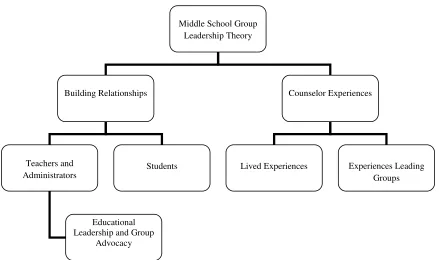
barriers many other school counselors experienced. Through educational leadership,
relationship building, and an understanding of the systems at work in schools, these
participants were able to establish a group program in their schools. The participants in
this study also reveal the experiences they used to develop their skills as group leaders.
GROUP LEADERSHIP OF EXPERIENCED MIDDLE SCHOOL COUNSLEORS
by Robert E. Rice
A Dissertation
Presented in Partial Fulfillment of Requirements for the Degree of
Doctor of Philosophy in
Counselor Education and Practice in
the Department of Counseling and Psychological Services in
the College of Education Georgia State University
Copyright by Robert E. Rice
ii
ACKNOWLEDGMENTS
I would like to express my deep appreciation to Dr. Catherine Chang, Dissertation Advisory Committee chair for her insightful commentary and enthusiastic
iii
TABLE OF CONTENTS
Page
List of Tables ... iv
List of Figures ...v
Abbreviations ... vi
Chapter 1 MIDDLE SCHOOL GROUP LEADERS ...1
Review of Group Work in Schools ...2
Groups in the School Setting ...2
School Counselors as Educational Leaders ...11
Group Leadership...14
References ...23
2 GROUP LEADERSHIP OF EXPERIENCED MIDDLE SCHOOL COUNSELORS ...32
Method ...39
Results ...57
Discussion ...104
References ...121
iv
LIST OF TABLES
Table Page
1 Demographic Chart for Participants and Their School ...44
2 How do experienced middle school group leaders approach psycho-educational groups? ...59
v
LIST OF FIGURES
Figure Page
vi
ABBREVIATIONS
ACA American Counseling Association
ASCA American School Counseling Association
ASGW Association for Specialist in Group Work
CACREP Council for Accreditation of Counseling and Related Educational Programs
ELT Extended Learning Time
NCLB No Child Left Behind Legislative act of 2000
RTI Response to Intervention
NCLB No Child Left Behind Legislative act of 2000
SES Socio Economic Status
CHAPTER 1
MIDDLE SCHOOL GROUP LEADERS
In 2003, the American School Counseling Association (ASCA) established
guidelines for school counselors to develop and implement a comprehensive school
counseling program called the ASCA National Model® (ASCA, 2003). One of the four
elements of the ASCA National Model® included the delivery system used by school
counselors to implement their program. This delivery system is comprised of four parts:
guidance curriculum, individual student planning, responsive services, and systems
support. The ASCA National Model® recommends that school counselors spend
eighty-five percent of their time in the first three components and suggests group counseling as
an essential means of delivering services in those three areas (ASCA).
Groups are an effective and efficient format for confronting social/emotional or
academic (i.e. organization, study skills, or test taking skills) problems that prohibit
students from performing well in schools (Gansle, 2005; Gerrity & DeLucia-Waack,
2007; Gladding, 2008; Hoag & Burlingame, 1997; Kulic, Dagley, & Horne, 2004).
Gladding lists five types of groups (i.e. psycho-educational, tasks/work, counseling,
psychotherapy, & mixed method), the Association for Specialist in Group Work (ASGW,
2000) lists four (i.e. task/work, psychotherapy, counseling, and psycho-educational). The
most common types of groups offered in schools are counseling groups and
psycho-educational groups (ASCA, 2003; Dansby, 1996; Gerrity & DeLucia-Waack).
Counseling groups are remediation interventions (i.e. depression, grief); while
psycho-educational groups are preventive treatments and the most common type of groups
address issues such as bullying, study skills, making friends, anger management, or
self-esteem (ASGW; Gerrity & DeLucia-Waack).
Numerous studies (e.g. Gansle, 2005; Gerrity & DeLucia-Waack, 2007; Hoag &
Burlingame, 1997; Lavoritano & Segal, 1992; Paisley & Milson, 2007; Prout & Prout,
1998) confirmed the efficacy and effectiveness of groups for a variety of issues (i.e. anger
management, depression, self-esteem/self image, test anxiety) that affect school
performance and child development. Further examination of these studies revealed two
facts. There was little exploration into the group leaders that facilitated the groups, and
school counselors were seldom group leaders in these school-based studies(Gansle;
Gerrity & DeLucia-Waack; Hoag & Burlingame; Kulic, Dagley, & Horne, 2004).
Experienced, skilled, and effective group leadership isa critical component of effective
group treatment (Conyne, Harvill, Morganett, Morran, & Hulse-Killacky, 1990; Yalom,
2005). While recent research (i.e. Rubel & Kline, 2008) has examined the complex
workings of experienced group leaders in the clinical field, little information exists
concerning the processes middle school counselors employ when leading groups. In three
meta-analyses of school-based studies of group interventions (i.e. Hoag & Burlingame;
Kulic, et al; and Gansle) the group facilitator or change agent was not fully examined. In
this chapter, the author will provide a literature review of groups in the school setting and
group leadership perceptions and attitudes toward group work within the school setting.
Review of Group Work in Schools
Groups in the School Setting
Hoag and Burlingame (1997) reviewed 56 studies of group treatment for children
the clinical setting were more effective than groups in the school setting. However, group
in schools were significantly more effective than placebo groups. Hoag and Burlingame
did not find group leaders to be a major contributing factor in the success of the groups.
Though they mentioned the therapist (group leader) as one of the variables, their analyses
found the influence of the role of the group leader did not reach statistical significance.
Their analyses disclosed little data on the training or experience of the group leaders.
Hoag and Burlingame’s study revealed that a fifth of the group leaders were described as
school counselors and over a fourth of the studies “utilized a mix of school counselors,
other professionals (psychologist or social workers), and graduate students” (p. 237). The
significant variable in the study was the socio-economic status (SES) of the students.
Students with middle SES exhibited more improvement from group intervention, and
Hoag and Burlingame concluded that for lower SES students “pre-training interventions
may be valuable with challenging adolescent population” (p.241). While pre-training may
be one option for higher group success, several other possibilities may account for poor
success with lower SES students. These include the following: the students may have
been inappropriate for the group intervention, the group members were incompatible
(perhaps from poor screening), or the group leaders were not experienced leading lower
SES students in a group setting. Hoag and Burlingame’s study was followed by Kulic,
Dagley, and Horne’s (2004) study of group work for children and adolescents that found
the SES of students a factor for group effectiveness.
Kulic, Dagley, and Horne (2004) concentrated on 94 studies of prevention
intervention groups for children and adolescents conducted from 1990 to 2000. Like
schools, and they found clinical settings to be more effective than school settings. They
proposed that this might be because the client referred to a clinical setting is in a more
severe pathological state and has “a greater gap to be crossed going from ‘ill’ to ‘healthy’
in schools, one is more likely to see prevention oriented treatments…with a smaller gap
to be crossed from ‘ill’ to ‘healthy’” (p. 143). While Hoag and Burlingame found SES to
be a factor related to group efficacy, these studies included inconsistent data about the
race and gender of the clients. The mention of race and gender implies that the
consideration of the race and gender of the client combined with the clients’ SES has
implications for group outcome.
It is not surprising that students with lower SES were less responsive to group
intervention because students from lower SES families generally are less successful in
schools and have difficulty feeling like they are a part of the school community (Ahar &
Krombry, 1993; Fine & Davis, 2003; & Rumberger, 2010). The National Center for
Educational Statistics (2009) reports that dropout rates, retention rates, and poor
academic performance are higher among students from families of lower SES compared
to students from families of middle and upper SES. While the number of students
dropping out of high school has declined (15% in 1970 to 8% in 2008) in the last 38
years, students from the lower SES quartile (16.4% dropout rate in 2008) are dropping
out of high school at almost twice the rate of students in the lower middle economic
quartile ( 9.4% dropout rate in 2008). This is three times the rate of students in the upper
middle quartile (5.4% dropout rate in 2008). Fine and Davis found that students from
families of low SES were 40% more likely to be retained (in some grade prior to high
Jimerson, Anderson, and Whipple (2002) examined research literature concerning
retention as a variable in high school dropout rates, and they found that students retained
once in elementary school (grades K-6) were three times as likely to drop out in high
school as their non-retained counterparts. Further, students retained more than once were
almost five times as likely to drop out of high school. They found that the literature on
retention suggested that emotional immaturity, low SES, and low parent educational
levels were risk factors for retention and dropout. They argue that once retention occurs,
“disengagement, absenteeism, low self-esteem associated with dropout is more likely to
occur, reinforcing developmental pathways leading to high school dropout” (p.454).
Disengagement as well as disruptive classroom behavior may be what the researchers
saw in low SES students not being as receptive to group treatment (Hoag & Burlingame,
1997; Kulic, Dagley, & Horne, 2004). Hoag and Burlingame suggested training the
students prior to the group intervention; however, they did not address the group leader’s
skills in working with this population.
Edmondson and White (1998) conducted a study that directly addressed the SES
and dropout question using a combination of group counseling and tutorials as an
intervention. Their quantitative study addressed middle school students from low SES
families who were doing poorly in academics. The study included a control group
(students with no intervention but they could see their counselor for individual concerns),
students with only tutorials, and students with group counseling and tutorial groups.
Undergraduate and graduate education majors tutored students, and the school counselor
conducted the groups. The content areas for the groups were identity exploration,
skills. Edmonson and White found that the combination of group counseling and tutorial
groups yielded the highest gains in academic achievement, positive classroom behavior
changes, and higher self-esteem when compared to students who had no services or
students with tutorials alone. While the students in this study were all from lower SES
families, volunteering gave them the motivation to do well. All of these students were
White and from a rural community, therefore generalizations cannot be made to other
SES populations.
Arhar and Kromrey (1993) found that at-risk middle school students perform
better in schools where the “teaming” of students creates a sense of belonging.
Interdisciplinary teams or teaming is a middle school construct where students are
grouped with teachers of usually four subject areas (math, English, science and social
studies) forming small academic communities (Forte & Schurr, 2002). In their study of
African American adolescent males, Uwah, McMahon, and Furlow (2008), found that
“belonging” in school was more than being recognized by students and teachers, it
included being actively incorporated in the activities and organizations of the schools.
The engagement of students by adults in the school was critical to the students’
connectedness to and achievement in the school environment. This is especially true for
early adolescents transitioning from elementary school to high school (Forte & Schurr).
While the aforementioned studies focused on clients as a significant variable,
Kulic, Dagly and Horne’s (2004) analyses highlighted the lack of information the studies
disclosed about the group leader’s training. They found that mental health professionals
led groups in more than a third of the studies. The remaining studies had either poorly
about the importance of group leader training in their discussion section: “We cannot
stress enough the importance we place on the change agent [group leader] variable. The
change agent is the central element around which an entire study circles; [group]
interventions can work wonders or fail miserably on the basis of its delivery” (p.149).
Gansle’s (2005) meta-analysis of school-based anger interventions and programs
also failed to address the training of group leaders and revealed the use of professionals
other than school counselors as group leaders. Though Gansle primarily focused on
interventions, her analysis revealed that the majority of the studies described
implementation of interventions by school psychologists, school consultants, or
professionals. The remainder of the studies listed university faculty, masters and
doctorate students, and schoolteachers as group leaders. The scant number of school
counselors as group leaders in these meta-analyses brings into question the number of
school counselors who actually conduct groups. The studies also leave unanswered Kulic,
et al.’s (2004) concern regarding the training and experience of the group leader in
schools. An examination of three studies of school counselor perceptions may reveal the
answer.
Dansby (1996) conducted a survey regarding group work in schools with school
counselors in Tennessee. From a list of 1368 Tennessee school counselors, Dansby sent
the survey to 300 randomly selected school counselors. The responding 159 school
counselors (representing a response rate of 53%) consisted of 54 elementary, 57 middle,
and 48 high school counselors. The majority of the school counselors (81%) were female
and all of the school counselors had ten years or more years of experience in school
and implementation of groups in schools. The majority of the respondents indicated that
group work was vital to their school counseling program and that they felt adequately
trained. While psycho-educational groups were the most prevalent groups conducted,
there were some remedial (i.e. suicide/depression, and fears) groups conducted.
School counselors reported that interferences (i.e. teacher, parent, or administrator
resistance) and lack of time were the predominant reasons school counselors gave for not
conducting more groups (Dansby, 1996). Interestingly, 39% of all school counselors
reported using counselors who were not in the school system, and 40% reported that
another school counselor was running groups. This practice of using personnel outside of
the school building may account for the large number of studies that reported groups
conducted by persons other than school counselors. In her discussion, Dansby gave
possible reasons for the interferences to groups. She suggested that school counselors are
not looking at their interventions from a systems theory perspective. She argued that
using a systems approach will allow the school counselor to see the “interrelatedness of
the interferences reported by the counselors and recognize the need to consider the effects
on the various subsystems” (p. 239). She suggested that if school counselors could show
teachers, principals, and parents how group interventions reinforced the other systems in
the school, they would gain more support for groups.
Dansby’s (1996) study was consistent with the meta-analyses of Kulic, Dagley,
and Horne (2004) and Gansle (2005) that reported non-school counselors conducted
many of the groups. There seems to be a conflict in the results school counselors reported
in Dansby’s survey. If school counselors viewed groups as vital, and they are adequately
professionals conducting a large portion of school counseling groups? Dansby argued
that if groups are effective with outside mental health professionals, the outside
professionals may become a separate system within the school. She positioned her logic
from a systems theory approach. She contended that allowing group leaders from outside
of the school to conduct groups, teachers’ and principals’ view the results as separate
from the school counseling program. This may affect the way school counselors’ roles
and services are defined.
Others (Amatea & Clark, 2005; Clark & Amatea, 2004; Dollarhide & Lemberger,
2006) echo Dansby’s concern for the role of the school counselor. Educational leadership
is a major component of the movement to define that role (DeVoss & Andrews, 2006;
Gysbers & Henderson, 2001; House & Hayes, 2002; House & Martin, 1998; Mason &
McMahon, 2009). ASCA and the Education Trust believe that school counselors should
become agents for change in transforming schools and they should be advocates for
access and equity (ASCA, 2003; Education Trust, 2003). According to the ASCA
National model educational leadership is one of the four major themes central for
defining the role of the counselor and setting the parameters of the counseling program
(ASCA). Not taking a leadership approach invites others to define the role of the school
counselor and scope of the school counseling program.
Amatea and Clark (2005) found that principals’ perceptions of the role of the
school counselor and the counseling program depended upon whether the principal
believed that the counseling program could improve test scores and attendance and
reduce discipline issues. Because principals are the leaders of the school, their perception
and delivers the services in their program. Principals in the study had a view of the
counselor role as one of four categories: innovative school leader, collaborative case
consultant, responsive direct service provider, and administrative team player. It is
significant to note that only three percent of the participants saw the counselor’s role as
an innovative school leader (the role that ASCA advocates in a comprehensive program).
Principals, who did see the school counselor as an innovative leader, saw the school
counselor as a leader sharing ideas and suggesting innovations to improve student
achievement, but they did not see the school counselor as another administrator. The
majority of the principals who felt this way were middle school principals.
Clark and Amatea (2004) conducted a qualitative study on teachers’ perceptions
of school counselors. The results of this study found that the 23 teachers in this study
viewed school counselors as being helpful. The level of helpfulness correlated to the
degree of communication, collaboration, and teamwork between the school counselor and
the teacher. Further, the teachers that experienced a working relationship in these three
areas supported classroom guidance and small group activity. Many looked to the school
counselor for support with students with special needs and help with classroom
management strategies. All teachers from the study expressed the importance of
individual counseling even without the three components.
While the perceptions of teachers and administrators can shape the school
counselor’s role within the school, outside forces also greatly affect the school counselor
and the choices in interventions and services. Dollarhide and Lemberger (2006) found
that the No Child Left Behind (NCLB) legislation act of 2001 created changes in schools
explored the impact of school change on the school counseling program. Data from an
on-line survey from 210 school counselors, who were members of the ASCA, showed
that the counselors surveyed had a clear understanding of NCLB. However, 74% of the
participants reported that the NCLB legislation had negative effects for the school
counseling programs because of school counselors’ increased time spent coordinating
testing. In addition, teachers and administrators became more resistant to allowing
students to see the school counselor during class time, because they did not want students
to miss instruction. Both of these conditions resulted in less time the school counselor
could devote to the academic and social/emotional needs of students.
School Counselors as Educational Leaders
Dollarhide and Lemberger’s (2006) also found that 17%, of the participants saw
positives changes because of the push by NCLB legislation to include a focus on
accountability. This group of school counselors believed that a focus on accountability
could provide a forum for school counselors to provide data to show the effectiveness of
counseling interventions. They believed that the shift to a focus on at-risk-students
creates more opportunity for collaboration between teachers and school counselors.
DeVoss and Andrews (2006) take this further arguing that there is a mandate for school
counselor leadership that stems from a social justice perspective which promotes access
and equity to education for all students. They agree with the view of the Education Trust,
ASCA, and NCLB that national and local data can be used as evidence for determining
the population of students that have gaps in their academic training (ASCA, 2003;
Education Trust, 2003; NCLB, 2002). DeVoss and Andrews advocated an integrative
(i.e. local school systems, district systems, and community influences) and actively uses
counselor skills to build coalitions, collaborate with administrators, parents, and teachers,
and promote the use of school counseling services to influence change.DeVoss and
Andrews believe that the gaps in academic success revealed in the nation and local data
offer, “…examples of targets for system-wide school reform in which school counselors
have a leadership role” (p 43).
The appeal by Dansby (1998) that school counselors adopt a systems approach to
incorporating groups in schools has become a major tenet in the school counseling
movement (ASCA, 2003; DeVoss & Andrews, 2006; Gysbers & Henderson, 2001;
House & Hayes, 2002; House & Martin, 1998). House and Hayes specifically call for
school counselors to become effective leaders by collaborating with other professionals
in their schools to influence system-wide changes.They contend that through
collaboration school counselors can influence the whole school and support individual
students.They caution that this “working relationship” requires a mutual understanding
and appreciation of the shared goals of student success, access-and-equity, and an
appreciation of the school as a community.
Dollarhide (2003) called for a holistic approach to leadership whereby leadership
is viewed in four contexts. The first context is structural leadership; this is, working to
build organizational structures such as an effective comprehensive counseling program.
The ASCA model provides the foundation for the development and implementation of a
viable counseling organization. The second context is human resources leadership
perspective or empowering and inspiring others to work together to achieve a common
the common mission of the school. The third context is political leadership where the
school counselor uses interpersonal skills and the school’s organizational power to
influence change. In this context, school counselors work with teachers, principals,
parents, and community leaders to build understanding and links between school
counseling and mission goals. The fourth context is symbolic leadership that interprets
and states the vision and meaning of change. In this leadership role the school counselor
advocates through the promotion of results data and leads by example. In their yearlong
qualitative study of new school counselor’s efforts in leadership, Dollarhide, Gibson, and
Sagnick, (2008) found that the school counselors who were the most effective in defining
their roles as leaders and school counselors were active in all four leadership contexts.
School counselors who can use these approaches to include group work in their efforts to
reach targeted student populations.
Conyne and Mazza (2007) advocated for an ecological approach to group work by
essentially applying the same four leadership contexts to five levels of group work. They
recommended approaching the school as a dynamic organism composed of many
connecting dynamic organisms including the student, the classroom, the school
personnel, the school itself, and the community. By understanding the interactive and
dynamic nature of the factors in this ecosystem, school counselors can use group work to
“promote an improved ecological concordance between the clients and their
environment” (p.19). Conyne and Mazza believe that drawing a connection between
student, classroom, teacher, school, and community can “improve the lives of the
students and of others both in and out of school” (p. 19). This is consistent with the four
In sum, the literature on the educational leadership of school counselors supports
school counselors taking an active leadership role to influence school reform and promote
systemic change for the good of all students. That role as educational leader places the
school counselor at the forefront of school policy, gives the school counselor a school
wide view of the systems within the school, and allows the school counselor to become
part of the school’s decision-making team. School counselors can use this holistic
approach to help incorporate the comprehensive school counseling program as a part of
the school’s plan for achieving its goals. This active involvement in school planning,
decision making, and improvement makes it possible for the school counselor to advocate
for the implementation of a group counseling program as a part of the comprehensive
school counseling program (Conyne &Mazza, 2007; Dollarhide, Gibson, & Sagnick,
2008; House & Hayes, 2002).
Group Leadership
While educational leadership can influence the reduction of external barriers to
group work by teachers and administrators, school counselors also have internal barriers
to group work. Uwah (2010) found that school counselors harbored concerns about group
leadership skills, time commitment, and often lacked the desire to conduct groups.
Further exploration into the internal barriers school counselors experience is evident in
the studies exploring school counselors’ perceptions of group leadership (Sisson, &
Bullis, 1992; Steen, Bauman, & Smith, 2007; Wiggins & Carroll, 1993). Sission and
Bullis surveyed elementary, middle, and high school counselors’ perceptions of the
training they received in graduate counseling programs. The school counselors from this
environment. Elementary school counselors gave more significance to the group
leadership training they received than either middle school or high school counselors.
Based on the results of their survey, Sisson and Bullis concluded that the upper grade
level school counselors did not see the need for more group work training because they
conducted few groups.
Wiggins and Carroll (1993) analyzed two surveys conducted with practicing
school counselors. The first study surveyed 90 school counselors with at least two
graduate courses in group work; however, there was no delineation of the counselor’s
grade level. These school counselors also had attended various workshops on group
leadership. The survey sampled school counselors from a single large suburban school
district. The survey asked school counselors to rate their training and ability.
Significantly school counselors “reported that their foremost need, listed three times more
often than all other items combined, was to learn more and better group leadership skills”
(p. 25). They also believed that the training they received in counseling preparation
courses and in workshops were predictable and offered only basic skills. Wiggins and
Carroll’s second study covered a three-year period and surveyed 2, 270 participants from
the United States and Canada. Forty percent of the participants came from school settings
(again no grade delineation was given), but represented school counselors, social
workers, and support group workers. The major concern for these participants was
learning more effective skills for working in the ‘here and now’ with group members.
In a more recent study Steen, Bauman, and Smith (2007) conducted a mixed
methods survey to explore school counselors’ practice of group work. They used the
While a response rate above 50% is optimal (Granello & Wheaton, 2004; Rubin &
Babbie, 2009), the survey sampled practicing school counselors from across the United
States thus, obtaining responses from school counselors who received their training from
many different institutions. This broad sampling may present a more comprehensive view
of school counselors’ perceptions toward group leadership and present more ability to
generalize.
Consistent with previous studies, Steen, Bauman, and Smith (2007) found that
school counselorsbelieved counseling groups were an effective intervention for students.
The school counselors voiced the same group work interferences that Dansby found in
her study (i.e. resistance by teachers and administrators and time constraints). However,
Steen et al. found that slightly over a half (63%) of the respondents listed school
counselor confidence in group skills as at least somewhat a factor in not conducting
groups. More than half of that number cited confidence in group skills as a major factor.
This and the previous two studies offer a departure from Dansby’s study that reported
that school counselors had confidence in their training for group work.
Additionally, Steen et al. (2007) found that of the school counselors who
conducted small groups, only a small number of them included multicultural
considerations. This is troubling because of the diverse populations school counselors
work with in today’s schools (Alliance for Excellent Education, 2008 & 2009). The
American Counseling Association (ACA), the American School Counseling Association
(ASCA), and the Association for Specialist in Group Work (ASGW) adopted a strong
stance on multicultural competence for their members. Each of the organizations has
of self-awareness, knowledge of cultures and oppression, and skills for working with
diverse clients (ACA, 2005; ASCA, 2003; ASGW, 2007).
Many studies have linked multicultural understanding and sensitivity to student
school success and identity development. Skills cannot be taught or learned if the
student’s cultural world is not considered (Rice, McMahon, Uwah & McLeod, 2009;
Schwallie-Giddis, et al, 2004; Skowron, 2004; Villalba, Brunelli, Lewis, & Orfanedes,
2007). Phinney, Cantu, and Kurtz (1997) studied African American, Latino, and White
students in grades nine through twelve and found that positive racial identity was an
important factor in student self esteem and increased level of comfort in participating in
the classroom. In their longitudinal study, Chavous, Bernat, Schmeelk-Cone, Caldwell,
Kohn-Wood, and Zimmerman (2003) found a close connection between academic
attainment and racial identity. They discovered that the connection between academic
achievement and racial identity development was stronger at early points in the student’s
middle and high school life than in later grade levels. Chavous et al. concluded that
students with greater racial identity development had higher grades and fewer discipline
referrals.
School counselors can assist students in the development of racial identity and
academic success through group counseling that encourages identity exploration and
open discussions. Allowing the group members to explore their self, identity, and growth
depends on the school counselor’s ability to establish an environment, which embraces
group members’ various cultures (Bailey & Bradhury-Bailey, 2007; Rayle & Myers,
2004). Berger (2006) studied the link between a caring environment and academic
students in middle and high school. He looked at micro-aggressions transmitted by
caregiver to students and found that this interaction induced iatrogenic harm to the
student eliciting feelings of inferiority, incompetence, or unworthiness. While the
micro-aggression might not be intentional, the choice of words, tone of voice, or body language
has the potential to cause iatrogenic harm when the student’s culture is not considered.
When students perceive caretakers as unresponsive to their culture and needs the result
can be resistance, acting out, or “shutting down” behaviors (Berger, 2006; Villalba, et al.,
2007). Clearly the need for a building a relationship with the student is important to
establishing the bond between student and caregiver. The importance of the relationship
and resulting alliance between the client and therapist is well-documented (Bordin, 1979;
Lambert & Barley, 2001; Martin, Garske, & Davis, 1999; Yalom, 2005).
Therapeutic alliance in the school setting. There is scant research that discusses
the therapeutic alliance in the school setting. A review of the literature concerning the
therapeutic alliance reveals the importance to the success of therapeutic interventions.
Bordin’s (1979) therapeutic alliance theory suggests that the working alliance between
client and therapist has more effect on therapeutic outcome than the theoretical
orientation of the therapist or the techniques employed by the therapist. Bordin attributed
three factors to the development of the therapeutic alliance: task, goals, and bond.
Lambert and Barley (2001) contend that the importance of the therapeutic alliance is
almost double that or therapists activities and second only to factors outside of therapy.
The research points to the strength of the therapeutic alliance as a strong predictor of
outcome regardless of the therapy or techniques used (Martin et al., 1999). Ross,
rehabilitation proposed that the interaction of “treatment setting, therapist and client
characteristics, cognitions, perceptions, emotion, and therapist and client behavior
produce a therapeutic alliance as measured by Bordin’s goals, tasks, and bond” (p. 477).
While many traditional therapist frown on self-disclosure, Saunders’(1999) study
found, that for brief therapy, the quality of sessions improved and were more effective
when there was a reciprocal intimacy (i.e. self-disclosure) between the client and
therapist. Goldfried, Burckell, and Eubanks-Carter (2003) suggest two types of positive
self-disclosure—disclosing personal reactions to the client (encouraging or discouraging
behaviors) and disclosing personal experiences (modeling pro-social behaviors)—can aid
in establishing the therapeutic alliance. Yalom (2005) contends that developing a
therapeutic alliance with group members is critical to the success of the group process.
Because of their proximity to students and the potential to see students regularly, school
counselors have the opportunity to create alliances with their students.
Confidence in group leadership skills. Further complicating the problem of
school counselor confidence is the differences between the perceptions of treatment
outcome between the group leader and group members. In Kastner and Ray’s (2000)
study with high school groups and Hagborg’s (1993) study of middle school students the
cohesion felt between the group members and group leader was considered, and the
researchers discovered a difference in perceptions. In both studies, group leaders’
perception of the group experience varied greatly from group members. Group members
perceived higher levels of group cohesion, group building, group maintenance, and
believed they were more task focused than the group leaders reported. Kastner and Ray
between psychotherapy and psycho-educational groups. The more severe clients and
more intense sessions in psychotherapy groups would see the opportunity for greater
change, and may not be an error in perceptions. Hagborg attributed much of his results to
the tendency of middle school students to be less concerned about goal achievement and
more focused on the sense of belonging that groups provided. This perception
discrepancy between group leader and members is not unique to adolescents; it can also
occur in adult groups and requires the group leader to seek feedback for clarification of
perceived group dynamics (Hagborg; Kastner & Ray). Though they found a disconnect
between counselor perceptions of gains in groups and the adolescent group members,
Kastner and Ray saw that student gains, while small during the group experience,
continued to have an impact long after the group experience. These studies focused on
outcome results and did not factor in group leadership skills or group leaders
multicultural competence.
While many of the studies described here did not directly address counselor/group
leader confidence or training, Kulic, Dagley, and Horne’s (2004) challenge that lack of
group leader experience and training in facilitating groups is critical when evaluating
group treatment outcomes remains significant. Experience and training of group leaders
has been the subject of research for some time (Akos, Goodnough, & Milsom, 2004;
Hillerbrand & Claiborn, 1990; Kivlighan & Quigley, 1991).
In 1988, Hulse-Killacky assembled four renowned expert group leaders to discuss
effective group leadership (Conyne, Harvill, Morganett, Morran, & Hulse-Killacky,
1990). The themes that emerged from these conversations revealed the complexity of
agreement that in training there was too much attention spent on process and not enough
on the mechanics of group leadership. While techniques were important, there is not a set
list be checked off during a session. They expressed that the skills required to conduct
groups are many but include flexibility, preparedness, knowledge of self, the ability to
create therapeutic climates and intervene critically, and the ability to problem solve group
processes. They underscored the complexity of leading groups that, in addition to the
aforementioned challenges, requires the group leader to be imaginative and alert to the
intricate and impromptu situations that often occur during the group process.
In the most recent study of group leadership, Rubel and Kline (2008) found that
experts divulged that the experience of running groups shaped leader attitudes and
knowledge. As counselors conducted more groups, they gained increasing confidence in
the group process, group members, and their perceived leadership abilities. Rubel and
Kline’s study revealed that as they conducted more groups the expert group leaders grew
in three skill areas the researchers called perceiving, understanding, and formulating.
Perceiving is the awareness of the group members’ feelings, behaviors, and ideas as the
group leader is actively self-aware. Understanding is the marrying of perceptions and
knowledge gained through experience or theory. Finally formulation is the process of
developing or sensing (that ‘aha moment”) an intervention to fit the understanding of an
event during group interaction or what Yalom (2005) calls the “group discourse”. Honing
these three skills is an active and reflective endeavor requiring multiple group
experiences. Rubel and Kline’s participants self-identified as counselors, psychologists,
study, and the unique nature of conducting groups in a school setting may require skills
not explored in their study.
The literature concerning group leadership for school counselors is found in
manuals for group counseling in schools (Brigman & Goodman, 2001; DeLucia-Waack,
2006; Greenburg, 2003). These books give suggestions for conducting groups in schools,
and offer some insight into group leadership, however they do not address the logistical
challenges school counselors face. I could find no studies that examined the experiences
of school counselor group leadership.
This review of literature examined group counseling in middle schools. The initial
review found group counseling is an effectiveand efficient intervention for addressing
academic and social emotional concerns that impede the success of early adolescents in
middle schools. The literature also reveals that few school counselors are conducting
groups in schools because of external interferences from within the school. Time
constraints, teacher and administrator resistance to groups, the reluctance of students
from lower SES to participants fully were cited as external inhibitors of successful
groups. Additionally internal barriers to school counselors leading groups also abound.
Internal barriers to groups were examined through the lens of educational leadership, the
therapeutic alliance between student and group leader, and group leader confidence. The
review of literature represents an extensive review of relevant literature to the grand
question examined. If some middle school counselors are successful in conducting groups
in schools, what are their secrets? How do experiences middle school counselors
Reference
Alliance for Excellent Education. (2008). African American Students and U.S. High
Schools. Retrieved from: http://www.all4ed.org/files/AfAm_FactSheet.pdf
Alliance for Excellent Education. (2009) Latino student and U.S. high schools.
Retrieved from: http://www.all4ed.org/publications/Latino_FactSheet.pdf
Amatea, E.S. & Clark, M.A. (2005). Changing schools, changing counselors: A
qualitative study of school administrator’s conceptions of the school counselor
role. Professional School Counseling, 9(1), 16-27
American Counselor Association. (2005). Multicultural Counseling Competencies.
Retrieved from: http://www.counseling.org/Counselors
American School Counselor Association. (2003). The ASCA national model: A
framework for school counseling programs, Professional School Counseling, 6,
165-168.
Arhar, J. & Kromrey, J. (1993). Interdisciplinary teaming in the middle level school:
Creating a sense of belonging for at-risk middle level students. Retrieved from
ERIC database. (ED364456)
Association of Specialist in Group Work. (2000). Professional standards for the training
of group workers. Retrieved from:
Bailey, D.F. & Bradhury-Bailey, M.E. (2007). Promoting achievement for African
American males through group work. The Journal for Specialists in Group Work,
32(1), 83-96.
Berger, V. M. (2006). Does caring matter? A qualitative study of urban African
American alternative school students' perceptions of their school experiences,
past and present. Ed.D. dissertation, Duquesne University, PA. Retrieved from
Dissertations & Theses: A&I database. (Publication No. AAT 3209708).
Brigman,G. & Goodman, B.E. (2001). Group counseling for school counselors: A
practical guide. Portland, ME: Walch Publishing.
Capelluti, J. (1991). Organizing middle level schools to meet the needs of students and
staff. In J. Capelluti & D. Stokes (Eds.), Middle level education: Program,
policies, and practices, (6-11). Reston, VA: National Association of Secondary
Principals.
Chavous, T.M., Bernat, D.B., Schmeelk-Cone, K., Caldwell, C.H., Kohn-Wood, L., &
Zimmerman, M.A. (2003). Racial identity and academic attainment among
African American adolescents. Child Development, 74(4), 1076–1090.
Clark, M.A. & Amatea, E. (2004). Teacher perceptions and expectations of school
counselor contributions: Implications for program planning and training.
Professional School Counseling, 8(2), 132-140.
Conyne, R.K., Harvill, R.L., Morganett, R.S., Morran, D.K., & Hulse-Killacky, D.
(1990). Effective group leadership: Continuing the search for greater clarity and
understanding. The Journal for Specialists in Group Work, 15(1), 30-36. doi:
Conyne, R.K., & Mazza, J. (2007). Ecological group work in schools. The Journal for
Specialists in Group Work, 32(1), 19-29. doi:10.1080/01933920600977499
Dansby, V.S. (1996). Group work within the school system: Survey of implementation
and leadership role issues. The Journal for Specialists in Group Work, 21(4),
232 – 242. doi: 10.1080/01933929608412255.
DeVoss, J.A. & Andrews, M.F. (2006). School counselors as educational leaders. New
York, NY: Lahaska Press.
DeLucia-Waack, J.L. (2006). Leading psychoeduactional groups for children and
adolescents. Thousand Oaks, CA: Sage Publications.
Dollarhide, C.T. (2003). School counselors as program leaders: applying contexts to
school counseling. Professional School Counseling, 6(5), 304-308.
Dollarhide, C.T., Gibson, D.M., & Saginak, K.A. (2008). New counselors’ leadership
efforts in school counseling: Themes from a year-long qualitative study.
Professional School Counseling,11(4), 262-271.
Dollarhide, C.T. & Lemberger, M.E. (2006). “No child left behind”: Implications for
school counselors. Professional School Counseling, 9(4), 295-304.
Edmondson, J. H., & White, J. (1998). A tutorial and counseling program: Helping
students at risk of dropping out of school. Professional School Counseling, 1(4),
43-47.
Education Trust (2003). The new vision for school counseling. Retrieved from
http://www.edtrust.org/dc/tsc/vision
Fine, J.G. & Davis, J.M. (2003). Grade retention and enrollment in post secondary
Forte, I. & Schurr, S. (2002). The definitive middle school guide: A handbook for success.
Nashville, TN: Incentive publications.
Gansle, K.A. (2005). The effectiveness of school-based anger interventions and
programs: A meta-analysis. Journal of School Psychology, 43, 321-341.
Gerrity, D.A. & DeLucia-Waack, J.L. (2007). Effectiveness of groups in the schools. The
Journal for Specialists in Group Work, 32(1), 97 – 106.
Gladding, S.T. (2008). Groups: A counseling specialty. Upper Saddle River, NJ: Pearson
Prentice Ha
Goldfried, M., Burckell, L., & Eubanks-Carter, C. (2003). Therapist self-disclosure in
cognitive behavior therapy. Journal of Clinical Psychology, 59(5), 555-568.
Retrieved from Academic Search Complete.
Granello, D.H. & Wheaton, J.E. (2004). Online data collection: Strategies for research.
Journal of Counseling and Development, 82(4), 387-393.
Greenburg, K.R. (2003). group counseling in k-12 schools: A handbook for school
counselors. Boston, MA: Pearson Education.
Guba, E. G. & Lincoln, Y.S. (1989). Fourth Generation Evaluation. New Park, CA:
Sage Publications.
Gysbers N.C., & Henderson, P. (2001). Comprehensive guidance and counseling
programs: A rich history and a brighter future. Professional School Counseling,
4(4), 246-256. Retrieved from Academic Search Database.
Hagborg, W. J. (1993). Middle-school student satisfaction with group counseling: An
initial study. The Journal for Specialists in Group Work,18(2), 80 — 85.
Hillerbrand,E. & Claiborn, C.D. (1990). Examining reasoning skill differences between
expert and novice counselors. Journal of Counseling and Development, 68(6),
684-691. Retrieved from ERIC database, (EJ1417914).
Hoag, M.J. & Burlingame, G.M. (1997). Evaluating the effectiveness of child and
adolescent group treatment: A meta-analytic review. Journal of Clinical Child
Psychology,26(3),234-246.
House, R.M. & Hayes, R. L. (2002). School counselors: Becoming key players in school
reform. Professional School Counseling,5(4), 249-256.
House, R.M. & Martin, P.J. (1998). Advocating for better futures for all students: A new
vision for school counselors. Education, 119(2), 284-291. Retrieved from
Academic Search Database.
Janson, C., Stone, C., & Clark, M.A. (2009). Stretching leadership: A distributive
perspective for school counselor leaders. Professional School Counseling, 13(2),
98-106.
Jimerson, S. R., Anderson, G.E., & Whipple, A. D. (2002). Winning the battle and losing
the war: Examining the relation between grade retention and dropping out of high
school. Psychology in the Schools, 39(4), 441-457.doi: 10.1002/pits.10046
Kasak, D. (2001). Flexible organizational structures. In T.O. Erb (Ed.), This we
believe…and now we must act. (90-98). Westerville, OH: National Middle school
Association.
Kastner, J.W. & Ray, K.P. (2000). Adolescent ratings of group process: What they see
10(4), 213-221. Retrieved April 19, 2008, from ABI/INFORM Global database.
(Document ID:15733467).
Kulic, K.R., Dagley, J.C., & Horne, A.M. (2004). A Comprehensive review of prevention
groups for children and adolescents. Group Dynamics: Theory, Research, and
Practice,8(2),139-151. doi: 10.1037/1089-2699.8.2.139
Lambert, M.J. & Barley, D.E. (2001). Research summary on the therapeutic relationship
and psychotherapy outcome. Psychotherapy: Theory, Research, Practice, and
Training 38(4), 357-361. doi: 10.1037/0033-3204.38.4.357.
Lavoritano, J. E & Segal, P. B. (1992). Evaluating the efficacy of short-term counseling
on adolescents in a school setting. Adolescence,27(107), 535. Retrieved from
Research Library database. (Document ID: 1499692).
Martin, D.J., Garske, J.P., & Davis, M.K. (2000). Relation of the therapeutic alliance
with outcome and other variables: A meta-analytic review. Journal of Consulting
and Clinical Psychology, 68(3), 438-450. doi:10.1037/0022-006X.68.3.438.
Mason, E.C.M. & McMahon, H. G. (2009). Leadership practices of school counselors.
Professional School Counseling, 13(2), 98-106.
National Center for Educational Statistics (2009). Digest of educational statistics. U.S.
Department of Education Institute of Education Sciences. Retrieved from
http://nces.ed.gov/pubsearch/pubsinfo.asp?pubid=2010013
No Child Left Behind Legislation Act of 2001, H.R. 1, 107th Cong. (2002). Retrieved
Paisley, P.O. & Milsom, A. (2007). Group work as an essential contribution to
transforming school counseling. The Journal for Specialists in Group Work,
32(1), 9-17.
Prout, S.M. & Prout, H.T. (1998). A Meta-analysis of school-based studies of counseling
and psychotherapy: An update. Journal of School Psychology, 36(2), 121-136.
doi: 10.1016/S0022-4405(98)00007-7
Rayle, A.D.& Myers, J.E. (2004) Counseling adolescents toward wellness: The roles of
ethnic identity, acculturation, and mattering. Professional School Counseling,
8(1), 81-89.
Rice, R.E., McMahon, H.G., Uwah-Williams, C. & McLeod, A. (2009). How do middle
school counselors determine the approaches they use when conducting groups
with African American and Latino students? Unpublished manuscript,
Department of Counseling and Psychological Services, Georgia State University,
Atlanta, GA.
Ross, E.C., Polaschek, D.L.L., & Ward, T. (2008). The therapeutic alliance: A theoretical
revision of offender rehabilitation. Aggression and Violent Behavior, 13, 462-480.
doi: 10.1016/j.avb.2008.07.003.
Rubel, D.J. & Kline, W.B. (2008). An exploratory study of expert group leadership. The
Journal for Specialists in Group Work, 33(2), 138 — 160.
Rubin, A. & Babbie, E.R. (2009). Essential research methods for social work. Belmont,
Rumberger, R.W. (2010). Education and the reproduction of economic inequality in the
United States: An empirical investigation. Economics of education Review, 29,
246-254. doi: 10.1016/j.econdurev.2009.07.006.
Schwallie-Giddis, P., Anstrom, K., Snachez, P., Sardi, W.A., & Granato, L. (2004).
Counseling the linguistically and culturally diverse student: Meeting school
counselor’s professional development needs. Professional School Counseling,
8(1), 15-23.
Sisson, C. F. & Bullis, M. (1992) Survey of school counselors' perceptions of graduate
training priorities.School Counselor40(2).
Skowron, E.A. (2004). Differentiation of self, personal adjustment, problem solving, and
ethnic belonging among persons of color. Journal of Counseling and
Development, 82(4), 447-456.
Steen, S., Bauman, S. & Smith, J. (2007). Professional school counselors and the practice
of group work. Professional School Counseling, 11(2), 72-80.
Uwah, C. (2010). A phenomenological exploration of secondary school counselor’s
experiences engaging in group work. Dissertation Abstracts International Section
A: Humanities and Social Sciences, 70(8-A), 2906-29A).
Uwah, C., McMahon, H., & Furlow, C. (2008). School belonging, educational
aspirations, and academic self-efficacy among African American high school
students; Implications for school counselors. Professional School Counseling,
11(5), 296-305.
Villalba, J.A., Brunelli, M., Lewis, L. & Orfanedes, D. (2007). Experiences of Latino
from Latino parents in burgeoning Latino communities. Professional School
Counseling,10(5), 506-509.
Wiggins, J.D. & Carroll, M.R. (1993). Back to the basics: Perceived and actual needs of
group leaders. The Journal for Specialists in Group Work, 18(1), 24 – 28
Yalom, I.D. & Leszcz, M. (2005). The theory and practice of group psychotherapy, (5th
CHAPTER 2
GROUP LEADERSHIP OF EXPERIENCED MIDDLE SCHOOL COUNSELORS
Numerous studies confirm that groups are an effective and efficient method for
mediating the social/emotional and academic complications that may be inhibiting
students from achieving success in schools (Gansle, 2005; Gerrity & DeLucia-Waack,
2007; Gladding, 2008; Hoag & Burlingame, 1997; Kulic, Dagley, & Horne, 2004). In
three meta-analyses of school-based group counseling studies, psycho-educational groups
were found to be an effective treatment for a variety of issues (i.e. social/emotional or
academic) that affect student learning (Gansle; Hoag & Burlingame; Kulic, et al.). Kulic,
et al. found that while the results of groups conducted in clinical settings were more
significant, school-based group counseling was also an effective intervention. Their
justification for the disparity was that children and adolescents in the clinical groups
typically had more serious pathologies than school-based group members, therefore, a
greater movement toward wellness was to be expected.
The American School Counseling Association’s (ASCA) national model for
comprehensive school counseling programs has responded to this research by suggesting
that groups are an essential means for delivering focused services to a large number of
students (ASCA, 2003). School counselors agree that groups are an effective intervention
for students with difficulties in school, yet school counselors also report that there are
challenges to conducting groups because of inhibitors such as teacher and administrator
resistance to groups, non-counseling duties, time constraints, and large caseloads
An extensive review of the literature reveals that the majority of the research on
groups in schools has been conducted in elementary and high schools. There are scant
empirical studies on group efficacy conducted in middle schools. Middle level education
is a unique period and therefore warrants further exploration. Middle level education was
adopted to address the developmental needs of early adolescence (e.g. ages 10-15). The
term middle school is typically used to identify middle level education however; some
schools still remain a k-8 or k-12 configuration that does not separate schools into distinct
grade levels. While configuration varies among middle schools (i.e.5-8, 6-7, 7-8, 7-9), the
most common is a grade configuration of grades 6-8 and all of the schools in this study
fell into the 6-8 grade configuration (Capelluti, 1991;Kasak, 2001). Therefore, the
purpose of this study is to explore how middle school counselors experience and conduct
group counseling sessions.
Group Leadership
Hoag and Burlingame (1997) did not find group leadership to be statistically
significant in group counseling outcome, however, Kulic, et al, (2004) maintain that the
outcome of the group intervention was directly related to group leader effectiveness and
skill. Kulic, et al.’s findings are consistent with others (e.g. Conyne, Harvill, Morganett,
Morran, & Hulse-Killacky,1990; Rubel & Kline, 2008; Yalom, 2005) who have
expressed the importance of experienced, skilled, and effective group leaders to group
treatment success.
While there are studies that have researched effective group leadership skills, the
unique nature of middle school counseling presents dilemmas that require approaches
2004; Kulic, Dagley, & Horne, 2004; Rubal & Kline, 2008; Yalom, 2005). Assisting the
early adolescent in the school environment presents distinctive challenges to the middle
school counselor and may require unique skills for group leadership. More studies are
needed to assess the skills requiredby middle school counselors to enhance their delivery
of group counseling services.
Given the importance of group leadership, there is another conclusion that can be
drawn from these studies. The studies in the three meta-analyses primarily used
professional counselors, schoolteachers, school psychologists, or university personnel as
group leaders (Gansle, 2005; Hoag & Burlingame, 1997; Kulic, et al., 2004). The fact
that few school counselors were group leaders in the studies is important because school
counselors are trained to work within the unique framework of the school environment.
Further, the ASCA national model recommends that school counselors use group work in
three areas of their delivery of services: guidance curriculum, individual student
planning, and responsive services (ASCA, 2003).
School Counselor Confidence and Attitudes Concerning Group Leadership
Surveys of school counselor training and attitudes reveal some insight into the
lack of school counselors’ group leadership in the literature. Sisson and Bullis (1992)
surveyed elementary, middle, and high school counselors, and examined their attitudes
towards the training they received in counseling programs. From the answers to questions
on skill development, they found that school counselors valued skills they perceived as
necessary for their work environment. However, only elementary school counselors
valued group training and saw group counseling as important to their counseling