Optimization of Energy Consumption based Cluster Head Selection in
WSN for IOT Applications
M. Susmitha
1S. Maheshwaran
22
Assistant Professor
1,2
P. R. Engineering College, India
Abstract— Wireless sensor networks (WSN) groups
specialized transducers that provide sensing services to Internet of Things (IOT) devices with limited energy and storage resources. Since replacement or recharging of batteries in sensor nodes is almost impossible, power consumption becomes one of the crucial design issues in WSN. Clustering algorithm plays an important role in power conservation for the energy constrained network. Choosing a cluster head can appropriately balance the load in the network thereby reducing energy consumption and enhancing lifetime. The paper focuses on an efficient cluster head election scheme that rotates the cluster head position among the nodes with higher energy level as compared to other. Presence of selfish nodes is a very big problem in Wireless Networks. A selfish node doesn't forward packets and utilize to its own profit but it is hesitating using personal resources for others. If such activities occurs within most of the nodes in the network, the network is interrupted. Selfish behaviour detection is an essential condition in wireless networks. In our project we have described an efficient method for detection and punishment of a selfish node. Here we proposed a new framework is degree of intrinsic selfishness and the degree of extrinsic selfishness. Under the distributed node-selfishness management, a path selection criterion is designed to select the most reliable and shortest path in terms of RNs’. Degree of intrinsic selfishness nodes affected by their available resources, and the optimal reasons are determined by the source to stimulate forwarding multiservice of the RNs in the selected path. The algorithm considers initial energy, residual energy and an optimum value of cluster heads to elect the next group of cluster heads for the network that suits for IOT applications such as environmental monitoring, smart cities, and systems. Simulation analysis shows the modified version performs better than the LEACH protocol by enhancing the throughput by 60%, lifetime by 66%, and residual energy by 64%.
Keywords: WSN, IOT, CH Selection, Residual Energy, Lifetime, Energy Efficient
I. INTRODUCTION
Internet of Things (IOT) is an ecosystem of interconnected devices and objects by using the web enabling them to ship and acquire data. It is an invisible but intelligent network that senses, controls and can be programmed [1], by employing embedded technological know how to communicate with each other. The IOT gives immediately get right of entry to information related to any device with excessive productivity and effectivity [2].
Till date, about 5 billion smart gadgets are already connected and by way of 2020 about 50 billion devices to be connected [1].The number of human beings actually communicating may exceed the variety of devices/machines related to them virtually. This will generate massive traffic
where humans may come to be the minority of generators and receivers of traffic[3].This offers the cause for exploring IOT for various research areas owing to its challenges and opportunities WSN acts as a medium that bridges the digital world to the real world. Tiny sensors or actuators related with each other are responsible for sensing and transferring the values to the Internet. WSN comprises sensor nodes deployed in a network subject to monitor quite a number bodily and environmental parameters. The routing route of statistics from the sensing node to the sink node or base station(BS) must be designed in an power efficient manner because recharging the sensor battery is practically impossible.
Different from the ad-hoc network, WSN intended for IOT application faces numerous challenges in phrases of a range of sensor nodes, hardware, mode of communication, battery power and computational price to name a few. Apart from sensing, the sensors used in the IOT paradigm are assigned with extra functionalities and has to face new challenges in phrases of QOS (quality of service), protection and power management [5]. Some of these troubles are addressed by adopting more than a few technological changes in primitive protocols and schemes used for WSN. QOS requirements in IOT based WSN faces large challenges like extreme resource content, redundancy in data, dynamic dimension of the network, less reliable medium, heterogeneous network, and a couple of BS or sink nodes [6]. The key safety trouble in WSN consists of data authenticity and confidentiality, data integrity and freshness in data [7].
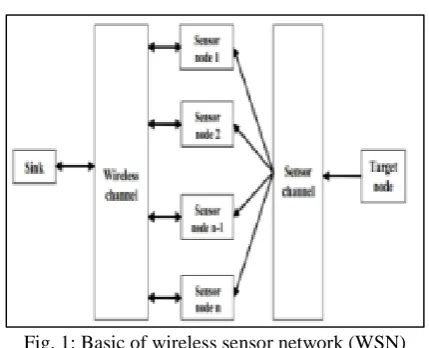
Fig. 1: Basic of wireless sensor network (WSN) The lifetime of energy is a particularly defined parameter in a WSN because of all sensor nodes are located a long way away from base Sinks(BS), its electricity of the node is now not restricted. The sensor nodes are spatially distributed in WSN and nodes collect the information inside the range. The accumulated information transmits to Sinks (BS) in Figure1.
The Sinks receives the records either locally or through the Network gateway [6].The storage potential and capability of the computational, ability of verbal exchange of the sensor nodes are very less amount. So, a clustering technique to improve the entire network lifetime. Every cluster member its data forwards to its Head of Cluster. The Head of Cluster (CH) is taking responsibility at a time of sensed records transmit to the Sinks. Hence, the choice of Head of Cluster (CH) should be careful. The selected cluster head based on the proposed scheme collects statistics from a member in a Cluster and convey to the Sinks. At the time of transmission, energy is directly proportional to distance and network. So, accelerated the lives of the Sensor nodes.
II. CLUSTERING
A node in a cluster that is responsible for collecting data from the sensors in its cluster and relay these data to the Base Station. The role of Cluster Head usually rotates between nodes in the cluster. WSN divides clusters each having a coordinator (cluster head) responsible for gathering the data from the nodes and sending it to the sink (base station). Ideal cluster head is the one which has the highest residual energy, the maximum number of neighbor nodes, and the smallest distance from base station.
Fig. 2: Cluster group classification
A. Benefits:
Clustering Intelligence Servers provides the following benefits: Increased resource availability: If one Intelligence Server in a cluster fails, the other Intelligence Servers in the cluster can pick up the workload. This prevents the loss of valuable time and information if a server fails.
B. Formation:
This means that they form in groups or clusters, since molecular clouds are composed of hundreds of solar masses of material. After the remnant gas is heated and blow away, the stars collect together by gravity. Early in the formation of our Galaxy, very large, globular clusters formed from giant molecular clouds.
C. Purpose:
Clustering is the task of dividing the population or data points into a number of groups such that data points in the same groups are more similar to other data points in the same group than those in other groups. In simple words, the aim is to segregate groups with similar traits and assign them into clusters.
D. Choosing of Cluster Head:
The cluster heads can be selected randomly or based on one or more criteria. Selection of cluster head largely affects WSNs lifetime. Ideal cluster head is the one which has the highest residual energy, the maximum number of neighbor nodes, and the smallest distance from base station.
E. Working:
A computer cluster is a set of loosely or tightly connected computers that work together so that, in many respects, they can be viewed as a single system. Unlike grid computers, computer clusters have each node set to perform the same task, controlled and scheduled by software.
F. Useful:
Clustering is useful for exploring data. If there are many cases and no obvious groupings, clustering algorithm can be used to find natural groupings. Clustering can also serve as a useful data-reprocessing step to identify homogeneous groups on which to build supervised models.
III. PROPOSED SYSTEM
[image:2.595.66.268.601.756.2]at any time data transfer will not stop that node is called non-selfish node.
A. Advantages of Proposed System
1) More reliable
2) Effectively detects selfish nodes 3) Maintains properly the node
4) Multi information’s transmission to destination without theft problem
5) Reducing node losses
6) Due to the presence of selfish nodes in the network, if a path has been broken, then the next best available path will be automatically selected for data transmission. So, this scheme guarantees smallest amount of idle time.
IV. THEORETICAL BACKGROUND
A. Selfish Node:
Mobile wireless network, capable of autonomous operation operates without base station or infrastructure. In this network nodes cooperate with each other to provide connectivity and operate without centralized administration. But when nodes drop packets of others due to honest or malicious causes they are called selfish nodes. A node is called selfish if it drops packets of others due to either honest causes such as collisions, channel errors, or buffer overflows or malicious causes they are called selfish nodes. A node is called selfish if it drops packets of others due to either honest causes such as collisions, channel errors, or buffer overflows or maliciously such as to save its energy or bandwidth, black hole or wormhole attack, network congestion. A selfish Node degrades efficiency of packet transfer and accelerates the packet delivery time and packet loss rate and finally creates Network Partitioning. To enforce cooperation and to minimize battery usage.
B. A Brief Review of Network Security
This section shows security requirements, possible attacks in traditional networks. Passive attack happened without the interrupting in the communication operations. For the Active attack node works as active node. It can perform the operations like interruption, modification, or fabrication, at the time of attack directly. In the Internal Attack nodes are the part of network in order to perform attack. Whereas External Attack nodes does not belong the network in order to perform attack. In the purpose of Black hole Attack, malicious user broadcast the message having the false information about the shortest path.
This shortest path is work for the attack. Some time it also makes the set of intermediate nodes and works as an attacker. The operation can perform like routing loops and forwarding packets dropping packets. It will degrade the quality of services. The Routing protocols are responsible to perform dynamic routing and information sharing as well. Table Driven Protocol is the type approach the protocol will store the table in order to get the route of destination. With the help of that table the route will decides and forward the packet to the destination node. There are many table driven protocol has developed like DSDV, WRP etc. this approach is also known as the proactive protocols. On Demand Protocol is another approach to route the packet in the
wireless network. This approach does not have any pre decided route.
1) Authentication:
It is needed in order to be sure about the identity of the sender or receiver of a message. The attack is called masquerading, that is pretending to be somebody else. Since in mobile ad hoc networks there are no central authorities available for certificates and key distribution to authenticate identities, it becomes harder to detect corrupted nodes. A distributed kind of authentication is needed. All other services depend on authentication.
2) Confidentiality:
It concerns the content of a message. Only the sender and the receiver are supposed to know the content. Attacks include message interception (man in-the-middle attacks), content release to other parties, etc. In mobile ad hoc networks, wireless link broadcast facilitates eavesdropping and key distribution is more difficult.
3) Integrity:
It ensures that system assets and transmitted information are modified only by authorized parties. Modification includes writing, changing, changing status, deleting, creating, and the delaying or replaying of transmitted messages.
4) Availability:
The of services or devices is attacked by denial of service. This is traditionally done by interruption, network or server overload. With mobile ad hoc networks of potentially low powered devices, sleep deprivation (engaging the devices CPU until the battery power is exhausted) or incorrect forwarding of messages are effective attacks. Network overload is easier on small bandwidth wireless links and bogus routing advertisements are harder to detect in a dynamic environment.
5) Access Control:
Restricts resources, services or data to special identities according to their access rights or group memberships for instance. Access control enforces authorization. Means to attack are again masquerading, message interception and modification, forging, etc. Since with mobile ad hoc networks there is no infrastructure and the network is potentially highly dynamic, it is hard to detect corrupted nodes. In order to exercise access control, distributed authentication management is needed.
6) Non-Repudiation:
This is about not being able to deny having sent or received a message. A typical attack is masquerading. Threats endanger the security, they can be deliberate or accidental. Attacks are materialized threats. Safeguards aim at protecting against threats and can be physical control, mechanism, policy, procedure to protect assets from threats. A policy governs whether a service is used. A vulnerability is the absence of a safeguard. Mechanisms provide services. Attacks are interruption for availability, interception for confidentiality, modification for integrity, fabrication for authenticity. Attacks are passive (release of contents, traffic analysis) or active (masquerade, replay, modification, denial of service).
V. CONCEPT
providing flexible, adaptive, while offering cost-effective solutions to the service providers. Preserving rare access bandwidth and power, as well as security concerns may induce some selfish users to avoid forwarding data for other nodes. However, the selfish behaviour degrades the performance of a wireless network since it increases the latency in packet delivery and packet drops and decreases the network throughput. To solve the issue of selfish nodes in a wireless network, this project detecting node misbehaviour. The scheme is applicable for Transmission control protocol and Internet protocol like TCP/IP, to make a strong and reliable of the nodes based on their packet forwarding activities as observed by their neighbours.
VI. METHODOLOGY
Wireless networks are self-configuring, dynamic systems in which nodes are free to move. The source node can send packets to the destination node through relay node. In wireless network, some nodes may selfishly decide only to cooperate partially, or not at all, with other nodes as it’s a cost intensive activity. This behavior of selfish nodes could then degrade the overall data accessibility which results into performance degradation of overall network. This project will focus the non-cooperative performances on the network layer. Since the memory, the bandwidth, and the power saving are very important in wireless network. Hence some nodes want to save their memory, bandwidth, and power by dropping packets from the other nodes. These nodes with misbehaviours are called the selfish nodes. Packets may be dropped due to network congestion or because a selfish node is not faithfully executing a Selfish Alert (SA) algorithm to solve the selfish node problemand provide better performance in an efficient way.In our proposed dynamic method, server monitor both data and relay node.
A. Networks Special Properties
Mobile ad hoc networks exhibit properties different from fixed networks or infrastructure based wireless networks. These properties make it harder to implement security services or even exhibit vulnerabilities to different and additional security attacks:
Unreliable wireless links are vulnerable to jamming and by their inherent broadcast nature facilitate eavesdropping.
Constraints in bandwidth are caused by the limits of the air interface with fading and noise. Computing power in mobile devices require security mechanisms to be low in computation overhead. Battery power in mobile devices can lead to application specific trade-offs between security and longevity of the device.
Mobility/Dynamics make it hard to detect behaviour anomalies such as advertising bogus routes since routes in this environment change frequently. It is difficult to employ mechanisms like firewalls, because the border between being inside or outside the network is blurred.
[image:4.595.320.535.64.268.2]VII. DESGIN
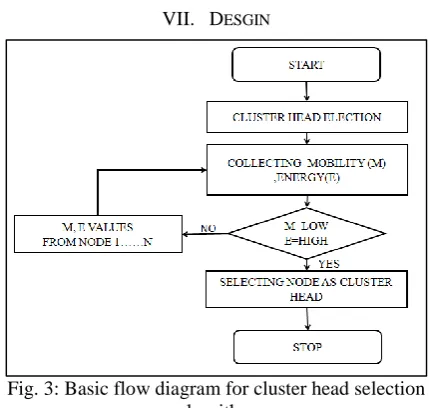
Fig. 3: Basic flow diagram for cluster head selection algorithm
The cluster head election will be depending on the higher energy level of node in the cluster. As shown in the figure 3 first the process will be started then cluster head election will be started .Then it will searching for higher energy level here higher energy node will be denoted by Energy(E) and the lower energy level will be denoted by Collecting Mobility(M). Next step will be searching for M and E , if the node having Energy(E) then that node will be consider as cluster head and then the process will be stop.If the node having collecting Mobility(M) it will be search again from node 1…N for the energy level E.
A. Selfish Alert Algorithm
Algorithm for detection of selfish nodes in a wireless networks. It uses reliable clustering of the nodes. The algorithm has a high detection rate. The proposed algorithm initially clusters the neighbours of a monitoring node and then classifies the clusters into selfish node.
B. Cluster Head Selection:
C. Step By Step Procedure for Above Flow Diagram: 1) STEP 1: Node creation
Consider here we create 30 nodes. 2) STEP 2: Node initialize started
3) STEP 3: Cluster classification and grouping
Cluster classified as group of five. Here each group having six nodes and each group will be differentiate by means of colour variation.
4) STEP 4: Cluster head selection started
Cluster head will be selected depending on the high value(power) of node.
5) STEP 5: Cluster head selection finished 6) STEP 6: Path identification
Path will be identified for transmitting the data from source to destination.Here we conside the path will be 14-17-11-5-1-4.
7) STEP 7: Selfish node detection
The selfish node will be node1, the node1 is selfish node because of that node will not properly transmitting the data from node 5 to 4,so it is called as selfish node. It is also the intermediate or relay node of node 5 to 4.Here the selfishness also occurred in intermediate node.
8) STEP 8: Path changed
Because of the data will be transmitted successfully and also the cluster head value(power) drain.
[image:5.595.45.290.363.494.2]D. Static Non Selfish Node:
Fig. 5: Non selfish node
In this method the data will be transmitted from source node to destination node by using relay node as intermediate node. In this static method it has only one path of transmitting the data from source to destination so there is no chance of selfish node so it is called as non-selfish node.
E. Dynamic Selfish Node:
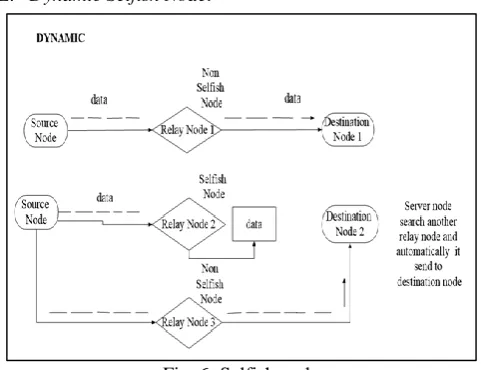
Fig. 6: Selfish node
This method is also similar to static method of data transmission from source to destination. But in the dynamic there is many path of data transmission for example in fig 3.4 the data transmission from source node1 to destination node1through relay node1 in that there is no chance of alternative path for selfish node selection so it is called non selfish node. In the source node2 to destination node2 data transmission through relay node2 is not possible because it a selfish node so it will automatically detected the alternative path for transmitting the data, here the data from source node2 to destination node2 transmitting data through relay node3. This method is called dynamic selfish node.
VIII. CONCLUSION
Introduces an efficient approach to reduce the detection time of selfish nodes based on contact dissemination. If one node has previously detected a selfish node. The detection of contacts between nodes is straight forward when it starts receiving packets from a new node it is assumed to be a new contact. Then, the node transmits one message including all known positives it knows to this new contacted node. They have investigated the media stream delivery through one path in SEWNs with the unknown node-selfishness dynamics. The node-selfishness dynamics have been designed to formulate the dynamics of the RN’s DENS with respect to its own resources and the received incentives. Under the unknown node-selfishness dynamics, the ONAS has been conceived to identify the dynamic node-selfishness model and also to approximate the finite-horizon utility and the optimal incentives. The convergence of the ONAS achieves with Lyapunov Techniques. On the one hand, although we mainly focus on the effect of the node-selfishness on the media stream delivery in this thesis, the delivery utility can be extend by introducing more impact factors. On the other hand, the node selfishness dynamic proposed in this thesis just a linear and simple control model.
REFERENCES
[1] J. Chase, “The evolution of the internet of things,” Texas Instruments, 2013.
[2] D. Bandyopadhyay and J. Sen, “Internet of things: Applications and challenges in technology and standardization,” Wirel. Pers. Commun., vol. 58, no. 1, pp. 49–69, 2011.
[3] L. Tan and N. Wang, “Future internet: The internet of things,” in 2010 3rd International Conference on Advanced Computer Theory and Engineering (ICACTE), 2010, vol. 5, pp. V5--376.
[4] W. B. Heinzelman, A. P. Chandrakasan, and H. Balakrishnan, “An application-specific protocol architecture for wireless microsensor networks,” IEEE Trans. Wirel. Commun., vol. 1, no. 4, pp. 660–670, 2002. [5] J. Gubbi, R. Buyya, S. Marusic, and M. Palaniswami, “Internet of Things (IoT): A vision, architectural elements, and future directions,” Futur. Gener. Comput. Syst., vol. 29, no. 7, pp. 1645–1660, 2013.
[image:5.595.46.291.567.752.2][7] Q. Jing, A. V Vasilakos, J. Wan, J. Lu, and D. Qiu, “Security of the Internet of Things: perspectives and challenges,” Wirel. Networks, vol. 20, no. 8, pp. 2481– 2501, 2014.
[8] W. R. Heinzelman, A. Chandrakasan, and H. Balakrishnan, “Energyefficient communication protocol for wireless microsensor networks,” in Proceedings of the 33rd Annual Hawaii International Conference on System Sciences, 2000, p. 10 pp. vol.2-.
[9] M. Chatterjee, S. K. Das, and D. Turgut, “An on-demand weighted clustering algorithm (WCA) for ad hoc networks,” in Global Telecommunications Conference, 2000. GLOBECOM’00. IEEE, 2000, vol. 3, pp. 1697– 1701.
[10]J. Xu, N. Jin, X. Lou, T. Peng, Q. Zhou, and Y. Chen, “Improvement of LEACH protocol for WSN,” in Fuzzy Systems and Knowledge Discovery (FSKD), 2012 9th International Conference on, 2012, pp. 2174–2177. [11]Y.-K. Chen, “Challenges and opportunities of the
internet of things,” in 17th Asia and South Pacific Design Automation Conference, 2012, pp. 383–388.
[12]A. Ali, Y. Ming, T. Si, S. Iram, and S. Chakraborty, “Enhancement of RWSN Lifetime via Firework Clustering Algorithm Validated by ANN,” Information, vol. 9, no. 3, p. 60, 2018.
[13]C. Wang, K. Sohraby, B. Li, M. Daneshmand, and Y. Hu, “A survey of transport protocols for wireless sensor networks,” IEEE Netw., vol. 20, no. 3, pp. 34–40, 2006. [14]M. C. M. Thein and T. Thein, “An energy efficient cluster-head selection for wireless sensor networks,” in Intelligent systems, modelling and simulation (ISMS), 2010 international conference on, 2010, pp. 287–291. [15]S. H. Kang and T. Nguyen, “Distance based thresholds
for cluster head selection in wireless sensor networks,” IEEE Commun. Lett., vol. 16, no. 9, pp. 1396–1399, 2012.
[16]J. A. Stankovic, “Research directions for the internet of things,” IEEE Internet Things J., vol. 1, no. 1, pp. 3–9, 2014.