Performance of Cognitive Radio PHY under
Adaptive Modulation Coding
Kajal Yadav1, Dakshi Jain2, Thangudu Varunraj3, Vipin Sharma4
1, 2, 3, 4
Electronics and Communication Engineering Department, ABES Institute of Technology, Ghaziabad, Uttar Pradesh, India
Abstract: Cognitive radio has been emerging as an intelligent communication system in the field of technology. The major focus is to performance analysis of “Bit error rate (BER)” at different “Signal to noise ratio (SNR)” using cognitive radio physical layer which senses the secondary spectrum for the primary users using Rayleigh and AWGN channel. The model uses various encoding schemes, digital modulation schemes as well as channel conditions. The modulation schemes can be of lower modulation schemes (BPSK,QPSK) or higher modulation schemes(M-array QAM). The system shows that error rate is reduced by Reed Solomon (RS) encoding by 10%, by using Convolution encoding by 95% and 98% error by applying RS with Convolution encoding providing better and improved BER. Cognitive allows an unlicensed user to use the RF environment to carry out tasks while the primary environment is busy or unavailable. It has been analyzed from the simulation results that the system performance is reduced by increasing noise power.
Keywords: Cognitive Radio, Bit error rate, Signal to noise ratio, Reed Solomon encoding, Convolution encoding, Additive white Gaussian noise, OFDM modulation.
I. INTRODUCTION
Cognitive radio has proved to be a promising future for wireless broadcasting and communication. With the increasing population day by day, the licensed and unlicensed bands are being crowded up giving the path for spectrum sensing.
This paper presents physical layer performance analysis of BER at different SNR levels over a Rayleigh channel along with AWGN noise. In this we have used Time Division Multiple Access (TDMA) system along with Orthogonal Frequency Division Multiplexing (OFDM) for the licensed users and non- persistent Carrier Sense multiple Access (CSMA) system for unlicensed users and who gets a opportunity to use the licensed spectrum.
The various digital modulation schemes used are PAM, BPSK, QPSK, 8PSK, 16PSK,16QAM and 64QAM .In this we have used RS encoding along with convolution encoding schemes with varying values of Signal to Noise ratio (SNR) to compute Bit Error Rate (BER).
The paper is organized as follows:
Section 1 all the parameters of system. Section 2 explains the physical layer of cognitive radio. Section3 gives calculation of probability of noise for modulation schemes. Section 4Shows the simulation based results. Section5 Conclusion of the paper.
II. PHYSICAL LAYER OF CR
Cognitive radio is related to the concern with the act or processing of knowing and perceiving. Cognitive radio is a network that it can sense the surrounding environment to check spectrum that which spectrum is free or busy and allow secondary to use. The primary used is known as licensed user and secondary is known as unlicensed user.
Figure1. Cognitive Radio Layers
The physical layer in cognitive layer is responsible for:
Sensing of Spectrum: Sensing of spectrum is used to detect which band is free and unused. Reconfiguration: Reconfiguration is related with CR in which we two type of users that is licensed and unlicensed .When the licensed user will appears then reconfiguration is done usually.
Changing of operation parameters: When some parameters like frequency, modulation and power are need to change, then changing of parameters used.
III. METHODOLOGY
The methodology that explains the whole scenario which is required to perform the analysis. We first need to create a simulation scenario in the MATLAB simulink which will help to reduce the errors. The basic idea behind this is to use the simulink of MATLAB 7.9.0 (R2009b) environment for the simulation of physical layer model. On the cognitive physical layer we are using various encoding for minimizing the error.
IV. PARAMETERS OF THE SYSTEM
A. BER (Bit error rate)
It is the ratio of the total received bits to the total transmitted bits. When we transmit a data through a channel, in which noise is present and that noise will add into the data due to which data is being lost .At the receiver side the lost data is received of the total data.
BER =
When transmitter and receiver medium is good or less error is present in a medium and the SNR is high then BER is always less and in data communication system, BER should not exceed 10-3.
B. Snr (Signal To Noise Ratio)
SNR is parameter which measures the quality of the transmission channel over a network channel. It is used to compares the levels of the desired signal to the levels of the background noise.
SNR is a ratio of the signal power to the noise power and it is always expressed in decibels.
SNR = (( ))
V. SIMULINK BLOCK MODEL
Fig.3 Block model on simulink
A. The Simulink Model Must Consist of 1) Random source
2) Transmitting module
4) Receiving module
The transmitter gets input as random binary sequence from MAC PDU which is also known as Bernoulli Binary block. Transmitter implements STC to provide transmit source reduced fading margin. This input data is fed to the randomizer to allow bit by bit processing and ignore long sequence of ‘0’ and ‘1’. The randomized data is encoded to remove errors. The FEC encoding helps to minimize the errors to improve BER which is done using RS encoding and Convolution encoding. The encoded data is interleaved by working over position of bits so that the data is rearranged according to the index vector. Lastly, the interleaved data is multiplexed using OFDM to divide the higher data rate channel in several orthogonal sub-channels of lower data rate.
At the channel end that is, channel sensing the multiplexed data from the OFDM is incurred as input. The channel sensing consists of AWGN and Rayleigh channel that helps to reduce fading characteristics as well as Doppler’s shift in the data. Channel sensing is required to seize the secondary channel available for the users so that it is not occupied by any primary user.
The Gaussian distribution function of AWGN channel is:
P(x) =
√ ^
( )^ ; with µ=0 and σ2
=
The channel capacity of AWGN channel is:
C= log (1 + )
The Gaussian distribution function of Rayleigh channel is:
P(y)= ^ ^
At the receiver end the reverse procedure of the transmitter is carried out to obtain the original baseband signal by removing the added redundant data to avoid data loss.
VI. PROBABILITY OF ERROR FOR ADAPTIVE MODULATION SCHEMES
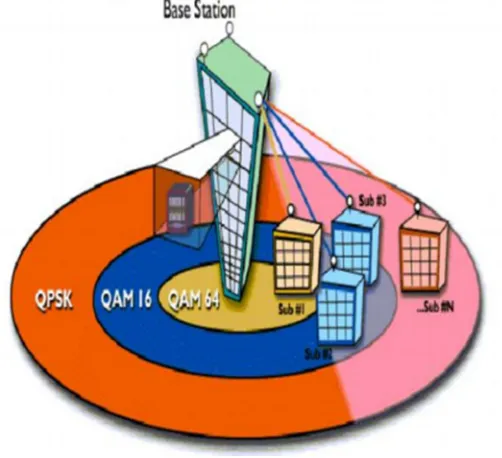
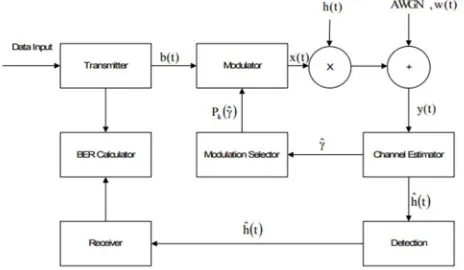
[image:5.612.184.435.442.671.2]The adaptive modulation schemes are used to increase the speed and capacity of the channels. The adaptive modulation schemes are of two categories-higher modulation schemes (M-ary QAM) and lower modulation schemes (QPSK,BPSK).To achieve robust and efficient characteristics the adaptive modulation scheme are used to reduce the fading characteristics as well as Doppler’s effect. The adaptive modulation schemes changes the transmission parameters such as power rate. Due to fading and Doppler shift effect, the Probability of Error of the system increases resulting in degradation of the physical layer performance.
FIG 4.Adaptive Modulation Schemes
FIG 5.Basic block diagram of adaptive modulation for cognitive radio
From the following formula Probability of Error for M-array PSK has been calculated.
Pe =
Probability of Error for M-array QAM has been calculated through this formula which is as follows,
Pe = 4-2(2-m/2) Q
( )
M
[image:6.612.189.421.78.213.2]VII. RESULTS
FIG 7. BER Performance of BPSK
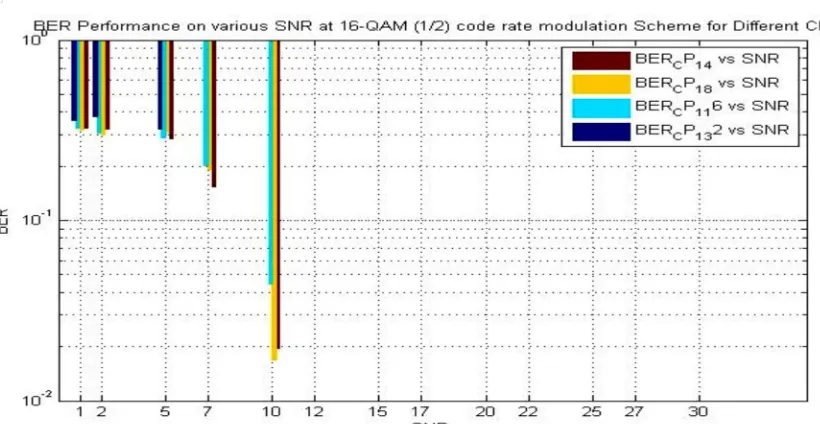
[image:7.612.131.484.369.711.2]FIG 9. BER Performance of 16-QAM
VIII. CONCLUSION
In this dissertation we have made a simulation model of the physical layer of IEEE 802.16e. The performance is measure for different modulation technique with different coding rate in terms of BER. We know that fading is one of the main aspects of wireless communication. At the starting of our simulation, we used AWGN channel and got same results using Rayleigh fading and AWGN. After obtaining the result it was found that with the lower modulation technique gives the lower BER and lower transmission efficiency where higher modulation technique like 16-QAM give higher BER with better transmission efficiency. This model is very useful for analysis the effect of different modulation technique, and also this model helps to optimize the overall system.
REFRENCES
[1] S.Haykin,“Cognitive Radio: Brain-Empowered Wireless Communications,”IEEE JSAC,vol.23,no.2,Feb.2005, pp. 201–20
[2] F. K. Jondral, “Software-Defined Radio — Basic and Evolution to Cognitive Radio,” EURASIP J. Wireless Communication and Networking, 2005. [3] Rao Farhat Masood, Member IEEE, MIE (Pak), PEC National University of Sciences and Technology, Pakistan.
[4] James E. Gilpy, Transcript International Inc., August 2003,“Bit Error Rate Simulation using Matlab