2018 International Conference on Applied Mechanics, Mathematics, Modeling and Simulation (AMMMS 2018) ISBN: 978-1-60595-589-6
Evolutionary Game Analysis and Simulation Research on Mobile
Application Security Governance under Public Participation
Zhen XU
No. 81, Middle Road, University Town, Shapingba District, Chongqing, China
Keywords: Public participation, Mobile application security, Governance.
Abstract. The increasingly prominent mobile application security problem has seriously damaged the vital interests of the public and hindered the healthy development of the mobile application industry. Based on the evolutionary game model, this paper has presented the interactive evolutionary game model between the public and the application platform under the bounded rationality. Using the Jacobian matrix solution and numerical simulation methods, this paper studies the evolutionary stability result under different key parameters in terms of the cost of public participation and penalty intensity. The results show that the system exhibits three kinds of evolutionary stability results with the change in key parameters, increases the probability of government supervision, and reduces the cost of public participation and the degree of information asymmetry. Meanwhile, the penalty for application platform violations is increased, helping the system evolve to an ideal state. The research conclusions provide the basis and reference for effectively governing the mobile application security.
Introduction
With the development of mobile communication technology and the rapid popularization of smart phones, the mobile Internet has gradually penetrated into all aspects of people's daily life, which has greatly promoted the economic and social development. According to the 40th Statistical Report on Internet Development in China released by CNNIC, the number of China's Internet users had reached 751 million by June 2017, including 724 million mobile phone Internet users. In this context, thanks to the rapid development of mobile applications industry, a variety of soaring mobile applications are gradually covering people's daily consumption, entertainment, travel and socializing areas. However, while mobile applications provide convenient and fast mobile Internet information services for the public, they also bring a series of security problems such as “tariff consumption, copycat applications or IPR violators”, which directly damage the vital interests of the public and hamper the development of the mobile application industry.
Literature Review
The mobile application security has become a hot issue in the academic circles. He D et al. analyzed the reasons why mobile terminals are susceptible to mobile malware infection, and put forward countermeasures and suggestion from three perspectives--application platform, developers and users
[1]
This paper, from the perspective of information economics, discusses the interactive mechanism between the public and the application platform in mobile application security governance by means of quantitative analysis of evolutionary game theory, studies the value conditions of decision-making parameters when the game system evolves to the ideal state, and puts forward corresponding governance measures and suggestions.
Construction of Evolutionary Game Model
Basic Assumption of Evolutionary Game Model
The two players in this model are the public and the application platform, both of which feature bounded rationality. The behavior set of the public is (participation, non-participation), the behavior set of the application platform is (compliance, violation). The basic assumptions of the model are as follows:
Assumption 1: At the beginning of the game, the proportion of public participation is x(0 ≤ x ≤
1), the proportion of non-participation is 1 − x; the proportion of application platform group compliance is y(0 ≤ y ≤ 1), and the proportion of violations is 1 − y.
Assumption 2: The basic benefit of the application platform is d. Selection of the violation (i.e. passive review of the application uploaded by the developer) will lead to the payment of audit cost of 0 and the conspiracy benefits from the developer are ∆d, including download income sharing, advertising income sharing, payment content sharing, etc. Due to the lack of management responsibility of the application platform itself, mobile application security incidents occur frequently, which brings losses of g to consumers and the public. The penalties for violations after being investigated by the government authorities are z (fine and social responsibility cost).
Assumption 3: The audit cost borne by the application platform for choosing the compliance behavior equals to ∆c, thereby creating a green and secure mobile application download and use environment for the benefit h of the consumers and the public. Because of the social public's preference for green applications, the compliance behavior of application platform will bring some external benefits to itself ρδ (such as the increase in the number of users and the promotion of social reputation). δ is the maximum of external benefits and ρ is the public preference. The larger the value, the greater the external benefits will be generated by compliance behavior of the application platform.
Assumption 4: The benefits of public participation in mobile application security governance are
r and the cost of reporting complaints is c; the probability of supervision by government departments is q, which reflects the supervision of government departments on the application platform. This paper assumes the probability of public participation in the supervision by the government departments is q = 1. Because of the existence of information asymmetry, the probability of successful detection of application platform violations by the government authorities is λ, which reflects the degree of information asymmetry between the government and application platform. As the direct consumers of mobile applications, the public provides the government with the violation information about their own platform, which reduces the degree of information asymmetry between the government departments and the application platform. Therefore, the government and the application platform are in a state of information symmetry with public participation. In this case, λ= 1. The model parameters are all greater than zero, and the interaction payment matrix between the public and the application platform is shown in the table 1 below:
Table 1. Behavioral interactive payment matrix of social public and application platform.
Participants Application platform
Compliance 𝐲 Violation 𝟏 − 𝐲
Social public
Active participation x (r + h, d + ρδ − ∆c) (r − g − c, d − z + ∆d)
Passive participation
Solution to the Jacobian Matrix of Evolutionary Game Model
Analysis of Evolutionary Stability Results Based on Replicator Dynamics Equation
According to Table 1, the expected revenue from the strategy of “active participation” and “passive participation” adopted for the social public is Ex, E1−x respectively:
Ex= y(r + h) + (1 − y)(r − g − c) (1)
E1−x = y(rh) + (1 − y)(−g) (2)
Similarly, expected revenue Ey, E1−y from the strategy of “compliance” and “violation” adopted
for the application platform is respectively:
Ey = x(d + ρδ − ∆c) + (1 − x)(d − ∆c) (3)
E1−y = x(d − z + ∆d) + (1 − x)(d − qλz + ∆d) (4)
According to the Malthusian Equation, a two-dimensional power system which is formed by the replicator dynamics equation concerning the “active participation” strategy of the social public and the “compliance” strategy of the application platform is shown as follows:
dxdt= x(1 − x)(r − c − cy) (5)
dydt = y(1 − y)[qλz − ∆d − ∆c + (ρδ + z − qλz)x] (6)
Four equilibrium points for the strategic interaction between the social public and the application platform obtained from the stability conditions of differential equation:(0,0), (1,0), (0,1), (1,1), when 0 < x0 < 1,0 < y0 < 1, (x0, y0) is also the equilibrium point. Where,
x0 = ∆c−qρδ−qλλz+∆dz+z y0 = c−rc (7)
Equilibrium Points and Stability Analysis
[image:3.595.90.508.515.589.2]The equilibrium results obtained from the replicator dynamics equation are not necessarily the evolutionary stability result of system ESS, and the determinant traces and values of equilibrium points obtained according to the Jacobian matrix solving method are shown as follows
Table 2. Determinant traces and values of equilibrium points.
Equilibrium point 𝐓𝐫𝐉 𝐃𝐞𝐭𝐉
(𝟎, 𝟎) (𝐫 − 𝐜) + (𝐪𝛌𝐳 − ∆𝐝 − ∆𝐜) (𝐫 − 𝐜)(𝐪𝛌𝐳 − ∆𝐝 − ∆𝐜)
(𝟎, 𝟏) 𝐫 + (∆𝐝 + ∆𝐜 − 𝐪𝛌𝐳) 𝐫(∆𝐝 + ∆𝐜 − 𝐪𝛌𝐳)
(𝟏, 𝟎) −(𝐫 − 𝐜) + (𝛒𝛅 + 𝐳 − ∆𝐝 − ∆𝐜) −(𝐫 − 𝐜)(𝛒𝛅 + 𝐳 − ∆𝐝 − ∆𝐜)
(𝟏, 𝟏) −𝐫 − (𝛒𝛅 + 𝐳 − ∆𝐝 − ∆𝐜) 𝐫(𝛒𝛅 + 𝐳 − ∆𝐝 − ∆𝐜)
(𝐱𝟎, 𝐲𝟎) 𝐏 𝐐
Obviously, the local equilibrium point (x0, y0) obviously does not satisfy the conditions. Therefore, this equilibrium point (x0, y0) is surely not ESS. It is only required to consider the remaining four equilibrium points. According to the judgment method as above mentioned, according to the determinant traces and values of Jacobian matrix at each equilibrium point, the local stability can be judged. The following propositions can be obtained:
Proposition 𝟏: when the parameters cand z have different value conditions, the system will show different evolutionary stability results, specifically divided into the following four states:
Table 3. Conditions for the evolutionary stability results of system.
State Evolutionary stability result Condition 1 Condition 2
State I (𝟎, 𝟎) 𝐜 > 𝒓 𝐳 < 𝐳𝟎
State II (𝟏, 𝟎) 𝐜 < 𝒓 𝐳 < 𝐳𝟎
State III (𝟎, 𝟎) and (𝟏, 𝟏) 𝐜 > 𝒓 𝐳𝟎< 𝒛 < 𝐳𝟏
State IV
(𝟏, 𝟏) 𝐜 < 𝒓 𝐳𝟎< 𝐳 < 𝐳𝟏 or
[image:3.595.105.489.724.799.2]where, z0 = ∆c + ∆d − ρδ, z1 =∆c+∆dqλ
[image:4.595.59.534.169.362.2]It is proved that: according to the two- dimensional power system, the determinant traces and values of Jacobian matrix at each equilibrium point can be obtained, and the local stability can be judged. Therefore, the judgment of State I is shown in Table 4, and the judgment method for the other states is consistent, so it will not be described in detail.
Table 4. Local stability analysis result of system in State I.
Equilibrium point 𝐓𝐫𝐉 𝐃𝐞𝐭𝐉 Stability
(𝟎, 𝟎) − + 𝐄𝐒𝐒
(𝟎, 𝟏) Undetermined − Saddle point
(𝟏, 𝟎) + + Instability point
(𝟏, 𝟏) Undetermined − Saddle point
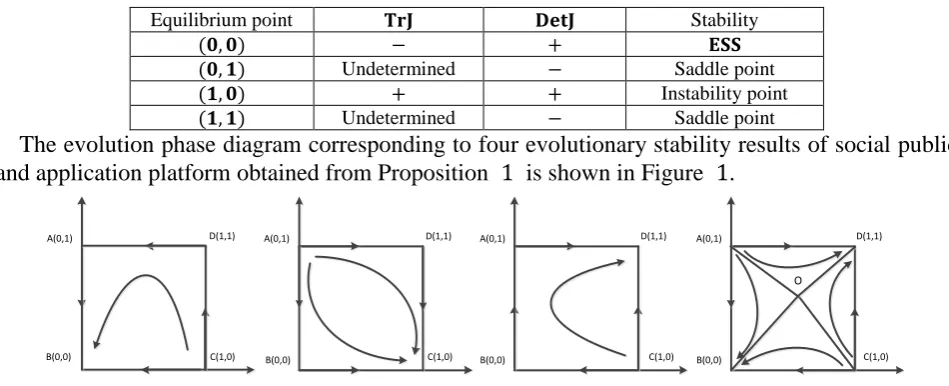
The evolution phase diagram corresponding to four evolutionary stability results of social public and application platform obtained from Proposition 1 is shown in Figure 1.
D(1,1) A(0,1)
C(1,0) B(0,0)
D(1,1) A(0,1)
C(1,0) B(0,0)
D(1,1) A(0,1)
C(1,0) B(0,0)
D(1,1) A(0,1)
C(1,0) B(0,0)
O
Figure 1. Evolution phase diagram corresponding to the evolutionary stability results.
Evolutionary and Simulation Analysis
Centered on the value change of two key parameters, namely public participation cost c and punishment intensity z, the evolutionary stability results of system are analyzed and the parameter assignment is: r = 5, ∆c = 5, ∆d = 5, ρ = 0.2, δ = 10, q = 0.5,λ= 0.8, and the conclusions reached are shown as follows:
Conclusion 1: When the parameters satisfy the conditions c > 𝑟 and z < z0, State I is the
evolutionary stability result of system, and the behavioral selection of social public and application platform is respectively passive participation and violation.
When the public participation cost is high and the punishment intensity applied by the government over the violation behavior of application platform is small, the evolutionary stability result will be the passive participation of social public and the violation behavior of application platform. In the initial development stage of mobile application market, the popularizing rate of mobile application that is a newly sprouted thing is low and a series of social issues brought by the security of mobile application are still not prominent. First, the related governments and social public pay a little attention to the security of mobile application. There are short of convenient and effective channels for reporting and complaint and the social participation needs to consume huge time and energy cost and even faces the difficult situation that there is no way for complaint. Therefore, the public participation cost is high. Second, due to the hysteretic nature of policy and legislation, the government departments do not formulate the laws and regulations on security governance of mobile application or the punishment mechanism is not perfect, so the binding effect on the violation behavior of application platform is not sufficient and the profit-driven application platform is lack of management responsibility to let the platform inundated with the mobile applications that have security risk and the mobile application security accident frequently occur.
platform groups for selecting the compliance behavior are gradually decreased with the increase of evolution time and finally their behavioral selection tends to reach the stability point (0,0).
[image:5.595.69.496.102.261.2]
Figure 2. Dynamic evolution diagram of system in State I. Figure 3. Dynamic evolution diagram of system in State II.
Conclusion 2: When the parameters satisfy the conditions c < 𝑟 and z < z0, State II is the evolutionary stability result of system and the behavioral selection of social public and application platform is respectively active participation and violation.
When the public participation cost is low and the punishment intensity applied by the government over the violation behavior of application platform is small, the evolutionary stability result will be the active participation of social public and the violation behavior of application platform. Compared with the State I, the social popularizing rate of mobile application is greatly increased and the social issues arising from the security of mobile application are increasingly severe, so the related government departments attach great importance to them and take certain measures. One one hand, the reporting and complaint mechanism for mobile application security is established and perfected and smooth reporting and compliant channels are established for the public, so the public participation cost is low; on the other hand, the government departments successively formulate a series of related laws and regulations to specify the management review responsibility of application platform, but these laws and regulations do not specify the specific punishment constraint mechanism for the violation behavior of application platform; and it is found by the application platform that the benefits brought from its violation behavior are much larger than the cost that it pays, so the violation behavior becomes an actual choice for the application platform.
Scenario 2: In case of c = 2, z = 5, the evolutionary simulation results obtained according to the simulation program are shown in Figure 3. According to the figure, the proportion of social public for selecting the participation behavior and the proportion of application platform groups for selecting the compliance behavior are gradually decreased with the increase of evolution time and finally their behavioral selection tends to reach the stability point (1,0).
Conclusion 3: when the parameters satisfy the conditions c > 𝑟 and z0 < 𝑧 < z1, state III is the evolutionary stability result of system, and the behavioral selection of social public and application platform has two stability results, respectively being active participation and compliance as well as passive participation and violation.
When the public participation cost is high and the punishment intensity applied by the government over the violation behavior of application platform reaches a certain level, the system may have two evolutionary stability results. The specific results are determined by the value conditions of related parameters. In State III, due to information asymmetry and limitation of governmental supervision resources, the governmental supervision efficiency is not high. Then the violation behavior of application platform cannot be constrained purely depending on the governmental supervision, but the auxiliary supervision of social public is also required. However, a certain participation cost needs to be paid for the participation of social public and thus two evolutionary stability results will appear, namely active participation and compliance as well as passive participation and violation. In view of the persistence of system evolution, the system will
0 0.5 1 1.5 2 2.5 3 3.5 4 4.5 5 0
0.1 0.2 0.3 0.4 0.5 0.6 0.7 0.8 0.9 1
Time/t
P
ro
p
o
rt
io
n
/x
(t
)
y
(t
)
The public=0.8 Application platform=0.8
0 0.5 1 1.5 2 2.5 3 3.5 4 4.5 5
0 0.1 0.2 0.3 0.4 0.5 0.6 0.7 0.8 0.9 1
Time/t
P
ro
p
o
rt
io
n
/x
(t
)
y
(t
)
keep the coexistence situation of active and passive participation of social public as well as compliance and violation behaviors of application platform for a very long period of time.
Scenario 3: in case of c = 8, z = 15, the specific state of system is determined by the proportion of initial groups that select the group behavior, and the evolutionary simulation results obtained according to the simulation program are shown in Figure 4 and Figure 5. According to the replicator dynamics equation, under this scene, the x threshold that affects the behavioral selection of application platform groups is: x = 4 11⁄ , and the y threshold that affects the behavioral selection of social public is: y = 3 8⁄ . In other words, if the proportion of social public selecting the active participation behavior and the proportion of application platform groups selecting the compliance behavior are higher than the threshold, the system will be guided to evolve towards an ideal state.
[image:6.595.62.534.214.408.2]
Figure 4. Dynamic evolution diagram of system in State III. Figure 5. Dynamic evolution diagram of system in State III.
Conclusion 4: when the parameter meets the conditions that c < 𝑟 and z0 < 𝑧 < z1 or z > z1, the evolutionarily stable results of the system will be as per status IV and the behavior choice of the public and application platform is (positive participation and compliance) respectively.
When the public participation cost is relatively low, and the punishment intensity of the government to the application platform's illegal behaviors is at a certain level or is relatively large, the evolutionarily stable result is that the public will positively participate, while the users of the application platform will try the best to be in compliance. Compared with status I and II, due to the perfection of the public participation mechanism and the soundness of governmental laws and regulations, the public participation cost is relatively low; meanwhile, the government will continuously enhance the punishment intensity against the application platform's illegal behaviors, until the platform's profit from violating rules is less than the cost of violating rules paid thereby, and the users of the application platform will generally select compliant behaviors. Under such a status, expressions z0 and z1 show that when the government's supervision probability is relatively high or when the degree of asymmetry of information between the government and the application platform is relatively low, regardless of the external revenue from the public's compliant behavior on the application platform, high-intensive governmental supervision is sufficiently enough to shock and awe the application platform's motivation to conspire with the developer, urge the platform to positively perform its management responsibilities and then effectively reduce the safety risk of mobile application.
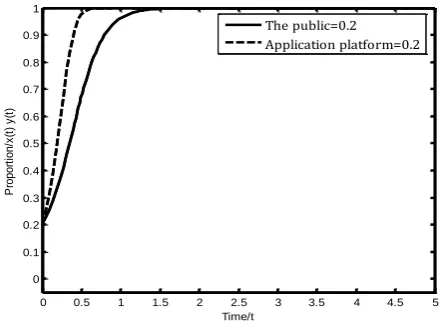
Scenario 4: in case that c = 2, z = 15 meets the first situation and c = 2, z = 30 meets the second situation, based on the simulated program, the results obtained are as shown in Figure 6 and Figure 7. As shown in the figure, in the scenario, even if the initial proportion of the public and the application platform's compliance is as low as 0.2, with the lengthening of the evolutionary time, the proportion of the public selecting participative behaviors and the application platform's users selecting compliant behaviors will gradually increase, until the behavior choice of these two items reach the stable point (1,1).
0 0.5 1 1.5 2 2.5 3 3.5 4 4.5 5
0 0.1 0.2 0.3 0.4 0.5 0.6 0.7 0.8 0.9 1
Time/t
P
ro
p
o
rt
io
n
/x
(t
)
y
(t
)
The public=0.2 Application platform=0.5 The public=0.5 Application platform=0.5 The public=0.8 Application platform=0.5
0 1 2 3 4 5 6 7 8 9 10
0 0.1 0.2 0.3 0.4 0.5 0.6 0.7 0.8 0.9 1
Time/t
P
ro
p
o
rt
io
n
/x
(t
)
y
(t
)
Figure 6. Dynamic Evolution Diagram of System under Status IV.
Figure 7. Dynamic Evolution Diagram of System under Status IV.
Conclusions
This paper constructs the evolutionary game model and the analogue simulation tools and depicts the evolving laws of behavioral interaction presented by the change of the public and the application platform with the conditions of decision parameters during the security governance of mobile applications. Researches show that: ① The behavior choice of the public and the application platform is closely related to the values of two decision parameters, i.e. the public participation cost and the punishment intensity and with the continuous change of the decision parameters, the stable results presented by the evolutionary game system will change accordingly; ② it will benefit the system for evolving to the ideal status to increase the supervision probability of governmental institutions, reduce the public participation cost and the degree of asymmetry of information and intensify the punishment intensity against application platform's illegal behaviors. Relevant research conclusions could provide theoretical guidance to a certain extent for the positive participation of the public and the making of governmental decisions during the security governance of mobile applications, but the conclusions of the paper remain to be further verified by theories and practice.
References
[1] He D, Chan S, Guizani M. Mobile application security: malware threats and defenses[J]. IEEE Wireless Communications, 2015, 22(1):138-144.
[2] Zhou Y, Jiang X. Dissecting Android Malware: Characterization and Evolution[C]// Security and Privacy. IEEE, 2012:95-109.
[3] Peng S, Yu S, Yang A. Smartphone Malware and Its Propagation Modeling: A Survey[J]. IEEE Communications Surveys & Tutorials, 2014, 16(2):925-941.
[4] Yang Huan, Zhang Yuqing, Hu Yupu, et al. Detection System of Malicious Acts of Android Applications Based on Multiple Features [J]. Chinese Journal of Computers, 2014, 37(1):15-27.
[5] Wu Jingzheng, Wu Yanjun, Wu Zhifei, et al. Detection Method of Malicious Android Privacy Exposure Type Application Based on the Directed Information Flow [J]. Journal of University of Chinese Academy of Sciences, 2015, 32(6):807-815.
[6] Lin Huizhen, Hu Jing, Li Hao. Supervisory Dilemma and Laws & Regulations of the APP Market [J]. Legal System and Society, 2016(14).
[7] Fang Jingjing, Cui Mengyue. Brief Talk about Supervisory Decisions on Smart Phone APP in the Internet Era [J]. Science & Technology for China's Mass Media, 2017(2).
0 0.5 1 1.5 2 2.5 3 3.5 4 4.5 5 0
0.1 0.2 0.3 0.4 0.5 0.6 0.7 0.8 0.9 1
Time/t
P
ro
p
o
rt
io
n
/x
(t
)
y
(t
)
The public=0.2 Application platform=0.2
0 0.5 1 1.5 2 2.5 3 3.5 4 4.5 5 0
0.1 0.2 0.3 0.4 0.5 0.6 0.7 0.8 0.9 1
Time/t
P
ro
p
o
rt
io
n
/x
(t
)
y
(t
)
[image:7.595.312.533.82.243.2]