Munich Personal RePEc Archive
Rent-seeking measurement in coal
mining by means of labour unrest: an
application of the distance function
Rodriguez-Alvarez, Ana and Del Rosal, Ignacio and Baños
Pino, Jose
Departmen of Economics. School of Economics and Business
Administration. University of Oviedo
2002
Online at
https://mpra.ub.uni-muenchen.de/3682/
UNIVERSIDAD DE OVIEDO
DEPARTAMENTO DE ECONOMÍA
PERMANENT SEMINAR ON EFFICIENCY AND PRODUCTIVITY
RENT-SEEKING MEASUREMENT IN COAL MINING BY MEANS OF
LABOUR UNREST: AN APPLICATION OF THE DISTANCE FUNCTION
Ana Rodríguez-Álvarez
*, Ignacio del Rosal
**and José Baños-Pino
*Efficiency Series Paper 02/2002
Abstract
We propose a method based on the distance function to empirically estimate the social cost arising from rent seeking behaviour in declining industries. Due to import competition, the factors of a particular industry undergo losses in real income, and have incentives to seek protection. In the case of declining industries, workers play a central role and the losses in output due to strikes are used to quantify the social cost of rent seeking. In our model, strikes are considered as a “bad” input into the production process. We apply our approach to the case of Spanish coal mining. We have estimated a system of equations formed by the input distance function and cost share equations using annual data over the period 1974-1997. This procedure has allowed us to calculate the cost that strikes have imposed on the sector.
Keywords: Production theory, rent seeking, input distance function, shadow prices, coal sector.
*
Departamento de Economía, Universidad de Oviedo, Spain.
** Departamento de Economía Aplicada, Universidad de Oviedo, Spain.
We thank participants in the Oviedo Permanent Seminar on Efficiency and Productivity and a referee for comments and suggestions.
1. Introduction
As is well-known, the concept of rent seeking, introduced by Tullock (1967) and coined by Krueger (1974), refers to the use of economic resources by an agent or group of agents with the aim of obtaining a transfer from the government. Normally arising in the context of monopolies, tariffs, and so on, it is certainly an attractive concept and has generated great deal of literature. However, exact measurement of costs associated with rent seeking has proven to be very elusive, even on a theoretical level (see Rowley, Tollison and Tullock, 1988; and especially the paper of Higgins and Tollison, 1988). Three decades after introducing the concept, Tullock (1997) stresses the empirical difficulty of finding forms of accurately measuring this social loss.
The expansion of international trade over recent decades as a consequence of liberalization has meant that domestic sectors have had to undergo adjustment processes due to the increase in import competition. This is especially relevant in the case of declining industries in developed countries. In these cases, rent seeking on the part of the protectionist lobby can be interpreted as a form of negotiating the productive adjustment, and will generate welfare costs which must be compared with “normal” adjustment costs such as unemployment. A complication that arises in this context of productive adjustment is that the agents affected by the competition of imports i.e. managers and workers, have incentives to invest resources in order to pressure the government into maintaining or increasing protection. This is a clear case in which rent seeking involves social loss.
In the context of declining industries faced with import competition, Baldwin (1984) uses a model of specific factors to analyse how workers and managers see their real incomes reduced due to adjustments in activity. Under such conditions, these agents have many incentives to invest resources in lobbying or other rent seeking activities to obtain trade protection from the government.
desirability of rent transfers associated with rent seeking. In the context of industries in decline, one cannot determine whether the income redistribution generated by labour unrest is socially desirable or not. However, the first criterion is more important, and here there are no doubts: labour unrest implies a production loss, and therefore a social loss.
The aim of our work is to present and to discuss a form of measuring the cost of rent seeking as a result of labour unrest. To illustrate our method, we carry out an empirical application to the Spanish coal mining sector. The effects of protectionist policy in this sector have been analysed in Del Rosal (2000), while a previous attempt to quantify labour unrest has been carried out in Del Rosal and Fonseca (2001). In the latter study, the main target was to quantify the effects of strikes through the surplus associated with the labour demand in the industry.
We seek to use a more rigorous procedure to measure the effects of labour unrest as a form of rent seeking in the context of declining industries. With this aim, we will estimate the sector’s technology in order to evaluate the effects of labour unrest on production. However, while labour unrest constitutes an “input” to production, it does not have a market price. To solve this problem, we propose using the distance function (Shephard, 1953, 1970) in order to obtain virtual or shadow prices and thereby evaluate labour unrest, which can be considered in this context as an undesired input. We follow a procedure similar to that which other authors have used to obtain the shadow prices for undesirable outputs (see Färe, Grosskopf, Lovell y Yaisawarng, 1993; Färe & Grosskopf, 1998), but adapt it to case of undesirable or “bad” inputs.
example Berdnt, 1991, chapter 9). The use of the production function together with the associated system of share equations requires the assumption that firms are minimising costs, whereas this is not necessary with the distance function. It is very difficult to justify the assumption of cost minimisation in sectors which are highly regulated, in industries protected from import competition, or in economic activities where price controls exist. For these reasons, we opt for an input distance function in order to obtain shadow prices for labour unrest.
The paper has the following structure. In section 2 we outline the main features of the Spanish coal mining sector, paying particular attention to the way in which the sector has been protected from external competition. In section 3 the methodology used, based on the input distance function, is presented, and we discuss its main properties and characteristics and address the issue of how it can be used to quantify the effect of labour unrest. In section 4 the estimation and the main results are presented. Section 5 summarises the main conclusions.
2. Productive adjustment and labour unrest: the case of spanish coal mining
national production and most of the employment in the sector (see Vázquez and Del Rosal, 1999; and Del Rosal, 1999).
For four decades, the adjustment process has been continuous, as in other European countries. However, the competition from foreign coal has not led to a complete closure of of the mines, thanks to an active protection policy which has given rise to a series of events that have permitted a more gradual adjustment, such as the nationalization of a part of the sector (creating HUNOSA) and, more importantly, the imposition of obligatory consumption of the so-called national coal (see Del Rosal, 2000) in the electricity industry. With the energy crisis of the seventies, the adjustment process was halted somewhat, allowing a rise in energy prices and a certain preservation of activity and employment. However, in the second half of the eighties the inability of national coal to compete with imports was accentuated by the fall of international prices. From then on the prices paid by the thermal power stations to national coal duplicate the prices of imported coal. In the face of all this, the productive adjustment has intensified.
Table 1: Labour Unrest and Productive Adjustment (1973-1997)
Period Labour Unrest
(% lost days) Variation in Employment Variation in no. of exploitations
1973-1983 1,62 +177,6 +9,4
1984-1997 2,77 -2053,8 -9,3
Source: Del Rosal and Fonseca (2001) and Carbunión
.
the loss of working days was in excess of 5%) and which coincides with times with accelerated adjustment in the sector.
Regardless of the reasons for labour unrest in the sector the loss of working days implies some costs in terms of lost production. With this in mind, we now discuss how the cost of these strikes can be quantified using the distance function.
3. Methodology: the input distance function
3.1. Basic aspects of the input distance function
The distance function is a concept introduced by Shepard (1953) to represent the firm’s technology. The distance function allows multiproduct technologies to be modelled and while it does not preimpose any economic behaviour (such as cost minimisation) it does permit tests for such behaviour. This makes it preferable to the traditional cost function in the context of sectors such as that of Spanish coal mining where the assumption of cost minimisation is questionable.The distance function can be defined in terms of inputs or outputs. Given that we want to evaluate inputs which may be considered as non desireable, we have proposed the use of the input distance function.
Our measurement of labour unrest will be carried out by exploiting the duality which exists between the cost function and the input distance function. To explain how the input distance function works, we provide an illustration in Figure 1 below for the case of a firm which uses two factors of production (x1 and x2) to produce the output y. In the
figure, we represent different combinations of factors (P and R) that produce the output
Figure 1: Input Distance Function
Formally, and generalizing for multiple inputs and outputs, the index of technical efficiency is defined as:
TEI(y, x) = minλ{λ: λx∈ L(y)} (1)
where L(y) is the input requirement set, x is the input vector and y is the output vector.
The input distance function (Shephard 1953, 1970) is the reciprocal of the technical efficiency index of Farrell, that is, the ratio 0P/0R, and it can be defined as the highest
scale (δ) by which all the factors can be divided proportionally while continuing to produce the same output level. Formally:
DI(y, x) = maxδ{δ: x/δ ∈ L(y)} (2)
When DI equals 1, production is technically efficient way. A value superior to 1 tells us
the degree of efficiency achieved. For example, a value of 2 would imply that half of each of the inputs could be used to obtain the same production. The relationship between the measure of technical efficiency of Farrell and the input distance function can be expressed as:
TEI(y, x) =
1
D
I(
y, x
)
(3)x
1x
20
y
P
•
The input distance function satisfies the following properties:
1) it is decreasing in outputs.
2) it is not decreasing in inputs.
3) it is homogeneous of degree 1 in inputs.
4) it is concave in inputs.
5) it can represent a multioutput process
6) it is the dual of the cost function. The duality between both functions can be expressed by means of the two following equations (Shephard, 1953, 1970):
DI (y, x) = minW{Wx: C(y,W) = 1} (4)
C(y, W) = minx{Wx: DI(y,x) = 1} (5)
where W is the input price vector (normalized by the cost), so that the minimum cost of producing y equals 1.
From this duality, Shephard (1970, p. 171) defines a relationship between the inputs and their prices through the following dual equations:
Shephard’s Lemma:
x
is(
y,w
)
=
∂
y,w
∂
C(
)
w
i (6)Dual Shephard’s Lemma1:
i I s
i
x
)
(
D
)
(
W
∂
∂
y,
x
x
y,
=
(7)where:
w is the input price vector,
x
is(
y,w
)
indicates the input choice under cost minimization given (y,w)Wsi
(
y,
x
)
=w
C(
)
i s
y,w
s is the cost minimising price given (y,x), where the vector Ws
(y, x) is
known as (normalized) shadow price vector.
That is to say, the duality that exists between the input distance function and the cost function allows us to identify the (normalized) shadow price vector that minimizes costs given (y, x). Therefore, the condition of minimum cost is always satisfied with regard to these shadow prices. However, the vector of shadow prices may or may not coincide with the vector of market prices. Only in the case where the shadow prices coincide with those of the market would the firm be minimizing costs with respect to the market prices. Thus, with this methodology it is not necessary to assume that the firm minimizes costs with regard to the market prices. This property is especially attractive when it comes to the analysis of public sectors, regulated sectors, or those where price controls exist, given that this assumption is inappropriate. Moreover, the input distance function does not assume exogeneity of the market input prices, which constitutes another advantage in non-competitive sectors where a certain degree of price control may exist.
These properties of the input distance function are especially relevant in terms of the objectives of this research, given that the Spanish coal sector, as mentioned above, has been subjected to a high degree of public intervention and regulation.
3.2. Obtaining the cost of the unrest by means of a distance function
In our model, we assume that workers go on strikes to get public sector protection, to maintain their jobs, and to obtain higher salaries or better working conditions. Thus, these strikes are considered as a “undesired intermediate input” into the production process. Strikes (H), which are chosen by the worker, are assumed to be exogenous to the firm:
y
Strikes (H)
Workers Coal Mining
H > 0 Sector
x
monetary terms, we define the following input distance function:
DI(y, x, H) = minW{Wx: C(y,W, H) = 1} (8)
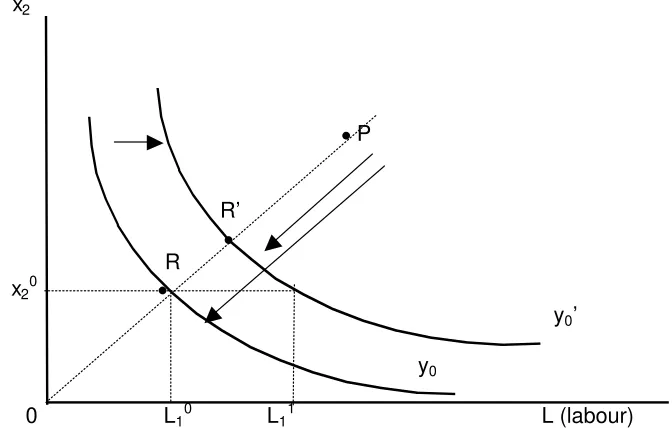
where H is a labour unrest variable, measured by the number of strike hours in the sector due to the industrial disputes. The duality of the input distance function and the cost function, analysed in the previous section, proves useful when it comes to the derivative ∂DI(y,x,H)/∂H. The expected sign of this derivative is negative. In Figure 2, if
strikes increase, the isocuant shifts to the right because more labour is needed to produce the same output (that is to say, strikes are an output-reducing input). In this way, distance decreases.
x2
• P
R’
•
R
x20 •
y0’
y0
[image:11.595.127.463.285.508.2]
0 L10 L11 L (labour)
Figure 2: Strikes in the Input Distance Function
Mathematically, according to the envelope theorem ∂DI(y,x,H) / ∂H is equal to ∂L (.)/∂H,
where L(.) it is the Lagrangean associated with equation (8). Then,
∂DI (y,x,H)/ ∂H = -λ∂C (y,W,H)/ ∂H (9)
where λ is the Lagrange multiplier. The first order conditions associated with the
minimization problem (8) require that ∂L (.)/∂Wi = xi - λ∂C(y,W, H)/∂Wi = 0. If DI is equal
to 1 (i.e., if we are in the frontier), the quantity xi coincides with the optimal, so that λ=
) H , ( C CMgH ) H ( C H ) H , ( C H ) H , ( DI s s s w y, , w y, w y, x y, = ∂ ∂ = ∂ ∂ − (10)
That is, the absolute value of the derivative ∂DI(y,x,H)/∂H is equal to the marginal cost
(normalized by the total cost) of an hour of strike registered in the sector. Therefore, once the technology is estimated, it is feasible to deduce the annual cost of the conflict, where this is calculated as the number of hours of strikes in a year by the marginal cost of an hour of strike.The marginal cost of strike hours is an input shadow cost which is non desireable.
4. Empirical model
To estimate the production technology by means of a input distance function, we propose an econometric approach. To improve the efficiency, the estimation of the distance function will be carried out jointly with the share equations that are obtained by differentiating the logarithm of the distance function with respect to the logarithm of each input. A flexible functional form is specified, namely the translog function. With this, the econometric specification of the input distance function in the short run can be written as follows:
∑
∑∑
= = = + + + + + = n 1 i n 1 i n 1 j jt it ij it i 2 rt rr rt r0 lnx lnx
2 1 x ln y ln 2 1 y ln B 1
ln á á â â
+ +
+
∑
= 2ct cc ct c n 1 i it rt
ri lnh
2 1 h ln x ln y
ln î î
ñ cr ct rt
n
1 i
it ct
cilnh lnx î lnh lny
î +
∑
= + + + 2 ft ff ftf lnff
2 1 ff
ln ç
ç fr ft rt
n
1 i
it ft
filnff lnx ç lnff lny
ç +
∑
= + + + 2 t tt tt lnT
2 1 T ln ø
ø tr t rt
n
1 i
it t
tilnT lnx ø lnT lny
ø +
∑
=
+εt (11)
The share equations can be written as:
t it it C w x t ti ft fi ct ci rt ri n 1 j jt ij
i â lnx ñ lny î lnh ç lnff ø lnT
â + + + + +
=
∑
=
+ µit (12)
y is output; x is the input vector (i, j = 1,..., n); h is the index of conflict; ff is a quasi-fixed input; T is a time trend; B0 is constant; C is total cost; w represents input prices (unit
costs); and εt and µit are error terms. εt is assumed to follow a normal distribution with
zero mean.
If costs are not being minimised, the error term µit may have a non-zero mean. We
therefore assume that the µit’s have means ai, and we propose the following
transformation of the error term, following Ferrier and Lovell (1990):
t it it C w x t ti ft fi ct ci rt ri n 1 j jt ij i
i a ) lnx lny lnh lnff lnT
(â + + â +ñ +î +ç +ø
=
∑
=
+ (µit – ai) (12b)
where the transformed error terms (µit – ai) have zero means.
Also, homogeneity of degree one in variable inputs has been imposed: that is
i n
=
∑
1βi = 1; j
n
=
∑
1βij = 0;
∑
=
n
r 1
ρri = 0; i
n
=
∑
1ηfi =0; i
n
=
∑
1Ψti = 0; and symmetry: βij = βji.
4.1. The data
The estimation of the distance function will be carried out for the coal sector by aggregating three types of coal: coal, anthracite and lignite. The data have been obtained from two statistical publications: Estadistica Minera de España (Mining Statistics of Spain), and the annual reports of Carbunión (the employer’s organization). The sample period (conditioned by the availability of data) is 1974-1997. The variables used are:
a) Output (Y): production of coal measured in equivalent thermal units. It has not been possible to distinguish between the three types of coal due to lack of degrees of freedom.
b) Labour (L): total potential working hours (total working hours contracted ).
c) Capital (K): this factor, which is considered fixed, has been approximated using a Divisia-Törnqvist quantity index, in which the different types of machines have been considered in terms of the corresponding vapor horsepower.
using the implicit deflator of the GNP with a base in 1986, obtained from the National Accounts elaborated by the National Institute of Statistics (INE) .
e) Labour Unrest (H): number of working hours lost. This variable has been constructed by applying the percentage of lost days, according to Carbunión, to working hours, according to the Estadistica Minera de España .
Moreover, we have considered the expenditure on the different variable inputs (expenditure on labour and supplies).
Finally, a time trend has been included in an attempt to capture technical progress.
4.2. Empirical results
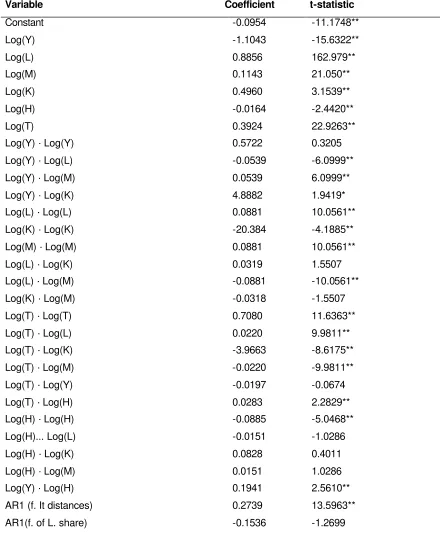
The system of equations (11-12b) has been estimated by means of the iterative seemingly unrelated regressions system (ITSUR). Since the share equations sum to 1, the estimation requires dropping one of the input share equations. Nevertheless, the result is invariant to the omitted share equation. Furthermore, an autoregressive first order parameter has been introduced to correct for possible first order autocorrelation in the different equations of the system. Also, to deal with the heteroscedasticity problem, the correction proposed by White (1980) has been used. The estimated parameters of the system of equations (11-12b) are presented in Table 2, where the variables have been divided by their geometric means. Therefore, the first order coefficients can be interpreted as elasticities evaluated at the sample geometric mean.
The coefficients of the inputs and the outputs have the expected signs. That is to say, the estimated distance function is decreasing in outputs and increasing in inputs. The positive coefficient of aL indicates that systematically too many workers are being
employed. That is, at the mean, workers are employed in a proportion different to that which would minimise costs, which would appear to be coherent in a in declining industry such as that under study.
The coefficient of the strikes (H) also has the expected negative sign. From this it can be deduced that labour unrest has a negative influence on the sector’s technology. As analysed in the previous section, the absolute value of the derivative (∂DI(y,x, H) / ∂H)
Table 2: Estimated Input Distance Funtion (sample 1974-1997)
Variable Coefficient t-statistic
Constant -0.0954 -11.1748**
Log(Y) -1.1043 -15.6322**
Log(L) 0.8856 162.979**
Log(M) 0.1143 21.050**
Log(K) 0.4960 3.1539**
Log(H) -0.0164 -2.4420**
Log(T) 0.3924 22.9263**
Log(Y) · Log(Y) 0.5722 0.3205
Log(Y) · Log(L) -0.0539 -6.0999**
Log(Y) · Log(M) 0.0539 6.0999**
Log(Y) · Log(K) 4.8882 1.9419*
Log(L) · Log(L) 0.0881 10.0561**
Log(K) · Log(K) -20.384 -4.1885**
Log(M) · Log(M) 0.0881 10.0561**
Log(L) · Log(K) 0.0319 1.5507
Log(L) · Log(M) -0.0881 -10.0561**
Log(K) · Log(M) -0.0318 -1.5507
Log(T) · Log(T) 0.7080 11.6363**
Log(T) · Log(L) 0.0220 9.9811**
Log(T) · Log(K) -3.9663 -8.6175**
Log(T) · Log(M) -0.0220 -9.9811**
Log(T) · Log(Y) -0.0197 -0.0674
Log(T) · Log(H) 0.0283 2.2829**
Log(H) · Log(H) -0.0885 -5.0468**
Log(H)... Log(L) -0.0151 -1.0286
Log(H) · Log(K) 0.0828 0.4011
Log(H) · Log(M) 0.0151 1.0286
Log(Y) · Log(H) 0.1941 2.5610**
AR1 (f. It distances) 0.2739 13.5963**
AR1(f. of L. share) -0.1536 -1.2699
(*) Statistically significant at 10% level; (* *) stat.sig. at 5% level.
Summary of the empirical results
Equation R2 DW S.E. Regression
Distance Function - 2.554 0.011
Given the translog function used in the econometric model we have that: H D H ln ) H , ( D ln H ) H , (
DI I I
∂ ∂ = ∂
∂ y,x y,x
(13)
Using equations (10) and (13) we obtain:
H D H ln ) H , ( D ln ) H , ( C
CMgH I I
∂ ∂ −
= y,x
w
y, s (14)
and, rearranging terms we have that:
) H , ( C H D H ln ) H ( D ln
CMgH I I s
w y, x, y, ∂ ∂ −
= (15)
Now, since: I D C ) H , (
C s = w
y, (16)
we finally obtain:
H C H ln ) H ( D ln CMgH I ∂ ∂ −
= y,x, (17)
Therefore from expression (17), we have been able to obtain a shadow price of the strike hours (H) from the derivative of the distance function with respect to the said variable; the costs (C) reconstructed from the information used; and the value of the variable (H), the strike hours. With all this, the ”shadow”marginal cost of one strike hour, on average, amounts to 1,234 pesetas. From this we can directly obtain the (mean) total cost atributable to conflict in the sector by multiplying by the number of strike hours; this yields CMgH ·H = 1,876 millon pesetas.
pesetas per hour of labour. This result corroborates the hypothesis that in some industries where rent-seeking is a phenomena, the actual wage paid can prove to be a deceptive indicator of the evaluation of the value of the marginal productivity of labour. Indeed, import protection, public assistance and union action, all habitual features in declining industries, can have the consequence that labour is not correctly allocated in terms of price (wage) and/or quantity. In these cases, the modern theory of protectionism offers powerful tools to reconstruct more adequate shadow prices.
In conclusion, comparing the values at the mean, the results obtained can be interpreted in two directions. Firstly, the quantity of work contracted is superior to that which would minimise costs. This result supports the initial idea that in industries in decline, the workers have incentives to seek protection for their jobs via labour unrest. From these results we can therefore deduce that the assumption of cost minimisation is not valid. This should be taken into account when attempting to estimate the technology with appropriate tools such as the input distance function. On the other hand, the sector’s workers receive a wage superior to the competitive wage, implying that they are receiving an effective wage that is above their opportunity cost and which thus constitutes an economic rent. As such, the results would indicate that there is a certain market power in the hands of the workers and mining unions (see for example Lewis, 1986).
All this leads us to suspect that rent-seeking activities exist, and it also supports the idea of using labour unrest to quantify the costs associated with this, as we have stated at the beginning. Thus, this study provides an illustrative example of how an input distance function can be used to obtain shadow prices of factors which have an influence on the activities of the companies but which do not have a market price.
5. Conclusions
previously been adopted (Del Rosal and Fonseca, 2001), the contribution of this work consists of itsuse of the most advanced tools in the theory of productionto obtaina value for the labour unrest in question, without the necessity of having to impose restrictions on behaviour of agents in the sector.
The input distance function has been used to obtain shadow prices for non desireable outputs. We propose the use of this function due to the number of advantages it has when trying to empirically obtain shadow prices of factors which influence production in a negative manner, such as strikes, and which therefore can be considered as non desireable or “bad” inputs. First, it allows us to obtain certain prices or shadow costs, which is especially useful when trying to put a value on concepts that do not have a market price, such as conflict. Second, it is not necessary to assume that the firm minimizes costs, nor that the prices of the inputs are exogenous. These characteristics make the input distance function an appropriate tool with to analyse the coal sector.
References
Baldwin, R.E. (1984), “Rent-Seeking and Trade Policy: An Industrial Approach",
Weltwirtschaftliches Archiv, 120, 662-677.
Berndt, E. R. (1991), The Practice of Econometrics. Classic and Contemporary, Reading (Massachusetts) etc., Addison-Wesley.
Cornes, R. (1992), Duality and Modern Economics, Cambridge University Press, Cambridge.
Del Rosal, I. (1999), “El Comercio Exterior de Carbón”, Boletín Económico de Información Comercial Española, nº 2613, April, 7-14.
Del Rosal, I. (2000), “How Costly is the Maintenance of the Coal-Mining Jobs in Europe? The Spanish Case 1989-1995”, Energy Policy, 28 (8), 537-547.
Del Rosal, I. and A. Fonseca (2001), “Rent-Seeking Measurement by Means of Labour Unrest in Trade Related Adjustment Processes. A Note”, Applied Economics Letters, 8, 273-277.
Ferrier, G. and C. A. K. Lovell (1990), “Measuring Cost Efficiency in Banking: Econometric and Linear Programming Evidence”, Journal of Econometrics, 46, 229-245.
Färe, R. and S. Grosskopf (1990), “A Distance Function Approach to Price Efficiency”, Journal of Public Economics, 43, 123-126.
Färe, R. and S. Grosskopf (1998), ”Shadow Pricing of Good and Bad Commodities.” American Journal of Agricultural Economics, 80, 584-590.
Färe, R., S. Grosskopf, C.A.K. Lovell and S. Yaisawarng (1993), “Derivation of Shadow Prices for Undesirable Outputs: A Distance Function Approach”, Review of Economics and Statistics, 75, pp. 374-380.
Färe, R. and D. Primont (1995), Multi-Output Production and Duality: Theory and Applications, Kluwer Academic Publishers, Norwell, Massachusetts
Farrell, M.J. (1957), The Measurement of Productivity Efficiency", Journal of the Royal Statistical Society, Series TO, CXX, Part 3, 253-290.
Higgins, R. S. and R. D. Tollison (1988), “Life Among the Triangles and Trapezoids: Notes on the Theory of Rent-Seeking", in C.K. Rowley, R. D. Tollison and G. Tullock (eds), The Political Economy of Rent-Seeking, Kluwer, Boston, 147-157.
Krueger, A.O. (1974), The Political Economy of the Rent Seeking Society", American Economic Review, 64, 291-303.
Lewis, H. G. (1986), “Union Relative Effects: A Survey”. University of Chicago Press, Chicago, IL.
McNutt, P. A. (1996), The Economics of Public Choice, Edward Elgar, Cheltenham (UK).
Rowley, C.K., R.D. Tollison, and G.Tullock (editors) (1988): The Political Economy of Rent-Seeking, Kluwer, Boston.
Shephard, R. W. (1953), Cost and Production Functions, Princeton University Press, Princeton.
Shephard, R. W. (1970): Theory of Cost and Production Functions, Princeton University Press, Princeton.
Tullock, G. (1967), The Welfare Costs of Tariffs, Monopoly and Theft", Western Economic Journal, 3, 224-232.
Tullock, G. (1997), “Where is the Rectangle?”, Public Choice,91, 149-159.
Vázquez, J.A. and I. Del Rosal, (1999), “The Mining of Coal”, Revista Asturiana de Economía, 15, 219-237.
Efficiency Series Papers
01/2001 Future Research Opportunities in Efficiency and Productivity Analysis
Knox Lovell
02/2001 Some Issues on the Estimation of Technical Efficiency in Fisheries
Antonio Alvarez
03/2001 A Resource-Based Interpretation of Technical Efficiency Indexes
Eduardo González and Ana Cárcaba
04/2001 Different Approaches to Modeling Multi-Species Fisheries
Antonio Alvarez and Luis Orea
05/2001 The Relationship Between Technical Efficiency and Farm Size
Antonio Alvarez and Carlos Arias
06/2001 New Developments in the Estimation of Stochastic Frontier Models with Panel Data
William Greene
07/2001 Human Capital and Macroeconomic Convergence: A Production-Frontier Approach
Daniel J. Henderson and R. Robert Russell
08/2001 Technical Efficiency and Productivity Potential of Firms Using a Stochastic Metaproduction Frontier
George E. Battese, D.S. Prasada Rao and Dedi Walujadi
09/2001 Measuring Technical Efficiency with Neural Networks: A Review
Francisco J. Delgado, Daniel Santín and Aurelia Valiño
10/2001 Evaluating the Introduction of a Quasi-Market in Community Care: Assessment of a Malmquist Index Approach
Francisco Pedraja Chaparro, Javier Salinas Jiménez and Peter C. Smith
11/2001 Economic Efficiency and Value Maximisation in Banking Firms
Ana Isabel Fernández, Fernando Gascón and Eduardo González
01/2002 Capacity Utilisation and Profitability: A Decomposition of Short Run Profit Efficiency Tim Coelli, Emili Grifell-Tatjé and Sergio Perelman
02/2002 Rent-Seeking Measurement in Coal Mining by Means of Labour Unrest: An Application of the Distance Function