Fast vector Quantization of Color Image Coding
with Single Codebook based on Orthogonal
Polynomials
Krisshnamoorthy R
Computer Vision Lab, Department of CSE,
Anna University of Technology, Tiruchirappalli –
620 024.
Punidha R
Computer Vision Lab, Department of CSE,
Anna University of Technology, Tiruchirappalli –
620 024.
ABSTRACT
In this paper, a new fast vector quantization encoding technique for transform coding of RGB color images that does not require a color coordinate conversion matrix is proposed. The proposed work directly applies the orthogonal polynomials transformation on the input image and transformed training set with reduced dimension is obtained for the vector quantization and hence the proposed work has reduced computational complexity. In the codebook generation phase of vector quantization encoding, a new transformed binary tree algorithm is proposed to construct a single codebook for all the three color components, utilizing the inter-correlation property of the individual color plane as well as interactions among the color planes with the proposed transformation and so a big saving in codebook construction time is achieved. A new transformed tree structured codeword matching algorithm is proposed in order to further reduce the vector quantization encoding time for finding the closest codeword of an input vector. The experimental results show that the proposed algorithm greatly reduces the encoding time when compared with recent fast vector quantization algorithms.
General Terms
Image Coding, Vector Quantization.
Keywords
Orthogonal Polynomials Transform, Transformed Binary Tree, Transformed Tree Structured Codeword Matching.
1.
INTRODUCTION
We In the current scenario, Vector Quantization (VQ) is found to be an efficient technique for data compression and is used in numerous applications including image encoding and image recognition [6]. Various type of VQ techniques such as Address VQ [13], Classified VQ [3], Finite state VQ [9], Adaptive VQ [7] have been reported for various purposes. Vector quantization based image compression [4,14,15] exhibits good compression performance at low bit rates while computational complexity has been always a tough problem for its time consuming encoding system. Vector quantization in frequency domain also called as Transformed Vector Quantization is reported by combining both transform coding and VQ that takes the advantage over VQ in spatial domain. The transformed vector components in high frequency regions are low energy components and can be discarded. Consequently the dimension of transformed vectors and the complexity of VQ are both reduced. This yields a reduced codebook size and hence a higher compression ratio than that of a VQ alone. Traditionally, VQ encoding contains two
phases: codebook generation phase and codeword matching phase. For the codebook generation technique, the Linde– Buzo-Gray (LBG) algorithm [17], which is also called the Generalized Lloyd Algorithm (GLA) is the most commonly technique. Techniques for fast and efficient codebook generation of vector quantization have been reported in the literature. Various improvements [5, 8, 11] for LBG based codebook construction algorithm have been adopted to minimize the computing time and to generate better codebook for representing the input vector. Most of the existing vector quantization algorithms are experimented with monochrome images and few vector quantization techniques have been reported with color image coding. A color image coding technique with variable blocks size is reported in [12], wherein the DCT transform is combined with vector quantization. A wavelet based color image compression is implemented in [2], in which the RGB color space is converted into YUV color space and the vector quantization is applied as if there are three monochrome images.
The second stage of VQ encoding is the closest codeword search algorithm, where the index of codeword with minimum distortion is obtained from the codebook and is entropy coded for further compression. In order to find the best-matched codeword in the encoder, generally the vector quantization technique employs the full search algorithm, and examines the euclidean distance between the input vector and all the codewords in the codebook. Hence the encoding time complexity in the full search algorithm is given as O(kn) where k is the input vector dimension and n is the codebook size, and this complexity grows as the input vector dimension increases. To overcome this problem, few fast codeword search algorithms have been reported in [1, 10, 18]. In [10], an algorithm for fast codeword search is presented wherein the Karhunen-Loeve Transform (KLT) transformed codewords and partial distortion rejection is used to find the closest codeword. Recently, a fast codeword search algorithm is reported in [1] and uses projection pyramids and hadamard transform to eliminate unlikely codewords,
not required in the proposed scheme. The transformed binary tree codebook algorithm has the advantage that the computational complexity grows linearly with rate, rather than exponentially as in GLA. Once the codebook is constructed using the proposed Transform Binary Tree (TBT) algorithm, the second phase of VQ encoding involves closest codeword search algorithm. For efficient codeword search, a new algorithm called Transformed Tree structured Codeword Matching (TTCM) is proposed, which traverses minimum number of nodes to find the best matched codeword.
This paper is organized as follows: The proposed orthogonal polynomials based transform coding of color images is presented in section 2. The basis operator of the proposed transform coding for reconstruction purpose is given in section 3. The proposed fast orthogonal polynomials transform based VQ encoding (FOPTVQE) is presented in section 4. The experimental results and comparison with existing techniques are presented in section 5 and the conclusion is presented in section 6.
2.
ORTHOGONAL POLYNOMIALS
BASED TRANSFORM CODING
In order to devise a color image transform coding technique, we first analyze the color image formation system. As per the classical definition, the color image formation can be described as
)
(
)
(
)
(
)
,
,
(
)
,
,
(
x
y
z
f
d
d
d
I
(1) where the object function
f
(
,
,
)
is integrable on a measure space and
is a
finite measure with an infinite number of points of increase. The imageI
can be considered to be a signed measure on the ring of all measurable sets. It can be easily shown that ifI
is non-negative and finite valued on the
ring
of measurable sets thenf
can be defined as a kind of derivative ofI
relative to a signed measure supported by a null set. Expressing object functionf
in terms of derivatives of the image functionI
relative to its spatial and color coordinates is very useful in connection with devising a color image transform coding technique. Since representation of f in terms of derivatives ofI
is considered to be an ill-posed problem [16], it is desirable that differentiation ofI
must undergo a smoothing process. The underlying smoothing operation can be either of the following two types of linear transformation:1. The integral convolution transformation
x
t
I
t
dt
x
f
(
)
(
)
(
)
(2) (2) 2. The ordinary linear transformation
1 0)
1
...,
,
0
(
,
n k k iki
u
I
i
n
f
(3)(3) The linear transformation defined in equation (2) by the
matrix
(
x
i
t
i)
is a smoothing operation provided it is totally positive, whereas the linear transformation defined in equation (3) by the matrixik
u
U
is a smoothing operation provided it is totally positive. The matrix U is totally positive provided all the minors of all
orders of its determinant
u
ik are non-negative. The point-spread functionM
(
s
,
x
)
is considered to be a real valued function defined for(
s
,
x
)
(
S
X
)
whereS
andX
are ordered subsets of real values. In the case whereS
consists of a finite set {0, 1, …, n-1}, the function)
x
,
s
(
M
reduces to a sequence of functions M(i x) = ui (x) , i = 0, 1, …, n-1As shown in equation (2), the process of image analysis can be viewed as the linear transformation defined by the point-spread operator M(x, y) (M(i, t) = ui(t))
(4) where
,
,
and
s
are coordinates in the 3-D transformed space andI
(
x
,
y
,
z
)
is a color image region wherein x and y are two spatial coordinates and z indicates the color space. Considering each of X, Y and Z to be finite set of values {0, 1, … n-1} equation (2) can be written in matrix notation as followsI
M
M
M
t n k j iijk
(
)
1 0 , , '
(5) where the point spread operatorM
is
1 1 1 1
10 1 1 1 1 1 0 0 1 0 1 0 0 n n n n n n x u x u x u x u x u x u x u x u x u M (6)
is the outer product andijk
be the n3 matrices arranged in the dictionary sequence that takes the effect of individual R,G and B planes as well as interactions among the color planes.I
is the image and
ijk
be the coefficients of transformation.We consider the set of orthogonal polynomials u0(x), u1(x), …, un-1(x) of degrees 0, 1, 2, …, n-1, respectively. The generating formula for the polynomials is as follows.
,
i
for
)
x
(
u
)
n
(
b
)
x
(
u
)
x
(
)
x
(
u
i1
i
i i1
1
(7)
,
)
x
(
u
and
,
x
)
x
(
u
1
0
1
where
n x i n x i i i i i i)
x
(
u
)
x
(
u
u
,
u
u
,
u
)
n
(
b
1 2 1 1 2 1 1 and
n xx
n
11
Considering the range of values of
x
to be,
n
,...,
,
,
i
,
i
x
1
2
3
we get
X x y Yz Z
'(s,ς,η) M(ζ,x)M(η,y)M(s,z)I(x,y,z)dxdydz
2
1
1
1
4
4
2 12 2 2
n
x
n
,
)
i
(
)
i
n
(
i
)
n
(
b
n x i
Next, we construct point-spread operators |M|s of different width from the above orthogonal polynomials using equation (5).
3.
THE
ORTHOGONAL
POLYNOMIALS BASIS
In case of R-G-B color space, the elements of the finite set Z for convenience can be labeled as {1, 2, 3}. For the sake of computational simplicity, the finite Cartesian coordinate set S, X and Y are also labeled in the identical manner. The point spread operator in equation (5) that defines the linear orthogonal transformation of color images can be obtained as |M|
|M|
|M| in which |M| can be computed and scaled from equation (7) as follows.|M|=
2 1 2 2
20 1 2 1 1 1 0 0 2 0 1 0 0
x
u
x
u
x
u
x
u
x
u
x
u
x
u
x
u
x
u
=1
1
1
2
0
1
1
1
1
(8) (8) The set of 27 three dimensional polynomial basis operators Oijk (0 ≤ i, j, k ≤ n-1) can be computed as
Oijk = ûi
ûj
ûkwhere ûi is the (i + 1) st column vector of |M|. The operator Oijk is arranged in the dictionary sequence in such a manner
that it becomes the ( i
32 + j
3 + k) + 1st column vector of the point-spread operator |M|
|M|
|M| in equation (5) Having described the Orthogonal Polynomials model and its basis, we present the concept of proposed fast vector quantization in the next section.4.
PROPOSED
CODEBOOK
GENERATION
AND
CODEWORD
MATCHING TECHNIQUE
In this section, the proposed VQ encoding algorithm called Fast Orthogonal Polynomials Transform based VQ Encoding (FOPTVQE) is presented. In the literature of transform based color image coding systems, a preprocessing step is done as the color coordinate conversion before the application of orthogonal transformation in order to reduce the correlation between R, G and B color planes. Then the new color coordinate systems are encoded as if they were three monochrome images using any one of the transform based coder such as DFT, DCT, DWT, and KLT. The inter-correlation of individual color planes and interactions among the color planes is not effectively utilized in the exiting color image coding systems and the color coordinate conversion is an additional overhead. In this proposed work, new orthogonal polynomials based color image transform coding technique is proposed that does not require color coordinate conversion process for compression of composite color images. The proposed algorithm consists of three steps: extraction of features with orthogonal polynomials transform coefficients, design of Transformed Binary Tree (TBT) for codebook generation and Transformed Tree Structured Code word Matching(TTCM). The input image is divided into (n
n) non overlapping region and then the unitary orthogonal polynomials transform is applied to extract the frequency features
ijk
with dimension k on the combined three color image regions. Being unitary, the high energy components in the transformed domain are concentrated in the low frequency region. These low energy components are discarded and transformed training vectors with reduced dimension d areobtained for vector quantization. From the d-dimensional transformed training vectors, the binary tree based algorithm is used for codebook generation since it reduces both codebook generation time and codeword matching of VQ encoding algorithm.
The Transformed Binary Tree(TBT) codebook generation algorithm exhibits higher computational efficiency and lower memory space, by focusing on the tasks of choosing the effective feature as split key and a good decision principle at each node to obtain better balanced tree structure. For binary tree partitioning, a single feature with largest variance is used as split key which is extracted from the training vectors. The rationale behind this choice is that if the data are very spread out along a particular feature, then presumably differences in that feature are more significant than differences in another more densely grouped feature. Once the split key has been chosen, the decision principle to be decided upon, is a simple threshold operation. The mean value that corresponds to the split key feature is used as the threshold (T) because the mean not only contains most of the statistical information of the feature but also requires less computation. The threshold T partitions the training feature vectors at each non-terminal node into two halves. If the key value of a vector is less than the split threshold, then the vector is placed on the left child node; otherwise, it is on the right child node. The splitting procedure is repeated until the desired number of clusters i.e. the desired codebook size is reached. The number of clusters is equal to the number of leaves at the lowest level of the binary tree. Finally, the code words of the codebook are formed by computing the centroids of the feature vectors falling at each node.
In the code word matching of VQ encoding, the binary tree based search algorithm called Transformed Tree structured Codeword Matching (TTCM) algorithm with a better time-quality trade-off to obtain the closest codeword is implemented in FOPTVQE algorithm because Full Search (FS) technique is an exhaustive search approach and is time consuming. In the proposed algorithm, the reduced d-dimensional codebook binary tree is dynamically traversed with minimum number of nodes to find closest codeword index I of input training vector x. Initially, the algorithm is proposed to find the local closest codeword with single path tree search method. Next it limits the number of search paths in the binary tree using critical function as given below.
matching from O(ckn) to O(dlogn), where d is the reduced dimension of transformed coefficients
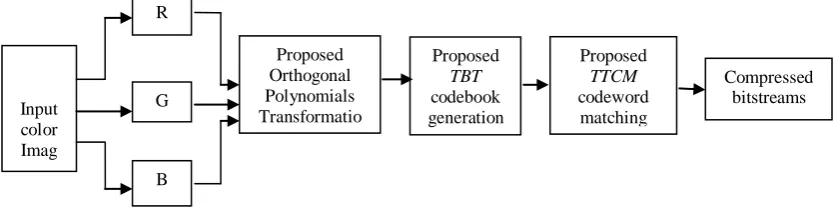
ijk' . The value of c is also reduced to 1, since single codebook is generated for all [image:4.595.77.495.135.242.2]the three color components utilizing the inter-correlation property of the color planes due to the proposed transform. The block diagram of the proposed color image coding
Figure 1 Block diagram of proposed FOPTVQE color image coding technique
algorithm is given in fig.1. The proposed Fast Orthogonal Polynomials Transform based Vector Quantization Encoding (FOPTVQE) technique is presented as an algorithm hereunder.
The proposed FOPTVQE Algorithm:
Input : Color image of size (image_width
image_height) and 3-Dimensional polynomials operator|M| =
M
M
M
Output : Encoded color image with proposed FOPTVQE algorithm.
Step:
1. Initialize blks=(image_width
image_height) / (n
n).2. Partition the input image into non-overlapping blocks of size (n
n) and obtain input block of pixel values [I] from three individual R, G and B color components for total number of blocks blks. 3. Compute the orthogonal polynomials transformedco-efficients
ijk
M
t
I
with dimension k as described in section II.4. Discard the high frequency coefficients based on energy preserving property of the proposed transform coding and obtain the transformed training vectors X={xi, i=1,2,…blks} with dimension d for all the blocks as described in section V.
5. Apply the proposed TBT algorithm as described below and construct the codebook C with N code words and each codeword consists of d-dimensional code vector represented as cij ( i=1 to N, j=1,2,..,d, where d < k).
6. For each input transformed training vector x in X, apply the proposed TTCM algorithm to find the closest code word index I from the codebook C. 7. Encode the closest codeword index I using entropy
encoding for further compression. END.
Proposed Transformed Binary Tree(TBT) codebook generation algorithm:
Input : Transformed training vectors X each with d-dimensionalfeatures.
Output : Codebook C with N codeword with proposed algorithm.
Step:
1. Partition all the input training vectors X into a binary tree.
(a) Compute the mean and variance of each feature from d-dimensional transformed training vectors X. For any non terminal node n, the mean
M
n(
j
)
and varianceV
n(
j
)
for the jth feature are defined as
n
z
(
j
)
X
)
j
(
M
X
i n i n n
1
1
n
z
(
j
)
M
(
j
)
X
)
j
(
Var
X i
n n
i n n
1
2
1
where j = 1, 2…, d and
z
in(
j
)
is the jth feature corresponding to training vectors at node n.(b) Select the feature with the largest variance
}
,...,
2
,
1
),
(
max{
)
(
p
V
j
j
d
V
n
n
as the split feature and the corresponding mean value
M
n(
p
)
as the threshold T. (c) Compare the value of the pth feature of thetraining vector with split threshold. If it is less than
M
n(
p
)
, then place the vector on the left sub tree; otherwise place it on the right sub tree.(d) Repeat (a) through (c) until the required number of clusters is formed.
2. Compute the centroid of the feature vectors falling on each of the terminal node of the binary tree and use it as code vector of the final codebook C. END.
Proposed Transformed Tree structured Codeword Matching (TTCM) closest codeword search algorithm: Input : Codebook C and input transformed training vector x.
Output : Closest codeword index I with proposed TTCM algorithm.
Step :
1. Read the input transformed training vector x and set root node of binary tree as first non terminal node n.
Input color Imag
e
R
G
B
Proposed Orthogonal Polynomials Transformatio
n
Proposed TBT codebook generation
Proposed TTCM codeword matching
2. Find the distortion between x and left, right child of non terminal node n as defined in section IV.
3. Push the child node with greater distortion into the stack and set the other child node one as the current non terminal node n.
4. Repeat steps 2 and 3 until n is a leaf node.
5. Set the leaf node index I as local closest code word LC. 6. Pop up the non terminal node n from stack to search for
other paths in the binary tree for finding global closest code word GC.
7. Calculate the critical function F using equation (9) to determine dynamically to whether add the paths for further search with user defined threshold TH.
8. If
F
(
x
,
n
)
TH
, then select both the children of node n for further search and push the child node with greater distortion onto stack; otherwise traverse the child node with minimum distortion.9. Repeat steps 6 through 8 until n is a leaf node.
10. Set the global closest code word GC as leaf node and output its index I.
END.
5.
EXPERIMENTS AND RESULTS
The proposed FOPTVQE algorithm for color image coding has been experimented in Intel Core(2)-Quad, 2.3 GHZ speed processor system with 2000 test images. Two sample standard test images viz. lena and sailboat images which are of size (256
256) with pixel values in the range of 0-255 in each of R,G and B color planes are shown in figure 2(a) and 2(b) respectively. The input color images are partitioned into non-overlapping blocks of size (33) in the three R, G, B color space, and the proposed transform coding is applied to obtain the transformed co-efficients
ijk' as described in section 2. After discarding half of the high frequency transformed coefficients, the vector of d-dimensional transformed training vectors X are obtained for codebook training. The codebook is constructed with the proposed TBT algorithm for different sizes as described in section 4 and the computation time are noted in mille seconds(ms) for various test images including the sample images shown in figure 1. To construct the codebook of size 2048, the proposed algorithm took 92.124ms and 89.623ms for lena and sailboat images respectively. Similarly, for the codebook of size 512, the proposed algorithm took 63.340ms for lena image and 60.180ms for sailboat image. In the same way, when the codebook size is 128, the proposed TBT algorithm takes 47.118ms and 45.172ms for the same standard test images. The experiment is repeated for various code book sizes with different images and the results obtained by the proposed algorithm are presented in table 1. In order to measure the performance of the proposed codebook generation algorithm, we conduct experiments with recent fast codebook generation algorithms such as Pattern Reduction Enhanced GLA (PREGLA)[5] and Codebook Generation Algorithm Using Codeword Displacement (CGAUCD)[11] techniques on the same computer system and the results obtained are incorporated in the same table 1.(a) (b)
Figure 2. Original test images
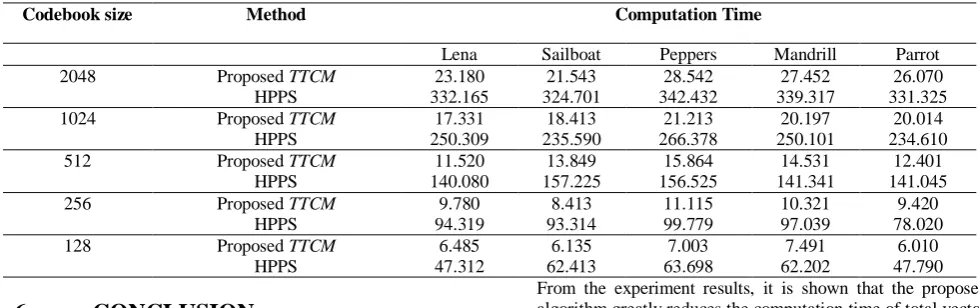
[image:5.595.328.530.70.180.2]The code word matching of VQ encoding involves in finding the index of best codeword that represents the input vector. The FOPTVQE technique uses Transformed Tree structure Codeword Matching (TTCM) algorithm to find closest codeword of input vector x. In the proposed TTCM algorithm, the threshold value is set to 0.5 to find the global closest code word GC with index I. This index I is further encoded using entropy coding to yield compressed bit streams. The computation times of codeword search using proposed TTCM algorithm for various codebook sizes are presented in table 2. For code word matching, when the code book size is 2048, the proposed TTCM algorithm takes 23.180ms and 21.543ms for lena and sailboat images respectively. When the codebook size is 512, the average execution time of the proposed algorithm is 11.520ms and 13.849s for lena and sailboat images. Similarly for a codebook of size 128, the average execution time of the proposed algorithm is 6.485s and 6.135ms for the same standard images. The performance of this proposed algorithm is also compared with existing fast codeword search algorithm Hadamard Projection Pyramid Search (HPPS)[1] and the results are included in table 2. The performance of the proposed vector quantization is also measured with Peak-Signal-to-Noise-Ratio (PSNR) in decibels (dB) for various bits per pixel (bpp). For this measure, the decompression is done by first entropy decoding followed by inverse vector quantization as a simple table look up process in the codebook. Then the inverse transform is applied on the de-quantized coefficients with orthogonal polynomials basis as described in section 3 and the reconstructed color image is obtained. . A graph is plotted with bits per pixel in x-axis and the PSNR in the y-axis for the proposed and recent fast vector quantization encoding techniques and the same is presented in fig 3 for lena image. The result of reconstructed images corresponding to the original images shown in figure 2 with the proposed algorithm is presented in figure 3(a) and 3(b) for the codebook of size 1024. From the experimental results it is evident that the proposed fast vector quantization encoding technique with orthogonal polynomials transform greatly reduces the encoding time and gives good PSNR when compared with existing fast vector quantization techniques.
(a) (b)
[image:6.595.49.536.234.425.2]Figure. 4. Results of proposed FOPTVQE technique when the code book size is 1024.
Table 1 Comparison of computing time (ms) for codebook generation using proposed TBT, PREGLA and CCAUCD schemes for set of training images.
Codebook size Method Computation Time
Lena Sailboat Peppers Mandrill Parrot
2048 Proposed TBT 92.124 89.623 91.020 92.518 93.290
PREGLA 829.145 703.412 834.108 794.639 824.219
CGAUCD 953.134 831.422 921.391 893.422 920.172
1024 Proposed TBT 78.578 75.190 76.152 78.378 77.304
PREGLA 447.136 397.115 479.740 451.481 431.220
CGAUCD 551.023 461.474 582.421 528.453 580.235
512 Proposed TBT 63.340 60.180 62.185 63.018 64.482
PREGLA 366.145 302.049 375.271 389.569 342.790
CGAUCD 451.859 398.906 463.891 458.922 471.266
256 Proposed TBT 55.239 53.111 57.687 57.392 56.470
PREGLA 267.193 224.418 281.629 295.290 273.380
CGAUCD 341.227 303.641 352.875 341.890 361.765
128 Proposed TBT 47.118 45.172 48.027 47.810 48.290
PREGLA 202.140 198.331 211.591 221.204 226.510
CGAUCD 286.330 249.500 296.359 291.125 280.390
Table 2 Computing time (ms) for codeword matching with proposed TTCM and HPPS technique for set of training images.
Codebook size Method Computation Time
Lena Sailboat Peppers Mandrill Parrot
2048 Proposed TTCM 23.180 21.543 28.542 27.452 26.070
HPPS 332.165 324.701 342.432 339.317 331.325
1024 Proposed TTCM 17.331 18.413 21.213 20.197 20.014
HPPS 250.309 235.590 266.378 250.101 234.610
512 Proposed TTCM 11.520 13.849 15.864 14.531 12.401
HPPS 140.080 157.225 156.525 141.341 141.045
256 Proposed TTCM 9.780 8.413 11.115 10.321 9.420
HPPS 94.319 93.314 99.779 97.039 78.020
128 Proposed TTCM 6.485 6.135 7.003 7.491 6.010
HPPS 47.312 62.413 63.698 62.202 47.790
6.
CONCLUSION
A new fast VQ encoding algorithm for color image transform coding is presented in this paper with orthogonal polynomials transformed reduced dimension training set. Due to the inter-correlation property of the proposed transform, a single codebook for vector quantization is generated for all the three color components of training image and hence the codebook construction time is reduced one third of existing techniques. The proposed transformed binary tree algorithm significantly reduces the codebook construction time when compared with recent fast codebook generation algorithms. The codeword matching phase of proposed vector quantization technique uses transformed tree structured codeword matching algorithm to find the closest codeword which also reduces the computation time total vector quantization encoding time.
From the experiment results, it is shown that the proposed algorithm greatly reduces the computation time of total vector quantization encoding since it reduces both codebook generation time as well as closest codeword search time.
7.
REFERENCES
[1]Ahmed Swilem. 2010. A fast vector quantization encoding algorithm based on projection pyramid with hadamard transformation. Image and Vision Comput., 28, (12), pp. 1637-1644.
[image:6.595.47.537.459.613.2][3]Baskar Ramamoorthy, Allen Gersho. 1986. Classified vector quantization of images, IEEE Trans. on Commun., 34, (11), pp.1105-1115.
[4]Chaur-Heh Hsieh, Wei-Yang Shao, Ming-Haw Jing. 2000. Image compression based on multi-stage vector quantization, J. of Visual Commun. and Image Represent., 11, (4), pp.374-384.
[5]Chun-Wei Tsai, Chao-Yang Lee. 2009. A fast VQ codebook generation algorithm via pattern reduction, Pattern Recognition Lett., 30,(7), pp.653-660.
[6]Gersho. A., Gray. R. M.. 1994. Vector quantization and signal compression, Kluwer Academic Publishers, 1994. [7]Guobin Shen, Bing Zeng, Ming-L.Liou. 2003. Adaptive vector quantization with codebook updating based on locality and history, IEEE Trans. on Image Process., 12,(3), pp.283-295.
[8]Giuseppe Campobello, Mirko Mantineo, Giuseppe Patane, Marco Russo. 2005. LBGS: a smart approach for very large sets vector quantization, Signal Process: Image Commun., 20, (1), pp.91-114.
[9]Hsien-wen Tseng, ChinChu Chang. 2005. A very low bit rate image compression using transformed classified vector quantization, Informatica, 29, pp.335-341. [10]Jim Z.C.Lai, Yi-Ching Liaw. 2009. A novel encoding
algorithm for vector quantization using transformed codebook, Pattern Recognit. Lett., 42, (11), pp.3065-3070.
[11]Jim.Z.C.Lai, Yi-Ching Liaw, Julie Liu. 2008. A fast VQ codebook generation algorithm using codeword displacement, Pattern Recognit., 41,(1), pp.315-319. [12]Matsumoto Hiroki, Kichikawa Fumito, Sasazaki Kazuya,
Maeda Junji, Szuki Yukinori. 2010. Image compression using vector quantization with variable block size division, IEEJ Electronics, Information and Syst., 130, (8), pp.1431-1439.
[13]Nasser M. Nasrabad, Yushu.Feng. 1990. Image compression using address vector quantization, IEEE Trans. on Commun., 38, (12), pp.2166-2173.
[14]Paul Shelley, Xiaobo Li, Bin Han. 2004. A Hybrid quantization scheme for image compression, Image and Vision Comput., 22, (3), pp.203- 213.
[15]Robert Li, Jung Kim. 2000. Image compression using fast transformed vector quantization, IEEE Proc. of Appl. Imagery Pattern Recognit. Workshop, pp.141-145. [16]Tikonov, A.N.Arsenin. 1977. Solutions of Ill-posed
Problems, John Wiley and Sons, New York, 1977. [17]Yoseph Linde, Andres Buzo, Robert M.Gray. 1980.
An algorithm for vector quantizer Design, IEEE Trans. on Commun., 28, (1), pp.84-94.