Teacher Assessment and Profiling using Fuzzy Rule
based System and Apriori Algorithm
Atta-ur-Rahman
BIIT, PMAS Arid AgricultureUniversity, Rawalpindi Punjab, Pakistan
ABSTRACT
Teachers Assessment and Profiling System (TAPS) is a unique kind of approach to examine weaknesses and strengths of a teacher so that he/she may be advised to improve his/her teaching expertise. There are many software and commercially available tools for this purpose. What makes our approach distinguished from other is that a Fuzzy Rule Based System (FRBS) is proposed for assessment and for profiling apriori algorithm is proposed. Both approaches can find adequate reasoning for a teaching advisor. So, administrator will view electronically the profile of a teacher over the semesters. This could greatly help an institution to provide quality education to their students by using this system for rectification and promotion of specific teacher. Significance of the proposed scheme is shown by example and results.
General Terms
Fuzzy Rule Based System, Apriori Algorithm, Assessment, Profiling
Keywords
Apriori algorithm, Fuzzy Rule Based System; Profiling; Assessment
1.
INTRODUCTION
Teacher Assessment is a necessary step for improving the performance of a teacher in different subjects. Assessment of a teacher helps to improve quality education in an institute. It also helps to improve students’ learning capabilities or learning needs. Teachers face assessment from the time they start teaching. They keep on this when they get up their first position, during their trial period and through the rest of their career, irrespective of whether they stay in the classroom or move into management positions which do not involve a formal teaching factor.
Wang et al [1] described a student profiling system. The aim of the system was to provide an agent based educational system to provide storage of learning and an interaction history for each individual student who has used a web-based teaching system. This system also record student learning activities, providing web-based assessments to students, measuring students’ academic performance, and allowing teachers to analyze students’ activities. This system also has student agents and teacher agents that login to the system and interact with each other.
Virtual campus is a research project which aims to provide a comprehensive and innovative e-learning environment for authoring, fruition and tutoring [2]. The paper introduces TVM, the tutoring module developed for virtual campus. TVM tracks the learners' behavior within the virtual campus
environment and defines a user model (based on Bayesian networks) in terms of learning attitudes, efficiency of learning strategies, and attitude to cooperation and communication. Derived information is used to build and make available graphical reports to learners and teachers. Moreover TVM, relying on fuzzy logics, exploits the user model to support learners' choices making suggestions which take into account the style, the behavior and the results obtained in the past. In [3] a neuro fuzzy reasoner is used to model the behavior of students. The fuzzy model successfully handles reasoning with imprecise information and enables representation of student modeling in linguistic form the same way human teachers can do. The students’ classification can be based on activity evaluation. Classification can be easily expressed in terms of fuzzy logic. Some test cases and rules were developed to classify the students. According to student performance in tests the teacher changes their teaching strategies.
In [4] the proposed approach is based on the usage of electronic questionnaires (e-questionnaires) designed by a group of experts. Through the automatic analysis of the learners’ responses to the questionnaires, all learners are assigned to different learner profiles. According to these profiles they are served with learning material that best matches their educational needs.
Online teacher profiling system (OTPS) for secondary school provides effectiveness and efficiency to the education information management [5]. This system helps the school itself to evaluate the information of a teacher’s performance and its available profile. It helps in making decision of teacher’s allocation process. According to profiles teachers should be posted at respective school. So, management decided that which teacher is better with which class or subject.
In [6], the authors focused on the techniques incorporated during last decade (1999-2009) and on student modeling as it seems to be one of the latest research trends and in the same time one of the most significant and challenging tasks for an instructor, let alone for an intelligent tutoring system. Ma and Zhou [7] [8] implemented a fuzzy set approach in order to assess the outcomes of learning process. In this paper fuzzy set principles were applied to the determination of the assessment criteria and the corresponding weights and finally students’ performance was evaluated on a fuzzy grading scale according to the selected criteria.
5 contains some result of the proposed system while section 6 concludes the paper.
2.
SYSTEM MODEL
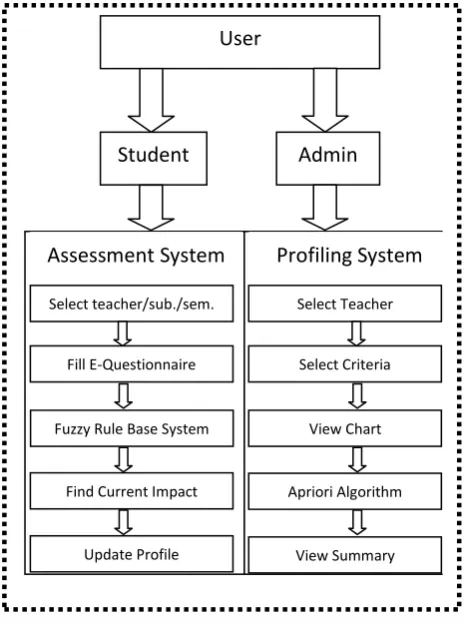
The system model considered for the research is a department of a university where a number of disciplines are offered, number of courses being taught by many teachers and many students enrolled with many teachers for certain number of courses. Following figure shows the flow diagram of proposed system.
In this system user enters to system. If user is a student then he will proceed to assess the teacher, where there he would choose the teacher, subject semester and discipline etc. After that e-questionnaire is appeared, after filling the form student submits it. System feed that information to proposed Fuzzy Rule Base System that will calculate impact of the teacher and then profile of the teacher is updated.
[image:2.595.316.542.191.371.2]Similarly, profiling system helps in viewing the trend and finding the association of the teacher ranking with subject, semester and discipline. User selects the teacher and then choose criteria for example semester wise or discipline wise or subject wise etc, then this information is fed to apriori algorithm which as consequences summaries the teacher profile.
Fig 1: Schematic of the proposed system model
3.
PROPOSED FUZZY RULE BASED
SYSTEM
Fuzzy logic is recommended for the situations that are vague, ambiguous, noisy or missing certain information [9]. A Fuzzy Rule Base System is proposed for calculating the score of a teacher based upon the electronic questionnaire. There are many ways to build a Fuzzy Rule Base System, we have used table lookup scheme for this purpose. Following are the steps involved in creation of fuzzy rule based system.
3.1
Obtaining Facts
An electronic questionnaire (e-questionnaire) is initially filled by the student where there are certain questions asked and answers are in form of numbers ranged from 1 to 5.
3.2
Data Acquisition
Data is obtained from the answer taken from students in previous phase. In this way the numeral answers obtained in previous sections are converted into categories like “agree”, “disagree” etc by using fuzzification process as shown in fig-2.
Fig 2: Fuzzification
3.3
Rules Formulation
Rules for each pair are obtained by the appropriate fuzzy set used. That is by putting complete pair in input/output set and a rule generated for each pair.
3.4
Completion of Lookup Table
Since in lookup table scheme we may not have complete number of IO pairs, then those parts are filled by heuristic or expert knowledge.
3.5
Creation of FRBS
Using the Lookup table in above phase Fuzzy Rule Base is created using Fuzzy Logic Toolbox in MATLAB.
3.6
Components of FRBS
3.6.1 Rule Format
A rule shows the fact inserted by the administrator.. It can be stated as “for a given answer of question 1 and question 2 and so on question n which category is described. The input-output pairs needed for design of FRBS are of the form;
1 2
(
x
p,
x
p,....,
x
np;
y
p);
p
1, 2,3...
M
(10)Where xij represents ith question in jth rule, M is total number of rules and n is total number of questions asked. So the rule format will be given as;
{IF (
x
1is Good andx
2is Good and…x
nis Good) THEN y is Good}3.6.2 Fuzzy Sets
Sufficient numbers of fuzzy sets are used to cover the input output spaces. There are five input variables Q1 to Q5. There is one output variable that is impact of the teacher. Three
User
Student
Admin
Assessment System
Select teacher/sub./sem.
Fill E-Questionnaire
Find Current Impact
Update Profile
Profiling System
Select Teacher
Select Criteria
View Chart
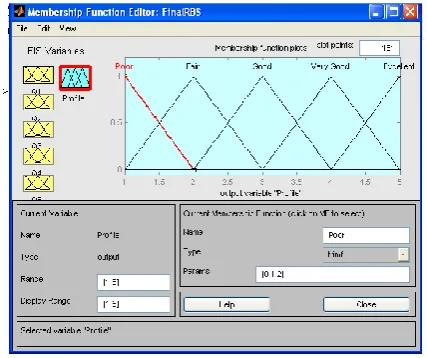
[image:2.595.53.286.336.649.2]fuzzy sets are used for each input variable while five fuzzy sets are used output variable “Profile”. It is shown in fig-3.
Fig 3: Output variable membership functions
3.6.3 Fuzzifier
Standard triangular fuzzifier is used with AND as MIN and OR as MAX.
3.6.4 Rule Base
Rule base contains rules against all the IO pairs. As there are five input variables each with three fuzzy sets then total possible number of rules is almost 243. Rule base is complete in a sense that rules are defined for all possible combinations of input spaces. It is shown in fig-4.
3.6.4 Inference Engine
Standard Mamdani Inference Engine is used that will infer which input pair will be mapped on to which output point.
3.6.5 Defuzzifier
[image:3.595.323.574.368.544.2]Standard Center Average Defuzzifier (CAD) is used for defuzzification.
Fig 4: Fuzzy Rule Base for the Proposed System
4.
APRIORI ALGORITHM
Apriori algorithm is used to find associations between a teacher and subject, between teacher and class, etc. Apriori is an algorithm for association rule mining. It was developed by
Rakesh Agrawal in 1994 [10]. This algorithm is considered to operate on databases that have different transactions and item sets. The Apriori Algorithm is used to find relations among different item set. It is called the Market Basket Analysis. Every data set has an amount of stuff and it is called an operation. The production of Apriori is the set of rules that tell us how these items are common in sets. Apriori uses Breadth first search and make a structure like tree to count nominated item sets powerfully. After calculating the candidates Apriori calculates frequent item sets using transactional database. There are three steps of apriori algorithm
Candidate generation
Finding frequent item sets
Rule generation
Few modifications are introduced in Apriori algorithm for finding associations. The table of item set is split on the basis of target entry. Apriori algorithm is applied to each sub table to find association. Those item sets which have target entry (e.g. Teacher) are selected and all other item sets which don’t have target entry are ignored. The associations found in this regard are quite useful for management. One can check that which teacher is better with which class, subject, semester etc. This algorithm is utilized for finding the association of teacher to class, teacher to subject, teacher to semester and teacher to discipline. A database is used to manipulate the algorithm. Schema of the database is shown in fig-5.
Fig 5: Schema of the database used for Apriori algorithm
5.
RESULTS
An example is presented here to show the results and effectiveness of proposed scheme. Table-I shows the data set used for the Apriori algorithm. In this data set the values like “Good”, “Poor” etc are obtained from fuzzy rule based system in advance. Complete example can be seen in Appendix-I. The associations generated by the Apriori Algorithms are given by;
(Adil, fall, 28, BSCS, C++, Good) (Adil, spring, 28, MCS, Ai, V.Good) (Adil, spring, 28, BSIT, Web, Poor)
Table 1: Example data set for Apriori Algorithm
1 Adil, Fall, 28, BSCS, Good, C++
[image:3.595.57.272.516.691.2]3 Adil, Fall, 28, MIT, Poor, Ai
4 Fall, 28, BSCS, Good, C++
5 Spring, BSIT, Adil, Web, Poor
6 Spring, AI, Adil, MCS, V.Good, 28
7 BSCS, Good, C++ , Adil, Fall, 28,
8 28, Adil, Web, Poor Spring, BSIT
9 C++, Adil, Fall, 28, BSCS, Good
10 V.Good, 28, Spring, Ai, Adil, MCS,
11 Web, Poor, 28, Spring, BSIT, Adil,
6.
CONCLUSIONS
In this paper a Teacher Assessment and Profiling system is proposed and designed; also results are shown with the help of some diagrams and example. This is an electronic assessment and profiling system for a teacher. This has two main components one is assessment and other is profiling. For teacher assessment system, a Fuzzy Rule Base System is proposed. Similarly for finding the trends in data obtained for a teacher over the semesters, Apriori Algorithm is used. Results show the significance of proposed approach. A software tool is built that incorporates this research. The salient features of proposed work over the other are follows;
1. Fuzzy Rule Base System to extract the hidden facts 2. Apriori Algorithm to find the associations and
relationship between the data items
3. A software tool that helps assessment and profiling the teacher
7.
ACKNOWLEDGMENTS
This research work was supported by Barani Institute of Information Technology.
8.
REFERENCES
[1] Kwok, J. W., H. Wang, S.Y. Yuen and F. S. K. Leung. “Student Profiling System for an Agent-Based Educational System”. January 2000.
[2] Sbattella, L. and R. Tedesco. “Profiling and tutoring
users in virtual campus.” November 2004.
[3] Z. Sevarac “ Neuro Fuzzy Reasoner for Student
Modeling.” In: Proceedings of the 6th International Conference on Advanced Learning Technologies, pp. 740–744, 2006.
[4] Tzouveli, P., P. Mylonas and S. Kollias “An intelligent
e-Learning system based on learner profiling and learning resources adaptation.” May 2007.
[5] A. Bakari N. Atiqah. ”Development of Online Teacher
Profiling System for Secondary School.” May 2007.
[6] A. S. Drigas, Argyri K., and Vrettaros J. “Decade
Review (1999-2009): Artificial IntelligenceTechniques in Student Modeling”. Institute of informatics and telecommunications. Greece.
[7] Ma, J. “Group decision support system for assessment of
problem-based learning.” IEEE Trans. Educ. Vol. 39, 388–393, 1996.
[8] Zhou, D., Ma, J., Kwok, R.C.W., Tian, Q.,”Group
decision support system for project assessment based on fuzzy set theory.” Presented at the Proc. 32nd Hawaii Int. Conf. System Sciences (HICSS-32), Honolulu, HI, January 1999.
[9] Zadeh, L. A. “ Fuzzy Logic systems: Origin, Concepts
and Trends.”, 2004.
[10] Agrawal, R and Srikant. “Fast Algorithm for Mining
Association Rule.” Proc. of the 20th Int'l Conference on Very Large Databases, Santiago, Chile, Sept. 1994
APPENDIX-1
Sr. Candidates Frequent set
1. Adil,Fall,Spring,28,BSCS,B
SIT,MIT,MCS,
Good, V.Good, Poor,
C++,Ai,Web
Adil,Fall,Spring,28,BSCS
,BSIT,MCS,
Good,V.Good,Poor,C++,
Ai,Web
2. (Adil, Fall) (Adil, Spring)
(Adil, 28) (Adil, BSCS)
(Adil, MCS) (Adil, BSIT)
(Adil, Good) (Adil,
V.Good) (Adil, Poor) (Adil,
C++) (Adil, Ai) (Adil,
Web) (Fall, Spring)
(Fall, 28) (Fall, BSCS)
(Fall, MCS) (Fall, BSIT)
(Fall, Good) (Fall,V.Good)
(Fall, Poor) (Fall, C++)
(Fall, Ai) (Fall, Web)
(Spring,28) (Spring,
BSCS) ( Spring, MCS)
(Spring, BSIT) (Spring,
Good) (Spring, V.Good)
(Spring, Poor) (Spring,
(Adil, Fall) (Adil,
Spring) (Adil, 28) (Adil,
BSCS) (Adil, MCS)
(Adil, BSIT) (Adil,
Good) (Adil, V.Good)
(Adil, Poor) (Adil, C++)
C++) (Spring, Ai), (Spring,
Web) (Fall, Spring) (28,
BSCS) (28, MCS) (28,
BSIT) (28, Good)
(28,V.Good) (28, Poor)
(28, C++) (28, Ai) (28,
Web) (BSCS, BSIT)
(BSCS, MCS) (BSCS,
Good) (BSCS, V.Good)
(BSCS, Poor) (BSCS,
C++) (BSCS, Ai) (BSCS,
Web) ) (BSIT, MCS)
(BSIT, Good) (BSIT,
V.Good) (BSIT, Poor)
(BSIT, C++) (BSIT, Ai)
(BSIT, Web) (MCS,
Good) (MCS, V.Good)
(MCS, Poor) (MCS, C++)
(MCS, Ai) (MCS, Web)
(Good, V.Good) (Good,
Poor) (Good, C++) (Good,
Ai) (Good, Web) (V.Good,
Poor) (V.Good, C++)
(V.Good, Ai) (V.Good,
Web) (Poor, C++) (Poor,
Ai) (Poor, Web) (C++, Ai)
(C++, Web)(Ai, Web)
3. (Adil, Fall, Spring) (Adil,
Fall ,28) (Adil, Fall,
BSCS) (Adil, Fall, MCS)
(Adil, Fall, BSIT) (Adil,
Fall, Good) (Adil, Fall,
V.Good) (Adil, Fall, Poor)
(Adil, Fall, C++) (Adil,
Fall, Ai) (Adil, Fall, Web)
(Adil, Spring, 28) (Adil,
Spring, BSCS) (Adil,
Spring, MCS) (Adil,
Spring, BSIT) (Adil,
Spring, Good) (Adil,
Spring, V.Good) (Adil,
Spring, Poor) (Adil,
Spring, C++) (Adil,
Spring, Ai) (Adil, Spring,
Web) (Adil, 28, BSCS)
(Adil, 28, MCS) (Adil, 28,
BSIT) (Adil, 28, Good)
(Adil, 28, V.Good) (Adil,
28, Poor) (Adil, 28, C++)
(Adil, 28, Ai) (Adil, 28 ,
(Adil, Fall ,28) (Adil,
Fall, BSCS)
(Adil, Fall, Good) (Adil,
Fall, C++)
(Adil, Spring, 28) (Adil, Spring, Web)
(Adil, 28, BSCS) (Adil, 28, MCS)
(Adil, 28, BSIT) (Adil, 28, C++)
(Adil, 28, Ai) (Adil, 28 , Web)
(Adil, 28, Good) (Adil, 28, V.Good)
(Adil, 28, Poor) (Adil, BSCS, C++)
(Adil, BSCS, Good) (Adil, MCS, Ai)
Web) (Adil, BSCS, MCS)
(Adil, BSCS , BSIT) (Adil,
BSCS, Good) (Adil,
BSCS, V.Good) (Adil,
BSCS, Poor) (Adil, BSCS,
C++) (Adil, BSCS, Ai)
(Adil, BSCS , Web) (Adil,
MCS, BSIT) (Adil, MCS,
Good) (Adil, MCS,
V.Good) (Adil, MCS,
Poor) (Adil, MCS, C++)
(Adil, MCS, Ai) (Adil,
MCS , Web) (Adil, BSIT,
Good) (Adil, BSIT,
V.Good) (Adil, BSIT,
Poor) (Adil, BSIT, C++)
(Adil, BSIT, Ai) (Adil,
BSIT, Web)
(Adil, Good, V.Good)
(Adil, Good, Poor) (Adil,
Good, C++) (Adil, Good,
Ai) (Adil, Good, Web)
(Adil, V.Good, Poor) (Adil,
V.Good, C++) (Adil,
V.Good, Ai) (Adil,
(Adil, BSIT,
Web) (Adil, BSIT, Poor) (Adil, Good,
C++) (Adil, V.Good, Ai) Adil, Poor,
Web)
V.Good, Web) (Adil, Poor,
C++) (Adil, Poor, Ai)(Adil,
Poor, Web) (Adil, C++,
Ai)
(Adil, C++, Web) (Adil,
Ai,Web)
4. (Adil, Fall ,28, BSCS) (
Adil, Fall ,28, C++) (Adil,
Fall ,28, Good) (Adil, Fall
,28, MCS) (Adil, Fall
,Spring, 28) (Adil, Fall
,28,BSIT) (Adil, Fall ,28,
Ai) (Adil, Fall ,28,
V.Good) (Adil, Fall
,28,Web)
(Adil, Fall ,28,Poor) (Adil,
Fall , BSCS, Good) (Adil,
Fall , BSCS, C++) (Adil,
Fall ,C++ , Good) (Adil,
Spring, 28, Web) (Adil,
Spring, 28, BSCS) (Adil,
Spring, 28, MCS) (Adil,
Spring, 28, BSIT) (Adil,
Spring, 28, Good) (Adil,
(Adil, Fall ,28, BSCS) (
Adil, Fall ,28, C++)
(Adil, Fall ,28, Good)
(Adil, Fall , BSCS,
C++) (Adil, Fall ,
BSCS, Good) (Adil, Fall
,C++ , Good) (Adil,
Spring, 28, Web) (Adil,
Spring, 28, MCS) (Adil,
Spring, 28, BSIT) (Adil,
Spring, 28, Ai) (Adil,
Spring, 28, V.Good)
(Adil, Spring, 28, Poor)
(Adil, Spring, BSIT,
Web) (Adil, Spring,
Web, Poor) (Adil, 28,
BSIT, Web) (Adil, 28,
BSIT, Poor) (Adil, 28,
Spring, 28, V.Good) (Adil,
Spring, 28, Poor) (Adil,
Spring, 28, C++)(Adil,
Spring, 28, Ai) (Adil,
Spring, 28, Poor) (Adil,
Spring, BSIT, Web) (Adil,
Spring, Web, Poor)(Adil,
28, BSIT, C++) (Adil, 28,
BSIT, Ai) (Adil, 28, MCS,
BSIT) (Adil, 28, BSIT,
V.Good) (Adil, 28, BSIT,
Good)
(Adil, 28, BSIT, Web)
(Adil, 28, BSIT, Poor)
(Adil, 28, MCS, Ai) (Adil,
28, MCS, C++) (Adil, 28,
MCS, Good) (Adil, 28,
MCS, V.Good) (Adil, 28,
MCS, Poor) (Adil, 28,
MCS, Web) (Adil, 28,
C++, Ai)
(Adil, 28, C++, V.Good)
(Adil, 28, C++, Good)
(Adil, 28, C++, Web)
(Adil, 28, C++, Poor)
MCS, V.Good) (Adil,
28, C++, Good) (Adil,
28, Ai, V.Good) (Adil,
28, Poor, Web) (Adil,
BSIT, Poor, Web)
(Adil, 28, Ai, V.Good)
(Adil, 28, Ai, Good) (Adil,
28, Ai, Web) (Adil, 28, Ai,
Poor) (Adil, 28, Good,
V.Good) (Adil, 28,
V.Good, Web) (Adil, 28,
V.Good, Poor) (Adil, 28,
Good, Web) (Adil, 28,
Good, Poor) (Adil, 28,
Poor, Web) (Adil, BSIT,
Poor, Web)
5. (Adil, Fall ,28, BSCS,
C++) (Adil, Fall ,28,
BSCS, Good) (Adil,
Spring, 28, MCS, Ai)
(Adil, Spring, 28, MCS,
V.Good) (Adil, Spring, 28,
BSIT, Web) (Adil, Spring,
28, BSIT, Poor)
(Adil, Fall ,28, BSCS,
C++,Good)
(Adil, Spring, 28, MCS,
Ai, V.Good)
(Adil, Spring, 28, BSIT,