5
IV
April 2017
Technology (IJRASET)
©IJRASET: All Rights are Reserved
1045
Application Based Multimodal Biometric System
for Speech Controlled Device
Akshay Ramesh1, Sayantan Chakraborty2, Jaykumar Chaudhary3
1,2,3 Department of Electronics & Telecommunication Engineering, Mukesh Patel School of Technology Management & Engineering, NMIMS(Deemed-to-be University),Mumbai, Maharashtra, India
Abstract: Multimodal biometric systems have been widely used to overcome the limitations of unimodal biometric systems and to achieve high recognition accuracy. Unimodal biometric systems developed for each of the biometric features may not always meets the required performance. We introduce a system on JAVA platform, which integrates face recognition, fingerprint verification, and speech recognition for personal identification. The methods are analysed to integrate the various features together to acquire a multimodal biometric system. This system takes advantage of the capabilities of each individual biometrics. The processed information from all these three modules is combined with the help of fusion algorithm in context switching in which feature vectors are made independently for query images and are then compared to the enrolment templates which are stored during database preparation for each biometric trait. Further, this paper is to propose the integration of Biometric technology with Automobile system and controlling the system using Speech input once the authentication is done, through an Android device and Bluetooth module for portability, thus visualizing the future possibilities of Biometric Authentication and its applications in vehicular world.
Keywords— JAVA, Face Recognition, Speech Recognition, Fingerprint Recognition, Fusion, Bluetooth Technology, Arduino, Android, Automobile.
I. INTRODUCTION
A Biometric system is an identification system based on the use of different biometric features of individuals by the analysis of physiological characteristics, such as fingerprints, eye retinas and irises, voice patterns, facial patterns and hand measurements for authentication purposes or behavioural characteristics. Authentication systems setup with one biometric modality may not be sufficient for the pertinent application in terms of properties such as universality, distinctiveness, acceptability etc. Unimodal biometric systems are lacking operational advantages pertaining to the performance and accuracy [1].
The face, fingerprint and voice recognition problem can be divided further main stages: face, fingerprint and voice detection (verification), and authentication based on the face, fingerprint and voice detected and verified. Multimodal biometric system is a refined system of unimodal system incorporating the remedial measures for the drawbacks faced in unimodal biometric system. For example, since few percentages of people can have worn, cut or unrecognizable prints, fingerprint biometric may produce erroneous results. Our focus is specifically on multimodal biometrics system of authentication because it shows significant promise in terms of security and performance supplemented with providing convenience for users, and also we have included Speech Processing module after authentication to control a robotic car giving a set of specified directions using Arduino.
A. Face Recognition
Facial recognition generally involves two stages:
Face Detection where a photo is searched to find a face, then the image is processed to crop and extract the person’s face for easier recognition.
Technology (IJRASET)
©IJRASET: All Rights are Reserved
1046
B. Speech Recognition
To be able to control devices by voice has always intrigued mankind. Today after intense research, Speech Recognition System, have made a niche for themselves and can be seen in many walks of life. The accuracy of Speech Recognition Systems remains one of the most important research challenges e.g. noise, speaker variability, language variability, vocabulary size and domain.
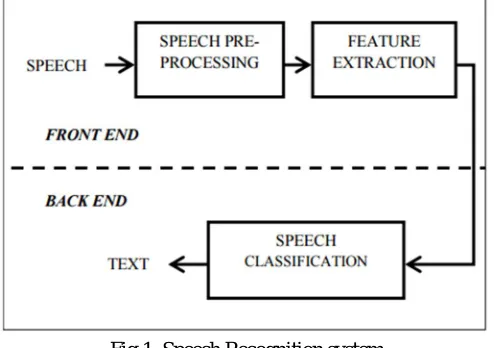
[image:3.612.183.430.172.346.2]The design of speech recognition system requires careful attentions to the challenges such as various types of Speech Classes and Speech Representation, Speech Pre-processing stages, Feature Extraction techniques, Database and Performance evaluation.Block Diagram for Signal Pre-processing stage is shown in Figure below:
Fig 1. Speech Recognition system
The software being described here uses Google voice and speech APIs. The voice command from the user is captured by microphone .this is then converted to text by using Google voice API [3]. The text is then compared with the other previously defined commands inside the command configuration file. If it matches with any of them, then bash command associated with it will be executed.
C. Fingerprint Recognition
The fingerprint biometrics system is considered as one of the most efficient and trusted security system. The main reason for its reliability is that a fingerprint cannot have a positive match with someone else who is an unauthorized user. Each and every individual has a unique fingerprint and making it impossible to hack it.
Fingerprint recognition is a biometric technique for personal identification. The personal identification techniques are popularly used in the scientific, industrial, medical and forensic applications. Biometrics based fingerprint recognition provides one of the promising solutions for the security of the software and the domain of applying this techniques for security is increasing day by day. Fingerprint recognition is based on the fact that every human being has a unique pattern of ridges and valleys on their fingertips. The scanner makes a copy of the fingerprint and compares its characteristics to the ones stored beforehand. These characteristics are measured based on special points (such as branches and loops) on a print [4] .
II. LITERATURESURVEY
In 2004, Toh et al. [5] developed a multimodal biometric system using hand geometry, fingerprint, and voice at match-score-level fusion. Shahin et al. (2008) [6] used hand veins, hand geometry and fingerprint to provide high security. Chandran et al. (2009) [7] combined iris and fingerprint to improve the performance. Kang and Park (2009) [8] presented multimodal finger veins recognition using score level fusion for finger geometry and finger veins. Poinsot et al. (2009) [9] presented palm and face multimodal biometrics for small sample size problems. Tayal et al. (2009) [10] presented multimodal iris and speech authentication system using decision theory.
Technology (IJRASET)
©IJRASET: All Rights are Reserved
1047
presented which includes better speed, memory management and portability
Various fingerprint matching systems have been proposed which emphasizes on minutiae information, local ridges [11]; some studies are based on singularity point’s position, orientation [12], and relative distance detection, novel printing novel EESM-based fingerprint algorithm for indoor positioning [13]. Similarly, Le Hoang Thai and Ha Nhat Tam proposed a paper titled “Fingerprint recognition using standardized fingerprint model” [16] which gives a detailed explanation of step by step implementation of fingerprint recognition and generates an accuracy of 98.33-99.4%.
III. DESCRIPTION
The paper consists of authentication and recognition modules, and different software technologies have been used to implement them step-by-step. The connectivity of software and hardware module has been done using the Bluetooth technology which will be explained further in this chapter.
A. Face Recognition module
1) What is OpenCV?: It stands for Open Source Computer Vision, it was designed especially for computational efficiency with strong focus on real time applications. OpenCV is mostly a high-level library implementing algorithms for calibration techniques (Camera Calibration), feature detection (Feature) and tracking (Optical Flow), shape analysis (Geometry, Contour Processing), motion analysis (Motion Templates, Estimators), 3D reconstruction (View Morphing), object segmentation and recognition (Histogram, Embedded Hidden Markov Models, Eigen Objects). The essential feature of the library along with functionality and quality is performance.
2) Face detection using Haar cascade filters: A facial detection algorithm, specifically the Haar cascade classifier, was used to detect faces on a Java application. The cascade classifier works in two phases. In the first phase, called the learning or training phase, the algorithm is supplied with a large number of images. The algorithm runs a series of feature detecting filters over the examples and generates data based on the shape of the object. Once it has gathered this data, it can be used in the detection phase. Then we need to extract features from it. Each feature is a single value obtained by subtracting sum of pixels under white rectangle from sum of pixels under black rectangle.
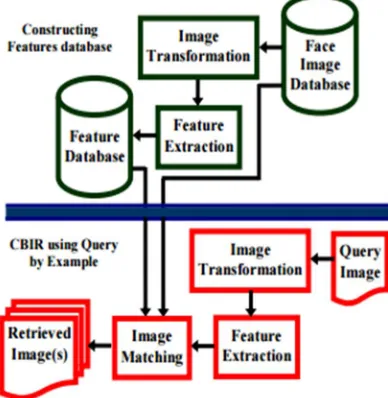
[image:4.612.210.404.463.662.2]3) Face Recognition using CBIR technique: Content Based Image Retrieval (CBIR) methods can be assigned to one of two major approaches, spatial or transform domain techniques. Spatial domain techniques are mostly based on colour, shape, or texture features that are extracted directly from images. Transform domain methods utilize global information from images to perform image retrieval.
Fig 2. CBIR using SQL and Java
B. Speech Recognition using Google Speech API and Java
Technology (IJRASET)
©IJRASET: All Rights are Reserved
1048
database to translate spoken language to text using their own servers processing power (cloud-based computing).Google’s current speech recognition system is speaker-independent and is built on deep neural networks together with hidden Markov models (DNN-HMM). The strength of Google Speech lies in general purpose use, e.g. when making search requests on the World Wide Web. Google uses cloud-computing for speech recognition tasks.
The use of controlling a robot with voice commands using speech recognition will also be reviewed.
1) Powerful Speech Recognition: The API recognizes over 80 languages and variants, to support your global user base.
2) Powered by Machine Learning: The most advanced deep learning neural network algorithm to your user's audio for speech recognition with unparalleled accuracy. Speech API accuracy improves over time as Google improves the internal speech recognition technology used by Google products.
3) Context-aware recognition: Speech recognition can be tailored to context by providing a separate set of word hints with each
API call.
C. Fingerprint Recognition using SFG software
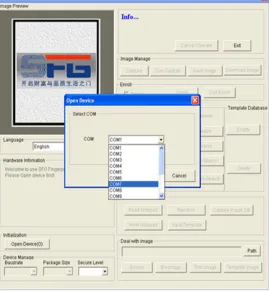
[image:5.612.193.462.289.580.2]This software is connected to the fingerprint device via COM port, and the authentication is done by giving the input fingerprint of the user to the module and registering by assigning a proper User ID in the software.
Fig 3. Selected port for fingerprint sensor
D. Bluetooth SPP Pro Application for Portability
Technology (IJRASET)
©IJRASET: All Rights are Reserved
1049
Fig 4. Application showing device properties
E. Arduino for Automobile and Bluetooth connectivity
The Arduino Integrated Development Environment - or Arduino Software (IDE) - contains a text editor for writing code, a message area, a text console, a toolbar with buttons for common functions and a series of menus. It connects to the Arduino and Genuino hardware to upload programs and communicate with them.
Programs written using Arduino Software (IDE) are called sketches. The console displays text output by the Arduino Software (IDE), including complete error messages and other information.
An android sketch has been developed which includes both Bluetooth connectivity and control of the automobile system. The baud rates have been defined in the initial part of the program for Bluetooth and fingerprint module and the directions for the automobile system have been defined according to the speech input given through the android device which has been integrated with Google API using Android Studio Development kit.
IV. IMPLEMENTATION
A. Face Recognition
The first step is to detect the face using an external camera and recognizing the face by comparing it with the Database server, and then sending a mail to the user’s android device if the face is valid.
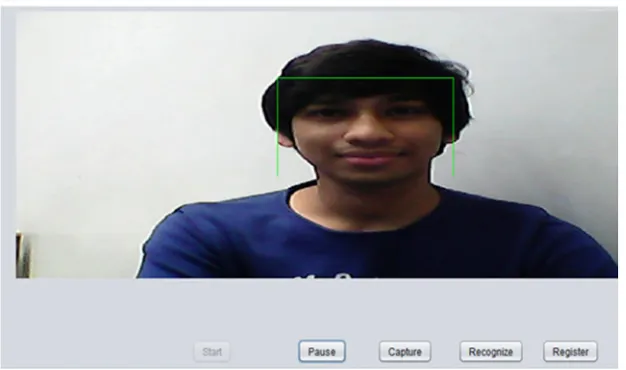
Now using Java Eclipse environment, the implementation of Face Recognition is carried out. This will detect the face objects visible to the default webcam and create rectangular objects covering the face of the person.
[image:6.612.151.464.524.709.2]With the help of Java Swings, we created a GUI for image capturing, registering and recognition. The GUI is as shown below:
Technology (IJRASET)
©IJRASET: All Rights are Reserved
1050
B. Speech Recognition
Android can’t recognize speech, so a typical Android device cannot recognize speech either. The easiest way is to ask another application to do the recognition for us. One such app is “Google Voice Search”. It is one of the best recognizers available for Android and supports a lot of languages. This service requires Internet connection because the voice recognition occurs on Google servers. This app has a very simple Activity that informs users they can speak. The moment the user stops talking, the dialog is closed and our application (intent caller) receives an array of strings with the recognized speech.
In our project we use Google Speech API for following two reason:
1) Password activity to access the application
2) Speech input to control the automobile motion
Since our aim is to make Bluetooth connected speech controlled automobile, we applied speech package into the “password activity” of Bluetooth SPP Pro for initialization of application, and also applied into byte stream mode for controlling automobile with speech command.
Only authorised user can access the application for controlling the automobile, we define unique set of passwords into the code. After receiving password from user, it will compare with the passwords which are defined in the code. If password matches, only then it will initialize the application and application will search nearest Bluetooth connected automobile. If not, it will terminate the operation.
HC-05 Module connected with Arduino accepts the data in serial communication mode. To send data serially we modified the byte stream mode of application, into which we provide the input as speech command which will be converted into text stream and this stream is transmitted serially from the android device.
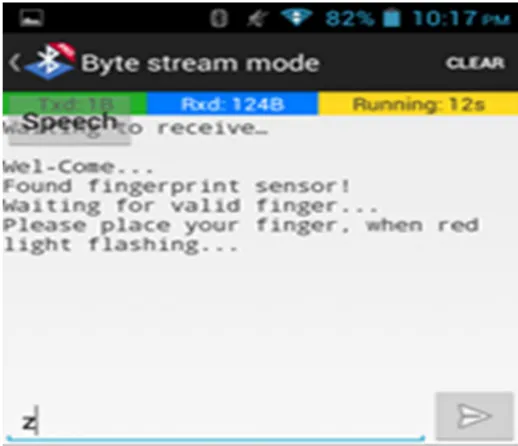
[image:7.612.175.434.353.576.2]Once the connection is successful with the device, it will ask for specific command to initialize the automobile. After initialization, it will ask user to put his finger onto fingerprint module for verification.
Fig 6. Fingerprint verification initialization
C. Fingerprint Recognition
Technology (IJRASET)
[image:8.612.168.446.81.282.2]©IJRASET: All Rights are Reserved
1051
Fig 7. Architecture of Fingerprint Matching Algorithm in R305
Image Pre-processing: The pre-processing steps try to compensate for the variations in lighting, contrast and other inconsistencies which are introduced by the sensor during acquisition process.
Feature extraction: The feature extraction technique for minutiae points (bifurcations and endings), pores and ridge contours is described in this section.
Minutiae Extraction: Most of the minutiae extraction techniques trace the fingerprint skeleton to find different types of minutiae points.
Ridge Detection: An important property of the ridges in a fingerprint image is that the gray level values on ridges attain their local maxima along a direction normal to the local ridge orientation. The ridge map is cleaned using a connected component algorithm. Minutiae Detection: The minutia points are then extracted from the thinned ridge map by examining the 8 neighbourhood of each ridge skeleton pixel. The ridge breaks, Ridge bending direction and width are the information extracted but this may contain spurious minutiae.
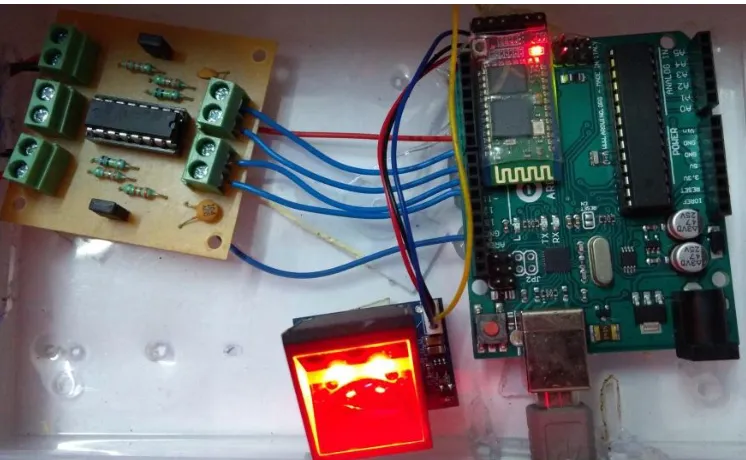
D. Practical Arrangement of System
[image:8.612.120.493.484.714.2]Technology (IJRASET)
©IJRASET: All Rights are Reserved
1052
Bluetooth controlled Automobile is controlled by using Android mobile phone instead of any other method like buttons, gesture etc. Here only needs to speak specific commands in android phone to control the car in forward, backward, left and right directions.
Here android phone is used as transmitting device and Bluetooth module placed in automobile is used as receiver. Android phone will transmit command using its in-built Bluetooth to car so that it can move in the required direction like moving forward, reverse, turning left, turning right and stop.
V. TESTING AND RESULTS
After successfully executing a face detection algorithm, an appropriately sized and scaled image of a face could be used for face recognition.. As a result, hard-coded training is used, for which the algorithm already knows the desired features. The Haar cascade classifier algorithm was implemented by modifying sample code provided by OpenCV. A working Java application was created that could detect the user’s face and place a green box around it.
The test results show that the detection method can accurately detect and trace human face in real time.
[image:9.612.193.418.508.690.2]The accuracy of this module was calculated for three people, and it can be represented in the form of a confusion table as shown below:
TABLE I Confusion table for Face Recognition accuracy Face Recognition accuracy
User 1 User 2 User 3 Overall Accuracy
No. of times face was detected correctly (out of
10 attempts)
10 8 9 90%
No. of times face was detected correctly considering noisy environments (out of 10
attempts)
9 8 8 83.33%
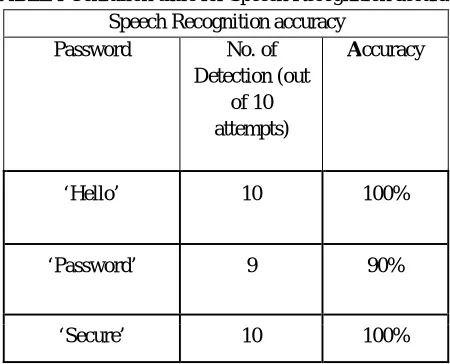
Thus from the above table, accuracy of Face recognition using Java and OpenCV proved to be better than other techniques stated in the literature survey. Similarly for the Speech Module, Google Speech API was used and it was very much compatible with other software technologies (Java and Android) and the accuracy obtained is far better than the existing speech classifiers.
TABLE I Confusion table for Speech Recognition accuracy Speech Recognition accuracy
Password No. of
Detection (out of 10 attempts)
Accuracy
‘Hello’ 10 100%
‘Password’ 9 90%
‘Secure’ 10 100%
Technology (IJRASET)
©IJRASET: All Rights are Reserved
1053
compared with the existing database and the user is authenticated if a match is found.
VI. CONCLUSION AND FUTURE SCOPE
After some research was performed, it was discovered that OpenCV code can be executed on the Android platform, as well. OpenCV offers many features that facilitate both facial recognition and face detection. The implementation of this project involves devices running Android version 2.0, for which access to devices is readily available. The availability of such devices running this software version facilitated better testing and demonstration. One of the reasons that this implementation is desirable on the Android platform is the availability of a front facing camera on mobile Android devices. A user interface can be developed with the touchscreen of the device to allow simple user commands. Once a user’s face could be successfully recognized on the Android device, the face recognition can implemented as a security mechanism for the device.
Also, for the Speech Recognition module, we are planning to make it Speaker dependent rather than speech dependent system, and there will be a focus on development of the system automatically guess what the user intended to say, rather than what was actually said, to avoid mistakes and use many languages with translation according to user needs and microphone and sound system that will be designed to adapt more quickly to changing background noise level, different environment.
Further, the fingerprint sensors of Mobile devices can be used instead of the external fingerprint module and thus the whole system can be made portable for real time applications in the industries. Problem with this is, not every phone has the provision of fingerprint sensors and thus we need to have a latest smartphone device for the implementation with compatible OS version. The same concept can also be applied for Home Automation and security where the person has to first Authenticate himself for entering inside his house. There will be a Wi-Fi module instead of Bluetooth device, which would be connected with the user’s phone and the range of Wi-Fi module will be restricted, so that not everyone can connect to it. After entering inside the house, user can control the home appliances using his speech inputs.
REFERENCES
[1] K.Sasidhar, Vijaya L Kakulapati. et. al. Multimodal Biometric Systems,”STUDY To Improve Accuracy And Performance”, IJCSES, Vol.1, No.2, November
2010.
[2] Face Detection and Recognition using OpenCV, Article, Published by Shervin Emami, 2010.
[3] Kavita S.Yadav, M.M.Mukhedkar “Review on speech recognition” Electronics and Telecommunication Dept. Dr.D.Y.Patil COE, Ambi,Talegaon, Dist: Pune. ,
vol 1 No. 2, 2013
[4] Marcos Faundez-Zanuy & Joan Fabregas“Testing Report of a Fingerprint-Based Door-Opening System”,IEEE A&E SYSTEMS MAGAZINE. JUNE 200
[5] K. A. Toh, X. D. Jiang, and W. Y. Yau, ―Exploiting global and local decisions for multimodal biometrics verification,IEEE Trans. Signal Process. , vol. 52, no. 10, pp. 3059–3072, Oct. 2004.
[6] Shahin MK, Badawi AM, Rasmy ME (2008),”A Multimodal Hand Vein,Hand Geometry and Fingerprint Prototype Design for High Security Biometrics,
CIBEC” 08.
[7] Chandran GC, Rajesh RS (2009).,”Performance Analysis of Multimodal Biometric System Authentication”, Int. J. Comput. Sci. Network Security, 9: 3.
[8] Kang BJ, Park K (2009),” Multimodal Biometric Authentication Based on the Fusion of Finger Veins and Finger Geometry”, Optical Eng., 48.
[9] Poinsot A, Yang F, Paindavoine M (2009),”Small Sample Biometric Recognition Based on Palmprint and Face Fusion”, Fourth International Multi Conference
on Computing in the Global Information Technology.
[10] Tayal A, Balasubramaniam R, Kumar A, Bhattacharjee A, Saggi M (2009).,”A Multimodal Biometric Authentication System Using Decision Theory, Iris and
Speech Recognition”, 2nd International Workshop on Nonlinear Dynamics and Synchronization.
[11] K A. Nagaty,“An Energy-Based Fingerprint Matching System”,Consumer Communications and Networking Conference, 2004. CCNC 2004. First IEEE. \
[12] C. Militello, V. Conti, F. Sorbello,S. Vitabile,“A Novel Embedded Fingerprints Authentication System Based on Singularity Points”,International Conference
on Complex, Intelligent and Software Intensive Systems,0-7695-3109-1/08 $25.00 © 2008 IEEE
[13] Fan Wang, Zhengyong Huang, Hui Yu, Xiaohua Tian, Xinbing Wang, Jinwei Huang, “EESM-based Fingerprint Algorithm for Wi-FiIndoor Positioning
System” 2013 2nd IEEE/CIC International Conference on Communications in China (ICCC): Wireless Networking and Applications (WNA),978-1-4673-2815-9/13/$31.00 ©2013 IEEE.
[14] Sahani S. , Ramamohan S. , and Pradhan V. , - "On Speech Synthesis for Gujarati Numeric", Bulletin of the Marathwada Mathematical Society, Vol. 13, No. 2,
pages 53-60, December – 2013.
[15] V. Blanz and T. Vetter. Face recognition based on fitting a 3d morphable model. IEEE Trans. on Pattern Analysis and Machine Intelligence, 25(9):1063– 1074,
2003.
[16] Le Hoang Thai and Ha Nhat Tam, “Fingerprint recognition using standardized fingerprint model”, IJCSI International Journal of Computer Science Issues,