Technology (IJRASET)
©IJRASET: All Rights are Reserved
1576
Comparative Study on Seismic Evaluation of
Multistoried Building with and without Floating
Column
Jayesh Rathi1, Sharvari Dhepe2
1
Scholar M.Tech. (Structural Engineering), 2Assistant Professor(Department of Applied Mechanics)
Government College of Engineering, Amravati (M.S.)
Abstract: Structural Engineering is a branch of Civil Engineering mainly deals with the analysis and design of the building. When earthquake occur, the seismic forces which are developed due to earthquake need to be carried down through the height of the building. So in case of a building with floating column there will be discontinuity in transfer path. The forces are transferred through the shortest possible path.
This paper deals with the comparative study of a normal multistoried building with the building containing the floating column. In this study, a ten storey building is considered for analysis purpose. For a building with floating column, some columns at the base is removed and the analysis is done. The various structural responses such as Storey Displacement, Storey Drift and Storey Shear and Time period have been evaluated and compared. The dynamic analysis is done using Response Spectrum Method for the multistoried building. For analysis purpose, ETABS software has been used.
Keywords- Dynamic analysis, ETABS, floating column, response spectrum analysis, seismic forces
I. INTRODUCTION
A. Introduction
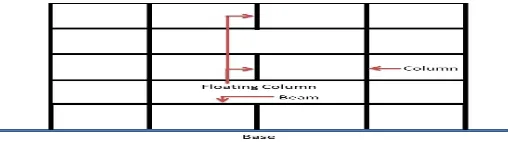
A column is supposed to be a vertical member starting from foundation level and transferring the load to the ground. The term floating column is also a vertical member which at its lower level rests on a beam which is a horizontal member. The beams in turn transfer the load to other columns below it [1].
The building can be categorized into two type, regular building and irregular building. Building with any irregularity comes into irregular building. Building with floating column is an irregular building.
In India, now a days many multistoried have keep their ground storey open as an unavoidable feature. The main purpose of opening ground storey is to accommodate parking or reception lobby. This type of building is mainly known as irregular building
When an earthquake occurs, the forces generated by earthquake need to be brought down through the height of the building. In every building the load transfer takes from horizontal member (beams and slabs) to vertical member i.e. columns and walls which transfer the load to the foundation [6]. So building with floating column, there will be discontinuity in load transfer path. The forces which are generated will be transferred to the ground through the shortest possible path. Figure1 shows the model of building with floating column and load transfer path.
[image:2.612.183.437.626.697.2]In this paper a normal building is considered. In order to convert it into a building with floating column, two cases are considered. For this two cases the various parameters such as storey displacement, storey drift, storey forces and time period are calculated.
Technology (IJRASET)
©IJRASET: All Rights are Reserved
1577
B. Objective and Scope
1) To study the effect of floating column on a building by considering two different cases.
2) To compare the various structural parameters of a building with normal building.
3) To study the dynamic effect on a normal building and building with floating column.
II. MODELLINGDETAILS
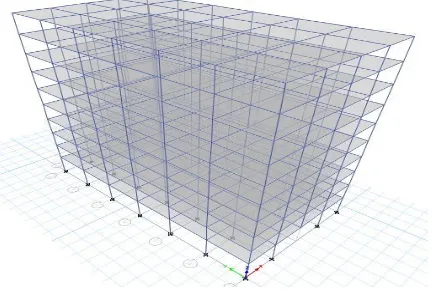
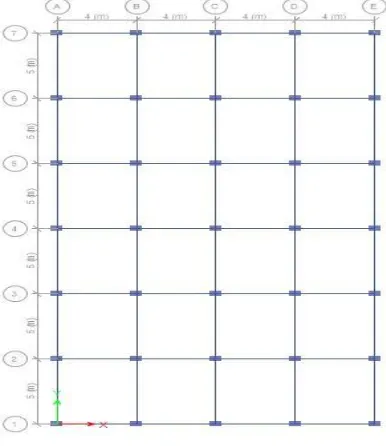
For the evaluation purpose a normal building with 10 storey is considered. In order to make a building with floating column, some of the columns at storey one is removed. The plan and elevation of normal building is shown in following figures. The building has area 16m x 30m. The spacing of columns in X direction is 4m and the spacing of columns in Y direction is 5m.
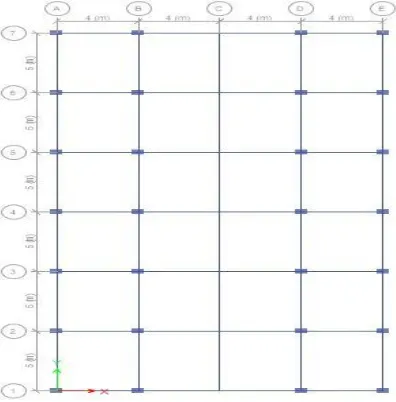
For floating column building two cases are considered. In first case all the column of center line in Y direction are removed and in second case all the columns of center line in X direction are removed. Both normal and building floating columns are analyzed for zone V and the following structural parameters are calculated:
A. Storey Displacement
B. Storey Drift
C. Storey Forces
D. Time Period
The building properties are shown in following table
TABLEIBUILDING PROPERTIES
Member Dimensions
Beams 350mm x 500mm, 500mm x 700mm
Columns 400mm x 400mm, 600mm x 600mm
Slab Thickness 125mm
Loads
Floors Live Load 4 kN/m2
Floor Finish 1.5 kN/m2
Walls
External Walls 12 kN/m
Internal Walls 6 kN/m
Parapet 4.6 kN/m
Grade
Concrete M 35
Rebar HYSD 500
[image:3.612.219.437.533.680.2]Building plan and elevation of all the cases are shown are shown in following figure
Technology (IJRASET)
©IJRASET: All Rights are Reserved
1578
[image:4.612.221.430.109.431.2]Following figure shows the elevation of a normal building
Fig. 3 Elevation of a normal building.
[image:4.612.221.414.460.683.2]Technology (IJRASET)
©IJRASET: All Rights are Reserved
1579
[image:5.612.210.410.90.413.2]\
Fig. 5 Plan of case1 building with floating column
[image:5.612.209.407.462.663.2]Technology (IJRASET)
©IJRASET: All Rights are Reserved
1580
III. MODELLINGDETAILS
In this study, normal building and two different cases of building with floating column were analyzed and the results obtained are compared. The results are shown in tabular form and are shown in form of graphs
The various structural parameters computed after the analysis are Storey Displacement, Storey Drift, Storey Forces and Time Period
A. Storey Displacement
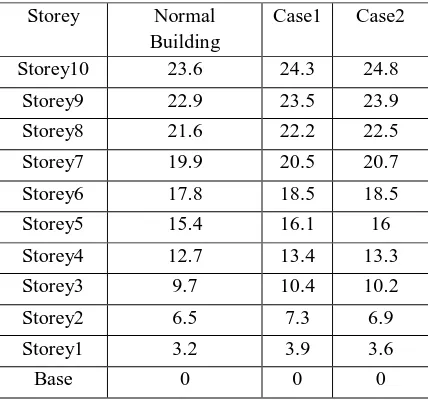
The lateral movement of a building which is caused by the lateral force is known as the storey displacement. With the introduction of floating column in a building, storey displacement increases. Since the columns of storey one are removed, storey displacement is maximum for storey one and it goes on decreasing for upper stories.
For case1, storey displacement for storey one increases by 22% while for top storey it increases by 3%. For case2, storey displacement for storey one increases by 12.5% while for top storey it increases by 5%.
Following table shows the storey displacement for normal building and building with floating column.
TABLEIIISTOREY DISPLACEMENT
Storey Normal
Building
Case1 Case2
Storey10 23.6 24.3 24.8
Storey9 22.9 23.5 23.9
Storey8 21.6 22.2 22.5
Storey7 19.9 20.5 20.7
Storey6 17.8 18.5 18.5
Storey5 15.4 16.1 16
Storey4 12.7 13.4 13.3
Storey3 9.7 10.4 10.2
Storey2 6.5 7.3 6.9
Storey1 3.2 3.9 3.6
Base 0 0 0
[image:6.612.199.413.264.465.2]Following graph shows the comparative analysis of storey displacement for all the cases.
Fig. 7 Graph showing comparison of storey displacement
B. Storey Drift
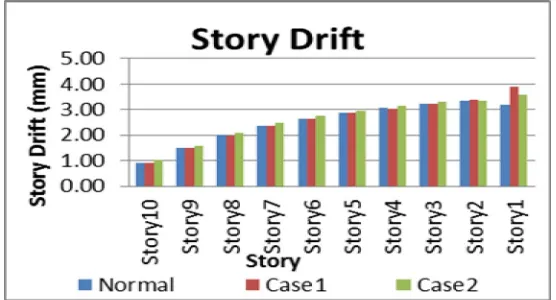
Storey Drift is defined as the difference between the relative storey displacements. Storey displacement is directly proportional to the storey displacement. As we introduce floating column in a building, storey drift increases as storey displacement increases. Storey drift goes on decreasing as we move towards top stories.
[image:6.612.192.431.497.608.2]Technology (IJRASET)
©IJRASET: All Rights are Reserved
1581
For case1, storey drifts for storey one increases by 22% while for top storey it increases by 1.1%. For case2, storey displacement for storey one increases by 11.87% while for top storey it increases by 11%.
Following table shows the storey drift for normal building and building with floating column.
TABLEIIIIISTOREY DISPLACEMENT
Storey Normal Building Case1 Case2
Storey10 0.91 0.92 1.01
Storey9 1.49 1.49 1.59
Storey8 1.99 1.98 2.10
Storey7 2.36 2.36 2.47
Storey6 2.64 2.64 2.74
Storey5 2.86 2.86 2.96
Storey4 3.05 3.05 3.14
Storey3 3.23 3.23 3.32
Storey2 3.35 3.37 3.36
Storey1 3.20 3.89 3.58
[image:7.612.159.454.145.299.2]Following graph shows the comparative analysis of storey drift for all the cases.
Fig. 8 Graph shows the comparison of storey drift
C. Storey Forces
The forces which are induced at every storey during earthquake are known as the storey forces.
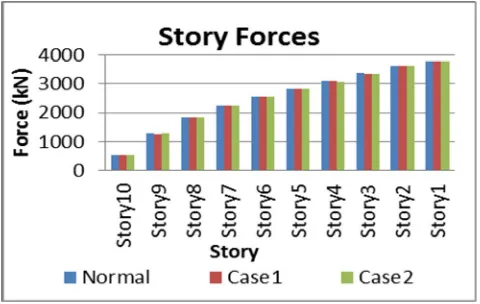
Storey forces induced in normal building will be more than building containing floating column. For a building, storey forces goes on increasing for lower stories and it will be maximum for bottom storey.
For case1, storey force for storey one decreases by 0.1% while for top storey it decreases by 1.85%. For case2, storey force for storey one decreases by 0.23% while for top storey it decreases by 1.11%.
Following table shows the storey forces for normal building and building with floating column.
TABLE IIIV Storey Displacement
Story Normal Building Case1 Case2
Story10 539 529 533
Story9 1278 1264 1269
Story8 1828 1817 1841
Story7 2237 2235 2230
[image:7.612.163.441.334.484.2]Technology (IJRASET)
©IJRASET: All Rights are Reserved
1582
Story5 2826 2819 2815
Story4 3095 3084 3077
Story3 3362 3350 3346
Story2 3612 3604 3603
Story1 3779 3775 3770
[image:8.612.186.426.179.331.2]Following graph shows the comparative analysis of storey forces for all the cases.
Fig. 9 Graph shows the comparison of storey forces
D. Time Period
Time period is defined as the time taken by the building to undergo a cycle of one to and fro movement. The time period for a building with floating column is more than that of a normal building.
For case1, time period increases by 2.3% and for case 2 it increases by 0.07%.
[image:8.612.226.390.446.513.2]Following table shows the time period for normal building and building containing floating column.
TABLE IIV Story Displacement
Case Period(Sec)
Normal Building 1.341
Case 1 1.372
Case 2 1.342
[image:8.612.191.432.541.659.2]Following graph shows the comparative analysis of time period for all the cases.
Fig. 10. Graph shows the comparison of time period
IV. CONCLUSION
A. On the basis of Analysis and Results, the following Conclusion has been made
Technology (IJRASET)
©IJRASET: All Rights are Reserved
1583
2) Storey Drift: As storey displacement increases, storey drift also increases since storey displacement is directly proportional to
storey displacement.
3) Storey Forces: Storey forces are less for building with floating column since in floating column building, there is less number
of columns as compared to normal building.
4) Time Period: Time period is more for building with floating column as compared to normal building.
5) The performance of building with floating column can be improved by increasing the size of beams and columns of the storey
containing floating column.
REFERENCES
[1] Isha Rohilla1, S.M. Gupta2, BabitaSaini3 "Seismic Response Of Multi-Storey Irregular Building With Floating Column", IJRET: International Journal of Research in Engineering and Technology, eISSN: 2319-1163, pISSN: 2321-7308.
[2] A.P. Mundada A. and S. G. Sawdatkar A, "Comparative Seismic Analysis of Multistorey Building with and without Floating Column", International Journal of Current Engineering and Technology, E-ISSN 2277 – 4106, P-ISSN 2347 – 5161
[3] Ashwin Sanjay Balwaik, "Comparative Analysis of G+1 Structure With and Without Floating Column", International Journal of Scientific & Engineering Research, Volume 6, Issue 6, ISSN 2229-5518 IJSER, June2015
[4] Kavya N, Dr. K.Manjunatha, Sachin. P. Dyavappanavar, "Seismic Evaluation Of Multistorey RC Building With And Without Floating Column Kavya" International Research Journal of Engineering and Technology, (IRJET) e-ISSN: 2395 -0056 Volume: 02 Issue: 06| Sep-2015.
[5] Sreekanth Gandla Nanabala, Pradeep Kumar Ramancharla and Arunakanthi, "Seismic Analysis of A Normal Building and Floating Column Building", International Journal of Engineering Research & Technology, (IJERT) ISSN: 2278-0181 Vol. 3 Issue 9, September- 2014
[6] Sarita Singla and Ashfi Rahman, "Effect of Floating Columns on Seismic Response of Multi-Storeyed RC Framed Buildings", International Journal of Engineering Research & Technology, (IJERT) ISSN: 2278-0181 Vol. 4 Issue 06, June-2010
[7] Srikanth M. K, Yogeendra Holebagilu, “Seismic Response of Complex Buildings with Floating Column for Zone II and Zone V”, International Journal of Engineering and Research, ISSN: 2321 – 7758, Vol 2. Issue 4, 2104
[8] Pratyush Malviya, Saurav, “Comparitive Study of Effect of Floating Columns on the Cost Analysis of a Structure Designed on STAAD PRO”, International Journal of Scientific & Engineering Research, Volume 5, Issue 5, May 2104.
[9] Sabari S, Praveen J. V, “Seismic Analysis of Multistorey Building with Floating Column”, International Journal of Civil Engineering Research, ISSN 2348 – 7607, Vol 2. Issue 2, pp:(12-23), October 2014
[10] Mahesha M, K. Lakshmi, “Comparitive Study on #D RC Frame Structure with and Without Floating Columns for Stiffness Irregularities Subjected to Seismic Loading”, International Research Journal of Engineering and Technology, Vol. 2 Issue 5, August 2015.
[11] Shiwli Roy, Gargi Danda de, “Comparitive Studies of Floating Column of Different Multistoried Building”, International Journal for Research in Applied Science & Engineering Technology, ISSN: 2321 – 9653, Vol. 3 Issue VIII, August 2015
[12] Kavya N, K. Manjunatha, Sachin Dyavappanavar, “Seismic Evaluation of Multistorey RC Building with and without Floating Column”, International Research Journal of Engineering and technology, ISSN: 2395 – 0056, Vol. 2 Issue 6, September 25
[13] Badgire Udhav, Shaikh A. N, Maske Ravi, “Analysis of Multistorey Building with Floating Column”, International Journal of Engineering Research, Vol. 4 Issue 9, pp 475-478, ISSN: 2319 – 6890, September 2015.
[14] Nakul Patil, Riyaz Shah, “Comparative Study of Floating and Non-Floating Columns with and without Seismic Behavior”, International Journal of Research in Engineering Science and Technology, ISSN 2395 – 6453, Vol. 1, Issue 8, December 2015.