5
III
March 2017
Technology (IJRASET)
Capacity Maximization and Error Rate
Performance of OFDM using MIMO in Software
Defined Radio
Varshini Ramesh1, Nivetha Subramaniyan2, Ms. Savitha Gopalan3
1,2
Student, 3Assistant Professor, Electonics and Communication Engineering Jeppiaar SRR Engineering College, India
Abstract: Orthogonal Frequency Division Multiplexing (OFDM) is one of the modulation techniques in Software Defined Radio. Peak to Average Power Ratio (PAPR) and Secondary Power Ratio (SPR) is taken into consideration to increase the Signal to Noise Ratio (SNR) in OFDM and to lessen the PAPR on the receiver side, Multiple All Pass filter is used along with the clipping technique. FEC coding is performed by suggesting convolution order. Bit Error Rate (BER) performance is analysed by varying window size, bits per symbol and modulation schemes. In the recent years, Multiple Input and Multiple Output (MIMO) is a captivating technology for wireless system. In order to transmit maximum number of information without delay and collision, the capacity of the MIMO channel is increased with the help of modified water filling algorithm. Inter Carrier Interference (ICI) and Inter Symbol Interference (ISI) are overcome with the help of the group pilot algorithm.
Keywords: Orthogonal Frequency Division Multiplexing (OFDM), Multiple Input Multiple Output (MIMO), Peak to Average Power Ratio (PAPR), Signal Power Ratio (SPR), Bit Error Rate (BER), Inter Carrier Interference (ICI), Inter Symbol Interference (ISI), Partial Transmit Scheme (PTS).
I. INTRODUCTION
Software Defined Radio is an idea which has been since early nineties. Although SDR concepts have been used in military application for several years it is only recently that designers of cost effective products such as cars, radios, and mobile phones have started developing SDR based solutions. Software Defined Radio is to merge hardware and software technologies to make system flexible for wireless communication. Current and future broadband wireless standards are based on Orthogonal Frequency Division Multiplexing which is a multicarrier modulation scheme. Wireless communication is get affected by Inter Symbol Interference which originate from multi-path transmission and delay. Thus advantage of OFDM is the reduction of ISI. Moreover the SDR-OFDM will provide better spectrum efficiency. It provides good resistant to frequency selective of the channel by dividing the entire spectrum into narrow band subcarriers for wide band transmission of data. Single Input and single Output channel which is considered as simplest form of radio link is limited in its performance because of interference and fading. In contrast Multiple Input and Multiple Output act as a high data rate interface technology. It is a method of multiplying the capacity of a radio link using multiple transmit and receive antennas to exploit multipath propagation. To combat the effect of frequency selective fading MIMO is combined with the OFDM. The capacity of the channel can be increased by increasing the power budget allocation in wireless medium. As there is an increasing number of transmissions via different channel there is a problem of collision, hence capacity should further increase. Spatial Multiplexing which is the basic principle of MIMO is used to provide additional data capacity by utilising the different path to carry additional traffic. OFDM has large Peak to Average Power which results reducing the power efficiency of the transmitted data. Inter Symbol Interference and Inter Frequency Interference can be eliminated by cyclic prefix. But elimination of Inter Symbol Interference leads to Inter-Carrier Interference. This paper categorized as follows
A. Materials and methods used in the proposed paper.
B. SDR- OFDM along with MIMO channel simulations of the proposed system.
C. Simulation results of the proposed system and finalizes the paper.
II. MATERIAL AND METHODS
In the proposed system of SDR-OFDM
Technology (IJRASET)
Algorithms (LMMSE).
C. Reduction of PAPR.
D. Capacity Maximization in MIMO channel and zero forcing beam forming.
E. Reduction of ISI and ICI.
[image:3.612.154.417.142.425.2]III. BLOCK DIAGRAM
Fig. 1 Block Diagram of SDR-OFDM
The block diagram of SDR-OFDM is shown in the Fig. 1.OFDM is the method of encoding the given digital data on multiple carrier frequencies. It is also known as digital multi-carrier modulation scheme. The data is carried by closely spaced orthogonal sub-carriers. Coding or encoder is used for security of data. Since the QAM modulator accepts the input in the form of matrix, the interleaver is used to convert the output of encoder (Binary data) into matrix form. Every subcarrier is modulated by using Quadrature Amplitude Modulation. The output of the QAM modulator is complex conjugate of binary data. To achieve time synchronisation pilot insertion is used. Guard bit which is also known as guard interval is to eliminate the need of pulse shaping filter and it reduces the sensitivity to time synchronization problem. OFDM carriers are generated with the help of all the modulated subcarriers by employing Inverse Fourier Transform Module (IFFT). As IFFT allow only parallel form of data serial to parallel conversion is used. Cyclic prefix is used to eliminate the Inter Symbol Interference.
IV. BIT ERROR RATE PERFORMANCE
A receiver antenna of an OFDM receives the channel information. The information is passed through Analog to digital conversion, Fast Fourier Transform and then enters into channel estimation block. FFT is used to demodulate the OFDM signal. This OFDM signal consists of sequence of N QAM (Quadrature amplitude modulation) symbol values. Every OFDM value will get affected by amplitude variation, inaccuracy in local oscillator when the signal passes through the channel. This results in the signal strength. Performance of QAM modulator is enhanced by LMMSE (Linear minimum mean square algorithm). LMMSE algorithm is used to increase the Signal to Noise Ratio and to decrease the error. LMMSE algorithms reduces the distortion that has been occurred in the channel. After removing the pilot data and guard bit, the Bit Error Rate is calculated. Bit error rate is computed by
BER=
Technology (IJRASET)
A. Reduction of PAPR
A number of independently modulated subcarriers are consisted in an OFDM signal, which may reveal a high instantaneous signal peak with respect to the average signal level, which give rise to large Peak-to-Average Power Ratio. Peak to Average Power Ratio happens due to multiple subcarriers. It reduces the power efficiency of RF amplifier. This PAPR is reduced by using Multiple All Pass Filter. The scheme used for PAPR reduction is The Partial Transmit Scheme.
1) The Partial Transmit Scheme: In the PTS scheme of PAPR reduction, a data block of N symbols given as input is fragmented into divide sub-blocks. The subcarriers in each sub-block are multiplied by a phase weighting factor of that sub-block. The principle structure of PTS scheme is shown in the Fig. 2. The phase weighting factors are preferred in such a manner that the PAPR of the entire signal is minimized. So PAPR reduction is modulating (baseband) signal in an OFDM system consisting of N subcarriers can be expressed as
PAPR = | ( )|
[| ( )| ] ……..(2)
Fig. 2 Block Diagram of OFDM transmitter with PTS scheme
V. CAPACITY MAXIMIZATION OF SDR-MIMO AND BEAMFORMING
In order to rise the capacity of the MIMO channels, the power allocations must be done appropriately. To compute the best power allocation, given the amount of power allocated to pilots is mandatory. Sub-channel allocation must be done in a way in which each sub channel is allocated to a user who has the best sub-channel response. Now, the difficult of power allocation between users is represented by
MAX log( 1 + ) subject to ∑ = ….(3)
which is total power for data transmission, after pilot insertion.
In modified water filling algorithm the condition the power is less than threshold value is checked and then Power is allocated to the require channel. Power Allocation is calculated by
Powerallo= (Power+ sum (1-(H))/NA-1.H …….. (4) Where NA is channel length.
VI. REDUCTION OF ISI AND ICI
Technology (IJRASET)
oscillator inaccuracies and the Doppler shift. In such cases, the orthogonality of the carriers is no longer maintained, which consequences in inter carrier interference (ICI).
Bits are assigned to subcarriers assigned to each user satisfying the target data rates of each user. As results of the subcarrier allocation, the optimization problem can be simplified as the bit allocation problem as follows.
Min ∑ ∑ ( , , )
,
∈ , …..(5)
Bit loading problem is overcome with the help of group pilot algorithm.
VII. RESULTS AND DISCUSSIONS
A. Simulation Results
[image:5.612.251.393.245.439.2]The Bit Error Rate is calculated. The graph between Signal to Noise Ratio versus Bit Error Rate with and without LMMSE algorithm is shown in the below Fig 3. Thus the signal strength is improved.
Fig. 3 SDR OFDM with and without LMMSE
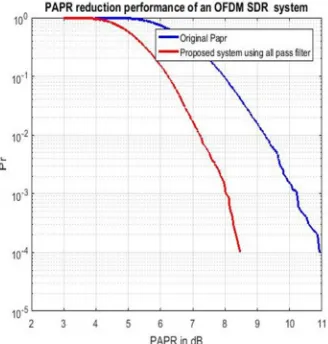
The amount of PAPR reduction is proportional to the number of phase weighting factor. The Fig. 4 explains about the PAPR reduction of SDR-OFDM using Multiple All Pass Filter. In the result Pr is receiver power. PAPR is measured with respect to receiver power.
[image:5.612.221.385.520.692.2]Technology (IJRASET)
Fig. 5 Secondary Power Ratio
Fig. 6 Receiver Power Ratio
[image:6.612.210.398.515.699.2]Secondary power ratio and receiver power ratio is measured along with the PAPR reduction to increase the performance of the system. Fig. 5 and Fig. 6 shows the SPR and RPR versus Probability of detection. In SPR reduction the Probability of False Alarm (back ground noise) is kept as constant whereas in RPR reduction graph the Probability of False Alarm is varied.
Technology (IJRASET)
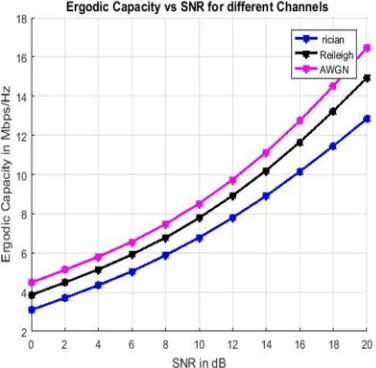
The capacity maximization of three different channels i.e. racian, reileigh, AWGN is compared in the below Fig. 7. The variation of capacity with respect to the time is termed as ergodic capacity. In additive white Gaussian noise channel capacity maximization is achieved to a maximum value.
[image:7.612.195.374.135.368.2]The Zero forcing Beam forming of the OFDM by taking MIMO channel is analysed in the Fig. 8
Fig.8 Performance of OFDM ZFBF equalizer.
Elimination of ISI and ICI is achieved to a considerable level is explained in the Fig 9. Here the bit error rate of channel such Single Input and Single Output of 64 QAM, MIMO OFDM channel and SDR OFDM with LMMSE is analysed.
Fig. 9 ISI and ICI cancellation
VIII. CONCLUSION
[image:7.612.200.402.424.613.2]Technology (IJRASET)
domain and can be easily implemented in SDR. It is demonstrated by a software reconfigurable OFDM system. The capacity and power allocation of MIMO channel is analyzed. Similarly, software defined antennas can also be implemented by using this approach. Adaptive modulation can be applied to this system which diminishes the antenna sizes, while still being able to deliver high data rate
REFERENCES
[1] Alexander M. Wyglinski, Digital Communication Systems Engineering with Software-Defined Radio, Mobile communications series, U.S. Library, 2013
[2] Hen Geul Yeh, Paul Ingerson, “Software defined radio for OFDM transceivers,” IEEE, 2010.
[3] Kelley, “Software Defined Radio for Broadband OFDM Protocols,” Proc. IEEE Intern. Conf. Systems, Man, Cybernetics, San Antoniou, TX, Oct. 2009, pp.
2309-2314
[4] Rivet et al., “A disruptive architecture dedicated to software-defined radio,” IEEE Trans. Circuits System II: Express Briefs, vol. 55, no. 4, April 2008, pp.
344-348.
[5] H. G. Yeh, Y. K. Chang, and B. Hassibi, “A scheme for cancelling inter carrier interference through conjugate transmission for multicarrier communication
systems,” IEEE Trans. on Wireless Commun.
[6] H.G.Yeh and V.R.Ramirez, “Implementation and Performance of a M-ary PSK and QAM OFDM System in a TMS320VC5416 Digital Signal Processor,”
Proc. 2nd Intern. Conf. on Digital Communications, Santa Clara, CA, July, 2007.
[7] H.Chang and T. Nguyen, “An OFDM-specified lossless FFT architecture,” IEEE Trans. Circuits Syst II: Express Briefs, vol. 53, no.6, pp. 1235-1243, June 2006.
[8] H. D. Schulze and C. Lueders, Theory and applications of OFDM and CDMA: wideband wireless communications, John Wiley & Son, Chichester, 2005.