IMPROVING ATTITUDE TOWARDS GREEN ENVIRONMENT AWARENESS THROUGH THE SLGEA-Code MODULE Rose Amnah Abd Rauf
University Malaya, Kuala Lumpur, Malaysia rose [email protected]
Abtracts
This paper is part of a large study which was on developing a green environment awareness module using QR-Code. My main focus of the study was on the development of the module. In this paper, I focus on the evalution phase of the module after it was taught by a teacher to two form four classes. The aim of the evaluation is to test whether students attitude can be nurtured to behave, act and react towards conservation of the green environment using the module. The researcher developed Green Environment Awareness Module with QR-Code (SLGEA-Code) as a self-learning and- mobile learning instructional approach. The module was evaluated on two classes one is the treatment group and the other is the control group. The evaluation phase employed a quasi-experimental design. Two groups of form four secondary students were the sample of the study. The researcher trained 1experienced teacher to teach to2 form Four classes; treatment class (n= 35) and compared gains in attitude towards green environment to the normal approach (control) class (n=33). The measure for attitudes towards the environment were adapted from the GASE scale. There were five domains; willingness to learn and inform about environmental issues; disbelief in explanations related to environmental issues; sensitivity towards environmental issues and saving the environment; disbelief in environmental, and belief in protecting habitat. Students in the treatment group showed statistically greater growth in their attitudes towards the environment in all the of the domains compared to the pre-test. This study revealed the potential of using a self-learning module to nurture students attitude towards caring for the environment by giving them massive and immediate information in a convenient, interesting and current way.
Keywords: green environment, awareness, attitude, QR-Code
INTRODUCTION
The need for Environment Education
The world environment is rapidly changing. All these changes are the result of human activities in the process of development by indiscrimate use of the natural resources. Thus, the responsibility of caring and protecting the environment falls on the shoulder of all human beings.
There is a need to educate the people so that they are more aware and take active part in the move to care for the environment by making informed decisions and taking the right action to protect the environment (UNESCO-UNEP, 1977). By making people aware of through education and training on protection and conservation of the environment and this in turn will then inculcate in them sensitivity towards environmental issues and develop a responsible attitude towards the environment.
Environmental education (EE) emerged in the seventies in which the world realized that through mass environment education program can spread concerns and awareness towards the environment. The United Nation Conference on Human and Environment recommended
Environmental Education to be included in school curriculum to redefine and re-established environmental education (OECD, 1973). Various organisations such as Danish University Consortium for Environment, Development (D.U.C.E.D.), M.U.C.E.D (Malaysia), T.U.C.E.D (Thailand). and S.A.D.U.C.E.D (South Africa) were established as a measure in its efforts to fight environmental problems through environmental education (Adnan, 2005). Even though environmental
20thand 21st September, 2015 Global Research&
education and Green strategies of the National environmental policy was put through Vision 2020, it was not implemented effectively in schools (Agnes & Nor, 2011). Now EE it is considered as education for sustainability.
Environment education can be defined as a process of individuals and community gaining awareness of their environment and at the same time acquire the knowledge, skills experience, values, including the desire and will to act towards solving present and future environmental problems (UNESCO-UNEP (1977). This process of learning will lead students to greater understanding on how the interaction between earth's resources, natural and human- made systems.
Pant (2012) stressed that teachers can play an important role for environment education to succeed. They are responsible in transmitting knowledge and creating awareness about the environment to students in hope that these students who are our future generation can help and carry on the role in conserving a clean and healthy environment. They are also responsible to be the role model to younger generations and solve local and global environmental issues. This poses as a challenge for the teachers. For teachers to succeed in their mission, they should be properly trained on environment concepts and skills to impart it to learners (Ferry, 2009). They should be well equipped with the knowledge, methods, and teaching learning material to inculcate the right understanding of and attitude towards environment in learners. Teacher should be supported with various teaching materials for them to execute their role of imparting the knowledge and skills. Thus, technology is seen can play an important role in order to create a workforce and community of environmentally aware and concerned citizens (Pant, 2012).
The North American Association for Environmental Education (NAAEE) in their Guidelines for Excellence recommended that all materials and activities should have fair and accurate information on environmental problems, issues, and diversity. Information about natural and built environmens, attitudes and values should be provided in depth. Materials presented should be oriented towards civic responsibility. Instructional methods chosen should be able to create an effecive learning environment and most importantly a well designed and easy to use materials.
The critical step to creating behaviour change is to through public awareness of global warming and climate change (Bowman et aI., 2009; ecoAmerica, 2008; The Topos Partnership, 2009). A common language should evolve to address the concerns of communities and inspire individuals to take action for a green environment regardless of different belief that each individual hold regarding environmental issues (Saunders, Brooks &Myers, 2006; Schultz &Zelezny, 2003) ..
With rapid population increase and economic growth in many countries, the environment is becoming more vulnerable and natural resources are depleted faster to meet the basic needs. Pudin, Tagi & Periasamy (2005) believe that education is critical in the effort to achieve environmental and ethical awareness, the right values and attitudes, appropriate skills and behaviour that is consistent with sustainable development. Both formal and in-formal education is important for effective in decision making on what to do and how to act in environmental issues.
In the Malaysia's National Policy on the Environment, 2002, believed that through sustainable environmental development will enhance the live quality of the people despite of continued economic, social and cultural progress. Moreover, one of the key areas of the Green Strategies is 'Education and Awareness'( Pudin, 2006). Among the strategies for Education and Awareness suggested were devising a formal and imformal environment education (EE) , training and nformation dissemination programmes so that there is an intergration between schools with tertiary institutions. Through this it was also suggested that suitable and relevant methods of imparting EE and development of materials to support these move.
20th and 21st September, 2015
Global Re5earcr &
Environmental issues concerning awareness and understanding provide the basis for commitment and meningful action towards sustainable development of the environment ( Salequzzaman & Stocker, 2001). In line with the growing interest and activity in environmental education, awareness and training, the demand for educational materials and study aids has also increased. However, the limited availability of materials may not meet individual country requirements in terms of local language, and in coverage of the most relevant issues to the country. A widely felt constraint has been the lack of standardization in textbooks and other material on environmental issues and a failure to provide the full information base. While the subject of environment can be interpreted and presented in many ways, and it can be looked at through a scientific or cultural angle, there is a basic need to present facts accurately and discuss issues in a balanced manner.
In order to create and embed awareness of the importance of sustaining the environment children should be educated with vast authentic materials to the abuse of the environment made by men. This can be achieved through a module giving them unlimited information and by giving them the first hand supply of information by the click of a phone or device. The use of QR code is the most suitable technology to support this because QR code can contain massive information in a small square patern. There is no need to use papers and to bring thick books every where. QR code will enable us to learn and educate about the environment anywhere and anytime where it is permissable. Attitudes towards environment education
Ajzen & Fisbein (1980) defined attitude as favourable and unfavourable feelings towards the environment or related problem. According to Eagly & Chaiken (1993) a person's real attitude can be revealed through his or her own personal evaluations rather that what he or she claims to do. Enviromental education goals are to challenge the cognitive, metacognitive, affective and behavioral levels of individuals or communities (Sanera, 1998). Past reseachers found that by having positive attitudes, emotions, thoughts or behaviours of the environment will make people to be more sensitive and responsible to the environment see the need for green environment (Simsekli, 2001; Erten at al., 2003; Ozrnen et aI., 2005; Erol & Gezer, 2006). There is a causal link between attitudes, intentions and behaviour (Hini, Gendall & Kearns, 1995). Loudon & Bitta (1993) believed that attitude is directly related to behavioral change. Thus, Crawley & Koballa (1994)states that from the study of attitudes can show that people make evaluative judgements and rely on them, to decide possible courses of action in the future.
Past research showed that there are links between attitude,behaviour, awareness and knowledge (La Trobe &Acott, 2000; Ayush, 2008; Lahiri, 2011; Grizzell, 2007;). Flamm (2006) from researchs done in the past indicated that there is a link between knowledge and attitude and attitude is further connected to behaviour. Thus, to improve the attitude of people might also improve their behaviour and it is assumed that it can be achieved through knowledge.
Even though Foxall (1983) study suggest three possible causal relationships between attiudes and behaviour which were attitudes cause behaviour, behaviour causes attitudes and attitudes and behaviour have a reciprocal effect. Barwise & Ehrenberg (1985) and East (1990) acknowledge that there are evidence to support Foxall suggestions. A study by Hini, Gendall and Kearns (1995) found that there is a link between attitudes and behaviour and also that attitudes had predictive ability towards behaviour.
20th and 21st September, 2015
TheQRCode
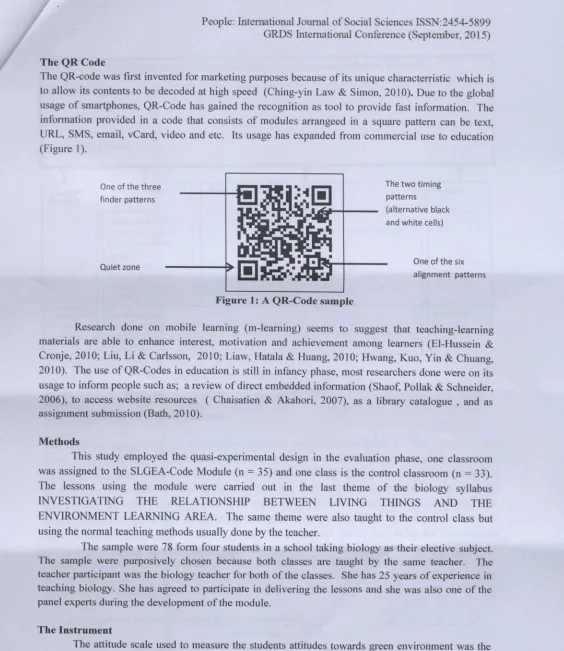
The QR-code was first invented for marketing purposes because of its unique characterristic which is to allow its contents to be decoded at high speed (Ching-yin Law & Simon, 2010). Due to the global usage of smartphones, QR-Code has gained the recognition as tool to provide fast information. The information provided in a code that consists of modules arran geed in a square pattern can be text, URL, SMS, email, vCard, video and etc. Its usage has expanded from commercial use to education (Figure 1).
One of the three
finder patterns
The two timing
patterns
(alternative black
and white cells)
Quiet zone
One of the six
alignment patterns
Figure 1: A QR-Code sample
Research done on mobile learning (m-learning) seems to suggest that teaching-learning materials are able to enhance interest, motivation and achievement among learners (El-Hussein & Cronje, 2010; Liu, Li & Carlsson, 2010; Liaw, Hatala & Huang, 2010; Hwang, Kuo, Yin & Chuang, 2010). The use of QR-Codes in education is still in infancy phase, most researchers done were on its usage to inform people such as; a review of direct embedded information (Shaof, Pollak & Schneider, 2006), to access website resources (Chaisatien & Akahori, 2007), as a library catalogue, and as assignment submission (Bath, 2010).
Methods
This study employed the quasi-experimental design in the evaluation phase, one classroom was assigned to the SLGEA-Code Module (n
=
35) and one class is the control classroom (n=
33). The lessons using the module were carried out in the last theme of the biology syllabusINVESTIGATING THE RELATIONSHIP BETWEEN LIVING THINGS AND THE
ENVIRONMENT LEARNING AREA. The same theme were also taught to the control class but using the normal teaching methods usually done by the teacher.
The sample were 78 form four students in a school taking biology as their elective subject. The sample were purposively chosen because both classes are taught by the same teacher. The teacher participant was the biology teacher for both of the classes. She has 25 years of experience in teaching biology. She has agreed to participate in delivering the lessons and she was also one of the panel experts during the development of the module.
The Instrument
The attitude scale used to measure the students attitudes towards green environment was the GASE inventory developed by Metin (20] 0). The attitude scale consisted of five domains; 1) Willingness to learn and inform about environmental issues; 2) Disbelief in explanations related to environmental; 3) Sensitivity towards environmental issues and saving the Environment; 4) Disbelief in environmental pollution; 5) Belief in protecting Habitat. But the items in the inventory is refering to Turkey's environmental issues. The researcher modified items refering to Malaysia'S
201hand 21stSeptember, 2015
environmental issues. The inventory was pilot tested and improved before administering it to the samples. The Cronbach-alpha coeffieciaent is 0.88. The scale has 27 items. The instrument measured the responses using a likert scale scoring 1 for Strongly disagree to 5 for Strongly agree.
Overview of the development of The Module
The module was development using the ADDlE Model which consists of 5 phases. Needs analysis were done by interviews and survey to biology teachers and students. For the feasibility study, five biology teachers were interviewed on the need of a module to impart and thus inculcate the awareness to green evironment. The findings revealed that direct resources are minimal and teachers have to search on their own for teaching-learning material which they found time consuming and takes lots of their limited time. They would like if they have the option of using an available module complete with specific resources to the topic at hand. Questionnaires to identify areas, problems in teaching environment education, teaching approaches used and suggestions were disseminated to biology teachers. Teachers were also tested on their knowledge of environment education. Students were also given questionnaires to identify their level of awareness and also their preferences on how environment education should be taught. Through the needs analysis it was evident that the Module to improve green environment is necessary and relevant.
The next phase is the process where by it includes the design, development and implementation process followed by the evaluation process. In the design process the delphi technique was employed to detemine the framework of the module, the content, the activities and measures/evaluation in the module. The development of the conceptual framework of the module has been discussed in a journal by the researchers (Rose Amnah & Mohamad Sattar, 2013). The unique characteristic of the module was to give massive informative, educative and reliable information about the environment which incorporate the use of QR-Code for easy retrieval. The module consisted of four sections which were natural disaster, pollutions, human activities, and green projects. The features of the module were information in the form of text, pictures, graphics and QR-Codes giving access to video clips, websites and information on the topic being taught/learn/discussed.
The Evaluation Phase The procedure
The teacher was given training on how to use the module in class and how the students can use it at home. The training was a one day session given by the researcher. The instructional approach of the module is the content of the module was used as the dicussion topic in class and students were given questions to answer after exploring the topics and QR-Codes provided in the module on their own. The approach was self-learning and m-Iearning. The teacher taught the class from July to August 2013 (8 weeks) during 4 times of 40-minutes class.
Every students in the treatment classroom were provided a copy of the module. The module was used during the lesson and students were allowed to take home the module to continue with their self-learning and mobile learning. Students have to do the exercise at the end of each sections. These will then be discussed in the class with the teacher. The implementation of the evaluation phase is shown in Figure 2.
20thand 21st September, 2015
The QR Code
[image:6.578.8.572.18.669.2]The QR-code was first invented for marketing purposes because of its unique characterristic which is to allow its contents to be decoded at high speed (Ching-yin Law & Simon, 2010). Due to the global usage of smartphones, QR-Code has gained the recognition as tool to provide fast information. The information provided in a code that consists of modules arran geed in a square pattern can be text, URL, SMS, email, vCard, video and etc. Its usage has expanded from commercial use to education (Figure 1).
One of the three
finder patterns
The two timing
patterns
(alternative black
and white cells)
Quiet zone One of the six
alignment patterns
Figure 1: A QR-Code sample
Research done on mobile learning (m-learning) seems to suggest that teaching-learning materials are able to enhance interest, motivation and achievement among learners (El-Hussein & Cronje, 2010; Liu, Li & Carlsson, 2010; Liaw, Hatala & Huang, 2010; Hwang, Kuo, Yin & Chuang, 2010). The use of QR-Codes in education is still in infancy phase, most researchers done were on its usage to inform people such as; a review of direct embedded information (Shaof, Pollak & Schneider, 2006), to access website resources (Chaisatien & Akahori, 2007), as a library catalogue, and as assignment submission (Bath, 2010).
Methods
This study employed the quasi-experimental design in the evaluation phase, one classroom was assigned to the SLGEA-Code Module (n
=
35) and one class is the control classroom (n=
33). The lessons using the module were carried out in the last theme of the biology syllabusINVESTIGATING THE RELA TIONSHIP BETWEEN LNING THINGS AND THE
ENVIRONMENT LEARNING AREA. The same theme were also taught to the control class but using the normal teaching methods usually done by the teacher.
The sample were 78 form four students in a school taking biology as their elective subject. The sample were purposively chosen because both classes are taught by the same teacher. The teacher participant was the biology teacher for both of the classes. She has 25 years of experience in teaching biology. She has agreed to participate in delivering the lessons and she was also one of the panel experts during the development of the module.
The Instrument
The attitude scale used to measure the students attitudes towards green environment was the GASE inventory developed by Metin (2010). The attitude scale consisted of five domains; 1) Willingness to learn and inform about environmental issues; 2) Disbelief in explanations related to environmental; 3) Sensitivity towards environmental issues and saving the Environment; 4) Disbelief in environmental pollution; 5) Belief in protecting Habitat. But the items in the inventory is refering to Turkey'S environmental issues. The researcher modified items refering to Malaysia's
20th and 21st September,2015 Global R~search&
Implementation of Green Environment Awareness Module (8weeks) Content of module
•
Natural disasters•
Pollution•
Human activities•
Green project1
I
1
t
Treatment Week I-Lecture in Week2-7: Week8:
Group I classroom
• Introduction by
•
Facilitating, teaching, discussion in classroom on issues • Post Testteacher on the module and discussion of the task.
that is going to use
•
Monitoring discussion and execution ofself-learning• Pre-test on attitudes earning
towards the
environment
• Module distributed • Teacher explain how
to search informations
through OR-Code and
Control • Normal teaching • Post test
Group 2 • Pre-test on attitudes towards the environment
regulate arningand use the module.
Figure 2: Implementation of Treatment Findings
Impact of Module on Student Attitude
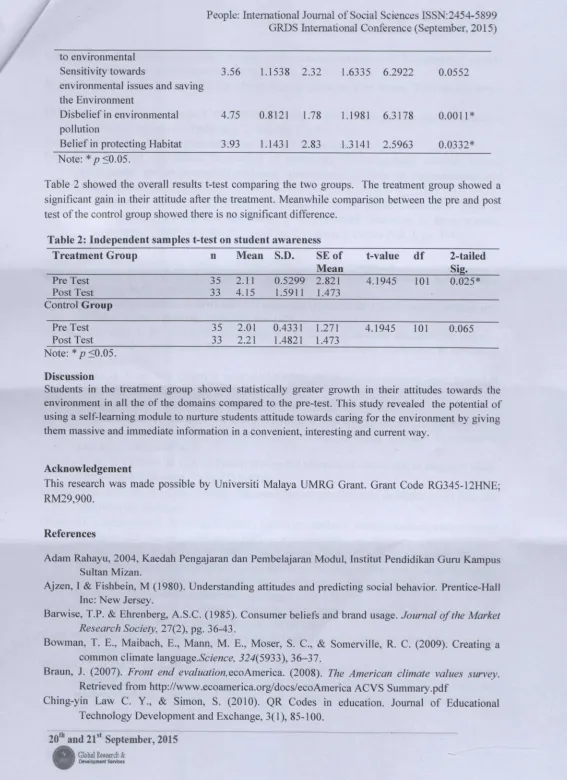
The result on impact of student attitude towards green environment in Table 1. The group with the given module showed a gain in attitude towards green awareness (4.75-3.56) compared to students without the module. These students who received module with QR-Code) showed a high mean scores in all items compared to students in the control group. Majority of these students in the treatment group (4.63) are willing to learn and be informed about the environmental issues than students in the control group (1.59). Disbelief in explanations related to environmental for students in the treatment group improved (3.88) and Sensitivity towards environmental issues and saving the Environment (3.56) better that the control group with only 2.43 and 2.32 mean scores. The students in the treatment also give high mean score (4.75 & 3.93) related to Disbelief in environmental pollution for the environment and Belief in protecting Habitat. Whereas the control group showed a lower mean which was 1.78 and 2.83.
Table 1: Students attitude towards green environment
Item
Treatment Control
Group Group
(N= 35) (N = 33) 2-tailed
Mean S.D. Mean S.D. t-value Sig.
4.63 0.1729 1.59 0.8452 7.1523 0.0342* 3.88 1.3453 2.43 1.6327 1.5483 0.0401 * Willingness to learn and inform
about environmental issues Disbelief in explanations related
20thand 21st September, 2015 Global Re5~arch&:
to environmental Sensitivity towards
environmental issues and saving the Environment
Disbelief in environmental pollution
Belief in protecting Habitat
3.56 l.1538 2.32 l.6335 6.2922 0.0552
[image:8.582.6.573.18.798.2]4.75 0.8121 l.78 1.1981 6.3178 0.0011 * 3.93 l.1431 2.83 1.3141 2.5963 0.0332* Note: *p :::;0.05.
Table 2 showed the overall results t-test comparing the two groups. The treatment group showed a significant gain in their attitude after the treatment. Meanwhile comparison between the pre and post test of the control group showed there is no significant difference.
Table 2: Independent samples t-test on student awareness
Treatment Group n Mean S.D. SEof t-value df 2-tailed
Mean Sig.
Pre Test 35 2.11 0.5299 2.821 4.1945 101 0.025*
Post Test 33 4.15 1.5911 l.473
Control Group
Pre Test 35 2.01 0.4331 1.271 4.1945 101 0.065
Post Test 33 2.21 1.4821 1.473
Note: *p :::;0.05. Discussion
Students in the treatment group showed statistically greater growth in their attitudes towards the environment in all the of the domains compared to the pre-test. This study revealed the potential of using a self-learning module to nurture students attitude towards caring for the environment by giving them massive and immediate information in a convenient, interesting and current way.
Acknowledgement
This research was made possible by Universiti Malaya UMRG Grant. Grant Code RG345-12HNE; RM29,900.
References
Adam Rahayu, 2004, Kaedah Pengajaran dan Pembelajaran Modul, Institut Pendidikan Guru Kampus Sultan Mizan.
Ajzen, I & Fishbein, M (1980). Understanding attitudes and predicting social behavior. Prentice-Hall Inc: New Jersey.
Barwise, T.P. & Ehrenberg, A.S.C. (1985). Consumer beliefs and brand usage. Journal a/the Market Research Society, 27(2), pg. 36-43.
Bowman, T. E., Maibach, E., Mann, M. E., Moser, S. C., & Somerville, R. C. (2009). Creating a common climate language.Science, 324(5933),36-37.
Braun, J. (2007). Front end evaluation,ecoAmerica. (2008). The American climate values survey.
Retrieved from http://www.ecoamerica.org/docs/ecoAmericaACVS Summary.pdf
Ching-yin Law C. Y., & Simon, S. (2010). QR Codes in education. Journal of Educational Technology Development and Exchange, 3( 1), 85-100.
20th and 21st September, 2015
e·
Global. Research &Crawley, F, E. & Koballa, T. R (1994). Attitude research in science education: Contemporary models and methods. Science Education, 78(1),35 - 55.
Eagly. A. H. & Chaiken. S. (1993). The Psychology of Attitudes. Fort Worth. TX:Harcourt Brace Jovanovich.
EI-Hussein, M. O. M., & Cronje, J. C. (2010). Defining Mobile Learning in the Higher Education Landscape. Educational Technology & Society, 13 (3), 12-21.
East, R. (1990). Cahnging consumer behaviour. Chassell Educational Ltd: London.
Erol, G.H. & Gezer, K. (2006). Prospective of elementary school teachers' attitudes toward environment and environmental problems, International Journal of Environmental and Science Education, 1(1), 65-77.
Erten, S., Ozdernir, P. & GUier, T. (2003). Determination of the pre-schoolteachers' levels of environmental awareness and the status of environmental education in these schools,
Proceedings ofOMEP 2003 World Council and Conference, Turkey (vol. 2, pp. 334-350).
Foxall, G.R (1983). Consurmer choice. The Macmillan Press Ltd: Hong Kong.
Hini, D., Gendall, P. & Keams, Z (1995). The Link between environmental attitudes and behaviour,
Marketing Bulletin, 6(3), pg. 22-31.
Intergovernmental conference on environmental education organized by Unesco in co-operation with UNEP at Tbilisi (USSR) on 14-26 Oktober 1977.
Hwang, G. J., Kuo, F. R, Yin, P. Y., & Chuang, K. H. (2010). A heuristic algorithm for planning personalized learning paths for context-aware ubiquitous learning. Computers & Education, 54(2),404- 415.
La Trobe, H.L.& Acott, T.G. (2000) A modified NEP/DSP environmental attitudes scale. Journal of Environmental Education, 32( 1), 12-21.
LAHIRl, Jhumpa (2008): Unaccustomed Earth. New York: Knopf
Liaw, S.-S., Hatala, M., & Huang, H.-M. (2010). Investigating acceptance toward mobile learning to assist individual knowledge management: based on activity theory approach. Computers & Education, 54(2), 446-454.
Liu, Y., Li, H., & Carlsson, C. (2010). Factors driving the adoption of rn-Iearning: an empirical study. Computers & Education, 55(3),1211-1219.
Loudon, D.L. & Della Bitta, AJ. (1993). Consumer Behaviour: Concepts and Applications (4th ed). McGraw Hill: Auckland.
Ozmen, D., Cetinkaya, A.<;. & Nehir, S. (2005). University students' attitudes towards environmental problems, TAF Preventive Medicine Bulletin, 4(6),330-344.
Pudin, S., Tagi, K. & Periasamy, A. (2005). Environmental Education in Malaysia and Japan: A Comparative Assessment Retrieved from http://www.ceeindia.org/esf/download/paper20.pdf Saunders, C., Brooks, A., & Myers, O. (2006). Using psychologyto save biodiversity and human
well-being: Challenges ahead. Conservation Biology, 20(3), 702-705
Schultz, P. W., & Zelezny, L. C. (2003). Reframing environmental messages to be congruent with American values. Human Ecology Review, 10(2), 126-136.
Shaof, M., Pollak, H., & Schneider, J. (2004). Math Trail. The Consortium for Mathematics and Its Applications.
Simsekli, y. (2001). Evaluation of activities in the selected schools for appliedenvironmental education project in Bursa city with respect to the contributions of school manager and teachers employed. The Journal of the Faculty of Education of Uludag University, 14(1), 73-84.
20thand 21st September, 2015
Global Research&:
The Topos Partnership, with C. Pike &M. Herr. (2009).Climate crossroad: A research-basedframing guide. Retrieved from http://www.connectusfund.org/files/CLIMATE CROSS ROADS.pdf UNESCO (1980). Environmental Education in the Light of the Tbilisi Conference (Paris UNESCO).
20thand 21st September, 2015
Global Re5f4fCn &