6
I
January 2018
M. A. Archana, Dr. C. Parthasarathy 1
Research scholar, 2Assistant Professor,Sri Chandrase kharendra Saraswathi Viswa Maha Vidyalaya, [SCSVMV], Kanchipuram, Tamilnadu, India
Abstract: This paper presents an overview of Energy efficient routing protocols that are intended to improve the throughput performance over Wireless Mesh Networks. The accompanying routing protocols depend on vitality efficient and throughput change in mesh network. Here the Dynamic source routing protocol, Intra-zone Routing Protocol (IARP) is used within the routing area to avoid congestion and Inter-zone Routing Protocol (IERP) was used between more than a specified routing areas. Keywords: Energy, Throughput, AODV, Routing Management, Wireless Mesh Networks
I. INTRODUCTION
A wireless mesh network (WMN) is an accumulation of radio terminals in which every hub transfers information utilizing mesh topology. It is additionally characterized as a sort of wireless ad hoc networks. The engineering of wireless mesh topology contains gateways, switches and mesh clients. The switches are in charge of sending network traffic from or to the gateways which is not important to interface it to the internet. Mobile phones, laptops and different gadgets are considered as mesh clients [1].
For the radio nodes, the scope region is assessed in view of the working region of nodes called mesh cloud. To frame a radio network, the mesh cloud is gotten to just in view of the working between each radio nodes. In mesh network, in the event that one hub is not worked for quite a while then alternate nodes are speak with each other to give repetition and unwavering quality. It might act naturally mend or self-shape on the grounds that the nodes can impart utilizing different nodes or middle of the road nodes. It is conceivable to execute it in all cellular and wireless innovations like 802.15, 802.11, and 802.16 without protocol confinements [2].
In MESH networks, soaring is a well-known idea utilized with steering protocols. The explanation behind utilizing is the need of interfacing internet with broad band get to. It is influenced in the area where legitimate physical association is not given this network. Consequently the costly of developing the network surpasses the real advantages of this mesh network. The ad hoc network gives the imperative idea of protocol steering in WMNs. Contingent upon the aggregate number of nodes and conceivable ways, the metrics based protocols are just utilized as a part of this network. This system does not consider the request of different innovations and execution of connections because of its adequacy. To make inventive steering and for the advancement of existing protocols, the disadvantages and distinctive procedures of metrics are required. The differing number of value measures, for example, security, adaptability, issues in regards to QoS, Efficient utilization of vitality, limit of switches without troubles and diminished reaction time if any progressions happen in topology needs to fulfil for the determination of protocol [3].
II. LITERATURE REVIEW
In WMN, the vitality utilization and throughput usage is considered for the plan of routing protocols. For efficient routing, it ought to guarantee low utilization of vitality with expanded throughput use. The accompanying routing protocols depend on vitality efficient and throughput change in mesh network.
A. AODV (Ad hoc On-Demand Distance Vector)
Figure 1: AODV protocol architecture
At the point when a node acquires the routing message, then it quits routing to the current node and send answer to the new node through different courses. The course started by the other node contains the most minimal estimation of bounce number for different nodes. The unused passages of routing table can be utilized after a specific day and age. The blunder message for routing is sent to the source node if node disappointment happens. The design (Figure 1) of AODV routing contains catche, FIFO, catche required for processing. For dealing with the courses; AODV utilizes three sorts of control messages. They are RREP, RERR and RREQ [4-6].
B. B.A.T.M.A.N. (Better Approach to Mobile Adhoc Networking)
The Better Approach to Mobile Adhoc Networking (B.A.T.M.A.N.) is a routing protocol which is reasonable for multi-jump ad hoc networks and it was made to trade existing OLSR. It was produced for the most part for potential utilization of mesh networks. In B.A.T.M.A.N., the aggregate data about the information's routing way is not incorporated. Henceforth it decreases the need of distributing network data to nodes if changes happen. Every node has just the data about the course utilized by the specific node to send and get packets. When sending the packets, transitory courses are made in light of the information goes through the middle of the road nodes. Routing data is kept up by the gathering of networks.
For various routing systems, advanced status of packet routing was built up. Routing table upkeep and UDP packet transmission is maintained a strategic distance from by making a delegate and unmistakable packet transmission by its own. Like other routing protocols, B.A.T.M.A.N. has routing components. Here, best way of packet was dictated by distinguishing different nodes and there courses. It considers each new node and gives data to the neighbors about alternate nodes which are already exists. The transitional PC and routing link was chosen by the administrator of network and professionals in stable network condition. At the point when the network changes always, the undertaking of finding the course was mechanized utilizing diminished investment of thresholds [7].
C. DSDV (Destination-Sequenced Distance-Vector Routing)
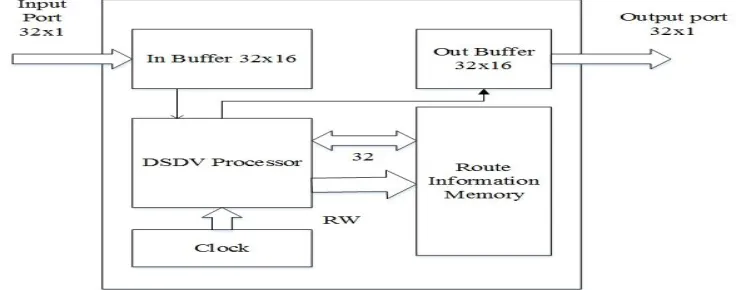
The table driven routing plan for mobile ad hoc networks which are used by Destination-Sequenced Distance-Vector Routing (DSDV) depends on Bellman Ford algorithm. The issue of circling is tackled by using this algorithm. Course data and succession number are the sections associated with each routing table.
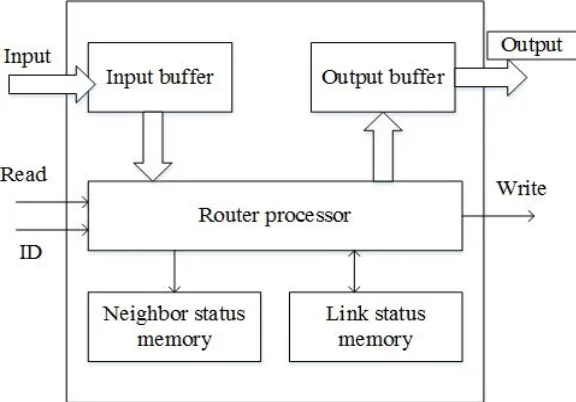
[image:3.612.118.486.573.718.2]The most ideal way information is put away by hubs preparing the course disclosure packets. The scholarly ways are used to course packets. To complete source routing, the coordinated packets contain the address of each gadget the packet will cross. This may bring about high overhead for long ways or broad areas, as IPv6. To maintain a strategic distance from using source routing, DSR on the other hand portrays an arrangement number decision that licenses packets to be sent on a hop-by-hop commence [9].
This protocol is truly in perspective of source routing whereby all the routing information is kept up at flexible hubs. It has only two important stages, which are Route Discovery and Route Maintenance. Course Reply would simply be created if the message has accomplished the normal objective hub. Course record which is at initially contained in Route Request would be implanted into the Route Reply.
E. OLSR (Optimized Link State Routing protocol)
OLSR is a routing protocol which can be used for wireless ad hoc networks which routes the IP address of the node. This is one of the optimized protocols used in mobile networks. Hello and TC messages are used by the OLSR protocol for link state routing which is proactive. It detects the information for the status of links using ad hoc and mobile networks. For computing the destination node with next hop, each node uses the topology information for all nodes in the link connection. Shortest hop path can be used to forward the hop information [10].
F. OSPF (Open Shortest Path First Routing)
OSPF routing protocol is used for Internet Protocol network services. It is categorised under the group of interior gateway protocols and it uses link state routing algorithm for detecting the required path. It was operated within a specific autonomous system. This routing protocol is mainly used by IGP of huge network enterprise. The protocol used by large service enterprise provider is Intermediate System to Intermediate System (IS-IS). IS-IS is one of the dynamic routing protocol which uses link state routing. OSPF can be used within a single routing domain of autonomous system which selects route for Internet Protocol (IP) packet routing. OSPF is an interior gateway protocol (IGP) to collect the information of links from the routing table and it develops the network topology for all routes. The routing information is forwarded to the Internet layer from the routing table to route the data packets based on the IP address of destination. Internet Protocol Version 4 (IPv4) and Internet Protocol Version 6 (IPv6) are the network versions supported by OSPF. It can also support for the addressing model of Classless Inter Domain Routing (CIDR) [11].
G. PWRP (Predictive Wireless Routing Protocol)
Figure 3 PWRP Architecture
It utilizes the entire network throughput needed for total transmission in 802.11g network. To establish a well-defined and user specified structure of network TropOS wireless service can be used. It has specific routers which uses software implementation with Mesh OS. To enlarge the network coverage area, the small and large networking areas are designed efficiently and which are scalable due to all operations. TropOS are well suited with area having more than thousands of miles [12].
H. TORA (Temporally-Ordered Routing Algorithm)
The Temporally Ordered Routing Algorithm (TORA) is mainly used for data routing in wide variety of Mobile ad hoc network and mesh networks. Park's algorithm is the wireless product developed for routing across various networks. Hierarchical or flat routing algorithms are used by TORA and it gives better scalability among networks. For controlling the propagation of message between various routing algorithms, this algorithm provides highest degree of potential. The solution from the minimal path is not selected by the TORA which is not specific to other routing algorithms [13].
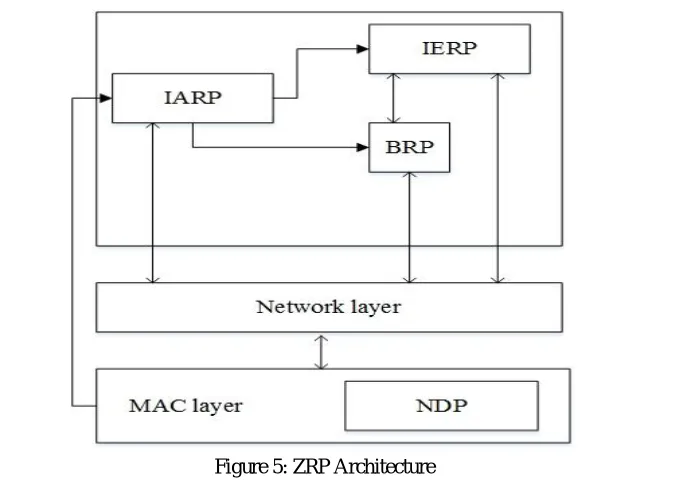
[image:5.612.164.452.514.715.2]Both routing protocols like reactive and proactive are used by ZRP or Zone Routing Protocol to transmit the information through the network. To enhance the speed and minimize the computations the efficient protocols are detected from the entire network. If the destination terminal is similar to the source terminal, the packet transmission is enabled by proactive protocol which stores the routing information in a table. For the source node of the packet, the routing is enhanced to the reactive protocol that detects the best routing path for destination. By using these routers the computation overhead was reduced. When the node is selected for routing, the proactive protocol stores the routing information in its table to transmit the data packet. The routing table is responsible for sending the packets which has the same routing information with the source node [15].
Figure 5: ZRP Architecture
III. CONCLUSION
In this paper, we compare the routing protocols that can achieve less energy consumption. We have here discussed that the attainable minimum delay and packet delivery ratio are of important issue to be considered. The different methods of Energy Efficient and Throughput Enhancement Routing Protocols gives us an idea as how to use them for over Wireless Mesh Networks Finally, maximum all the packets from the source will reach at the destination with minimum delay. Quality of service in the entire network is higher.
REFERNCES
[1] Daniel Aguayo, John Bicket, SanjitBiswas, Glenn Judd, and Robert Morris (2004) ‘Link-level measurements from an 802.11 b mesh network’, ACM, In ACM SIGCOMM Computer Communication Review, Vol 34, no 4, pp 121-132.
[2] Wei Zhang, Zhe Wang, Sajal K. Das, and Mahbub Hassan (2008) ‘Security issues in wireless mesh networks’, Springer US, In Wireless Mesh Networks, pp 309-330
[3] Sheikh Ferdoush, and Xinrong Li (2014) ‘Wireless sensor network system design using Raspberry Pi and Arduino for environmental monitoring applications’, Procedia Computer Science, Vol 34, pp 103-110
[4] Ali Moussaoui, FouziSemchedine, and AbdallahBoukerram (2014) ‘A link-state QoS routing protocol based on link stability for Mobile Ad hoc Networks’, Journal of Network and Computer Applications, Vol 39, pp 117-12
[5] LilianaEncisoQuispe, and Luis Mengual Galan (2014) ‘Behavior of Ad Hoc routing protocols, analyzed for emergency and rescue scenarios, on a real urban area’, Expert Systems with Applications, Vol 41, no 5, pp 2565-257
[6] SurmukhSingh, and Sunil Agrawal (2014) ‘VANET routing protocols: issues and challenges." IEEE, In Recent Advances Engineering and Computational Sciences (RAECS),pp 1-
[7] D. G. Reina, Jose Maria León-Coca, S. L. Toral, EleanaAsimakopoulou, Federico Barrero, Peter Norrington, and NikBessis (2014) ‘Multi-objective performance optimization of a probabilistic similarity/dissimilarity-based broadcasting scheme for mobile ad hoc networks in disaster response scenarios’, Soft Computing, Vol 18, no 9, PP 1745-1756
[8] Zehua Wang, Yuanzhu Chen, and Cheng Li (2014) ‘PSR: A lightweight proactive source routing protocol for mobile ad hoc networks’, IEEE transactions on Vehicular Technology, Vol 63, no 2, pp 859-868.
[9] ShubhajeetChatterjee, and Swagatam Das (2015) ‘Ant colony optimization based enhanced dynamic source routing algorithm for mobile Ad-hoc network’, Information Sciences, Vol 295, pp 67-90.
[10] AshishKots, and Manoj Kumar (2014) ‘The fuzzy based QMPR selection for OLSR routing protocol’, Wireless networks, Vol 20, no 1, pp 1-10
[11] Stefano Vissicchio, Olivier Tilmans, Laurent Vanbever, and Jennifer Rexford (2015) ‘Central control over distributed routing’, ACM SIGCOMM Computer Communication Review, Vol 45, no 4, pp 43-56
[12] Faisal KarimShaikh, and SheraliZeadally (2016) ‘Energy harvesting in wireless sensor networks: A comprehensive review’, Renewable and Sustainable Energy Reviews, Vol 55, pp 1041-1054
[13] Rohini Sharma, and D. K. Lobiyal (2015) ‘Proficiency analysis of AODV, DSR and TORA Ad-hoc routing protocols for energy holes problem in wireless sensor networks’, Procedia Computer Science, Vol 57, pp 1057-1066
[14] Varun G. Menon, and PM Joe Prathap (2016) ‘Opportunistic routing with virtual coordinates to handle communication voids in mobile ad hoc networks’, Springer International Publishing, In Advances in Signal Processing and Intelligent Recognition Systems, pp 323-334
[15] G. Ravi, and K. R. Kashwan (2015) ‘A new routing protocol for energy efficient mobile applications for ad hoc networks’, Computers & Electrical Engineering, Vol 48, pp 77-8
[16] YahyaTashtoush, Omar Darwish, and Mohammad Hayajneh (2014) ‘Fibonacci sequence based multipath load balancing approach for mobile ad hoc networks’, Ad Hoc Networks, Vol 16, pp 237-246
[17] Wui Lee Chang, Kai Meng Tay, and CheePeng Lim (2017) ‘A New Evolving Tree-Based Model with Local Re-learning for Document Clustering and Visualization’, Neural Processing Letters, pp 1-31
[18] Francisco J. Rodriguez, Susel Fernandez, Ines Sanz, Miguel Moranchel, and Emilio J. Bueno (2016) ‘Distributed approach for smart grids reconfiguration based on the OSPF routing protocol’, IEEE Transactions on Industrial Informatics, Vol 12, no 2, pp 864-871.