
Title: Implementing Peer Learning Across Organisations: The Development of a Model
Author: Paul Ashwin
Affiliation: University of Oxford
Correspondence Address: Institute for the Advancement of University Learning University of Oxford
Littlegate House St Ebbe's Street Oxford OX1 1PT
Telephone: +44 (0)1865 286811 Fax +44 (0)1865 286801
Abstract
Peer learning can be implemented by individual teachers within an organisation or can be implemented across an organisation by a central implementer. In this paper, it is argued that the types of approach required in these two forms of implementation are very different and whilst the former is dealt with in the literature on peer learning, the latter has been largely unconsidered. The paper reports how a review of the literature on organisational change was used to develop a model of how to implement peer learning across organisations. It describes how this model was used to guide the implementation of peer learning across a UK further education college. The results of a pilot study into the model’s effectiveness in this context are reported. These results suggest that the model appeared to be a useful guide to the implementation of peer learning across an organisation and, as such, is worthy of further investigation in other contexts.
Key Words
Educational Innovations Implementation Strategies Peer Learning
Implementing Peer Learning Across Organisations: The
Development of a Model
1There has been a good deal of writing on the implementation of peer learning. For example, two recent books (Boud et al 2001, Falchikov 2001) have considered the implementation, operation and effectiveness of peer learning schemes. This literature considers the implementation of peer learning from the perspective of teachers who wish to implement peer learning on their courses. However, peer learning can also be implemented across organisations. This raises a different range of issues to be considered in implementing peer learning and it is these issues that are the focus of this paper.
In this paper the literature on implementing peer learning across organisations is reviewed and found to offer an over simplified account of the implementation process. It is reported how a new model for the implementation of peer learning across organisations was developed through a review of the literature on organisation change. The results of a pilot study of this model’s effectiveness in a single educational setting are reported. It is concluded that the model was a useful guide to the implementation of peer learning in this context and is worthy of further investigation in other contexts.
Defining peer learning
The literature on implementing peer learning
Given the potential benefits claimed for peer learning in terms of increased rates of student retention and achievement for a relatively low cost (for example see Topping 1996, Packham and Miller 2000, Boud et al 1999), it is not surprising that some institutional managers are attracted to the idea of implementing peer learning across their organisations. However, whilst there has been a lot of consideration of the implementation of peer learning from the perspective of teachers who wish to implement peer learning on their courses in higher education if not in further education (see Boud et al 2001, Falchikov 2001 for two recent examples), there has been very little consideration of the implementation of peer learning across organisations.
There are two problems with this approach. First, it fails to recognise the differences between implementing peer learning on a single course and implementing peer learning across organisations. When a decision is made to implement across an organisation this is by its nature a management decision and involves a central implementer or co-ordinator. This implementer needs to work with teachers and students who may be sceptical about the motives behind the implementation of peer learning and may feel that there are potentially institutional rewards for those who participate and sanctions for those who do not. This is a very different scenario to teachers choosing to use peer learning. Second, this approach to implementing peer learning represents the use of what Chin and Benne (1970) called an empirical-rational strategy. This strategy is based on the assumption that those involved in, and affected by, changes will follow the rational choice once it is revealed to them, in this case choosing to become involved in peer learning. Elton and Cryer (1994) also criticise such strategies because they seek to change sympathetic individuals and then expect them to bring change throughout an institution. In seeking an alternative approach to the implementation of peer learning across organisations it becomes clear that the process of organisational change needs to be considered in a more sophisticated way.
A model for the implementation of educational innovations
steps of change, unfreezing is dealt with in point 1), changing in points 2) and 3), and refreezing in point 4). The model is as follows:
1) Putting the innovation into the context of current conflicts in the system
In order to gain support for the innovation, the implementers need to place it in the context of current conflicts in the system. It needs to be presented as the answer to problems that have already been identified in the system (Berg and Östergren 1977a, b). However, if the innovation is presented as a potential solution to these conflicts, then this will shape its aims and in turn the form of the innovation that is used.
2) Involving those affected by the introduction of the innovation
3) Developing the innovation in response to the quality of its fit with the environment in which it is implemented
Those involved in the implementation need to have the confidence to make any changes that become necessary to increase the chances of the schemes achieving their objectives during the implementation. Any model of the innovation that is used is only a guide and it should not prevent the implementer making individual innovation schemes fit within the particular environment in which they are implemented (Berg and Östergren 1977a, 1977b, Fullan 1993). Those who are leading the implementation need to recognise that it will take time for the innovation schemes to be implemented and to work effectively (Hörd 1987).
4) Embedding the innovation
Planning needs to begin early for the embedding of the innovation within the institution. If the innovation is not embedded in the institution, then it will be open to changes in priorities in that institution and may disappear when those involved in introducing them move on within, or leave, the institution (Schein 1972, Elton 1999). The approach to the innovation needs to be continually reviewed so that its fit within the organisation is maintained.
Using the model to improve the implementation of peer learning in post-compulsory education
the University of Missouri Kansas City in 1973. In its original form this scheme has the following characteristics (see Blanc et al 1983, Martin and Arendale 1993, Center for Supplemental Instruction 1998):
• SI targets ‘high risk’ courses. These are defined as courses that historically have a 30% or greater failure and withdrawal rate. These courses are defined as conceptually difficult rather than the students being seen as ‘difficult’ or the teaching being seen as ‘poor’.
• SI involves peer facilitators (SI leaders) who have completed a course, or elements of a course, offering support to all the students (SI users) who are studying that course, or the elements of that course.
• The SI leaders receive an initial two-day training on learning theory and the SI approach, and on-going support from a central SI Co-ordinator, who supports and administers the scheme.
• SI is offered in weekly sessions that take place outside of the mainstream curriculum. The SI users’ attendance at these sessions is voluntary.
• The SI sessions begin at the same time as the course so that problems can be picked up as they occur, rather than providing support once problems have been identified.
• The SI leaders do not teach new course material, but instead structure the sessions to facilitate the SI users sharing, processing, and restructuring course material through group discussion and exercises.
After three years of attempting to promote SI in the college and despite high levels of management support, there were low levels of student and teacher participation in SI. A new implementation strategy was developed in September 1996, by applying the model for implementing educational innovations to the implementation of peer learning. The existing SI implementation strategy was reviewed under each of the headings in the model and from this a new implementation strategy, the Peer Support implementation strategy, was developed.
1) Putting the innovation into the context of current conflicts in the system
The main focus of SI was the improvement of retention and achievement on courses. This addressed the conflict between increasing retention and achievement within a context of reduced funding per student. However, this conflict reflected the concerns of management. Teachers did not see the need for SI and reported seeing it as representative of changes in the roles of teachers that they were trying to resist. Many of the students who were offered support did not attend the sessions, and so it would appear that they did not see it as addressing their needs. SI leaders reported gaining from their involvement in the schemes, but suggested that the SI approach prevented them from supporting as many students as they might have under an alternative approach.
of the teachers and students did think that Peer Support had improved academic performance on their courses. However, the presentations involved different emphases and not all schemes that teachers developed had a direct effect on retention. In this way whilst under the SI implementation strategy managers decided which form of peer learning would be used, under the Peer Support implementation strategy teachers and students made this decision.
2) Involving those affected by the introduction of the innovation
SI is a pre-designed peer learning scheme, which has a rigid structure that is implemented regardless of the context in which it operates. It was designed outside of the college and implemented in the way that was presented in the literature on SI. Thus, those affected by the introduction of SI were not involved in its implementation. They were not consulted and their ideas and experiences were not used to ensure a fit between the form of peer learning and college environment. Many teachers and students did not participate in SI and this seemed to be because they did not see it as relevant to them.
3) Developing the innovation in response to the quality of its fit with the environment in which it is implemented
SI was not changed in response to its shortcomings. The feedback from students, SI leaders and teachers about its lack of relevance was viewed, at first, as being due to their lack of understanding of the scheme and what it was trying to achieve. The schemes were implemented by the SI co-ordinator acting alone using a single model for the schemes, and this made changing the schemes very difficult.
In implementing Peer Support, schemes were changed in response to their shortcomings. The teachers and students acting with the Peer Support co-ordinator implemented the schemes. The design of a Peer Support scheme was recognised as a developmental process. Schemes were changed at the end of and during the year. Feedback from teachers and students was automatically used to alter the scheme because it was they who were partly responsible for designing the scheme.
4) Embedding the innovation
SI was embedded in the institution in terms of the provision of a post to implement the scheme. However, it was not embedded into courses and the courses involved in SI changed from year to year.
To summarise, the main differences in the approaches adopted in implementing SI and Peer Support can be characterised in three ways. First, whilst SI was designed outside of the college, the teachers and students involved in running the Peer Support schemes designed them. Second, whilst SI was imposed by management, in the sense that they decided on the model of peer learning that would be used, Peer Support was imposed on management, in the sense that teachers and students could design their own models of peer learning. This was a change that was accepted by management. Finally, whereas a peer learning co-ordinator acting largely in isolation implemented SI, Peer Support was implemented by a co-ordinator acting with teachers and students.
Research Methods
In order to assess the effectiveness of the new implementation strategy two measures were used. First, the number and diversity of peer learning schemes was examined. If the implementation strategy was successful then more teachers would have been willing to become involved in the scheme and equally students and teachers would have begun to develop schemes that reflected their views of how peer learning could be effective. Second, the number of students involved in peer learning, as well as the proportion of those who were offered peer learning who attended, were examined. If the schemes that were implemented were more relevant to the students, then the number and proportion of students who attended would have increased.
Results
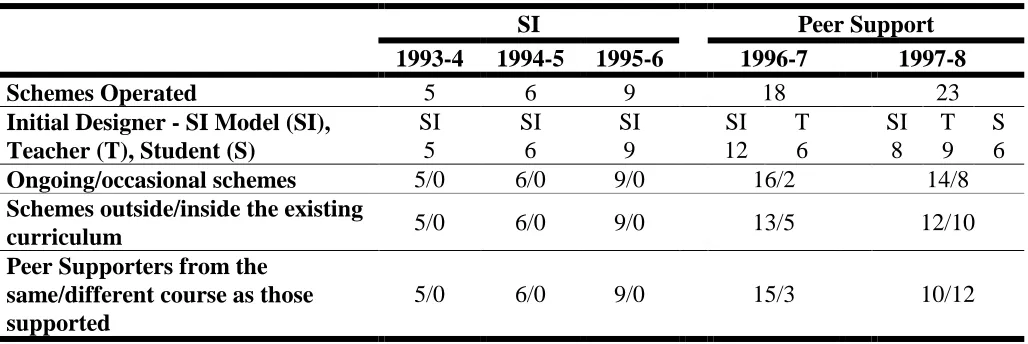
Table I shows the number and diversity of schemes that were developed under Peer Support and SI in the college. It shows that the number of schemes operated rose with the introduction of the Peer Support implementation strategy. The number of schemes Table I
operated rose sharply in 1996-7, the year that the SI implementation strategy was replaced with the Peer Support implementation strategy. In the two years following the setting up of SI in 1993-4, the number of peer learning schemes had increased by 80%, whereas in the two years of Peer Support the number of schemes increased by 156%.
these schemes were not necessarily new forms of peer learning, in fact SI still operated on a number of courses and some of the others forms are discussed in Topping (1996). What was new was the process in which teachers and students, in discussion with the implementer of peer learning, designed schemes that they felt were most appropriate for their context.
Table II shows the involvement of students who were offered peer learning under the SI and Peer Support implementation strategies. As student attendance at most of the schemes was voluntary, the increases in the level of attendance and the percentage of students who were offered peer learning who attended suggest that the schemes were more relevant to the students to whom they were offered. Average attendance under the SI implementation strategy had been low. Under the three years that SI ran average attendance only increased by 29%. When the Peer Support implementation strategy was introduced in 1996-7 the average attendance rose by 105%. Under the Peer Support implementation strategy there was also an increase in the number of students offered peer learning and the percentage of those who attended one or more and three or more sessions. In 1997-8, 54% of students offered peer learning attended at least one session compared to 23% in 1993-4. The percentage of students attending sessions under the Peer Support implementation strategy were higher than has been reported in the SI literature (for example Center for Supplemental Instruction 1998) where, on average, a third of students attend one session.
Conclusions
It appears that the model for the implementation was a useful and effective guide for the implementation of peer learning in this context. The number and diversity of schemes increased, as did the number of students, and the proportion of those students Table II
offered peer learning, who attended. It appears that it was the involvement of students and teachers in the process of designing peer learning schemes they felt fitted with their context that was key to the improved implementation of peer learning.
There are two limitations of this research. First, the measures used give no indication of the quality of peer learning that was offered, or the how involvement in peer learning affected the quality of students’ learning. There were quality assurance procedures under both implementation strategies but these issues of quality are something that would be worthy of investigation if the model were used in the future. Second, this investigation of the implementation of peer learning was very much a pilot study and as such only considered the implementation of peer learning within a single organisation. This gives no indication of whether the implementation strategy is applicable to other contexts. However, the results of this pilot study are encouraging enough to suggest that the model of implementation is worthy of further investigation in other contexts.
Notes
1. I would like to thank the students and staff of Newham College of Further Education for their support in conducting this research. I would also like to thank Lewis Elton, Ann Meredith, and Keith Trigwell for their helpful comments on earlier drafts of this paper.
References:
AINSWORTH,L.,GARNETT,D.,DANAY,P.,SHANNON,S. AND RIPPERGER-SUHLER,K.
(Eds) Supplemental Instruction: increasing achievement and retention, New directions in Teaching and Learning, 60, Winter (San Francisco, Jossey-Bass).
BERG,B.&ÖSTERGREN,B. (1977a) Innovations and Innovation Processes in Higher
Education (Stockholm, UHÅ.)
BERG, B. & ÖSTERGREN, B. (1977b) Innovation Processes in Higher Education, Studies in Higher Education 4, pp. 261 – 268.
BLANC,R.A.,DEBUHR,L.E.,&MARTIN,D.C. (1983) Breaking the attrition cycle: the
effects of Supplemental Instruction on undergraduate performance and attrition, Journal of Higher Education, 54(1), pp.80-90.
BOUD, D., COHEN, R., & SAMPSON, J. (2001) Peer learning and Assessment, Assessment and Evaluation in Higher Education, 24(4), pp. 413-426.
BOUD, D., COHEN, R., & SAMPSON, J. (2001) Peer learning in higher education
(London, Kogan Page).
BROWN, W.F. (1977) Student-to-Student Counseling: An approach to academic achievement, Revised Edition (Austin, University of Texas Press).
CENTER FOR SUPPLEMENTAL INSTRUCTION (1998) Supplemental Instruction: Review of
City and other institutions from across the United States (Kansas City, University of Missouri-Kansas City).
CHIN, R. & BENNE, K.D. (1970) General strategies for effecting changes in human
systems in W.G. BENNIS, K.D. BENNE & R.CHIN (eds.) The Planning of Change Second Edition ( London, Holt Rinehart and Winston).
DONALDSON, A.J.M. & TOPPING, K.J. (1996) Promoting Peer Assisted Learning
Amongst Students in Higher Education (Birmingham, Staff and Educational Development Association).
ELTON,L (1999), New ways of learning in higher education: managing the change, Tertiary Education and Management, 5, pp. 207 – 225.
ELTON,L.and CRYER,P.(1994)‘Quality and change in higher education’ Innovative
Higher Education 18 (3) pp.205-220.
FALCHIKOV,N. (2001) Learning together: peer tutoring in higher education (London, RoutledgeFalmer).
FULLAN,M. (1991) The New Meaning of Educational Change (London, Cassell).
FULLAN, M. (1993) Change Forces. Probing the depth of educational reform
GOLDSCHMID,B. & GOLDSCHMID,M.L. (1976) Peer teaching in higher education: a review, Higher Education, 5, pp. 9-33.
GOODLAD, S. & HIRST, B. (1989) Peer Tutoring: a guide to learning by teaching
(London, Kogan Page).
GRIFFITHS, S., HUSTON, K., & LAZENBATT, A. (1995) Peer Tutoring: Enhancing Student Learning through Peer Tutoring in Higher Education (Colraine, University of Ulster).
HÖRD,S. (1987) Evaluating Educational Innovation (London, Croom Helm).
LEWIN,K. (1952) Field Theory in Social Change (London, Tavistock).
MARTIN,D.C.&ARENDALE,D.R. (Eds) (1993) Supplemental Instruction: Improving
First-Year Student Success in High-Risk Courses Second Edition (Columbia, SC, National Resource Center for the Freshman Year Experience and Students in Transition).
MARTIN,D.C.&ARENDALE,D.R. (Eds) (1994) Supplemental Instruction: increasing achievement and retention, New directions in Teaching and Learning, 60, Winter (San Francisco, Jossey-Bass).
PARLETT,M.&HAMILTON,D. (1972) Evaluation as Illumination: A new approach to
the study of innovatory programs (Edinburgh, University of Edinburgh Centre for Research in the Educational Sciences, Occasional Paper Number Nine).
RUST,C.&WALLACE,J.(Eds) (1994) Helping Students to Learn from Each Other:
Supplemental Instruction (Birmingham, Staff and Educational Development Association).
RYAN,B.A. (1974) PSI. Keller’s Personalised System of Instruction: An Appraisal
(Washington, DC, American Psychological Association).
TOPPING,K. (1996) The effectiveness of peer tutoring in further and higher education:
a typology and review of the literature, Higher Education, 32(3), pp. 321-345.
SCHEIN,E.H. (1972) Professional Education (New York, McGraw Hill).
WINTER,R. (1996) Some principles and procedures for the conduct of action research in O, ZUBER-SKERRITT (ed) New Directions in Action Research (London, Falmer
Press).
WHITMAN, N.A. (1988) Peer Teaching: To Teach is to Learn Twice (Washington,
SI Peer Support 1993-4 1994-5 1995-6 1996-7 1997-8
Schemes Operated 5 6 9 18 23
Initial Designer - SI Model (SI), Teacher (T), Student (S)
SI 5
SI 6
SI 9
SI 12
T 6
SI 8
T 9
S 6
Ongoing/occasional schemes 5/0 6/0 9/0 16/2 14/8
Schemes outside/inside the existing
curriculum 5/0 6/0 9/0 13/5 12/10
Peer Supporters from the same/different course as those supported
[image:20.595.43.557.100.272.2]5/0 6/0 9/0 15/3 10/12
SI Peer Support 1993-4 1994-5 1995-6 1996-7 1997-8 Number of peer learning sessions 60 105 121 219 326
Average Attendance 2.8 2.8 3.6 7.4 8.2
Number of students offered peer
learning 326 414 572 964 1246
Students attending ≥ 1 sessions 76 130 132 395 677
Percentage of students offered peer
learning who attended ≥ 1 sessions 23% 31% 23% 41% 54%
Students attending ≥ 3 sessions 31 49 67 195 380
Percentage of students offered peer
![[−2]proPSA versus ultrasensitive PSA fluctuations over time in the first year from radical prostatectomy, in an high-risk prostate cancer population: A first report](data:image/gif;base64,R0lGODlhAQABAIAAAP///wAAACH5BAEAAAAALAAAAAABAAEAAAICRAEAOw==)