Munich Personal RePEc Archive
Forecasting international bandwidth
capacity using linear and ANN methods
Madden, Gary G and Tan, Joachim
Curtin University of Technology, School of Economics and Finance,
Perth WA 6845, Australia, Curtin University of Technology, School
of Economics and Finance, Perth WA 6845, Australia
2008
Online at
https://mpra.ub.uni-muenchen.de/13005/
Forecasting International Bandwidth Capacity using Linear and ANN
Methods
Abstract
An artificial neural network (ANN) can improve forecasts through pattern recognition of historical data. This paper evaluates the reliability of ANN methods, as opposed to simple extrapolation techniques, to forecast Internet bandwidth index data that is bursty in nature. A simple feedforward ANN model is selected as a nonlinear alternative as it is flexible enough to model complex linear or nonlinear relationships without any prior assumptions about the data generating process. These data are virtually white noise and provides a challenge to forecasters. Using standard forecast error statistics, the ANN and the simple exponential smoothing model provide modestly better forecasts than other extrapolation methods.
Keywords: artificial neural networks, packet data traffic, telecommunications forecasting
Gary Madden*
School of Economics and Finance, Curtin University of Technology GPO Box U1987, Perth, WA 6845
Tel: 61-8-9266-4258 [email protected]
Joachim Tan
School of Economics and Finance, Curtin University of Technology Perth, WA 6845
Australia
I. Introduction
For electronic markets to successfully deliver IP-based telephony, video and TV requires a
quality of service that matches their analogue counterparts. Clearly, traffic management is a
key component of any business critical network. That is, as traffic patterns continue to
rapidly evolve, service providers need to monitor, analyse and optimize traffic to forecast
and accommodate future trends. Interestingly, the International Telecommunication Union
(ITU) makes recommendations on best practices for network operation (Villén-Altamirano
2001).1 ITU traffic engineering recommendations are identified by traffic demand
characterization, grade of service objectives, traffic controls and dimensioning, and
performance monitoring. In particular, forecasting is an important input into network traffic
control and performance monitoring.2 Recommendation E.507 deals with methods deemed
appropriate for forecasting traditional services based on historical data. The
Recommendation provides an overview of existing mathematical techniques for forecasting
that includes curve-fitting models, autoregressive models, autoregressive integrated moving
average (ARIMA) models, state space models with Kalman filtering, regression models and
econometric models.3 However, Recommendation E.507 does not explicitly consider
appropriate mathematical and statistical techniques for forecasting packet-switched data
traffic, which is bursty in nature.4 While forecasting how broadband traffic flows arise is
difficult because the composition of services provided over these networks is not well
understood, more fundamentally, the focus of forecasting interest for packet-switched
networks is different to that for circuit-switched networks. That is, the forecasting concern
should be congestion spikes which slow the system, rather than predicting average network
Accordingly, this paper applies an artificial neural network (ANN) model to forecast Internet
bandwidth traffic via pattern recognition of historical data. ANNs are potentially useful for
this application as they require few a priori assumptions about the models for problems
under study. In particular, ANNs are argued to learn from examples and capture subtle
functional relationships among data even when the underlying relationships are unknown or
hard to describe (Zhang et al 1998). In doing so the paper evaluates the relative reliability of
ANN methods when compared with several linear extrapolation techniques. The paper is
structured as follows. The nature and characteristics of plain old telephone service (POTS)
and packet data traffic are considered in Section II. Section III reviews forecast methods
employed in this study, and discusses error statistics used to evaluate forecast performance.
Section IV provides a description of Internet router index data modelled in the study. These
data allow the examination of traffic characteristics—most significantly, the burstiness of
data traffic. Section V presents nonlinear test results. Section VI presents forecast results and,
Section VII concludes.
II. POTS and Packet Data Traffic Behavior
The POTS network is a connection-oriented network where calls are assigned constant
bandwidth. Commonly accepted fundamental assumptions about such traffic are: (a) within
hour traffic fluctuations are reasonably well predicted with traffic models based on a Poisson
arrival process; (b) beyond hourly variations are significant but follow patterns that tend to
repeat, e.g., there is an hour of the day ‘busy hour’ that tends to bear the highest load; (c)
there are predictable seasonal variations, e.g., there is a ‘busy season’ that is repeated
annually; (d) annual traffic variation is generally gradual, and the use of linear forecasting
network, new calls are denied access (Noll 1991). In this network, the ‘low-frequency’
traffic variations are either repetitive daily variations or of low magnitude annual variations.
Higher-frequency variability caused by individual call attempts is well understood.
Therefore, in a POTS network a major way to manage congestion is to engineer the network
so congestion rarely occurs. However, when discussing data traffic, another paradigm is
required as the dominant traffic variability is in the range of milliseconds, and packets and
‘packet trains’ enter the network at random times.5 The variability at this time scale is
enormous, with relatively low mean utilization and high burstiness.
III. Forecast Model Specification
Traditional approaches to times series prediction, such as Box-Jenkins, assume that series are
generated by linear processes (Pankratz 1983). As many real world systems are nonlinear,
the application of these methods to forecasting is problematic (Granger and Terasvirta 1993).
An obvious alternative is the formulation and application of a pre-specified nonlinear model.
However, nonlinear models face the difficulty of being general enough to capture all
important features of these data. ANNs, which are nonlinear data driven approaches, are
more flexible in that they can perform nonlinear modelling without any detailed a priori
knowledge of relationships among input and output variables (Zhang et al 1998).
Accordingly, this study examines the performance of an ANN against several linear
extrapolation models in forecasting Internet bandwidth index data. This focus is interesting,
as the received M-competition literature indicates that ANN methods are not superior to the
relatively simpler extrapolation methods commonly employed by professional forecasters.
However, Madden and Coble-Neal (2005) find that standard univariate linear time-series
poor forecast performance is in part due to bandwidth index data not exhibiting underlying
patterns for required extrapolation techniques to generate reliable forecasts. Further, data
generated by complex processes, such as by Internet routers, can appear random.
Accordingly, under these circumstances, the analysis of these data by a nonlinear ANN
model is worthy of consideration.6
A commonly employed model is the single hidden layered feedforward network without any
direct connections between inputs and outputs. This ANN is chosen because Hornik et al
(1989) shows an ANN model with a single layer and a sufficient number of hidden nodes
can approximate any continuous function to an arbitrary degree of accuracy. The ANN used
here is assumed sufficient to capture any underlying nonlinear processes in these data. In
particular, the ANN ( , )p q model employed for forecasting is
1
( )
q
t j t j j
y β G yγ t
=
′
=
∑
+ε)
(1)
where yt′ is a vector series of p lagged dependent variables yt−j(j=1, 2,…,p as inputs, q is
the number of hidden layer cells, ( )G ⋅ is the transfer function that connects the p+1 input
components with the hidden layer and εt is white-noise error. A logistic (or sigmoid)
transfer function:
1
0 0 1 2 2
(1 exp( ( j j t j t pj t p)))
G= + − γ +γ y− +γ y− + +… γ y− − (2)
is employed. While cosine, hyperbolic tangent, linear and sine functions are sometimes used,
performance of networks (Zhang 2004).
The total number of parameters for an ANN model estimated by (1) is equal to the number
of lags and hidden layers. Lags of the series vary from 1 to 5, and hidden layers vary from 1
to 2 to determine the best ANN ( , )p q model. Hence, the ANN model contains
parameters. (q+1)(p+ −1) 1
Due to the short length of sample series, an in-sample model selection criterion is employed.
ANN model parameters are estimated by minimising the in-sample mean squared prediction
error. The best fitting ANN model is chosen by comparing values of the generalised
Akaike’s Information Criteria (AIC), Bayesian Information Criterion (BIC) and a modified
AIC (AICC) proposed by De Gooijer and Kumar (1992) and Granger (1993).7 Comparison
of test criterions under different parameter configurations leads to the estimation of 10 ANN
models under each test criterion. The generalised AIC, the AICC and the generalised BIC
test statistics are
T m AIC d q p 2 ) ˆ log( (2, ) +
= σ ,
1 2 ) ˆ log( (2, )
− − + = m T m
AICC σ pq ,
and T T m BIC d q p ) log( ) ˆ log( (2, ) +
= σ .
2 ) , (
ˆ pq
is the number of observations, the exponential d is a constant, usually set greater than 1 for
nonlinear models, adjusts the magnitude of the penalty term in the BIC test (De Gooijer and
Kumar, 1992 and Granger, 1993) and m is the number of parameters of each particular
ANN ( , )p q model tested.9
The univariate linear extrapolation techniques used to allow forecast accuracy comparison
with ANN forecasts are: Parzen’s (1982) ARARMA, ARMA, Holt, Holt-D, Holt-Winters,
Simple Exponential Smoothing (SES) and Grambsch and Stahel’s (1990) Robust Trend
(RT).10 These latter forecast methods are shown reliable by Fildes (1992), Makridakis et al
(1993), Fildes et al (1998) and Makridakis and Hibon (2000) by consistently performing
well in the M-competition.11
Estimation by method begins at observation 8 to allow a subset of data of observation 1 to
observation 7 to estimate each model.12 This allows a possible maximum 7 period lag length
for the estimation of parameters of the ARARMA and ARMA models.13 Hence, the
parameters by method are estimated from observation 8 to 202. Grid search for the optimal
lag length for the ARMA, ARARMA are based on the lowest value of the AIC, while the
ANN models are based on the lowest value of AIC, Modified AIC and BIC statistics.14
Holt-D, Holt-Winters and RT models have fixed lag lengths and do not require grid search to
select the best model.15 The best model by series and method are used to generate 30
one-step forecasts. To evaluate forecasts, the last 30 series observations are set aside.
Forecast accuracy measures employed are guided by Armstrong and Collopy (1992), viz.,
mean absolute percentage error (MAPE), median absolute percentage error (MdAPE) and
IV. Data
Data used is acquired from the Internet Traffic Report and consists of 59 bandwidth traffic
index series. Series are comprised of 232 observations.17 These data are sampled from a
continuous data generating process, and drawn daily at 7am Australian Eastern Standard
Time weekdays from 18 February 2000 through 3 March 2001. A representative specimen of
these data is shown in Figure I. Each series is an index measure of Internet traffic that
oscillates between zero and 100, and appear to exhibit typical characteristics of stationary
series.18 A common feature of many series is the presence of occasional downward spikes.
Spikes are outlier index values that indicate network congestion. In forecasting with linear
models, where the goal is often mean prediction with minimum error, it is common practice
to eliminate outliers from sample data. However, for packet data networks the accurate
prediction of congestion spikes is a forecasting goal due to the nature of congestion, i.e.,
degraded network quality of service rather than access denial.
<Insert Figure I here>
Summary statistics indicate the frequency of the downward spikes with 27 of the 59 routers
reporting at least one minimum value below the 25th percentile. Sampled regions include
Australia, East Asia, Israel, North America, Russia, South America and Western Europe.
Regions not included are Africa, Antarctica and most of the Middle East. The Denver
denver-br2.bbnplanet.net router is recorded as providing the fastest response, while AOL1
pop1-dtc.atdn.net has the lowest response time. On average, the Perth1 opera.iinet.net.au
typically records the slowest response.19 The sample average coefficient of variation is 6.3
and the corresponding standard deviation is 1.8.
Following Fildes (1992), the frequency of outliers, strength of trend, degree of randomness
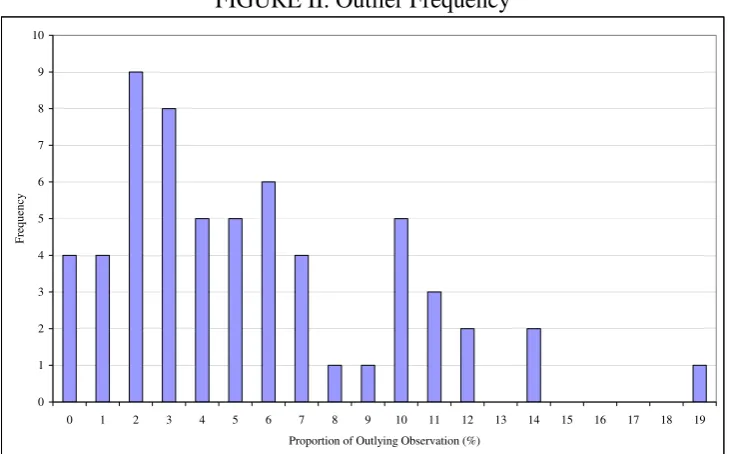
and seasonality are analyzed. The results are shown in Figure II through Figure V. An
observation Xt is treated as an outlier when either Xt <Lx−1.5(Ux −L) or
, where L )
( 5 .
1 x x
x
t L U L
X > + − x denotes the lower quartile and Ux the upper quartile. The
strength of trend is measured by the correlation between series (with outliers removed) and a
time trend, with the absolute value of the trend indicating its strength. Randomness is
measured by estimating the regression:
3 t 3 2 t 2 1 t 1
t t X X X
X′ =α+β +δ ′− +δ ′− +δ ′− , (3)
where X′t denotes the series Xt with outliers removed. R2 measures the variation explained
by the model. High R2 indicates low randomness, while low R2 reveal high randomness.
Deterministic seasonality is estimated by regressing the series on an intercept and dummy
variables which equal one when t=s, where t denotes observation Xt’s position in time and
s corresponds to the frequency of the seasonality. For example, to test the hypothesis that
Mondays are statistically different to bandwidth capacity for the rest of the week, t = {1, 2,
3, 4, 5, … , T}, s = {1, 5, 10, 15, … , T} and dummy variable DMonday = 0 for t = s, zero
otherwise.
Figure II reveals half the series contain between 1% and 5% outliers. In percentage terms
these data appear slightly more heterogeneous than Fildes (1992) telecommunications data.
Figure III shows that these data are generally not correlated with time. This contrasts with
Fildes, where the data there exhibit strong negative trends. Moreover, histograms contained
in Figure III and Figure IV reveals that variation in these data presents a high degree of
randomness with little serial correlation.
<Insert Figures III & IV here>
Finally, Figure V presents some evidence of regularity in weekly capacity variation
aggregated by region. There appear regular dips occurring on different days across regions.
Typically, Asia experiences lower traffic volumes from Wednesday through Friday, while
most Australian routers have excess capacity from Monday through Tuesday. Conversely,
Europe and North America experience a smoother traffic flow—perhaps due to more
sophisticated capacity pricing and network management systems. Finally, South American
Internet traffic variation is tied to particular routers.
<Insert Figure V here>
Regressions are also conducted to test for regularity of both weekly and monthly traffic
patterns. Weekly variation is not apparent with only 6 routers reporting regular spikes across
weeks. Surprisingly, given the short time-series, substantial monthly variation was found for
95% of sampled routers.20 Although the sustained increase in traffic is too haphazard across
routers to reveal a cyclical pattern. Most routers experience significant increase for an
reflect the average lagged response time required before routers are expanded to cope with
the increased traffic. Once expanded, the Internet traffic index for the router is likely to
increase, reflecting a permanent increase in capacity. To sum, these data exhibit a high
degree of randomness with not infrequent spikes in index scores apparent. Compared to
telecommunications data analyzed in Fildes (1992) and Fildes et al (1998), these data appear
considerably more heterogeneous and so less predictable.
V. Tests for Nonlinearity
To further uncover the structure of the data, several parametric nonlinearity tests are
performed.21 Tests employed are the Ljung-Box (1978) Q test (LBQ), McLeod and Li
(1983) test (Mc&Li), Engle’s (1982) autoregressive conditional heteroscedasticity test
(ARCH), Ramsey’s (1969) regression error specification test (RESET), Tsay’s (1989)
threshold autoregressive test (TAR) and White’s (1989,1990) ANN test.22
Each of the tests is sensitive to linear and nonlinear correlation. Hence, it is important to
control for the presence of linear autocorrelation prior to performing tests on the data by
filtering the linear autocorrelation of traffic index series before the nonlinear tests are
employed. This pre-whitened process applies the best fitting ARMA ( , )p q model by series
based on the lowest value AIC statistic.23 The nonlinear tests are then applied to the
residuals of the best fitting ARMA model by series.
From the normality test performed on the residuals of pre-whitened series indicate residuals
are highly non-normal. This suggests the ARMA model is unable to capture data
characteristics. This result is similar to Madden and Coble-Neal (2005) suggesting univariate
methods such as ARMA may not be suitable for modelling the bursty Internet traffic data.
The JB test suggests possible misspecification of the ARMA model. However, Ramsey’s
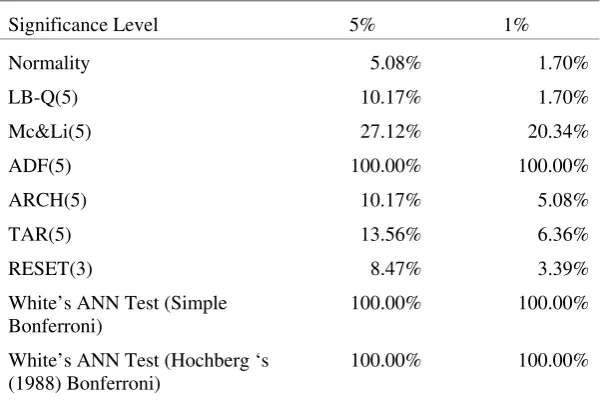
RESET test, shows no nonlinearity in these data. 24 The RESET test show only 8.47% (5 of
59 index data series) and 3.39% of series tested at the 5% and 1% significance levels,
respectively, are misspecified.
To further investigate the data structure, Tsay’s TAR test, LBQ(5) test and Engle’s
ARCH(5) test are employed. The results of the TAR test shows 13.56% and 6.36% of series
have threshold breaks in the traffic data series at the 5% and 1% significance, respectively,
indicating most series do not exhibit breaks in mean value.25
Next, to examine these data for ARCH effects, the LBQ(5), Mc&Li(5) and ARCH(5) tests
are conducted. No ARCH effects are present in these data. The LBQ(5) show 10.17% and
1.7% of series do not have any cross correlations in the residuals at the 5% and 1%
significance levels, respectively. ARCH(5) tests indicate a similar finding, as 10.17% and
5.08% of tested series do no exhibit ARCH effects at 5% and 1% significance, respectively.
Despite mixed evidence of nonlinearity, White’s ANN test strongly rejects linearity. P
-values of White’s ANN test are estimated using the Bonferroni technique and Hochberg’s
(1988) modified Bonferroni technique at 5% and 1% significance.26 The nonlinearity
captured using the ANN test may be the result of interactions between the lags of the traffic
series. This means employing a more flexible modelling technique using the ANN model
<Insert Table II here>
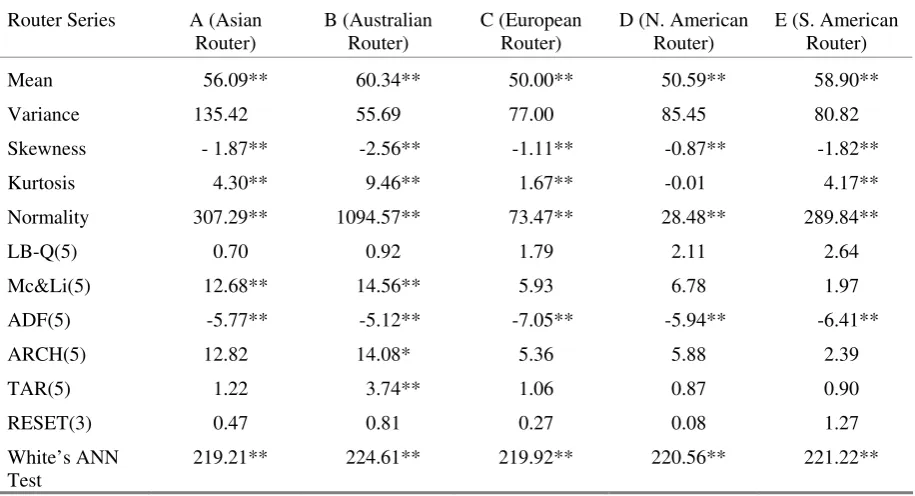
To ascertain if the characteristics of the sample series are homogeneous, a randomly chosen
sub-sample of geographical regions is examined.27 The results are reported in Table II. The
Internet traffic index across regions are stationary but are not normally distributed. Table II
shows routers in Asia typically face congestion on the Internet networks with highest
variance. This is followed by the North American and South American regions. Although the
Australian router has the lowest variance, the results also suggest nonlinear behaviour is
present.
VI. Forecasts
To identify the most accurate forecast model, aggregate results (either mean or median of 59
forecasts) by method are compared through an output sample forecast horizon. A maximum
30 steps (days) ahead forecasts using MAPE, MdAPE and PB error statistics are
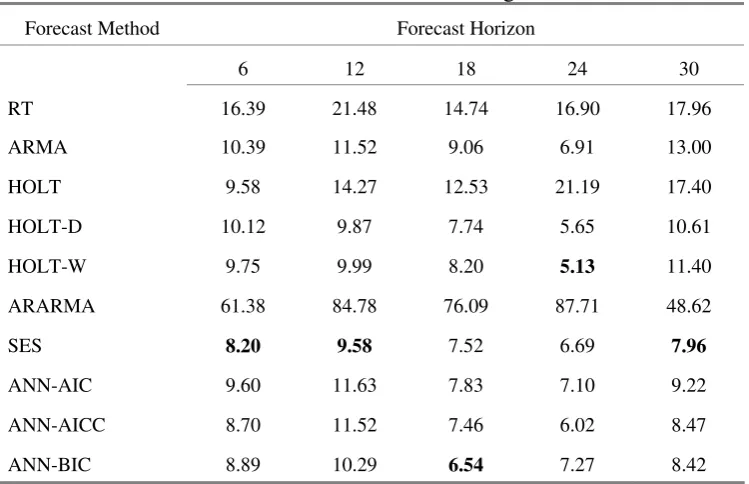
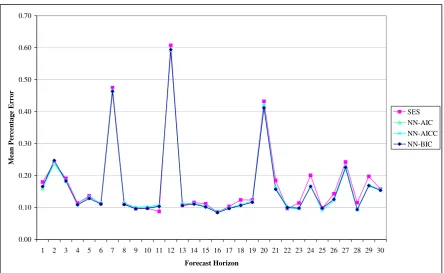
considered.28 Table IV and Table V present the MAPE and MdAPE results.29 The MAPE
error statistic confirm the ANN model as best forecast method for all horizons (short,
intermediate and long horizon), as it consistently yields lowest percentage error when
compared to sample data. The only exception is for the 12-day horizon, where the Holt-D
has the lowest percentage error. The best fit ANN model selected by AIC, AICC or BIC
yields similar results, indicating there is no advantage in using either statistic when selecting
the best fit ANN model.30 For short-horizon forecasts, the RT model performs well when
The MdAPE results show slightly different results. The MdAPE shows the SES model is
best for forecasting short horizons of 6 days and 12 days, and the long horizon of 30 days
ahead. For the intermediate horizon forecasts of 18 days and 24 days ahead, the ANN model
and the Holt-W model yield the lower errors.
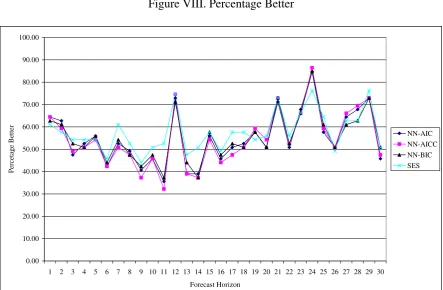
The results on the PB statistic reported in Table VI, confirming those of Table IV and Table
V, and show the ANN and SES models are consistently the best methods for forecasting
bursty broadband data. Figure VI, Figure VII and Figure VIII illustrate forecasts for 1 day to
30 days ahead for the best forecast methods. Figure VI and Figure VIII show the SES and
ANN models forecast better for most forecast horizons. The only exception is the RT model
for 1 day ahead forecasts (not shown).
<Insert Table IV here>
<Insert Table V here>
<Insert Table VI here>
To sum, Figure II, Figure III and Figure IV suggest the SES and ANN methods provide an
improvement over other linear extrapolation techniques and indicate the SES and ANN
models considered here are useful for establishing relatively accurate judgement-free
projections of bandwidth loads up to 30 days ahead. The results of the SES and ANN models
are superior for most forecast horizons. For short-horizon forecasts (1 day ahead), a naïve
<Insert Figure VI here>
<Insert Figure VII here>
<Insert Figure VIII here>
VII. Conclusion
The paper compares linear extrapolation and an ANN model forecasts for bursty
packet-switched broadband data that exhibits little structure. Bursty broadband packet data is
generated by not well understood underlying patterns and so can appear random, resulting in
standard extrapolation techniques being unable to provide to reliable forecasts—especially of
congestion spikes. Therefore, a feedforward ANN model is considered as an alternative
forecasting method. ANNs are a non-linear data driven techniques that learn from underlying
data patterns. Importantly, these techniques do not require any a priori assumptions as to the
underlying data generating process. The sample forecast MAPE and MdAPE error statistics,
and PB measure show that the SES and ANN models provides more reliable forecasts than
the linear extrapolation methods suggested by the ITU. This outcome suggests ITU
Recommendation E.507 for forecasting network data should be amended. First, ANN models
should be included. Second, the ITU should also provide separate traffic forecasting
recommendations for traditional POTS and packet-switched data as they are different in
nature. The encouraging findings from this study suggest that further gains in forecast
accuracy may be obtained from experimenting with an ANN model that includes a feedback
References
Armstrong, J. and Collopy, F. (1992), ‘Error Measures for Generalizing about Forecast
Methods: Empirical Comparisons’, International Journal of Forecasting, 8, 69-80.
De Gooijer, J. and Kumar K. (1992), ‘Some Recent Developments in Non-linear Time Series
Modelling, Testing and Forecasting’, International Journal of Forecasting, 8, 135-56.
Engle, R. (1982), ‘Autoregressive Conditional Heteroskedasticity with Estimates of the
Variance of United Kingdom Inflation’, Econometrica, 50, 987-1007.
Fildes, R. (1992), ‘The Evaluation of Extrapolative Forecasting Methods’, International
Journal of Forecasting, 8, 81-98.
Fildes, R., Hibon, M., Makridakis, S. and Meade, N. (1998), ‘Generalising about Univariate
Forecasting Methods: Further Empirical Evidence’, International Journal of
Forecasting, 14, 339-58.
Grambsch, P. and Stahel, W. (1990), ‘Forecasting Demand for Special Services’,
International Journal of Forecasting, 6, 53-64.
Granger, C. (1993), ‘Strategies for Modelling Nonlinear Time-Series Relationships’,
Economic Record, 69, 233-8.
Granger, C.W. and Terasvirta, T. (1993), Modelling Nonlinear Economic Relationships,
Oxford University Press: Oxford.
Hochberg, Y. (1988), ‘A Sharper Bonferroni Procedure for Multiple Tests of Significance’,
Biometrika, 75, 800-2.
Hornik, K., Stinchcome, M. and White, H. (1989), ‘Multilayer Feedforward Networks are
Universal Approximators’, Neural Networks, 2, 359-66.
Kuan, C. and White, H. (1994), ‘Artificial Neural Networks: An Econometric Perspective’,
Ljung, G. and Box, G. (1978), ‘On a Measure of Lack of Fit in Time Series Models’,
Biometrika, 65, 297-303.
Madden, G. and Coble-Neal, G. (2005), ‘Forecasting International Bandwidth Capacity’,
Journal of Forecasting, forthcoming.
Makridakis, S., Chatfield, C., Hibon, M., Lawrence, M., Mills, T., Ord, K. and Simmons,
L.F. (1993), ‘The M-2 Competition: A Real-time Judgmentally Based Forecasting
Study’, International Journal of Forecasting, 9, 5-23.
Makridakis, S. and Hibon, M. (2000), ‘The M3-competition: Results, Conclusions and
Implications’, International Journal of Forecasting, 16, 451-76.
McLeod, A. and Li, W. (1983), ‘Diagnostic Checking ARMA Time Series Models Using
Squared-Residual Autocorrelation’, Journal of Time Series Analysis, 4, 269-73.
Noll, A. (1991), Introduction to Telephones and Telephone Systems, Second Edition, Artech
House: Boston.
Opinix (2001), Internet Traffic Report. At: http://www.internettrafficreport.com.
Pankratz, A. (1983), Forecasting with Univariate Box-Jenkins Models: Concepts and Cases,
John Wiley: New York.
Parzen, E. (1982), ‘ARARMA Models for Time Series Analysis and Forecasting’, Journal of
Forecasting, 1, 67-82.
Qi, M. and Zhang, P. (2001) ‘An Investigation of Model Selection Criteria for Neural
Network Time Series Forecasting’, European Journal of Operational Research, 132,
666-80.
Rissanen, J. (1987), ‘Stochastic Complexity and the MDL Principle’, Econometric Reviews,
6, 85-102.
Ramsey, J. (1969), ‘Tests for Specification Errors in Classical Linear Least-Squares
Tsay, R. (1989), ‘Testing and Modelling Threshold Autoregressive Processes’, Journal of
American Statistical Association, 84, 213-40.
Villén-Altamirano, M. (2001), ‘Overview of ITU Recommendations on Traffic Engineering’,
ITU-T Working Party 3/2 on Traffic Engineering Working Paper, ITU: Geneva.
Warner, B. and Mistra, M. (1996), ‘Understanding Neural Networks as Statistical Tools’,
American Statistician, 50, 284-93.
White, H. (1989), ‘Some Asymptotic Results for Learning in Single Layer Feedforward
Network Models’, Journal of the American Statistical Association, 84, 1003-13.
White, H. (1990), ‘Connectionist Nonparametric Regression: Multilayer Feedforward
Networks can Learn Arbitrary Mappings’, Neural Networks, 3, 535-50.
Zhang, G. (2004), Neural Networks in Business Forecasting, Idea Group Publishing: London.
Zhang, G., Patuwo, B. and Hu, M. (1998), ‘Forecasting with Artificial Neural Networks: The
State of the Art’, International Journal of Forecasting, 14, 35-62.
Appendix
Following the recommendations of Armstrong and Collopy (1992) and Fildes (1992), the
error measures used are the mean absolute percentage error (MAPE), median absolute
percentage error (MdAPE) and percentage better (PB). To estimate the MAPE of a particular
method i for horizon h using series j, the absolute percentage error APEi h j, , is first estimated;
, , ,
, ,
,
i h j h j i h j
h j
F A
APE
A
−
where Fm h j, , is the forecast for method i for horizon h using series j. and Ah j, is the actual
value at horizon h for series j. Hence, the MAPEi h j, , is summarised across series;
, , ( , , )
i h j i h j
MAPE =mean APE ,
The symmetric MAPE is not used here as it generates a higher penalty for high forecasts
then low forecasts (Goodwin and Lawton, 1999 and Koehler, 2001). The advantage of using
MAPE is the MAPE is scale-invariant. As none of the observations in the data are negative,
the MAPE is most appropriate. The root mean squared error (RMSE) is not considered as
included because of it is affected by the scale of the data. The MdRAEi h j, , error statistic is
also derived from the APEi h j, , , the median of the APEi h j, , is:
, , ( , , )
i h j i h j
MdRAE =Median APE ,
where the MdAPE is observation 1
2
j+
if is odd, or the mean of observations j
2
j
when
is even, when the
j
, ,
i h j
APE observations are ordered by rank. The percentage better (PB)
statistic counts and reports the proportion that a given method has a forecasting error larger
than a relative method. The relative method for forecasting compared in this study is the
random walk model.
, ,
1 1
*100
n i h j ijt
j
PB
s = δ
⎡ ⎤
= ⎢ ⎥
where 1 , , , , , ,
0
i h j h j rw h j h j ijt
if F A F A
otherwise
δ = ⎨⎧⎪ − −
⎪⎩
≺
is the proportion of times a particular
model i forecasting horizon h for series j has a lower forecast error than the random walk
model and s is the total number of series forecasted. A value of greater than 50 for
indicates the forecasts obtained for a particular forecasting method i is more accurate
than the random walk.
, ,
i h j
PB
, ,
i h j
[image:21.595.122.474.293.517.2]PB
Figure I: Malaysia fe1-0.bkj15.jaring.my
0 10 20 30 40 50 60 70 80 90 18/02/ 2000 3/03 /200 0 17/03 /2000 31/03/ 2000 14/04 /2000 28/04/ 200 0 12/05/ 2000 26/05 /2000 9/06/ 2000 23/06 /2000 7/07/ 2000 21/07/ 2000 4/08 /200 0 18/08/ 2000 1/09 /200 0 15/09/ 200 0 29/09/ 2000 13/10 /2000 27/10/ 2000 10/11 /2000 24/11/ 200 0 8/12 /200 0 22/12 /2000 5/01/ 2001 19/01 /2001 2/02/ 2001 16/02/ 2001 2/03 /200 1 16/03/ 2001 30/03 /2001 Time T raf fi c I ndex
FIGURE II. Outlier Frequency
0 1 2 3 4 5 6 7 8 9 10
0 1 2 3 4 5 6 7 8 9 10 11 12 13 14 15 16 17 18 19
Proportion of Outlying Observation (%)
[image:22.595.72.508.409.576.2]Frequency
FIGURE III. Strength of Linear Trend FIGURE IV. Variation Explained by Linear/AR
0 5 10 15 20 25 30 35
-0.4 -0.3 -0.2 -0.1 0 0.1 0.2 0.3 0.4
Correlation With Time
F
requency
0 2 4 6 8 10 12 14 16 18
-0.02 -0.01 0.00 0.01 0.02 0.03 0.04 0.05 0.06 0.07
Adjusted R Squared
Fr
FIGURE V. Daily Variation in Capacity Utilization
No difference Early Week Mid Week Late Week Asia
Australia Europe
North America South
America 0
2 4 6 8 10 12
F
requenc
y
Asia Australia Europe North America South America
Table I. Percentage of Traffic Index Series with Significant Tests
Significance Level 5% 1%
Normality 5.08% 1.70%
LB-Q(5) 10.17% 1.70%
Mc&Li(5) 27.12% 20.34%
ADF(5) 100.00% 100.00%
ARCH(5) 10.17% 5.08%
TAR(5) 13.56% 6.36%
RESET(3) 8.47% 3.39%
White’s ANN Test (Simple Bonferroni)
100.00% 100.00%
White’s ANN Test (Hochberg ‘s (1988) Bonferroni)
100.00% 100.00%
[image:23.595.148.449.410.616.2]Table II. Representative Sample of Selected Summary Statistics by Geographical Location and Tests
Router Series A (Asian
Router)
B (Australian Router)
C (European Router)
D (N. American Router)
E (S. American Router)
Mean 56.09** 60.34** 50.00** 50.59** 58.90**
Variance 135.42 55.69 77.00 85.45 80.82
Skewness - 1.87** -2.56** -1.11** -0.87** -1.82**
Kurtosis 4.30** 9.46** 1.67** -0.01 4.17**
Normality 307.29** 1094.57** 73.47** 28.48** 289.84**
LB-Q(5) 0.70 0.92 1.79 2.11 2.64
Mc&Li(5) 12.68** 14.56** 5.93 6.78 1.97
ADF(5) -5.77** -5.12** -7.05** -5.94** -6.41**
ARCH(5) 12.82 14.08* 5.36 5.88 2.39
TAR(5) 1.22 3.74** 1.06 0.87 0.90
RESET(3) 0.47 0.81 0.27 0.08 1.27
White’s ANN Test
219.21** 224.61** 219.92** 220.56** 221.22**
Note: The number of series tested is 59. Geographical regions are from the Internet Traffic Report. All results (except ADF(5) test) are performed on residuals of the best fitting ARMA model (lowest AIC statistic). Normality is the Jarque–Bera normality test; LB-Q(5) is the Ljung-Box portmanteau test of autocorrelation order 5; Mc&Li(5) is the McLeod and Li test order 5; ADF(5) is the augmented Dickey-Fuller unit root test with 5 lags; ARCH(5) is Engle’s LM test for ARCH with 5 lags; TAR(5) is Tsay’s TAR-test for determining the presence of thresholds in the data using up to 5 lags; RESET(3) is Ramsey’s RESET test with power 3; White’s ANN Test is an ANN nonlinear test. * and ** denote significance at the 5% and 1% levels, respectively.
Table III. Results of White’s ANN Test of the Random Sub-sample Data Series
Series A (Asian
Router) B (Australian Router) C (European Router) D (N. American Router)
E (S. American Router)
Simple Bonferroni
(p-values)
0.00** 0.00** 0.00** 0.00** 0.00**
Hochbeg (1988) Bonferroni
(p-values)
0.00** 0.00** 0.00** 0.00** 0.00**
[image:24.595.69.527.518.641.2]Table IV. Mean Absolute Percentage Error
Forecast Method Forecast Horizon
6 12 18 24 30
RT 20.29 63.52 18.06 24.08 23.55
ARMA 11.78 58.49 12.44 16.76 16.62
HOLT 12.30 71.59 22.87 40.85 35.07
HOLT-D 12.58 57.00 12.12 16.83 16.55
HOLT-W 11.94 57.92 13.39 20.01 17.49
ARARMA 58.42 58.35 63.13 80.95 53.67
SES 11.14 60.75 12.37 20.11 15.76
ANN-AIC 11.41 59.20 11.05 16.54 15.75
ANN-AICC 11.26 59.14 10.72 16.73 15.30
ANN-BIC 11.09 59.40 10.67 16.60 15.38
Note: RT is the robust trend model; ARMA is the autoregressive moving average model; HOLT is Holt’s linear no trend model; Holt-D is Holt’s model with exponential smoothing; HOLT-W is the linear no trend Holt-Winters model; ARARMA is the long memory model; SES is the linear no trend simple exponential smoothing model; ANN-AIC is best fitting ANN model; ANN-AICC is the best fitting ANN; ANN-BIC is best fitting ANN model selected. Percentages in bold are models with the lowest mean absolute percentage of error.
Table V. Median Absolute Percentage Error
Forecast Method Forecast Horizon
6 12 18 24 30
RT 16.39 21.48 14.74 16.90 17.96
ARMA 10.39 11.52 9.06 6.91 13.00
HOLT 9.58 14.27 12.53 21.19 17.40
HOLT-D 10.12 9.87 7.74 5.65 10.61
HOLT-W 9.75 9.99 8.20 5.13 11.40
ARARMA 61.38 84.78 76.09 87.71 48.62
SES 8.20 9.58 7.52 6.69 7.96
ANN-AIC 9.60 11.63 7.83 7.10 9.22
ANN-AICC 8.70 11.52 7.46 6.02 8.47
ANN-BIC 8.89 10.29 6.54 7.27 8.42
[image:25.595.112.487.444.686.2]Table VI. Percent Better
Forecast Method Forecast Horizon
6 12 18 24 30
RT 25.42 45.76 35.59 47.46 28.81
ARMA 32.20 72.88 42.37 81.36 42.37
HOLT 38.98 52.54 30.51 37.29 27.12
HOLT-D 40.68 71.19 47.46 79.66 44.07
HOLT-W 38.98 71.19 45.76 76.27 47.46
ARARMA 13.56 25.42 22.03 25.42 18.64
SES 45.76 74.58 57.63 76.27 50.85
ANN-AIC 42.37 72.88 52.54 84.75 45.76
ANN-AICC 42.37 74.58 50.85 86.44 47.46
ANN-BIC 44.07 71.19 50.85 84.75 50.85
Note: RT is robust trend model; ARMA is the autoregressive moving average model; HOLT is Holt’s linear no trend model; Holt-D is Holt’s model with exponential smoothing; HOLT-W is the linear no trend Holt-HOLT-Winters model; ARARMA is the long memory model; SES is the linear no trend simple exponential smoothing model; ANN-AIC is best fitting ANN model; ANN-AICC is best fitting ANN model; and ANN-BIC is best fitting ANN model. Percentage better statistic is the proportion of series for a model that is better than the random walk forecast. Percentages in bold are models with the highest percentage accuracy.
Figure VI. Mean Absolute Percentage Error
0.00 0.10 0.20 0.30 0.40 0.50 0.60 0.70
1 2 3 4 5 6 7 8 9 10 11 12 13 14 15 16 17 18 19 20 21 22 23 24 25 26 27 28 29 30
Forecast Horizon
Me
an
Perc
entage
Erro
r
[image:26.595.76.521.468.741.2]Figure VII. Median Absolute Percentage Error
0.000 0.020 0.040 0.060 0.080 0.100 0.120 0.140 0.160
1 2 3 4 5 6 7 8 9 10 11 12 13 14 15 16 17 18 19 20 21 22 23 24 25 26 27 28 29 30
Forecast Horizon
A
verage
Per
centage
Err
or
SES NN-AIC
NN-AICC NN-BIC
Figure VIII. Percentage Better
0.00 10.00 20.00 30.00 40.00 50.00 60.00 70.00 80.00 90.00 100.00
1 2 3 4 5 6 7 8 9 10 11 12 13 14 15 16 17 18 19 20 21 22 23 24 25 26 27 28 29 30
Forecast Horizon
Perce
tage B
et
te
r
NN-AIC NN-AICC NN-BIC
3
1
The ITU is an organization sponsored by the United Nations that makes recommendations on network traffic management.
2
Traffic forecasting is necessary for strategic analysis, e.g., on the introduction of a service and for network planning, such as equipment and circuit provision and plant investment.
3
Recommendation E.507 also describes methods to evaluate and select an appropriate technique, depending on available data and forecast period.
4
Congestion occurs only when there is visible degradation of network performance to users. Thus, when the network traffic load is heavier than usual, but performance is acceptable, congestion has not occurred. Bursty traffic is characterized by extremely high peak-to-mean ratios in traffic volumes. The burstiness of traffic is an important test of the congestion management capability of high-speed integrated-service networks.
5
A packet train is a closely-spaced sequence of packets between a source and destination.
6
For an extensive discussion of ANN models and their properties, see Kuan and White
(1994), Warner and Mistra (1996), Zhang et al (1998) and Zhang (2004)
7
Both criteria are generalisations of Rissanen’s (1987) complexity criterion.
8
Other selection criteria are not considered as they are not widely used.
9
Following Qi and Zhang (2001), the value of d = , gives the most parsimonious model.
Hence, generalised AIC and BIC statistics are calculated with d =3.
10
Following suggestions by Rob Hyndman, the no trend, no seasonal version of the simple
exponential model (SES) is included in the analysis. The SES model used is yt = yt−1+αet
0.3
,
withα = . The results for other α values are not reported.
11
Quantile forecasting is performed in an attempt to forecast congestions. However, the forecasts did not perform as well as univariate linear methods and are not reported.
12
Estimation method is by minimisation of sum of squared errors.
13
Total possible lags for the ARARMA model is 7 as the ARARMA is estimated by applying an appropriate AR model (lags 1 and 2). Residuals are estimated with another ARMA model (ARMA lags are 1 to 5) to generate the ARARMA model.
14
While use of the AIC, modified AIC and BIC for this purpose are open to criticism, there is no clearly superior test in all situations. See, for example, De Gooijer and Kumar (1992) or Qi and Zhang (2001).
15
0,100]
)
16
Mean square error measures are avoided as they are scale dependent and sensitive to outliers.
17
The Internet Traffic Report URL is http://www.internettrafficreport.com.
18
The use of index data is effectively an external normalization with training data in [ .
19
Time-of-day and scale of demand effects may impact on router performance. For example, the Perth router services a small market and likely to have relatively low early morning congestion, while the Yahoo router may experience peak demand in the mid-to-late afternoon.
20
Comparisons between consecutive months are considered.
21
Nonlinear parametric tests employed are parametric as data set is too small to employ non-parametric nonlinear tests.
22
The McLeod and Li (1983) test is a squared residual analogue of the Ljung-Box (1978) Q
test.
23
The number of ( ,p q
0,100]
l
kp
lags used to pre-whiten each series is from 1 to 5.
24
The RESET test is a general test to examine if a functional form is misspecified.
25
This result is expected as ADF(5) tests show all series are stationary. In addition, traffic
index data oscillates in [ .
26
The Bonferroni p-value is α =
l
, where the k is the number of random draws of the
hidden units used to estimate the ANN model andp is the lowest p-value for k draws.
Hochberg’s (1988) modified Bonferroni p-value method is estimated by the lowest α value
calculated by multiplying the ithp-value using m draws by (m i− −1)
3
d = , )
.
27
Geographical regions are from the Internet Traffic Report. At
http://www.internettrafficreport.com
28
There is no consensus best fit ANN metric. The criteria used are least AIC, AICC and BIC statistics.
29
The MAPE, MdAPE and PB statistics for the ANN model with direct connections (not shown) lie between ANN models without direct connections. Hence, the results of NN-AIC, NN-AICC and NN-BIC specifications are the best ANN model without direct connections.
30
This is consistent with Qi and Zhang (2001) that show the AIC, AICC and BIC are equally