Munich Personal RePEc Archive
A Simple Accounting Framework for the
Effect of Resource Misallocation on
Aggregate Productivity
Aoki, Shuhei
Graduate School of Economics, University of Tokyo
26 October 2008
Online at
https://mpra.ub.uni-muenchen.de/12506/
A Simple Accounting Framework for the Effect of Resource
Misallocation on Aggregate Productivity
∗
Shuhei Aoki
†Graduate School of Economics, University of Tokyo
January 5, 2009
Abstract
This paper develops a simple accounting framework that measures the effect of resource
misallocation on aggregate productivity. This framework is based on a multi-sector general
equilibrium model with sector-specific frictions in the form of taxes on sectoral factor inputs.
Our framework is flexible for the assumption on preferences or aggregate production functions.
Moreover, this framework is consistent with that commonly used in productivity analysis. I
apply this framework to measure the extent to which resource misallocation explains the
differ-ence in aggregate productivity across developed countries. I find that resource misallocation
explains, on average, 17% of the difference in the measured aggregate productivity among
developed countries. I also provide the methods to decompose the causes of the misallocation
effect.
JEL Codes: E23, O11, O41, O47
Keywords: distortions; frictions; productivity; resource allocation
∗The old version of this paper is titled “A Simple Accounting Framework for Frictions on Sectoral Resource
Allocation,” and was presented at the 2006 Fall JEA meeting. I thank Toni Braun and Fumio Hayashi, Tomohiro Hirano, Tomoyuki Nakajima, Minoru Kitahara, Julen Esteban-Pretel, Katsuya Takii, and Kyoji Fukao for their helpful comments and suggestions. All remaining errors are mine.
†Graduate School of Economics, University of Tokyo, 7-3-1, Hongo, Bunkyo-ku, Tokyo 113-0033, Japan. Email:
1
Introduction
There are large disparities in incomes even across developed countries. Prescott (2002) reports
that there is approximately a 30% to 40% difference in per capita income among highly developed
countries. He argues that the most important factor in this disparity is the difference in the level
of aggregate total factor productivity (TFP).1From this standpoint, many theoretical models have
been proposed that try to explain the difference in aggregate TFP. Restuccia and Rogerson (2008)
point out that many of these models can be characterized as following the theory of resource
misallocation. This theory states that frictions due to various reasons prevent the efficient use
of resources, resulting in a low aggregate TFP. Then, to what extent does resource misallocation
actually affect aggregate TFP and explain the difference in aggregate TFP across countries?
To answer these problems, this paper proposes a simple accounting framework that measures
the effect of resource misallocation on aggregate TFP from data. This framework is based on a
multi-sector general equilibrium model with sector-specific frictions in the form of taxes on sectoral
factor inputs (capital and labor). As in Chari, Kehoe and McGrattan (2002) and Restuccia and
Rogerson (2008), the sector-specific frictions in the form of taxes for each firm or sector reflect the
various kinds of frictions the firm or sector faces. As in Chari et al. (2002), I measure these
sector-specific frictions using the model from data (which are measured from the difference in factor input
returns between sectors) and assess the effect of these frictions on aggregate TFP. A characteristic
of their tax (or wedge) approach is that this approach can deal with the various types of frictions
that distort resource allocation all together.
Compared with the other papers (cited below) that measure the effect of resource
misalloca-tion on aggregate TFP, there are two distinct characteristics in this paper’s framework. First, our
framework is flexible for the assumption on preferences or aggregate production functions. In
par-ticular, when we measure the contribution of resource misallocation to the difference in measured
aggregate TFP, we do not need to assume a specific form of preferences or aggregate production
functions.2 Second, this paper’s framework is consistent with that commonly used in productivity
analysis.
1
Parente and Prescott (2000) argue that the most important factor in the income disparities between developed and developing countries is also the difference in aggregate TFP.
2
I apply this framework to the sectoral data of countries that are included in the EU KLEMS
database (Timmer, O’Mahony and van Ark, 2008).3 I find that, on average, 17% of the difference
in the measured aggregate TFP between the U.S. and other countries is due to sector-level resource
misallocation. The correlation between aggregate TFP and the misallocation effect is high (0.55).
The transport and financial sectors are the primary sources of capital misallocation, while the
agricultural and financial sectors are primary sources of labor misallocation. I also find that the
differences in sectoral shares between countries, which may be due to structural transformations,
magnify the effect of sector-level resource misallocation on the difference in measured aggregate
TFP.
Several papers measure resource misallocation from cross-sectional differences in factor input
returns and calculate the resource misallocation effect on aggregate TFP using the general
equilib-rium framework. This paper fits into this literature. To the best of my knowledge, the earliest work
in this field is de Melo (1977). A computable multi-sector general equilibrium model is applied
to the Colombian economy by de Melo (1977) to calculate the effect of the removal of distortions
on sector-level resource allocation. Recently, Restuccia, Yang and Zhu (2008) and Vollrath (2009)
used a two-sector model to measure the magnitude of barriers to resource allocation between the
agricultural and non-agricultural sectors. Using a standard model of monopolistic competition with
heterogeneous firms and manufacturing plant-level data from China, India, and the U.S., Hsieh
and Klenow (2007) estimated how resource misallocation affects aggregate TFP. As mentioned
above, compared with these papers, our framework is flexible for the assumption on preferences
or aggregate production functions.4 Moreover, our framework is compatible with the framework
commonly used in productivity analysis. Finally, using this paper’s framework (to be precise, the
framework of the previous version of this paper, Aoki, 2006), Miyagawa, Fukao, Hamagata and
Takizawa (2008) used the Japanese Industrial Productivity (JIP) Database to measure the effect
of sector-level resource misallocation on aggregate TFP.
Literature on productivity analysis has measured the effect of change in sectoral reallocation
on aggregate TFP growth (see Syrquin, 1984, and Basu and Fernald, 2002, among others). I
show that this paper’s decomposition is a generalization of previous studies; while previous studies
3
The countries are Australia, Austria, the Czech Republic, Denmark, Finland, Germany, Italy, Japan, Nether-lands, Portugal, Sweden, the U.K., and the U.S.
4
measured the effect of resource misallocation on the aggregate TFP growth rate over time, this
paper’s framework can also measure the effect on the level of aggregate TFP and on the difference in
aggregate TFP across countries. This paper also provides the micro-foundations for the reallocation
effect. Owing to this, the approach used herein can further decompose the causes of resource
misallocation.
Several studies provide examples of resource misallocation. Caballero, Hoshi and Kashyap
(2008) argue that during the Japanese stagnation of the 1990s, the forbearance lending of banks
shifted resources from healthy firms to zombie firms and zombie-dominated sectors. Kiyotaki and
Moore (1997) argue that the differences in the degree of borrowing constraint between firms can
shift resources from high-productivity firms to low-productivity firms. Hayashi and Prescott (2008)
argue that, for institutional reasons, there was a barrier to labor mobility between the agricultural
and non-agricultural sectors in prewar Japan. In my model, frictions in the form of taxes capture
the effect of these distortions on resource allocation.
The remainder of the paper is organized into four sections. Section 2 sets up and analyzes
a static multi-sector general equilibrium model with frictions in the form of sector-specific taxes
on factor inputs. Using the model, Section 3 develops methods to measure the effects of resource
misallocation on aggregate TFP. Using the developed framework, Section 4 measures the effect of
sector-level resource misallocation on aggregate TFP from data. Section 5 concludes.
2
The Model
In this section, I develop a multi-sector competitive equilibrium model with sector-specific frictions.
In keeping with Chari et al. (2002), sector-specific frictions are modeled in the form of taxes on
sectoral factor inputs, the firms are price-takers and pay linear taxes on capital and labor, and
each firm’s problem is static. I argue in Appendix A that several types of frictions in each sector
are isomorphic to the taxes on the sector’s factor inputs.5
5
2.1
I
Industrial sectors
There are I industrial sectors in the economy. Firms in each sector produce goods (homogeneous
within a sector but heterogeneous among sectors) by using two factor inputs: capitalK and labor
L(hereafter,J denotes the factor input in general). Firms are price-takers in both the goods and
factor markets and pay linear taxes on capital and labor inputs, which vary by sectors. Thus,
firms in sectori produce goods given the goods price of the sectorpi and capital and labor costs
(1 +τKi)pK and (1 +τLi)pL, respectively, where τKi and τLi are the capital and labor taxes of
the sector, respectively, and pK andpL are the common factor prices of capital and labor across
sectors, respectively. As each sector produces different goods, the goods price pi can vary across
sectors in equilibrium (even if there are no taxes). On the other hand, because capital and labor
are homogeneous across sectors, ifτKi= 0 andτLi= 0, the factor costs incurred by firms equalize.
As I assume a firm’s production function to be constant-returns-to-scale (CRS), I will identify a
sector using a firm below.
The firms possess the Cobb-Douglas production technology exhibiting CRS. Therefore, a firm
i’s production function can be written as follows:
Vi=Fi(Ki, Li)≡AiKiαiL
1−αi
i , (1)
whereViis the output,Ki is the capital input,Li is the labor input, andAi is the productivity of
the firm. I assume that the capital intensity αi can vary by sector.
In this setting, the firm’s problem is written as
max
Ki,Li
The first-order conditions (FOCs) are as follows:6
αipiVi
Ki
= (1 +τKi)pK, (2)
(1−αi)piVi
Li
= (1 +τLi)pL. (3)
If a firm’s profit is negative for any positiveKiandLi, the firm chooses not to produce, and the
above FOCs do not hold. Although hereafter, I assume that the above FOCs hold for all sectors,
the results used in the later sections, i.e., (9)–(12), hold even when some sectors do not produce.
2.2
Aggregator function
I assume the CRS aggregator function:
V =V(V1, . . . , VI). (4)
I also assume that the following condition is satisfied:
∂V ∂Vi
=pi. (5)
This condition is satisfied ifV is an aggregate good and firms that produceV fromVi are
compet-itive or if V is the household’s utility and the household choosesVi to maximize V. Under these
conditions, the following equation holds7:
V =∑
i
piVi. (6)
6
Note that from (1) and the FOCs, we also attain the following unit cost function:
pi= 1
ααi
i (1−αi)
1−αi
{(1 +τKi)pK}αi{(1 +τLi)pL}1−αi
Ai
.
7
2.3
Resource constraints
Finally, I assume that the aggregate capital and labor supply are exogenous. Thus, the following
resource constraints apply:
∑
i
Ki = K, (7)
∑
i
Li = L, (8)
whereK andLare the aggregate capital and labor supply, respectively.
2.4
Equilibrium relations
A competitive equilibrium of this economy is defined in the following manner.
Definition. Given the productivities and taxes of I goods sectors {Ai,1 +τKi,1 +τLi}, and
the aggregate capitalKand laborL, respectively, acompetitive equilibriumis a set of the output,
capital, labor, and prices ofIgoods sectors{Vi, Ki, Li, pi}, the aggregate valueV, and the common
factor prices pK andpL that satisfy the following conditions:
1. FOCs of firms inI goods sectors (2) and (3), whereVi is given by (1),
2. CRS assumption and marginal conditions (4) and (5),
3. resource constraints (7) and (8).
In what follows, I derive the expressions forKiandLi using the equilibrium conditions. Using
(2) and (7), Ki can be rewritten as follows:
Ki=
(1+τKi)pKKi
(1+τKi)pK
∑
j
(1+τKj)pKKj
(1+τKj)pK
K
= piYiαi
1 (1+τKi)pK
∑
jpjYjαj
1 (1+τKj)pK
K
= σ˜iαi
1 1+τKi
∑
jσ˜jαj1+1τKj
where ˜σi is the sectoral sharepiVi/V.8 This equation is rearranged as follows:
Ki=
˜
σiαi
˜
α λ˜KiK, (9)
where ˜α is the weighted average of capital intensities ∑
iσ˜iαi and ˜λKi is the term composed of
frictions.9 ˜λ
Ki is defined as
˜
λKi≡
λKi
∑
j
(σ˜
jαj
˜
α
)
λKj
, and λKi≡
1 1 +τKi
. (10)
In the same way, we obtain the equilibrium allocation ofLi:
Li=
˜
σi(1−αi)
1−α˜ λ˜LiL, (11)
where
˜
λLi ≡
λLi
∑
j
(σ˜
j(1−αj)
1−α˜
)
λLj
, andλLi ≡
1 1 +τLi
. (12)
Equations (9)–(12) uncover several effects of taxes on the resource allocation of capital and
labor. First, from (9) and (11), we find that taxes mainly affect the allocation of resources through
˜
λJ i, although taxes can also affect ˜σi. Second, from (10) and (12), we find that ˜λJ i is the ratio
of the reciprocal of sector i’s return on the factor input and the mean of the reciprocals of the
returns across sectors. Owing to this property, the absolute magnitude of taxes does not affect the
resource allocation among sectors. For instance, if the tax on capital is identical across sectors,
then ˜λKi becomes unity, which is equal to the value when there were no frictions. On the other
hand, the distribution of taxes across sectors affects resource allocation. For example, if λKi is
smaller than the weighted average ofλKj (i.e., sector i’s capital is taxed more) and if ˜σi do not
vary much, ˜λKi becomes less than unity; in this case, the capital allocated to sectoriis less than
that allocated when there were no frictions.
In the empirical section, I do not measure frictions λJ i themselves, but measure ˜λJ i, which
8
I add a tilde (˜) to denote the variables that depend on the functional form ofV.
9
capture the distribution of these frictions. ˜λJ iare measured using the rewritten forms of equations
(9) and (11):
˜
λKi=
(σ˜
iαi
˜
α
)−1K
i
K, and ˜λLi=
(σ˜
i(1−αi)
1−α˜
)−1L
i
L. (13)
3
Analyzing the Effects of Resource Misallocation on
Ag-gregate TFP
In this section, in order to calculate the effects of resource misallocation on aggregate TFP, I
decompose aggregate TFP into sectoral TFPs, sectoral shares, and resource misallocation by taking
an approximation of aggregator functionV. I provide an interpretation of the decomposition. This
section also describes a method to identify which sector contributes to resource misallocation. Since
the component of resource misallocation consists of a combination of sectoral frictions and sectoral
shares, I also describe a method to identify the contribution of these factors.
3.1
Decomposition of aggregate TFP
In order to analyze the effect of resource misallocation on aggregate TFP, I compare the aggregator
function at stateS, VS, with that at state T,VT, and apply the mean value theorem (hereafter,
the variables with the superscript S denote those at stateS, such as VS). StateS, for example,
corresponds to Japan, while stateT corresponds to the U.S. I assume that the capital intensity of
each sectorαi is the same across different states.
By applying the mean value theorem and using (5) and (6), we obtain
ln
(VS
VT
)
=∑
i
∂lnV ∂lnVi
ln
(VS i VT i ) ≃∑ i ¯
σiln
(VS i
VT i
)
,
where ¯σi ≡ (˜σiS + ˜σTi )/2.10 The RHS is the Tornqvist index of the value added difference. By
10
In order to derive the first equality, I defineφ(x) as follows:
φ(x)≡lnV(exp{xlnVS
1 + (1−x) lnV
T
1 }, . . . ,exp{xlnV
S
I + (1−x) lnV T
substituting (1), (9), and (11) into the above equation, we obtain the following decomposition:
∑
i
¯
σiln
(VS i VT i ) = ∑ i ¯
σiln
(AS i AT i ) +∑ i ¯
σiln
( ˜ σS i ˜ σT i /
(˜αS)αi(1−α˜S)1−αi
(˜αT)αi(1−α˜T)1−αi
) +∑ i ¯ σi {
αiln
( ˜ λS Ki ˜ λT Ki )
+ (1−αi) ln
( ˜ λS Li ˜ λT Li )}
+¯αln
(KS
KT
)
+ (1−α¯) ln
(LS
LT
)
, (14)
where ¯α≡∑
iσ¯iαi.
I define the aggregate TFP of stateS relative to stateT and refer to it as ATFP as follows:
ATFP≡∑
i
¯
σiln
( VS i VT i ) −α¯ln
(
KS
KT
)
−(1−α¯) ln
(
LS
LT
)
. (15)
This is the standard definition of aggregate TFP.11 By rewriting (14) using the definition of
ag-gregate TFP, I obtain
ATFP =∑
i
¯
σiln
(AS i AT i ) +∑ i ¯
σiln
( ˜ σS i ˜ σT i /
(˜αS)αi(1−α˜S)1−αi
(˜αT)αi(1−α˜T)1−αi
) +∑ i ¯ σi {
αiln
( ˜ λS Ki ˜ λT Ki )
+ (1−αi) ln
( ˜ λS Li ˜ λT Li )} . (16)
I refer to the first term of the RHS in (16) as the sectoral TFP term (STFP). STFP is the
weighted average of sectoral TFPs and is the same as the Domar (1961) weighted aggregate TFP. I
refer to the second term as the sectoral share term (SS); this term mainly consists of sectoral shares.
Theoretically, when the differences in ˜σi between states S and T are small, SS is approximately
zero (for the proof, see Appendix B). In addition, as reported in Section 4, SS is small in our data.
I refer to the third term in (16) as the allocational efficiency term (AE), which represents resource
misallocation because it consists of ˜λi that, as can be seen from (9) and (11), distort resource
and apply the mean value theorem in the following manner:
φ(1)−φ(0) =φ′(θ)(1−0),
where 0≤θ≤1.
11
allocation. When the friction level is identical across the sectors for each state (i.e., λS
i =λSj and
λT
i =λTj), AE = 0.
3.2
Interpretation of the decomposition
The decomposition in (16) can be used to calculate the measured difference in aggregate TFP
between the two actual states due to the differences in sectoral TFPs measured by STFP and
due to the difference in the distribution of sectoral frictions measured by AE. When used in this
manner, this paper’s decomposition can be considered as an extension of that by Syrquin (1984)
and Basu and Fernald (2002): we can show that when S and T correspond to periods t and
t−1, respectively, AE is equal to their reallocation term.12 Compared with theirs, our framework
enables further decompositions of AE in several different ways. For example, AE in (16) can be
decomposed into a stateSfrictions component that consists of ˜λS
Kiand ˜λSLi and a stateT frictions
component that consists of ˜λT
Ki and ˜λTLi. In a later section, I explain how to decompose AE into
sectoral contributions.
The decomposition in (16) can also be used to measure how aggregate TFP would change
when frictions counterfactually disappear under certain conditions. Applying the framework of
this paper, Miyagawa et al. (2008) calculate this effect under the following conditions: state S
corresponds to an actual state, state T corresponds to a no-frictions state (i.e., ˜λT
J i = 1), and
sectoral TFPs and sectoral shares of stateT are the same as those of stateS.
We can also reinterpret the measured AE or SS + AE between two actual states from this
viewpoint: the negative of the AE (or SS + AE) between the two actual states measures how the
difference in aggregate TFP between the two states would change when frictions counterfactually
disappear in both cases. This is under the condition that the differences in sectoral shares ˜σi
between states S andT are due to factors other than the differences in sectoral frictions between
the states (or due to the differences in sectoral frictions).
To show this, first, let us consider the case where the differences in sectoral shares ˜σi between
states S and T are due to factors other than the differences in sectoral frictions λi between the
states. In this case, when frictions disappear for both states, AE becomes zero while STFP and
SS remain unchanged because sectoral frictions do not affect ˜σi(and sectoral TFPs). Then, ATFP
12
without friction is equal to STFP + SS, while ATFP with frictions is equal to STFP + SS + AE.
The misallocation effect is equal to the difference between these two ATFPs, i.e.,−AE.
Next, let us consider another case in which the differences in sectoral shares ˜σi between states
S andT are due to the differences in sectoral frictionsλi between the states. In this case, when
the frictions at state S change to those at state T, ˜σi, ˜α, and ˜λi are the same for states. Then,
the change in aggregate TFP by the change in frictions is equal to−(SS + AE). It is also equal to
the change in aggregate TFP when the frictions in both cases are eliminated.
Since, as noted above, SS is small in our data, I will henceforth focus on AE.
3.3
Contribution of each sector to AE
An advantage of our framework is that it can identify which sector’s frictions cause the difference
in aggregate TFP. This section provides the method.13 In order to identify the contribution of
the frictions of a particular sector (referred to as sector i), I calculate a fictitious AE under the
following assumptions (while I drop out superscripts S and T for convenience, note that these
assumptions are applied to both states). For both states, I fix the factor inputs of sector ito the
actual observed values andefficientlyreallocate theremaining factor inputs across the remaining
sectors of the economy. Then, the only source of distortion would be in sectori. For simplicity, I
also assume that sectoral shares ˜σi are fixed. I refer to the AE calculated under this assumption
as AEi.
AEi is measured as follows (here, I decompose AEi into capital and labor components). First,
under the above assumption, from (9) and (11), sector i’s ˜λJ i is the same as the actual ˜λJ i.
Second, under the above assumption, since factor prices are the same across the remaining sectors,
˜
λJ m= ˜λJ n= ˜λJ−i for the remaining sectors (mandnare the sectors other than sectori, and are
summarized by−i). By rearranging
K−i ≡K−Ki=
∑
m̸=i
Km=
∑
m̸=i
˜
σmαm
˜
α λ˜K−iK (17)
13
In (16), I do not simply decompose AE into sectoral components. The reason for this is as follows. From (9) and (11), we find that the (absolute) distance of ˜λJ ifrom unity represents the magnitude of distortion. However, a
simple decomposition of AE in (16) by sectors does not capture this characteristic. Suppose that ˜λS Ki>λ˜
T Ki= 1.
Then, although the stateS’s allocation of capital in sector iis distorted while stateT’s is not, a simple sectoral decomposition of capital AE, ¯σiαiln(˜λSKi/˜λ
T
Ki), becomes positive (this implies that the sector’s friction has a positive
(note thatK,Ki, and consequentlyK−i are the same as the actual ones whileKm(m̸=i) is not),
we obtain
˜
λK−i=
(σ˜
−iα−i
˜
α
)−1K
−i
K , (18)
where ˜σ−i ≡ 1−σ˜i and α−i ≡ ∑m̸=i(˜σm/(1−σ˜i))αm (i.e., α−i is a weighted average of am
(m̸=i)). Then, the capital component of AEi, denoted by capital AEi, is calculated as follows:
capital AEi= ¯σiαiln
( ˜ λS Ki ˜ λT Ki )
+ ¯σ−iα¯−iln
(˜
λS K−i
˜
λT K−i
)
, (19)
where ¯σ−i ≡ 1−σ¯i and ¯α−i ≡ ∑m̸=i(¯σm/(1−σ¯i))αm (i.e., ¯α−i is a weighted average of am
(m̸=i)). In the same manner, labor AEi is calculated by
labor AEi= ¯σi(1−αi) ln
( ˜ λS Li ˜ λT Li )
+ ¯σ−i(1−α¯−i) ln
(˜
λS L−i
˜
λT L−i
)
, (20)
where ˜λL−i is measured by
˜
λL−i=
(
˜
σ−i(1−α−i)
1−α˜
)−1
L−i
L , (21)
whereL−i≡L−Li.
As is obvious from (19) and (20), AEi is equal to AE when there are only two sectors: sectors
iand−i. In Appendix C, I show that the sum of AEi calculated above is approximately equal to
the actual AE.14
3.4
Contribution of sectoral frictions and sectoral shares to AE
AE depends on not only the differences in sectoral frictions λJ i across states but also those in
sectoral shares ˜σi, because ˜λJ idepends on both factors. This section illustrates why the distinction
between the two factors is important and provides a method for identifying the effect due to each
factor.
To understand the importance of the differences in ˜σi across states for AE, suppose a
two-14
sector model (an agricultural sector A and a non-agricultural sectorN). Additionally, I assume
that αi = 0 for these sectors. Further, suppose that the λLi are the same for statesS and T but
˜
σi are not. Then, AE is calculated as
AE = ¯σAln
( ˜ λS LA ˜ λT LA )
+ ¯σNln
( ˜ λS LN ˜ λT LN )
= ln(
˜
σTAλLA+ ˜σNTλLN
) −ln(
˜
σASλLA+ ˜σNSλLN
)
.
Now further assume that ˜σS
A>σ˜TAandλLA> λLN. The former assumption is reasonable whenT
is a more mature economy than S. The latter is also reasonable because, in data,λLA is higher
than the average of all sectors.15 AE then becomes negative, irrespective of the sameλ
Li. In this
case, the differences in ˜σi generate the effect of sector-level resource misallocation on aggregate
TFP.
In order to identify how much is due to sectoral shares, I calculate a counterfactual AE using
˜
λJ i({σ˜jS, λTJ j}) instead of ˜λJ iS, where ˜λJ i({σ˜Sj, λTJ j}) is calculated from the sectoral shares of state
S σ˜S
j and the sectoral frictions of stateT λTJ j as follows (¯σi and the state T remain unchanged):
˜
λKi({σ˜jS, λTKj})≡
λT Ki
∑
j
(σ˜S jαj
˜
αS
)
λT Kj
, λ˜Li({σ˜Sj, λTLj})≡
λT Li
∑
j
(σ˜S j(1−αj)
1−α˜S
)
λT Lj
.
I refer to the AE calculated using these frictions as the counterfactual AE. If the magnitude of
AE is large owing to the differences in ˜σi across countries, the counterfactual AE will be close to
the AE calculated using ˜λS
J i. If the results are due to the differences in ˜λJ i across countries, the
counterfactual AE will be small in magnitude.
In the empirical section, ˜λKi({˜σjS, λTKj}) is measured from
˜
λKi({σ˜Sj, λTKj}) =
˜
λT Ki
∑
j
(˜σS jαj
˜ αS ) ˜ λT Kj , (22)
because the denominator of the ˜λT Kj(i.e.,
∑
m(˜σTmαm/α˜T)λTKm) is canceled out andλTKjappear on
the RHS of the numerator and denominator of (22). In the same way, ˜λLi({σ˜jS, λTLj}) is measured
15
from
˜
λLi({σ˜Sj, λTLj}) =
˜
λT Li
∑
j
(σ˜S j(1−αj)
1−α˜S
)
˜
λT Lj
. (23)
4
Empirical Results
In this section, using the framework developed in the previous sections and the sectoral data of
countries that are included in the EU KLEMS database, I calculate the contribution of
sector-level resource misallocation to cross-country differences in aggregate TFP. After measuring the
distribution of sector-level frictions from the data, I calculate sectoral share (SS), allocational
efficiency (AE), and aggregate TFP (ATFP) between the U.S. and other countries (in the model,
stateTcorresponds to the U.S. and stateS, to other countries). I also identify the sector that causes
the resource misallocation and whether or not misallocation is due to the differences in sectoral
shares across countries. Since I impose an assumption thatαi is the same across countries, I also
check its robustness.
4.1
Measurement procedure
We can measure AE by measuring ˜λJ i, ˜λJ−i, ˜λJ i({σ˜Sj, λTJ j}),αi, and ˜σi.
˜
λJ i can be measured from (13) because Ki, K,Li, andL are available from the data, and ˜σi
andαican be measured as discussed below. Measuring ˜λJ iin this way would capture several kinds
of distortions that affect cross-sectional, sector-level resource allocation such as those in Appendix
A. In the same manner, ˜λJ−i and ˜λJ i({σ˜jS, λTJ j}) are measured from (18), (21), (22), and (23).
For the reasons explained below, I useαi measured from the U.S. data, under the assumption
that the biases on measuredαi are small in the U.S. and that theαi of a given sector is the same
across developed countries. For the robustness check, in Section 4.6, I also measure AE where αi
is measured from each country’s data.
The reason I do not useαi in each country is because the measuredαi can be biased if there
are market imperfections. Since the taxes in our model do not correspond to those in the tax data,
we cannot measure an unbiased αi by simply using FOCs in (2) and (3). Thus, we have to deal
is known that if there are imperfections in the goods market,αi measured from revenue share can
have biases (for details, see Basu and Fernald, 2002). On the other hand, if there are imperfections
in the factor markets, theαimeasured from the factor input costs can have biases (for details, see
Appendix A.4).
The ˜σi can be measured from the sectoral nominal shares, which is consistent with the model’s
assumption.
4.2
Data
I mainly use the annual sectoral data of the EU KLEMS database (Timmer et al., 2008), except
for the data on purchasing power parity (PPP) rate for value added which are taken from the
Groningen Growth and Development Centre (GGDC) Productivity Level database (Inklaar and
Timmer, 2008, hereafter the GGDC database), and that on PPP rate for capital which are taken
from OECD (2002).16 The countries studied are Australia, Austria, the Czech Republic, Denmark,
Finland, Germany, Italy, Japan, Netherlands, Portugal, Sweden, the U.K., and the U.S. for 1985,
1995, and 2005.17 The sectors considered in this study include (1) “Agriculture, Hunting, Forestry
and Fishing” (hereafter, the agricultural sector), (2) “Mining and Quarrying” (the mining sector),
(3) “Total Manufacturing” (the manufacturing sector), (4) “Electricity, Gas and Water Supply”
(the electricity sector), (5) “Construction” (the construction sector), (6) “Wholesale and Retail
Trade” (the wholesale sector), (7) “Hotels and Restaurants” (the hospitality sector), (8) “Transport
and Storage and Communication” (the transport sector), and (9) “Financial Intermediation” (the
financial sector).18
We need data on sectoral capital inputsKi, sectoral labor inputsLi, sectoral capital intensities
αi, and sectoral shares ˜σi, in order to measure SS and AE. ForKi, I use “real fixed capital stock,
1995 prices” of “all assets” in the EU KLEMS database. For Li, I use “total hours worked by
persons engaged.” Theαiare measured as the “capital compensation”/(“capital compensation” +
16
Although the GGDC database also provides capital and labor data for cross-country comparisons, I do not use these data. This is because the capital and labor data in the database are constructed assuming that the rate of return on an input—which, roughly speaking, corresponds to (1 +τJ i)pJ in our model, is the same across sectors.
17
They are the countries whose output, capital, and labor data are available in the EU KLEMS database. For the Czech Republic, Germany, Portugal, and Sweden, I use the data for 1995 and 2005 due to data availability. For the U.S., I use “United States-NAICS based” data. Moreover, for the measurement ofαi, I use the U.S. data from
1977 to 2005.
18
“labor compensation”) for the U.S. (average figures for the years 1977 to 2005). The ˜σi are
mea-sured from the share of nominal value added (“gross value added at current basic prices”) of each
country during each period.
In order to measure ATFP, we need the PPP-adjusted sectoral outputVPPP
i and the sectoral
capitalKPPP
i .19 The PPP-adjusted output of sectoriat yeart,VitPPP, is obtained as the nominal
value added×price-adjustment rate, where the price-adjustment rate is calculated as the inflation
rate divided by the PPP rate, (Pc
VA,i,1997/PVAc ,i,t)/PPP c
VA,i,1997(PVAc ,i,tis the “gross value added,
price indices” for sectoriin countrycat yeart, and PPPcVA,i,1997is the PPP rate for value added for
sector iin the countryc’s currency per U.S. dollar in 1997).20 The PPP-adjusted sectoral capital
KPPP
i is calculated in a similar manner, except that we use the same price-adjustment rate across
the sectors to be consistent with the model (in the model, capital is homogeneous). More
pre-cisely, the price-adjustment rate for capital is calculated as (Pc
K,TOT,1999/PK,c TOT,1995)/PPPcK,1999
(Pc
K,TOT,tis the “gross fixed factor formation price index” of “all assets” for “Total Industries” in
countrycin yeart, and PPPcK,1999is the PPP rate for “capital goods” in countryc’s currency per
U.S. dollar in 1999).21
For reference, I report the measured ˜λKiand ˜λLin Figures 1 and 2 (the values are the averages
of the years for each country and each sector). The higher the sectoral return on capital or labor
as compared with the other sectors of the same country, the lower the measured ˜λKior ˜λLi.
[Figure 1]
[Figure 2]
4.3
SS, AE, and the contribution to ATFP
Using (15) and (16), I calculate the sectoral share (SS), allocational efficiency (AE), and aggregate
TFP (ATFP) between the U.S. and other countries. Note that in the equations, stateTcorresponds
to the U.S. while state S corresponds to other countries. Table 1 reports the averages of these
19
Note that the choice of the PPP rates only affects ATFP and not SS or AE.
20
In the GGDC database, the PPP rates for value added in the manufacturing and transport sectors are not available, while those for their subsectors are available. I obtain the PPP rates in the manufacturing and transport sectors by taking the geometric average of the subsectors’ PPP rates, where the weights are the averages of the nominal value added shares in the two countries.
21
The PPP rate is taken from Table 2 in OECD (2002).
results over the years. For reference, in Table 2, I also report the decomposition of AE into two
components—the U.S. and other countries as discussed in Section 3.2.22 Further, AE is decomposed
into a capital frictions component that consists of ˜λS
Ki and ˜λTKi and a labor frictions component
that consists of ˜λS
Li and ˜λTLi. To see how AE and ATFP change over the years, Figure 3 plots the
scatter graph of AE and ATFP.
[Table 1]
[Table 2]
[Figure 3]
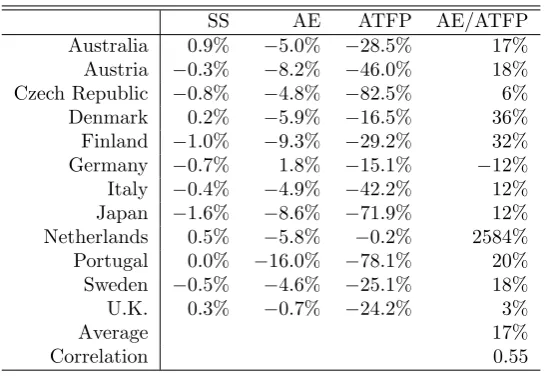
The first column in Table 1 reports the sectoral shares (SS). We find that SS is small and
approaches zero. The second column reports the allocational efficiency (AE). For example, the
result on AE for Japan implies that the aggregate TFP of Japan as compared with that of the
U.S. is 8.6% lower because of sector-level resource misallocation. The third column calculates the
differences in aggregate TFP (ATFP) between the U.S. and other countries.
The importance of resource misallocation for the difference in aggregate TFP can be measured
by dividing AE by ATFP. The results are shown in the fourth column in Table 1. The results
range from less than 0% for Germany to more than 100% for the Netherlands. The average figure
across countries, when we exclude Germany and the Netherlands, is 17%.23 This implies that,
on average, 17% of the differences in aggregate TFP between the U.S. and other countries are
explained by resource misallocation. In addition, the correlation between AE and ATFP in the
table is 0.55 (see also the scatter graph in Figure 3). These results suggest that the sector-level
resource misallocation is an important factor of cross-country differences in aggregate TFP between
these developed countries.
4.4
Contribution of each sector to AE
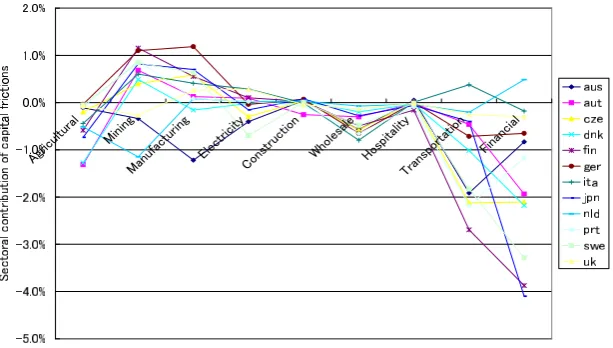
Using the result in Section 3.3, this section analyzes which sector contributes to AE. Figures 4 and
5 report the capital and labor AEi calculated using equations (18)–(21).
22
Although we might expect the value of the U.S. component to be stable across countries, unfortunately, it is not so.
23
[Figure 4]
[Figure 5]
Figure 4 reports that for these countries, the magnitude of capital AEiis large for the transport
and financial sectors; this implies that these sectors are the causes of resource misallocation of
capital. This is because the return on capital is low (i.e., ˜λKi is high) in the transport sector,
while the return on capital is high (i.e., ˜λKiis low) in the financial sector (see Figure 1).24 On the
other hand, Figure 5 suggests that the agricultural and financial sectors are the causes of labor
misallocation. As in capital AEi, this is because the return on labor is low (i.e., ˜λLiis high) in the
agricultural sector, while the return on labor is high (i.e., ˜λLi is low) in the financial sector (see
Figure 2).
4.5
Contribution of sectoral frictions and sectoral shares to AE
As argued in Section 3.4, the AE results depend on the differences in sectoral frictions and the
differences in sectoral shares across countries. The interpretation of the results in the previous
sections differs depending on the actual cause of the AE. If the former is the cause, the differences
in sectoral frictions between countries are a cause of the differences in aggregate TFP between
countries. On the other hand, if the latter is the cause, other mechanisms that affect sectoral shares
generate the effect of sector-level resource misallocation on the differences in aggregate TFP. Here,
in order to identify this problem, I calculate the counterfactual AE discussed in Section 3.4.
The first column in Table 3 reports the counterfactual AE for each country. The magnitude of
the counterfactual AE is not small. In order to ascertain the magnitude, I calculate the ratio of
the counterfactual AE and the original AE in the second column of Table 3. The ratio varies from
less than 0% for Japan to more than 100% for Australia, the Czech Republic, Germany, and the
U.K. This result implies that all of the measured misallocation for Japan is due to the differences
in sectoral frictions between Japan and the U.S. On the other hand, most of the misallocation
effect for Australia is due to the differences in sectoral shares between Australia and the U.S.
[Table 3]
24
4.6
Capital intensity
α
iI measureαi from the U.S. data, under the assumption that theαiare the same across developed
countries. For the robustness check, I also calculate the cross-country AE for the case where the
αiare measured for each country for each year.25 I report the results in the third column of Table
3. We can confirm that the results are similar to the AE in Table 1.
5
Concluding Remarks
In this paper, I proposed a simple multi-sector accounting framework to measure the effect of
resource misallocation on aggregate productivity. The characteristics of this framework are that
it is micro-founded, flexible for the assumption on preferences or aggregate production functions,
and consistent with the framework commonly used in productivity analysis. Using this framework,
I measured the extent to which resource misallocation explains the difference in aggregate TFP
across developed countries. I found that sector-level resource misallocation accounted for, on
average, 17% of the differences in aggregate TFP among developed countries. I also provided
methods to identify the causes of the resource misallocation.
There are some limitations in this paper’s analysis. The first involves the interpretation of
cross-sectional differences in returns on factor inputs. In this paper, cross-sectional differences in
returns are interpreted as distortions. However, other interpretations such as the differences in
efficiency wage and the quality of factor inputs (e.g., differences in educational attainment) across
sectors, and the existence of investment adjustment costs are also possible. For the former two
instances, some of these effects might cancel each other out in a cross-country analysis if the degree
of these effects is similar across countries. The effect in the last case might be inferred from the
change in the effect of measured frictions over a period of time. However, further improvements
are needed to solve these problems. Second, this paper does not take into account material inputs.
If frictions on the allocation of materials exist, there can be effects on aggregate productivity.
25
AE expressed in (16) is modified as follows: AE =∑
i
¯
σi
{
αSi ln ˜λ S Ki−α
T i ln ˜λ
T Ki
}
+∑
i
¯
σi
{
(1−αSi) ln ˜λ S
Li−(1−α T i) ln ˜λ
T Li
}
.
The years whenαi ∈/ [0,1] is measured are eliminated from the calculation (this is the reason why the result for
Exploration of this issue is also left for future research.
Appendix
A
Examples of Sector-level or Firm-level Frictions
In the model in Section 2, the frictions that firms face appear as taxes imposed on their factor
inputs, firms are price-takers, and a firm’s problem is static. In the following examples, following
Chari et al. (2002), I argue that the effect of several types of frictions in each sector is isomorphic
to the taxes on this sector’s factor inputs—the allocation is the same. In particular, in the last
example, the effect of frictions in a dynamic model is isomorphic to taxes in the static model in
Section 2 in terms of the current period allocation.
As mentioned in Section 4.1, Appendix A.4 explains thatαi measured from factor input cost
can have biases for the following models.
A.1
Barrier to labor mobility
Hayashi and Prescott (2008) argue that a barrier to labor mobility from the agricultural sector to
the non-agricultural sector was one of the causes of stagnation in prewar Japan. I demonstrate
that the allocation of this model can be achieved in the model in Section 2.
First, let us consider a labor immobility model. Suppose that there are two sectors (the
agri-cultural sector A and the non-agricultural sector N). The firms in each sector are competitive.
However, there is a constraint on labor mobility between the sectors: labor input in sectorA,LA,
has to be at least ¯LA(i.e.,LA≥L¯A). Notations of the model are basically the same as in Section
2. Then, the typical firm’s problem is
max
Ki,Li
piFi(Ki, Li)−pKKi−pLiLi, i∈ {AorN}. (24)
The factor price on labor, pLi, can be different between the sectors, because of the constraint on
labor mobility:
Therefore, the allocation may differ from that in the no-friction case.
Suppose that other settings are the same as in Section 2. Then, if I set (1 +τLA)pL =pLA,
(1 +τLN)pL =pLN, and (1 +τKi) = 1 in the Section 2 model, the effect of the barrier to labor
mobility is isomorphic to the taxes in the Section 2 model. For the proof, check that equilibrium
conditions for these two models are identical.
A.2
Imperfect competition
I demonstrate that frictions caused by imperfect competition such as monopoly, oligopoly, or
monopolistic competition can also be expressed as taxes on factor inputs.
Let us consider the following firm’s problem: the firm is a price-taker in the factor market but
a price-setter in the output market. Notations of the model are basically the same as in Section 2.
Accordingly, the firm’s cost minimization problem is
min
Ki,Li
pKKi+pLLi, (26)
s.t. Vi=Fi(Ki, Li). (27)
The FOCs of the problem are
pi
∂Fi(Ki, Li)
∂Ki
= pi
γi
pK, (28)
pi
∂Fi(Ki, Li)
∂Li
= pi
γi
pL, (29)
where γi is the Lagrange multiplier andpi is the price of the good that the firm produces. Since
γi is equal to the marginal cost, pi/γi is the markup and is equal to unity when the firm is a
price-taker in the output market.
Suppose that the other settings are the same as in Section 2. Then, if I set (1 +τKi) =
(1 +τLi) =pi/γi in the Section 2 model, the effect of imperfection is isomorphic to the taxes in
the Section 2 model. The proof is the same as that in Section A.1.
A.3
Borrowing constraint
firms can affect resource allocation and aggregate productivity. I demonstrate that the allocation
of this model at a certain period can be achieved in the model in Section 2.
First, let us consider a recursive borrowing constraint model under no uncertainty. Suppose
a typical firm i. The state of the firm is as follows: Ki,−1 is the capital input and Bi,−1 is
the borrowing. The firm chooses labor input, Li, new capital, Ki, and new borrowing Bi. For
simplicity, the prices are constant. Then, the firm’s problem is written as follows:
Ji(Ki,−1, Bi,−1) = max
Ki,Li,Bi
πi+mJi(Ki, Bi),
s.t. πi=piFi(Ki, Li)−pLLi−qK(Ki−(1−δ)Ki,−1)
+Bi
R −Bi,−1,
Bi≤θiqK(1−δ)Ki, (30)
wheremis the discount factor,Ris the gross interest rate,qK is the price of capital (not the rental
price but the asset price),δis the depreciation rate, (30) is the firm’s borrowing constraint in the
next period, andθi is the firm’s collateral constraint parameter. The other notations are the same
as in Section 2. This firm’s problem is similar to that of Jermann and Quadrini (2006) except for
the timing of the investment and the formulation of the borrowing constraint. Then, the FOCs
are rearranged as follows:
pi
∂Fi(Ki, Li)
∂Ki
=qK−mqK(1−δ)−ηiθiqK(1−δ), (31)
pi
∂Fi(Ki, Li)
∂Li
=pL,
where ηi is the Lagrange multiplier of the firm’s borrowing constraint and is zero when the
con-straint is not bound.
Suppose that, in the above model, other settings, aggregate capital, and labor of the current
period are the same as in the model in Section 2. Then, if I set (1 +τKi)pK to be equal to the
RHS of (31) and (1 +τLi) = 1 in the model in Section 2, the effect of the borrowing constraint
is isomorphic to the taxes in the model in Section 2. For the proof, check that (intratemporal)
A.4
Biases arising in the measurement of
α
iHere, I argue that if there are imperfections in the factor market as in Appendices A.1 and A.3,
αi measured from factor input cost can have biases.
To examine this, take the labor immobility model in Section A.1 as an example. In this model,
because of the barrier to labor mobility, the labor input cost is different across sectors, although
the quality of labor input is homogeneous in the model. However, the labor input cost is usually
measured under the assumption that the cost of labor input with the same quality level is the same
between sectors. Thus, measured 1−αi can have biases, if the labor input cost measured in this
way is used.26 A similar problem arises on the capital side in the case of the borrowing constraint
model in Section A.3.
B
Value of
SS
when the Differences in
σ
˜
iare Small
Here, I show that SS defined in Section 3.1 is approximately zero when the differences in ˜σibetween
the states S andT are small. When ∑
iγi= 1, the following relationship holds:
∑
i
γi∆ lnγi≃
∑
i
γi
∆γi
γi
= 1−1
= 0.
By settingγi≡σ˜iαi/α˜ orγi≡σ˜i(1−αi)/(1−α˜), we find that
¯
α∑
i
¯
σiαi
¯
α ∆ ln
(
˜
σiαi
˜
α
)
and (1−α¯)∑
i
¯
σi(1−αi)
1−α¯ ∆ ln
(
˜
σi(1−αi)
1−α˜
)
are approximately zero (∆ denotes the difference between statesS andT). Finally, SS is the sum
of these terms.
26
C
Relation between
AE
iand
AE
This appendix shows that if ˜σS
i and ˜σiT are small for each sector, the sum of AEi is approximately
equal to AE. The sum of the capital AEi, AEKi, in (19) can be written as follows:
∑
i
AEKi= AEK+
∑
i
(¯α−σ¯iαi) ln
(˜
λS K−i
˜
λT K−i
)
,
where AEK is the capital component of AE (AEK ≡∑iσ¯iαiln
(
˜
λS Ki/˜λTKi
)
). We show that the
second term of the RHS of the above equation approximately becomes zero. Then, the sum of
AEKiis approximately equal to AEK. In the same manner, we can show that the sum of AELi is
also approximately equal to AELi. Thus, we can show the statement of the appendix.
To demonstrate that the second term of the RHS of the above equation approximately becomes
zero, I further focus on the stateS component (the same result applies to the stateT component).
Thus, I show
∑
i
(¯α−σ¯iαi) ln ˜λSK−i≃0, (32)
when ˜σS
i and ˜σiT are small (note that ¯σi depends on ˜σTi ). From (18), we obtain the following
relationship:
˜
λSK−i= 1 +
1−˜λS Ki
˜
αS
˜
σS iαi −1
By substituting the above in the LHS of (32) and rearranging, we obtain
(32) =∑
i
( α¯−σ¯
iαi
˜
αS−σ˜S iαi
) ( α˜S
˜
σS iαi
−1
)
˜
σSiαiln
1 +
1−λ˜S Ki
˜
αS
˜
σS iαi −1
=∑ i ( ¯
α−σ¯iαi
˜
αS−σ˜S iαi
)
˜
σiSαiln
1 +
1−λ˜S Ki
˜
αS
˜
σS iαi−1
˜
αS
˜
σSiαi−1
For sufficiently small ˜σS
i and ˜σiT,
(
¯
α−σ¯iαi
˜
αS−σ˜S iαi
) ≃ α¯
˜
αS, and
1 +
1−λ˜S Ki
˜
αS
˜
σS iαi −1
˜
αS
˜
σSiαi−1
≃exp(1−˜λSKi
)
.
Thus, if ˜σS
i and ˜σiT are small in all the sectors,
(32)≃ α¯
˜
αS
∑
i
˜
σSiαi
(
1−˜λSKi
)
= 0.
The last equation becomes zero, because from definition ∑
iσ˜iSαi= ˜αS and∑i˜σiSαi˜λSKi= ˜αS.
References
Aoki, S., 2006. A simple accounting framework for distortion on sectoral resource allocation. Paper
presented at the 2006 Fall Meeting of Japan Economic Association.
Basu, S. and J. G. Fernald, 2002. Aggregate productivity and aggregate technology. European
Economic Review46, 963–991.
Caballero, R. J., T. Hoshi, and A. K. Kashyap, 2008. Zombie lending and depressed restructuring
in Japan.American Economic Review, forthcoming.
Caves, D. W., L. R. Christensen, and W. E. Diewert, 1982. Multilateral comparisons of output,
input, and productivity using superlative index numbers.Economic Journal92, 73–86.
Chari, V. V., P. J. Kehoe, and E. R. McGrattan, 2002. Accounting for the great depression.
American Economic Review 92, 22–27.
Christensen, L. R., D. W. Jorgenson, and L. J. Lau, 1973. Transcendental logarithmic production
frontiers.Review of Economics and Statistics 55, 28–45.
de Melo, J. A. P., 1977. Distortions in the factor market: Some general equilibrium estimates.
Domar, E. D., 1961. On the measurement of technological change.Economic Journal71, 709–729.
Hayashi, F. and E. C. Prescott, 2008. The depressing effect of agricultural institutions on the
prewar Japanese economy.Journal of Political Economy116, 573–632.
Hsieh, C.-T. and P. J. Klenow, 2007. Misallocation and manufacturing TFP in China and India.
NBER Working Papers 13290, National Bureau of Economic Research, Inc.
Inklaar, R. and M. P. Timmer, 2008. GGDC productivity level database: International comparisons
of output, inputs and productivity at the industry level. GGDC Research Memorandum GD-104,
Groningen: University of Groningen.
Jermann, U. and V. Quadrini, 2006. Financial innovations and macroeconomic volatility. NBER
Working Papers 12308, National Bureau of Economic Research, Inc.
Kiyotaki, N. and J. Moore, 1997. Credit cycles.Journal of Political Economy105, 211–248.
Miyagawa, T., K. Fukao, S. Hamagata, and M. Takizawa, 2008. Efficiency of sector-level resource
al-location (in Japanese). In Fukao, K. and T. Miyagawa (Eds.).Productivity and Japan’s Economic
Growth: Industry-Level and Firm-Level Studies Based on the JIP Database. Tokyo: University
of Tokyo Press, 129–155.
OECD, 2002. Purchasing Power Parities and Real Expenditures, 1999 Benchmark Year. Paris:
OECD.
Parente, S. L. and E. C. Prescott, 2000. Barriers to Riches (Walras-Pareto Lecture Series).
Cam-bridge: MIT Press.
Prescott, E. C., 2002. Richard T. Ely lecture: Prosperity and depression. American Economic
Review92, 1–15.
Restuccia, D. and R. Rogerson, 2008. Policy distortions and aggregate productivity with
hetero-geneous establishments.Review of Economic Dynamics11, 707–720.
Restuccia, D., D. T. Yang, and X. Zhu, 2008. Agriculture and aggregate productivity: A
Syrquin, M., 1984. Resource reallocation and productivity growth. In Syrquin, M., L. Taylor, and
L. E. Westphal (Eds.). Economic Structure and Performance : Essays in Honor of Hollis B.
Chenery. Orlando: Academic Press, 75–101.
Timmer, M. P., M. O’Mahony, and B. van Ark, 2008. EU KLEMS growth and productivity
accounts: An overview.Technical report, University of Groningen & University of Birmingham.
Downloadable atwww.euklems.net.
Vollrath, D., 2009. How important are dual economy effects for aggregate productivity? Journal
SS AE ATFP AE/ATFP Australia 0.9% −5.0% −28.5% 17% Austria −0.3% −8.2% −46.0% 18% Czech Republic −0.8% −4.8% −82.5% 6%
Denmark 0.2% −5.9% −16.5% 36%
Finland −1.0% −9.3% −29.2% 32% Germany −0.7% 1.8% −15.1% −12% Italy −0.4% −4.9% −42.2% 12% Japan −1.6% −8.6% −71.9% 12% Netherlands 0.5% −5.8% −0.2% 2584% Portugal 0.0% −16.0% −78.1% 20% Sweden −0.5% −4.6% −25.1% 18%
U.K. 0.3% −0.7% −24.2% 3%
Average 17%
[image:30.595.163.436.133.321.2]Correlation 0.55
Table 1: Sectoral share (SS), allocational efficiency (AE), aggregate TFP (ATFP), and AE di-vided by ATFP (AE/ATFP) of the countries compared with the U.S. Notes: AE (or SS + AE) measures the effect of resource misallocation on the difference in aggregate TFP (ATFP) between other countries and the U.S. Moreover, AE/ATFP measures the extent to which the differences in aggregate TFP between the countries are explained by resource misallocation. “Average” is the average of AE/ATFP across the countries when we exclude Germany and the Netherlands. “Correlation” is the correlation between AE and ATFP. These values are the averages over the years.
Each country U.S. Capital Labor Australia −7.8% 2.8% −4.4% −0.6% Austria −12.1% 4.0% −3.1% −5.1% Czech Republic −7.8% 3.0% −3.6% −1.2% Denmark −10.2% 4.3% −3.8% −2.1% Finland −12.9% 3.5% −5.3% −4.1%
Germany −4.5% 6.2% 0.1% 1.6%
Italy −8.8% 3.9% 0.1% −5.1% Japan −13.9% 5.3% −4.0% −4.6% Netherlands −9.9% 4.0% −1.2% −4.6% Portugal −19.0% 3.1% −2.7% −13.3% Sweden −9.8% 5.2% −4.3% −0.3% U.K. −5.3% 4.6% −0.5% −0.2%
[image:30.595.162.437.466.627.2]CFAE CFAE/AE AE with diffαi
Australia −7.1% 142% −5.8%
Austria −3.1% 38% −9.6%
Czech Republic −6.1% 126% −3.9%
Denmark −2.7% 45% −5.9%
Finland −3.6% 39% −5.6%
Germany 1.8% 100% n.a.
Italy −3.2% 65% −5.9%
Japan 0.3% −4% −9.7%
Netherlands −4.2% 73% −4.4%
Portugal −6.4% 40% −13.5%
Sweden −0.6% 14% −4.3%
[image:31.595.169.429.134.295.2]U.K. −2.6% 381% −3.2%
Table 3: Counterfactual AEi (CFAE in the table), the ratio of CFAE and AE (CFAE/AE), and
AE with country-specific αi (AE with diffαi). Notes: Counterfactual AE measures the effect of
resource misallocation on aggregate TFP when the frictions of each country are the same as those of the U.S., but the sectoral shares are not. AE with country-specific αi is calculated using αi
Figure 1: Measured capital wedge ˜λKi for each country. Note: These values are the averages over
the years.
Figure 2: Measured labor wedge ˜λLi for each country. Note: These values are the averages over
[image:32.595.155.463.425.602.2]Figure 3: Scatter graph of allocational efficiency (AE) and aggregate TFP (ATFP) of the countries compared with the U.S. for 1985, 1995, and 2005. Note: AE measures the effect of resource misallocation on the difference in aggregate TFP (ATFP) between other countries and the U.S.
Figure 4: Sectoral contribution of capital frictions, capital AEi. Notes: Capital AEi measures the
[image:33.595.156.463.438.612.2]Figure 5: Sectoral contribution of labor frictions, labor AEi. Notes: Labor AEi measures the effect