http://dx.doi.org/10.4236/jmp.2016.72020
An Alternative Demonstration of the Carnot
Efficiency “
Without
” Using the Entropy
Function
Olivier Serret Cugnaux, FranceReceived 5 November 2015; accepted 26 January 2016; published 29 January 2016
Copyright © 2016 by author and Scientific Research Publishing Inc.
This work is licensed under the Creative Commons Attribution International License (CC BY). http://creativecommons.org/licenses/by/4.0/
Abstract
Entropy function is used to demonstrate the Carnot efficiency, even if it is not always easy to under- stand its bases: the reversible movement or the reversible heat transfer. Here, it is proposed to demonstrate the Carnot efficiency “without” using the Entropy function. For this, it is necessary to enhance two concepts: heat transfer based on the source temperature and work transfer based on external pressure. This is achieved through 1) a balance exchanged heat, based on the source tem- perature and the system temperature, and 2) a balance exchanged work, based on the external pres- sure and the internal pressure. With these enhanced concepts, Laplace function
(
p v⋅ γ =Constant)
and Carnot efficiency
1
COLD Carnot
HOT
T T = −
η can be demonstrated without using the Entropy func-
tion (𝑺𝑺). This is only a new formalism. Usual thermodynamics results are not changed. This new formalism can help to get a better description of realistic phenomena, like the efficiency of a rea- listic cycle.
Keywords
Entropy, Carnot Efficiency, Laplace Law, Heat, Work, Thermodynamic Engine, Cycle Efficiency
1. Introduction
1.1. Main Paradox about Entropy
En-tropy. Whereas the world and the Universe should work to chaos according to the second law of Thermodynam-ics with Entropy, since the Bing Bang and the primordial soap, stars, planets, life, more organized worlds have appeared and not a more chaotic world. For scientist, this paradox would only be apparent, because the Chaos would be created “elsewhere”. For Creationist, if there is a contradiction between the two assessments, that means that one is false, and it would be the Evolution one. Here, the purpose is not to debate or to argue about Evolution vs. Creationism. But our purpose will be to recognize this paradox, and between the two assessments, if one is false, it would be the Entropy function.
1.2. History
Let us remind ourselves where Entropy function (noted S) comes from and its role in thermodynamic efficiency and in the increase of disorder.
Sadi Carnot found the engine efficiency of a thermal motor depends only of its temperatures: the higher the difference of temperatures is, the higher the efficiency is.For a thermodynamic cycle, the efficiency η is defined by
Hot
W Q
η= (1)
Like water falling from top to bottom to turn the wheel of a mill, Sadi Carnot compared in 1824 the tempera-ture to an invisible fluid dropping from hot to cold which would turn thermodynamic engines [2]. But for his part Joule demonstrated that Heat is not a fluid, and can be proceed from the Work.
Later Rudolf Clausius created in 1854 the Entropy function, which name means “content transformative” and sounds like “Energy”. Because it is not easy to define the entropy itself, difference of entropy (∆S) of a system is defined as:
rev dQ S
T
∆ =
∫
(2)where T is the absolute temperature of the system, and dQrev the incremental reversible transfer of heat into that system. Using the equivalence of Heat and Work, efficiency can be written:
1 Cold
Hot
Q
Q
η= − (3)
And thanks to this Entropy function, it can be demonstrated that the engine efficiency will be limited by the temperature of the sources:
1 Cold
Hot T
T
η ≤ − (4)
where THot is the temperature of the hot source, and TCold the temperature of the cold source. 1
Cold
Hot
T T
−
is
called the Carnot efficiency.
In 1877, Boltzmann linked the Entropy function to the probability of the number of specific ways in which a system may be arranged, especially with irreversible movements of particles.
At the beginning of the 20thcentury, Bergson stated that the entire Universe is changing over time, in a con-stant direction. And since then, the Entropy function is linked to the Chaos.
An easy way would be to disconnect the Entropy function from the Chaos, but even keeping the original con-cept of Claudius with reversible transfer, it remains another paradox.
1.3. Another Paradox
Entropy variation is defined by reversible transfer of heat, as seen in Equation (2):
rev dQ S
T
But what does a “reversible” transfer of heat mean? It would mean that heat could go from one side to another, back and forth indefinitely without any change in the environment!… In a way, a perpetual transfer! Let us re-member that the reversible transfer of heat was imagined when heat was still considered as a fluid. In fact the heat goes from the hot source to the cold source, and so “any real transformation is irreversible in fact” [3]. Be-cause variation of entropy is defined by reversible heat, that means that demonstrations using entropy are based on impossible transfers!
Let us now try to demonstrate thermodynamic properties without using this Entropy function, qualified by Bergson [4] as the most “metaphysical” of the physical laws.
2. Definitions and Hypotheses
2.1. The “Internal” Energy
“Internal” energy is not named as such to distinguish it from an external energy, but from the kinetic energy of the system and from the potential energy of the system. From a microscopic point of view, it is the sum of the kinetic energies of the atoms, and it is called U. From a microscopic point of view, it is difficult to define it and in practice, internal energy cannot be measured. It is always surprising to base a theory on a concept we cannot measure!
2.2. The First Law of Thermodynamics
If internal energy cannot be measured, its main property is easy to define and to measure: the variation of inter-nal energy is the sum of the work and the heat exchanged with the outside.
U W Q
∆ = + (5)
It is called the first law of Thermodynamics
2.3. The Mechanical Work
Traditionally, the infinitesimal work δW exchanged by the system with the outside is calculated thanks to the formula
Ext
W P dV
δ = − ⋅ (6)
with dV the volume variation and PExt the external pressure.
It is surprising that the work received or supplied by the “internal” system is due to the “external” pressure only. A work refers to a volume variation, a movement. According to the mechanical principle of inertia, a movement is due to a force. A force cannot exist if the internal pressure is equal to the external pressure. In fact, a force depends of the “difference” of pressure between the inside and the outside. Let us clarify
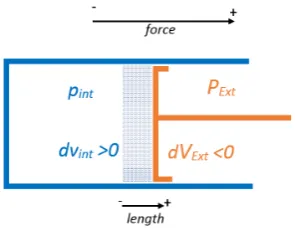
• δWExt is the work supplied (<0) or received (>0) by the outside, the Universe
• δwint is the work supplied (<0) or received (>0) by the inside, the system
• dVExt the variation of volume of the outside, the Universe
• dvint the variation of volume of the inside, the system
When the volume of the inside system increases (respectively decreases), the volume of the outside decreases (respectively increases):
Ext int
dV = −dv (7)
Taking an axis positive from Left to Right, general expression of the transferred work is:
(
)
(
)
Infinitesimal work= − PLeft−PRight × Volume variation (8)
which means, if the system is on the Left side, and the outside on the right side (see Figure 1):
(
)
int int Ext int
w p P dv
δ = − − ⋅ (9)
(
)
Ext int Ext Ext
W p P dV
δ = − − ⋅ (10)
Figure 1. Work exchanged from the inside (in blue) to the outside (in red).
Ext int
W w
δ = −δ (11)
Note: when we get the same pressure inside and outside, we get equilibrium, there is no movement and so no work:
[
pint=PExt] [
⇒ δWExt =δwint =0]
(12)2.4. The Exchanged Heat
The energy radiated Q
dt
δ
by a body in vacuum is proportional to its temperature according to Stéphan-Boltz-
mann law [5] [6]:
4
Q
T A dt
δ =σ
(13)
with the constant 8 2 4
5.67 10 W m K
σ = × − ⋅ − ⋅ −
, T the temperature and A the area of the body.
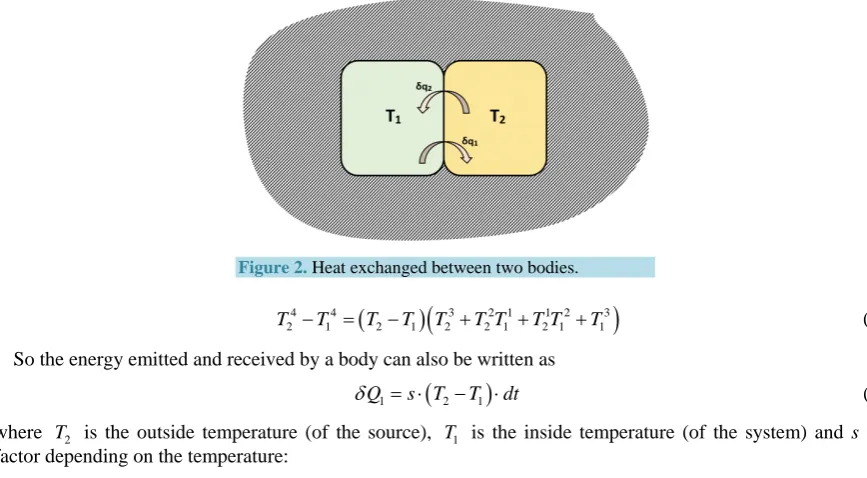
What is true for a single body should be true for several bodies. Let us have an adiabatic (without loss of heat) enclosure with two bodies inside (see Figure 2).
First one will emit (so it will have a negative value) the energy
4
1 1
q T Adt
δ = −σ (14)
and this emitted energy will be received (so it will have a positive value) by the second body. The second body will emit the energy
4
2 2
q T Adt
δ = −σ (15)
and this emitted energy will be received by the first body. When we do the balance, the energy emitted and re-ceived by each body is
for the first body
1 2 1
Q q q
δ =δ −δ (16)
(
4 4)
2 1
1
Q T T Adt
δ =σ − (17)
and for the second body
2 1 2
Q q q
δ =δ −δ (18)
(
4 4)
2 1 2
Q T T Adt
δ =σ − (19)
We can check at the equilibrium where the temperatures are equal that each body emits and receives the same amount of energy, thus the balance for each body is nil:
[
T1=T2] [
⇒ δQ1=δQ2=0]
(20)Figure 2. Heat exchanged between two bodies.
(
)
(
)
4 4 3 2 1 1 2 3
2 1 2 1 2 2 1 2 1 1
T −T = T −T T +T T +T T +T (21)
So the energy emitted and received by a body can also be written as
(
)
1 2 1
Q s T T dt
δ = ⋅ − ⋅ (22)
where T2 is the outside temperature (of the source), T1 is the inside temperature (of the system) and s is a
factor depending on the temperature:
(
3 2 1 1 2 3)
2 2 1 2 1 1
s= ⋅σ T +T T +T T +T ⋅A (23)
Why should we use this group? Because at the usual temperature, for example at 10˚C and 30˚C, the mathe-matical difference of s with the average temperature (20˚C) will be about 0.1%, which is insignificant:
(
10 C; 30 C)
100732228s = ⋅ ⋅σ A
and
(
20 C)
100615028s = ⋅ ⋅σ A
And with regards to the difference with the entropy, s is only a calculation, it is not a state “function”.
To conclude, we do not need to use the Entropy function to explain that Heat goes from hot to cold. It can be explained by a hot body emitting more heat than a cold body, and so the difference of heat looks like a heat transfer from the hot body to the cold body.
2.5. The Writing Convention
To simplify the reading (and the writing), when it is possible or easier we will use:
• Small letters for the internal system.
• Capital letters for the external Universe, or sources.
• δQcold = ⋅s T
(
COLD−Tcold)
⋅dt is the energy emitted and received from the cold inside system.• δQCOLD = ⋅s T
(
cold −TCOLD)
⋅dt is the energy emitted and received from the cold outside source. Another application (from Equations (10) and (11).• dwint= −
(
pint−PExt)
⋅dvint is the work received or supplied by the internal system (small letters).• dWExt = −
(
pint−PExt)
⋅dVExt is the work received or supplied by the external Universe (Capital letters). Let us now demonstrate the first “isentropic” law without using the entropy function.3. Laplace’s Law Demonstration
3.1. Traditional Demonstration
Traditionally the Laplace law is demonstrated by using the two equations hereafter
int
and
Ext
W P dV
δ = − ⋅ cf. Equation (6)
Then, it is done the hypothesis of a reversible way (let us remember that a reversible way does not exist) in order to write the equality:
int Ext
p =P (25)
which is clearly excessive, because when the internal pressure and the external pressure are equal, there is no movement!
3.2. Traditional Formulas
We will use the perfect gas formula and definitions hereafter:
int int int
p ⋅v = ⋅R T (26)
int int
H = +U p v (27)
int v
int v
U C
T ∂ = ∂
(28)
int p
int p
H C
T ∂ = ∂
(29)
p
v
C
C
γ = (30)
With previous equations, it is traditionally demonstrated that
1 v
R C
γ =
− (31)
3.3. Alternative Demonstration of Laplace Law
According to the first law of thermodynamic, with the new expression defined earlier:
U w Q
∆ = + cf Equation (5)
which can also be written as:
dU =δw+δQ (32)
In the case of an adiabatic transformation (and so irreversible), there is no heat exchange: 0
Q
δ = (33)
dU=δw (34)
and using Equations (10) and (26):
(
)
v int int Ext int
C ⋅dT = − p −P ⋅dv (35)
Dividing by the temperature Tint:
int ext int
v int int
int int int
dT P p
C dv dv
T T T
⋅ = ⋅ − ⋅ (36)
Using Equation (7) on the variation of internal and external volume
int ext int
v ext int
int int int
dT P p
C dV dv
T = −T ⋅ −T ⋅
⋅ (37)
1 1
int Ext int
v Ext int
int Ext int int int
dT R T R T
C dV dv
T V T v T
⋅ ⋅
= − −
(38)
int Ext int
v Ext int
int Ext int int int
dT R T R T
C dV dv
T V T v T
⋅ ⋅
= − −
⋅ ⋅ (39)
int Ext Ext int
v
int int Ext int
dT T dV dv
C R R
T = − T V − v (40)
For the outside Universe, it is considered as infinite,
Ext
V ≈ ∞ (41)
So
limExt Ext 0
V
Ext dV
V
→∞ = (42)
And so lim 0 Ext Ext Ext V int Ext T dV R T V →∞ − =
(43)
Then int int v int int dT dv C R
T = − v (44)
Integrating it:
0 0
ln int ln int
v int int T v C R T v ′ ′ = − ⋅ ⋅
(45)
Then using Equation (31) on the property of 𝐶𝐶𝑣𝑣:
1 0 0 int int int int T v v T γ− ′ = ′
(46)
Which is equivalent, using Equation (26) of perfect gas
( )
0 0
int int int int
p v′ ′ =γ p v γ (47) It is nothing else than the Laplace law:
Constant int int
p ⋅vγ = (48)
The difference with the classical demonstration is that it has not been confused pint and PExt. Only the adiabatic property (and not the “reversible” property) was used. That means Laplace law has been demonstrated without using neither the Entropy function nor the Entropy property.
4. Carnot’s Efficiency Demonstration
4.1. Traditional Demonstration
Traditionally to demonstrate the Carnot efficiency, the in-equation hereafter is used, which links the sources temperatures to the exchanged energies:
0 hot cold HOT COLD Q Q T T δ δ
+ ≤ (49)
COLD source. This equation comes from the Entropy function.
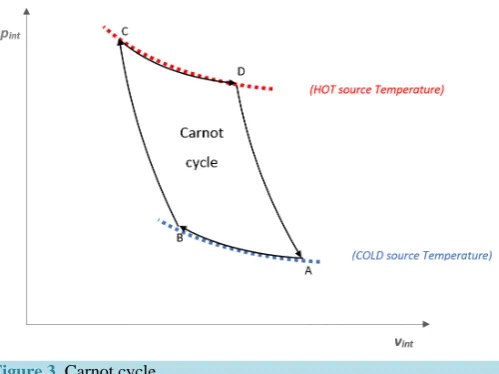
The trouble is it is forgotten that when two bodies (the system and the source) are at the same temperature, there is no exchange of heat (see Figure 3):
[
TCOLD source =TAB] [
⇒ δQcold =0]
(50)[
THOT source=TCD] [
⇒ δQhot=0]
(51)Starting again from the definition of the cycle efficiency with Equation (1) and (3),
undefined 0
hot
W W
Q
η= = = (52)
0
1 1 undefined
0
cold
hot
Q
Q
η= − = − = (53)
the Carnot efficiency is mathematically undefined!
Let us check now the situation without using the Entropy function or its property.
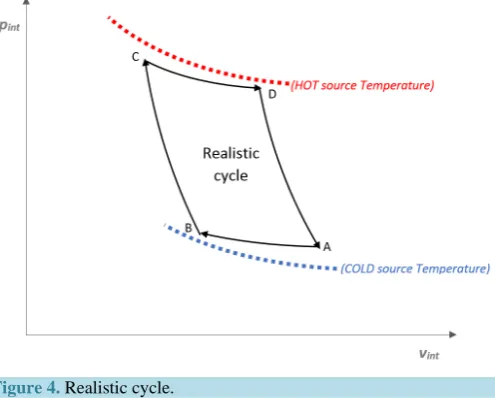
4.2. Preliminaries Demonstrations 4.2.1. A Realistic Cycle
Let us have a cycle as shown in Figure 4:
• From A to B, in contact with the COLD source (with a source temperature lower than the system
tempera-ture), the system is quite isotherm, cools down but with TAB≠TCOLDsource. Let us call the average temperature of the system between A and B:
cold AB A B
T =T ≈T ≈T (54)
• From B to C, the system is pressed without adding or loosing heat (it is an adiabatic process):
0 BC
Q = (55)
• From C to D, in contact with the HOT source (with a source temperature higher than the system tempera-ture), the system is quite isotherm, worms up but with TCD≠THOTsource. Let us call the average temperature of the system between C and D:
hot CD C D
T =T ≈T ≈T (56)
• From D to A, the system expands without adding or loosing heat (it is an adiabatic process):
0 DA
[image:8.595.192.442.531.718.2]Q = (57)
Figure 4. Realistic cycle.
4.2.2. Comment about the “Quasi-Isotherm”
In previous demonstrations, some “quasi”-isotherm parts were noticed. Let us look at a realistic example to check the value. The Stirling engine is an engine with outside sources.
From Solo Kleinmotorem [7], 10 kW output, 650˚C (923 K) Hot temperature, 150 bars, 1500 rpm, Helium
(5183 J/kg.K; 0.05 kg/m3 at 1 bar), for 161 Liters of engine displacement:
Power=Flow Capacity Temperature difference× × (58)
Numerical application:
161 1500
10000 0.05 150 5183 0.06
1000 60
= × × ×
So the temperature difference will be of (0.06/923=) 0.01%, which is negligible. The temperature Thot of the system can effectively be considered as quasi-constant.
A B hot
T =T =T (59)
4.2.3. Equality of Work
Starting again from the first law of Thermodynamics Equation (5),
BC BC BC
U w Q
∆ = + (60)
DA DA DA
U w Q
∆ = + (61)
Because these two parts are adiabatic, QBC=QDA =0 as previously seen Equation (55) and Equation (57),
BC BC
U w
∆ = (62)
DA DA
U w
∆ = (63)
Then, using the definition of Cv from Equation (28), we can write for perfect gas:
(
)
BC v C B
U C T T
∆ = − (63)
(
)
DA v A D
U C T T
∆ = − (64)
And so from the construction of the cycle and the Equations (62) to (64):
(
)
BC v hot cold
w =C T −T (65)
(
)
DA v cold hot
The first result is:
BC DA
w = −w (67)
4.2.4. Equality of Pressure
In §3, without using the Entropy function, we have demonstrated
( )
0 0
int int int int
p v′ =γ p v γ cf. Equation (47)
and so using the Equation (26) of the property of perfect gas, we can get the general equation:
1 0 0 int int int int T p T p γ γ − ′ ′ =
(68)
and in particular, for the adiabatic parts (BC) and (DA):
1 C C B B T P T P γ γ −
= (69)
1 D D A A T P T P γ γ −
= (70)
Because we have quite isotherm part with (AB) and (CD):
C hot
B cold
T T
T ≈T (71)
hot D
A cold
T T
T ≈T (72)
and so 1 1 C D B A P P P P γ γ γ γ − − =
(73)
C D
B A
P P
P = P (74)
The second result is:
C B
A D
P P
P =P (75)
4.2.5. Equality of Temperature
For an isotherm part of a cycle, for a perfect gas:
(
int Ext)
intw p P dv
δ = − − ⋅ cf. Equation (9)
Including the perfect gas property of Equation (26)
AB
AB ext int
int
R T
w P dv
v
δ = − −
⋅ ⋅
(76)
CD
CD ext int
int
R T
w P dv
v
δ = − −
⋅
⋅ (77)
ln B 0
AB AB
A
V
w R T
V
⋅ ⋅
= − +
(78)
ln D 0
CD CD
C
V
w R T
V
⋅ ⋅
= − +
(79)
Or with the perfect gas property, the third results are
ln A
AB cold B
P
w R T
P ⋅
≈ ⋅
(80)
ln C
CD hot
D
P
w R T
P ⋅
≈ ⋅
(81)
4.2.6. Equality of Energy
For an isotherm part, for a perfect gas:
0 U
∆ = (82)
For the quasi isotherm part (CD), for a perfect gas
0
CD CD CD
U w Q
∆ = + ≈ (83)
The fourth result or quasi-isotherm work is:
CD CD
w ≈ −Q (84)
AB AB
w ≈ −Q (85)
4.3. Alternative Demonstration of Carnot Efficiency 4.3.1. Inequality
In Figure 5 in P-V, the pressure is represented as a function of the volume, so the area is proportional to the work according to the formula:
( )
w=
∫
p v ⋅dv (86) [image:11.595.188.440.530.709.2]Because the hot temperature Thot of the system is lower than the HOT temperature THOT of the source, and the cold temperature Tcold of the system is higher than the COLD temperature TCOLD of the second source, the area of the system is always lower than the area delimited by the source temperatures.
( )
( )
hot HOT
cold COLD
T T
T p v ⋅dv< T p v ⋅dv
∫
∫
(87)So for a same heat transferred (cf Equation (1) on the efficiency definition):
isotherm cycle Carnot
η <η (88)
4.3.2. Carnot Efficiency
Let us now demonstrate cycle efficiency without using the Entropy function. The total work of the cycle is the sum of the supplied and received works:
AB BC CD DA
w=w +w +w +w (89)
As previously demonstrated with the first result:
BC DA
w = −w cf. Equation (67)
So
AB CD
w=w +w (90)
As previously demonstrated with the fourth result:
CD CD
w ≈ −Q cf. Equation (84)
So the efficiency definition of Equation (1):
AB CD
CD
w w
w
η= +
− (91)
or
1 AB
CD
w w
η= + (92)
Due to the third results
ln
1
ln
B cold
A
C hot
D
P R T
P
P R T
P η
= −
⋅
⋅ ⋅
⋅
(93)
And due to the second result
1 cold
hot T
T
η = − (94)
And of course if we extrapolate to the limits with Tcold =TCOLD and Thot =THOT, we could get
1 COLD
Carnot
HOT T
T
η = − (95)
4.4. Comments
Sadi Carnot considered the temperature as a fluid: the higher the temperature difference is, the more efficient it is (as for mill, the higher the water level difference is, the more efficient it is). He did not used the entropy func-tion (which was invented by Rudolf Clausius).
Here, we still have the same conclusion—the higher the temperature difference is, the more efficient it is— but for other reasons:
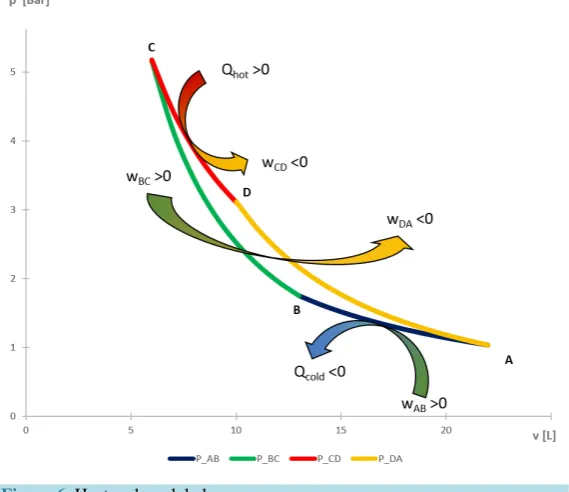
Figure 6. Heat and work balance.
• Because they are quite isotherm, the heat received in CD is transformed into work, and the work received in AB is transformed into “heat” to the cold source. But in the cycle, the heat received is proportional to the temperature of the hot source (cf Equation (81)), and the heat delivered is proportional to the cold one. So the system receives more heat than it delivers, and so the balance is delivered in work. See Figure 6.
5. Conclusions
Traditional thermodynamics was elaborated two centuries ago, when heat was understood as an invisible fluid! The main concepts were formalised during this period, like the Carnot’s efficiency and then the Entropy func-tion.
The purpose of this paper is to demonstrate the Carnot’s efficiency without using the Entropy function. For this, we have generalised both concepts:
• The balance exchanged work, which includes the external pressure and the internal pressure.
• The balance exchanged heat, which includes the temperature of the source and the temperature of the system. On these two general concepts, we have demonstrated first the Laplace’s law, or adiabatic compression/de- pression, and then the inequality of Carnot efficiency.
In my previous essay [8], the work variation 𝛿𝛿𝛿𝛿 had not yet been generalised. So the comparison chart of this other article has been updated in Appendix (Chart 1).
Acknowledgements
I would like to thank Dinusha for the corrections.
References
[1] Morris, H. (1985) Does Entropy Contradict Evolution? http://www.icr.org/article/does-entropy-contradict-evolution/
[2] Carnot, S. (1953) Réflexions sur la puissance motrice du feu. Blanchard. [3] Desit-Ricard, I. (2001) Une petite histoire de la Physique, 56 Ed. Ellipse.
[4] Bergson, H. (1908) L’évolution créative, III, Bibliothèque de philosophie contemporaine. [5] Fitzpatrick, R. (2006) Thermodynamics & Statistical Mechanics.
[6] American Chemical Society (2015) Energy Balance and Planetary Temperatures.
http://www.acs.org/content/acs/en/climatescience/energybalance.html
[7] EPRI (2006) Stirling Engine Assessment, A41. http://www.engr.colostate.edu/~marchese/mech337-10/epri.pdf
[8] Serret, O. (2014) Thermodynamics and Irreversibility: From Some Paradoxes to the Efficiency of Effective Engines.
http://www.scirp.org/journal/PaperInformation.aspx?PaperID=50604
Appendix
Chart 1. Traditional form vs. proposed form.
Thermodynamics Traditional form Proposed form
Energy variation dU=δQ+δW dU=δQ+δw
Exchanged work δWrev= −Pext⋅dv δwint= −(pint−PExt)⋅dvint
( )
Ext int Ext Ext
W p P dV
δ = − − ⋅
Exchanged heat δQrev= ⋅T dS
Q s T dt
δ = ∆⋅ ⋅
2 1
Q q q
δ =δ −δ
Reversible movement Valid Not valid
Reversible heat transfert Valid Not valid
Entropy Valid Not valid
Isotherm movement Valid Not valid (it is quasi-isotherm)
Heat goes from hot to cold A consequence of dS A consequence of δQ
Laplace law A consequence of dS A consequence of δQ
Carnot efficiency 1 COLD
Carnot HOT
T T
η = − Undefined (it is a limit)
Cycle efficiency Undefined 1 cold COLD
Cycle
HOT hot
T T
T T
η = − −