Welding Parameter Optimization of Surface Quality by Taguchi Method
Chuan Huat Ng
1, a *and Mohd Khairulamzari Hamjah
2,b1
Faculty of Mechanical and Manufacturing Engineering, Universiti Tun Hussein Onn Malaysia,
P.O. Box 101, 86400 Parit Raja, Johor Malaysia
2
Department of Mechanical Engineering, Politeknik Kuching Sarawak, Sarawak Malaysia
a,
*[email protected], [email protected]
Keywords: Gas Tungsten Arc Welding (GTAW), Welding Parameter, AISI1018, Optimization,
Taguchi Method
Abstract. An experimental study of GTAW was conducted to determine the optimization of weld parameters on the droplet formation in the surface quality of weld pools. These optimization investigations consisted of welding current, welding speed and feed rate. The strength and surface quality of weld pool were measured for each specimen after the welding parameter optimizations and the effect of these parameters on droplet formation were researched. To consider these quality characteristics together in the selection of welding parameters, the Orthogonal Array of Taguchi method is adopted to analyze the effect of each welding parameter on the weld pool quality, and then to determine the welding parameters with the optimal weld pool quality.
Introduction
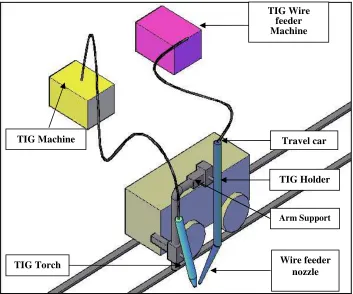
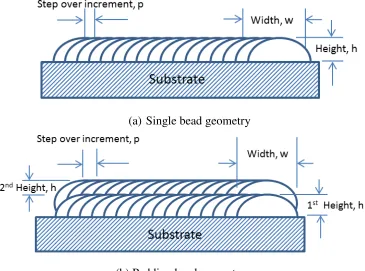
Gas tungsten arc welding (GTAW) or Tungsten Inert Gas (TIG) is an arc welding process that uses an arc between a non-consumable tungsten electrode and the weld pool. The metal to be welded is melted by the intense heat of the arc and fuses together with (Fig. 1) the filler metal. The research on controlling GTAW metal transfer modes is essential to high quality welding procedures. The GTAW welding parameters are the most important factors affecting the quality, productivity and cost of welding joint [1]. Weld bead size and shape are important considerations for design and manufacturing engineers in the fabrication industry. The weld pool quality play an important role in determines the mechanical strength of the weld pool geometry. The sectional geometry of single-pass bead and the overlap of the adjacent beads have critical effects on the dimensional accuracy and quality of weld pools [2] and shown in Fig. 2. The simple overlapping parabolic pattern has been developed by a symmetric parabola of the form y = a + cx2[3]. The GTAW is becoming the most preferred technology because it has the cleanest weld bead [4].
Several researchers investigated the problem of the surface quality in the metallic parts and tools using direct metal prototyping techniques are still low compared to conventionally machined parts. This can be proven in Rapid Prototyping (RP) technology where the demand to produce prototypes by using TIG had already been developed. Most of the rapid prototyping (RP) methods still need post processing such as milling and polishing as surface finishing [5]. The heat transfer and fluid flow model of GTAW has been developed for investigate the effect of welding parameter for shape formation of weld pool [6]. Rapid growth in computing power and numerical algorithms has made it possible to model real-world welding processes through computer simulations. Furthermore, finite element method (FEM) has been the most popular and powerful tool for simulating the thermo mechanical behavior of a structure during welding process [7]. In recent years, the Taguchi method has become a powerful tool for improving productivity during research and development [8] so that high quality products can be produced quickly and at low cost.
Experiment Procedures
These plates of mild steel alloy were cut to the required size (50 mm × 75 mm) by power hacksaw cutting and grinding. New semi automatic TIG, shielded by inert gas, is used to strike an electric arc with the base metal. The heat generated by the electric arc is used to melt and joint the base metal. The traveling speed of the electrode is controlled by a travel car. In the experiments, the welding power source is provided by a GTAW Miller Syncrowave 250 DX OC AC/DC Squarewave Panel. The shielding gas is argon and the flow rate of the shielding gas is controlled by a valve meter. The base metal is AISI 1018 mild steel plates. A single-pass welding process is performed because the thickness of mild steel plates is 5 mm. Based on the above discussion; the GTAW process involves a number of welding process parameters such as arc gap, flow rate, welding current and welding speed. The quality of the welds is dependent on the selection of the welding process parameters. In the present study, GTAW experiments are carried out by varying the arc gap of 3 mm, the flow rate in the range of 1.5–4.61 mm/min, the welding current in the range of 150–
Table 1 Chemical compositions of base metal (mass fraction, %)
C Fe Mn P S
0.14 – 0.2 98.81 – 99.26 0.6 – 0.9 0.04 0.05
[image:2.595.122.475.388.682.2]170 A, and the welding speed in the range of 150–223 mm/sec. To evaluate the quality of GTAW, the measurements of the weld pool quality are performed. In this study, the roughness and hardness of the weld pool are used to describe the weld pool quality and measured by Mitutoyo surface roughness test and Rockwell hardness test. Basically, weld penetration at the back face of the base metal must be achieved to ensure the weld strength.
Fig. 1 Schematic Diagram of Semi GTAW process
Table 2 Mechanical properties of base metal
Yield Strength Tensile Strength Elongation(In 50mm) Hardness Rockwell
370 MPa 440 MPa 15% B71
Travel car
TIG Torch
TIG Holder TIG Wire
feeder Machine
TIG Machine
Arm Support
(a) Single bead geometry
(b) Padding bead geometry
Fig. 2 Single and padding weld bead geometry diagram
The Taguchi method of welding parameter optimization
[image:3.595.117.482.83.354.2]The Taguchi method uses a special design of orthogonal arrays to investigate the entire process parameter space with a small number of experiments. A loss function is then defined to calculate the deviation between the experimental value and the desired value. Taguchi recommends the use of the loss function to measure the deviation of the quality characteristic from the desired value. The value of the overall loss function is further transformed into a signal-to-noise (S/N) ratio [1,2]. In the present research study, Three (3) level of welding parameters such as welding current, welding travel speed and feed rate are considered. The value of the welding process parameter at the different levels is listed in Table 3. The interaction effect between the welding parameters is
Table 3 Welding parameters and their levels Level
Parameter (factor) Low Medium High
Welding current (Ampere) 150 160 170 Welding Speed (mm/s) 150 186.11 222.22
Feed Rate (mm/min) 1.50 3.06 4.61
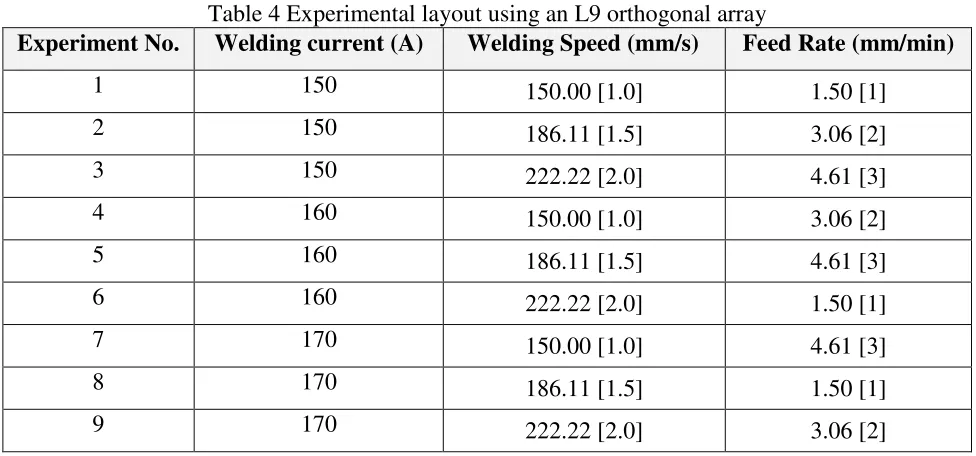
neglected. There are thus 12 degrees of freedom owing to the three sets of three level welding parameters. The degrees of freedom for the orthogonal array should be greater than or at least equal to those for the welding parameters. In this research study, an L9 (32) orthogonal array which has 8 degrees of freedom was used. Nine experiments are required to study the entire welding parameter space when the L9 orthogonal array is used. The experimental layout for the welding process parameters using the L9 orthogonal array is shown in Table 4 and the experimental results for the weld pool quality using the L9 orthogonal array are shown in Table 5. The roughness of the weld pool quality belongs to the smaller the better quality characteristic. The signal-to-noise ratio, or the SN number of the lower-the-better quality characteristic can be expressed as,
Table 4 Experimental layout using an L9 orthogonal array
Experiment No. Welding current (A) Welding Speed (mm/s) Feed Rate (mm/min)
1 150 150.00 [1.0] 1.50 [1]
2 150 186.11 [1.5] 3.06 [2]
3 150 222.22 [2.0] 4.61 [3]
4 160 150.00 [1.0] 3.06 [2]
5 160 186.11 [1.5] 4.61 [3]
6 160 222.22 [2.0] 1.50 [1]
7 170 150.00 [1.0] 4.61 [3]
8 170 186.11 [1.5] 1.50 [1]
9 170 222.22 [2.0] 3.06 [2]
The hardness of the weld pool quality belongs to the larger the better quality characteristic. The signal-to-noise ratio, or the SN number of the higher-the-better quality characteristic can be expressed as,
[image:4.595.56.543.391.784.2]SN = -10 (log (∑ (1/Y2)/n) (2)
Table 5 Experimental results for the weld pool quality
R u n A m p er e (A ) T ra v el S p ee d (m m /s ) F ee d R a te (m m /m in )
Surface Roughness (Ra) Surface Hardness (HRA)
Single Bead Padding Bead Single Bead Padding Bead S N R A 1 M ea n 1 ( µ m ) S N R A 1 M ea n 1 ( µ m ) S N R A 2 M ea n 2 S N R A 2 M ea n 1
1 150 150.00 1.50 -12.45 2.56 -10.90 3.51 33.32 46.51 33.44 47.07
2 150 186.11 3.06 -9.85 2.98 -11.10 3.57 33.40 46.83 33.27 46.10
3 150 222.22 4.61 -6.78 4.16 -8.20 2.57 33.30 46.36 33.63 48.05
4 160 150.00 3.06 -10.22 2.66 -10.60 3.40 33.64 48.07 33.44 47.11
5 160 186.11 4.61 -9.69 2.73 -9.75 3.07 33.37 46.73 33.47 47.17
6 160 222.22 1.50 -8.79 3.23 -7.92 2.47 33.58 47.77 33.48 47.28
7 170 150.00 4.61 -9.49 3.02 -10.90 3.52 33.61 47.93 33.29 46.17
8 170 186.11 1.50 -8.64 2.18 -8.93 2.79 33.76 48.74 33.37 46.63
9 170 222.22 3.06 -8.35 3.10 -8.96 2.80 33.36 46.69 33.45 47.10
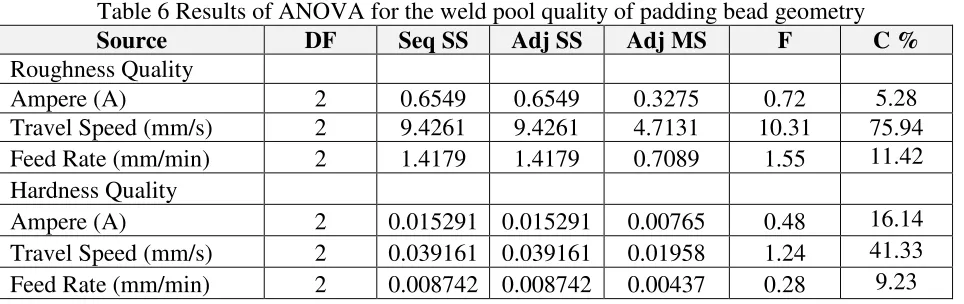
The effect of each welding process parameter on the S/N ratio at different levels can be separated out because the experimental design is orthogonal. The mean of the S/N ratio for each level of the welding process parameters is summarized and shown in Table 5. Results of analysis of variance ANOVA (Table 6) indicate that flow rate, welding current and welding speed are the significant welding parameters affecting the multiple quality characteristics.
Table 6 Results of ANOVA for the weld pool quality of padding bead geometry Source DF Seq SS Adj SS Adj MS F C % Roughness Quality
Ampere (A) 2 0.6549 0.6549 0.3275 0.72 5.28 Travel Speed (mm/s) 2 9.4261 9.4261 4.7131 10.31 75.94 Feed Rate (mm/min) 2 1.4179 1.4179 0.7089 1.55 11.42 Hardness Quality
Ampere (A) 2 0.015291 0.015291 0.00765 0.48 16.14 Travel Speed (mm/s) 2 0.039161 0.039161 0.01958 1.24 41.33 Feed Rate (mm/min) 2 0.008742 0.008742 0.00437 0.28 9.23
Conclusion
In this paper, the selection of the welding parameters for semi automatic GTAW of mild steel with the optimal weld pool quality has been reported. The Orthogonal Array of Taguchi method is adopted to solve the optimal weld pool quality which welding speed contributed highest in the quality characteristics.
Acknowledgements
This research project work is funded under FRGS grant Vot1057.
References
[1] H. M. Khairulamzari, Optimization of new semi automatic TIG welding process for surface quality through Taguchi Method, Master Dissertation, Universiti Tun Hussein Onn Malaysia 2014. [2] S. Suryakumar, K.P. Karunakaran, A. Bernard, U. Chandrasekhar, N Raghavender and D.Sharma, Weld bead modeling and process optimization in Hybrid layerd Manufacturing. Computer Aided Design. 43(2012) 331-334.
[3] Y. Cao, S. Zhu, X. Liang and W. Wang, Overlapping model of beads and curve fitting of bead section for rapid manufacturing by robotic MAG welding process, Robotic and Computer Integrate Manufacturing. (2011) 641–645
[4] D. Li, S. Lu, W. Dong, D. Li and Y. Li, 6 Study of the law between the weld pool shape variations with the welding parameters under two GTAW processes, Material processing technology. (2012) 128–136
[5] K. P. Karunakaran, A. Bernard, S. Suryakumar, L. Dembinski and G. Taillandier, Rapid manufacturing of metallic objects, Rapid Prototyping Journal. 18 (2012) 264–280
[6] A. Traidia, F. Roger and E. Guyot, Optimal parameters for pulsed GTAW in partially and fully penetrated of weld pools, International of thermal science. 49(2010) 1197–1208
[7] A. Traidia and F. Roger, Numerical and experimental study of arc and weld pool behavior for pulse current GTAW, International journal of heat and mass transfer. 54(2011) 2163–2179