
Fuzzy logic controller design for inverted pendulum system
42
0
0
Full text
(2) v. ABSTRACT. Inverted pendulum system is unstable without control, that is, the pendulum wills simply fall over if the cart isn’t moved to balance it and naturally falls downward because of gravity. Thus, the inverted pendulum system is inherently unstable. In order to keep it upright, or stabilize this system, one needs to manipulate it, either vertically or horizontally and it requires a continuous correction mechanism to stay upright since the system is unstable, non-linear and non-minimum phase behavior. To overcome this problem, the fuzzy logic controller will be designed. The Fuzzy Logic Controller has been chosen to stabilize the pendulum rod and keeping the cart in a desired position. Fuzzy logic has provided a simple way without going through the mathematical approach as conventional controller in order to arrive at a definite conclusion based upon nonlinear and an unstable of inverted pendulum system. Besides that, Fuzzy logic control system (FLC) was chosen as the control technique because of its ability to deal with nonlinear systems, as well as its intuitive nature. One special feature of fuzzy logic control is that it utilizes the expertise of humans to control the physical system, so that complex system can be controlled without extensive modeling of the relationship between the input and output of the system..
(3) vi. ABSTRAK. Inverted Pendulum System adalah tidak stabil tanpa alat kawalan, yang akan menyebabkan bandul mudah untuk terjatuh jika kereta itu tidak bergerak untuk mengimbanginya yang semulajadinya akan jatuh kebawah disebabkan oleh tarikan graviti. Oleh itu, inverted pendulum system memang tidak stabil. Dalam usaha untuk memastikan system ini dalam keadaan tegak atau stabil, suatu benda diperlukan untuk dimanipulasikan sama ada dalam keadaan menegak atau melintang dan ia memerlukan mekanisme pembetulan yang berterusan untuk mengekalkan kedudukan tegaknya disebabkan sistem ini kurang stabil, tidak linear dan keadaan fasa yang tidak minimum. Pengawal logic fuzzy akan direka untuk mengatasi masalah ini. Pengawal logic fuzy dipilih untuk menstabilkan rod bandul dan untuk mengekalkan kereta pada kedudukan yang dikehendaki. Pengawal logic fuzzy juga menyediakan cara yang mudah tanpa perlu menggunakan pendekatan matematik seperti pengawal konvensional untuk mencapai keputusan yang tetap berdasarkan pada Inverted Pendulum System yang tidak stabil. Selain itu, pengawal logic fuzy juga dipilih sebagai alat pengawal kerana keupayaannya mengawal sistem tidak linear serta sifat semulajadinya yang senang dikendalikan dan difahami. Salah satu keistimewaan pengawal logic fuzy ini adalah menggunakan kepakaran manusia untuk mengawal sistem fizikal, supaya sistem yang kompleks boleh dikawal tanpa perlu mengaitkan hubungan kompleks model antara sistem masukan dan keluaran..
(4) vii. TABLE OF CONTENTS. TITLE PAGE. i. DECLARATION. ii. DEDICATION. iii. ACKNOWLEDGEMENT. iv. ABSTRACT. v. ABSTRAK. vi. TABLE OF CONTENTS. vii. LIST OF TABLES. xi. LIST OF FIGURE. xii. LIST OF SYMBOLS AND ABBREVIATION. xvi. LIST OF APPENDICES CHAPTER 1. CHAPTER 2. xviii. INTRODUCTION. 1. 1.1. Project Background. 1. 1.2. Problem Statement. 3. 1.3. Aim of Project. 3. 1.4. Objective of Project. 3. 1.5. Project Scope. 4. 1.6. Outline of the Report. 4. LITERATURE REVIEW. 5. 2.1. Introduction to Inverted Pendulum. 5. 2.1.1 Present Application of Inverted Pendulum. 7.
(5) viii. 2.2. 2.3. 2.4. 2.5. CHAPTER 3. Fuzzy Logic System. 10. 2.2.1 Foundation of Fuzzy Logic. 11. 2.2.2 Fuzzy Inference System. 14. MATrix LABoratory (MATLAB). 14. 2.3.1 MATLAB Simulink. 14. System Design with Hardware. 15. 2.4.1 The Motor and the Control Circuit. 15. 2.4.2 Feedback Network. 16. 2.4.3 Arduino Interface Board. 17. Previous Case Study. 17. METHODOLOGY. 20. 3.1. Design Overview. 20. 3.2. First Phase: Inverted Pendulum Design. 22. 3.2.1 Inverted Pendulum Model. 22. Second Phase: Fuzzy Logic Controller (FLC). 27. 3.3.1 Fuzzy of Inverted Pendulum System. 28. 3.3.2 Fuzzy Interface. 30. 3.3. 3.3.3 Membership Function of the Inverted. 3.4. Pendulum FLC. 31. 3.3.4 Fuzzy Inference Engine. 37. 3.3.5 Rule Base. 38. 3.3.6 Defuzzificztion. 41. 3.3.7 Summary. 41. Third Phase: System Design with Hardware. 42. 3.4.1 Mechanical Design. 43. 3.4.2 Electrical Part. 43. 3.4.2.1 DC Motor and Motor Driver. 44. 3.4.2.2 Quadrature Hall Effect Encoder. 45. 3.4.2.3 Non-Contacting Analog Rotary Position Sensor 3.4.2.4 Arduino Mega 2560. 45 46.
(6) ix. 3.4.3 Design Process and Its Implementation. 47. 3.4.3.1 Test DC Geared Motor SPG30-20K by using Arduino Board. 47. 3.4.3.2 Test Quadrature Hall Effect Encoder by using Arduino Board. 49. 3.4.3.2 Non-Contacting Analog Rotary Position Sensor by using Arduino Board 3.4.4 Summary. CHAPTER 4. 50 52. ANALYSIS RESULT AND DISCUSSION. 53. 4.1. 53. Open Loop Result 4.1.1 Open Loop Impulse Response of the Inverted Pendulum System. 54. 4.1.2 Open loop Step Response of the Inverted Pendulum System. 54. 4.1.3 Pole-Zero Analysis of the Inverted Pendulum System 4.2. Fuzzy Logic Controller Control Method. 56 56. 4.2.1 The Best Design of Fuzzy Logic Controller 57 4.2.2 System Performance of Fuzzy Logic Controller with Different Types of Membership Function 4.3. 4.4. 60. Comparison of the Inverted Pendulum with And without Controller. 66. Hardware Implementation. 66. 4.4.1 Testing DC Geared Motor SPG30-20K by using Arduino Board. 66. 4.4.2 Testing Quadrature Hall Effect Encoder by using Arduino Board. 68. 4.4.3 Testing Non-Contacting Analog Rotary Position Sensor by using Arduino Board 4.5. Summary. 70 72.
(7) x. CHAPTER 5. CONCLUSION. 73. 5.1. Conclusion. 73. 5.2. Suggestion for Future Works. 74. REFERENCES. 75. APPENDICES. 78. VITA. 87.
(8) xi. LIST OF TABLES. 3.1. Parameter of inverted pendulum. 23. 3.2. Input and output of FLC. 30. 3.3. Standard labels of quantization. 32. 3.4. Rule base control cart position in FLC1. 40. 3.5. Rule base control angle in FLC2. 40. 3.6. The Arduino Mega 2560 specification. 46. 4.1. Performance comparison between different types of fuzzy logic controller. 65. 4.2. The voltage and speed value. 67. 4.3. Clockwise rotation. 69. 4.4. Counter clockwise rotation. 69. 4.5. The sensor angle and voltage value. 71.
(9) xii. LIST OF FIGURE. 2.1. Free body diagram of the inverted pendulum system. 6. 2.2. Quanser Inverted Pendulum System. 8. 2.3. Scooter SEGWAT HT. 8. 2.4. Wheeled Inverted Pendulum System. 9. 2.5. Robotic Wheelchairs. 9. 2.6. Humanoid Robot. 10. 2.7. Truth table for Boolean logic AND, OR and NOT. 12. 2.8. The two-valued and multivalued logic for AND, OR and NOT. 13. 2.9. Arduino Board. 17. 3.1. The flow chart diagram for developing the Fuzzy Logic control for Inverted Pendulum System. 21. 3.2. Free body diagram for Inverted Pendulum system. 23. 3.3. Free body diagram of the system. 24. 3.4. The Simulink for inverted pendulum system. 27. 3.5. Flow chart Fuzzy Logic Control. 27. 3.6. Block Diagram for Fuzzy Logic Control System. 28. 3.7. Block diagram of inverted pendulum system with fuzzy logic controller. 3.8. 29. Block diagram of inverted pendulum system with two fuzzy logic controller. 30. 3.9. Fuzzy Control Process. 31. 3.10. Input position, x of triangular membership function (FLC1). 3.11. Input position, (FLC1). 33 of triangular membership function 33.
(10) xiii. 3.12. Input position, x of generalized bell membership function (FLC1). 3.13. Input position,. 33 of generalized bell membership function. (FLC1). 34. 3.14. Input position, x of gaussian membership function (FLC1) 34. 3.15. Input position,. 3.16. Output, u of Fuzzy Logic Position Controller (FLC1). 35. 3.17. Input angle,. of triangular membership function (FLC2). 35. 3.18. Input angle,. of triangular membership function (FLC2). 35. 3.19. Input angle,. of generalized bell membership function. of gaussian membership function (FLC1) 34. (FLC2) 3.20. Input angle,. 36 of generalized bell membership function. (FLC2). 36. 3.21. Input angle,. of gaussian membership function (FLC2). 36. 3.22. Input angle,. of gaussian membership function (FLC2). 37. 3.23. Output, u of Fuzzy Logic Angle Controller (FLC2). 3.24. Inverted Pendulum condition when the big positive force. 37. (to the right) should be applied. 38. 3.25. Inverted Pendulum condition nearly a zero angle. 39. 3.26. Inverted Pendulum condition when the small negative force (to the left) should be applied. 39. 3.27. Simulink of Fuzzy Logic Controller of inverted pendulum 42. 3.28. Overview of the inverted pendulum system. 42. 3.29. The mechanical parts of the system. 43. 3.30. DC geared motor SPG30-20K with encoder. 44. 3.31. Motor Driver L293D. 45. 3.32. 5V Quadrature Hall Effect Encoder. 45. 3.33. Non-Contacting Analog Rotary Position Sensor. 46. 3.34. The Arduino Mega 2560. 47. 3.35. The inverted pendulum system. 47. 3.36. Pin connection for L293D. 48.
(11) xiv. 3.37. Motor connection with motor driver L293D and Arduino board. 3.38. Schematic diagram motor connection with motor driver L293D and Arduino board. 3.39. 49. Encoder connection with motor, oscilloscope and Arduino board. 3.40. 48. 49. Schematic diagram encoder, Arduino board and Oscilloscope. 50. 3.41. Connection for the sensor. 50. 3.42. The connection for sensor with Arduino board. 51. 3.43. Schematic diagram sensor with Arduino board. 52. 4.1. Simulation of the open loop impulse response for inverted pendulum. 4.2. Simulation of the open loop step response for cart position of inverted pendulum system. 4.3. 54. 55. Simulation of the open loop step response for pendulum angle of inverted pendulum system. 55. 4.4. Simulation of the open loop pole-zero response. 56. 4.5. Graph of reference position vs cart position against time. 58. 4.6. Graph of falling pendulum angle vs time. 58. 4.7. Transient response specification. 59. 4.8. Graph of cart position at input reference 0.1. 60. 4.9. Graph of pendulum angle at input reference 0.1. 61. 4.10. Graph of cart position at input reference 0.2. 61. 4.11. Graph of pendulum angle at input reference 0.2. 62. 4.12. Graph of cart position at input reference 0.3. 62. 4.13. Graph of pendulum angle at input reference 0.3. 63. 4.14. Graph of cart position at input reference 0.4. 63. 4.15. Graph of pendulum angle at input reference 0.4. 64. 4.16. Graph of cart position at input reference 0.5. 64. 4.17. Graph of pendulum angle at input reference 0.5. 65. 4.18. Garph of the speed against voltage. 67.
(12) xv. 4.19. Motor rotates clockwise along the whole length of the rail with channel A. 4.20. Motor rotates clockwise along the whole length of the rail with channel B measurement. 4.21. 4.24. 69. Motor rotates clockwise along the half of the length rail with channel B measurement. 4.23. 68. Motor rotates clockwise along the half of the length rail with channel A measurement. 4.22. 68. 69. The sensor reading from the serial monitor in the Arduino software. 70. The voltage of the sensor against the sensor angle. 71.
(13) xvi. LIST OF SYMBOLS AND ABBREVIATION. IP. -. Inverted Pendulum. FLC. -. Fuzzy Logic Controller. FL. -. Fuzzy Logic. Cart. -. Carriage. MATLAB. -. MATrix LABoratory. MF. -. Membership Function. F. -. Force applied to cart. M. -. Mass of cart. m. -. Mass of pendulum. b. -. Fiction. l. -. Length of pendulum. i. -. Inertia of the pendulum. g. -. Gravity. L. -. Length of the rail. x. -. Cart position co-ordinate. θ. -. Pendulum angle. kg. -. Kilogram. Nm-1s-1. -. Newton meter per second. m. -. Meter. cm. -. Centimetre. N/kg. -. Newton per kilogram. -. Velocity. -. Angular velocity. P. -. Vertical direction. N. -. Horizontal direction. -. Force in x-axis.
(14) xvii. -. Force in y-axis. V. -. Voltage. rpm. -. Revolutions per minute. ZMP. -. Zero Moment Point. DC. -. Direct current. ADC. -. Analog-to-Digital Converter. I/O. -. Input/Output. USB. -. Universal serial bus. SFC. -. Scalar fuzzy control. FLC1. -. Fuzzy Logic Position Controller. FLC2. -. Fuzzy Logic Angle Controller. IC. -. Integrated Circuit. BJT. -. Bi-polar junction transistors. FET. -. filed effect transistors. EMF. -. Electromagnetic Field. A/D. -. Analog/Digital.
(15) xiv. LIST OF APPENDICES. A. Gantt chart for PS 1. 79. B. Gantt chart for PS 2. 80. C. Coding Program. 81. D. Datasheet. 84.
(16) CHAPTER 1. INTRODUCTION. 1.1. Project Background. Modern day control engineering is a relatively new field of study that gained a significant attention during 20th century with the advancement in technology. Control theory is a field rich in opportunities and new directions [1] dealing with disciplines and methods that leads to an automatic decision process in order to improve the performance of a control system. The evolution of control theory is related to research advanced on technology, theoretical controller design methods and their real-time implementation [2, 3]. It is important to note that evolution of control theory is also closely related to education [4, 5] and the next generations of students studying control system must receive the scientific and pedagogical supports required to verify conventional techniques, develop new tools and techniques and verify their realization [6]. In the field of control engineering, Inverted Pendulums (IP) are one of the most commonly studied and at the same time IP represents one of the most difficult system to control. This explains the fact that although many investigations have been carried out on the inverted problem, researchers are still constantly experimenting and building it as the inverted pendulum is a stepping stone to greater balancing control systems such as balancing robots..
(17) 2 The inverted pendulum is a system that has a cart which is programmed to control a pendulum. This system is inherently unstable since even the slightest disturbance would cause the pendulum to start falling. Thus some sort of control is necessary to maintain a balanced pendulum. An ideal controller would keep the pendulum balanced with very little change in the angle or cart displacement. Obviously limitations would be imposed based on the actual parameters of the system as well as the method for implementing a controller. Thus designing a controller that is close to the ideal situation is a challenging design problem. Fuzzy logic control system (FLC) was chosen as the control technique because of its ability to deal with nonlinear systems, as well as its intuitive nature. Fuzzy logic is gaining increasing interest in the controls community. It is one of several control schemes, that include neural network and genetic algorithm based controllers, which are considered unconventional. One special feature of fuzzy logic control is that it utilizes the expertise of humans to control the physical system, so that complex system can be controlled without precise knowledge of the plant. The designer can build up the controller based on general idea of what it must accomplish. It is for this reason that fuzzy logic is particularly useful in instances where a human operator is being replaced, or where a human has an implicit model in mind of the input-output behavior of the system. Another reason for the recent interest in fuzzy logic controllers is their inherent robustness property because of the fuzzy nature of the controller, variation in system parameters are handled with ease. However, all evidence of robustness is either from simulations or experiments as no mathematical proofs of robustness can be constructed. In a well-written paper, Abramovitch [7] points out that fuzzy logic is not a magical control technique that can solve every problem and provides a balanced view of the pros and cons of fuzzy logic control. For an example, there are clearly some situations where fuzzy logic will not work well because fuzzy controllers rely on sample rates that are high relative to the system dynamics as well as a common sense control situation. For fast systems with a complex input-output relationship, other control schemes may be more appropriate. Thus, the modeling and analysis for this controller is done in MATLAB and Simulink. Therefore, the best control approach needs to be discovered in order to give the best performance for the inverted pendulum system..
(18) 3 1.2. Problem Statement. This project studies comprehensively about the methods of stabilizing an inverted pendulum. An inverted pendulum system is unstable without control, that is, the pendulum wills simply fall over if the cart isn’t moved to balance it and naturally falls downward because of gravity. Thus, the inverted pendulum system is an inherently unstable. In order to keep it upright, or stabilize the system, one needs to manipulate it, either vertically or horizontally and it requires a continuous correction mechanism to stay upright since the system is unstable, non-linear and non-minimum phase behavior. To overcome this problem, the fuzzy logic controller will be designed.. 1.3. Aim of Project. The aim of this study is to stabilize the inverted pendulum such that the position of the carriage (cart) on the track is controlled and accurately so that the pendulum is always erected in its inverted position during such movements. Thus need to design a better controller for the inverted pendulum system by using Fuzzy Logic Controller.. 1.4. Objective of Project. The main objectives of this project are: 1) To understand the concept and synthesis the mathematical model of the inverted pendulum. 2) To design fuzzy logic controller for an inverted pendulum system using MATLAB command and Simulink. 3) To develop a controlled program of the proposed technique on Arduino board..
(19) 4 1.5. Project Scopes. The scopes ranges that had been covered during the development of this system are listed as below: i.. Study the concept of an inverted pendulum system and synthesis the mathematical model of this system which is created by K. Ogata (1978).. ii.. Fuzzy Logic Controller system have to be studied and designed before implementing and analyzing the output result for this project by using the MATLAB command and Simulink.. iii.. Study and Interfacing the design controller with the hardware using Arduino board.. 1.6. Outline of the Report. This thesis contains five chapters. The first chapter is about the introduction of this project. It will explain about the background of the project which include the aim and objectives of project and as well as project scopes. The second chapter is about literature review. It will explain about the theory and concept of an inverted pendulum, theory and application of fuzzy logic controller of this project. It also consist the previous case study and the application in real world and many more. The third chapter is discusses the system that has been developed. It will explain and focus on the concept of inverted pendulum system without any controller and how to derive the mathematical model of the inverted pendulum system. Besides that, it also consist the method that be used to design the fuzzy logic controller. The effectiveness of the proposed method is verified by develop simulation model in MATLAB-simulink and experimental by using Arduino board. The fourth chapter is about the analysis result and discussion. In this section the performance of the controller has been verified in simulation results and the other results also have been including during the experimental. This last chapter presents the conclusion and suggestion for this project. A few recommendations and suggestions have been includes to other researcher on how to improve the efficiency and accuracy of this system for the future work..
(20) CHAPTER 2. LITERATURE REVIEW. This chapter discusses relevant references related to the project. This will critically provide as much information as needed on the technology available and methodologies used by other research counterparts around the world on the topic. There are groups of control method in fuzzy logic controller for inverted pendulum which had been implemented will be discussed.. 2.1. Introduction to Inverted Pendulum System. Since the 1950s, the inverted pendulum, especially the cart version, was used for teaching linear feedback control theory [8] and it also one of an example studied that had been used as references to design, implementation and development of control to stabilize open-loop unstable systems. The first solution to this problem was described by Roberge in 1960 [9] and then by Schaefer, and Cannon in 1966 [10]. This system also had been used in many books to solve the linear optimal control problem [11] and the complex nonlinear control problem [12] for unstable systems. The inverted pendulum system had the same principle as balancing a brush, pen or other object on the palm of hand. For an example, when balancing a pen on palm of a hand, a person balancing the pen moves the hand in the direction that the pen is falling. This serves to constantly adjust the position of the hand to keep the object upright [13]. An inverted pendulum does basically the same thing. Force must be properly applied to keep the system intact..
(21) 6 An inverted pendulum system consists of a thin rod (pole) attached at its bottom of a moving cart as shown by a basic block diagram in Figure 2.1. In a normal condition, a pendulum is stable when hanging downwards, a vertical inverted pendulum is naturally unstable, and must be actively balanced in order to remain upright, usually by moving the cart horizontally as part of a feedback system.. Figure 2.1: Free body diagram of the inverted pendulum system. The equation of the cart in this system (2.1) The equation of the pendulum in this system (2.2) The equation of the force in the vertical direction this system (2.3) The equation of the force in the horizontal direction this system (2.4) The overall mathematical modeling will be discussed on chapter 3.. To achieve this, proper control theory is required. The inverted pendulum is an invaluable tool for the effective evaluation and comparison various control theories. The inverted pendulum is used in simulations and experiments to show the performance of different controllers (e.g. PID, State Space and Fuzzy controllers and else)..
(22) 7 The inverted pendulum is a classic problem in dynamics and control theory and widely used as benchmark for testing control algorithms (PID controllers, neural network, genetic algorithm and so on). Variations on this problem include multiple links, allowing the motion of the cart to be commanded while maintaining the pendulum, and balancing the cart-pendulum system. The inverted pendulum is related to rocket or missile guidance, where thrust is actuated at the bottom of a tall vehicle [14]. Another way that an inverted pendulum may be stabilizes, without any feedback or control mechanism, is by oscillating the support rapidly up and down. If the oscillation is sufficiently strong in terms of its acceleration and amplitude, then the inverted pendulum can recover from perturbations in a strikingly counterintuitive manner [13][14][15]. There are many types of models for inverted pendulum system. Some of them are two-stage of inverted pendulum system, parallel inverted pendulum system, rotational inverted pendulum system, bi-axial inverted pendulum system and many more. In that case, the uniqueness and the wide application of the technologies that come from this unstable factor have gained an interest among many robotic researchers around the world. In recent years, researchers have applied the idea of an inverted pendulum model to various problems like designing walking gaits for humanoid robots, balancing two wheel robots, robotic wheelchairs, personal transport systems and others [13][14][15].. 2.1.1 Present Applications of Inverted Pendulum. Inverted pendulum is currently used as teaching aids and research experiments. For an example the Quanser (2004), a supplier of educational and research based equipment produce modular systems which can be configured as single or double inverted pendulum [16] as shown in Figure 2.2. Their range offers both a rotary and a linear version. Many researchers have also built their own inverted pendulum system to suit their investigations..
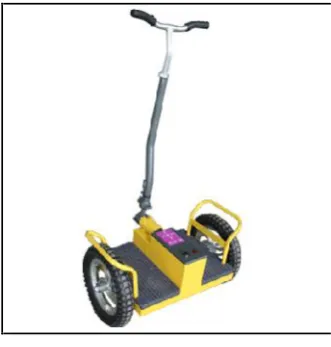
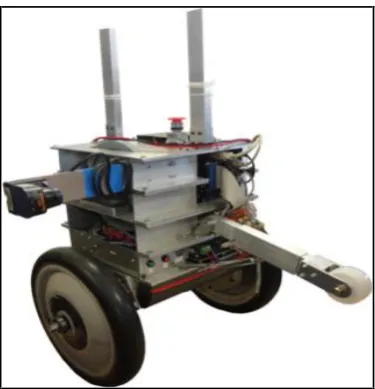
(23) 8. Figure 2.2: Quanser Inverted Pendulum System. One of an example a similar and commercially available system is a balancing scooter ‘SEGWAY HT’. Dean Kamen who holds more than 150 U.S. and foreign patents related to medical devices, climate control system and helicopter design has inverted this scooter. The ‘SEGWAY HT’ is able to balance a human standing on its platform while the user traverses the terrain with it [17] as shown in Figure 2.3.. Figure 2.3: Scooter SEGWAY HT. In another paper ‘Cooperative Behavior of a Wheeled Inverted Pendulum for Object Transportation’ presented by Shiroma et al. in 1996 shows the interaction of forces between objects and the robot by taking into account the stability effects due to these forces. This research highlights the possibility of cooperative transportation between two similar robots and between a robot and a human [18] as shown in Figure 2.4..
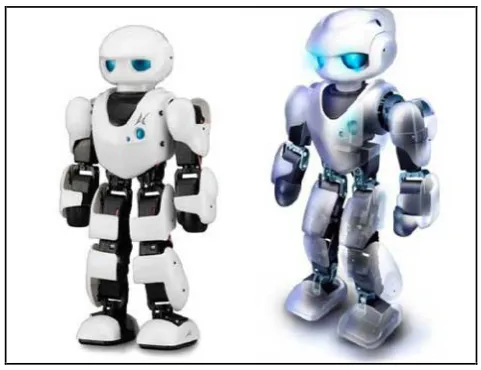
(24) 9. Figure 2.4: Wheeled Inverted Pendulum System. The rapid increase of the aged population in countries like Japan has prompted researchers to develop robotic wheelchairs to assist the infirm to move around, by Takashi et al.2001. The control system for an inverted pendulum is applied when the wheelchair move with a small step or road curbs [19] as shown in Figure 2.5.. Figure 2.5: Robotic Wheelchairs. Lastly, Sugihara et. Al. (2002), modeled the walking motion of a human as an inverted pendulum in designing a real time motion generation method of a humanoid robot that control the center of gravity by indirect manipulation of the Zero Moment Point (ZMP). The real time response of the method provides humanoid robots with high mobility [20] as shown in Figure 2.6..
(25) 10. Figure 2.6: Humanoid Robot. 2.2. Fuzzy Logic System. Over the last few years a new and artificial method of controlling processes has found a growing number of applications. Although the basic concept of Fuzzy Logic were developed in the 1960’s, only recent progress in computer techniques have made its practical use possible. The concept of Fuzzy Logic Controller (FLC) was conceived by Lotfi Zadeh [21], a professor at the University of California at Berkley, and presented not as a control methodology, but as a way of processing data by allowing partial set membership rather than crisp set membership or non-membership. This approach to set theory was not applied to control systems until the 70's due to insufficient smallcomputer capability prior to that time. Professor Zadeh reasoned that people do not require precise, numerical information input, and yet they are capable of highly adaptive control. If feedback controllers could be programmed to accept noisy, imprecise input, they would be much more effective and perhaps easier to implement [22]. Fuzzy logic (FL) is a form of multi-valued logic derived from fuzzy set theory to deal with reasoning that is approximate rather than precise. Just as in fuzzy set theory the set membership values can range (inclusively) between 0 and 1, in fuzzy logic the degree of truth of a statement can range between 0 and 1 and is not constrained to the two truth values {true (1), false (0)} as in classic predicate logic [23]. FL provides a simple way to arrive at a definite conclusion based upon vague, ambiguous, imprecise, noisy, or missing input information..
(26) 11 Instead of the mathematical modeling and writing differential equations describing the characteristics of the inverted pendulum system, FL is another controller technique is introduced initially to mimic human behavior in robotics. Since the human body is perfect in keeping its balance, the scientists came up with the inverted pendulum system to represent the human-like balancing as closest as it could be. To actualize this idea the fuzzy logic and fuzzy controllers are used to stabilize the inverted pendulum with its rod kept upright.. 2.2.1 Foundation of Fuzzy Logic. Fuzzy logic starts with the concept of a fuzzy set. A fuzzy set is a set without a crisp, clearly defined boundary [24]. It can contain elements with only a partial degree of membership. Unlike classical set theory that classifies the element of the set into crisp set, fuzzy set has an ability to classify elements into a continuous set using the concept of degree of membership. The characteristic function or membership function not only gives 0 or 1 but can also give values between 0 and 1. A fuzzy set is a set with fuzzy boundaries. In fuzzy logic, the truth of any statement becomes a matter of degree. Any statement can be fuzzy. A value between 0 and 1 represents the degree of membership, also called membership value. In this inverted pendulum system, the fuzzy boundaries can be considered according to the rules that are going to be used. As the number of rules increased, the degree of membership will become more accurate. A membership function (MF) is a curve that defines how each point in the input space is mapped to a membership value (degree of membership) between 0 and 1 [25]. The input space is sometimes referred to as the universe of discourse. The only condition a membership function must really satisfy is that it must vary between 0 and 1. The function itself can be an arbitrary curve whose shape can define as a function that suits us from the point of view of simplicity, convenience, speed, and efficiency. A classical set might be expressed as. A = {x | x > 6}. (2.1).
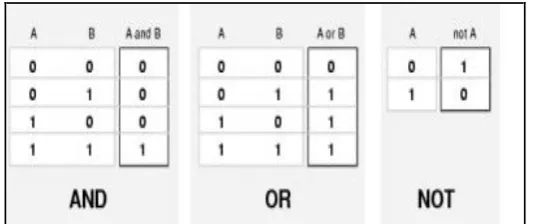
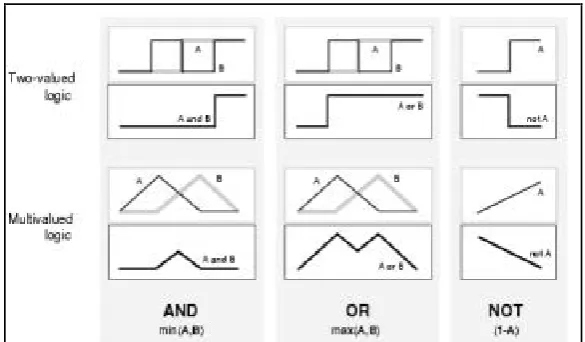
(27) 12 A fuzzy set is an extension of a classical set. If X is the universe of discourse and its elements are denoted by x, then a fuzzy set A is defined as a set of ordered pairs.. A = {x, μA(x) | x Є X}. (2.2). μA(x) is called the membership function (MF) of x in A. the membership function maps each element of X to a membership value between 0 and 1. The Fuzzy Logic Toolbox includes 11 built-in membership function types. These 11 functions are built from several basic functions which are piecewise linear functions, the Gaussian distribution function, the sigmoid curve, quadratic and cubic polynomial curves. There is a very wide selection to choose from these membership functions. Membership function can be created in Fuzzy Logic Toolbox, but for this project, only one out of these 11 membership functions will be used which is triangular. This membership function is chosen because of the simplicity and based on the parameter used for this system. A membership function associated with a given fuzzy set maps an input value to its appropriate membership value. The most important thing to realize about fuzzy logical reasoning is the fact that it is a superset of standard Boolean logic. In other words, if the fuzzy values are kept at their extremes of 1 (completely true) and 0 (completely false), standard logical operations will hold. As an example, consider the standard truth tables are shown in Figure 2.7.. Figure 2.7: Truth table for Boolean logic AND, OR and NOT. Moreover, since there is a function behind the truth table rather just the truth table itself, the values other than 1 and 0 now can be considered. Figure 2.8 shows the graph that is explaining the same information as before. The truth table have been.
(28) 13 converted to a plot of two fuzzy sets applied together to create one fuzzy set. The upper part of the figure displays plots corresponding the two-valued truth tables above, while the lower part of the figure displays how the operations work over a continuously varying range of truth values A and B according to the fuzzy operation that have defined before.. Figure 2.8: The two-valued and multivalued logic for AND, OR and NOT. Given these three function, any construction now can be resolved by using fuzzy sets and the fuzzy logical operation AND, OR and NOT. That is how the fuzzy operator will be used in this system. After making some studies on this part, only one fuzzy logical operation is suitable for this inverted pendulum system. AND operation is used to get the minimum value of multivalued logic. This part will be further discussed in the next chapter. Fuzzy sets and fuzzy operators are the subjects and verb of fuzzy logic. These if-then rule statements are used to formulate the conditional statements that comprise fuzzy logic. A single fuzzy if-then rule assume the form. If x is A the y is B. (2.3). Where A and B are linguistic values defined by fuzzy sets on the range X and Y. the if-part of the rule “x is A” is called the antecedent or premise, while the thenpart of the rule “y is B” is called the consequent or conclusion. In general, one rule by itself can’t produce the good result. The system actually needs two or more rules that can play off one another. The output of each.
(29) 14 rule is a fuzzy set. The output fuzzy sets for each rule are then aggregated into a single output fuzzy set. Finally the resulting set is defuzzified, or resolved to a single number.. 2.2.2 Fuzzy Inference System. Fuzzy inference is the process of formulating the mapping from a given input to an output using fuzzy logic. The mapping then provides a basis from which decisions can be made, or patterns discerned. The process of fuzzy inference involves all the pieces which are membership functions, fuzzy logic operators and if-then rules. There are two types of fuzzy inference systems that can be implemented in the Fuzzy Logic Toolbox which are Mamdani-type and Sugeno-type. These two types of inference systems vary somewhat in the way outputs are determined.. 2.3. MATrix LABoratory (MATLAB). MATrix LABoratory is a language for technical computing, developed by the Mathworks, Inc. It provides a single platform for computation, visualization, programming and software development. All problems and solutions in MATLAB are expressed in notation used in linear algebra and essentially involve operations using matrices and vectors. MATLAB can be used to solve problems in control systems.. 2.3.1 MATLAB Simulink. Simulink is a tool for modeling, simulating and analyzing multi domain dynamic systems. Its primary interface is a graphical block diagramming tool and a customizable set of block libraries. Simulink offers tight integration with the rest of the MATLAB environment and both drive MATLAB or can be scripted from it. Simulink is widely used in control theory and digital signal processing for multi domain simulation and design..
(30) 15 2.4. System Design with Hardware. To design any system, a set of requirements is necessary to have guidelines when making decisions about implementation. This project is no different. Taking the constraints into consideration, a set of requirements and goals was established for this project as follows: . Working mechanical system.. . Good interface between Atmel Mega2560 and the mechanical system.. . Well-designed accurate sensors.. . MATLAB interface (visual and data extraction). . Easily programmable through user interface to allow other solutions.. 2.4.1 The Motor and the Control Circuit. There are three main choices to use for motor for this project which are DC motor, stepper motor and lastly a servomotor. The two main considerations in choosing a motor are needs for high torque and high speed. The torque is necessary for the cart to change direction quickly in order to keep the pendulum balanced. High speed is needed such that the cart can move faster than the pendulum can fall. The DC motor could have high torque and high speed, but it comes at a cost. First of all, when the torque and speed of a DC motor increase, it requires more power to run the motor. This will be limited by the circuitry used to control the motor. The control circuitry for a DC motor is a motor driver which controls the direction of current across the motor based on the directional signal. Another input to the motor driver controls the speed of the motor. The stepper motor could provide high torque, but it would lack sufficient speed. A bi-polar stepper would be necessary to ensure that the motor turns both directions. For this motor, there are four input lines that need to be toggled in the correct order to have the motor turn in a certain direction and in the opposite order for the motor to move in reverse direction. This control can be done externally through the use of digital logic components that would require just a directional signal and a speed control, but this would make the design more complex. Stepper motors are also costly and consume a great deal of power..
(31) 16 The servo motor could supply high speed, but would suffer with the torque. It would also be harder to incorporate into this design. First off, servo motors typically have the ability to turn only 360°. In order to have such a motor, the drive wheel attached to the motor shaft would have sized such that one rotation could cause the cart to travel the length of the track. This would require a large wheel would decrease the amount of torque provided by the motor and could possible damage the motor. Also note that controlling a servo motor could be quite difficult in this application since the voltage level applied to the motor tells the motor which angle to be at. There is less intuition in designing controller that operates in this way. Regardless of which motor is chosen, a separate power supply will be necessary just for the motor. The large power consumption by the motors and the inductive spikes created each time the motor changes direction could be harmful to any other circuit hooked up to the same power supply. The only way to control the motor would be through opto-islolation which completely separates circuits with different power supplies.. 2.4.2 Feedback Network. Designing an accurate feedback network is essential to stabilizing the system. Thus the sensors need to relatively noiseless and have a fast response such that the information retrieved from the sensors accurately reflects the state of the system. Determining the variables of the system to measure can be difficult. In this case there are four parameters that govern the inverted pendulum system (which will be derived in a next chapter). They are (1) the angle, (2) the angle’s velocity, (3) the displacement of the cart, and (4) the velocity of the cart. Thus there are four measurable parameters that could be used for feedback, which would determine the control necessary to stabilize the system. Most conventional approaches to this problem only measure the angle and displacement and derive the other two parameters from these. This project follows in suit since those two parameters are the easiest to measure and give the most information about the system. When gathering information from the sensors it will be necessary to have sensors that produce a variable voltage output that can be sampled by the Mega2560. The Mega2650 will be programmed to use its internal Analog-to-Digital Converter (ADC) to convert the voltage outputs of the sensors into a binary representation.
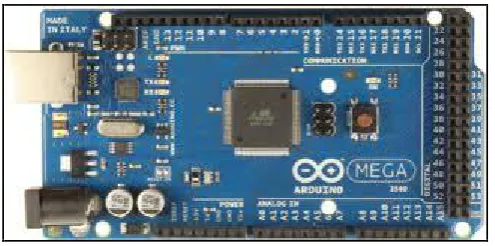
(32) 17 which then can be converted into a usable measurement. The internal ADC runs as fast as 15 kHz, but can only perform one conversion at a time so the Mega2650 will alternate between the two sensors. It may be possible to incorporate faster and more accurate external ADCs, but it will require a larger I/O interface and accurate timing to guarantee good readings.. 2.4.3. Arduino Interface Board. Arduino is a small microcontroller board with a universal serial bus (USB) plug to connect to the computer and a number of connection sockets that can be wired to external electronics such as motors, relays, light sensor, laser diodes, loudspeakers, microphone and more. They can either powered through the USB connection from the computer, from 9V battery, or from a power supply. They can be controlled from the computer or programmed by the computer and then disconnected and allowed to work independently. The board design is open source. These mean that Arduino is a compatible board as shown in Figure 2.9. This competition has led to low costs for the boards. The software for programming the Arduino is easy and also freely available for Windows, Mac, and LINUX computers.. Figure 2.9: Arduino Board. 2.5. Previous Case Study. There are a lot of researchers done similar with this project, mostly by foreign manufacturers, university and colleges. Development of fuzzy logic control techniques began in earnest in 1980’s with a large number of papers published. The growth of fuzzy logic techniques was partly due to fuzzy controllers solving.
(33) 18 previously intractable or very difficult control problems. In this report, the inverted pendulum system is used as a case study therefore special consideration is given to publications that solve the pole-cart problem, either as a research paper dedicated to this particular problem or just using it for testing the proposed control method. In M.J. Desylvia’s MSc thesis (Desylva 1994) a fuzzy logic controller was developed for the task of balancing the inverted pendulum from an arbitrary set of initial conditions. The rule base developed was based on intuition and logic rather than any mathematical model. This approach made the control process much simpler as there was no need to solve nonlinear differential equations. However, results achieved are specific to the inverted pendulum system and have no much value as a method that can be extended to other dynamical systems [24]. Besides that, in the paper by K.J. Astrom and K. Furuta (Astrom and Furuta 2000) the authors discuss simple strategies, based on Lyapunov analysis, for swinging up an inverted pendulum and show that the cart-pendulum system critically depends on the ratio of the maximum acceleration of the pivot to the gravity acceleration. Comparison of energy based strategies with minimum time strategies are provided. In the paper, a designed controller is capable of bringing the pendulum to the upright position in one swing, providing that the control force satisfies u > 2g. Instead of controlling position and velocity of the cart-pendulum system, the method relies on the control task being achieved by controlling the energy of the system, namely acceleration of the pivot [25]. W.S. Yu and C.J. Sun (Yu and Sun 2001) developed a fuzzy adaptive control for a class of nonlinear systems and verified it on the example of the inverted pendulum. The control algorithm guarantees global stability of the system with the output of the system approaching the origin if there are no disturbances and uncertainties, converging to the neighborhood of the origin for all realizations of uncertainties and disturbances [26]. Similar approach was presented by T. J. Koo (Koo 2001) [27] using reference model adaptive fuzzy control. N. Muskinja and N. Tovornik (Muskinja and Tovornik 2006) designed an adaptive fuzzy controller for a real inverted pendulum and compared various control strategies. Their investigation showed advantages of using fuzzy control theory in real-time applications, specifically for the inverted pendulum system with the aim of fast stabilization of the pendulum and the pendulum cart [28]..
(34) 19 Other than that, Sliding mode technique is one of the most popular techniques used to control the inverted pendulum problem. W. Chang (Chang et al. 2002) [29] used the inverted pendulum system as a case study for the robust fuzzy-model-based sliding mode controller and tested it on several initial conditions but with limited scope. The cart‘s position was fixed and located at the origin, only pole angle varied: 0.08π, π/60, 89π/180, π/4. The focus of their research was on system uncertainties not on the region of controllability. Sliding mode control provides a robust controller but with inherent chattering problem that various techniques seek to overcome, supervisory controller being one of the relatively simple solutions Lastly, a new fuzzy control method, scalar fuzzy control (SFC) was discussed in (Mlynski and Zimmermann 2008). In general, the method is concerned with the problem of representing imprecise statements and knowledge, and processing it to draw conclusions from them. The method goes back to the principles of the multivalued logic and introduces axiomatic framework to develop SFC. The method is based on so called: Calculus of imprecise knowledge and deals with linguistic variables. SFC is used to solve the inverted pendulum problem. Surprisingly, the results achieved by SFC are quite similar to presented in this thesis, especially state variables convergence. The initial conditions investigated being: pole angle = 0 and 1 rad (≈ 57º), and cart‘s position x = 0.0m and x = 10.0m. The rate of stabilization is slightly slower than achieved in this project. The restrictions imposed on the system in this thesis do not allow for cart‘s position to be larger than 1 m from the origin therefore it is difficult to compare SFC results. The results achieved in (Mlynski and Zimmermann 2008) [30] make this method very robust and provide another proof of fuzzy logic solving real-life problems..
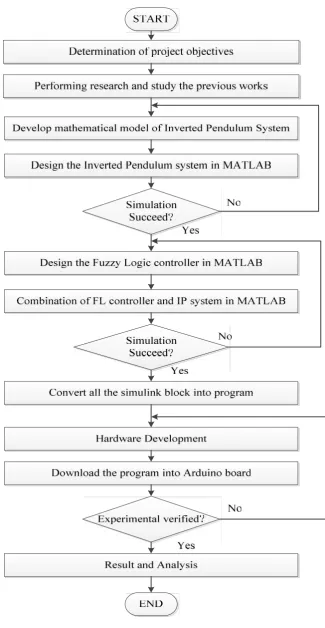
(35) CHAPTER 3. METHODOLOGY. This chapter discusses about the methodology of this project, which includes design, analysis, modify and obtain the result for software and hardware.. 3.1. Design Overview. This section briefly discusses the overall project design including the workflow of activities, controller design and model inverted pendulum design. Figure 3.1 shows the flow chart of this project activity. Basically, the process of developing a fuzzy logic control for inverted pendulum can be divided into three (3) phases: first phase is inverted pendulum design, second phase is fuzzy logic controller and last phase is interfacing the system design with hardware. Figure 3.1, also shows the steps for the design fuzzy logic control for inverted pendulum system. Before designing the inverted pendulum system, their mathematical model needs to be obtained in the first place. From the mathematical model, the transfer function of the system can be derived. Then MATLAB command or Simulink is used to generate the output response..
(36) 21. Figure 3.1: The flow chart diagram for developing the Fuzzy Logic control for Inverted Pendulum System.
(37) 22. 3.2. First Phase: Inverted Pendulum Design. The first phase of this project involves the inverted pendulum design. The previous chapter has discussed about the theory and previous researches on inverted pendulum system. In this chapter, the first step that should be taken is to derive the mathematical model for the inverted pendulum (IP) system. After that, the IP system can be designed based on the mathematical model calculation by using the MATLAB/ simulink. The inverted pendulum is a highly nonlinear and open-loop unstable system. This means that standard linear techniques cannot model the nonlinear dynamics of the system. When the system is simulated the pendulum falls over quickly. So, the project requirement is to be fulfilled based on the objective and scopes.. 3.2.1 Inverted Pendulum Model. The inverted pendulum system consists of a moving cart and a pivoted bar that is free to oscillate in the x-y plane. However, the cart is constrained to move only in the xplane as shown in Figure 3.2. For this system, the control input is the force (F) that moves the cart horizontally and the outputs are the angular position of the pendulum θ and the horizontal position of the cart x. Figure 3.2 shows an inverted pendulum on cart system. The figure includes the external forces acting on the system where: . F is the driving force that apply to the system. . b is the frictional force opposing the motion of the cart-pendulum system. . Mg is the force of gravity on the cart alone. . mg is the force of gravity on the pendulum alone.
(38) 23. Figure 3.2: Free body diagram for Inverted Pendulum system. Table 3.1 shows the parameters of the inverted pendulum that has been used during the simulation on MATLAB.. Table 3.1: Parameters of inverted pendulum. Parameter. Definition. Value. Unit. M m b l i g L F x θ. Mass of cart Mass of pendulum Fiction Length of pendulum centre of mass Inertia of the pendulum Gravity constant Length of the rail Force applied to cart Cart position co-ordinate Pendulum angle from the vertical. 0.208 0.08 0.16 0.382 0.000012 9.8 89.4 -. kg kg Nm-1s-1 m kg.m2 N/kg cm. The suitable mathematical model of the inverted pendulum system has been derived by considering the free body diagram of the system as shown in Figure 3.3. Forces and moments acting in the system were analysed using the figure based on the parameter in the Table 3.1..
(39) 24. Figure 3.3: Free body diagram of the system. To model the system using simulink is challenging because of the physical constraint (the pin joint) between the cart and pendulum which reduces the degree of freedom in the system. Both the cart and the pendulum have one degree of freedom (x and θ respectively). The differential equations can be generating for these degrees of freedom from first principles employing Newton’s Second Law. based. on the following principles:. Summing the forces of the cart in the horizontal direction (3.1). Summing the forces of the pendulum in the horizontal direction (3.2) (3.3). Substitute equation (3.3) into the equation (3.1) to get the first equation of motion for this system: (3.4). Force balance (Newton’s Second Law) applied to the vertical movement (3.5).
(40) 75. REFERENCES. 1.. Murray, R. M., Åström, K.J., Boyd, S.P., Brockett, R.W., Stein, G. (2003).Future directions in control in an information-rich world, IEEE Control Systems Magazine, 23, p. 20-33.. 2.. Bars, R., Colaneri, P., de Souza, C. E., Dugard, L., Allgöwer, F., Kleimenov, A. et al (2006). Theory, algorithms and technology in the design of control systems, Annual Reviews in Control, 30, 19-30.. 3.. Bars, R., Colaneri, P., Dugard, L., Allgower, F., Kleimenov, A., Scherer, C.W(2008). Trends in theory of control system design - status report by the IFAC coordinating committee, In: Proceedings of the 17th IFAC World Congress, Séoul, V. 17, p. 93-114.. 4.. Horaìcek, P. (2000). Laboratory experiments for control theory courses: A survey, Annual Reviews in Control, 24, 151-162.. 5.. Kheir, N. A., Åström, K. J., Auslander, D., Cheok, K. C., Franklin, G. F., Masten, M. M. et al. (1996). Control systems engineering education, Automatica, 32, 147-166.. 6.. Bencomo, S. D. (2004). Control learning: Present and future, Annual Reviews in Control, 28, 115-136.. 7.. Abramovitch, D. "Some Crisp Thoughts on Fuzzy Logic." Proceedings of the American Control Conference. Baltimore, Maryland, June 1994.. 8.. Kailath, T. (1980). Linear Systems, Englewood Cliffs: Prentice-Hall.. 9.. Roberge, J. K. (1960). The Mechanical Seal, Bachelor’s thesis, Massachusetts Institute of Technology..
(41) 76. 10.. Schaefer, J. F. Cannon, R. H. (1966). On the control of unstable mechanical systems, In: Proceedings of the third Automatic and Remote Control, London, v. 3, p. 12-24.. 11.. Kwakernaak, H., Sivan, R. (1972). Linear Optimal Control Systems, New York: Wiley.. 12.. Khalil, H. K. (2002). Nonlinear Systems, New Jersey: Prentice Hall.. 13.. Akira Inoue, Mingcong Deng, Tomohiko Tanabe, “Practical Swing-up Control System Design of Cart-type Double Inverted Pendulum, “Proceedings of the Chinese Control Conference 2006, pp. 2141 – 2146, 2006.. 14.. Chin-I Huang, Li-Chen Fu, “Passivity based control of the double inverted pendulum driven by a linear induction motor, “ Proceedings of 2003 IEEE Conference on Control Applications CCA 2003, vol. 2, pp.797 – 802, 2003.. 15.. S. Yasunobu, T. Iwasaki, “Swing up intelligent control of inverted pendulum based on human knowledge,’’ Proceedings of SICE Annual Conference, vol. 2, pp. 1869 – 1873, 2004.. 16.. K M Goher, M O Tokhi (2010). A New Configuration of Two-Wheeled Inverted Pendulum: A Lagrangian-Based Mathematical Approach, Multidisciplinary Journals in Science and Technology, Journal of Selected Areas in Robotics and Control (JSRC), December Edition, 2010. 17.. Shiroma,N, Matsumoto, O., Kajita, S. & Tani, K, 1996 ‘Cooperative Behaviour of a Wheeled Inverted Pendulum for Object Transportation’, Proceedings of the 1996 IEEE/RSJ International Conference on Intelligent Robots and Systems '96, IROS 96, Volume: 2 , 4-8 Nov. 1996.. 18.. Takahashi, Y., Ishikawa, N. & Hagiwara, T, 2001 ‘Inverse pendulum controlled two wheel drive system’, Proceedings of the 40th SICE Annual Conference, International Session Papers SICE 2001, pp. 112 -115.. 19.. Sugihara, T, T Nakamura & Hirochika I., 2002 ‘Realtime Humanoid Motion Generation Through ZMP Manipulation based on Inverted Pendulum.
(42) 77. 20.. Control’,Proceedings of the 2002 IEEE International Conference on Robotics & Automation,Washington D.C.. 21.. Yi, J., Yubazaki, N. (2000). Stabilization fuzzy control of inverted pendulum systems. Artificial Intelligence in Engineering, Vol. 14, pp. 153–163.. 22.. L A Zadeh,"Fuzzy Sets" Information and Control, Vol.8, pp,353-383, 1965.. 23.. Kevin M. Passino and Stephen Yurkovich, Fuzzy Control, Addison –Wesley Logman, Inc., 1997.. 24.. Leonid Reznik, Fuzzy Controllers, 1st edition, Newness..
(43)
Figure

+7


Related documents
A framework of self-organising Peircean semiotic processes is introduced and it is then applied to demonstrate the emergence of autonomous representational structures in
I find the longer school year decreases the probability of grade repetition and increases educational attainment.. It also increases the probability of working in formal
Li et al EURASIP Journal on Advances in Signal Processing 2014, 2014 48 http //asp eurasipjournals com/content/2014/1/48 RESEARCH Open Access Security management based on
Data yang telah diperoleh dari proses pengumpulan data akan. diolah dengan menggunakan program analisis
Laughter and smiling associated with pleasant feelings, with the exception of laughing in response to feelings of disharmony, and laughter induced by the release of ten- sion can
Being able to access public funding remains vital for community education providers to be able to offer training opportunities for their learners that are relevant to the industries
Alachua County is a home rule charter county, governed by a Board of five elected County Commissioners.. It operates under the established Commission/Manager form of
