International Journal of Emerging Technology and Advanced Engineering
Website: www.ijetae.com (ISSN 2250-2459,ISO 9001:2008 Certified Journal, Volume 3, Issue 5, May 2013)
153
Evolution of Data Hiding By Neural Network and Retrieval or
Encrypted Image, Text, Audio and Video Files
Rakesh Giri Goswami
1, Prof. Sitendra Tamrakar
21
M.Tech Scholar, 2Assistant Professor, Dept.of CSE, NIIST, Bhopal Abstract—Information Hiding is a method of hiding secret
messages into a cover-media such that an intended observer will not be aware of the existence of hidden messages. In such applications various file formats are used as cover-object which contains confidential data. As the new research field the techniques introduces Artificial Neural Network. It is an efficient method to solve complex problems. This newly developed technique uses Multilayer Perceptron algorithm of Neural Network for data security. Results are observed through different Media file as cover-objects. In the proposed method, MLP algorithm is implemented with traditional substitution method to obtain high embedding capacity with no visibility. The system provides confidentiality and integrity to the data during communication through open channels.
Keywords—
Data Hiding, Neural Network, MLP
I. INTRODUCTION
Today internet [1] became an important part of our daily life, everybody wants to send and share information through internet. Therefore, everybody wants our secret data should be transferring in secure manner i.e. no manipulations, no hacking and modifications and its integrity should be maintained. Data security is the major issue for secure data transfer. There are several techniques used in this respect some of the well known techniques are:
1.Cryptography: Cryptography changes the contents of the file into unreadable form. Sender and receiver have the key to unlock the contents.
2.Watermarking: All objects are marked in the same way. Shows ownership of digital data.
3.Steganography or Data Hiding: Hides the existence of secret message into cover-object.
4.Digital Signature: Allows authorship of a document to be asserted [2].
Steganography and Cryptography are both used to ensure data confidentiality, security and data integrity. In cryptography message is encrypted into unreadable form, however the main difference is that within encryption anybody can see that both parties are communicating in secret, whereas Steganography hides the existence of a secret message in such a way that nobody can see that both parties are communicating in secret.
Encryption permits secure connection requiring a key to read the information. An attacker will not eliminate the encryption but it is somewhat easy to modify the document, making it unreadable for the intended recipient Digital signatures allow authorship of a document to be asserted. The signature can be removed easily but any changes made will invalidate the signature, therefore integrity is maintained. facts and figures concealing is a method of concealing mystery notes into a cover-media such that an accidental observer will not be cognizant of the existence of the hidden messages. In this paper, 8-bit grayscale images are chosen as the cover media. These images are called cover-images. Cover-images with the secret notes embedded in them are called stego-images. For data hiding procedures, the likeness value mentions to the value of the stego-images. the paper is mainly conceived for supplying security for the facts and figures. In this, the mailer encrypts the facts and figures to some pattern. While encrypting the facts and figures in to some pattern, the key document is entered by the mailer.
Fig.1. Data Hiding Process
The purpose of the key file[13,14] is to provide security to the scheme as it is renowned only to the mailer and the receiver.
International Journal of Emerging Technology and Advanced Engineering
Website: www.ijetae.com (ISSN 2250-2459,ISO 9001:2008 Certified Journal, Volume 3, Issue 5, May 2013)
154
And also we have to consider the move the large allowance of facts and figures through the network will give mistakes while moving. Nevertheless, perceptive facts and figures move is to be carried out even if there is need of an alternative. mesh security in the existing scheme is the motivation component for a new system with higher-level security measures for the data exchange.
This paper suggests the following characteristics. It provides flexibility to the client to secure the facts and figures very effortlessly. In this system the facts and figures is furthermore hided interior the JPEG Image and Video document. The purchaser who got the document will do the operations like de-embedding, and decryption in their grade of hierarchy.
II. DATA HIDING VARIOUS STREAMS
2.1 Data hiding in still images
Data hiding [11]in still images presents a variety of challenges that arise due to the way the human visual system (HVS) works and the typical modifications that images undergo. Additionally, still images provide a relatively small host signal in which to hide data. 200 pixels provide roughly 40A equitably usual 8-bit images of 200 kilobytes (kB) of facts and figures space in which to work. This is matching to only round 5 seconds of telephone-quality audio or less than a single frame of NTSC TV. Also, it is sensible to anticipate that still images will be subject to procedures extending from simple affine transforms to nonlinear transforms such as cropping, blurring, filtering, and lossy compression [3].
2.2 Data hiding in audio
Data hiding [4] in audio pointers is particularly challenging, because the human auditory system (HAS) functions over a broad dynamic variety. The HAS perceives over a variety of power greater than one billion to one and a range of frequencies larger than one thousand to one, Sensitivity to additive random disturbance is furthermore acute[12].
2.3 Data hiding in text
Soft-copy text [5,6] is in numerous ways the most difficult location to conceal facts and figures. (Hard-copy text can be treated as a highly structured likeness and is readily amenable to a variety of techniques such as minor variations in note forms, kerning, baseline, etc.). Data concealing in text is an exercise in the breakthrough of modifications that are not observed by readers.
2.4 Data Hiding in Video
A video facts and figures embedding scheme [7,8] in which the embedded signature data is reconstructed without understanding the original owner video. The proposed method endows high rate of data embedding and is robust to shift compensated cipher, such as MPEG-2. Embedding is founded on texture masking and utilizes a multi-dimensional lattice structure for encoding signature data. Signature facts and figures is embedded in one-by-one
III. RELATED WORK
3.1 Traditional Data Hiding Methods:
Data hiding techniques [9 10] are classified according to mechanism and changes takes place during embedding as well as the media used for hiding.
a) Techniques according to the mechanism used are:
Substitution system.
Transform Domain Technique.
Spread Spectrum Technique.
Statistical Methods.
Distortion Techniques.
Cover Generation Technique
b) Data hiding are classified according to the file formats used in several Medias like text, image, audio and video.
3.2 Current state of art
A lot of research works have been carried out in the literature for data hiding and some of them have motivated us to take up this research. Brief reviews of some of those recent significant researches are presented below:
In the literature, many techniques for data hiding have been proposed [2-5]. One of the common techniques is based on manipulation the least significant bit (LSB) plans. A LSB substitution method replaces some LSB of the cover-image with the secret data [1,6-8,13,14].
International Journal of Emerging Technology and Advanced Engineering
Website: www.ijetae.com (ISSN 2250-2459,ISO 9001:2008 Certified Journal, Volume 3, Issue 5, May 2013)
155
Chang et al [7] proposed a method of finding the optimal LSB in image hiding by dynamic programming strategy. The suggested procedure finds the optimal LSB substitution that Wang [8] discovered of approximate OLSB, the procedure decreases the computation time too Safy et al., [4] proposed an adaptive steganographic method in which the morsels of the payload are hidden in the integer wavelet coefficients of the cover image adaptively along with optimum pixel change algorithm. Hassan Mathkour et al., [5] contrasted the power and flaws of the living techniques of steganography and implemented a new steganographic wizard founded tool, which have been examined against several other devices like F5, S-Tools etc., for more robust and protected steganography. Vijayalakshmi et al.,[6] suggested modulo based likeness steganography algorithm. The procedure combines trials of LSB morsels utilising addition modulo to get the worth which is contrasted to the part of the payload. If these two standards are identical, no change is made in sample else add the distinction of these two values to the sample.
Wein Hong et al., [7] suggested a lossless steganography technique wherein the mystery data is hidden inside the compressed Absolute instant impede Truncation Coding image. Naji et al., [8] analysed different steganographic methods and flaws in the respective methods.
Hassan Shirali-Shahreza and Mohammad Shirali- Shahreza [9] proposed a synonym text steganographic technique in which the words in American English are substituted by the words having different terms in British English and vice-versa.
IV. PROPOSED METHOD
4.1 Neural Networks:
Proposed method uses a multi-layered perceptron model[15,16] for neural network model. Multi-layered perceptron basically has a synaptic link structure with neurons between the layers but no synaptic link among the layer itself. Signals given to the input layer will propagate forwardly according to the synaptic weight of the neurons connected from the input values and reaches to the output layer as shown in Figure1.:
Fig.1 Neural Networks Structure
Normally sigmoid function[17] is used for this model and is expressed as follows
Each synaptic link has a network weight. The network weight from unit i to unit j is expressed as wij and the output value for unit i is expressed as Oi. The yield standards for the unit is determined by the network weight and the input pointer. Consequently, to change the yield worth to a desired worth, change of these network weights are needed.
In proposed method, we use back propagation learning as learning method. Back propagation learning is a supervised learning. This method endeavours to lower the difference between the teacher pointer and the yield pointer by altering the mesh weight. alterations of the mesh heaviness according to the distinction in the top level propagate backward to the smaller level. This difference between the teacher signal values are called as error and often expressed as δ . When teacher signal tk is given to the unit k of output layer, the error δk will be calculated by following function
:
International Journal of Emerging Technology and Advanced Engineering
Website: www.ijetae.com (ISSN 2250-2459,ISO 9001:2008 Certified Journal, Volume 3, Issue 5, May 2013)
156
After calculating the error values for all units in all layers, then network can change its network weight. The network weight is changed by using following function:
η in this function is called learning rate. Learning rate is a constant which normally has a value between 0 and 1 and generally represents the speed of learning process.
V. EXPERIMENTAL EVALUATION
5.1 Performance Evaluation Parameter
Peak Signal to Noise Ratio (PSNR)[12] is used to evaluate the quality of the stego after embedding the secret message in the cover image. PSNR measures the quality of the image by comparing the original image or cover image with the stego-image. It is expressed in terms of logarithmic decibel scale(dB).Higher the value of PSNR the more quality the stego have. The acceptance range of PSNR is ,typical values for the PSNR in lossy image and video compression are between 30 and 50 dB, where higher is better, but acceptable values for wireless transmission quality loss are considered be about 20 dB to 25 dB.It is most easily defined via the mean squared error (MSE). A cover image C (i, j) that contains N by N pixels and a stego image S(i, j) where S is generated by embedding /mapping the message bit stream ,
The PSNR is defined as:
5.2 Implementation
The proposed application is developed in java programming and applied on different file format of different size and observed possibilities of data hiding and retrieving as follows:
Table1
Different File Formats as Cover Cover
Object
File format Hide Retrie ve
Text docx √ √
Presentati on
ppt √ √
Html htm √ √
Image jpg √ √
Image bmp √ √
Image gif √ √
Audio mp3 √ √
Audio wav √ √
Audio wma √ √
Video mpeg √ √
Video avi √ √
Video wmv √ √
5.3 Experimental simulation
To calculate the simulation results, the four groups’ of Multimedia containers are prepared. Each group of suspect data with varying file format is combined to form a common set of Text, Audio, Video and Image that means the embedded information was a randomly multimedia data. To perform MLP Algorithm in the implementation a Self set was defined as a collection of 100 clean, 512x512-pixel JPEG, 512 x512 BMP images, 5 MB Audio File, 50 MB Video File, 1 MB Text File.
2 N
1 i
N
1 j
ij S ij C NxN
1
M SE
M SE 10
PSNR
log
255
2International Journal of Emerging Technology and Advanced Engineering
Website: www.ijetae.com (ISSN 2250-2459,ISO 9001:2008 Certified Journal, Volume 3, Issue 5, May 2013)
157 5.3.1 Data Hiding in Image
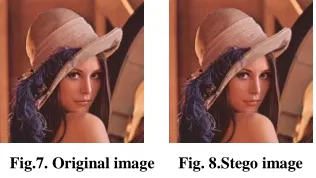
In our simulation we had tried to hide text contained inside different size and format of the image file like BMP, JPEG and GIF. PSNR of the file are calculated which is shown by table 2.
[image:5.612.347.542.160.268.2]Fig.7. Original image Fig. 8.Stego image
[image:5.612.90.248.202.291.2]Observed PSNRs for the respective image file formats are given by the table.2
Table 2
Image File Formats and its PSNR
S No. Image File Formats
Size
(in KB)
PSNR
(in dB)
1 JPG 6.98 44.3
2 GIF 144 41.2
3 BMP 768 37.6
5.3.2 Data Hiding in Text
The following fig.9 HTML text frame can be used as container for embedding information where as table .3 represents the PSNR for the text formats.
Fig. 9 HTML text frame
Table 3
Text File Formats and its PSNR
5.3.3 Data Hiding in Audio and Video
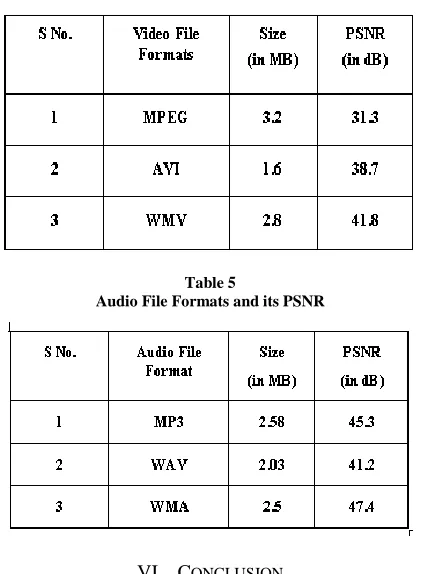
[image:5.612.73.261.332.480.2]Artificial Neural Network’s data hiding method is used to embed information in different audio (table.5) and video file (table.4) and we have calculated their respective PSNR which indicates at the better stego quality image.
Fig.9. Video Frame
Fig. 10.Message to be embedded into Video Frame
<html>
<body>
………
<p>Image Example:</p>
<a
href="http://www.quackit.com/travel/new_
zealand/milford_sound">
<img
src="/pix/milford_sound/milford_sound_t.j
pg" style="max-width:100%" alt="Milford
Sound in New Zealand" /></a>
<div class="more-info">
[image:5.612.337.551.345.610.2]International Journal of Emerging Technology and Advanced Engineering
Website: www.ijetae.com (ISSN 2250-2459,ISO 9001:2008 Certified Journal, Volume 3, Issue 5, May 2013)
158
Table 4
[image:6.612.63.275.156.443.2]Video File Formats and its PSNR
Table 5
Audio File Formats and its PSNR
VI. CONCLUSION
The security of facts and figures is of farthest
importance in today's information-based humanity,
encompassing the fields of infantry, diplomacy, company, medicine, and even the one-by-one, the data have to be safeguarded to avoid the unauthorized or illicit accesses and avert the misuses and abuses. Any system or technique that deals with, processing information (data), wants to put this data in shapes or forms of media under the condition that it must be not visible in its new form for human observer. All such systems are called hiding systems for information. In this paper, we had technique as possible methods for embedding data in host text, image, video and audio signals .While we have had some degree of success Proposed method uses MLP Algorithm for classifying the input patterns to corresponding hidden signals.
REFERENCES
[1] Arup Kumar Bhaumik, Minkyu Choi,Rosslin J.Robles and Maricel O.Balitanas. “Data Hiding in video” International journal of Database Theory and Application vol.2, No.2 June 2009.pp 9-14 [2] Jacob T. Jackson, Gregg H. Gunsch, Roger L. Claypoole, and Gary
B.Lamont.:Novel Steganography Detection Using an Artificial Immune System Approach” IEEE 2010
[3] Poulami Dutta, Debnath Bhattacharyya and Tai-hoon Kim.”Data hiding in Audio Signal”.International Journal of Database theory and Application vol.2,No.2 June2009 pp.1-8
[4] Shan Wang,Bian Yang and Xiamu Niu .”A secure Steganography Method based on Genetic Algorithm” Journal of Information Hiding and Multimedia Signal Processing ,’Ubiquitous International’,ISSN2073-4212 ,Volume 1 Number 1 ,2010, pp:323-322.
[5] Encryption, Data Hiding, and Hostile Code. In Write Work.com. Retrieved 02:12, October 24, 2012
[6] Jammi Ashok, y.Raju k.Srinivas “Steganography: an overview” International Journal of Engineering Science and Technology Vol. 2(10), 2010pp: 5985-5992
[7] W.Bender,D.Gruhl,N.Morimoto,A.lu. “Techniques for data hiding” IBM System Journal, Vol 35,No. 3&4,1996 pp:313-336
[8] M.S Shashidhara,A.Pandurangan,Suhasini CHV “Data hiding and retrival of Encrypted file in Images and videos using ANN methods Int.J.Advanced Networking and Applications Vol.02,Issu:02,2010, pp:544-549
[9] Abbas Cheddad,Joan Condell,Kenvin Curran,Paul Mc Kevitt.”Digital image stegnogrphy:survey and analysis of current methods”.SIgnal processI 90 2010 pp: 727-752
[10] Jayaram P.,Ranganatha H.R,Anuppama H S .”Information Hiding using Audio Steganography”.The international Journal of Multimedia & Its Application (IJMA) Vol.3, No.3 August 2011,pp-86-96,
[11] I,Aveibas,N.Memon,B.Sankur.”Steganalysis based on image quality metrics”.Multimedia signal Processing, 2001. IEEE IV workshop 2001
[12] El-sayed M.El-Alfy,Azzat A.Al-sadi “Pixel-Valued Differencing Steganogrphy:Attacks and Improvements” ICCIT,2012, pp:757-765 [13] Rosziati Ibrahim , Teoh suk kuan “ Steganography Algorithm to hide Secret message inside an image” Computer Technology and Application 2 ,2011, pp:102-108
[14] Imran Khan “An Efficient Neural Network based Algorithm of Steganography for image” International journal of Computer Technology and Electronics Engineering(IJCTEE) Vol.1,Issue 2, ISSN 2249-6343, 2011, pp:63 -67
[15] K.B Shiva Kumar K B Raja “Bit Length Replacement Steganography Based on DCT coefficients” International Journal of Engineering Science and Technology vol.2(8), 2010, pp:3561-3570 [16] Souvik Bhattacharya, Lalan Kumar ang gautam Sanyal “ A novel