N A N O C O M M E N T A R Y
Open Access
Interface modification effect between p-type a-SiC:
H and ZnO:Al in p-i-n amorphous silicon solar cells
Seungsin Baek
1*, Jeong Chul Lee
2, Youn-Jung Lee
1, Sk Md Iftiquar
1, Youngkuk Kim
1, Jinjoo Park
1and Junsin Yi
1*Abstract
Aluminum-doped zinc oxide (ZnO:Al) [AZO] is a good candidate to be used as a transparent conducting oxide [TCO]. For solar cells having a hydrogenated amorphous silicon carbide [a-SiC:H] or hydrogenated amorphous silicon [a-Si:H] window layer, the use of the AZO as TCO results in a deterioration of fill factor [FF], so fluorine-doped tin oxide (Sn02:F) [FTO] is usually preferred as a TCO. In this study, interface engineering is carried out at the AZO and p-type a-SiC:H interface to obtain a better solar cell performance without loss in the FF. The abrupt potential barrier at the interface of AZO and p-type a-SiC:H is made gradual by inserting a buffer layer. A few-nanometer-thick nanocrystalline silicon buffer layer between the AZO and a-SiC:H enhances the FF from 67% to 73% and the efficiency from 7.30% to 8.18%. Further improvements in the solar cell performance are expected through optimization of cell structures and doping levels.
Keywords:buffer layer, amorphous materials, thin films, plasma deposition, electrical properties
Introduction
TCO plays an important role in a silicon-based thin-film solar cell because of good electrical conductivity as well as optical properties such as transparency and haze ratio. Additionally, the interface properties with an adjacent p-layer are also important. The FTO has been widely used as a front TCO in a single p-i-n a-Si:H solar cell. The FTO, however, has a low haze ratio in a wavelength longer than 700 nm, which is a limiting factor for tandem solar cells that incorporates a low-bandgap bottom cell. The AZO has several advantages such as good electrical conductivity, plasma robustness, light-scattering properties [1-3], etc. One drawback of AZO is that when it is used in amor-phous silicon [a-Si] solar cells, having a-SiC:H or a-Si:H window layer, the FF deteriorates [4-7]. It is assumed that the work function of AZO is lower than that of FTO [8], causing an increased barrier potential to occur at the front interface obstructing the carrier movements and thus, low-ering the FF. In this paper, we report some attempts in interface engineering to lower the effect of the barrier between the AZO and the p-type a-SiC:H in order to enhance the FF and efficiency.
Experimental methods
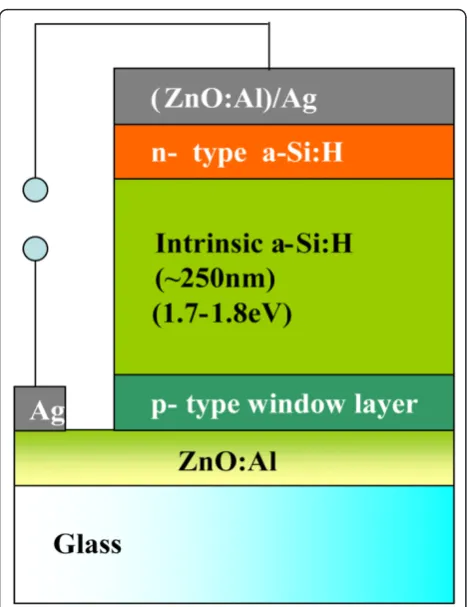
The structure of the p-i-n a-Si solar cells is shown in Figure 1. The textured AZO films are prepared by chemi-cal etching of radiofrequency [rf] magnetron-sputtered AZO, in 1% HCl solution. The base pressure for the rf sputtering is 1 × 10⁻⁷Torr. The AZO deposition pressure is set at 5 mTorr with Ar flow rate as 3 sccm. An rf power of 100 W is used in the AZO deposition. For p-i-n silicon film deposition, a cluster-type multi-chamber che-mical vapor deposition [CVD] system is used, as shown in Figure 2. Each of the solar cell layers is prepared in a separate chamber. For the deposition of p- and n-type silicon films, a conventional 13.56-MHz capacitively
coupled CVD is used with SiH4, H2, B2H6 (1% in H2),
CH4(50% in H2), and PH3(1% in H2) gases. The intrinsic a-Si:H layer is deposited with a 60-MHz
very-high-frequency CVD with SiH4 and H2gases. The dilution
ratios,R= H2/SiH4, are 8 and 0.8 for i-type a-Si:H and p-type a-SiC:H, respectively. The substrate temperature and deposition pressure are kept at 200°C and 0.3 Torr, respectively, for all silicon layers. DarkI-Vcharacteristics are measured, and the applied bias-dependent TCO/p series resistance is estimated.
Interface modification of AZO/p-type a-SiC:H is car-ried out by inserting a highly conductive material between the AZO and p-type a-SiC:H as a buffer layer.
* Correspondence: [email protected]; [email protected]
1
School of Information and Communication Engineering, Sungkyunkwan University, 300 Cheoncheon-dong, Jangan-gu, Suwon, 440-746, South Korea Full list of author information is available at the end of the article
It is first done by profiling the flow rate of B2H6during the deposition of p-type a-SiC:H. Initially, the flow rate of B2H6is kept high to minimize the depletion in the p-layer, and then, the flow rate of B2H6 is decreased to reduce the light absorption. After the B2H6 profiling, the
cell results in a AZO/p+ a-SiC:H/p a-SiC:H/i a-Si:H/n a-Si:H structure. In another set, a nanocrystalline silicon layer is used as the buffer layer. A few-nanometer-thick nc-Si:H is deposited on AZO before the cell fabrication. All investigated cells have a 500-nm Ag back contact that defines a 0.25-cm2 cell area. The illuminated I-V properties of solar cells are measured by an AM 1.5 G double-beam solar simulator (Wacom, Co., Ltd, Kazo-shi, Saitama, Japan), and series resistance is obtained from theI-Vcurves.
Results and discussion
Figure 3 shows the voltage-dependent series resistance for AZO/p-type a-SiC:H structures. It is seen that the resistance is highly dependent on the applied voltage. The resistance displays a Gaussian distribution centered at 0 V, and the peak value is as high as 18 Ω cm2. It implies that there exists some kind of obstruction of carrier movement which is dependent on the applied voltage. It seems that the obstruction is most likely the interface barrier caused by the work function differences between the AZO and p-type a-SiC:H.
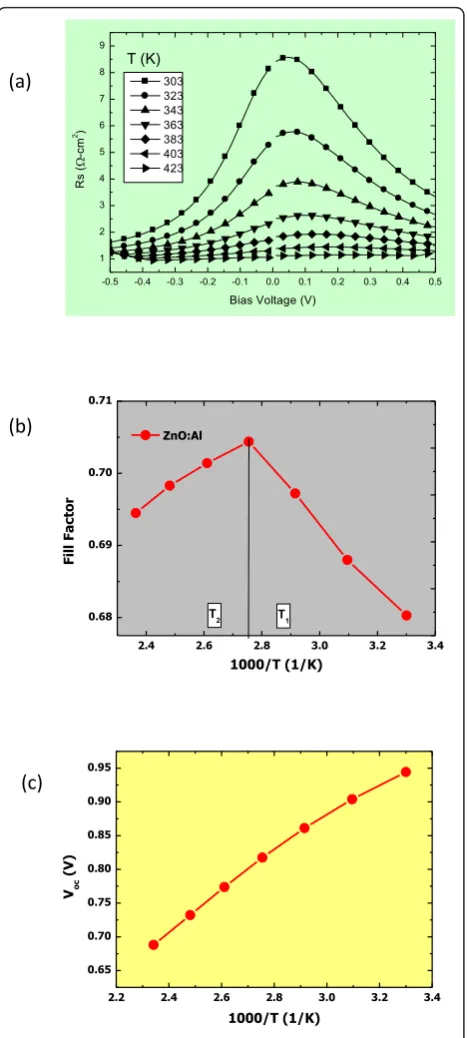
[image:2.595.57.291.85.389.2]Figure 4a shows the dependence of resistance on the bias voltage as the temperature is increased. As the tem-perature increases, the resistance decreases and so does its dependence on the bias voltage. At 0 V, theRTCO/p remains below 2.5Ωcm2when the temperature is over 363 K. Figure 4b, c shows the dependence of solar cell characteristics on the measured temperature of p-i-n a-Si solar cells with AZO as TCO. Here, the temperature range has been divided into two regions: T1and T2, as shown in Figure 4b. In region T2(above 343 K), the FF decreases as the temperature increases, which is in accor-dance with the generally known fact that the FF decreases with an increased temperature due to the leakage
[image:2.595.57.291.500.710.2]Figure 1The p-i-n a-Si:H solar cell structure using AZO as TCO.
Figure 2The cluster-type multi-chamber system.
-1.0 -0.8 -0.6 -0.4 -0.2 0.0 0.2 0.4 0.6 0.8 1.0 0
2 4 6 8 10 12 14 16 18 20 22
R TCO/p
:
-cm
2
Voltage (V) ZnO:Al
[image:2.595.305.539.525.702.2]current. However, in region T1(303 to 343 K), a different behavior of FF is observed. In this range of temperature, the FF decreases rapidly with a decrease in temperature. As the temperature is lowered, the junction potential at the interface increases, which may be the dominant
factor for the decrease in the FF. Figure 4c shows that the open-circuit voltage [Voc] increases inversely with the temperatureT, which we find thatVocdecreases linearly with the temperature. Thus, it becomes necessary and possible to improve the FF in a-Si solar cell where AZO is used as a TCO.
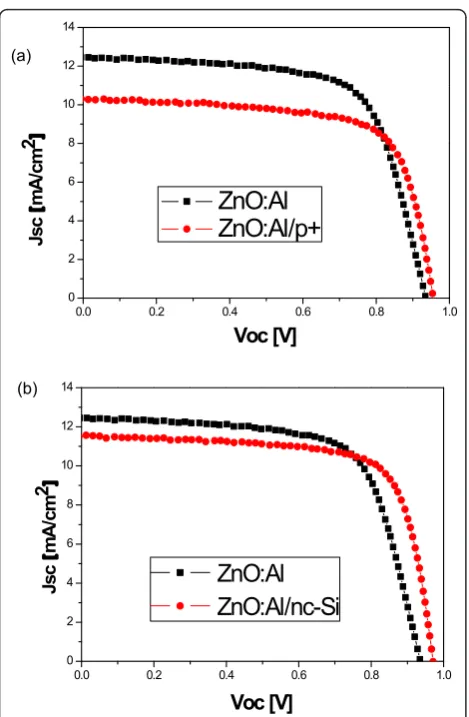
As the potential barrier at the AZO/p interface is due to the work function difference, it is possible to insert a suitable buffer layer, with higher conductivity, between the AZO and p-type a-SiC:H in order to reduce the loss in the FF. As mentioned in the‘Experimental methods’ section, a p+ a-SiC:H buffer layer is made between the AZO and p-type a-SiC:H by profiling the B2H6flow rate. Figure 5a shows lightI-V characteristics of the cells. With the introduction of the buffer layer, there is an increase in theVoc, but a reduction in the short-circuit
current density [Jsc] has also been observed. The
increased conductivity of the p+ a-SiC:H buffer layer reduces the effect of the potential barrier, but the increased doping concentration results in increased defect density in the p+ a-SiC:H and the interfaces, thus, more carrier recombination and decreasedJsc. Figure 5b shows the lightI-Vcharacteristics of AZO/p-type a-SiC: H and AZO/buffer/p-type a-SiC:H solar cells where the buffer layer is a few-nanometer-thick nanocrystalline sili-con. Even though there is a smaller decrease in theJsc, it can be seen that theVocand FF are much more improved It has been shown that the resistance of the AZO/p-type a-SiC:H p-i-n solar cell is highly dependent on the bias voltage. The maximum resistance is obtained with the bias of around 0 V. It is assumed that there is a potential barrier at the interface which disturbs the car-rier movement, and the height of the potential barcar-rier is affected by applied voltage. To reduce the effect of the barrier at the interface, buffer layers are inserted. Figure 6 shows the bias-dependent resistance of the AZO/p-type a-SiC:H p-i-n solar cell and the ones with interface engineering. It is seen that the resistance for the cells with the buffer layers does not depend much on the applied voltage, indicating that the effect of potential barrier at the interface is almost negligible. Although the cell with the AZO/p+ a-SiC:H/p-type a-SiC:H front interface structure does not show the effect of potential barrier at the interface, its solar cell characteristics are not improved. It means that just by getting rid of the potential barrier does not improve the efficiency of solar cells. Good electrical, optical, and interface properties as well as lowering the interface potential barrier are necessary to assure high cell efficiency.
Figure 7 shows the band diagrams of the interface between the AZO and p-layer with and without the buffer layers simulated by ASA. At the depth of about 801 nm, it is seen that although the barrier height at the valence band actually decreases for the one with a p+ buffer layer, -0.5 -0.4 -0.3 -0.2 -0.1 0.0 0.1 0.2 0.3 0.4 0.5
1 2 3 4 5 6 7 8 9
T (K)
Rs
(
-cm
2)
Bias Voltage (V) 303
323 343 363 383 403 423
2.4 2.6 2.8 3.0 3.2 3.4 0.68
0.69 0.70 0.71
Fill F
a
ctor
1000/T (1/K) ZnO:Al
T2 T1
2.2 2.4 2.6 2.8 3.0 3.2 3.4 0.65
0.70 0.75 0.80 0.85 0.90 0.95
Voc
(V)
1000/T (1/K)
(a)
(b)
[image:3.595.58.292.86.606.2](c)
Figure 4Variation of resistance (RTCO/p), FFs andVoc. (a) The
bias voltage dependence ofRTCO/punder various temperatures. (b)
the shape of the energy band diagram is similar to the one without a buffer layer. For the case where nanocrystalline silicon is used as a buffer layer, the shape of the energy band diagram changes much. First, the barrier height is reduced. The bandgap of the nanocrystalline silicon is smaller than a-SiC:H, indicating that both the optical and electrical properties are different. At the depth of about 810 nm, because of the smaller energy bandgap of the nanocrystalline silicon, an opposite banding occurs at the valence band. It helps generated holes to move towards the TCO and be collected.
Table 1 shows that the FF and Vocimprove when the potential barrier is lowered; this is a different set of cells than that in Figure 5. There is a large drop inJscin the case where p+ a-SiC:H is used as a buffer layer due to increased defects and lower optical bandgap of this layer. When the nanocrystalline silicon layer is used as a buffer layer, there is a large increase in the Vocand FF with a smaller decrease in theJsc, resulting in higher cell efficiency.
There are a number of factors that limit the solar cell performance, the potential barrier at the front interface being one of them. Since the material properties of nanocrystalline silicon differ from the amorphous (b)
(a)
$%#!"
$%#!"'(&
$%#!"
[image:4.595.305.539.86.270.2]$%#!"'%)
Figure 5LightI-Vcharacteristics. The lightI-Vcharacteristics of solar cells having (a) AZO/p-type a-SiC:H and AZO/p+ a-SiC:H/p-type a-SiC:H front interface and (b) AZO/p-type a-SiC:H and AZO/nc-Si/p-type a-SiC:H front interface.
-1.0 -0.8 -0.6 -0.4 -0.2 0.0 0.2 0.4 0.6 0.8 1.0 0
2 4 6 8 10 12 14 16 18
R TCO/p
:
-cm
2
Applied Bias (v)
ZnO:Al ZnO:Al/p+ ZnO:Al/nc-Si
Figure 6Dependence of resistance on the applied bias. The dependence of resistance on the applied bias for a normal cell with AZO as TCO and two other cells with interface engineering.
795 800 805 810 815
-4 -3 -2 -1 0 1 2 3 4 5 6
non P+ p_nc-Si
p layer buffer
layer AZO
Conduction band
Valence band
Depth (nm)
En
ergy (
eV)
[image:4.595.57.291.501.693.2]Figure 7Energy band diagram. Energy band diagram of the interface between the AZO and p-type layer with and without the buffer layers.
Table 1 Solar cell parameters for cells with and without the interface engineering
AZO AZO/p+ AZO/nc-Si
Voc(V) 0.92 0.94 0.97
Jsc(mA/cm 2
) 11.7 10.3 11.53
FF 0.67 0.71 0.73
Efficiency (%) 7.30 7.01 8.18
Voc, open-circuit voltage;Jsc, short-circuit current density; FF, fill factor; AZO,
[image:4.595.303.539.649.713.2]silicon, its electrical characteristics such as electron affi-nity, mobility gap, electrical conductivities, etc. also dif-fer, and some are favorable for the solar cells. That is why the solar cell performance with the nc-Si as a buffer layer is much better. In this paper, improvements of a-Si p-i-n solar cell with AZO as TCO have been obtained only by engineering the interface between the p-type a-SiC:H and AZO and shows that a large increase in the solar cell efficiency can be obtained by using nc-Si as a buffer layer. In this study, no other optimizations such as optimizing the thickness of each layer, etc. have been carried out.
Conclusion
In order to improve the FF of a-Si p-i-n solar cells with AZO as TCO, interface engineering has been carried out by inserting a buffer layer between the AZO and p-type a-SiC:H. It is shown that by engineering the inter-face between the two materials, the effect of potential barrier at the interface can be reduced, resulting in an increase in the FF and cell efficiency. The best cell per-formance obtained in this study is by using nc-Si as a buffer layer since it provides better optical transmission and electrical conductivity suitable for the solar cell per-formance. The cell efficiency improves from 7.30% to 8.18% by using a few-nanometer-thick nc-Si layer. Further improvements in the solar cell performance are possible through optimization of thickness of each layer, doping concentration, etc.
Acknowledgements
This work was supported by the Priority Research Centers Program through the National Research Foundation of Korea (NRF) funded by the Ministry of Education, Science and Technology (2010-0020210).
Author details
1
School of Information and Communication Engineering, Sungkyunkwan University, 300 Cheoncheon-dong, Jangan-gu, Suwon, 440-746, South Korea
2
Photovoltaic Research Center, Korea Institute of Energy Research, 152 Gajeong-ro, Yuseong-gu, Daejeon, 305-343, South Korea
Authors’contributions
JCL gave an idea for related thin-film solar cell analysis and worked on the manuscript. Y-JL also contributed to the experiment analysis with scientific opinion. SMI had focused on the related Si thin-film solar cell devices with SB. YK also generated the general analysis for the thin-film solar cell as well as the single-layer of amorphous. JP mainly focused on the analysis of the basis on the solar cell as well as the overall collection and arranged the optimized manuscript. JY had been guiding the research. All authors read and approved the final manuscript.
Competing interests
The authors declare that they have no competing interests.
Received: 9 September 2011 Accepted: 18 January 2012 Published: 18 January 2012
References
1. Kluth O, Rech B, Houben L, Wieder S, Schöpe G, Beneking C, Wahner H, Löffl A, Schock HW:Texture etched ZnO:Al coated glass substrates for silicon based thin film solar cells.Thin Solid Films1999,351:247-253. 2. Tark SJ, Kang MG, Park S, Jang JH, Lee JC, Kim WM, Lee JS, Kim D:
Development of surface-textured hydrogenated ZnO:Al thin-films forμ c-Si solar cells.Curr Appl Phys2009,9:1318-1322.
3. Bittkau K, Carius R, Lienau C:Guided optical modes in randomly textured ZnO thin films imaged by near-field scanning optical microscopy.Phy Rev B2007,76:035330.
4. Palit N, Chatterjee P:Computer analysis of a-Si:H p-i-n solar cells with a hydrogenated microcrystalline silicon p layer.J App Phys1999,
86:6879-6889.
5. Lee JC, Dutta V, Yoo J, Yi J, Song J, Yoon KH:Superstrate p-i-n a-Si:H solar cells on textured ZnO:Al front transparent conduction oxide.Superlattices Microstruct2007,42:369-374.
6. Kubon M, Boehmer E, Siebke F, Rech B, Beneking C, Wagner H:Solution of the ZnO/p contact problem in a-Si:H solar cells.Sol Energy Mater Sol Cells
1996,41-42:485-492.
7. Arya RR, Oswald RS, Li YM, Maley N, Jansen K, Yang L, Chen LF, Willing F, Bennett MS, Morris J, Carlson DE, Thin Film Div, Solarex Corp, Newtown PA:
Progress in amorphous silicon based multijunction modules.Proc 1st WCPEC: December 5-9 1994; Waikoloa394-400.
8. Lee WY:X-ray photoelectron spectroscopy and Auger electron spectroscopy studies of glow discharge Si1-xCx:H films.J Appl Phys1980,
51:3365-3372.
doi:10.1186/1556-276X-7-81
Cite this article as:Baeket al.:Interface modification effect between p-type a-SiC:H and ZnO:Al in p-i-n amorphous silicon solar cells.Nanoscale Research Letters20127:81.
Submit your manuscript to a
journal and benefi t from:
7Convenient online submission 7 Rigorous peer review
7Immediate publication on acceptance 7 Open access: articles freely available online 7High visibility within the fi eld
7 Retaining the copyright to your article