DOI: https://doi.org/10.1108/ICT-10-2018-0090 Link to Leeds Beckett Repository record: http://eprints.leedsbeckett.ac.uk/5963/
Document Version: Article
The aim of the Leeds Beckett Repository is to provide open access to our research, as required by funder policies and permitted by publishers and copyright law.
The Leeds Beckett repository holds a wide range of publications, each of which has been checked for copyright and the relevant embargo period has been applied by the Research Services team.
We operate on a standard take-down policy. If you are the author or publisher of an output and you would like it removed from the repository, please contact us and we will investigate on a case-by-case basis.
Page 1 of 21
The Learning-Driven Organization:
Towards an Integrative Model for Organizational Learning
Abstract
Purpose: We propose a model for organizational learning that can help organizations to transform into a Learning-Driven Organization (LDO); a model that considers the whole ecosystem, its subsystems and considers the importance of technology, digitalisation and dataism. We seek to answer key questions, specifically, a) what makes an organization learning-driven? and b) how the learning ecosystem works organization-wide?
Design/methodology/approach
This paper draws on prior research conducted by the authors in the hospitality sector. Insights were gleaned from both theoretcal perspectives and qualitative data drawn from a number of empirical studies. This paper focuses on critically reviewing the literature on organizational learning, and selected organizational development frameworks such as European Foundation for Quality Management and Investors in People .
Findings:
We propose an ecosystem model that entails three subsystems for OL. At this stage, we propose a conceptual framework that will be tested in the following part two.
Leaders in organizations need to re-design their organizations to incorporate learning at all levels, i.e. individuals, teams, and organization-wide. Learning should be an overarching approach within and beyond the boundaries of the organizations; for organizations to learn effectively, learning should be strategized and institutionalized.
Research Implications:
Page 2 of 21
research should focus on reviewing and evaluating what did we learn about learning and how can we further learn, unlearn and re-learn.
Practical Implications:
We argue that organizations should look into learning as an enabler towards creativity and innovation, which should ultimately lead to excellence and fulfilling the needs of all stakeholders. Organizations should be consciously aware of their emerging intangible assists and proactively encourage their people towards more creativity., Learning can be institutionalized, and the organization transforms into a Learning-Driven Organization (LDO).
Originality/value
The LDO model will help organizations to strategize learning. Strategic learning about understanding a global strategy and how each business unit in an organization contributes its best, most innovative thinking followed by actions that execute the strategic intent of the organization.
Key Words:
Organizational Learning, Learning Mechanisms, Learning-Driven Organization, Individual Learning, Team Learning, Informal Learning
Introduction
Page 3 of 21
pressures on why leaders and managers need to become learning-driven. This includes how much attention needs to be given to collaboration as well as to competition or whether adding benefit to communities and society in general needs to be given more prominence. This calls into question the extent to which the provision of learning will and should extend beyond organizational boundaries and bring some results to society at large. It also has to include how technology in all its forms has the potential to transform our lives but also the possibility to destroy. This might consist of technology that is used to exploit and denigrate human effort and reward and even replace humans or whether it helps to explore potential, creativity and development (Mitic et al., 2017; Roztocki and Weistroffer, 2015). In the same vein, Kuusisto, (2017) argues that there has been very little research done on the overall “big” picture of the effects of digitalisation on organizations, calling for more research on the phenomenon.
In this paper, we argue that learning was, has become and always will be a critical process. At a time when so many organizations, the people in those organizations and those who depend on organizations to live their lives, are faced with many and often contradictory pressures, we argue that learning by conscious human beings needs to be pursued strategically, critically and embedded in how we live and work. We pose two questions: a. what makes an organization learning-driven? and b. how the learning ecosystem works organization-wide
We begin with a brief overview of the literature relating to organizational learning before considering the key elements of what we call a Learning Driven Organization (LDO). We then report emerging results of the development of the LDO in an effort to create meaning structures for organizational learning.
Literature Review:
Page 4 of 21
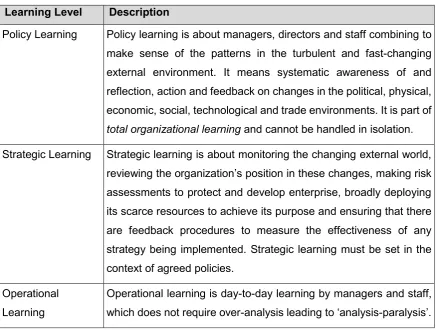
[image:5.595.73.513.429.759.2]barriers to OL, such as fear, stress and lack of motivation at a personal level, strict work rules, and narrow jobs and blame cultures within an organization. Others are more positive about the potential of OL. Dixon, (1999, p. 6), for example, defined OL as ‘the intentional use of learning processes at the individual, group and system level to continuously transform the organization in a direction that is increasingly satisfying to its stakeholders’. Dixon's definition focuses on the view that learning should lead to the satisfaction of an organization's stakeholders; it depends on the use of processes without much focus on the culture. Garratt (2000) suggested a three-level model (depicted in Table 1) that identifies three levels of learning, where the first level policy learning represent the external effectiveness, the operational level represents the internal efficiency while the strategic learning level represents the integration of these two other levels. This model seems comprehensive as it tackles the various aspects and stakeholders within and beyond the organization’s boundaries.
Table 1- Summary of Garratt’s Levels of Learning
Learning Level Description
Policy Learning Policy learning is about managers, directors and staff combining to make sense of the patterns in the turbulent and fast-changing external environment. It means systematic awareness of and reflection, action and feedback on changes in the political, physical, economic, social, technological and trade environments. It is part of total organizational learning and cannot be handled in isolation. Strategic Learning Strategic learning is about monitoring the changing external world,
reviewing the organization’s position in these changes, making risk assessments to protect and develop enterprise, broadly deploying its scarce resources to achieve its purpose and ensuring that there are feedback procedures to measure the effectiveness of any strategy being implemented. Strategic learning must be set in the context of agreed policies.
Operational Learning
Page 5 of 21
Source: Adapted from Garratt (2000, pp. 3-11)
Dixon (1999) and Garratt (2000) both imply a degree of intention that stimulates an OL process — acquiring information to make knowledge that forms intelligence that allows changing behaviour by humans and increasingly, non-humans. For humans, this can involve reflection to reveal values and assumptions, insights into practice, allowing a revision of attitudes, deciding responsibly and wisely. Senge (1990) and Fibuch & Roberston (2017) concluded that an organization’s employees could create, acquire and transfer knowledge that allows the organization to adapt to unpredictable market conditions more quickly than competitors and by the acquisition and dissemination of knowledge, an organization can shape its future. These may, or may not, lead to an improvement in performance (Brockbank et al., 2002). Frequently considered as tacit knowledge, it is quite possible that learning can remain hidden or unrecognized, deliberately or otherwise. For example, Crossan et al.’s (1999) model of OL casts ‘intuiting’ as an initial process of seeing patterns which become possible ideas for application through explanation and sharing through ‘interpreting’. However, such processes might not flow unhindered. Models of OL emphasize the need for a consideration of contextual features and space to enable knowledge sharing and conversion (Nonaka et al. 2000). Values play a crucial role (Fenwick 2008) where learning occurs on the basis of meanings made in local contexts, often beyond the sight of leaders and managers (Yanow, 2000; Lave and Wenger, 1991).
Page 6 of 21
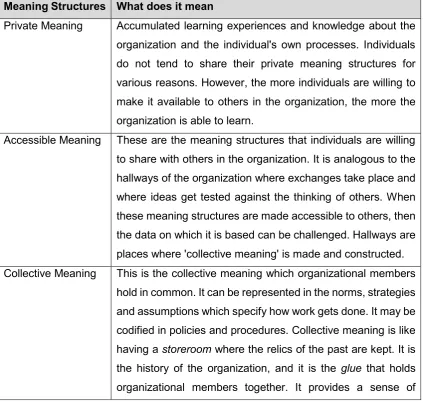
[image:7.595.74.498.352.755.2]The concept of OL is not new and has been present in the management literature for many years, but it became widely recognizedonly in the 1990s (Popova-Nowak and Cseh, 2015; Argote, 2011). Dixon (1999) argues that, in order for OL to occur, private meaning structures should be made more accessible and moved to the accessible meaning structures. Moreover, the latter should be pushed towards collective meaning structures. This is further explained in Table 2:
Table 2- Types of Meaning Structures
Meaning Structures What does it mean
Private Meaning Accumulated learning experiences and knowledge about the organization and the individual's own processes. Individuals do not tend to share their private meaning structures for various reasons. However, the more individuals are willing to make it available to others in the organization, the more the organization is able to learn.
Accessible Meaning These are the meaning structures that individuals are willing to share with others in the organization. It is analogous to the hallways of the organization where exchanges take place and where ideas get tested against the thinking of others. When these meaning structures are made accessible to others, then the data on which it is based can be challenged. Hallways are places where 'collective meaning' is made and constructed. Collective Meaning This is the collective meaning which organizational members
Page 7 of 21
belonging and community, and it saves the organization's time. However, it can also have a negative impact on the organization when it became obsolete or inhibits learning. Source: Adapted from Dixon (1999, p.45-49)
Page 8 of 21
against a goal which becomes a learning process through feedback to ensure work is correct and improving.
Towards a Learning-Driven Organization
Friedman et al. (2001), argued that visionaries and advocates of OL provided little guidance on how to put organizational learning into practice in order to ‘get there from here’. A necessary condition for systematically promoting OL is the existence of OL structures in which the learning process can be carried out (Garratt, 2000; Friedman et al., 2001). In the same vein, Mitki et al. (2008) argued that the need to test organizational learning mechanisms could guide managerial actions towards reinforcing and fostering creativity. Popper and Lipchitz’s (2000) work attempts to give clarity to the nature of organizational learning mechanisms (OLMs) as they provided the first comprehensive definition of these, defined as institutionalized arrangements that allow organizations to collect systematically, analyze, store, retrieve and use information that is relevant to the performance of the organization and its members (Cirella et al., 2017). Later, Shani and Docherty (2008) developed a theoretical framework of OLMs that classified three broad categories, namely cognitive, structural and procedural mechanisms which Cirella et al. (2017) tabulated as follows:
a) Cognitive Mechanisms includes clarity of strategy, connection strategy-activities, coherence strategy training, learning encouragement culture, and sharing of a common language.
b) Structural Mechanisms includes information between colleagues, knowledge of who does what, participation in teamwork, continuous improvement, and reference for having support.
c) Procedural Mechanisms: knowledge of resources and objectives, knowledge of controlling criteria, midway reviews, post-project reviews and routines about use of archives.
Page 9 of 21
In spite of the confusion on the meaning of OL, there is almost a consensus on its importance to the organizations’ performance in the long-term as well as the short-term. Authors such as Senge, 1990; Nonaka and Takeuchi, 1995; Sharma, 2003; Marquardt, 2002; Akhavan and Jafari, 2006; Bowen et al. 2006; Saadat and Saadat, 2016, argued that learning is a meaningful way to improve performance in the long-term, and in the near future, organizations that can utilise people’s abilities, commitment and learning capacity in all the levels can accomplish their goals and realise their vision. Organizations can improve their performance through OL (Jyothibabu et al., 2010; Guta, 2014). In order to confirm such claims about OL’s importance, researchers have attempted to develop measures to see if and how its impact can indeed be measured objectively or based on judgments or opinions (Chiva et al., 2007). To measure OL, either we measure OL capabilities or OL processes, in addition, learning effects can be measured on an individual level, a team level and an organizational level. (Guta, 2014). Jyothibabu et al. (2010) attempted to develop a conceptual approach for measuring OL by merging the enablers model developed by Crossan et al. (1999) and the performance model developed by Bontis et al. (2002). That approach incorporated learning enablers, learning results (at individual, group and organizational level) and performance outcomes. However, it can be argued that Individual Learning Levels (ILL), Group Learning Levels (GLL) and Organizational Learning Levels (OLL) can be considered as enablers as well as an outcome. We, therefore, believe that there is a need for a more precise approach for measurement that can focus on ‘how to’ undertake such analysis.
Templeton et al. (2002) emphasised on the importance of measuring OL as in order to assess the extent of it in organizations and how it supports the management of the organization. Putz et al. (2012) suggested an approach to measure the impact of OL based on errors at work, however that approach is focused on only on failures and does take account of the context of organizational climate. In the same vein, Weinzimmer and Esken (2017) proposed a model to measure learning from mistakes, and they provided empirical evidence to confirm that OL has an impact on organization performance. However, this model is focused on errors rather than on overall OL.
Page 10 of 21
(2004) all focused on the ethos and philosophy that underpin OL. Dixon (1999) focused on the individual, and team learning cycles from a practice perspective and Lipshitz et al. (2007), Marsick and Watkins (2003), Friedman et al. (2001) and Argote (2013) focused on OL mechanisms and the process of OL. Chiva et al. (2007), Guta (2014), Crossan et al. (1999) and Bontis et al. (2002) focused on the measurement of OL. Although all of the above areas of focus are crucial for learning to occur and be sustained, learning would not occur due to culture only or structure. If learning does not occur, there will be no need for its measurement. Therefore, we argue that there is a need for an integrative ecosystem that incorporates three components of OL, i.e. culture, mechanisms and results. Our LDO Model is an attempt to provide practitioners in all circumstances and in any type of organization with an opportunity to become the drivers of learning. Based on a critical literature review and informed by primary and secondary data, we suggest that organizations and those who make the key decisions on how they work, need to grasp a way of thinking and working that considers learning holistically, operationally and consider its impacts beyond the boundaries of the operations. In the context of the LDO model, we define learning as: “The process of modifying organizational behaviour through the use of different processes, practices, methods and activities in drawing lessons learned from within and outside the organization for the purpose of systematically improving performance and transforming into a learning-driven organization”. Our assumption here is that learning remains principally a feature of human existence but with the progress of ML, we must be aware that this might always be the case; humans and non-humans might become the units for consideration (Harari, 2016).
Why the LDO Model?
Page 11 of 21
Every day, people in organizations face problems of various degrees of complication at all levels. While some problems can be easily solved, others defy quick solution and can produce and reproduce conflicting interpretations of what is happening. Such problems require a great deal of listening, understanding, reflection and analysis to understand the nature and complexity then find a way of moving forward. This necessitates, therefore:
a. the interpretations of the different people involved (including yourself) b. the different goals and expectations of those involved
c. a need to construct a way of proceeding
In many cases, the way issues are framed, locks people into a way of thinking and behaving, which might fix things in the short term but eventually brings back the original conditions of concern. In current times, we need learning to cope with exponential data and information overflow, and the new concepts and technologies which are evolving every day. We have already seen development such as the gig economy, expert economy, Internet of Things (IoT), Industries 4.0, smart cities, Decision Support Systems (DSS), smart products, drones, and digital medicine and so on, with more to come. It soon becomes clear that existing standards and frameworks cannot cope with the challenges; the major missing element throughout most of existing frameworks and models is ‘learning’. Learning should be the core element of any standard. Moreover, there is a major need for a model that develops an ecosystem that helps organizations shape their future.
Page 12 of 21
ISO 10018:2012 (ISO, 2017) has highlighted the importance of leaning, and established that learning processes might apply to a person or collectively to an organization. An organization should recognize that people learn in different ways. Through the LDO model we seek to instrumentalise integrating theory with practice and establishing an ecosystem that connects the dots and proposes an integrated model for organizational learning.
Integrative Model for Learning-Driven Organizations:
If we agree that OL should leverage for organizations to achieve their ambition, this means that organizations should look into learning as an enabler towards creativity and innovation, which should lead to fulfilling the needs of all stakeholders. Organizations should be consciously aware of their emerging intangible assists and proactively encourage their people towards more creativity. It is also worthy of reconfirming our understanding of the difference between creativity and innovation. Amabile (1997), stated that creativity is the first step in innovation is the successful implementation of novel ideas. Reflecting on the transformative learning theory, we argue that in order for organizational learning to effectively lead to transformation, people and leaders should be fully aware of their learning styles and their own frames of references. Hence, learning can be institutionalized, and the organization transforms into a LDO. A study by the Ministry of Business, Innovation and Employment in New Zealand, developed empirical evidence to confirm the links between innovation and employees ideas, especially newcomers. Innovation is seen as a critical mechanism for improving productivity growth (MBIE, 2014). This transformation should be reflected not only in the tactics and actions towards learning but also necessitates a profound and ongoing change in an OL culture.
Page 13 of 21
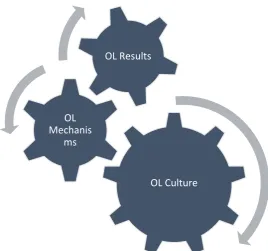
Figure 1 – Three subsystems that form the organizational learning ecosystem
We assume that OL Culture and OL Mechanisms are so embedded and intertwined to the extent that it is sometimes challenging to separate or label them; culture and mechanisms go together hand in hand. The model comprises of three subsystems, namely:
a) Organizational Learning Culture – OLC: why we do what we do – this represents the first sub-system in the LDO.
b) Organizational Learning Mechanisms - OLM: How we do what we do; which represents the second sub-system in the LDO. (Lipshitz et al., 2007; Cirella et al., 2016) and
c) Organizational Learning Results - OLR: what we get as a result of what we do;
A) Organizational Learning Culture (The Why)
Organizational Learning Culture (OLC) is difficult to grasp, which in turn makes it difficult to tackle or manipulate. We can make use of the metaphor of a river in flow inspired by Wittgenstein (1958). At one level, organizational culture acts as the soil for enabling the river’s life. It is the history from the past formation that sets what is allowed and what is not allowed. It can enrich and nurture learning and all other favoured
OL Culture OL
Mechanis ms
Page 14 of 21
approaches but also can prevent this from happening. The bed of the river interacts with its boundaries or the two banks that shape the river. The shaping can be understood as structures and systems, more or less permanent in culture but subject to possible disturbance, collapses and redirections. Then there is the flow of the river, everyday life (unless it dries up!) which is affected by the structures and systems but can also be the instigators of change to those structures and systems. Much of the river’s life is visible and can appear normal or under pressure but much can be hidden and below the surface. This can make it difficult to understand if you not in the flow or observing a static flow from the banks. Without understanding organizational culture, it becomes difficult to gain acceptance of change and reaping the benefit of what can be learned. Ravichandran and Mishra (2017) emphasized on the role of leadership in nurturing the culture of learning as the involved leadership supports the organizational culture of sharing, experimenting, learning knowledge. This facilitation of learning requires a culture, which promotes the generation of new insights, teamwork dialogue sharing and helps employees identifying their tacit knowledge. Employees who are aware of learning as well as facilitating the learning of others, is something we captured in the proposed OL Culture sub-system of the LDO in the following indicators:
1. Leaders establish and nurture learning culture organization-wide. 2. Leaders are role models for learning.
3. Trust is organization-wide
4. Transparency and openness for learning are in place. 5. Continuous improvement is embedded.
6. People are engaged at all levels.
7. Teamwork is encouraged and rewarded organization-wide.
8. Autonomy and empowerment are inherent in the decision-making process.
B) Organizational Learning Mechanisms (The How)
Page 15 of 21
1. Organization strategy sets a direction for learning and responds to the consequences
2. Budget for organizational learning is secured, and responsibility is allocated 3. There are various types of activities to help people understand how they learn 4. The organization is engaged in learning activities that extend its previous
boundaries.
5. People are recognised for their learning
6. Learning is articulated, shared, understood and implemented.
7. Appropriate mechanisms, such as coaching and mentoring are employed to engage and involve people at all organizational levels.
8. Learning needs are identified, acted upon, and outcomes are measured for individuals, teams, and organization-wide.
9. Ongoing processes exist to consider the meaning of learning critically
10. Lessons learnt are documented, classified, communicated and utilized organization-wide.
11. Learning outcomes are publicly acknowledged and published on a regular basis (where applicable)
12. People at all levels have fair access to information appropriate to their needs. 13. People have fair access to support at all levels.
14. There are various channels where the organization can listen to its customers, partners and other stakeholders.
15. Feedback from all stakeholders is considered and acted upon.
16. Learning from others is encouraged, and supported organization-wide.
17. People are encouraged and supported to acquire further academic education and qualifications where applicable.
18. Appropriate technology is employed to support and facilitate learning.
19. Suggestions can flow into and within the organization, e.g. idea management systems, and internal blogs
20. The organization participates in knowledge acquisition and dissemination activities outside the organization, nationally and internationally.
C) Organizational Learning Results (The What):
Page 16 of 21
measuring the appropriateness of the employed learning mechanisms and approaches used will provide useful data.
1. Learning is measured throughout the organization.
2. People are aware of how learning benefits them at their individual role and at the organization level.
3. Strategic and operational decisions are informed by learning outcomes and the organization’s leaders are able to give specific examples of strategic adaption. 4. Learning helps the organization to achieve its strategic objectives.
5. Employed learning mechanisms are reviewed so that the organization is fully aware of what works and what does not.
6. Learning enables the organization to innovate and develop or improve products and services.
7. Learning enables the organization to predict and shape its future.
Finally, it is crucial to investigate the dynamics of organizational environment and ecosystem further, and relate to the expected outcomes from OL activities. While writing this paper, we gained further insights on how learning should be interweaved into every activity inside and outside the organization’s boundaries. We have further appreciated the importance of helping people to know what to do rather asking them to do their best. It is worthy to refer to the links that Amabile (1997) constructed between organizational creativity and innovation (exhibited in figure 2), the three components of the individual/team creativity intersection is creativity which presumably leads to innovation in the second Venn shape (i.e. the work environment where the latter impacts the first.)
Individual/Team Creativity Work Environment Task
Motivation
Creativity Skills Expertise
Organizational Motivation
Page 17 of 21 Figure 2 – Creativity Feeds Innovation
Adapted from Amabile (1997, p. 53)
Conclusion
This paper has built on the significant contributions of OL gurus; its aim has been to highlight the importance of OL so that organizations and individuals know why they should invest in learning. This paper attempted to answer two key questions, in the first question, what makes an organization learning driven, we highlighted the significance of OL culture, role of leadership in ensuring engagement of every employee, we also focused on engaging not only employees but the wider stakeholders such as partners, shareholders, and customers. For the second question of how ho the learning ecosystem works organization-wide, we differentiated between learning within and beyond the boundaries of the organization to develop the three subsystems including thirty-two expected practices that enable and sustain OL. The proposed LDO model is not meant to be a prescriptive ‘cookbook’ that may help straightjacket organizations and individuals in their endeavor to learn. Rather, we hope the LDO model will help organizations strategize learning involving understanding, making, executing, reviewing and critiquing strategy continuously on the basis of learning and how each part of an organization contributes to innovative thinking.
Page 18 of 21
includes all stakeholders of the organization. Organisations can now learn in more agile and cost-effective ways. Hence technology and applications of industry 4.0 such as the Internet of Things, Artificial Intelligence, Machine Learning and Digital Learning need to be included in the research agenda. Learning should not be limited to the learning and development department. There is a need to consider various forms of businesses of all sizes and location.
The next step of the research is to develop the LDO model in the direction of practices because practitioners would prefer having guidelines for practice instead of discussing the mere concepts of organizational learning. In our view, success and impacts of the model such as ISO 9001 and EFQM can be attributed to the clarity of the requirements of these models which were informed by research on the one hand and practice on the other.
References
Akhavan,P., and Jafari, M (2006). ‘Learning organizations; the necessity of knowledge era’. Journal of Tadbir, No. 169 (Cited in Saadat and Saadat, 2016)
Amabile, T. M (1997), Motivating Creativity in Organizations: In Doing What You Love and Loving What You Do, California Management Review, Vol. 40, No. 1, pp. 39-58 Antonacopoulou, E. (2006), “Learning-in-practise: the social complexity of learning in working
life”, AIM working paper series, Advanced Institute of Management Research, London Argote, L. (2013), Organizational learning: Creating, retaining and transferring knowledge.
New York: Springer Science Business Media.
Argote, L. (2011). Organizational Learning Research: Past, Present and Future. Management Learning Journal, Vol. 42, No. 4 pp. 439-446 DOI: 10.1177/1350507611408217 Argyris, C. and Schon, D. (1978) Organizational Learning: A theory of action perspective.
Cambridge, Mass: Addison Wesley.
Argyris, C. (1996) ‘Towards a comprehensive theory of management’, in Moingeon, B. and Edmondson, A. (eds) Organizational Learning and Competitive Advantage. London: Sage.
Bontis, N. Crossan, M.M. and Hulland, J. (2002), “Managing an organizational learning system by aligning stocks and flows”, Journal of Management Studies, Vol. 39, No. 4, pp. 437‐ 469
Brockbank, A. McGill, I. and Beech, N. (Edt.) (2002), Reflective Learning in Practice, Gower, England.
Page 19 of 21
Cirella, S., Ganterino, F, Guerci M., & Shani, A. (2016), Organizational Learning Mechanisms and Creative Climate: Insights from an Italian Fashion Design Company, Journal for Creativity and Innovation Management, Vol. 25 No. 2, pp 211-222.
Crossan, M., Lane, H. and White, R. (1999), “An organizational learning framework: from intuition to institution”, Academy of Management Review, Vol. 24 No. 3, pp. 522-37. Deloitte (2019), Leading the Social Enterprise; Reinvent with a human focus, Retrived from
Deloitte website [URL:
https://www2.deloitte.com/content/dam/insights/us/articles/5136_HC-Trends-2019/DI_HC-Trends-2019.pdf] Retrieved on 20/04/2019.
DiBella, A. & Nevis, E. (1998) How Organizations Learn: An Integrated Strategy for Building Learning Capability. San Francisco: Jossey-Bass.
Dierkes, M. Antal, A. B. Child, J. and Nonaka, I., (2001). Handbook of Organizational Learning and Knowledge, Oxford University Press.
Dixon N. M. (1999) The Organizational Learning Cycle: How we can learn collectively, 2nd edn. Gower.
Fibuch, E. and Roberston, J. (2017), At Top Organizations Learning Means Living, Physician Leadership Journal, Vol 4, No. 6, pp. 58-62
Fioretti, G. (2007) The Organizational Learning Curve, European Journal for Operational Research, Vol. 177, No. 3, pp. 1375-1384.
Friedman, V. J. Lipshitz, R. and Overmeer, W. (2001). Creating Conditions for Organizational Learning (in Dierkes et al Eds, 2001)
Garratt, B. (2000) The Learning Organization: Developing democracy at work. London: Harper Collins Business.
Garvin, D.A. (1993), “Building a learning organization”, Harvard Business Review, Vol. 71 No. 4, pp. 78-91. (Cited in Islam et al. 2015)
Guţă. A.L. (2014), “Measuring organizational learning. Model testing in two Romanian
universities”, Management & Marketing. Challenges for the Knowledge Society, Vol. 9, No. 3, pp. 253‐282.
Harari, Y., N. (2017), Homo Deus; A Brief History of Tomorrow, Vintage, UK.
Jyothibabu, C., Farooq, A. & Pradhan, B.B. (2010), “An integrated scale for measuring an organizational learning system”, The Learning Organization, Vol. 17, No. 4, pp. 303‐ 327.
Islam, T., Ahmed, I., & Ahmad, U.N.U, (2015) "The influence of organizational learning culture and perceived organizational support on employees’ affective commitment and turnover intention", Nankai Business Review International, Vol. 6 No. 4, pp.417-431, https://doi.org/10.1108/NBRI-01-2015-0002
ISO (2017) ISO 10018:2012, Guidelines on People Involvement and Competence, International Organization for Standardization, Switzerland
Kuusisto, M. (2017) "Organizational effects of digitalization: A literature review", International Journal of Organization Theory and Behavior, Vol. 20 Issue: 03, pp.341-362, https://doi.org/10.1108/IJOTB-20-03-2017-B003
Lipshitz, R. Friedman, V., J, and Popper, M., (2007) Demystifying Organizational Learning. California: Sage.
Page 20 of 21
Advances in Developing Human Resources, Vol. 5 No. 2 pp. 132-151 Marquardt, M.J. (2002), Building The Learning Organization, McGraw Hill, New York, NY.
MBIE (2014), McLeod, K., Fabling, R., and Maré, D. Hiring new ideas: International
migration and firm innovation in New Zealand, Report published by Ministry of Business, Innovation and Employed, New Zealand. Retrieved from
https://www.mbie.govt.nz/publications-research/research/migrants---economic-impacts/migration-hiring-new-ideas.pdf
Mezirow, J. (2003), Transformative Learning as Discourse, Journal of Transformative Education, Vol. 1, No. 1 (pp. 58-63)
Mitic, S., Nicolic, M., Jankov, J., Vukonjanski, J., Terek, E. (2017) The impact of information technologies on communication satisfaction and organizational learning in companies in Serbia, Computer in Human Behaviour, Vol. 76, No. pp. 87-101
Mitki, Y., Shani, A.B. & Stjernberg, T. (2008) Leadership Development and Learning
Mechanisms System Transformation as a Balancing Act. Leadership and Organization Development Journal, Vol. 29, pp. 68–84.
Nonaka, I. and Takeuchi, H. (1995). ‘The Knowledge-Creating Company: How Japanese Companies Create the Dynamics of Innovation’. Oxford University Press. New York. Pedler, M. and Hsu, S. (2019) "Regenerating the learning organisation: towards an
alternative paradigm", The Learning Organization, Vol. 26 Issue: 1, pp.97-112, https://doi.org/10.1108/TLO-08-2018-0140
Popper, M. and Lipshitz, R. (2000) Organizational Learning: Mechanisms, Culture, and Feasibility. Management Learning, Vol. 31, pp. 181–96.
Popova-Nowak, I.V and Cseh, M. (2015), The Meaning of Organizational Learning; A Meta- paradigm Perspective. Human Resource Development Review, Vol. No. 14 No. 3 pp. 299-331. DOI: 10.1177/1534484315596856
Putz, D., Schilling, J., Kluge, A., and Stangenberg, C. (2012), ‘Measuring organizational learning from errors: Development and validation of an integrated model and questionnaire’ Management Learning, Vol. 44 No. 5, pp. 511-536
Ravichandran, N. and Mishra, R. (2017). Toward building HR competencies: A shift from the non-learning toward the learning organization. International Journal of Healthcare Management, 11(3), pp.233-238.
Royal Society (2017) Machine learning: the power and promise of computers that learn by example. London: Royal Society
Roztocki, N., & Weistroffer, H. R. (2015). Information and communications technology in developing, emerging and transition economies: An assessment of research. Information Technology for Development, Vol 21, No. 3, pp. 330-364.
Saadat, V. and Saadat, Z. (2016). ‘Organizational Learning as a Key Role of Organizational Success’, Procedia - Social and Behavioural Sciences No. 230 pp. 219 – 225
Senge, P. (1990), “The Fifth Discipline”, New York: Currency Doubleday. Schein, E. H. (2004). ‘Organizational Culture and Leadership’ Wiley and Son.
Schilling, J. & Kluge, A. (2009). ‘Barriers to organizational learning: An integration of theory and research.’ International Journal of Management Reviews, Vol. 11, No. 3, pp. 337-360
Shani, A. B. (R) & Docherty, P. (2008) Learning by Design: Key Mechanisms in Organization Development. In Cummings, T. (ed.), Handbook of Organizational Change and Development. Sage, Thousand Oaks, CA.
Sharma, R. K. (2003). ‘Understanding organizational learning through knowledge management’. Journal of Information and Knowledge Management, Vol. 2 No. 4, pp. 343-352.
Page 21 of 21
Yang, B., Watkins, K. E., & Marsick, V. J. (2004). The construct of the learning organization: dimensions, measurement, and validation. Human Resource Development Quarterly, 15, 31–55. doi:10.1002/hrdq.1086.
Weinzimmer, L. G. and Esken, C. A. (2017). ‘Learning From Mistakes: How Mistake Tolerance Positively Affects Organizational Learning and Performance’ The Journal of Applied Behavioral Science, Vo. 53 No. 3, pp. 322-348
Wilhelm, W. (2005) ‘Learning Architectures: Building Organizational and Individual Learning’, 2nd edn. USA: GCA Press