VOL. II/XII, MAY-JUNE, 2014 www.srjis.com Page 1417
Developing Training Program for the B. Ed students to teach the subject
Science using Models of Teaching and finding out its effectiveness
R. A. Pathak, Ph. D.
Science occupies an important place in school curriculum yet the status of science teaching has shown considerable decline in developing countries. It should be taught through scientific method. This study attempts to develop a training programme for B.Ed. students so teach the subject science using models of teaching and finding out its effectiveness. The present study included Concept Attainment Model (CAM) and Inquiry Training Model (ITM) for teaching science. For this purpose 30 science teacher educators from 15 B.Ed. colleges from three zones, thirty science method B.Ed. students (purposive sample) and classes of standard VI, VII & VIII were selected as a sample for present research. The training programme was developed after carefully examining the suggestions given by the teacher educators during survey. After attaining the taw scores and applying statistical techniques like ‘ t’ test and ‘ chi’ square test, it was found that the developed training programme was effective, CAM and ITM were found to have a significant increase in the achievement of students’ subject science. The handbook is useful for B.Ed. students to again theoretical and practical knowledge about models of teaching.
Keywords: Developing, Training Program, B. Ed students, Science, Models of Teaching, effectiveness.
Introduction:
Science occupies an important place in school curriculum yet the status of science teaching has shown considerable decline in developing countries. Many developed and under developing countries in the last decade have regularly been in the process of reforming science curriculum to make it more primitive and progressive in nature
Lack of space, learning material are some of the significant determinants which affect quality of science teaching to a great extent. The teaching style in too many classrooms in developing countries remains the same essentially what it was generation ago. This resulted in poor innovation in this field. Hence the researcher decided to take up the task to develop the
VOL. II/XII, MAY-JUNE, 2014 www.srjis.com Page 1418 training programme for her students. The Researcher selected the Concept Attainment Model (CAM) and Inquiry Training Model (ITM) for teaching Science.
Statement of the Problem:
Developing Training Programme for the B.Ed. students to teach the subject science using Models of teaching and finding out its effectiveness.
Definitions of Key Terms: Training Programme – It refers to the various activities planned
and conducted by the researcher to help the Science method B.Ed. students in the understanding the theory behind the selected model of teaching, preparing lesson plans, conducting lessons and observing the lesson using the model and encouraging the use of Models of teaching in their day to day teaching.
Conceptual definitions:
MODELS OF TEACHING: - Joyce and Weil have said that a model is a pattern or plan. This pattern or plan is used for curriculum developments, design instructional material and guiding the teacher’s actions. The model is analyzed in terms of four concepts: Syntax, Social System, Principles of reaction and support systems.
CAM –
CAM is based on the strategies of Bruner, Good now and Austin. In this study reception oriented strategy based on the theory of Jerome Bruner has been used. In the present research CAM refers to teaching Science using three phases. :
Phase I: Presentation of data and identification of attributes Phase II: Testing attainment of the concept
Phase III: Analysis of the thinking strategies
Modified syntax of CAM
Therefore whenever necessary the B.Ed. students explained with diagrams and examples during the Phase – II of the model.
ITM –
ITM designed by Richard Suchman has been used in the study. In the present research ITM refers to teaching Science using following five phases:
Phase I : Encounter with the problem Phase II : Gathering data and verification Phase III : Data gathering and Experimentation Phase IV: Formulating an explanation
VOL. II/XII, MAY-JUNE, 2014 www.srjis.com Page 1419 1. Ther Researcher had to modify the syntax in the Phase-IV. While formulating the hypothesis the other part of the content which could be covered in these 3 phases was also included like detailed explanation, its types, illustrative figures, diagrams, use of graphic aids tec.
2. B.Ed students – Students from B.ED. Colleges affiliated to the University of Pune of 2008-2009 batch who from Marathi medium and have taken Science as one of their methods.
Effectiveness:- It refers to the:-
Opinion B.Ed. students regarding the utility of the Training Programme.
Achievement in terms of mean scores of achievement by the students in schools in the subject Science who have been taught using Models of teaching.
Willingness of B.Ed. students to use Models of teaching in their respective schools irrespective of the difficulties.
Objectives of the Study:
1. To find out the opinions of Science Teacher Educators about the use of Models of teaching by the B.Ed. Students while teaching in schools
2. To develop and conduct a training programme for Science method B.Ed. students so as to enable them to:
( i ) Comprehend the Models of teaching
( ii ) Prepare lessons notes for teaching in schools by using CAM and ITM and teach school students using these lesson notes
3. To Study the opinion of B.Ed. students about the training programme organized by the researcher on Models of teaching.
4. To compare students’ achievement in the subject Science when taught by using CAM and by traditional method.
5. To compare students’ achievement in the subject Science taught by using ITM and by traditional method.
6. To find out the willingness of B.ED. students about the use of Models of teaching in day to day Science teaching.
7. To prepare handbook for B.ED. Students for teaching Science subject in schools using ITM and CAM.
Hypothesis:
NULL HYPOTHESIS:
HO1. For Std. VI- There is no significant difference in the mean scores of the post test scores of the students from the experimental group and control group of Std VI when taught using CAM and Traditional method respectively.
VOL. II/XII, MAY-JUNE, 2014 www.srjis.com Page 1420
HO3. For Std. VIII- There is no significant difference in the mean scores of the post test scores of the students from the experimental group and control group of Std VIII when taught using CAM and Traditional method respectively.
HO4. For Std. VI- There is no significant difference in the mean scores of the post test scores of the students from the experimental group and control group of Std VI when taught using ITM and Traditional method respectively.
HO5. For Std. VII- There is no significant difference in the mean scores of the post test scores of the students from the experimental group and control group of Std. VII when taught using ITM and Traditional method respectively.
HO6. For Std. VIII- There is no significant difference in the mean scores of the post test scores of the students from the experimental group and control group of Std VIII when taught using ITM and Traditional method respectively.
De-limitations:
1) It was limited to the city of Pune
2) The selected school was affiliated to the curriculum of Secondary Education Board, Maharashtra State. Only schools in Pimpri Chinchwad area were selected for the experiment.
3) Only Marathi medium schools were selected
4) Only students who had taken ‘Science’ as their method were included in the training programme.
5) Out of the different models of teaching the study focused on ITM and CAM as these are more suitable for formation of concepts and to develop the spirit of inquiry in a subject like science.
6) The Reception oriented strategy was used for CAM
7) Only trained B.Ed. students implemented the programme in schools 8) The implementation was done on standards VI, VII and VIII. Limitations:
The researcher had no control over factors such as fatigue, interest and Motivation of the B.Ed. students.
The researcher had no control over factors such as fatigue, interest and Motivation of the students in schools.
Research Design:
1) Type: Applied research
2) Methodology: Mixed methodology adopted in the present research i.e. survey and
experiment
3) Sample :
I) 30 science teacher education
II) 30 science method students who underwent the programme ( purposive samples ) III) Std. VI, VII & VIII classes.
4) Tools:
VOL. II/XII, MAY-JUNE, 2014 www.srjis.com Page 1421 a) About usefulness of the training programme
b) Willingness to use Models in schools c) feedback regarding handbook 3) Achievement tests.
Procedure of the study: The procedure followed in the research was as follows:
Survey
Preparation of training programme
Conducting training programme for Teacher education and B.Ed. students
Taking feedback from the participating B.Ed. students regarding the training programme
Pilot study
Testing groups for equivalence
a) Teaching by models of teaching & conducting post test for Experimental group b) Teaching by traditional method & conducting post test for Control group
Implementation in schools
Taking feedback of the B.Ed students to findout their willingness regarding use of models
Preparation of handbook
Taking a feedback about the handbook ( from Experts and B.Ed. students )
[image:5.595.66.529.118.569.2]STATISTICAL ANALYSIS.
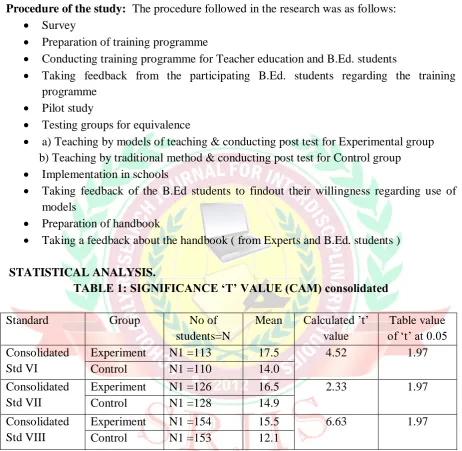
TABLE 1: SIGNIFICANCE ‘T’ VALUE (CAM) consolidated
Standard Group No of
students=N
Mean Calculated ’t’ value
Table value of ‘t’ at 0.05 Consolidated
Std VI
Experiment N1 =113 17.5 4.52 1.97
Control N1 =110 14.0 Consolidated
Std VII
Experiment N1 =126 16.5 2.33 1.97
Control N1 =128 14.9
Consolidated Std VIII
Experiment N1 =154 15.5 6.63 1.97
Control N1 =153 12.1
Observation and Interpretation: From the above table it is seen that the calculated value
of‘t’ is more than the table value for all the three standard VI, VII and VIII when taught through CAM and hence significant at 0.05 level.
TABLE 2: SIGNIFICANCE ‘t’ VALUE (ITM) consolidated
Standard Group No of
students-N
Mean Calculated ’t’ value
Table value of ‘t’ at 0.05 Consolidated
Std VI
Experiment N1 =138 11.5 2.83 1.97
Control N1 =140 9.9
VOL. II/XII, MAY-JUNE, 2014 www.srjis.com Page 1422
Std VII Control N1 =154 13.8
Consolidated Std VIII
Experiment N1 =188 14.6 5.61 1.97
Control N1 =185 12.1
Observation and Interpretation: From the above table it is seen that the calculated value
[image:6.595.33.596.236.627.2]of‘t’ is more than the table value for all the three standard VI, VII and VIII when taught through ITM and hence significant at 0.05 level.
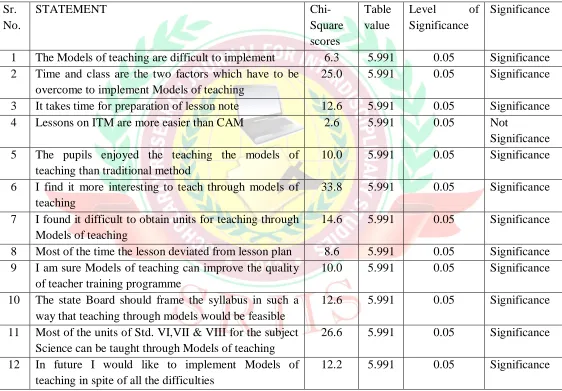
TABLE 3
Feedback of B.Ed. Students after Actual Teaching in Schools (Chi Square Test Scores)
Sr. No.
STATEMENT Chi-
Square scores
Table value
Level of Significance
Significance
1 The Models of teaching are difficult to implement 6.3 5.991 0.05 Significance 2 Time and class are the two factors which have to be
overcome to implement Models of teaching
25.0 5.991 0.05 Significance
3 It takes time for preparation of lesson note 12.6 5.991 0.05 Significance 4 Lessons on ITM are more easier than CAM 2.6 5.991 0.05 Not
Significance 5 The pupils enjoyed the teaching the models of
teaching than traditional method
10.0 5.991 0.05 Significance
6 I find it more interesting to teach through models of teaching
33.8 5.991 0.05 Significance
7 I found it difficult to obtain units for teaching through Models of teaching
14.6 5.991 0.05 Significance
8 Most of the time the lesson deviated from lesson plan 8.6 5.991 0.05 Significance 9 I am sure Models of teaching can improve the quality
of teacher training programme
10.0 5.991 0.05 Significance
10 The state Board should frame the syllabus in such a way that teaching through models would be feasible
12.6 5.991 0.05 Significance
11 Most of the units of Std. VI,VII & VIII for the subject Science can be taught through Models of teaching
26.6 5.991 0.05 Significance
12 In future I would like to implement Models of teaching in spite of all the difficulties
12.2 5.991 0.05 Significance
Interpretation:
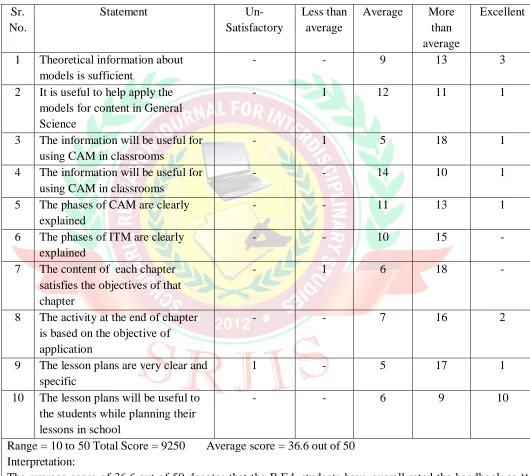
VOL. II/XII, MAY-JUNE, 2014 www.srjis.com Page 1423 A feedback was taken to find out the usefulness of the handbook developed by the researcher in consultation with her guide
TABLE 4
Responses of B.Ed. Students Regarding the Usefulness of the Handbook
Sr. No.
Statement
Un-Satisfactory
Less than average
Average More than average
Excellent
1 Theoretical information about models is sufficient
- - 9 13 3
2 It is useful to help apply the models for content in General Science
- 1 12 11 1
3 The information will be useful for using CAM in classrooms
- 1 5 18 1
4 The information will be useful for using CAM in classrooms
- - 14 10 1
5 The phases of CAM are clearly explained
- - 11 13 1
6 The phases of ITM are clearly explained
- - 10 15 -
7 The content of each chapter satisfies the objectives of that chapter
- 1 6 18 -
8 The activity at the end of chapter is based on the objective of application
- - 7 16 2
9 The lesson plans are very clear and specific
1 - 5 17 1
10 The lesson plans will be useful to the students while planning their lessons in school
- - 6 9 10
Range = 10 to 50 Total Score = 9250 Average score = 36.6 out of 50 Interpretation:
The average score of 36.6 out of 50 denotes that the B.Ed. students have overall rated the handbook as ‘‘ more than average” Thus they have a favorable opinion regarding the handbook
-
TABLE 5
Opinion Score of Experts Regarding the Handbook
VOL. II/XII, MAY-JUNE, 2014 www.srjis.com Page 1424
No. Satisfactory average than
average 1 Theoretical information about
models is sufficient
- - 1 3 1
2 It is useful to help apply the models for content in
General Science
- - 1 3 1
3 The information will be useful for using CAM in classrooms
- - - 4 -
4 The information will be useful for using CAM in classrooms
- - - 5 -
5 The phases of CAM are clearly explained
- - - 3 2
6 The phases of ITM are clearly explained
- - - 3 2
7 The content of each chapter satisfies the objective of that chapter
- - - 3 2
8 The content of each chapter satisfies the objective of application
- - 2 1 2
9 The lesson plans are very clear and specific
- - - 4 1
10 The lesson plans will be useful to the students while planning their lessons in school
- - - 3 2
Range = 10 to 50 Total score = 2080 Average score = 41.6 out of 50.
Interpretation: The average score of over 41.6 out of 50 denotes that the experts have
overall rated the handbook as ‘‘more than average”
Finding:
Finding From Survey:
1] The teacher educators needed training about Models of teaching- Theory and practical 2] The existing situation of Science teaching is that in most cases demonstration and lecture methods are used. Models of teaching are not used at all in schools.
3] The teacher educators suggested activities for the Training Programme activities such as organizing lectures based on theory of Models of teaching by experts, demonstration lessons, learning to develop and observe lesson based on Models of teaching and conducting lessons on peer group for the training programme.
VOL. II/XII, MAY-JUNE, 2014 www.srjis.com Page 1425 Training Programme: The teacher had a favorable opinion regarding the training programme
Actual implementation in schools:-
1. The teaching through CAM was found to have a significant increase in the achievement levels of the students of Standard VI, VII and VIII for the subject Science. This shows that teaching through CAM was more effective than teaching through traditional methods
2. The teaching through ITM was found to have a significant increase in the achievement levels of the students of standards VI, VII and VIII for the subject Science This shows that teaching through ITM was more effective than teaching through traditional methods
3. The individual classes of standard VI and VII (refer table Nos. 7,8,10 & 11) show that in some classes it did not show a significant difference in mean scores, but it standard VIII ( refer tables 9 & 12 ) nine out of ten classes showed a significant difference in the mean score. This could be due the fact that they are able to define generalize and inquire in a better manner as they grow older compared to the students from standard VI and VIII
4. The B.Ed. students showed willingness to implement models of teaching in the future in spite of all the difficulties faced by them.
5. The B.Ed. students showed an interest to teach through models
6. The handbook is useful for B.Ed. students to gain theoretical knowledge
7. The lesson plans given in the handbook are clear and specific and helpful to the students to plan lessons based on Models of teaching.
8. The handbook is found to be useful for the B.Ed. students as well as experts have a favorable opinion for gaining theoretical and practical information about Models of teaching.
Conclusions:
Conclusions from the survey:
The responses received during the Survey showed that there was a need amongst the teacher educators to know about the different Models of teaching and have a specially designed training programme for them.
Conclusion from the experiment:
a) The training programme was effective
b) The standard VI and VII students found it difficult to learn through CAM and ITM as compared to the standard VIII students.
c) The B.Ed. students showed willingness to teach through Models of teaching in their daily teaching.
VOL. II/XII, MAY-JUNE, 2014 www.srjis.com Page 1426 Contribution to the field of Education
In the present days, with a rapidly changing educational scenario, the role of the teacher and teaching are changing fast wherein he is enshrined with the responsibility of promoting fruitful learning and stimulation the students by adopting appropriate strategies. The study can be said to have implications for science education in particular and other discipline in general, for teacher educators, teachers, research workers, curriculum developers and the students.
a) The study has shown that information processing models have an instrumental effect in the classroom. They have an important role in bringing enrichment in the teaching process and could serve as instructional approaches to manage classroom activities to achieve a variety of educational objectives.
b) Models of teaching are applicable to Indian classrooms because they are based on no other technology except technologies of developing instructional material and therefore indigenous models are available for providing alternative instructional channels within existing classroom and school structure.
c) The programme outline will be useful for planning the training programme in other models also
d) The Handbook prepared will be useful for the teacher educators as well as science method B.Ed. students.
References
Buch M.B. ( 1973-1983 ) Sixty Survey of Research in Education, Sixth Survey of Research in Education (p 20 )
Chatterjee S.K., ( 2000 ) Advanced Educational Psychology, Books and Allied ( P ) Lt., Calcutta. Garrett H.E., ( 1981 ) Statistics in Psychology and Education, Bombay. Vakils, Feffer and Simons Ltd.
George A., ( 2007 ) A manual Practice Teaching Published by Ajay Verma, Commonwealth Publishers, New Delhi
Gupta Naresh Kumar, ( 2007 ) Research in Teaching Science, New Delhi, APH Publishing corporation ( pp 11-12 )
Gupta Naresh Kumar Ph.D. – A study of Relative effectiveness of some information processing MODELS OF TEACHING on mental processes and attitude towards science.
Joshi S.R. ( 2005 ) Teaching of Science, New Delhi, APH Publishing Corporation ( pp 3-15 )
Joyce Bruce & Marsha Weil ( 1980 ) – Models of Teaching New Delhi, Prentice Hall.
VOL. II/XII, MAY-JUNE, 2014 www.srjis.com Page 1427
Kaul Lokesh ( 2005 ) Methodology of Educational Research, 4th Edition, New-Delhi Vikas Publishing House ( p 150 )
Pandey S.N. PH.D. Education ( 1986 ) To study the effectiveness of the Advance organizer and ITMs and Conventional Teaching in terms of pupil’s outlook towards social studies to Class VIII student.
Singh Yogesh ( 2005 ) Research Methodology, New –Delhi, APH Publishing House, ( pp 166-167 )
Sushma ( 1987 ) Effectiveness of CAM and Biological science Inquiry Model to
class VIII students, Ph.D. Edu. BHU 1987.
Vaidya N. ( 1971 ) Impact of Science Teaching. Oxford and OBH.
Yadav M.S. ( 2000 ) Teaching of science, New Delhi, Anmol Prakashan.
www.gtce.prg.uk/newsfeatures/features/tlaspeech1