STRENGTHENING ANTI JAM GPS SYSTEM WITH
ADAPTIVE PHASE ONLY NULLING USING
EVOLUTIONARY ALGORITHMS
1V.THYAGARAJAN, 2 S.KAJA MOHIDEEN
1RESEARCH SCHOLAR BSA UNIVERSITY - CHENNAI, INDIA
2HOD/ECE & DEAN (SA), BSA UNIVERSITY - CHENNAI, INDIA
E-mail: [email protected]
ABSTRACT
Global Positioning System (GPS) signals are spread spectrum, modulated with very low average power due to background noise. Adaptive algorithms have shown to minimize output power of array to 5 dB of background noise. GPS jamming is an issue in defense and the corporate sector who are satellite-based navigation dependent for their day to day operations. GPS satellites network provides precise location information of all places globally, is widely used for asset tracking by corporates. GPS is vulnerable to jamming, due to its sensitive receivers as they receive very weak signals from satellites. In this study, a novel optimization method based on the Artificial Bee Colony algorithm for the interference cancellation design is proposed which maximizes gain towards the desired signal and also improve jamming rejection performance.
Keywords: Global Positioning System (GPS), Jamming, Anti-jamming, Artificial Bee Colony algorithm
(ABC)
1. INTRODUCTION
NAVSTAR Global Positioning System (GPS) is a radio-positioning and time transfer satellite designed, deployed, financed and operated by the U.S. Department of Defense. GPS demonstrated major benefits to civilians who apply GPS to varied applications. Features which are attractive to GPS include:
• Relatively high positioning accuracies, from tens of meters down to millimeters.
• Ability to determine velocity and time accurately commensurate with position.
• Users can access signals anywhere: in the air, on the ground or at sea.
• It has no user charges and requires relatively low cost hardware.
• It is an all-weather system, round the clock usable equipment.
• Position information is three dimensional: vertical and horizontal information are provided [1].
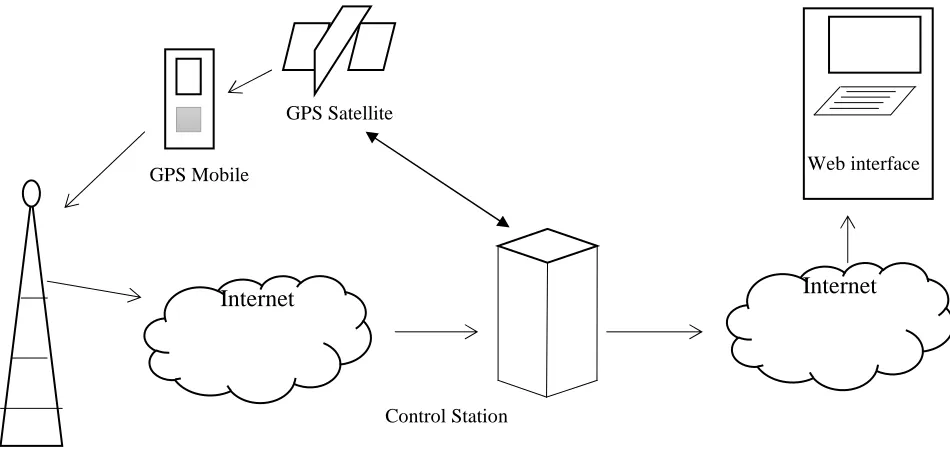
A typical GPS system currently in use is shown in figure 1.
GPS is a totally free navigation system ensuring reliable positioning, navigation, and timing services both to the armed forces and civilians globally and continuously for all. The system provides location and time to anyone with a GPS receiver. It ensures accurate location and time information for unlimited people in all weather conditions, day and night, anywhere.
GPS satellite signals from space are picked up and identified by GPS receivers which provide a three-dimensional location (latitude, longitude, and altitude) plus time. Individuals can purchase GPS handsets through commercial retailers. Then users can accurately locate their position and easily go to their destination, either by walking, driving, flying, or by boat. GPS today is a worldwide transportation systems mainstay ensuring navigation for aviation,
ground, and maritime work. Disaster
Daily work including banking, mobile phone operations, and even power grid control are facilitated by GPS provided accurate timing.
[image:2.612.89.564.139.369.2]Farmers, surveyors, geologists and others are helped to perform efficiently, safely, economically and accurately using free GPS signals [2].
Figure 1: GPS System
A GPS system’s three segments are as follows:
• Space segment: This includes 24 satellites circling the earth at an altitude of 12,000 miles enabling signals to move over a larger area. Satellites are arranged such that, a GPS receiver on earth always receives signals from a minimum four satellites at any time. Each satellite transmits low radio signals on a unique code through varied frequencies, allowing GPS receivers to identify signals. The purpose of coded signals is to calculate travel time from satellite to GPS receiver. Travel time multiplied by speed of light equals distance from satellite to GPS receiver. As these are low power signals and do not travel through solid objects, a clear view of the sky is important.
• Control segment: This tracks satellites providing them with correct orbital/time information. The segment comprises of four unmanned and one master control station. The unmanned stations receive data from satellites and send information to master control station where after correction it is sent to GPS satellites.
• User segment: This includes users and
GPS receivers. The number of
simultaneous users is without limits [3].
GPS is operational from early nineties and is available to users for more than ten years. Recently GPS jamming is of concern to users. Civilian applications safety concerns and those for military are on the rise. But, GPS downlink vulnerability to jamming is not new dating back nearly twenty years, as revealed by literature.
1. GPS receiver testing and performance characteristics against jamming were performed by civilian and military entities and till date no standard test methodology exists to define how accurate/repeatable GPS jamming testing should be. Recently there was an attempt to standardize military navigation testing facilities and testing procedures.
2. Hence, present navigation system testing, including GPS jamming, is not consistent across civilian and military communities [4].
The traditional procedure to identify and locate jammers is by using dedicated signal recognition and direction location equipment. This is usually
Internet
Web interfaceInternet
GPS Satellite
Control Station
GPS Tower
located in specialized aircraft like the jammer location pod for US Navy by FALON. While this is helpful against small number of bigger value jammers, it is impractical against a "mine field” of cheap GPS jammers present in battlefields.
Due to dedicated Electronic Intelligence (ELINT) platforms high cost, there is only one platform in an area. A single platform faces many problems to locate multiple jammers in a "mine field" scenario. A single platform makes only angle of arrival and Doppler measurements as Time Difference of Arrival (TDOA) measurements are not possible. TDOA techniques are advantageous in trying to locate numerous jammers. The second problem is time needed to ensure an accurate fix. A single ELINT platform should move to new location to triangulate. If jammer is far away it takes a long time for platform to move enough to ensure a triangulating measurement. With many jammers, measurements from many positions are required to ensure good measurements on all.
A cooperative Jammer Location system architecture is proposed under this effort. This uses data from many GPS receivers as jammer "sensors" to ensure many observations to deduce a jammer location. Many measurements are necessary [5] due to large number of jammers.
An anti-jam GPS receiver has to be operational at “cold” start, i.e., starting with no information about position and orientation. Here, though GPS satellites positions may be found at GPS almanac, GPS receiver cannot determine steering vectors linked to satellites till jammers are suppressed. Blind anti-jamming array processing methods like Minimum Variance (MV) ensure excellent jammer-suppression performance. Use of direct-sequence spread spectrum waveforms with 20 replicas of 1023-chip pseudo-noise (PN) codes, achieves processing gain of 43.1 dB by GPS coarse acquisition signals. High processing gain helps GPS signals to assume low power before dispreading and, so escape suppression/nulling. Sufficiently high signal level after dispreading provides proper signal delays detection for receiver positioning [6].
Nulling methods in GPS array pattern are based on selection of array parameters like complex weights (both amplitude and phase), phase-only, position only and amplitude-only of array elements, so that main beam continues pointing to desired signal, while nulls are formed in the direction of undesired sources. Interference suppression with complex weights is efficient due to its greater freedom for solution space. However, it is very
expensive due to prices of each array element’s [7] phase shifter and variable attenuator. Phase-only null synthesizing is attractive as required controls do not cost much. The problem with phase-only and element position only array nulling techniques is nonlinear and cannot be solved through analytical methods.
In this work a novel optimization method based on Artificial Bee Colony algorithm for multiple interference cancellation design is proposed. The proposed system maximizes gain to desired signal and improves jamming rejection performance. Section two reviews some of the techniques used in the literature. Section three describes in detail the proposed technique followed by result and discussion in the fourth chapter. Section five concludes this work.
2. LITERATURE SURVEY
A Phase-Only Adaptive Nulling with a Genetic Algorithm (GA) proposed by Haupt [8] describes a new approach to phased arrays based adaptive phase-only nulling. A GA adjusts least significant bits of beam steering phase shifters minimizing total output power. Using of small adaptive phase values, led to minor deviations in beam steering direction, and small perturbations in side lobe level which also constrained GA’s search space. Various results presented show this approach’s advantages and limitations. Generally GA proved better than earlier phase-only adaptive algorithms.
An Efficient Adaptive Beam Steering Using INLMS Algorithm for Smart Antenna proposed by Naik and Swamy [9], was based on LMS algorithm, providing comprehensive and detailed treatment of signal model for beam forming, and describing adaptive algorithms to adjust array weights. To improve LMS algorithm’s convergence rate in smart antenna systems, the INLMS algorithm was suggested. The new scheme promised reduction of data transmission bandwidth by improving convergence rate taking advantage of spatial filtering. A 28% overall convergence rate improvement was observed in simulations compared to LMS algorithm. Results suggest that INLMS algorithm can improve convergence rate and lead to improved system efficiency.
of interfering signals by reducing total output power. Adaptive linear antenna array optimization reviewed this method.
An amplitude-only linear antenna arrays pattern nulling with bees algorithm was proposed by Guney and Onay [11], an efficient Bee’s Algorithm (BA) based method for pattern synthesis of linear antenna arrays with prescribed nulls. Pattern nulling was achieved through control of each array element’s amplitude. Numerical examples of Chebyshev pattern with single, multiple and broad nulls imposed at interference directions showed BA’s accuracy and flexibility.
An augmentation of anti-jam GPS system using smart antenna with a simple DOA estimation algorithm was proposed by Mukhopadhyay, et al., [12], which discussed Smart Antenna Technology with help of Least Mean Square (LMS) algorithm, as adaptation algorithm to create null to interference and maximizing gain to desired Signal. It was to detect and collect desired signals multipath to improve jamming rejection performance with simulation results being tried out with MATLABTM for conventional GPS receiver on moving platforms like vehicle/airborne systems.
A Genetic Algorithm for nulls and side lobes level control in linear antenna arrays proposed by Goswami and Mandal [13] described design of a non-uniformly excited symmetric linear antenna array with optimized non-uniform spacing’s between elements using RGA optimization techniques. Simulated results reveal that optimizing excitation values of elements with optimal inter-element spacing’s of array antennas imposed deeper nulls in interference direction reducing SLL for given array elements number regarding the corresponding uniformly excited linear array with inter-element spacing of k=2.
Research on a GPS anti-jamming algorithm based on adaptive antennas was proposed by Li, et al., [14] which aimed at GPS in band interferences, a time space anti-jamming scheme dependent on adaptive antennas. It effectively suppressed narrow and wide bands interferences in GPS interferences simultaneously with adaptive time domain notch filtering and canceling narrow band interference while the power inversion algorithm suppressed spatial interferences. Simulation revealed that this scheme could get an ideal outcome with average suppression depth of more than 50dB, in the presence of several strong interferences, and improve performance of anti-jamming GPS receiver greatly.
The study and simulation of adaptive array processing with channel uniformity Adaptive anti-jam processing used by GPS was proposed by Xiang, et al., [15]. This usually works in environments of interferences. PI algorithm suppressed system interferences. However, amplitude and phase variance existing among antenna channel had a bad effect on PI algorithm and adaptive anti-jam processing. It proved PI algorithm not only rejected interferences, but conquered channel uniformity to a certain degree through academic research and simulation. The conclusion proved advantageous to engineering applications.
An optimal anti-jam attitude determination using GPS proposed by Markel, et al, [16] developed mathematical basis for GPS based AD system which performed even during strong external interference. This was done through approaching AD problem from an antenna array viewpoint and also by using phase and amplitude information, as against using phase information alone in "traditional" AD systems. MLAE’s simulation based performance results presented for various antenna topologies/interference scenarios, showed it offered significant improvement over traditional attitude determination methods.
An Anti-Jamming 5-Element GPS Antenna Array Using Phase only nulling was proposed by Kai et al [17], which describes a GPS antenna array capable of rejecting jamming signals from two directions. GPS array has five antenna elements of equal amplitude and different phases. The 5-element GPS array produced two nulls using phase only technique. The required phases’ closed-form solutions to produce two nulls were obtained and given. GPS antenna elements and arrays by Ansoft's HFSS simulation results were presented and discussed.
Effectiveness of GPS jamming and counter measures was proposed by Hunkeler, et al., [19] which analyzed behavior of commercial GPS receivers to find out whether a jamming attack could be detected thereby triggering an alarm. A flaw was detected in the only commercial GPS receiver with a jamming detection mechanism in the market, which permitted attackers to jam receiver without setting off an alarm.
A reduced-rank space-time process for anti-jamming GPS receivers proposed by Zhuang, et al., [20] described a reduced rank, subspace decomposition based MSNWF and WF to eliminate jamming effect of anti-jamming GPS receivers. A General Side lobe Canceller (GSC) structure equal to MSNWF calculated optimal weights for space-time processing. Simulation results demonstrated MSNWF’s satisfactory performance to cancel jamming and greatly reduced computational complexity through reduced-rank processing.
Research on GPS Frequency Domain Anti-Jamming Algorithms was proposed by Liu and Hu [21] which was a new adaptive threshold acquired method presented in GPS frequency domain anti-jamming algorithms. It compared performances of three frequency domain threshold notch algorithms and a frequency domain adaptive filter anti-jamming algorithm under differing ratio of jamming bandwidth to signal bandwidth. The performances of adaptive filter anti-jamming algorithm and zero value notch frequency domain threshold algorithms were better than mean value notch frequency domain threshold algorithm and white noise value notch frequency domain threshold algorithm. Finally, performance of frequency domain algorithms under different SNR was simulated with results showing that if SNR was better than -15dB, frequency domain anti-jamming algorithms suppressed partial spectrum jamming effectively.
Gain improvement topology using conical structure for jamming resilient GPS antennas was proposed by Cho, et al., [22]; this provided a low-cost and simple anti-jamming technique for GPS receiver’s gain improvement in GPS band. For GPS receiver, a micro strip patch antenna with RHCP was basic element. Hence, maximum difference between peak and horizontal gain was about 25 dB, when height (h) and upper diameter (d) of conical structure was h= λ0 and d=7/5 λ0, respectively.
Non-Planar Adaptive Antenna Arrays for GPS Receivers was proposed by Gupta, et al., [23]; this discussed various design parameters on
anti-jamming performance of non-planar GPS antenna arrays. Non-planar GPS antennas should have a convex surface, large curvature and many elements for best performance. Antenna elements should be distributed to fill available surface. Using guidelines, a six-inch-high, Non-planar GPS antenna with seven elements was designed. The experimental antenna’s anti-jamming performance was presented.
A circular antenna utilizing phase only adaptive nulling novel was proposed by Flam, et al., [24] which was developed as a multimode circular antenna applique. It suppressed undesired jamming signals through spatial filtering. The algorithm minimized antenna's output power and maintained main beam direction both of which were verified through computer simulation and experimentation.
An Anti-Jamming 5-Element GPS Antenna Array Using Phase-Only Nulling proposed by Kai Wu et al [25], studied and simulated adaptive array processing with channel uniformity. The Power-Inversion (PI) algorithm suppressed system interferences. But amplitude and phase variance existing among antenna channels affected adaptive anti-jam processing and PI algorithm. It was best to research relations between channel uniformity and adaptive processing. When amplitude and phase variance was limited under definite condition, PI algorithm not only rejected interferences, but also conquered channel uniformity through academic research and simulations. The conclusion was advantageous for engineering applications.
A novel phase-only nulling in a mono pulse phased array antenna proposed by Chang, et al., [26], indicated that for large phased arrays with low-resolution phase shifters, FPON algorithm was capable of treating many patterns simultaneously in many jammer environment. To treat more jammers and patterns with PPON algorithm, better performance requires high-resolution phase shifters and selected computation elements.
3. METHODOLOGY
circles can be covered by one watt radiated power. Adaptive Array Antenna Research provided techniques to continually monitor coverage areas and adapt to user’s motion to achieve minimum gain for interference. Hence, smart antenna receivers with an antenna array have a control unit which optimizes reception and radiation patterns dynamically responding to signal environment, i.e., a mobile vehicle in coverage area. This study proposed an Artificial Bee Colony algorithm based novel optimization method based for interference cancellation design that maximizes gain to a desired angle and improves jamming rejection. The proposed algorithm is implemented in the preprocessing stage of the GPS receiver system. The block diagram of the proposed system in shown in figure 2.
[image:6.612.93.298.296.374.2]
Figure 2: Block Diagram Of Proposed Technique
A honey bee colony can extend over long distances (more than 10 km) and in many directions simultaneously to exploit many food sources [27]. A bee colony prospers through development of its food foragers. In principle, flower patches with plenty of nectar/pollen to be collected with less effort should be visited by more bees, while patches with reduced nectar/pollen receive less bees.
Foraging begins in a colony with scout bees being sent to search for promising flower patches. They move randomly from patch to patch. During harvesting, a colony continues exploration, with a portion of the population being kept as scout bees. On returning to the hive, scout bees which found a patch rated above a certain quality threshold (measured as a combination of constituents, like sugar content) deposit nectar/pollen and return to the “dance floor” to perform the “waggle dance”.
The efficient foraging nature of the honey bees is modeled to find optimal solutions in the feature space. Intelligent honey bee swarms foraging behavior is simulated by ABC algorithm which is a simple, robust, population based stochastic optimization algorithm for both constrained and unconstrained problems [28] is
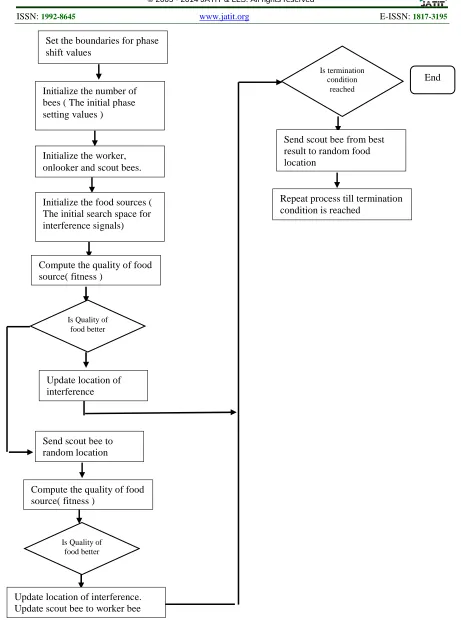
The block diagram of the optimization process is shown in figure 4.An artificial bee colony in an
ABC algorithm contains three groups of bees: employed bees, onlookers and scouts. A bee waiting on dance area to choose a food source is called onlooker and a bee flying to food source visited by it earlier is an employed bee. The other type of bee is scout bee which randomly searches for new sources. The food source position represents a possible solution to optimization problem and nectar amount in a food source corresponds to solution quality (fitness), calculated by:
The first half of the colony in the algorithm consists of employed artificial bees and second half is of onlookers. The number of employed bees or onlooker bees is equal to solutions number in population.
A food source is chosen by an artificial onlooker bee depending on probability value associated with food source, Pi, calculated by following expression
where SN is number of food sources equal to
number of employed bees, and is solution
fitness which is inversely proportional to where
is clustering problem’s cost function.
In the proposed method the goal of the optimization algorithm is to steer the array's main lobe away from the direction of the interference and place nulls in the direction of the interference. An initial population of worker bees search for food in different directions. The random directions taken by the bee are encoded to identify the angle of arrival. If interference is not present then the route is discarded. In the second phase the proposed algorithm modifies the phase weights based on the array power. The phase weights are represented as binary values. In this phase the initial search space is larger with the four least significant bits being changed to find local minima. Once a local minima is found the search is narrowed using the three least significant bits of the phase weights.
Preprocessing stage
GPS receiver phase
shifting block
ABC Optimizat
Figure 3: The Modified ABC Flow Chart For Faster Convergence Set the boundaries for phase
shift values
Initialize the number of bees ( The initial phase setting values )
Initialize the worker, onlooker and scout bees.
Initialize the food sources ( The initial search space for interference signals)
Compute the quality of food source( fitness )
Is Quality of food better
Update location of interference
Send scout bee to random location
Compute the quality of food source( fitness )
Is Quality of food better
Is termination condition
reached
End
Send scout bee from best result to random food location
Update location of interference. Update scout bee to worker bee
4. RESULTS AND DISCUSSION
The proposed algorithm is implemented in a5 element array. In the experiments conducted, the interference location is not known to the algorithm and the algorithm starts the search randomly using the initial bee population. The termination condition was to achieve a null at the interference. The settings used in the experiment are shown in Table 1.
Table1 The initial settings
Number of employed and onlooker bees
10
Number of iterations 500
Strength of
interference
50 dB stronger than GPS signal
Termination condition Null depth of -80dB
Abandon food value 80
The proposed system was able to detect and null the interference when the interference occurred at azimuth of 50 degree ( theta)and elevation of zero degree (pi) within the 11th iteration. The null was formed with -65 dB. The polar plot is shown in figure 4 and figure 5 shows the array pattern.
[image:8.612.86.522.53.729.2][image:8.612.320.528.75.264.2]
Figure 4: Theta Pattern For Phi =0 Degree, Frequency=1227 Mhz
Figure 5: RHCP Theta Pattern For Phi =0 Degree, Frequency=1227 Mhz
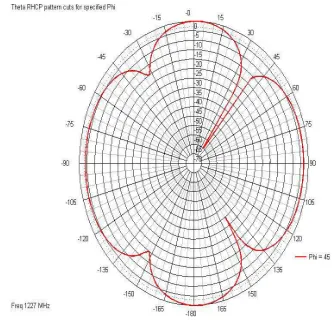
Figure 6 shows the polar plot for experiments conducted with interference occurring at elevation of 45 degree and azimuth of 37.5 degree. The proposed algorithm was able to identify the nulling angle and produce a null of -65dB.
Figure 6: RHCP Theta Pattern For Phi =45 Degree, Frequency=1227 Mhz
[image:8.612.339.506.370.530.2]Figure 7: RHCP Theta Pattern For Phi =45 Degree, Frequency=1227 Mhz
5. CONCLUSION
GPS is susceptible to jamming, as receivers are very sensitive receiving extremely weak satellite signals. This study proposes a new optimization method based on the ABC algorithm for interference cancellation design and improves jamming rejection. The proposed algorithm was not only able to identify the interference angle but also was able to null the same effectively.
REFRENCES
[1] Farrell, J. (2008). Aided navigation: GPS with
high rate sensors (pp. 72-75). New York:
McGraw-Hill.
[2] Rai, A. INTRODUCTION TO GLOBAL
POSITIONING SYSTEM.
[3] Chan, E. C., & Baciu, G. Introduction of Global Positioning System.Introduction to
Wireless Localization: With iPhone SDK Examples, 121-136.
[4] Rash, G. D. (1997). GPS Jamming in A Laboratory Environment. Naval Air Warfare
Center Weapons Division
(NAWCWPNS)/China Lake, 1-20.
[5] Brown, A., Reynolds, D., Roberts, D., & Serie, S. (1999, September). Jammer and interference location system–design and initial test results. In Proceedings of the ION GPS (Vol. 99). [6] Zhang, Y. D., & Amin, M. G. (2012).
Anti-Jamming GPS Receiver With Reduced Phase
Distortions. Signal Processing Letters, IEEE, 19(10), 635-638.
[7] Akdağlı, A., & Güney, K. (2001). Array pattern nulling using Simulated Annealing technique by controlling only the element
amplitudes. In Second International
Conference on Electrical and Electronics Engineering, ELECO(pp. 209-213).
[8] Haupt, R. L. (1997). Phase-only adaptive nulling with a genetic algorithm. Antennas and
Propagation, IEEE Transactions on, 45(6),
1009-1015.
[9] Naik, E. A., & Swamy, C. B. Efficient Adaptive Beam Steering Using INLMS Algorithm for Smart Antenna.
[10] Banerjee, S., & Dwivedi, V. V. (2013).
REVIEW OF ADAPTIVE LINEAR
ANTENNA ARRAY PATTERN
OPTIMIZATION. International Journal of
Electronics.
[11] Guney, K., & Onay, M. (2007). Amplitude-only pattern nulling of linear antenna arrays with the use of bees algorithm. Progress In
Electromagnetics Research, 70, 21-36.
[12] Mukhopadhyay, M., Sarkar, B. K., & Chakraborty, A. (2007). Augmentation of anti-jam GPS system using smart antenna with a simple DOA estimation algorithm. Progress In
Electromagnetics Research, 67, 231-249.
[13] Goswami, B., & Mandal, D. (2012). Genetic Algorithm for Nulls and Sidelobe Level Control in a Linear Antenna Arrays. Journal of
King Saud University-Computer and
Information Sciences.
[14] Li, L., Xi, X., & Wang, J. (2010, September). Research on GPS anti-jamming algorithm based on adaptive antennas. In Signals Systems
and Electronics (ISSSE), 2010 International Symposium on (Vol. 1, pp. 1-4). IEEE.
[15] Xiang, J., Guo, L., & Li, H. (2008, December). Study and simulating of adaptive array processing with effect of channel uniformity. In Systems and Control in Aerospace and
Astronautics, 2008. ISSCAA 2008. 2nd International Symposium on (pp. 1-4). IEEE.
[16] Markel, M., Sutton, E., & Zinuda, H. (2002). Optimal anti-jam attitude determination using the global positioning system. In Position
Location and Navigation Symposium, 2002 IEEE (pp. 12-19). IEEE.
Aerospace Conference, 2011 IEEE (pp. 1-5).
IEEE.
[18] Hu, H., & Wei, N. (2009, December). A study of GPS jamming and anti-jamming. In Power
Electronics and Intelligent Transportation System (PEITS), 2009 2nd International Conference on (Vol. 1, pp. 388-391). IEEE.
[19] Hunkeler, U., Colli-Vignarelli, J., & Dehollain, C. (2012, June). Effectiveness of GPS-jamming and counter-measures. In
Localization and GNSS (ICL-GNSS), 2012 International Conference on (pp. 1-4). IEEE
[20] Zhuang, X., Cui, X., Lu, M., & Feng, Z. (2009). Reduced-rank space-time processing for anti-jamming GPS receivers. Tsinghua
Science & Technology, 14(2), 189-195.
[21] Liu, Y. J., & Hu, H. Y. (2009, September). The research on GPS frequency domain anti-jamming algorithms. In Proceedings of the 5th
International Conference on Wireless
communications, networking and mobile
computing (pp. 2231-2233). IEEE Press.
[22] Cho, Y. K., Kang, H. D., Hyun, S. Y., & Yook, J. G. (2012, July). Gain improvement topology using conical structure for jamming resilient GPS antennas. In Antennas and
Propagation Society International Symposium (APSURSI), 2012 IEEE (pp. 1-2). IEEE.
[23] Gupta, I. J., Lee, T. H., Griffith, K. A., Slick, C. D., Reddy, C. J., Bailey, M. C., & DeCarlo, D. (2010). Non-planar adaptive antenna arrays for GPS receivers. Antennas and Propagation
Magazine, IEEE, 52(5), 35-51.
[24] Flam, R., Bull, J., Sinsky, A., Acoraci, J., & Wischhusen, C. (1988, June). A circular antenna utilizing phase only adaptive nulling.
In Antennas and Propagation Society
International Symposium, 1988. AP-S. Digest
(pp. 972-975). IEEE.
[25] Xiang, J., Guo, L., & Li, H. (2008, December). Study and simulating of adaptive array processing with effect of channel uniformity. In Systems and Control in Aerospace and
Astronautics, 2008. ISSCAA 2008. 2nd International Symposium on (pp. 1-4). IEEE.
[26] Chang, D. C., Hung, C. I., Chen, H. T., Lee, T. M., & Ho, K. T. (1992, July). A novel phase-only nulling in a monopulse phased array antenna. In Antennas and Propagation Society
International Symposium, 1992. AP-S. 1992 Digest. Held in Conjuction with: URSI Radio Science Meeting and Nuclear EMP Meeting., IEEE (pp. 1035-1038). IEEE.
[27] Pham, D. T., Ghanbarzadeh, A., Koc, E., Otri, S., Rahim, S., & Zaidi, M. (2006). The bees algorithm–a novel tool for complex optimisation problems. InProceedings of the
2nd Virtual International Conference on Intelligent Production Machines and Systems (IPROMS 2006) (pp. 454-459).
[28] Karaboga, D., & Ozturk, C. (2011). A novel clustering approach: Artificial Bee Colony
(ABC) algorithm. Applied Soft