LEACH-EMMR: AN IMPROVED CLUSTER BASED
MULTIHOP ROUTING ALGORITHM FOR VEHICLES
MONITORING NETWORKS IN MWSN
1
R.U.ANITHA, 2Dr.P.KAMALAKKANNAN
1
Department of MCA, Muthayammal Engineering College, Rasipuram-637408
2PG & Research Department of Computer Science, Government Arts College, Salem- 636007
E-mail: [email protected] , [email protected]
ABSTRACT
Due to rapid increase of vehicle accessibility and usage, traffic and overcrowding on the highways will produce an unsafe and inefficient to drive the vehicle. Vehicle Monitoring Network (VMN) is a Mobile Wireless sensor network based real-time system, which collects, transmits, analyzes and process the Vehicle Monitoring parameters in a testing area. Even though sensor networks are primarily designed for monitoring and reporting events, they are application dependent. A single routing algorithm cannot be sufficient in energy efficiency for mobile sensor networks in all applications. The cluster based methods and energy saving approaches are plays an important role on designing network routing protocols for the VMN. Thus this paper proposes an enhanced description of Mobile algorithm called LEACH-Enhanced Mobile by Multihop routing (LEACH-EMMR) algorithm for the VMN. Simulation results shows that the LEACH-EMMR can reduce the energy consumption of nodes, decrease the process of clustering and prolong the network lifetime in the VMN.
Keywords - Mobile WSN, LEACH-Mobile Protocol, Cluster head, Vehicle Monitoring, residual Energy, Distance.
1. INTRODUCTION
The Mobile Wireless Sensor Networks consists of a large number of low cost micro sensor nodes deployed in the monitoring region. These sensor nodes cooperate with each other to sensing, gathering and processing the information of sensing objects in the network coverage area, and send it to observers. Mobile WSNs not only have the communications but also have their own unique features of Application-Related, Data-Centered, Large-Scale Distribution, Dynamic Topology, High Reliability and Self-organization [1].
In Mobile Wireless Sensor Networks has a diversity of application areas but not limited to the following fields like disaster assistance, environment control, facility management, intelligent buildings, preventive maintenance, precision agriculture, logistics, telematics, medicine and health care, military command control [2][4][5].
A Mobile WSN is used to Monitoring the path of the vehicles. Magnetometer sensors are attached
to the nodes in order to detect the proximity of the vehicles. Nodes are worked together in estimating the path and velocity of a vehicle. Tracking results are transmitted to the aerial vehicle [6].
In order to reduce the power consumption of sensor networks and prolonging their lifetime, it is assumed that the scheme should be tagged with elegant, optimized and efficient algorithm to change sensor status from idle to active and vice versa[3][13].
In this paper propose an reliable architecture for intelligent vehicle monitoring system with the help of WSN among vehicle using Bluetooth devices and also an energy efficient cluster based algorithm for vehicle Monitoring Networks (VMN). Mobile Sensor nodes in WSN are deployed in central places to collect and provide information about the moving vehicles. Vehicles communicate themselves if it is accessible in the range using a Bluetooth technique and send the information to the base station. So that upcoming vehicles can able to use this information.
conventional algorithm. The third Section will explain the Motivation of this paper. The fourth section demonstrates that the proposed model which describes the components and working principles of the model. This section shows how the piconet is formed among vehicles to communicate and gather information. The proposed architecture and algorithm describes in the fifth section. The sixth Section which shows the analysis and simulation results. At Last the final sections seventh and eighth will conclude this paper and future works.
2. ANALYSIS OF CONVENTIONAL ALGORITHMS
2.1 Description of LEACH Algorithm
Low-Energy Adaptive Clustering Hierarchy (LEACH) protocol for sensor networks is proposed by W. R. Heinzelman et.al [7] which minimizes energy dissipation in sensor networks. In LEACH the operation is divided into rounds, during each round a different set of nodes are cluster heads (CH). Cluster heads are randomly changed over time to balance the energy consumption of nodes. The node chooses a random number between 0 and 1. The node becomes a cluster head for the current round if the number is less than threshold value.
The cluster head node sets up a TDMA schedule and transmits this schedule to all the nodes in its cluster, completing the setup phase which is then followed by a steady-state operation. During the steady operation phase, the sensor nodes can begin sensing and transmitting data to the cluster-heads. The cluster-heads aggregate the data sent from the nodes in their cluster before sending the data to the BS. After a certain period of time in the steady operation phase, the network goes into the setup phase again and starts another round of selecting the cluster-heads.
2.1.1 Existing Problems
LEACH [7] assumes homogeneous distribution of sensor nodes in the given area. This situation is not very realistic. LEACH assumes that all nodes have enough energy to transmit and reach the data to the BS and that each node has computational power to support different MAC protocols. Therefore, it is not applicable to networks deployed in large regions. It also assumes that nodes always have data to send and nodes located close to each other have correlated data. It is not obvious how the number of predetermined Cluster Heads is going to be uniformly distributed throughout the network. Therefore, there is a possibility that the elected CH
will be concentrated in one part of the network. Hence, some nodes will not have any CH in their area.
2.2 Description of LEACH-MOBILE Algorithm
Leach-Mobile [8] has been designed for mobility applications where fixed sensor nodes are mixed with mobile sensor nodes. The basic idea in leach-Mobile is to confirm whether a mobile sensor node is able to communicate with a specific cluster head. For that, the CH node transmits a request message to the mobile node. If the mobile sensor node does not receive the data transmission that is request message from CH node within the TDMA scheduled time slot, it sending the join-request message at TDMA time slot allocated. Then the mobile node decides the cluster which it will belongs to receive the join-ack message from the CH.
The protocol consists of two phases. They are Set-up phase and Steady-state phase. In set-up phase, the cluster heads are selected as in Leach [7] protocol. According to the received signal strength, each sensor nodes chooses most appropriate cluster head. Then it sends the join-message to the CH. After the CH receives the join-message from the mobile sensor node, it will create a TDMA schedule and broadcast to its member nodes.
In the steady state phase, time slot is assigned to each node for sending the data to the CH. The mobile sensor node wake up at the beginning of its timeslot and wait for data request message from the CH. If it receives the data request message, it will send the data back to CH. Otherwise it will go the sleep mode until the next TDMA time slot. If no data request message is received, it will once again send the join-request message to CH. On the other hand, if the cluster head does not receive the data from the sensor node during the two consecutive frames then the CH will remove the sensor node from its scheduling and assumed that the sensor node had moved out of the cluster.
2.2.1 Existing Problems
Although LEACH-Mobile solves the problem of uncertainty on the number of cluster-head at each round in LEACH, it still has problem in selection of cluster head mechanism and the unbalancing energy loads. This event select the nodes with highest mobility may also become a cluster heads.
dead if it is not have the energy to forward the information may occurred. Thus the selection mechanism of cluster head influences the performance and lifetime of the entire network. In addition to above problems, the transmitted message overhead is also increased in LEACH-Mobile because of membership declaration.
3. MOTIVATION
This paper discusses a routing protocol for vehicle monitoring in city roads as a background. The long term goal of our research is to provide a service oriented network architecture in city road environment. Let us consider an example situation which is demonstrating the Vehicle Monitoring Networks of this study. Suppose vehicles enter into the highway, the device which is equipped with the vehicle is immediately detected by the cluster heads located within the zone and it is included into the network upon the consent of the user.
Once the communication channel has been set up, the vehicle may choose to find out the path where it wants to move and also other queries related to road map and gets a suitable reply. If there is an accident in the zone of the city where the vehicle is located then it gets an alert message and also the vehicle can get the direction of roads which is nearest to their path. This is achieved by using mobile sensor nodes fixed in car can collect the information and make a map.
Then it finds a nearest coordinate node and provides the information to the vehicles. The improvement of the above example should be taken place for routing algorithms in vehicle monitoring networks in sensor network which is a proposed scheme in this paper.
4. PROPOSED WORK
4.1 Assumptions
The required devices and software is already installed in the vehicles to perform the protocols. So the installation of software is not required in this proposed method. The coverage area of the city environment will be 100% through the network system. Thus, there is no communication and inaccessible problems in this scheme. The database in the server is a fully authenticated one. The sensor nodes and cluster heads are considered as the faithful nodes in the network [9] [14].
4.2 Base Station
The Base station constantly delivers a power. It will communicate all the cluster heads. The position of the base station is stationary and located with respect to the cluster heads so that it can be reached by the maximum number of cluster heads. Only one base station is available in the entire network system. The major role of the base station is to store data. Thus, it acts as a warehouse of all the road map information in the entire city. When it is required for processing and location servicing, this data will be accessed by the cluster heads.
4.3 Cluster Head
A cluster head has a constant power supply and larger transmission range as compared to sensors nodes. It is a trusted node. The position of the cluster head is semi-static that is it does not move from one place to other frequently but occasionally. For instance, a check post is sited in a roadside area of the city for 3-6 months. So, the patrol in-charge has installed a cluster head in the check post and it remains stationary from 3 to 12 months. After the period is completed, the cluster head might move to another location.
The location of each cluster head will be acknowledged to every other cluster head and to the sensor nodes as well. The cluster head will keep the location information of the sensor nodes. The number of cluster heads shall remain constant depending on the size of the check post. The cluster heads will be responsible for detecting new incoming nodes and starts interact with them. It also maintains a log of the communication between itself and the sensor nodes.
4.4 Sensor nodes
The sensor nodes will be battery operated. If the transmission range is high then it acquires maximum energy constraint. It should be within the range of a cluster head. The number of sensor nodes shall remain constant as it depends on the size of the check post. Sensor nodes are semi-static in position. After sensing the information from a zone it can send a data to the cluster head. The sensor nodes will be communicating with the cluster heads or other sensor nodes using multiple hops technique. The sensor nodes shall take part in the routing protocol between the vehicles and the cluster heads. Table 1 show that the summary of components is as follows.
Table 1: Summary of components
4.5 Working principle
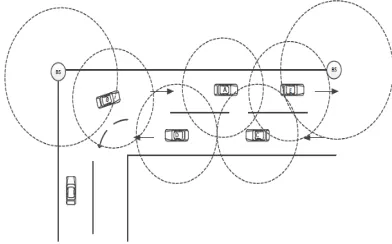
In the proposed approach Vehicles Monitoring Networks is formed with the help of WSN and ad-hoc network Bluetooth devices which is attached to vehicles. The example situation is shown in Figure 1.Here the vehicles are passing from end to end in both directions and base stations are situated in both the ends.
The previously passing vehicles are informed about the road conditions to the base stations. In this example, cars A, B and E can obtain the information from the one BS and store up the information to other BS because they travel along with them. At this time the base station is powered by solar power. It monitors up to 200 vehicles and can able to sense 100 m. If the vehicles cannot reach the BS then it communicates the other nearby vehicles which its communication ranges using piconet design in Bluetooth. The example situation shows in the Figure 1 are as follows.
Figure 1: Communication model between vehicles and WSN-BS.
Car A can locates its communication range and finds the cars D, C and E in its range. Then Car A sends a request message to nearest Car E and obtains an ACK which includes its ID from it. Car A receives information of road and traffic
conditions about the destination path of Car E. Lastly Car E can detect the WSN-BS as its range and starts sending a connection request and get an ACK from WSN-BS. After gets an ACK Car E sends the road conditions which was previously gathered from other vehicles and also its information to WSN-BS. Then the WSN-BS updates that new information regarding the road conditions from Car A through Car E. Thus the follow up vehicles can update the information from WSN-BS by utilizing the intelligent network for the vehicles.
5. PROTOCOL FUNCTION
In order to resolve above mentioned circumstances, an improved LEACH-Enhanced Mobile by Multihop Routing (LEACH-EMMR) algorithm is proposed which is based on the idea of cluster head selection procedure and data transmission using multihop routing. This algorithm is used to select an optimum cluster heads which is based on the significant parameters.
The residual energy and distance are taken into consideration for the constraints. If the node has higher residual energy and also least distance then it will have more chance to become a cluster head because of energy balancing of the node. This algorithm is applying the concept of number of rounds. Each round of the cluster is also composed of set-up phases and steady-state phases. The procedure of the LEACH-EMMR algorithm is as follows.
5.1 Setup phase
In this phase all the sensor nodes in the Wireless Sensor Networks are divided into smaller groups known as clusters. These sensor nodes are capable of operating in two basic forms, the sensing node and the cluster head node. In the sensing type nodes can sense and sends the sensed data to its cluster head. The cluster head node gathers data from its cluster members, performs data fusion, and transmits the data to the base station. The base station can take a rotation to carry out the cluster head selection. Each node uses the Formula (1) and (2) to calculate the values for residual energy and distance of the node.
Considering the remaining power function is used to increase the network lifetime, and it is defined by Equation (1):
Where xj
∈
cluster (1)Properties Base
Station
Cluster Head
Sensor Node
Vehicle Node
Power Unlimited Unlimited Limited Limited
Transmission
Range Large Large Small Small
Mobility Static Semi-static
Semi-static Mobile
Reputation Trusted Trusted Trusted
Non-Trusted
The remaining power of a node xi, RP (xi) depends on the number of nodes for the cluster i. If RP (xi) is higher means the more stable power and the more energy power. Thus, the node with large RP (xi) has a chance to select as a cluster head and able to support the network lifetime for a long time. The node can determine the needed energy to transmit to the cluster head based on the received signal strength.
The second parameter named distance of the nodes can be obtained from the calculation for distance of nodes in the every clusters and it is defined as following equations (2):
(2) Where diBS is the distance from node i to BS which is calculated from the following equation (3):
(3)
and dom is the distance of the outermost node from the Base station is calculates as from [11].Here (XBS,YBS) is the location of the Base station. The cost for distances of nodes in the cluster is an important factor.
After that the Cluster Heads are selected on the basis of remaining power and distance of the node by considering joint parameters which is defined in Equation (4):
(4)
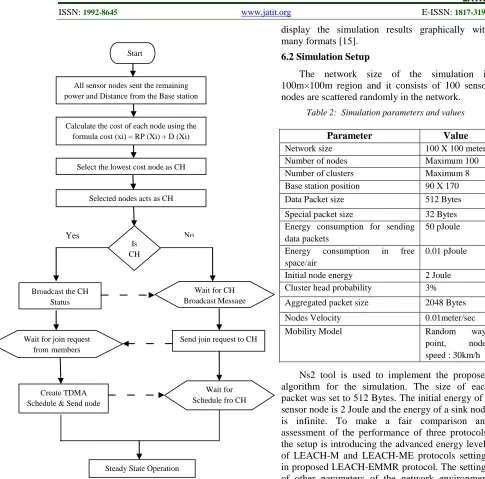
The Cost (xi) of the entire sensor nodes are calculated and select the cluster heads which has a minimum Cost (xi) among the nodes. If the node satisfied the above condition then that node will become a Cluster head. After that selected cluster heads should broadcast an advertisement message to the network for announcing themselves as cluster heads. After receiving this message, the member nodes whose belong to the cluster can send a join message as acknowledgement to their cluster heads. Figure 2 shows that the flowchart of set up phase in LEACH-EMMR algorithm and it gives the explanation about cluster head selection, message transmission, member node joining and TDMA schedule creation for data transmission of the proposed algorithm.
5.2 Steady-state phase
In this phase the sensed data is collected and transmitted in a multi-hop fashion to the base station. Once the clusters are established, the nodes transmit their data packets towards the cluster head using a TDMA communication within the cluster range. When the cluster-head receives all the nodes data, it performs its aggregation and compression techniques, to form a new message that sent to the base station via multi hops transmission. After a certain period which is calculated in advance, the next round starts with the election of new CHs.
Each node within the cluster sends its data to the cluster head with single hop transmission and cluster heads receive, aggregate the data and transmit to the base station via multi-hops transmission. Furthermore, the multiple access CDMA protocol is used so that multiple nodes can simultaneously send their data.
6. SIMULATION ENVIRONMENT
Figure 2: Flowchart of Set up phase in LEACH-EMMR
6.1 Simulation Platform
Ns2 simulator is used for simulating the proposed routing protocols. Ns2 is a fully fledged simulator for WSNs. NS2 emerged from the VINT project. It is written and developed in C++ and TCL. It is a very powerful in simulating tool of small to large scale based on Graphical User Interface (GUI). It provides extensive support for simulating TCP/IP, routing and multicast protocols over wired and wireless network.Ns2 GUI allows users to design various simulation scenarios and
display the simulation results graphically with many formats [15].
6.2 Simulation Setup
[image:6.612.32.517.70.549.2]The network size of the simulation is 100m×100m region and it consists of 100 sensor nodes are scattered randomly in the network.
Table 2: Simulation parameters and values
Parameter Value
Network size 100 X 100 meter
Number of nodes Maximum 100
Number of clusters Maximum 8
Base station position 90 X 170
Data Packet size 512 Bytes
Special packet size 32 Bytes
Energy consumption for sending data packets
50 pJoule
Energy consumption in free space/air
0.01 pJoule
Initial node energy 2 Joule
Cluster head probability 3%
Aggregated packet size 2048 Bytes
Nodes Velocity 0.01meter/sec
Mobility Model Random way
point, node speed : 30km/h
Ns2 tool is used to implement the proposed algorithm for the simulation. The size of each packet was set to 512 Bytes. The initial energy of a sensor node is 2 Joule and the energy of a sink node is infinite. To make a fair comparison and assessment of the performance of three protocols, the setup is introducing the advanced energy levels of LEACH-M and LEACH-ME protocols settings in proposed LEACH-EMMR protocol. The settings of other parameters of the network environment were displayed in Table 2.
6.3 Efficiency of the Proposed Scheme
The main aim of this paper is to extend the network lifetime by minimizing communication distance during transmission by taking remaining energy and distance as parameters. In order to estimate the performance of the new proposed cluster based algorithm (LEACH-EMMR), the simulation is performed for LEACH, LEACH-Mobile protocol and LEACH-EMMR using Ns2 simulator. To observe the energy level saving of the proposed protocol, 100 sensor nodes are randomly distributed between (0, 0) and (100, 100) m with base station set at a distance (x = 90, y = 170).
No Yes
Wait for CH Broadcast Message Broadcast the CH
Status
Wait for join request
frommembers
Send join request to CH
Create TDMA Schedule & Send node
Wait for Schedule fro CH
Steady State Operation Is
CH Start
All sensor nodes sent the remaining power and Distance from the Base station
Selected nodes acts as CH Select the lowest cost node as CH Calculate the cost of each node using the
LEACH-EMMR protocol is compared with LEACH and LEACH-Mobile protocols to test the energy consumption of the proposed protocol. Three metrics of evaluating network lifetime of WSN are proposed in [12]. They are First Node Dies (FND), half of the Nodes Dies (HND) and Last Node Dies (LND).
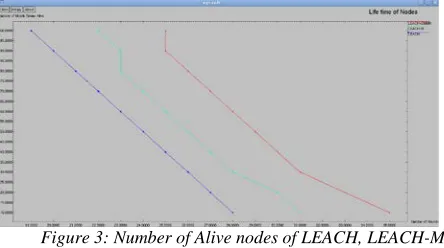
[image:7.612.314.528.234.366.2]First of all, it should be notice that the effect of total number of nodes alive over rounds in the network. In Figure 3, the x-axis represents the number of rounds. The y-axis represents the total number of mobile nodes in the networks. It can observe from the Figure 3 the number of node alive in LEACH-EMMR protocol is considerably higher than both the LEACH protocol and the LEACH-Mobile protocol. But, in general, with the increase in the percentage of nodes, the number of alive node is also increasable.
Figure 3: Number of Alive nodes of LEACH, LEACH-M and proposed protocol LEACH-EMMR.
[image:7.612.73.295.321.445.2]In Figure 4, the Energy consumption of the nodes in the wireless sensor network with the three protocols is checked. The x-axis represents the number of mobile nodes in the networks. The y-axis represents the Energy consumption of the nodes in the networks. It can be noticed from the Figure 5, the energy consumption of the nodes in the proposed protocol is higher than other two protocols.
Figure 4: Energy Consumption of LEACH, LEACH-M and LEACH-EMMR
In Figure 5, comparison of the First Node Dies (FND) of the three protocols while varying the proportion of nodes in the network is performed. Here the x-axis represents the number of mobile nodes. The y-axis represents the First node dies round in the network. From the graph, it can be observed that the First node dies in the round for the cluster head selection using EECHS-MWSN is later when compared to the LEACH and LEACH-Mobile. This provides evidence that the network life time in EECHS-MWSN protocol is more than that of other two protocols.
Figure 5: Rounds of the First Node Dies in LEACH, LEACH-M and LEACH-EMMR.
While Figure 6 gives a comparison of the half node Dies (HND) of nodes in the network while keeping the number of nodes constant. Here is also the x-axis represents the number of mobile nodes. The y-axis represents the half node dies round in the network. From this it can be observes the LEACH-EMMR protocol is better when compared to the other two protocols.
Figure 6: Rounds of Half of Nodes Die in LEACH, LEACH-M and LEACH-EMMR.
[image:7.612.92.532.483.727.2]Figure 7: Rounds of the Last Node Dies in LEACH, LEACH-M and LEACH-EMMR.
7. CONCLUSIONS
In this paper, a new cluster based algorithm for Vehicle Monitoring systems are introduced. The proposed LEACH-EMMR algorithm partitioned the sensor field into different clusters and selects a cluster head node on the basis of remaining energy and Distance for each cluster. Each node within the cluster sends its data to the cluster head with single hop transmission and cluster heads receive, aggregate the data and transmit to the base station via multi-hops transmission. This method keeps the energy dissipation of sensor nodes in the clusters. Through the simulation results it can be concluded that LEACH-EMMR is better saves energy than LEACH and LEACH-Mobile protocols.
8. FUTURE WORK
In the proposed approach it is assumed that the nodes are mobility but the sink is considered as static. In future the proposed protocol can be modified in such a way that it can also support mobility both in case of sensor nodes and sink and it can be implemented for reactive type of networks. Also in near future it can be integrate with multi-hop communication in data aggregation for better performance. And also LEACH-EMMR protocol will be compared with other LEACH-ME [17] and CBR-Mobile [18] a new cluster based protocols.
REFRENCES:
[1] C. Y. Chong, S. P. Kumar, "Sensor networks: Evolution, opportunities, and challenges", in Proceedings of the IEEE, vol. 91 No 8, pp. 1247-1256, 2003.
[2] Akyildiz, I. F., Su, W., Sankarasubramaniam, Y., & Cayirci, E.”A survey on sensor networks. IEEE Communications Magazine, 40(8), 102-116 2002.
[3] Abdollah (Ashkan) Ekhtiari “Remote Vehicle Status Monitoring Using Wireless Sensor
Networks” Luleå University of Technology, master's thesis, Department of Computer Science, Electrical and Space Engineering. [4] Hania Aoudia, Youcef Touati, Arab Ali-Cherif
and Patrick Greussay “Hierarchical Routing Approach-Based Energy Optimization in Wireless Sensor Networks” MobiWac’12, October 21–22, 2012, Paphos, Cyprus. Copyright 2012 ACM 978-1-4503-1623-1/12/10
[5] V. Rodoplu, T. H. Meng, "Minimum Energy Mobile Wireless Networks", IEEE Journal on selected areas in communications, vol. 17, no. 8, August 1999,pp-1333-1344.
[6] The 29 Palms Experiment: Tracking vehicles with a UAV-delivered sensor network. tinyos.millennium.berkeley.edu/29Palms.htm. [7] Wendi B.Heinzelman,Anantha P.Chandrakasan
and Hari Balakrishnan “An Application-Specific Protocol Architecture for Wireless Microsensor networks”,IEEE Transactions on wireless communications vol.1 NO.4 2002. [8] Do-Seong Kim and Yeong-Jee Chung,
“Self-Organization Routing Protocol Supporting Mobile Nodes for Wireless Sensor Network”, Proceedings of the First International Multi-Symposiums on Computer and Computational Sciences (IMSCCS'06), Volume 02, IEEE Computer Society Washington, DC, USA ©2006 ISBN:0-7695-2581-4, Pages 622-626 [9] Mohammad S. Obaidat, Sanjay K. Dhurandher,
Deepank Gupta,Nidhi Gupta and Anupriya Asthana “DEESR: Dynamic Energy Efficient and Secure Routing Protocol for Wireless Sensor Networks in Urban Environments” Journal of Information Processing Systems, Vol.6, No.3, September 2010 DOI : 10.3745/JIPS.2010.6.3.269
[10] S. Lindsey, C. Raghavendra, and K. M. Sivalingam, “Data gathering algorithms in sensor networks using energy metrics,” IEEE Trans. Parallel Distrib. Syst., vol. 13, no. 9, pp. 924–935, Sept. 2002.
[11] Tao Liu,Feng Li, “ Power Efficient Clustering Routing Protocol Based on Applications in Wireless Sensor Network” Proc. IEEE 2009. [12] M. J. Handy, M. Haase and D. Timmermann,
[13] Younis O, Fahmy S. “Heed: A hybrid, energy-efficient, distributed clustering approach for ad-hoc sensor networks”. IEEE Trans. on mobile Computing, 2004,3(4), pp 660−669. [14] K. Pahlavan and A. Levesque, Wireless
Information Networks. NewYork: Wiley, 1995. [15] Network Simulator, www. isi.edu /nsnam/ns. [16] K. Fall and K. Varadhan, “The network
simulator ns-2 documentation,” January 2008. http://www.isi.edu/nsnam/ns/nsdocumentation. html
[17] G. S. Kumar, M. V. Vinu Paul, G. Athithan and K.P Jacob, "Routing protocol enhancement for handling node mobility in wireless sensor networks,"in IEEE Transaction in wireless Communication, Region 2008, pp. 1-6.
[18] S. A. B. Awwad, C. K. Ng, N. K. Noordin and M. F. A. Rasid, "Cluster based routing protocol for mobile nodes in wireless sensor network," in Collaborative Technologies and Systems, IEEE Transaction on wireless communications 2009, pp. 233-241.
[19] R.U.Anitha and Dr.P.Kamalakkannan, "A Survey on Energy Efficient Routing Protocols in Wireless Sensor Networks", International Research Journal of Mobile and Wireless Communications, Vol 03, Issue 01, ISSN: 2249-6491 pp 100-105, January-April 2012 [20] R.U.Anitha and Dr.P.Kamalakkannan,”Energy
Efficient Cluster Head Selection Algorithm in Mobile Wireless Sensor Networks “, In the Proceedings of the International Conference on Computer Communication and Informatics (ICCCI -2013) Sri Sakthi Institute of Engineering and Technology, Coimbatore 04 – 06 January © 2013 IEEE Explore (Indexed by Scopus)