USER DATA RATE BASED VERTICAL HANDOFF IN 4G
WIRELESS NETWORKS
A.FERDINAND CHRISTOPHER1, DR.M.K.JEYAKUMAR2
Assistant Professor,Department of Computer Applications, Noorul Islam Centre for Higher Education,Tamilnadu, India1
Professor and Deputy Controller of Examinations, Noorul Islam Centre for Higher Education,Tamilnadu, India.2 E.mail: [email protected] ,[email protected]
ABSTRACT
Wireless Heterogeneous Networks are integrated within fourth generation recently. The 4G wireless communication system should assure a few of QoS related facilities such as offering high data rates, seamless mobility, strong RSS. When accomplishment and requisite of a user is acknowledged the system gets succeed in handoff and seamless connectivity. In such a user requisite data rate plays an imperative role in wireless networks. This paper proposes a novel method for vertical handoff in 4G wireless heterogeneous networks based on data transfer rate. In this paper distance based RSS is used as another parameter to initialize the handoff and an efficient data recovery technique is proposed. Log based recovery technique saves the logs in both mobile node and base stations for fast and lossless data recovery. Moreover, feasibility of this method is compared with existing method in terms of bandwidth and recovery time.
Keywords: Vertical Handoff, 4g Wireless Network, Data Rate Based, Data Recovery, Data Loss
1. INTRODUCTION
In recent years mobile nodes (MN) are prepared with various interfaces and can admittance a wide range of applications provided by various wireless networks with seamless connectivity. To access the communication services anytime, anyplace with best Quality of Service (QoS) at minimum cost heterogeneous wireless communication system is a finest solution [1]. A number of wireless networks such as Bluetooth, Wi-Fi, Wi-Max, GPRS and CDMA have been evolved. Each network has been developed for specific purpose with different features. Various Wireless Networks has special access technologies, coverage, and network architecture, protocols, and mobility management. Handoff is the method of shifting the channel or base station related with the current connection while a communication is in progress [2]. Vertical handoff is defined as a method which transfers a user connection from one kind of network to another.
There is a need to refuse the communication channel when the mobile user moves from one network to another by allowing for its features and also the user supplies. By vertical handoff channel handover among two contradictory networks has been done. Handoff among heterogeneous wireless access network technology is Vertical Handoff (Asymmetric). Vertical handovers are implemented
obliquely heterogeneous cells of access systems, which diverge in numerous aspects such as bandwidth, data rate, frequency of operation, etc. Implementation of vertical handovers became more challenging as compared to horizontal handovers using the different characteristics of the networks involved [3]. In order to afford seamless mobility, one of the foremost issues is the Vertical Handover (VHO) support. Detection policies, handover decision, and handover execution are splitted from VHO [5]. The Mobile Terminal (MN) may drop its present connection prior to completing all the essential signaling if the information is not given on time.
mobile applications will wait for faultless vertical handoff between heterogeneous access networks, through multiple interfaces. This is achieved by exchanging information across multiple layers of the same entity and by sharing information between nodes in the network. Accordingly, Mobile IP/IPv6 was planned to handle handoff without interrupting upper-layer sessions. With the assist of Mobile IP/IPv6, the capacity of service availability is deeply enlarged, which results in better accessibility to mobile users [7].When the user shift from base station to another,according to the need of the user they might want to continue inthe same network or like to connect to different networks.So when user needs to handoff specifically for their own aspiration, this type of handoff can beprovided without disturbing the current implementations of TCP.
Most extensively used standard is the Received Signal Strength (RSS) to settle on which network to use for the handoff from an applicant list of networks. Adaptive RSS threshold algorithm works well for handover from WLAN to 3G network. It helps in reducing handoff failure probability and also reducing unnecessary handover between WLAN to 3G as dynamic RSS threshold is dependent on MNs speed and Handoff Signaling delay. There are still several challenging issues on VHO support when applicant list is large with various technologies. These challenges mainly lie at the decision stage where multiple metrics must be used in deciding which network to handoff. Combining many metrics in a single decision process throws serious challenges [10]. With the development of 4G mobile communication systems, more and more mobile hosts nowadays are equipped with multiple network interfaces which are capable of connecting to the internet [13]. The assessment to decide best network for connectivity may be based on static factors such as the bandwidth of each network (capacity), usage charges of each network, power consumption of each network interface and battery level of mobile device. But there are several critical problems since mobile node is movable, so dynamic factors must be considered in handoff decisions for effective seamless connectivity. For example, information on current network conditions such as RSS can help in improving whole system performance; current user conditions, such as a mobile host’s moving speed can eliminate certain networks that do not support mobility, from consideration. Major process of VHO is handoff execution, during the handoff execution
connections are needed to be re-routed from the existing network to the new network in a seamless manner. This requirement refers to the Always Best connected (ABC) concept, which includes the authentication, authorization, efficient data recovery as well as the transfer of user’s context information [14].
In failure of network connectivity and handoff process data recovery or data retrieval is an essential issue. In mobile computing Checkpoint and rollback recovery is a popular technique for fault tolerance. In distributed systems, a critical problem with checkpointing/ recovery is the domino effect, which may force the system to restart from the initial state due to cascading rollback propagation. Thus, distributed checkpointing/recovery algorithms with no domino effect must be intended [8]. In checkpoint the status of a process contain process structure, register principles, segments, actual records and open file information [5]. Initial address of each section of a process to be checkpointed, size of a segment, actual data of a segment etc. are saved in checkpoint file. The recuperating process will pick up and resume execution from saved register values in checkpoint file. The checkpoint is commonly saved in base stations. Nowadays the MN moves across different base stations and might fail in other base stations. Checkpoint which is saved in another base station, the checkpoint needs to be transferred to the base station in which the failed host will recover for improvement. Through a number of base stations and gateway nodes checkpoint is transferred [16].
planned for the scattered systems. However, these schemes cannot be directly used in the mobile environment due to mobile computing system that has many constraints e.g. mobility, low bandwidth, less stable storage. Many checkpointing recovery schemes have been planned for the distributed systems, however these schemes cannot be straight used in the mobile environment, as mainly of the other distributed services. Particularly, the subsequent properties of the mobile computing system launch new design issues for checkpointing-recovery schemes [17]. The movement-based checkpointing and recovery algorithm is suitable to a wide range of database applications in mobile environments since it considers application/user behavior as defined by its recovery deadline and log arrival rate.
In this paper a novel method for handoff from one network to another based on data transfer rate in 4G heterogeneous wireless network is proposed. While a handoff method works only on user decision it will fail in gratifying the regulations of networks, i.e. even user gets weak RSS. So concurrently distance based RSS [19] [20] also decides the coverage region of 4G heterogeneous wireless networks and beacon signals. When a mobile node continuously received beacon signals from the base stations it is forced to handover from network to another. Vertical handoff is positioned based on several conditions that is threshold based RSS signal and congestion of base station. Here data rate is working for vertical handoff in case of user expectation. Since mobile nodes randomly causing handoff if a mobile node gets failure in communication, recovery data are to be collected from different base stations. Recovery time and security of this scattered information is imperative when convalescing from one network to another. Checkpoint based recovery scheme offers everlasting data which is mobile node scattered in different base stations. Moreover, logs of a mobile node will be saved in both base station and mobile node since the high cost and time of transferring the logs from base station.
The rest of this paper is organized as follows. Section 2 gives an overview of literature survey in the handoff techniques and data recovery of wireless networks. In Section 3 we outline the overall system design of our proposed work. Section 4 gives the algorithm of proposed method for vertical handoff based on data transfer rate and RSS. In section 5 we depict the recovery technique based on logs and checkpoint. We evaluate our
proposed method with experimental results in Section 5 and conclude in Section 6.
2.LITERATURE SURVEY
A. Bhuvaneswari and Dr. E. George Dharma Prakash Raj [1], have proposed unmanageable enlargement of wireless and mobile communication technology to access various wireless technologies aimed to afford the seamless uninterrupted connection and to have connection with the best network which provided the paramount quality of service (QoS). The network selection may vary consequently because each application required diverse QoS. When moving from one network to another, to attain this goal and to select the best network for a mobile terminal, for deciding the best network for a unambiguous application it is essential to have a good decision making algorithm that the user desirable based on QoS parameter. This accessible an indication of handoff types, handoff process, and categorization of vertical handoff, parameters required, existing work and the comparison table. Mandeep Kaur Gondara and Dr. Sanjay Kadam [2], have proposed and extracted the vertical handoff requirements. To realize the vertical handoff mechanism in 4G wireless networks a primitive, adaptive and intelligent approach was necessary to produce an effectual service for the user by considering dynamic and non dynamic parameters.
Issaka Hassane Abdoulaziz et al [3], have proposed a new vertical handoff decision algorithm handover necessity estimation (HNE), in heterogeneous wireless networks to diminish the amount of handover failure and redundant handover. Based on two parts they had proposed a multi criteria vertical handoff decision algorithm: traveling time estimation and time threshold calculation. Their proposed methods were compared beside two other methods: (a) the fixed RSS threshold based method, in which when the RSS from the WLAN reaches a predetermined threshold, handovers among the cellular network and the WLAN were initiated, and (b) the hysteresis based method, in which to prevent the ping-pong effect, a hysteresis was introduced. This method concentrated the number of handover failures and preventable handovers up to 80% and 70%, correspondingly in simulation results.
enclosed a larger area. Between WLAN and CDMA2000 cellular network a handoff algorithm was proposed. Traffic was confidential into real-time and non-realreal-time services in this algorithm. According to traffic classes the establishment of handoff was determined by the handoff delay time and throughput. It was also analyzed precisely. Rastin Pries et al [5], have proposed the incorporation of dissimilar wireless transmission technologies to carry out load control and to optimize the Quality of Experience (QoE) of the end user opportunities. However, when integrating these technologies several problems were occurred. In certain areas every technology had its strengths and weaknesses and to assess the performance numerous dissimilar approaches had to be applied. An application of a shared WLAN-UMTS network was the contribution of their work. They support the vertical handover decision, the load in the cell, Quality of Service (QoS) constraints, and user mobility using three different policies that they introduced. Simulation results illustrated how the policies were useful.
Haijie Huang and JianfeiCai[7], have proposed three network-layer schemes: Fast ACK, Slow ACK and ACK Delaying. To the network layer of mobile receivers these schemes required only minor modifications and no alteration to the TCP protocol and the TCP sender. During soft vertical handoffs these schemes can effectively enhanced TCP performance in Simulation results. On-going TCP sessions can remain active and handoff packet loss can be avoided with the help of Mobile IP/IPv6 and soft handoff. Due to the disparities in bandwidth and propagation delay between different access networks, TCP still faced several performance degradation issues. Particularly, some undesirable phenomenon may speciously trigger TCP congestion control proceedings during vertical handoffs and thus degrade TCP performance. AbhijitBijwe and Dr. C.G.Dethe [9], have proposed three discussed algorithms on RSS based vertical handoff. First algorithm was adaptive lifetime based vertical handoff, to choose the vertical handover which shared RSS and estimated lifetime. Second algorithm, was based on dynamic RSS threshold which was more appropriate for handover from WLAN to 3G network. Third algorithm was a traveling distance prediction method, which worked fit for WLAN to cellular networks and vice versa. This avoided preventable handoff and also minimized failure probability.
A. J. Onumanyi and E. N. Onwuka [10], proposed the aptitude to absorb currently vacant
heterogeneous networks. Network integration will not only carry about the recognition of omnipresent connectivity (anytime, anywhere), it will also accomplish the trance of always best connected (ABC). This was because these heterogeneous networks were harmonizing. On the other hand, wide local area network (WLAN) with high data rate suffered from narrow exposure area. Again, worldwide interoperability for microwave access (WiMAX) networks had emerged with a dissimilar set of harmonizing features. Only through the technology of network amalgamation will a user originate the finest that these networks had to suggest at anywhere and at anytime. The glue for the assimilation of these networks was the process called vertical handoff (VHO).Among different heterogeneous radio access technologies VHO was the flawless convey of an constant user session. To make precise and accurate decisions about obtainable wireless networks for connection, the success of any VHO process depended mainly on the ability.
Cheng-Minlin and Chyi-Rendow [8], have proposed a novel domino effect-free failure recovery technique for mobile computing. The three phase protocol algorithm that ensures a consistent checkpoint. A coordinated checkpointing protocol was used in the first phase among mobile support stations. A communication induced checkpointing protocol was used in the second phase among each mobile support station and its mobile hosts. Each mobile support station sent a checkpoint request in the last phase, to its mobile host which hadn’t received any message from the mobile support station throughout the second phase. For mobile computing systems numerical results were compared the proposed algorithm with both a quasi-synchronous failure recovery algorithm and a hybrid checkpoint recovery algorithm. J.C. Miraclin Joyce Pamila and K. Thanushkodi[11] have proposed the analyzed model parameters that affected application state recovery. Their proposed scheme was compared with the obtainable Lazy and Pessimistic scheme and to handle log, a trade off analysis between the cost invested and the return of investment in terms of improved failure recoverability was prepared. The best checkpoint interval period that yielded the preeminent return of speculation was recognized from the analysis.
recovery and Log-based recovery. An assortment of flavors of these two techniques, their mechanisms, advantages and drawbacks had been discussed in detail. Besides an exhaustive study of the implementation issues were also included. By the author various release issues had been addressed and definite solutions had been projected lastly.
3. SYSTEM MODEL:
4G heterogeneous wireless network considered here consists of m wifi base stations (2G), n number of 3G base stations, one 4G base station and p numbers of mobile nodes, where p>> m>> n. Fig 1 represents the model of 4G heterogeneous wireless network where centre point of hexagonal box represents the 3G network, rounds offered inside the hexagonal denotes wifi nodes. Initially mobile node is assumed as communicate with 2G access point which is represented as red point. Congestion of a network is deliberated based on a threshold value which is defined by system user. The communication between mobile nodes and base stations follows queue concept. Mobile nodes are roaming in random direction and gets connection based on Distance oriented RSS it is generated randomly. Mobile node keeps the migration checkpoint in every horizontal handoff whereas it save permanent checkpoint in vertical handoff.
Logs saved in the memory of mobile node will be update after every handoff.
Fig1. 4G Heterogeneous Wireless Network Model
3.1. Nomenclature: MN
BS.current BS.hand HH.count VH.count B.count RSS Rss.Th Beac.Th
Con Con.Th Chk.mig Chk.per L.count L.pen MN.mem hm.nw ht.nw D Th.hm
*** Mobile node
*** Base station at which the MN connected currently *** Base station to which the MN handoff
*** No. of horizontal handoff done *** No. of vertical handoff done
*** No. of times MN received beacon signal *** Received Signal Strength of base station *** Threshold value to decide beacon signal
*** Threshold value for No. of continuous beacon signals MN can receive *** Congestion of the base station
*** Threshold value to decide Congestion *** Migration checkpoint
*** Permanent checkpoint *** Log count
*** Pending communication in L.count *** Memory of MN
***Nearest Homogeneous Network *** Nearest Heterogeneous Network *** Estimated Data rate
4. PROPOSED VERTICAL HANDOFF METHODOLOGY:
In heterogeneous wireless network, providing a seamless connectivity is a crucial process. This connectivity can be ensured by QoS parameters such as congestion, handoff delay, RSS, amount of data loss, recovery time, failure rate, latency and bandwidth. When fulfillment and requirement of a user is acknowledged the ABC connectivity achieves something in handoff. In case of browsing or utilizing the internet, data usage and data rate are imperative parameter. Therefore, data rate based handoff is proposed and numerous parameters employs for vertical handoff decision in such a network but RSS plays an imperative role since it achieves better results and avoids unnecessary handoff. According to the coverage of network RSS is generated randomly which is based on distance
parameter. Mobile node roams front and rear about its position when connected with any base station. Therefore, the mobile node receives strong signals when it moves near the access point whereas receives beacon signals gradually while traverse towards the boundary of coverage region. When a network or mobile node shifting the source of connectivity it uses to access a supporting infrastructure, usually to support node mobility referred as vertical handoff. Congestion and RSS are two of the QoS related parameters which decide the vertical handoff and which network to be reachable for the connectivity from an applicant list of networks.
Architecture Of Proposed Work
MN
2G
Save logs and Check points
4G
Beac.th reached & Found nearest homogenous network without
congestion 2Gdata rate threshold exceeds ?
3G
Save logs and Check points
Beac.th reached & Found nearest homogenous network without
congestion 3Gdata rate threshold exceeds ? NO
NO
NO
NO Yes Yes
Yes
4.1. Vertical Handoff Based on Data Rate:
Handoff is enforced in two situations. First one is usual handoff which is automatically handoff when the MN moves beyond the exposure range of BS. When it enters into the coverage region of a new BS handoff should be initiated to maintain the seamless connection. After the MN handoff and begin connection with new BS lower level layer attributes gets modified. An added type of handoff provided based on user preferences. In 4G heterogeneous wireless network the user has open access to choose any kind of network based on the application or service. Here the need of the user is the imperative parameter to handoff. While the mobile user utilizing internet, speed and time are major parameters which proves the excellence of network. Data rate ensures the time and speed of a network. For example 2G networks provide 56kbps to 115kbps data rate and 3G network provides up to 4mbps. When user wants to grab the information of 500 MB when MN connected with a 2G networks, it may take long time and increasing load since its data rate is low. Therefore, user may initiate handoff to 3G without data loss. Here the information agent interacts with the higher level layers and gets the required details to initiate user preferred handover [18].
4.2. Distance Based RSS
Algorithm 4.2.1 describes the vertical handoff procedure based on data transfer rate and RSS of base stations. Every random movement of MN receives a RSS value which is based on environmental distance between the MN and BS. When a MN receives RSS below Rss.Th it considers as beacon signal or week signal. Continually reaching beacon signals might felt on terrible connection or disconnection. In case of random movement the MN can re-enter the superior coverage area even previously it reached Rss.Th. Therefore, a MN reached the Beac.Th threshold value that the scenario considered as dead end of reachable area besides the BS.current.
In the other hand, congestion of the network is significant parameter of VHO. Once a MN reached the above mentioned two conditions it checks for the congestion of homogeneous network. If the homogeneous network reached the threshold value Con.Th, the MN ensures the base station corresponds to the nearest heterogeneous network and execute handoff or else the MN handoff to available base station in homogeneous network.
5. DATA RECOVERY WITH CHECKPOINT AND LOGS:
Since MN move arbitrarily causing handoff within a particular time, data of a single MN gets scattered over a number of BS that can be at nearer or further distance. Suppose a MN fails at a faction which is
4.2.1: Algorithm for Data usage and RSS based handoff
in 4G Heterogeneous Wireless Network
Initialize MN = = 0, HH.count = = 0, VH.count = =
0, B.count = = 0, Rss.Th, Beac.Th, L.count = =
0,L.pen,Con.Th;
1. MN saves Logs in BS.current and MN.mem
2. For each contact L.count = L.count+ +
3. if (RSS < Rss.Th)
{
3.1 B.count = B.count + +
3.2 if (B.count = = Beac.Th && Con
<Con.Th )
{
3.2.1 BS.currentChk.per 3.2.2 hm.nw MN
3.2.3 HH.count = HH.count + +
}
else
3.2.4 BS.currentChk.per 3.2.5 ht.nw MN
3.2.6 VH.count = VH.count + +
4. Data Recovery()
}
5. else if (D > = Th.hm)
5.1. Repeat steps 3.2.4 to 3.2.6
else
difficult to collect all those scattered data from all BS where the mobile node connected. Recovery cost and Recovery time for this operation is very high because the failed data to be collected from a number of BS. Hence, a method is proposed in this paper which is based on encrypted checkpoint and logs. Although failed data collected through checkpoint, collecting and replaying the logs of a MN (preceding record of contacts and awaiting communication with other MN or BS) are indispensable task.
When MN decides to handoff, it ensures whether the BS.hand belongs to hm.nw or ht.nw. If it is hm.nw then migration checkpoint will be saved in BS.current or else permanent checkpoint will be saved. Concurrently logs will be saved which process founded on three cases.
Case 1:Logs will be saved only in BS.current at every communication (message, call, files transfer, etc).So in every failure or handoff MN needs to receive logs from BS.current and recovery overhead and recovery time increases.
Case 2: Logs will be saved only in MN.mem at every communication (message, call, files transfer, etc). So in every failure or handoff MN needs to replay the logs from its own memory. Therefore, recovery overhead and recovery time will be decrease but there is probability to crash the mobile memory [15].
Case 3:Logs will be saved in both BS.current and MN.memat every communication (message, call, files transfer, etc). Since MN.mem gets crashed the logs will be recovered from BS. So no data loss will be there during recovery process.
5.1: Algorithm for Data Recovery
4. Data Recovery () 4.1.BS.handChk.per 4.2 if (MN.mem = = crashed) {
4.2.1Transfer logs from Chk.per to BS.hand 4.2.2 Rollback L.pen
} else
4.3. Rollback L.pen from MN.mem
6. RESULTS AND DISCUSSION:
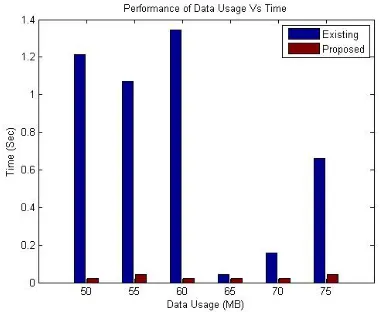
Our proposed data rate based vertical handoff is compared with distance based RSS handoff in 4G wireless networks [20]. Fig2 depicts the results for time comparison of different data usage using our proposed method and existing handoff method. Proposed method executes handoff based on data rate, when user need to download 50 MB data it connected from 2G to 3G. Whereas the existing handoff method is only based on RSS it could be connected with 2G network since MN received strong RSS from 2G base stations. So it consumed much time to access the data. Therefore, our proposed method is proved that this takes less time even the data usage is high.
[image:8.612.324.514.289.445.2]Fig2. Time Comparison For Various Data Usages
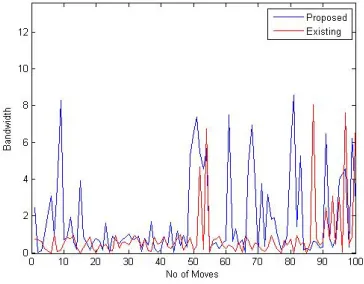
in case of MN connected with higher networks. Bandwidth was measured in Mbps and time was measured with measured in milliseconds in this experiments.
Fig 3.a. Bandwidth With Every Movement
Fig3.b. Bandwidth VS Data Usage
After the handoff process there is chance to data loss while transferring information of a mobile node from one network to another. So recovery technique was proposed based on checkpoint and logs. Case 1 and 2 saves the logs only in base station or mobile node. There is no assurance for lossless data recovery when handoff and failure occur. Every time transfer the logs from base station takes more time and recovery overhead whereas transfer from the mobile node also unsecured due to chance of memory crash in mobile node.
Fig 6 shows that the experimental results of case 3 mentioned in 5. Recovering data from base station corresponding to percentage of memory crash occurred in mobile node varies in time. Recovery
time increases when the amount of mobile memory crash increases. Since our proposed method uses one major condition to handoff from a network to another is data rate, which take less time to handover the mobile node. Existing methods have to check some other parameters to execute handoff. When MN handoff to 3G or 4G network under certain situation congestion is decreased showed in Fig4.
Fig4. Congestion Comparison
Fig5. Load Comparison
Fig7. Handoff time Comparison
From the above experimental results our proposed method for vertical handoff and data recovery in 4G wireless heterogeneous networks proved that it is much better than existing methods.
7. CONCLUSION
In this paper a novel method was proposed to execute data transfer rate vertical handoff in 4G wireless heterogeneous networks. The proposed method was implemented using MATLAB 7.10 in the environment of congested heterogeneous networks. This method was combined with the distance based RSS to handoff a mobile node. The data rate and RSS has simultaneously executed the vertical handoff in 4G wireless heterogeneous networks. Moreover an efficient data recovery technique was proposed which based on routinely stored logs and checkpoint. Since logs was stored in both base station and mobile node lossless data recovery has been achieved. Our proposed method was compared with Distance based RSS handoff and checkpoint based recovery scheme. The experimental results shows that the proposed method was much improved in both recovery time, bandwidth, and feasible and competent for high data usages.
REFERENCES
[1]A. Bhuvaneswari and Dr. E. George Dharma PrakashRaj,"An Overview of Vertical Handoff Decision Making Algorithms",I. J. Computer Network and Information Security,Vol. 4,pp. 55-62, 2012.
[2]MandeepKaurGondara and Dr.Sanjay Kadam, "Requirements of Vertical Handoff mechanism in 4G Wireless Networks", International Journal of Wireless & Mobile Networks (IJWMN), Vol. 3, pp. 2, 2011.
[3]IssakaHassaneAbdoulaziz, Li Renfa and ZengFanzi,"Handover Necessity Estimation for 4G Heterogeneous Networks", International Journal of Information Sciences and Techniques (IJIST), Vol.2, pp.1, 2012.
[4]Hyosoon Park, Sunghoon Yoon, TaehyounKim ,Jungshin Park, Misun Do, and JaiyongLee,"Vertical Handoff Procedure And Algorithm Between Ieee802.11 Wlan And Cdma Cellular Network",CIC'02 Proceedings of the 7th CDMA international conference on Mobile communications,Vol. 2524,pp. 103-112,2002.
[5]Rastin Pries, Dirk Staehle,David Hock and Matthias Hirth,"A Policy-Based Vertical Handover System",University of W¨urzburg Institute of Computer Science Research Report Series,pp.62, 2010.
[6]E.Arunand Dr.R.S.Moni,"Optimization Algorithm For A Handoff Decision In Wireless Heterogeneous Networks",International Journal of Next-Generation Networks (IJNGN) ,Vol. 2, pp. 3, 2010.
[7]HaijieHuang and JianfeiCai,"Adding Network-Layer Intelligence to Mobile Receivers for Solving Spurious TCP Timeout during Vertical Handoff"Journal
IEEE Network: The Magazine of Global Internetworking archive, Vol. 20,pp.24-31,2006.
[8]Cheng-Min Lin And Chyi-Ren Dow,"Efficient Checkpoint-based Failure Recovery Techniques in Mobile Computing Systems",Journal Of Information Science And Engineering,Vol. 17,pp. 549-573 ,2001.
[9]Abhijit Bijweand Dr. C.G.Dethe,"RSS based Vertical Handoff algorithms for Heterogeneous wireless networks - A Review",(IJACSA) International Journal of Advanced Computer Science and Applications,Special Issue on Wireless & Mobile Networks,2011.
[10]A. J. Onumanyi and E. N. Onwuka,"Techniques for vertical handoff decision across wireless heterogeneous networks: A survey",Scientific Research and Essays ,Vol. 6(4), pp. 683-687, 2011.
[12]SwagatikaPrusty,"Checkpointing and Rollback Recovery in Distributed Systems",Indian Institute of Technology, Guwahati , pp. 569-574,2009.
[13]PramodGoyal, and S. K. Saxena,"A Dynamic Decision Model for Vertical Handoffs across Heterogeneous Wireless Networks",World Academy of Science, Engineering and Technology, Vol. 31 , pp. 677-682 ,2008. [14]Mrs. Chandralekhaand Dr. Praffula Kumar
Behera, "Optimization Of Vertical Handoff Performance Parameters In Heterogeneous Wireless Networks",International Journal of Modern Engineering Research (IJMER), Vol. 1, pp. 597-601.
[15]PriyankaDey and SuparnaBiswas,"Handoff Based Secure Checkpointing And Log Based Rollback Recovery For Mobile Hosts", International Journal of Network Security & Its Applications (IJNSA), Vol.4, pp. 25, 2012.
[16]SuparnaBiswas, SarmisthaNeogy and PriyankaDey,"Mobility Based Checkpointing And Trust Based Recovery in Manet", International Journal of Wireless & Mobile Networks (IJWMN) ,Vol. 4, pp. 53, 2012. [17]TaesoonPark ,Namyoon Woo and Heon Y.
Yeom,"An Efficient Recovery Scheme for Mobile Computing Environment",Parallel and Distributed Systems,2003.
[18]M.Gopu, Dr. RiteshKhanna, “Integrated Three Layer Mobile Architecture for seamlessRoaming and User specific handoff in 4G networks”, International Journal of Scientific and Research Publications,Vol. 2, pp. 1-3, 2012.
[19]. A. Ferdinand Christopher and M. K. Jeyakumar, “Intelligent Congestion Aware Media Independent Handover for the 4G Heterogeneous Wireless Network”, International Journal of Soft Computing, Vol. 7, pp. 210 – 216, 2012.