ISSN: 1992-8645 www.jatit.org E-ISSN: 1817-3195
USING SOCIAL MEDIA AND CRM TECHNOLOGY IN
E-RECRUITMENT
1RAWAN ALMUSA, 2DR.WAFI ALBALAWI
1
Graduate Student, MIS Department, College of Business Administration, KSU 2
Chair, MIS Department, College of Business Administration, KSU
-mail: [email protected] , [email protected]
ABSTRACT
The online recruitment is one of the modern tool, adopted by prospective job seekers or employers to initiate the employment process. The latest technologies that facilitate the recruitment process are branch out from Web 2.0, such as social media and social customer relationship management (CRM). It is evident that companies are shifting trying from traditional CRM to social CRM in order to understand better customers’ need and offer optimal employment solutions. In this paper, researchers has address the role of social CRM towards the online recruitment process by analyzing intelligent solutions that assist recruitment companies to satisfy customers’ needs.
Keywords: Recruitment, Social Media, Customer Relationship Management (CRM), Job Seeker,
Employer.
1. INTRODUCTION
A traditional recruitment process has followed a predefine process for job announcement. These
announcements has disseminated through
company’s career portal, job portals, social media, mobile, consulting companies and so forth. The traditional life cycle of recruitment is heavily depend on human resources personnel to collect the resumes, shortlist the perspective candidates, organize interviews, references check and so forth.
During the interviews, recruiters analyze applicant’s communication skills and personality, and gauge if the applicant is a good fit for the organization. Electronic -recruitment or online recruitment is a term for performing recruitment process using internet, to be available 24 hours for employers and applicants, filtering electronic resume easily using selected criteria, and several recruitment functions to be automated and in parallel (Reiners & Alexander,2013).
Nowadays, internet is the most widely and vastly mode of communication available which has empowered millions of users by networking them socially to interact with each other beyond the expectations. Web 2.0 has even more influenced the users where they spend much of their time on social media such as social networking websites, multimedia site, user-sponsored blogs, podcasts,
corporate-sponsored websites, collaborative
websites, etc. Social media is a key component for
the success of any businesses from the business point view and presently social media tools are rapidly changing the communication of the organizations and customer relation management, Social media with use of internet service has emphasized by interacting and collaborating, creating opportunities between the organizations and the customers (Parveen, 2012). Hence, upon considering the aforesaid in this research proposes an interface model with three techniques to take advantage of social CRM in recruitment.
Targeting talented people becomes a competition between companies (Zhang & Zhou, 2012), knowing the fact that manpower is a critical key for enterprises to success and encouraging them to attract talented people around the world,
e-recruitment provides a global recruiting
environment that’s offers great volume of talented people and various expertise. The main goal of the recruitment process is employing the right person in the right position that can fulfill the enterprise needs, so in the long run will affect the enterprise’s revenues and performance (Khosla & Goonesekera, 2003).
ISSN: 1992-8645 www.jatit.org E-ISSN: 1817-3195
The utilizing of social media for recruitment is an approach that is appreciated by applicants globally. Organizations should also make use of the social media to find the suitable candidates, as most people spend a lot of time on the social media. Many posts we can find in social media contain job opportunity announcements, job seeker ask for a job that aligns with his/her qualifications. In addition, social media can help in describing
peoples’ interests, personality, exchanged
information, online socializing and opinion about any trend subject. On the other hand, it shows an enterprises’ profile, image, reputation, internal staff
communications and conversations, and
interactions with their customers.
The social media sites are not the only way of communication and maintaining the relationship with customers, but it’s also an important part of the social CRM that enables any enterprise to insight the customer needs in an external environment where recruitment parities exist, whether job seekers or employers (Sharma, 2011). In the present competitive business environment the success of the organization has increased by CRM though which the organizations can understand the customers’ requirements. CRM helps in enabling the development and implementation of the customer focused strategies in an effective and efficient manner (Chang, Park & Chaiy, 2010). However, the real value that comes from using social CRM is to understand the desires of applicants in finding the perfect job that fits his/her skills, meets his/her ambitions and makes them more productive. Therefore, it’s causing a growth in the profit and performance, and decreases the employees’ turnover rate (Khosla & Goonesekera, 2003; Zhenan & Hong Fang, 2012). Social CRM helps in achieving this value by analyzing and categorizing the social media collected data and using CRM’s functionalities. This paper will propose an interface model followed by three techniques which will utilize the social data and Talent Network Forms which is acquiring different talents from different countries, for capturing the candidate’s information by the employers and build better relationships accordingly.
The previous studies explored many ways of social media data analysis using information filtering, categorization and posts tag-based (Aihua & Xi, 2012). Certainly, there are some limitations and barriers of using social networking sites in e-recruitment industry, for instance cultural and language differences, having a global recruiting
environment by using the internet and social networks around the world, some countries had various ways in the recruiting process and idea acceptance. Another barrier is the privacy and security of applicants profiles in social media, many users’ social media profiles are private and this will impede the effectiveness of taking advantage of this technology.
2. RATIONALE OF THE STUDY
Recruitment is an essential part of any business,
and increasing the probability of success
recruitment will increase the business growth. Nowadays, the number of unemployed people is increasing due to continuing of use same process without innovation or weak utilizing of useful data such as social media in the recruitment process. Also diminishing the growth of business due to unproductive and unfulfilled employees. This study will develop the recruitment process and utilize the big data from different social media platforms in order to solve this problem.
3. DEFINITION OF TERMS
Recruitment Company or Agency ــــ defined as “A recruitment agency acts as an intermediary between an organization that is looking to employ someone and an individual who is looking for a job. A recruitment agent’s main function is to source the most suitable person for a job vacancy that they have been asked to fill”. (The London School of Economics and Political Science, 2013).
Employer ــــ was defined as “A legal entity that controls and directs a servant or worker under an express or implied contract of employment and pays (or is obligated to pay) him or her salary or
wages in compensation.” (Business Dictionary,
n.d.).
Applicant or Job Seeker ــــ was defined as “a
person who is actively looking for employment” (Dictionary.com, 2015).
CRM ــــ was defined as “a combination of
people, processes and technology that seeks to understand a company’s customers” (Mousavi & Demirkan, 2013).
Social media ــــ defined by Kaplan and Haenlein
(2010) as “a group of Internet-based applications
that build on the ideological and technological foundations of Web 2.0, and that allow the creation and exchange of user-generated content”,
Social media categorized into six forms such as
ISSN: 1992-8645 www.jatit.org E-ISSN: 1817-3195 communities, social networking sites, virtual game
worlds and virtual social worlds” (Aihua & Xi, 2012), in this paper we are focusing on social networking sites.
Recently, social networking sites become a big part in people daily activities, moreover, the whole world adapted this technology in diverse contexts (Graupner et al., 2012), such as marketing, education, customer service, entertainment, health care, politics, advertisement, recruitment and building different kind of relationships (between businesses and clients).
4. PROBLEM STATEMENT
It is critical for head hunters to locate and select the appropriate applicant for the open positions. In this respect, available pool of applicants needs to be through interviewed to match the best. Also, increased the number of unemployed people, and the number of employees that had not satisfied with their current positions which is not fitting their interest, preferences and qualifications. This will lead of having an employee that not reached his/her
ambitions; therefore it decreases his/her
productivity while the company will lose profits and resources (Wang et al., 2008).
To solve this problem, better understand job seekers and employers’ needs, by getting some significant information that cannot be obtained from the traditional CRM such as: customer personality and behavior. This work is established to eliminate these problems and enhance the recruitment process, and having more recruitment deals to gain more profits.
5. RESEARCH OBJECTIVES
The main objective of this research is to accomplish a successful recruitment process by matching the job seeker with opportunities using social CRM. In this research a model is proposed that following three techniques to take advantage from the combination of CRM and social media technologies, and having an affective recruitment process by eliminating the recruitment problems like employees’ nonsatisfaction, low productivity and enterprise losing profits and resources. The techniques are conducted from literature reviews and employed in the recruitment business, such as having composite user profile that consists integrated information from multiple resources to better understand customers. The other technique is looking for customer satisfaction by focusing on the customer orientation process. The last technique is
to analyze and categorize customers’ posts in social media to maintain the relationship with customers.
6. RESEARCH QUESTIONS
• How to use social media and CRM in the
recruitment process.
• How to combine three techniques from previous
studies into one comprehensive framework.
• What are the components of the proposed model
or framework?
7. LITERATURE REVIEW
Previous researches were mainly focusing on the use of social media and CRM technologies in sales
and marketing business, by building and
maintaining the relationship with their customers and more understanding of customers’ needs (Abrouk et al., 2013; Peterson et al.,2014; Ajmera et al., 2014). In addition, researchers took advantage of this in promoting their products and services, allowing customers to rate and evaluate these products and services, and getting much feedback from social media posts to enhance current services and provide new products, which eventually led to increased companies’ revenues and profits
The work of researchers and their suggestions in using different techniques, used by most enterprises as main strategy and essential customer care channel. The previous researchers did a great work in this business field and offered a good opportunity to implement their studies in other business areas.
In the paper written by Gahitte, Abrouk et al. (2013), they proposed the concept of composite user profile (Figure 1), which contains a set of
integrated user information from multiple
resources, such as the company’s CRM and user’s Twitter account to end up with one single account. The authors' purpose is to categorize users into communities, each with particular needs, because
this composite profile will clarify more
ISSN: 1992-8645 www.jatit.org E-ISSN: 1817-3195 a better understanding of customers and their
interests.
The authors mainly focused on the concept of increasing profits by enhancing social CRM, which describes the interaction between customers on the social media, such as promoting company’s products or reputation, our aim in this paper is only to increase the transparency between recruiting clients, by having in addition of applicant’s resume that consist of basic information, such as his/her name, age, town, qualifications, experience and skills, we can feed his/her master profile by getting more data that reflects his/her personality, behavior and what kind of job he is looking for that meets his/her expectations, from his/her multiple social media accounts and posts in Facebook, LinkedIn and Twitter. In other hand, the employer’s profile will contains information and overview about this company, available positions, jobs descriptions, what people are saying about them on social media, how they behave with their customers and employees, and how the relationship between their employees is.
[image:4.612.316.532.392.500.2]The main type of CRM that used in this proposal called Generic tools or Frameworks, it is a customized CRM that meets the company needs, and this type of CRM can be easily integrated with social networks applications (Abrouk et al., 2013).
Figure 1: DisCoCRM and User Profile [1]
The second technique that implemented in our proposed model was suggested by Rodriguez et al.
(2014), is a model called CUSTOMER
ORIENTATION MEDIATION MODEL, a model that looking for customer satisfaction, to increase sales performance and gaining profit. The authors highlighted the advantage of having CRM and social media technologies to enhance the sales performance by focusing on the customer orientation process and the relationship with the
customer. This study approved the effectiveness of
CUSTOMER ORIENTATION MEDIATION
MODEL in sales and marketing industry on a sample of business executives from a range of enterprises. Also this study provided evidence those technologies such as CRM and social media, positively impacts customer-orientation processes.
[image:4.612.97.304.442.578.2]An opportunity for further study was mentioned in this paper, which is implementing this model in different industries, and that’s what our work is about, is employing the COM model in the recruitment industry. In our proposed model we used this theory by taking the advantage of those two technologies, and focusing on the relationship with recruitment clients (Job seeker and employer), by enhancing the recruiting process. In our case, the main customer orientation process is matching each job seeker with an appropriate job, based on his/her education, experiences, qualifications and other criteria that determined by the company that’s looking for a perfect candidate. Achieving this will enhance the recruiting process as well, because it’s concentrating on customer needs or customer oriented (Figure 2).
Figure 2: Customer Orientation Mediation Model for recruitment process
Capturing this kind of information from social media will show what the interests of all parties are, understand and consider the customer preferences in the recruitment process. More understanding of the customer orientation process in the recruitment method, means getting more appropriate jobs for job seekers.
ISSN: 1992-8645 www.jatit.org E-ISSN: 1817-3195 think about products and services, classifying posts,
and taking action. Applying this tool for recruitment development will detect more job opportunities posts, and applicants’ job wishes, because customers always explaining their concerns and needs using social media like Facebook, Twitter and specially LinkedIn.
The analyzing mechanism works by defining specific keywords, and collecting all posts from different social media sites, which containing the defined keywords. In order to achieve the objective of this research, the analysis goes into two categories: job seeker’s needs category, and company’s available positions with descriptions category. In recruiting business it’s easy to detect posts in social media, because this will include certain and counted keywords such as “I’m looking for a job” or “I need an opportunity”, or announcing available positions such as “we are looking for candidates” and more. After analysis, an action should be taken, by matching the job with the candidate and accomplish a success recruitment process. By implementing this technique in the interface, recruitment companies can acquire new customers that may find a good job and the best candidates.
This system had many limitations, such as the different text structure of multiple social media sites and users’ incorrect spelling typing. Another limitation was mentioned in this study we don’t consider it as one in our proposed model, is data labelling, it easy to perform in the recruitment industry since we have only few labels based on specific keywords such as job opportunities, and potential candidates.
8. RESEARCH METHODOLOGY
In this research, we followed non-empirical methodology. A new recruiting model was proposed based on a deductive study from a number of researches in sales and marketing industry.
Each component of the proposed model is to be analyzed for feasibility in fitting the recruitment industry. On the other hand, the model’s integrated components will also be studied for effectiveness.
9. RECRUITMENT SOCIAL CRM MODEL
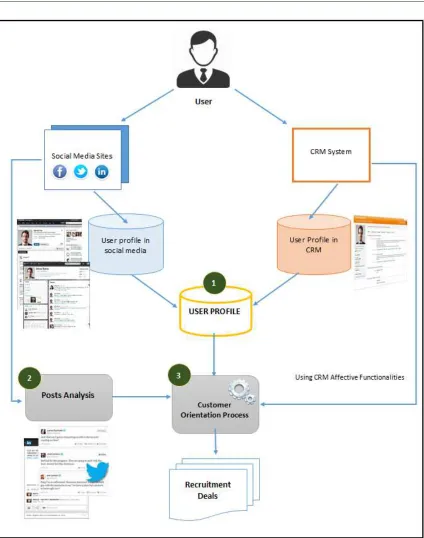
The proposed model in this paper introduces the combination of two worlds, CRM and Social Media sites, called RECRUITMENT SOCIAL CRM MODEL (Figure 3). This model could be implemented in recruitment companies, while their
main clients are: applicants and employers. This will have the power of CRM functionalities and social media data, to achieve the main goal of the recruitment process which is matching and employing the right person in the right position that can fulfill the enterprise needs, accomplish a successful recruitment process, and generating more and more recruitment deals. Details to clarify the proposed model’s concept are provided in the following sections.
8.1 Stakeholders roles
8.1.1 Recruitment company:
The role of Recruitment Company is acquire new clients either applicants or employers from social media or maintain existing ones using company’s CRM system. By implementing the proposed model, the company can achieve its main role which is matching applicant with appropriate job.
8.1.2 Employer:
The role of employer is to apply for Recruitment Company to be a client and having a profile in company’s CRM, or could be acquired from social media sites, so the company can achieve the employer needs by providing the best candidates for its vacancies.
8.1.3 Applicant:
The role of this entity is to apply for Recruitment Company to be a client and having a profile in company’s CRM, or could be acquired from social media sites, so the company can search and find the best vacancies or job descriptions that satisfy the applicant needs and desires.
8.2 Architecture Description
In figure 3, the model represented all combined three techniques we mentioned previously, its components, and where each one is located, the following describes each component:
8.2.1 User:
The user entity is the recruitment company’s client, whether job seeker that is looking for a job to meets his/her expectations, or employer that is looking for the best candidate to fits the job description and skills. The recruitment process needs those two parties to achieve the recruitment deal goal.
ISSN: 1992-8645 www.jatit.org E-ISSN: 1817-3195
Mainly we focused on Facebook and Twitter social media sites, since they are the top two popularity in generating daily posts and have a large volume of personal profiles. Researchers has investigated also LinkedIn platform which is the
largest professional network that gathers
professionals in one place as a business community. Some people may wonder if LinkedIn is enough in providing all recruitment requirements and solving this paper problem. We should insight that LinkedIn still doesn’t reach the full desires of their users and analyzing all users’ dimensions, especially customer’s behavior. In addition, as a job seeker, LinkedIn didn’t achieve 100% of success in offering the applicant with a suitable job. For example, a job seeker with information technology qualification and experience Java programming, he gets a job suggestion like Marketing Specialist, as a career development, the programmer will never
switch his career development from Java
programmer developer to marketer. In contrast, as recruiters they can find candidates by searching in specific criteria’s, or applicants that applied to their job offers. There is no intelligent process that can match an applicant with a job without any searching effort from both parties. So in this model we considered LinkedIn limitations to have affective and the automated recruitment process that’s highlighted applicant’s behavior, and recruiters’ employees’ relations to discover enterprise environment. We can use social media sites by collecting generated data, whether posts or users’ profiles to be as an input in the mentioned techniques to proceed.
8.2.3 CRM system:
In CRM system, which implemented in recruitment companies, researchers has used its main functionalities such as building and maintaining the relationship with customers, collecting the recruitment customers’ information and needs, assessing and analyzing customer preferences, acquiring more customers, and achieving customer’s satisfaction.
8.2.4 User profile in social media:
User profile in social media means user multiple social media accounts on Facebook, LinkedIn and Twitter that contain many information, such as applicant’s basic information, name, age, town, interests, information that reflects their personality and behavior, and his/her posts and opinion about any trend subjects. The employer profile will
contains information about this company, maybe some posts about available positions, what people are saying about them on social media, how they behave with their customers and employees, and how the relationship between their employees is.
8.2.5 User profile in CRM:
As recruitment company, CRM system will contain their clients’ fundamental information that required for traditional recruitment, such as
applicant’s résumé that consist of basic
information, such as his/her name, age, town, qualifications, experience and skills and what kind of job he/she is looking for that meets his/her expectations. As employer an overview about their company, available positions, job descriptions, and what kind of candidates they are looking for.
8.2.6 Single user profile:
The single user profile is the first technique which is represented and labeled with the model as the number (1), (see Figure 3). The single user profile is a composite user profile that consists integrated information from multiple resources to
better understand customers that includes
information from both user profile in social media accounts and user profile in the CRM. This profile will be the main input for the customer orientation process.
8.2.7 Posts analysis:
Posts analysis is the second technique which is represented and labeled with the model as the number (2), (see Figure 3). This technique is mainly for analyzing posts exist in social media, not for specific accounts, but generally published posts on Facebook, Twitter and specially LinkedIn. This analysis will detect more job opportunities posts, and applicants’ job wishes. The mechanism of analysis works by searching on specific keywords such as “I’m looking for a job” or “I need an opportunity”, or announcing available positions such as “we are looking for candidates” and more.
After analyzing and collecting the data, the posts should be categorized to achieve research objective, the categorization goes into two categories: job seeker’s needs category, and company’s available
positions with descriptions category. By
ISSN: 1992-8645 www.jatit.org E-ISSN: 1817-3195
8.2.8 Customer orientation process:
Customer Orientation Process the third technique that is represented and labeled with the model as the number (3), (see Figure 3). The customer orientation process is matching each job seeker with an appropriate job, based on criteria that determined by the applicant and employers, and more understanding for their needs. To achieve the customer satisfaction and consider the clients’ preferences in the recruitment process will enhance the recruiting as well, because it’s concentrating on customer needs or customer oriented. In addition, this technique is also processes the social media posts that analyzed from the previous technique (Posts Analysis) to complete extra recruitment matching. .
10. CONCLUSION
In this paper, researchers have presented Recruitment Social CRM Model that utilized social media technology and its generated big data to improve and accomplish a successful e-recruitment process. This model can be implemented in recruitment companies to assists in the process of matching an applicant with a job offered based on predefine criteria. This model was conducted from many previous studies that demonstrated the effectiveness of these techniques. This paper has implemented three techniques in a common interface to be used by any Recruitment Company. This model took the advantage of combining CRM and social media technologies in order to understand the current customers that exist in CRM as well as potential customers that exist in Social Media Sites, to satisfy and retain them which eventually led to gain more profit. Adopting this study will change the recruiting world since every employee will be satisfied with his/her job that will increase the chance of being innovative. In contrast, this will increase the evolution of companies and productivity by acquiring this kind of applicants.
The future work is recommendation to prototype the system, and implement in recruitment companies in order to validate the effectiveness of this model, and performing intelligent action toward the big data exists in social media.
REFRENCES:
[1] Z. Aihua and C. Xi, "A review of social media
and social business," in Multimedia
Information Networking and Security
(MINES), 2012 Fourth International
Conference on, 2012, pp. 353-357.
[2] J. Ajmera, H.-i. Ahn, M. Nagarajan, A. Verma, D. Contractor, S. Dill, and M. Denesuk, "A CRM system for social media: challenges and
experiences," in Proceedings of the 22nd
international conference on World Wide Web, 2013, pp. 49-58.
[3] H. Amintoosi and S. S. Kanhere, "A trust-based recruitment framework for multi-hop
social participatory sensing," in Distributed
Computing in Sensor Systems (DCOSS), 2013 IEEE International Conference on, 2013, pp. 266-273.
[4] N. An, J. Liu, L. Wang, and Y. Bai, "Employee Satisfaction as an Important Tool in Human
Resources Management," in Wireless
Communications, Networking and Mobile
Computing, 2008. WiCOM'08. 4th
International Conference on, 2008, pp. 1-4. [5] O. Y. Z. An and T. H. Fang, "A Survey and
Empirical Study of Employee Satisfaction in Growing Small and Micro Businesses," in
Business Computing and Global
Informatization (BCGIN), 2012 Second
International Conference on, 2012, pp. 34-38. [6] A. L. Bartell, "Recruiting research participants
with social media: A proposal for a body of
knowledge," in Professional Communication
Conference (IPCC), 2014 IEEE International, 2014, pp. 1-5.
[7] I. Basaille-Gahitte, L. Abrouk, N. Cullot, and E. Leclercq, "Using social networks to enhance
customer relationship management," in
Proceedings of the Fifth International
Conference on Management of Emergent Digital EcoSystems, 2013, pp. 169-176. [8] W. Chang, J. E. Park, and S. Chaiy, "How
does CRM technology transform into
organizational performance? A mediating role of marketing capability," Journal of Business Research, vol. 63, pp. 849-855, 2010.
[9] X. Chen, K. Madhavan, and M. Vorvoreanu, "A Web-Based Tool for Collaborative Social
Media Data Analysis," in Cloud and Green
Computing (CGC), 2013 Third International Conference on, 2013, pp. 383-388.
[10] S. M. Grant-Muller, A. Gal-Tzur, E. Minkov, S. Nocera, T. Kuflik, and I. Shoor, "Enhancing transport data collection through social media sources: methods, challenges and opportunities for textual data," IET Intelligent Transport Systems, vol. 9, pp. 407-417, 2014. [11] S. Graupner, C. Bartolini, H. Motahari, and J.
Erbes, "Evolving Social Media into
ISSN: 1992-8645 www.jatit.org E-ISSN: 1817-3195 Conference (SRII), 2012 Annual, 2012, pp.
183-190.
[12] A. Habul and A. Pilav-Velic, "Business
intelligence and customer relationship
management," in Information Technology
Interfaces (ITI), 2010 32nd International Conference on, 2010, pp. 169-174.
[13] A. A. Hamed, X. Wu, and J. R. Fingar, "A Twitter-based smoking cessation recruitment
system," in Proceedings of the 2013
IEEE/ACM International Conference on Advances in Social Networks Analysis and Mining, 2013, pp. 854-861.
[14] S. A. Hamid, H. Abouzeid, H. S. Hassanein, and G. Takahara, "Optimal recruitment of smart vehicles for reputation-aware public
sensing," in Wireless Communications and
Networking Conference (WCNC), 2014 IEEE,
2014, pp. 3160-3165.
[15] N. Karna, I. Supriana, and U. Maulidevi, "Social CRM using web mining," in
Information Technology Systems and
Innovation (ICITSI), 2014 International Conference on, 2014, pp. 264-268.
[16] R. Khosla, "An online multi-agent e-sales
recruitment system," in Web Intelligence,
2003. WI 2003. Proceedings. IEEE/WIC International Conference on, 2003, pp. 111-117.
[17] N. King and L. Khauli, "IT control over social media technology: A systems view of social
media management," in Systems Conference
(SysCon), 2015 9th Annual IEEE
International, 2015, pp. 634-638.
[18] S. M. Mousavi and H. Demirkan, "The Key to Social Media Implementation: Bridging Customer Relationship Management to Social
Media," in System Sciences (HICSS), 2013
46th Hawaii International Conference on, 2013, pp. 718-727.
[19] C. Oehri and S. Teufel, "Social media security
culture," in Information Security for South
Africa (ISSA), 2012, 2012, pp. 1-5.
[20] T. O'reilly, "What is Web 2.0: Design patterns and business models for the next generation of software," Communications & strategies, p. 17, 2007.
[21] F. Parveen, "Impact Of Social Media Usage
On Organizations," in PACIS, 2012, p. 192.
[22] T. Reiners and P. Alexander, "Social Network Perception Alignment of E-Recruiters and
Potential Applicants," in System Sciences
(HICSS), 2013 46th Hawaii International
Conference on, 2013, pp. 4576-4585.
[23] M. Rodriguez, R. M. Peterson, and H. Ajjan,
"CRM/social media technology: impact on
customer orientation process and
organizational sales performance," in Ideas in
Marketing: Finding the New and Polishing the Old, ed: Springer, 2015, pp. 636-638. [24] D. K. Sharma, "A social network perspective
by CRM," in Granular Computing (GrC),
2011 IEEE International Conference on,
2011, pp. 351-356.
[25] B. S. Solomon, D. Duce, and R. Harrison, "Methodologies for using Social Media
Collaborative Work Systems," in
Requirements Engineering for Social
Computing (RESC), 2011 First International Workshop on, 2011, pp. 6-9.
[26] A. Suh and G.-W. Bock, "The Impact of Enterprise Social Media on Task Performance
in Dispersed Teams," in System Sciences
(HICSS), 2015 48th Hawaii International
Conference on, 2015, pp. 1909-1918.
[27] W. van Osch and C. K. Coursaris,
"Organizational social media: A
comprehensive framework and research
agenda," in System Sciences (HICSS), 2013
46th Hawaii International Conference on, 2013, pp. 700-707.
[28] W. Zhang and C. Zhou, "How to enhance effectiveness of Internet recruitment of
enterprises," in Consumer Electronics,
Communications and Networks (CECNet),
2012 2nd International Conference on, 2012,
pp. 2623-2625.
[29] 12 February 2013. [Online]. Available: http://www.lse.ac.uk/intranet/CareersAndVac ancies/careersService/CareerPlanningJobHunt ing/JobHunting/RecruitmentAgencies/Recruit mentAgencies.aspx.
[30] "Business Dictionary," [Online]. Available: http://www.businessdictionary.com/definition /employer.html
ISSN: 1992-8645 www.jatit.org E-ISSN: 1817-3195
![Figure 1: DisCoCRM and User Profile [1]](https://thumb-us.123doks.com/thumbv2/123dok_us/8909007.958291/4.612.316.532.392.500/figure-discocrm-and-user-profile.webp)