ISSN: 1992-8645 www.jatit.org E-ISSN: 1817-3195
DATA MINING APPROACH TO ASSESS CONDITION OF
ROTATING MACHINE USING SOUND SIGNAL
1MOHAMMED AREF ABDUL RASHEED 2MANSOUR NASER ALRAJA
1,2
Asstt Prof., Department of Management Information Systems, Dhofar University
Email:
1[email protected], [email protected]ABSTRACT
Retrieval of beneficial information, knowledge and development of new methods can be carried out using data mining for visualizing and analyzing the data. In the environment several kinds of data are present and can be converted into distinct patterns. In automobile, every rotating machine components emit some kind of sound signals. These signals are due to vibration or friction of the rotating machine components. The emitted sound signal contains noise as well as useful data. The useful data provides the significance information about the machine operational status and can be employed for condition assessment of a rotating machine. This paper aims to describe the condition of automobile rotating machine using data mining approach through sound signals.
Key words: Information System, Signal Processing, Data mining, MCI
1. INTRODUCTION
The information systems play an imperative role in our daily life and development of varieties of business sectors. The application of information systems can be identify as a huge umbrella which covers plenty of research areas. One of the application areas is production and trouble shooting of a machine. The machine is the single most defining entity of the modern era. Its role at the turn of the twentieth century was a central one, which led to its application in almost all fields of human development viz invention of automobiles. An automobile is the combination of structure and complex machines. A machine is any device that uses energy to perform some activity. In common usage, it is a device having parts that perform or assist in performing any type of work. There are several types of machines most of them are rotating machines. The rotating machines have become mandatory part of all sectors of the industry. One of the biggest applications of a machine was in the form of motorized technology which became an integral part of the early automobile industry. Finally, in today’s world we are very much reliant on machines. One can’t imagine the life without support of machines. Any disruption in machines has affect on human life. Therefore, there is a continuing struggle to be able to keep the machines in working condition. Any breakdown or disruption
ISSN: 1992-8645 www.jatit.org E-ISSN: 1817-3195 signals also contain imperative information about
the operational status of a machine and can be used in condition assessment of a rotating machine [11]. Stationary features are appropriate for machine
condition assessment. The machine emits
continuous acoustic signals, and condition is reflected in altered sound patterns. Hence, the changes in emitted sound signal and its parameters are very well suited for condition assessment [13]. The problem of condition assessment is of utmost importance and constitutes an imperative issue in maintenance management strategies in order to reduce the failures and their consequences. Early detection of fault can increase machinery reliability and performance, reduce consequential damage, prolong machine life and reduce spare parts inventories and breakdown maintenance. So, condition assessment has received considerable attention in recent years [5]. By performing an aural inspection, an expert human operator or technician detects the fault in a machine while the machine is in operation. In such method, on several occasion the human ear may not able to differentiate sound patterns accurately. So, to make machine-computer interaction (MCI) more natural and friendly, it would be beneficial to give computers the ability to recognize the situation in the same way as a human does [17].
Manual condition assessment process essentially
involves hands on rich experience about
symptomatic features. Adoption of personal diagnostic skills and previous knowledge or experience does play an important role in condition assessment. Thus there is an increasingly need to develop computerized programs, techniques or systems that would be able to do so without the disassembling the unit.
The amount of data in the world seems to be increasing continuously. It results overwhelmed. It requires devoted efforts to discover interesting exceptions from data in data mining. An exception differs from the rest of data and thus is interesting and can be a clue for further discoveries [3]. Data mining becomes our hope for elucidating the useful data. Currently, saving of data via computer is too easy that previously we would have trashed. The data may be of any type such as textual, image, video or audio. Data mining techniques can be applied to acquire the data from simulations, experiments or observations in various scientific domains. Various researchers define data mining as the process of discovering patterns in the data. This process can be automatic or semiautomatic [7]. Data mining can also be defined as the steps in the Knowledge Discovery in Database (KDD) process
in which patterns are extracted from data. The extraction of patterns from the data increases opportunities and applicability in the field of scientific research. The pattern contains the information which can be useful for deriving significant results. In our study the patterns of sound have been taken into consideration.
2. CONDITION ASSESSMENT
The first document related to acoustic emission technology (AET) was reported by Balerston in 1969. Interestingly, this is probably one of the
earliest applications related to condition
monitoring. Since there has been increase in research of application-based studies in rotating structures. Balerston, Rogers, in 1979 utilized the sound technique for monitoring slow rotating antifriction slew bearings on cranes employed for gas production, and obtained some encouraging
results compared to vibration monitoring
ISSN: 1992-8645 www.jatit.org E-ISSN: 1817-3195 demands in fault detection [12]. Therefore there is a
need to use an approach which may assess the condition of automobile rotating machine using data mining approach which has been presented in this paper. The presented condition assessment method can be applied without disassembling the machine. It reduces efforts and time required to assess the condition of rotating machine.
3. SCIENTIFIC DATA MINING
TECHNIQUE
Data mining is the application of relatively novel data-driven approaches to find patterns in obtained data. The significance of data mining is to find
patterns which are not predicted by established
theories. The data mining techniques have been used to relate these unusual patterns to the operational condition of the equipment.
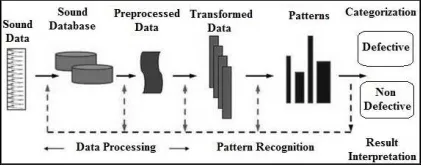
Figure 1: Adopted Scientific Data Mining approach for automobile machine health condition
Data mining provides an alternative to the traditional scientific method, where data analysis is highly developed and directed by hypothesis and theory [1, 14]. The traditional scientific data mining method has been adapted as shown in the given figure.
3.1 Data Acquisition
The study has been carried out on automobile rotating machine of passenger cars. The data acquisitions have been done from rotating machines. The proposed method adopted the signal-processing routines in information system as shown in figure 2.
The input power supply kept constant for all the rotating machines. During operation of the machine the emitted sound has been captured by the microphone using computer. Which, convert analog sound signals into digital data. The converted digital data save into the computer memory. To assess the condition of rotating machine, sound emitted by the machine has been considered. Transient is dynamic acoustic phenomena caused
[image:3.612.314.518.139.187.2]by friction and other events, can be detected through frequency analysis of emitted sound.
Figure 2: Principle of signal processing system
The presence of a noise in sound can make it difficult to analyze the data. This is especially true in the case of sound data if source of interest are occluded or not clearly separated from the background sound. In such cases, it may be difficult to remove noise from the sound. There are several specific domain algorithms available to reduce the noise in sound. This is because the noise in the data may be due to domain effects such as data acquisition sensor characteristics or external circumstances. Hence, the preprocessing techniques and algorithms have been applied to remove noise from the sound.
3.2 Sound Signal Analysis
The time waveform of the signal has been shown in figure 3 achieved from the developed information system. From these signals, we can compare the differences between the waveform. The waveform represents of new (a), old (b) and friction (c) of rotating machine. The friction occurs due to misalignment.
(a)
(b)
(c)
Figure 3: Sound Signal (a) New (b) Old (c) Friction
The signals are approximate sinusoidal waves with
frequency of rotation speed. The sound
characteristics of faulty rotating machine (old and friction) are sinusoidal with number of cycles per revolution. The signal also gives some indication of variations of machine behavior but it does not help much in condition assessment of a machine.
[image:3.612.90.302.330.413.2]ISSN: 1992-8645 www.jatit.org E-ISSN: 1817-3195
The components of this information system have various phases such as acquisition, quantization, coding, and preprocessing and feature extraction. The features can be extracted using frequency analysis. This method is most common and prominent to analyze the sound data. At first, transient part, DC offset and silence parts have been eliminated from the signal. Further, the data was normalized to zero-mean amplitude, then the system separate the whole data into various
adjacent blocked into frames, each frame kept (Xn, ;
where n=1,2..N) sequentially with an overlap between adjacent frames [6].
−
=
N
i
Cos
i
π
ω
0
.
54
0
.
46
2
..(1)i ni
ni
x
x
′
=
ω
i
=
0
,
1
,
2
...
N
−
1
Each complete set of samples (Xn) considered in
one frame, a pre-processing smoothing filter, the hamming window is used in subsequent Fast Fourier analysis. The cepstrum of a time domain signal is the Inverse Fourier Transform of the magnitude spectrum of the signal. The log-magnitude spectrum of a real signal is a real and even function, thus the cepstrum is normally computed via Discrete Cosine Transform which is equivalent with the Fourier transform in case of even functions.
A standard FFT algorithm is applied to each preprocessed frame.
∑
−=
−
=
10
2
N
n
nk N
i
n
k
x
e
X
π
…..(2)
1
...,
,...
0
−
=
N
k
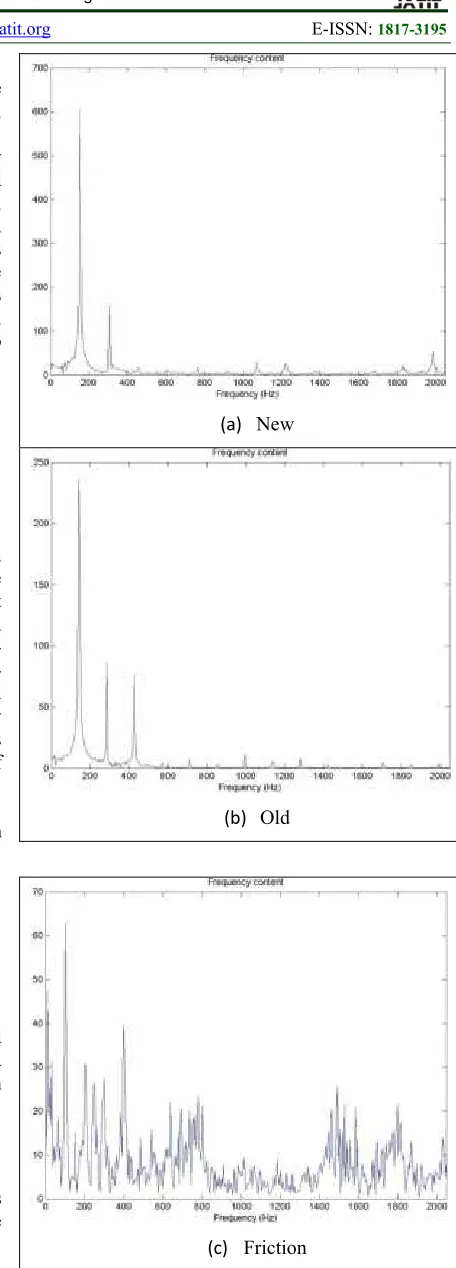
The output/result component from the described information system is shown in figure 4 which is a set of 2000 FFT coefficients. These windows can be received through the system.
4. RESULTS
To achieve the desired results, FFT technique was used which is the most admired and reliable techniques in signal processing system.
(a) New
(b) Old
[image:4.612.298.526.67.701.2](c) Friction
ISSN: 1992-8645 www.jatit.org E-ISSN: 1817-3195
The results of the sound analysis are described in this section. It illustrates the FFT plot for good
condition/non- defective and bad
[image:5.612.107.280.214.337.2]condition/defective automobile rotating machine. Following figure represents the FFT of different conditions. The FFT of new rotating machine depicts smooth plot whereas for old, high frequencies are absent.
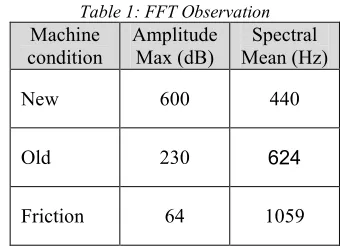
Table 1: FFT Observation Machine
condition
Amplitude Max (dB)
Spectral Mean (Hz)
New 600 440
Old 230 624
Friction 64 1059
Due to misalignment the output of such analysis received high level of noise characteristic frequencies which is one of the useful and valuable parameter for finding the health of condition assessment of automobile rotating machine, whereas for weak condition/old machine sound has missing frequencies compare to the new machine.
The RMS value of dB and frequency also been studied in this research but it doesn’t have direct relation with performance of rotating machine. The FFT observation table depicts the spectral mean values. These values are significant in identifying the defective non defective machine. The increase in spectral mean values is indication of initialization or occurrence of minor decay and defect in the machine.
5. CONCLUSION
In this paper, a non-destructive condition assessment approach has been proposed for automobile rotating machine using data mining technique through frequency domain analysis on acoustic signals. The useful information has been extracted using of the sound signals using data mining techniques. The extracted features are sensitive to condition assessment of rotating machine.
The salient feature of the study is as follows:
The proposed information system can be
used in condition assessment for
automobile rotating machine without dissembling the unit.
The proposed system is effective,
compact, convenient, portable and
economical. It has got real promising application. It can also be used in machine manufacturing plants for testing purpose for enhancing quality and reliability. It provides the benchmarking towards the condition of rotating machine.
Real test has been given to evaluate the proposed system performance. Three motors with different conditions have been presented as a test case. The results obtained by frequency analysis are in agreement with the results with the manual analysis. The major limitation of this study is the existence of noise in environment. The study can be revealed the appropriate results if and only if absences of noise exist but in this case the selection of filter becomes utmost importance.
REFRENCES:
[1] A MOHRAIN, 2003, ”Bearing Defect diagnosis
and acoustic emission”, Institution of
Mechanical Engineering, Journal of Engineering Tribology, Sage Publications Vol. 217, No. 4, 257-272.
[2] AL-GHAMD, ABDULLAH. M, M. DAVID,
2006, “A Comparative experimental study on
the use of acoustic emission and vibration analysis for bearing defect identification and
estimation of defect size”, Mechanical systems
and signal processing, Vol 20, Issue 7, 1537-1571.
[3] EINOSHIN SUZUKI, 2006, “Data Mining Methods for Discovering Interesting Exceptions
from an Unsupervised Table”, Journal of
Universal Computer Science, vol. 12, No. 6, 627-653.
[4] H. L. BALERSTON, 1969, “The Detection of
Incipient Failure in Bearings”, Materials
Evaluation, Vol. 27, 121–128.
[5] H. TIAN, Y. BO-SUK, Y. ZHONG-JUN, 2007, “Feature-based fault diagnosis system of induction motors using vibration signal”,
ISSN: 1992-8645 www.jatit.org E-ISSN: 1817-3195 [6] H. WU, M. SIEGEL, P. KHOSLA, 1999,
“Vehicle sound signature recognition by frequency vector principal component analysis”,
IEEE transactions on instrumentation and measurement, vol. 48, No. 5.
[7] IAN H. WITTEN, EIBE FRANK, 2011 “Data Mining, Practical machine learning tools and
techniques”, 2nd Edition, Elsevier Publications,
ISBN 13- 978-0123748560.
[8] L. M. ROGERS, 1979, “The Application of Vibration Analysis and Acoustic Emission
Source Location to On-line Condition
Monitoring of Anti-friction Bearings”,
Tribology International, Vol. 12, No. 2, 51–59.
[9] M. W. HAWMAN, W. S. GALINAITIS, 1988, “Acoustic Emission Monitoring of Rolling
Element Bearings,” Proceedings of the IEEE
Ultrasonics Symposium, Chicago, IL, USA,
885–889.
[10] MOHAMMED AREF, 2012, “Detection of fault in Automobile rotating machine through
computer sound acquisition system”,
International Journal of Advances in
Management, Technology & Engineering Sciences, Vol. II, Issue 2-III, 158-162.
[11] MOHAMMED AREF, S. C. MEHROTRA, 2010, “Fault Detection in Automobile Rotating
Machine using Sound Features” International
conference on Applied Mechanics, Material and Manufacturing (ICAMMM) Muscat, Sultanate of Oman, December 13-15, ISSN 2220-3508. [12] R. BAYER, 2008, “Condition monitoring and
fault diagnosis of a serial wound starter motor with learning vector quantization network”,
Journal of applied Sciences 8(18):3148-3156. [13] R. ISERMANN, 1993, Automatica ISSN
0005 - 098 CODEN ATCAA9 , vol. 29, No. 4,
pp. 815-835 (1 p.), Elsevier, oxford,
ROYAUME-UNI.
[14] S. BAGNOLI, R. CAPITANI, P. CITTI, 1988, “Comparison of Accelerometer and Acoustic Emission Signals as Diagnostic Tools in
Assessing Bearing,” Proceedings of the 2nd
International Conference on Condition Monitoring, London, UK, May, 117–125. [15] T. KAEWKONGKA, Y. H. J. AU, 2001,
“Application of Acoustic Emission to Condition Monitoring of Rolling Element Bearings,”
Measurement and Control, Vol. 34, No. 8, 254– 247.
[16] T. YOSHIOKA, T. FUJIWARA, 1984, “Application of Acoustic Emission Technique to Detection of Rolling Bearing Failure,”
American Society of Mechanical Engineers, Production Engineering Division Publication,
Vol. 14, 55–76.
[17] Y. WANG, L. GUAN, 2008 “Recognizing Human Emotional State from Audiovisual
Signals” , IEEE transactions on multimedia,