© 2005 - 2014 JATIT & LLS. All rights reserved.
ISSN: 1992-8645 www.jatit.org E-ISSN: 1817-3195
PERFORMANCE COMPARISON OF INTEGER CODED
CUCKOO AND LEVY FLIGHTS ALGORITHM APPLIED TO
UNIT-COMMITMENT PROBLEM
1J.CHITRA, 2 DR. C.S.RAVICHANDRAN
1Research Scholar, Department of EEE, Sri Shakthi Institute of Engg. & Technology, Coimbatore, Tamil
Nadu, India
2 Professor & Head, Department of EEE, Sri Ramakrishna Engineering College, Coimbatore, Tamil Nadu,
India
E-mail: 1 [email protected] , [email protected]
ABSTRACT
Optimal use of generated power using the Unit Commitment (UC) has been a of research interest for decades. Even though there were lots of optimization techniques tested on the Unit Commitment problem in the past the research is still on because of the newer optimization techniques.With this motivation new algorithms like the Cuckoo Search Algorithm (CSA) using Levy Flights Algorithm (LFA) is implemented on the Unit Commitment problem and compared with the Shifted Frog Leap Algorithm (SFLA). The parameters under study for performance comparison are the execution time, speed of convergence, search area and total number of iterations. MatlabTM based UC problem simulation is carried on a ten-unit system for a 24-hour load demand with the SFLA and CSA algorithm and the performance comparison is tabulated. The CSA algorithm gives overall improvement in the performance compared to the SFLA method of UC solution
.
Keywords: Cuckoo Search Algorithm, Unit Commitment, Shuffled Frog Leap Algorithm, Meta-Heuristic Search Algorithms, Optimization techniques
.
1. INTRODUCTION
The fast changing power requirement and power references in the power industry has brought in the problem of Unit commitment (UC) with higher accuracy and dynamics. So, the new techniques are introduced every now and then in order to attain the new accuracy and speed criteria. The techniques that later on were introduced with the deregulation for there were new power references introduced. The criterion of attaining minimum fuel cost is taken and optimized with the newly occurring algorithms to optimize the time, accuracy and computational complexity. The deregulated environment would create a complex situation of power and resource sharing during the peak and the base load conditions. This resource sharing has to occur with the above-discussed criteria considered. The review in of non-classical methods from expert systems to the natural systems implemented on the unit commitment is discussed [1]. The simultaneous
© 2005 - 2014 JATIT & LLS. All rights reserved.
ISSN: 1992-8645 www.jatit.org E-ISSN: 1817-3195
execution time and does not guarantee the optimal solution. PSO having larger search space could exhibits a better performance in optimization than the GA.SFLA has proved itself to be faster and more optimal as compared to LR and GA methods in solving UC problems [2]. In [20] UC problem was solved using the Imperialistic Competitive Algorithm (ICA). The ICA method gave the least cost function as compared to GA, Integer Coded GA, Hybrid PSO(HPSO) and Bacterial Foraging Algorithm(BFA).But when it comes to execution time BFA performed better than the ICA. In [22] a new meta-heuristic algorithm called the Cuckoo Search via Levy Birds (CSA) was introduced as a new bio-inspired technique. This introduces the dynamics of both the brood parasitic behavior of the Cuckoo species with Levy flights behavior of the fruit flies. CSA is a more generic optimization technique, which was used in the economic dispatch problem, which exhibited the least cost of all the previous methods [23].
This paper employs the CSA method to solve the UC problem and compares with the SFLA method’s solution previously obtained. Execution time, settling time and maximum number of iterations to solve the UC problem are compared as a measure of superiority between the methods used.
This paper is organized as follows, Section II gives a brief overview about the CSA method, Section III speaks about the problem formulation of UC problem with the constraints, Section IV provides the results and discussion of the two methods applied on the UC problem.
2.UNIT COMMITMENT PROBLEM
Like the other meta-heuristic methods CSA is also a population-based method with two sub operations in it .One is the direct search based on Levy Flights and a random search based on the probability for the host bird to discover the alien egg in its nest. As discussed by Xin She Yang et.al ,2009 CSA had a more power search method than other meta-heuristic search methods. This makes the CSA method to be more effective in applying on the UC problem. The steps involved in the CSA method is as defined in the following,
Initialization: The population, that is the number of host nest here in UC problem is the time each of the Generators are ON/OFF considering the unit’s
MDiand MU
irespectively. The population is
divided into many smaller units of time in integer format until the downtime and the uptime is satisfied for a particular generating unit. The initialization is mathematically formalized as given in [2],
Ti1= +Rand(max(0,MUi−Ti
0),T),ifT i
0>0
−Rand(max(0,MDi+Ti0),T),ifT i
0<0
(1)
where,Ti
0 is the time that particular generator was
ON previously. And it is defined in [2] that,
Ti c
c=1 C
∑
=T
where,
c
denotes in which cycle in thecommitment cycle the ithgenerator. And T is the
total scheduling period. For
Tic−1
<0 cycle
c
in ON mode with the period asgiven below
Tic= +Rand(MUi,RTi
c−1),if(RT i
c−1>MU i)
+RTic−1,otherwise.
(2)
where , RTic−1 is the residual time after allocating to
c
−1
cycles. RTic−1
=T− Ti
p
p=1 c−1
∑
(3)Sometimes the scheduling time is satisfied with
c
cycles itself so the rest the allocation between
c
+1to
C
cycles will be zero. As in these methods theminimum up time and minimum down time are satisfied the penalty function is not need to be added in the objective function. The upper and the lower limits of ithgeneration unit power is as
follows, Pimin
t <Pi
t <Pimax
t (4)
where, Pimin
t and P imax
t are the minimum and the
maximum power output of the ithgenerator at time
t. After considering the ramp and down time of the units the power generated are defined as,
P imax
t
=min{P
imax,Pi t−1
+τ.RU
i} P
imin
t
=max{P
imin,Pi t−1
−τ.RU
i}
(5)
where,
τ
is equal to 60 minutes which is the UC© 2005 - 2014 JATIT & LLS. All rights reserved.
ISSN: 1992-8645 www.jatit.org E-ISSN: 1817-3195
u
i(t).Pi t
i=1
N
∑
=Dt;t=1,...T (6)where, u
i(t) is the status of the i
thgenerating unit if
1then it is ON ,OFF if the value is 0. Dtis the load
demand of the system. The spinning reserve (10 minutes) of the power system is the excessive load that is pending after all the units have supplied its power, which can be denoted as,
u
i(t).Pimaxr
t
i=1 N
∑
≥Dt+Rt;t=1,...T (7)where, Pimaxr
t is the 10 minute maximum response
rate constrained power generation of the ith
generator which can be defined with equation (5) ,
Rt is the system reserve at time t with
τ
=
10
.
3.
CUCKOO SEARCH ALGORITHM WITH LEVY FLIGHTSThe solution vector is initialized and vector Ti
1
,where each nest represents the time each units would deliver power to the system denoted by (1) as approached in [2].Then the power demand for each hour is taken as the input and given for the unit commitment problem. The 24-hour data of the power demand is tabulated in Table.1. The initial solution set are checked for the inequality violation of MD
iand MUiand UC fitness function is
calculated using
TC= (FC
i(Pt i).u(t))
+SUT+SDT
i=1 N
∑
t=1 T
∑
(8)Where, FC
iis the fuel cost of the i
thgenerator,
SUT
andSDT
are startup and shutdown costsrespectively, which can be equated as follows.
SUT= H(T
i c c=2 C
∑
i=1 N∑
).SUi(−Ti c−1
) (9)
SDT= [1−H(T i
c)].SD i c=2 C
∑
i=1 N∑
(10)Where, SU
iand SDiis the startup and
shutdown cost of ithunit respectively, His the unit
step function. The start up cost depends on the time when the unit has been .
switched OFF before being started up.
SUi(−Tic−1)= Hcost
i,if(MDi
−Tic−1)≤Chour
i
Ccost
i,if(MDi
−Tic−1)>Chour
i
(11)
where, Hcostiand Ccostiare hot and cold start cost
respectively, Chour
iis the cold start hour of i
thunit.
The operator data for the ten generator system taken in this UC problem is as given in Table.2. The algorithm for the CSA with Levy Flights which has two searching methodology in it which includes direct search using Levy Flights and random search using probability for the host bird to find the alien egg in its nest is as given below,
1.The population of the time taken by each unit is randomly generated using the equation (1) which we could call it as nests.
2.The fitness function value in equation (8) is calculated for every population generated from the equation (1) .Where the fuel cost function is defined as below,
FC
i(Pi t)
=Ai+Bi.Pi t
+Ci.(Pi
t)2 (12)
where A
i,Biand Ciare the coefficients of the fuel
cost function as given in table.2.
3.The best Tibestvalue is choosen, which provides
the least total cost value as given in equation (8) for each nest and
Gbest
among all nests in thepopulation.
3.The maximum number of iteration ,
α
-theupdated step size, β-the distribution factor, Γ(.) -the gamma distribution factor are initialized for Levy Flights.
4. The new nest by using the new Levy flights is found using the Mantegna’s algorithm [23].
T
inew=Tibest+α×rand2× ∆Tinew (13)
where,
α
>
0
,rand2is a normally distributedstochastic number ,and the increased value ∆T
inewis determined by
∆T inew=ν×
σx(β)
σy(β) ×(T
ibest−Gbest) (14)
ν= rand x rand y 1 β (15)
where rand
xand randyare two normally distributed
© 2005 - 2014 JATIT & LLS. All rights reserved.
ISSN: 1992-8645 www.jatit.org E-ISSN: 1817-3195
and σy(β)given by,
σx(β)= Γ(1+β)×sin((πβ) / 2)
Γ((1+β) / 2)×2((β−1)/2)
1
β
(16)
σy(β)=1 (17)
where , β is between (0.3≤β≤1.99).
With the new generated nest values the fitness function is re-evaluated and the newly determined best value of each nest Tibestand best nest of all
nests
Gbest
is logged. The next action is the alienegg determination and randomization. The probability P
a of a host bird to determine the alien
egg in its nest will create a new solution for the UC problem [23]. The new value of Ti is determined as
follows
Ti dis
=Tibest+K+ ∆Ti
dis (18)
Where Kis the updated coefficient which depends on the probability of the host bird to realize the alien egg in its nest.
K= 1,if(rand3<Pa) 0,otherwise
(19)
and the gradient value ∆Ti
dis is determined by,
∆Tidis=rand
4×randp1
(
Tibest)
−randp2(
Tibest)
(20)Hour (h) Demand(MW)
1 700
2 750
3 850
4 950
5 1000
6 1100
7 1150
8 1200
9 1300
10 1400
11 1450
12 1500
13 1400
14 1300
15 1200
16 1050
17 1000
18 1100
20 1400
21 1300
22 1100
23 900
24 800
Table 1. Load Demand For 24 Hours
Every time Ti
disand T
inewis determined it
is taken care that it is within the upper and the lower limits between MU
iand MDi. And the
fitness function is re-evaluated for the new values of Ti
disand T
inewuntil the maximum number of
iteration is attained. The
Gbest
for each of thegenerators are found are tabulated.Similar implementation for the SFLA algorithm is applied and compared in this paper.
4. SIMULATION RESULTS & DISCUSSIONS
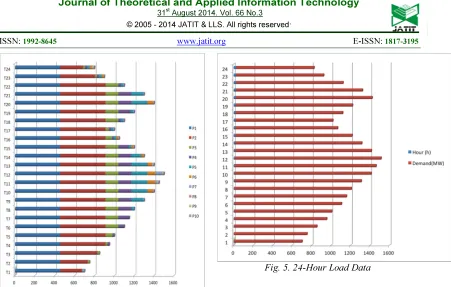
The SFLA and CSA method of UC problem solution has been applied on the above mentioned 10-unit system and the 24-hour load demand shown in fig.5. Matlab based simulation is carried out with the following parameters of optimization.
Cuckoo Search Algorithm (CSA) Parameters:
Population Size: 25
Maximum number of Iterations: 2000
P
a(Probability of worst nest)=-0.25
Shuffled Frog’s Leaping Algorithm:
Population Size: 200 Number of memeplexes: 20
Number of Frogs in each memeplexs=10 Number of evolutions (Ne) =100
Number of Shuffling Steps (Ns)=300
Total Number of Iterations= NeX Ns
For the system configuration given below
Intel I3 Processor, 2.6GHz,
8GB RAM
© 2005 - 2014 JATIT & LLS. All rights reserved.
ISSN: 1992-8645 www.jatit.org E-ISSN: 1817-3195
CSA algorithm is given as below in Table.3
Unit 1 Unit 2 Unit 3
Unit 4 Unit 5 Unit 6 Unit 7 Unit 8 Unit 9 Unit 10
Pimax
t 455 455 130 130 162 80 85 55 55 55
Pimin
t 150 150 20 20 25 20 25 10 10 10
A
i 1000 970 700 680 450 370 480 660 665 670 B
i 16.19 17.26 16.60 16.50 19.70 22.26 27.74 25.92 27.27 27.79 C
i 0.00048 0.00031 .002 .00211 .00398 .00712 .00079 .00413 .00222 .00173
MU
i 8 8 5 5 6 3 3 1 1 1
MDi 8 8 5 5 6 3 3 1 1 1
Hcost
i 4500 5000 550 560 900 170 260 30 30 30
C
costi 9000 10000 1100 1120 1800 340 520 60 60 60 Chour
i 5 5 4 4 4 2 2 0 0 0
[image:5.595.86.516.174.373.2]ini state 8 8 -5 -5 -6 -3 -3 -1 -1 -1
Table 2.Operator Data for Ten Unit System
S. no
Performance Comparison
SFLA CSA
1 Execution time is more to obtain the same results as compared to CSA (10942.14 secs)
Execution time is less Compared to SFLA (1080.58 secs)
2 Number of iterations required to obtain the same result as that of CSA is more (Total cost converges in 3000 (300*100) iterations
Less number of iterations are required. (Total cost converges in 2000 iterations)
3 More Number of population size is required
Less number of
population size is required
[image:5.595.85.297.399.623.2]4 Slow convergence Fast convergence 5 Search area is less Search area is more
Table.3 Performance Comparison between SFLA and CSA
The graphs obtained with the number of vector moment of each of the algorithm versus the cost function is generated. The graphs for SFLA and CSA are plotted in the Figure .1 and Figure .2
[image:5.595.353.541.417.581.2]© 2005 - 2014 JATIT & LLS. All rights reserved.
[image:6.595.93.517.75.348.2]ISSN: 1992-8645 www.jatit.org E-ISSN: 1817-3195
Fig. 2. Cost Function Vs Number Of Iterations(CSA)
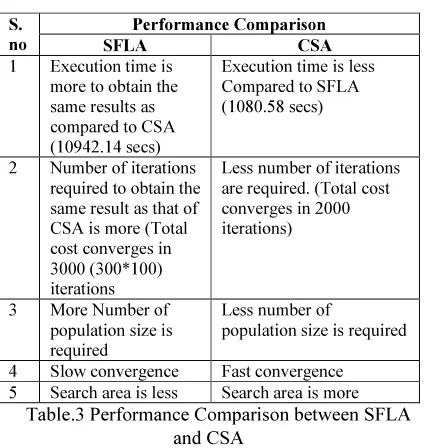
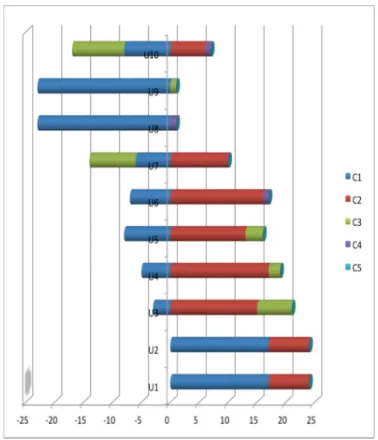
The plots from Fig.1 and Fig. 2 shows that the number of iterations consumed by the SFLA algorithm is 30000 iteration and for CSA it is 2000 iterations to attain the convergence of the UC problem. The cost obtained from the CSA method is less than that obtained from SFLA method. Table.3 also confirms that the execution time taken by the CSA is less than that of the SFLA method, less population size defined in CSA and more search ability and fast convergence compared to SFLA method. The fig.3(a) shows the 24-hour schedule of 10-generator system for the load demand shown in fig.5 using SFLA. Fig.4(a) shows the schedule of 10-generator system using cuckoo search
Fig.3(A). Generation In 24-Hour By 10-Generator System (SFLA)
Fig.3(B). Scheduling In Cycles (SFLA)(Negative Indicates Shutdown Time And Positive Indicates On
[image:6.595.313.502.384.604.2]© 2005 - 2014 JATIT & LLS. All rights reserved.
ISSN: 1992-8645 www.jatit.org E-ISSN: 1817-3195
Fig.4(A). Generation In 24-Hour By 10-Generator System (CSA)
Fig. 4(B). Scheduling In Cycles (CSA)(Negative Indicates Shutdown Time And Positive Indicates On
[image:7.595.89.540.74.361.2]Time)
Fig. 5. 24-Hour Load Data
5. CONCLUSIONS
This paper has attempted the performance comparison of the SFLA and the CSA method when applied on UC problem .A MatlabTM based simulation was carried out and the results were tabulated.The results thus obtained conclude that SFLA consumes more number of iterations for convergence as compared to CSA. The success rate of convergence for CSA was 100% which is better as compared to SFLA which gave the 97% success rate of convergence when tried for 10,000 runs. Thus the CSA had provided a overall improvement in the implementation of UC problem.The CSA has been faster in convergence and also the execution time.
ACKNOWLEDGEMENT
The authors like to thank the institute authorities, staffs, friends, sponsors & others for the whole hearted support given during the course of this preparation of this research paper & related to the research work.
REFERENCES
[image:7.595.89.295.398.622.2]© 2005 - 2014 JATIT & LLS. All rights reserved.
ISSN: 1992-8645 www.jatit.org E-ISSN: 1817-3195
[2] Javad Ebrahimi,Syed Hossein Hosseinian and
Grevog B.Gharehpetian,”Unit Commitment Problem Solution using Frog Leaping Algorithm”,IEEE Trans on Power Systems,2011.
[3] Happ.H.H,Johnson R.C., and Wright W.J., “Large Scale Hydro-Thermal Unit Commitment Method and Results”,IEEE Trans.Power App.Syst.,vol.PAS-90,no.3,pp.1373-1384,May/Jun.1971.
[4] Pang.C.K.,Sheble G.B., and Albuyeh.F,”Evaluation of Dynamic Programming based methods and Multi area representation for Thermal Unit Commitment”,IEEE Trans.Power
App.Syst.,vol.PAS-100,pp.1212-1218,Mar.1981.
[5] Snyder W.L., Jr.,Powell H.D., Jr., and Rayburn J.C., “Dynamic Programming Approach to Unit Commitment”,IEEE Trans.Power Syst.,vol.2,no.2,pp.339-347,May 1987. [6] Aoki K.,Itoh M., Satoh T., Narak., and
Kanezashi M., “Optimal Long-Term Unit Commitment in Large Scale Systems including Fuel Constrained Thermal and Pumped-storage Hydro”,IEEE Trans.Power Syst.,vol.4,no.3,pp.1065-1073,Aug.1989. [7] Lee F.N ., “A Fuel-Constrained Unit
Commitment Method”,IEEE Trans. Power Syst.,vol.4,no.3,pp.691-698,Aug.1989.
[8] Virmani S., Adrian E.C.,Imhof K., and Muhherjee S., “Implementation of a Lagrangian Based Unit Commitment Problem”, IEEE Trans.Power Syst.,vol.4,no.4,pp.1373-1380,Nov.1989. [9] Arroyo J.M. and Conejo A.J., “A Parallel
Repair Genetic Algorithm to Solve the Unit Commitment Problem,” IEEE Trans.Power Syst., vol.17,no.4,pp1216-12224,Nov.2002. [10]Damousis I.G .,Bakirtriz A.G., and
Dokopoulos P.S., “A Solution to the Unit Commitment Problem Using Integer-Coded Genetic Algorithm,” IEEE Trans.Power Syst.,vol.19,no.2,pp.1165-1172,May2004. [11]Kazarlis S.A., Bakirtis A.G., and Petridis V.,
“A Genetic Algorithm Solution to the Unit Commitment Problem,” IEEE Trans.Power Syst,vol.11,no.1,pp.83-92,Feb.1996.
[12]Rudolf A. and Bayrleithner R., “A genetic Algorithm for Solving the Unit Commitment Problem of a Hydro-Thermal Power Systems,” IEEE Trans.Power Syst.,vol.14,no.4,pp.1460-1468,Nov.1999.
[13]Swarup K.S and Yamashiro S., “Unit Commitment Solution using Genetic Algorithm,” IEEE Trans.Power Syst.,vol.17,no.1,pp.87-91,Feb 2002.
[14]Yang H., Yang P., and Huang C., “A Parallel Genetic Algorithm Approach to Solving the Unit Commitment Problem:Implementation on the Transputer Networks,” IEEE Trans.Power Syst., vol.12,no.2,pp.661-668,May 1997. [15]Bajpaiand P.Singh S.N., “Fuzzy Adaptive
Particle Swarm Optimisation for Bidding Strategy in Uniform Price Spot Market ,” IEEE Trans.Power Syst.,vol.22,n0.4,pp.2152-2160,Nov.2007.
[16]Gaing Z.L., “Discrete Particle Swarm Optimisation Algorithm for Unit Commitment ,” in Proc.IEEE Power Eng.Soc.General Meeting,Jul.2003,vol.1,pp.13-17.
[17]Pappala V.S.,and Erlich I., “ A new Approach for Solving the Unit Commitment Problem by Adaptive Particle Swarm Optimisation,” in Proc.IEEE Power and Energy Soc. General Meeting,Jul.2008,pp.1-6.
[18]Saber A.Y ., Senjyu T., Urasaki N., and Funabashi,T. “Unit Commitment Computation –A Novel Fuzzy Adaptive Particle Swarm Optimisation Approach,” in Proc.IEEE PSCE, Nov.2006,pp.1820-1828.
[19]Xiong W., Li M.J., and Cheng Y., “ An Improved Particle Swarm Optimisation Algorithm for Unit Commitment ,” in Proc.ICICTA 2008.
[20]Moghimi Hadji,M., Vahidi .B,”A solution to the Unit Commitment Using Imperialistic Competition Algorithm,” IEEE Trans.Power Systems,2012.
[21]Ouyang Z.,and Shahidhpour S.M., “A Multistage Intelligence System for Unit Commitment,” IEEE Trans.Power Syst., vol.7,n0.2,pp.639-646,May 1992.
[22]Xin-She Yang and Suash Deb ,”Cuckoo Search Via Levy Flights,” World Congress on Nature and Biologically Inspired Computer,2009. [23]Dieu n.Vo,Peter Schegner,Weerakorn