Journal of Theoretical and Applied Information Technology 10th September 2014. Vol. 67 No.1
© 2005 - 2014 JATIT & LLS. All rights reserved.
ISSN: 1992-8645 www.jatit.org E-ISSN: 1817-3195
191
DUPLICATE WEB PAGES DETECTION WITH THE SUPPORT
OF 2D TABLE APPROACH
1A.C. SANTHA SHEELA, 2C. JAYA KUMAR
1
Research scholar, Department of Computer Applications, Faculty of Computing, Sathyabama University, Chennai, TamilNadu.
2
Prof, Department of Computer Science &Engineering, R.M.K. Engineering College, Chennai, TamilNadu.
E-mail: [email protected], [email protected]
ABSTRACT
Duplicate and near duplicate web pages are stopping the process of search engine. As a consequence of duplicate and near duplicates, the common issue for the search engines is raising the indexed storage pages. This high storage memory will slow down the process which automatically increases the serving cost. Finally, the duplication will be raised while gathering the required data from the various sources based on the user’s query. The duplication will definitely slow down the information retrieval process. Duplication is nothing but the similar content or documents located under various sites. Content duplication can be taken place at different forms and levels such as exact document copy, paragraph copy, sentence copy, single word changes and sentence structure changes. Duplication detection is the process of identifying the multi-ple representations of a same real world object. In this paper, the content duplication is identified using two dimensional (2D) text matrix approach. By using the proposed 2D matrix approach, the system was able to detect duplicate web pages with a high precision value 92% is highlighting that the duplicate web page
detection with the 2D technique is performing well
Keyword:Near Duplicate Detection, 2D Approach, Information Retrieval, Content Duplicate.
1. INTRODUCTION
Web mining is an application of the data mining, i.e., when the data mining techniques are applied to the web content, it is referred to be the web mining. Web mining can be classified as web content mining, web usage mining and web struc-ture mining. Mining the content of the web page is called the web content mining. Web usage min-ing is the process of extractmin-ing the information about the web page usage based on the user’s requirements as such text, multimedia, etc. Min-ing the structure of the data is referred web ture mining [12]. Web page consists of the struc-tured, unstructured and semi structured data. Web data defined in a tabular format are referred as the structured data. Data represented in the hierar-chical format is called the unstructured data. Combination of structured and unstructured is called the semi structured data. It is nothing but the web page with a collection of the text, images, audio, video data. The chief gateways for access of information in the web are Search engines [2].
192 frequency (number) to the total number of words on the page. Ranking is calculated to identify the importance of each word in the document or web page. Web search engine faces massive problems due to the duplicate and near duplicate web pages. The search engines are very much affected by content duplication due to the high indexed stor-age pstor-ages, which leads to slow processing and which directs the high serving cost. So duplica-tion detecduplica-tion is very much essential. Web con-tent duplication is done to speed up the access to a remote user community. The duplications can be occurred in many ways. Some of them are listed below.
• Multiple URL’s for a same document
• Same web site hosted on multiple host
names
• Web Spammers
Duplication detection can be done by either supervised learning or unsupervised learning. Supervised learning is the machine learning ap-proach, here, the duplication detection system is trained using a set of data (training data), the system is tested with another set of data (test data) and the system is evaluated with a new set of data (validation data). The given data set is split into training, testing and validation data. Classification method or algorithm is used for supervised learn-ing. Unsupervised learning means without any training data, data have been classified Clustering method or clustering algorithm is used for unsu-pervised learning.
The rest of the paper is organized as follows. In section 2, the related work done on the ap-proaches available for duplicates and near dupli-cate detection is described. Section 3, 2D ap-proach for duplicate web page detection is pre-sented. In section 4, the experimental results are discussed. The conclusions are summed up in section 5.
2. RELATED WORK
Broder et al.[5] proposed a Digital Syn-tactic Clustering (DSC) algorithm for splitting the document into several shingles. A set of immedi-ate terms in a document is called shingle.
Shin-gles are chosen from each document to compare the similarity using jaccard overlap measure be-tween these documents. Overlapping shingles are considered for duplication detection. Even the work done in billions of documents but its effi-ciency is low. The drawback of this method is more number of comparisons required. The per-formance of the algorithm works poorly on small documents and produces many potentially dupli-cated. Later, Border [6] proposed an improved algorithm named DSC-SS Digital syntactic clus-tering- Super Shingle. In this algorithm, the shin-gles are merged as super shinshin-gles and hash values have been generated for these super shingles. However, the algorithm is performing poorly on small documents.
Charikar's [7] proposed a random projec-tion algorithm for identifying near-duplicates in web documents by mapping high dimensional vector of small sized fingerprint. It is a dimen-sionality reduction technique. For applying di-mensionality reduction to web pages, features are extracted from the page and weights are assigned to the feature. These features are computed by tokenization, case folding, stop word removal, stemming and phrase detection. The author con-verted a high-dimensional vector into an f-bit fingerprint. Property of fingerprints for near-duplicates are differing in a small number of bit positions. This technique used to find more near duplicate pairs on different sites. Henzinger [8] improved the precision by comparing the shingles and simhash.
G S Manku et al. [9] proposed a simhash algorithm by adding the feature weight to random projection. Simhash is generated by identified feature vectors and corresponding feature weights. This technique is useful for both single fingerprints (online queries) and multiple finger-prints (batch queries). Hamming distance is ap-plied for identifying the difference in the finger-prints. The fingerprints are considered as dupli-cate when the hamming distance of two simhash fingerprints is smaller than the threshold value.
193 their respective trustworthiness values. Their approach uses the web provenance concept using semantics by means of the provenance factors (Who, When, Where, What, Why and How). In this paper the author have tried with the first four factors for duplication detection and not consider-ing the factors ‘Why’ and ‘How’. Thus, the archi-tecture of a search engine or a web crawler based on the provenance and ranking are more effective in web search.
Theobald [10] proposed, SpotSigs: ro-bust and efficient near duplicate detection in large web collections and Kołcz [11] proposed Lexicon randomization for near-duplicate detection with I-Match concept.
3.2 D Approach For Duplicate Web Page De-tection
Detecting the duplicates and near dupli-cates are more essential with the aim of support-ing the search engines to retrieve useful and dis-tinct results on the first page. The size of the World Wide Web is estimated every day. The indexed web contains at least 5 billion of pages. The crawler crawl billion of web pages every day. This marking a page as a near duplicate should be done at quicker speeds. Near duplication detec-tion is performed using the keywords extracted from the web documents. The crawled web doc-uments are parsed to extract the distinct key-words. Parsing includes elimination of tags, stop words/common words to find the keywords. They pulled out keywords are stored in the table for processing the duplication detection. The similari-ty score of the two documents has been calculated using the keywords from the pages. One docu-ment is a new docudocu-ment another is already stored in the repository. The threshold value is evaluated at an average of similarity measures of more than hundred documents. The similarity score is lesser than the threshold value, then, the document is declared as near duplicate.
The duplication process is comprised with five steps:
A.Web Page Pre-processing
The first step in the identification of web content duplication is removing the tags and extracting the text contents alone for duplicate evaluation.
B. Stop Word Elimination
More than hundred stops words are collected and maintained as a table in the database. After re-moving the tags, the text contents from the web and the stop word table are passed as input for the stop word eliminator. It will remove the stop word from the text and produces the collected keywords from the newly considered web page as output.
C. Word Frequency Estimator
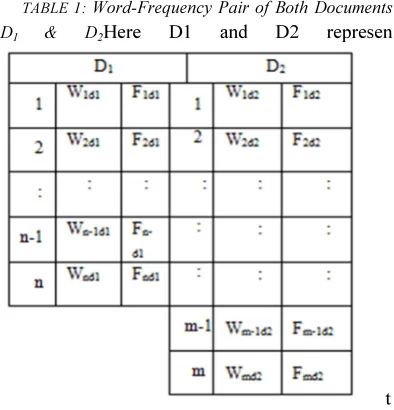
The collected keywords are used to find the total occurrences of the keywords in the actual docu-ment. After calculating the frequencies of each word, the keywords along with their frequency count are stored in the database, as in Table 1.
TABLE 1: Word-Frequency Pair of Both Documents
D1 & D2Here D1 and D2 represen
t the two documents and Wid1,(i=1,2..n) represents
the words in D1 and Fid1, (i=1,2..n) represents the
frequency count of ith word in D1. Similarly, in D2, the words and their frequencies are represent-ed as Wjd1,(j=1,2..m) Fjd1, (j=1,2..m). Here, n and
[image:3.595.312.509.408.613.2]194
D. 2D Word Table Construction
The unique keywords are considered for eliminat-ing the duplication and sorted by alphabetical order. The keywords are testing to put up on a 2D table with 26 rows with nil or n number of col-umns. The 26 rows represent the 26 English al-phabets. The word starts with ‘a’ will be placed in the 1st row. Similarly, the word starts with ‘z’ will be placed at 26th row. The number of col-umns of the first row is equal to the number of words starting with the alphabet ‘a’. In each row, the words will be arranged in ascending order. The table is an unequal sized one and it is repre-sented as 26×n, n≥0, reprerepre-sented as in Table 2.
E.
Similarity Measure Evaluation
A newly considered web page should be evaluat-ed for its content duplication. If the contents or texts are similar as the old or existing document D1, no need to consider the new web page. To decide whether the new web page is a duplication of an existing one or not, the similarity signifi-cance should be measured between the D1 and the new document D2. Instead of comparing the doc-uments in the form of strings as words or text, the
supporting information such as the frequencies of the keywords and word position in the 2D table are taken in finding the similarity measures.
While considering the documents, the keyword set Ws is used to evaluate the similarity
measures. Ws word set is nothing but the
collec-tion of three possible word sets such as common word set {Wc} (appearing in both documents),
words in D1 document alone but not in D2 docu-ment, {Wd1} and words in D2 documents which
are not in the D1 document, {Wd2}, represented in
Equ (1).
All three word sets are kept in a form of table for the remaining process. They are framed as table as in Table 3.
195
196
ܨௗଵ - Frequency count of jth
word of {Wd1} word
set
ݎݓ்ଵ
ೢభೕ
- Row position of jth word of {Wd1} from
2D table (T1) of D1
்݈ܿଵ
ೢభೕ - The column position
of jth word of {Wd1}
from 2D table (T1) of
D1
ܨௗଶ - Frequency count of
kth word of {Wd2}
word set
ݎݓ
்ଶೢమ ೖ
- Row position of kth word of {Wd2} from
2D table (T2) of D2
்݈ܿଶ
ೢమೖ
- Column position of kth word of {Wd2}
from 2D table (T2) of
D2
The document duplication decision is made us-ing the followus-ing conditions.
if SM = 0 [Cond 1]
The documents are mirrored duplicates / Exact duplicate
else if 0 < SM ≤15 [Cond 2]
The documents are close similar
else if 16 < SM ≤ 50 [Cond 3]
The documents are slightly similar
else if SM > 50 [Cond 4]
The documents are least similar
end.
4. RESULT AND DISCUSSION
The result of our experiment is presented in this section. The proposed approach is imple-mented in MATLAB with MS Excel. The Key-words are extracted from the web documents are stored in MS Excel. We experimented with sever-al documents and one example is given below:
Step 1:Two documents are considered for the experiment that extracted from the URL men-tioned in Table 4.
D1 Cricket Rules D2 About Cricket
By removal of the tags we get the con-tent for D1 are as follows:
197 out, or dismiss, the opposing batsmen when in the field. The cricket rules displayed on this page here are for the traditional form of cricket which is called "Test Cricket".
Step 2:More than hundred stop words are identi-fied and saved in the database like “a”, “above”, “across” and so on. Using that database stop words are removed and keywords are extracted for document D1 is shown. Similarly keywords for D2 also taken.
'welcome' 'greatest ' 'game ' 'cricket' 'site' 'help' 'explain' 'absolute' 'beginner' 'basic' 'rules ' 'cricket' 'rules' 'cricket' 'sports' 'worth' 'time' 'learning' 're-warding' 'sport' 'looking' 'play' 'backyard' 'mate' 'join' 'club' 'cricket-rules' 'help' 'learn' 'basics' 'begin' 'enjoy' 'popular' 'sports' 'world' 'cricket' 'game' 'played' 'bat' 'ball' 'large' 'field' 'known' 'ground' 'teams' 'players' 'object' 'game' 'score' 'runs' 'bat' 'dismiss' 'opposing' 'batsmen' 'field' 'cricket' 'rules' 'displayed' 'page' 'traditional' 'form' 'cricket' 'called' 'test' 'cricket' 'formats' 'game' 'matches' 'twenty20' 'cricket' 'rules' 'differ' 'slight-ly'
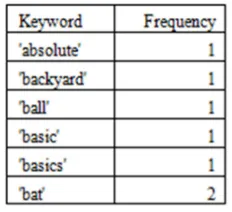
Step 3: Extracted keywords are stored and ar-ranged in alphabetical with word frequency are as follows in Table 4.
In the above Table word “absolute” appears only once in the document and word “bat” appears twice in the document and so on.
[image:7.595.315.510.130.317.2]Step 4: 2D Word Table Construction for “Cricket Rules” as shown in Fig 1. It consists word started with “a” in row1 and “b” in row2 and so on. Total 26 rows with n columns needed for 2D word table construction.
Fig 1. 2D Word Table Construction for “Cricket Rules”
Step 5: Similarity Measure Evaluation shown in Fig 2 done by listing the common words from document D1 and D2 in column1 and words only in D1 not in D2 listed in column2 and words only in D2 not in D1 are listed in column3. In this sample, we get nine common words, 48 distinct words in D1 and 65 distinct words in D2. For calculating similarity between these two docu-ments Equ (3) has been used. The similarity value is 11.4989. It satisfies the condition cond 2, con-cluded that document D1 & D2 “Cricket Rules” and “About Cricket” are close similar.
Fig 2. Similarity Measure Evaluation for docu-ment “Cricket Rules”
[image:7.595.126.242.486.592.2] [image:7.595.311.516.512.657.2]198 All the documents are compared with each other, with n2 (100 × 100 = 10000) combina-tions. It is observed that, for the similar docu-ments such as considering a document as D1 and D2, the similarity measure for the duplicate doc-uments is generated as 0. This is the indication of mirror duplication. Sample similarity values are listed in Table 6.
From the Table 6 initially, two different docu-ments about cricket are tested for the similarity. The similarity score for the two documents is 11.4989. This score helps to decide the status of the two documents are close similar.
Instead of taking two different documents, the same document Cricket is considered as Doc1 and Doc2. From this, the score is generated at 0.0. From the decision condition, this value helps to fix the two documents are exactly similar.
Next, the similarity measure is found between the documents Fruits and Vegetables, and it produced
the 222.7227, which helps to decide the two doc-uments are not similar.
When finding similarity between documents which consist less than the threshold value, then the documents are dissimilar documents. Other-wise the documents are similar documents.
5. CONCLUSION
Duplicate web pages detection tech-niques are important for improving the quality of search engine for extracting information. Numer-ous pages in web either duplicated or near dupli-cated. This kind of duplication leads to take more time to retrieve the results. When the data are integrated from the multiple web database dupli-cates or near duplidupli-cates arise. A 2D approach to duplicate web page identification is tried by 92% of precision. This is simple and fast to estimate the different web contents such as exact dupli-cates, close duplidupli-cates, slightly duplidupli-cates, or least duplicates.
REFERENCE
[1]. Narayana, V. A., Premchand, P., & Govardhan, A. “Effective Detection of Near Duplicate Web Documents in Web Crawl-ing”, International Journal of Computational Intelligence Research 5.1, 83-96, 2009.
[2]. Syed Mudhasir, Y., Deepika, J.,Sendhilkumar, S., & Mahlakshmi, G.S. “ Near-Duplicates Detection and Elimination Based on Web Provenance for Effective Web search”, IJIDCS vol 1: No:1,2011.
[3]. Tanvi Gupta., & Latha Banda. “ A Hy-brid Model For Detection And Elimination Of Near- Duplicates Based On Web Prove-nance For Effective Web Search.” Interna-tional Journal Of Advances In Engineering & Technology (IJAET), 2012.
[4]. Broder, S., Glassman, M., Manasse, & Zweig, G. “Syntactic Clustering of the Web”. In 6th International World Wide Web Con-ference, 393-404, 1997.
199 Sankoff, D. (eds.) CPM 2000. LNCS, vol. 1848, 1–10, 2000.
[6]. Charikar. M. S., “Similarity Estimation Techniques from Rounding Algorithms”, 34th Annual ACM Symposium on Theory of Computing,2002.
[7]. Henzinger, M. “Finding near-duplicate web pages: a large-scale evaluation of algo-rithms”, In Proceedings of the 29th annual in-ternational ACM SIGIR Conference on search and Development in Information Re-trieval, 284–291, 2006.
[8]. Manku, G.S., Jain, A., & Sarma, A.D., “Detecting near-duplicates for web crawl-ing”, In: Proceedings of the 16th Internation-al Conference on World Wide Web, 141– 150, 2007.
[9]. Theobald, M., Siddharth, J., & Paepcke, “SpotSigs: robust and efficient near duplicate detection in large web collections”. In: Pro-ceedings of ACM SIGIR, 2008.
[10]. Kołcz, A., & Chowdhury, A. “Lexicon randomization for near-duplicate detection with I-Match. Supercomputer”, 255-276, 2008.