3672
ADDRESS THE CHALLENGES OF IMPLEMENTING
ELECTRONIC DOCUMENT SYSTEM IN IRAQ
E-GOVERNMENT- TIKRIT CITY AS A CASE STUDY
1MUHANED AL-HASHIMI, 2MOHANAAD SHAKIR, 3MAYTHAM HAMMOOD ,
2,4ABDALLA ELDOW
1Department of BasicScience Branch, College of Dentistry, Tikrit University, Iraq
2Department of Information Technology, Al Buraimi University College, Oman
3Department of Computer Science, Tikrit University, Iraq
E-mail: 1[email protected], 2 [email protected], 3[email protected], 4[email protected]
ABSTRACT
Storing and archiving information plays a crucial role in any government’s strategy of serving its parties. One early step in achieving this goal is to implement a correct electronic document system for e-government agencies, which plays a crucial and important role in storing, processing, and managing data flow in an effective manner. However, this system in Iraq did not see the light so far even it is a strategic objective of e-government. This paper attempts to investigate the technological and human challenges that hinder the implementation of such system to support Iraqi e- government in overriding those challenges and speeding up its initiatives. The paper has utilized a quantitative approach via survey questionnaire from various public and private sectors at Tikrit city in Provence Salah al din to achieve its goal. The results indicate several challenges such as economic, computer illiteracy, technology acceptance, training and lack of series implementation steps by government.
Keywords: Challenges; Implementation; E-government; EDMS
1. INTRODUCTION
Governments seek to utilize the ICT to achieve better interaction with citizens, and other government entities, provide high quality services and enhance their delivery in an efficient way [1]. Since e-government is a foundation that utilizes data, information, and documents, it is important to manage these issues through storing, processing, managing their flow in effective manner, and to ensure the availability of information. Therefore, an electronic flexible document management system (EDMS) is needed to increase the efficiency and reduce the operations and duration of government processes [2], [3]. Document management needs
several resources such as application,
skill/expertise, technology and infrastructure. However, various problems are associated with these resources such as technology obsolescence, people hesitation to learn new technology/method, or acquire new method for keeping data. Briefly, several problems are associated to technology and
3673
2. EDMS CONCEPT AND BENEFITS
The EDMS is typically referring to a computerized system that facilitates the creation, capture, organization, storage, retrieval, manipulation and controlled circulation of documents in the electronic format [7]. All document management systems should have the following components [8], [9]:
• Capture and import tools to bring documents into the system.
• Methods for storing and archiving documents. • Indexing and retrieval tools to locate documents. • Distribution tools for exporting documents from the system.
• Security to protect documents from unauthorized access
The EDMS aim is not merely to exclude paper based files, but to manage all organizational documents, both computer-generated and paper-based, and various files such as digital audio and video files. Document management can manage millions of documents and retrieve the right one in seconds. It can share documents with colleagues while protecting confidential information. Moreover, it helps to send e-mail and fax files instantly, access documents while traveling, publish documents to CD, DVD or the Web, as appropriate, and assists to back up files and records for disaster recovery [8]. An EDMS helps the organization to achieve more efficient operations by reducing transaction costs,
automating processes, improving capacity,
minimizing errors, and saving on labor. Last but not least, improving information sharing and retrieval will result in a great improvement in government services to citizens [10].
2.1 EDMS Implementation
EDMS implementation is not an easy task and usually requires considering human, budgetary, and technical issues, however, the benefits offered by EDMS deserve its implementation. The literature lacks to implementation researches on EDMSs in
public administration [10]. Most EDMS
implementation studies have focused on a certain technical functionality of such system or provided some conceptual proposals [11], while few studies have addressed EDMS implementation success or failure in government context [12],[13]. Many developed countries such as Germany, Australia, and Croatia have utilized EDMS efficiently [13]. Also some developing countries have achieved successful implementation of EDMS such as Korea
and Malaysia [14], [7].However, many
implementing initiatives of EDMS were failed especially in developing countries. Iraqi e-government project has started in 2003 with Italian government cooperation and this project includes the
EDMS application. The e-government
implementation did not achieve any significant success due to several significant factors including lack of EDMS implementation in spite of the Italian support [13]. The failure of EDMS implementation stimulates researchers to investigate the factors that affect the success of such initiative. Detailed studies on such factors can be found in [13], [10].
This paper aims to address the challenges related to
people and technology that affect the
implementation of electronic document management system in Iraq, which can contribute to the literature
to fill its gap by such paper
.
3. METHODOLOGY
In this paper, we identify the technological and human challenges that affect the EDMS
implementation in Iraq
.
The implementing ofelectronic document system in Iraq e-government- Tikrit city has faced many challenges in Tikrit city which includes lack of IT facilities available to the government staff, low exposure and use of IT services/function such as email, online shopping, and etc. , and others. Therefore, the The implementing of electronic document system in iraq e-government- Tikrit city may pose a number of problems. To determine these problems, we firstly conducted a survey to various organizations that use the electronic document system. The questionnaires were distributed to collect the required data in order to diagnose the problems and challenges in electronic document system and to define the nature of these problems. The collected data gave a clear understanding about the existing problem and the method on how to address the issue in electronic document system problems with Iraq e-government- Tikrit city.
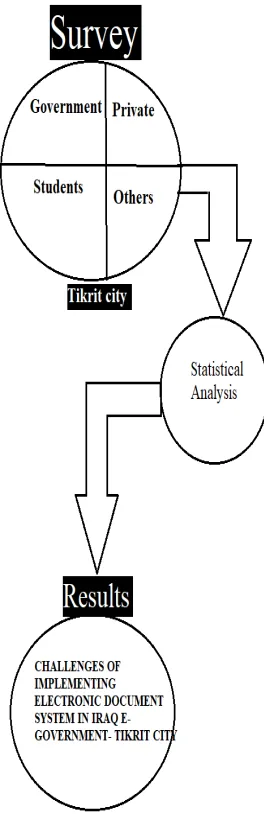
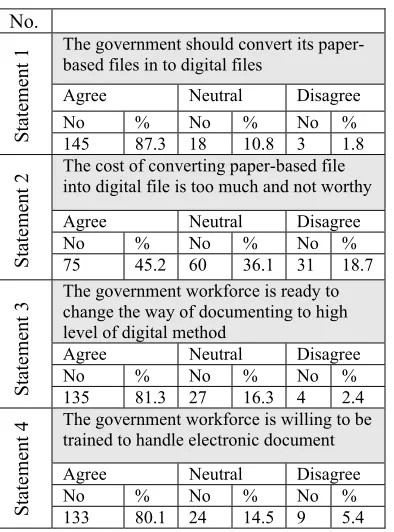
3674 Section 1 presents the demographic information of the respondents. Section 2 determines the level of IT use of the respondents. Section 3 explores the preferred medium by respondents to store contents, while section 4 investigates the respondents’ attitudes to adopt electronic method for saving data. The SPSS software package for statistical analysis is used to analyze the data. This study hopes to shed light on the common problems implementing of electronic document system in Iraq e-government- Tikrit city. Figure 1 shows the steps of the methodology.
Figure 1 Methodological Framework
4. RESULTS AND ANALYSIS
The first phase of data analysis is the descriptive analyses, which relate to first section of the questionnaire.
4.1 Descriptive Analyses
These analyses involve descriptive analysis for the
demographic variable of therespondents asgender,
age, The population of this study is a sample of Tikrit city which is (220) from different fields governmental of them (80), response from them (66), private sector is (25) responded from them
(17), students are
(
56) responded from them (37),and others (59) responded from them (42). Income and work as shown in table 1.
[image:3.612.317.521.312.716.2]3675 The demographic analysis indicates, as shown in table 1, that the respondents consisted of 74.1% males and 41.8% female, with an age range from less than 20 to more than 40 years. The largest age group of respondents was between 21 and 30 years old (41.4%) and the smallest age group was more than 40 years old (16%). The analysis also indicates that most respondents have income less than 500000 ID. Moreover, the largest respondent percentage is from government sector (40.7) while the respondents from private sector constitute 10.5%.
4.2 The Level of IT Use of The Respondents
[image:4.612.326.510.153.275.2]This analysis is related to section 2 of the questionnaire, which aims to determine the level of IT use of the respondents. It includes questions on using computer in office and home and on using the Internet and some services via it.
Table 2: Result of using computer in office
Do you use computer in your office
Scale Respondents Number %
Yes 64 39.8
No 98 60.2
[image:4.612.114.276.335.473.2]Table 2 reveals that more than half of the respondents 60.2% do not use computer in office while 39.8% use it in office. The study shows the sign that the level of technology exposed in Iraq was low.
Table 3: Result of using computer in home
Do you use computer in your home
Scale Respondents Number %
Yes 80 49.4
No 82 50.6
Table 3 shows that approximately half (50.6%) of the respondents do not use computer in their home while half of them (49.4%) use it in home.
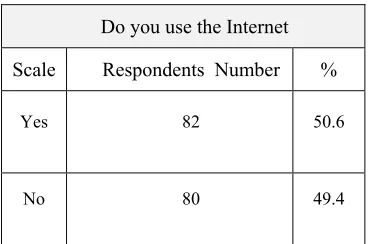
Table 4: Result of using the Internet
Do you use the Internet
Scale Respondents Number %
Yes 82 50.6
No 80 49.4
Based on Table 4, more than half of the respondents (50.6%) use the Internet while the other 49.4% do not use the Internet. The respondents who answered yes with previous question will proceed with the following questions on service via the Internet.
Table 5: Result of conducting services on the Internet
Statement Respondents Number %
Have you ever used mail to Iraqi e-government?
Yes 29 17.5
No 53 31.9
Do you use Iraqi e-government web side to get your information?
Yes 33 19.9
No 49 29.5
Comfortable use email : E-mail
Yes 74 44.6
No 8 4.8
Comfortable use email : E-government web side
Yes 59 35.5
No 22 13.3
Get your need or your services from the government via the Internet
Yes 65 39.2
[image:4.612.201.510.364.719.2] [image:4.612.111.280.587.720.2]3676 Based Table 5, majority of the respondents 31.9% never usee email in dealing with government. Therefore, majority of the respondents 29.5% did not use e-govermnet web site to get the informations. Apart from that, most of the respondents who answers these questions used email 44.6%, while similar results indicate that most of the respondents 35.5%. claimed they used e-govermnent website Finally, majority of the respondents 39.2%% claimed they obtained information on services from the Internet.
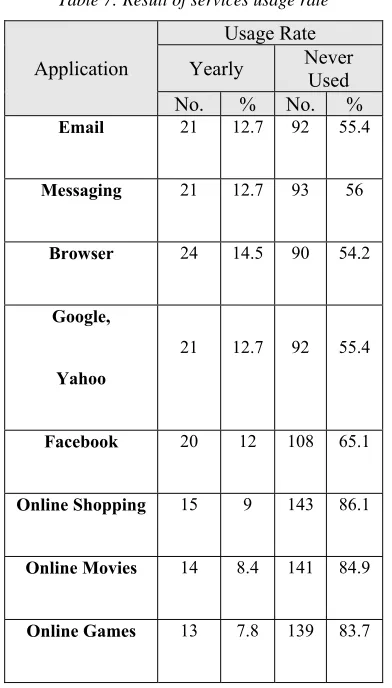
Table 6: Result of services usage rate
Table 7: Result of services usage rate
Application
Usage Rate
Yearly Never Used
No. % No. %
Email 21 12.7 92 55.4
Messaging 21 12.7 93 56
Browser 24 14.5 90 54.2
Google,
Yahoo
21 12.7 92 55.4
Facebook 20 12 108 65.1
Online Shopping 15 9 143 86.1
Online Movies 14 8.4 141 84.9
Online Games 13 7.8 139 83.7
Based on table 6, 7 results, high percentage of respondents ranging between (54-87%) does not use the applications via the Internet. Email, messaging, browser, google, yahoo, and Facebook are used by respondents but at few rates ranging between (10.2-16.9%) daily and comparable rates weekly, while the other applications are almost rarely used.
[image:5.612.91.284.264.629.2]3677
[image:6.612.308.522.103.503.2]4.3 Preferred Medium for Storing Content
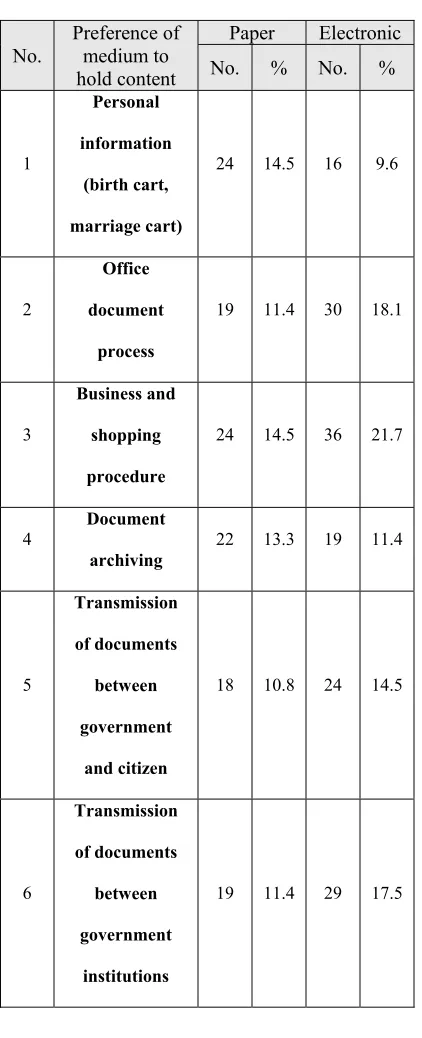
Table 8: Preference of medium to hold content
No. Preference of medium to hold content
Paper Electronic
No. % No. %
1
Personal
information
(birth cart,
marriage cart)
24 14.5 16 9.6
2
Office
document
process
19 11.4 30 18.1
3
Business and
shopping
procedure
24 14.5 36 21.7
4 Document
archiving
22 13.3 19 11.4
5 Transmission of documents between government and citizen
18 10.8 24 14.5
6 Transmission of documents between government institutions
19 11.4 29 17.5
Table 9: Preference of medium to hold content
No.
Preference of
medium to hold
content
Both paper &
Electronic
No. %
1
Personal information
(birth cart, marriage
cart)
124 74.7
2 Office document process
115 69.3
3 Business and shopping procedure
102 61.4
4 Document archiving 124 74.7
5
Transmission of
documents between
government and citizen
122 73.5
6
Transmission of
documents between
government
institutions
116 69.9
Table 8, 9 indicates that high respondents rate (61.4 -74.7%) preferred paper and electronic means for storing personal information, managing office document process, document archiving, and for business and shopping procedure. Also, the respondents prefer both means for managing document transmission between government and both citizens and institutions. Respondent’s rate (10.8-14.5%) prefers paper, while (9.6-21.7%) prefers electronic means.
[image:6.612.90.301.129.648.2]3678
[image:7.612.91.288.165.431.2]4.4 Willing to Adopt Electronic Means
Table 10: Respondents’ attitudes to adopt electronic means
No.
Statement 1
The government should convert its paper-based files in to digital files
Agree Neutral Disagree No % No % No % 145 87.3 18 10.8 3 1.8
Statement 2
The cost of converting paper-based file into digital file is too much and not worthy Agree Neutral Disagree No % No % No % 75 45.2 60 36.1 31 18.7
Statement 3
The government workforce is ready to
change the way of documenting to high level of digital method
Agree Neutral Disagree No % No % No % 135 81.3 27 16.3 4 2.4
Statement 4
The government workforce is willing to be trained to handle electronic document Agree Neutral Disagree No % No % No % 133 80.1 24 14.5 9 5.4
Based on table 10, high government workforce rate (87.3%) agrees that government should convert paper based files to digital files. The table also revealed that (45.2%) of respondents agreed that converting paper-based file into digital file is too costly and not worthy, (36.1%) of respondents stay neutral and 18.7% disagree with this statement. Based on the results, majority of the government workforce, 81.3% is ready to change the way of documenting to high level of digital method. Moreover, most respondents (80.1%) asserted that government workforce should be trained to get knowledge on electronic document.
It can be concluded, the majority of government workforce wish to change the traditional means and use of electronic documents, but with providing training programs that make it easier to use and to deal with such documents. However, the government did not take serious steps to conduct such programs and did not allocate the required budget to convert its paper-based files in to digital files.
5. DISCUSSION
There are basically two main problems identified through the survey. The first problem is the lack of IT facilities available to the government staff. This problem has later contributed to the second main problem which is low exposure and use of IT services/function such as email, online shopping, and etc. A pleasant finding from the questionnaire is that the citizens (respondents) are willing to accept the change into e-government as majority of respondent can accept both the classic and the new approach (electronic). Most of the respondents stated that they prefer to use both methods, while few respondents stated that they prefer to use digital means as medium.
This findings show that a transformation into e-government will not face a big resistance from the respondents/citizen given they are provided with the necessary equipment or facilities such as computer and Internet. Conclusively, the transition from present (where must transaction are paper base) to anew EDMS (where most transaction are electronic base) must be done gradually. This to accommodate some hesitant (which could be fear of technology) and provide smooth and comfortable transformation to highly digital data environment.
6. CONCLUSION
Most EDMS implementation studies have focused on a certain technical functionality of such system or provided some conceptual proposals [11], while few studies have addressed EDMS implementation success or failure in government context [12],[13]. Many developed countries such as Germany, Australia, and Croatia have utilized EDMS efficiently [13]. This paper is one of few papers that addressing the difficulties of implementing the electronic document system, particularly the ones related to technology and human attitudes and acceptance. All the difficulties can be overcome by taking serious and effective steps by government. Even the current security situation of Iraq poses several difficulties, the e-government program should be established and succeed. Iraq government should make e-government accessible to all level of Iraqi with confirmation and guidance to accept the new technology to achieve benefit for all. Upgrading
and transforming E-Government system in Iraqi
government are suggested to be done in stages which also can give the citizens some times to adapt to the
3679 current readiness of Iraq e-government to adopt EDMS.
7. REFRENCES
[1] Abdulwahida, H. S., Mutaliba, A. A., Yusofa, S. A. M., & Alib, S. J.: Designing and implementation Iraqi e- government front office
online system. Journal of Knowledge
Management, Economics and Information Technology, 4(1.1), (2014).
[2] Kunis, R., Rünger, G., & Schwind, M.: A new model for document management in e-Government systems based on hierarchical process folders. In The Proceedings of the 7th European Conference on E-Government (Eceg 2007), Academic Conferences Limited (p. 229), (2007).
[3] Tagbotor, D. P., Adzido, R. Y. N., & Agbanu, P. G.: Analysis of Records Management and
Organizational Performance. International
Journal of Academic Paper in Accounting, Finance and Management Sciences, 5(2), 1-16, (2015).
[4] Bunawan, A. A., & Nordin, S.: The Challenges in Preserving the Electronic Records Metadata. International journal of information systems and engineering, Vol. 1(1), (2015).
[5] Martinus, I., Sharief, M., Graul, B.: Government of Iraq E-government Strategy (2007-2010). USAID. Bearing Point, Inc, (2007).
[6] Mohammed, M. A., Aboobaider, B. M., Ibrahim, R., et al.: E-government and its Challenges in Developing Countries: Case Study Iraqi e-Government. The Social Sciences 11 (17): 4310-4319, (2016).
[7] Yatin, S. F. M., Ramli, A. A. M., Shuhaimi, H., Hashim, H., Dollah, W. A. K. W., Zaini, M. K., & Kadir, M. R. A.: Electronic Document
Management System: Malaysian
Experience.Australian Journal of Basic and Applied Sciences, 9(3), pp: 82-89, (2015). [8] Laserfiche: Document Management Overview.
Compulink Management Center, USA, (2007). [9] M-Files: Easy Document Management: A Guide
to Benefits, Features, and Selection. M Files Inc. USA, (2011).
[10]Alshibly, H., Chiong, R., Bao, Y.: Investigating the Critical Success Factors for Implementing Electronic Document Management Systems in Governments: Evidence from Jordan. Journal of
Information Systems Management,Volume
33(4), pp, 287-301, (2016).
[11] Nguyen, L.T.: Towards a theoretical framework for effective implementation of electronic
document and records management systems within the Australian public sector. (Doctoral dissertation). University of South Australia, Australia, (2011).
[12] McLeod, J.: On being part of the solution, not the problem: taking a proportionate approach to managing records. Records Management Journal, 22(3), 186-197, (2012).
[13] Abdulkadhim, H., Bahari, M., Bakri, A., & Ismail, W.: A Research Framework of Electronic Document Management Systems (EDMS) Implementation Process in Government. Journal of Theoretical and Applied Information Technology, 81(3), 420, (2015).
[14] Lee, K. R., & Lee, K. S.: The Korean government's electronic record management reform: The promise and perils of digital
democratization. Government Information
Quarterly, 26(3), 525-535, (2009).
[15] Shakir, M., Abubakar, A. B., Yousoff, Y., Al-Emran, M., & Hammood, M. application of confidence range algorithm in recognizing user
behavior through EPSB in cloud
computing. Journal of Theoretical and Applied Information Technology, 94(2), 416. (2016). [16] Shakir, M., Abubakar, A. B., Yousoff, Y. B.,
3680