ORIGINAL RESEARCH ARTICLE
NEW VALIDATED RP-HPLC METHOD FOR THE ESTIMATION OF
SUMATRIPTAN SUCCINATE IN PHARMACEUTICAL
FORMULATION
*Sivanadh, M.
Dept.of Chemistry, ANR College, Gudiwada, Krishna (Dt), Andhra Pradesh, INDIA – 521301
ARTICLE INFO ABSTRACT
Introduction: A simple, selective, linear, precise and accurate RP-HPLC method was developed and validated for rapid assay of Sumatriptan Succinate in Bulk and Pharmaceutical tablet Formulation. Isocratic elution at a flow rate of 1.5 ml/min was employed on symmetry Shimadzu LC-20 ATVP Kromasil C-18 column Column at ambient temperature. The mobile phase consisted of Orthophosphoric acid(1%):Acetonitrile : Methanol (90:5:5 v/v) . The UV detection wavelength was 210nm and 20 µl sample was injected. The run time for Sumatriptan Succinate is 6 min. The Percentage assay of Silymarin in formulation was found to be 100.08%. The amount of drug present in the human sample was found to be 0.287 mg/ ml The method was validated as per the ICH guidelines. The method was successfully applied for routine quality control analysis of pharmaceutical formulation. The HPLC method can be successfully applied for the routine quality control analysis of Sumatriptan Succinate formulations.
*Corresponding author:
Copyright ©2017, Sivanadh.This is an open access article distributed under the Creative Commons Attribution License, which permits unrestricted use,
distribution, and reproduction in any medium, provided the original work is properly cited.
INTRODUCTION
Sumatriptan is a triptan sulfa drug containing a sulfonamide group for the treatment of migraine headaches. Combination of sumatriptan and naproxen, has shown a benefit over either medicine used separately (Brandes, 2007). The device delivers a subcutaneous injection of 6 mg sumatriptan. A similar
application has been filed in Europe (Brandes, 2009). Phase
III studies with a iontophoretic transdermal patch (Zelrix) started in July 2008 (Clinical Trials). The injectable form of the drug has been shown to abort a cluster headache within
fifteen minutes in 96% of cases (Razzaque et al., 1999 and
Treatment of acute cluster headache with sumatriptan, 1991). This paradox has, to some extent been resolved by comparing the rates of absorption of the various sumatriptan formulations, rather than the absolute amounts of drug that they deliver (Fox,
2004 and Freidank-Mueschenborn, 2005), large doses of
sumatriptan (200 mg/day) can cause sulfhemoglobinemia, a rare condition in which the blood changes from red to greenish-black ("Patient bleeds dark green blood, 2010), due to
the integration of sulfur into the hemoglobin molecule. Among the many serotonin-like compounds studied, the discovery of the anti-migraine drug sumatriptan stimulated the development of other 5-HT1D receptor agonists (Hopkins, 1984). Most of the synthesis of those compounds, based on the conventional Fischer indole synthesis, using acid catalysis, generates impurities, with yields depending both of the product and the method used (Sanz, 2008). Maria J. Nozal, etal (María, 2001), developed a HPLC method for the assay of sumatriptan succinate. The HPLC method involves a C18 column at 25 °C, a mixture of ammonium phosphate monobasic (0.05 M)–acetonitrile (84:16, v/v) as a mobile phase and UV detection at 228 nm. Moira Dunne, etal (Moira Dunne, 1999), proposed a method is described for a fully automated, sensitive, accurate and precise assay for the determination of sumatriptan in human serum. The assay is
linear over the analytical range 1–30 ng ml−1. The intra-assay
data demonstrate a maximum bias and precision across the calibration range of 10% and 6.6%, respectively. G Rochholz,
et al (Rochholz, 2004), separation was achieved on a Thermo
ISSN: 2230-9926
International Journal of Development Research
Vol. 07, Issue, 06, pp.13486-13490, June,2017
Article History:
Received 29th March, 2017 Received in revised form 14th April, 2017 Accepted 06th May, 2017 Published online 30th June, 2017
Citation: Sivanadh, M.2017. “New Validated Rp-HPLC Method for the Estimation of Sumatriptan Succinate In Pharmaceutical Formulation”,
International Journal of Development Research, 7, (06), 13486-13490.
ORIGINAL RESEARCH ARTICLE Open Access
Key Words:
Hypersil C4 column (250 mm × 4.6 mm, 5 µm) using a mobile phase of 20 mM potassium dihydrogen phosphate adjusted to
pH 4.0 with orthophosphoric acid and acetonitrile (65:35, v/v )
at a flow rate of 1.0 mL min −1 . UV detection was performed
at 227 nm. A Femenía-Font, et al (Femenía-Font, 2003).
described a simple, accurate, precise and rapid HPLC method with UV detection has been validated in order to determine the in vitro transdermal absorption of sumatriptan succinate. A.V.D.Nagendra kumar et.al., (Basaveswara Rao, 2011). proposed a RP-HPLC method for the analysis of Zopiclone in tablet form. Chromatographic separation of Zopiclone was performed by using a kromosil C18 column (250 x 4.6mm, 5μm) as stationary phase with a mobile phase comprising of 0.1% Ortho phosphoric acid : Acetonitrile: Methanol : Tetrahydrofuron 30:45:20:5(v/v) at a flow rate of 1.0ml/min and UV detection at 303nm. The linearity of Zopiclone is in the range of 0.2mg/ml to 1.4mg/ml. The limit of detection for Zopiclone was found to be 10 nanograms.
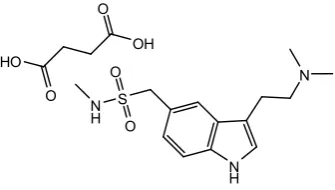
[image:2.595.79.247.273.368.2]O S N H N N H O O HO O OH
Fig. 1. Structure of Sumatriptan Succinate
Experimental
Instrumentation: Peak HPLC containing LC 20AT pump and
variable wavelength programmable PDA detector and
Rheodyne injector was employed for investigation. The
chromatographic analysis was performed on a Kromasil C18
column 250 x 4.6 mm ID with 5 particle size and the column
were maintained at ambient temperature. Degassing of the mobile phase was done using a Loba ultrasonic bath sonicator. A Denwar analytical balance was used for weighing the materials.
Chemicals and solvents: The reference sample of Suminat tablets was obtained from Cipla, Mumbai. The Formulation was procured from the local market. Pure drugs chromatogram was run in different mobile phases containing methanol, acetonitrile, THF, and different buffers like potassium dihydrogen phosphate, sodium dihydrogen phosphate, Ortho phosphoric acid in different volumes ratios. Different columns
like C8, C18, phenyl, cyano with different dimensions were
used. The chemicals were procured from E-Merck, India Limited.
The mobile phase: The mobile phase was prepared by mixing Orthophosphoric acid(1%) : Acetonitrile : Methanol (90:5:5 v/v) by ultra bath sonicator for 30 min.
Preparation of solutions
Preparation of standard solution: Stock solution of Sumatriptan succinate was prepared by dissolving accurately weighed 100mg of drug in 10ml Methanol (final concentration, 10mg/ml). The prepared stock solutions were stored away from light. From the stock, standard solutions was
Preparation of working standard solution (A.P.I): From the stock solution 5mg/ml solution was prepared.
Preparation of working standards for linearity: Solutions in the concentration range of 0.2-1.0mg/ml were prepared from the standard working solution.
Preparation of formulation sample solution: 10mg of SUMINAT tablet powder (50mg formulation) was weighed and dissolved in 10ml mobile phase. The resultant sample solution concentration is 1mg/ml. Then sonicated by ultra bath sonicator for 30 minutes and filtered through 0.45µm membrane filter. The amount of drug present in the 1mg formulation was calculated from linearity graph.
Preparation of serum sample solution: From a local hospital blood was collected and serum was separated. 1ml of this serum was taken in a test tube and added 100µl of diltizem hydrochloride (1µg/ml) and 0.1ml of 1M NaOH and 5ml of dichloromethane and mixed about 20min in vortex mixer and centrifuged at 3000 rpm for 10min. From this centrifuged solution 4ml of organic layer was separated and evaporated to dryness to get residue. To this residue 100µl of 1M acetic acid and 3ml of n-Hexane and mixed for 5 min by vortex mixer and evaporated the organic layer and finally the remaining sample was injected into HPLC and chromatogram was recorded. The amount of drug present in the blood sample was calculated from linearity graph.
Method Development
Detection of wavelength: The spectrum of 10ppm solution of Sumatriptan succinate was recorded separately on UV spectrophotometer. The peak of maximum absorbance wavelength 210nm was observed.
Choice of stationary phase and mobile phase: Finally the expected separation and peak shapes were obtained on
Kromasil C18 column 250 x 4.6 mm ID with 5 particle size.
Flow rate: Flow rates of the mobile phase were changed from 0.5-2.0 ml/min for optimum separation. It was found from experiments that 1.5 ml/min flow rate was ideal for elution of analyte.
Validation Procedure and Requirements: The analytical performance of the method of analysis was checked for specificity, System suitability, detection limit, and method precision.
Linearity and calibration: Linearity was assessed by
performing single measurement at several analyte
concentration varying quantities of stock standard solution diluted with the mobile phase to give a concentration of 0.2, 0.4, 0.6, 0.8 and 1.0 mg/ml Injection was made at intervals of 6min. The linearity was tested for the concentration ranging from 0.2mg- 1.0mg/ml. The peak area ratio of the drug was plotted against concentration. The linearity was evaluated by linear regression analysis, which was calculated by the least square regression method.
and the amount of drug were calculated in terms of Percentage Relative Standard Deviation. Sample concentration is 1mg/1ml.
Accuracy: Recovery assessment was obtained by using standard addition technique which was by adding known quantities of pure standards at three different levels in 80%, 100% and 120% to the pre analyzed sample formulation.
Assay: The estimation of drug in pharmaceutical dosage forms. SUMINAT tablets of 50mg strength were evaluated for the amount of Sumatriptan succinate present in the formulation. Each sample was analyzed in triplicate after extracting the drug. The amount of drug present in formulation was calculated by comparing the mean peak area from standard.
Intermediate Precision or Ruggedness: Inter-day variations were performed by using six replicate injections of standard and sample solutions of concentrations which were prepared and analyzed by different analyst on three different days over a period of one week. Ruggedness also expressed in terms of percentage relative standard deviation.
Robustness: Robustness was carried out by varying two parameters from the optimized chromatographic conditions.
Specificity: The method was determined as specific by comparing test results obtained from analyses of sample solution containing excuse ingredients with that of test results those obtained from standard drug.
System Suitability Parameter: System suitability tests were carried out on freshly prepared standard stock solutions of Sumatriptan succinate and it was calculated by determining the standard deviation of Sumatriptan succinate standards by injecting standards in five replicates at 10 minutes interval and the values were recorded.
Serum data of Sumatriptan: From linearity graph we can estimate amount of drug present in the sample. Amount of SUMATRIPTAN present in serum is 0.287mg/ ml
RESULT AND DISCUSSION
The Reverse Phase High Performance Liquid Chromatography method was developed a stability indicating assay method. Pure drugs chromatogram was run in different mobile phases containing methanol, acetonitrile, THF, and different buffers like potassium dihydrogen phosphate, sodium dihydrogen phosphate, Ortho phosphoric acid in different volumes ratios.
Different columns like C8, C18, phenyl, cyano with different
[image:3.595.186.413.381.519.2]dimensions were used.
Table. 1 Optical chracterisation of sumatriptan succinate
PARAMETERS Sumatriptan succinate
Linearity range(mg/ml) 0.2 – 1.0 Correlation coefficient ( r ) 0.9996
Slope ( m ) 199194.2
Intercept ( c ) -0.005728096
Limit of detection (LOD; µg/ml) 15 Limit of Quantification (LOQ; µg/ml) 40
Tailing factor 1.68
Retention time (min) 3.068
Theoretical plates 8284.38
( % ) R.S.D 0.12
( % )Accuracy 96.51
( % ) Formulation 100.08
Serum (mg/ml) 0.287
Table 2. Recovery data of sumatriptan succinate and their values
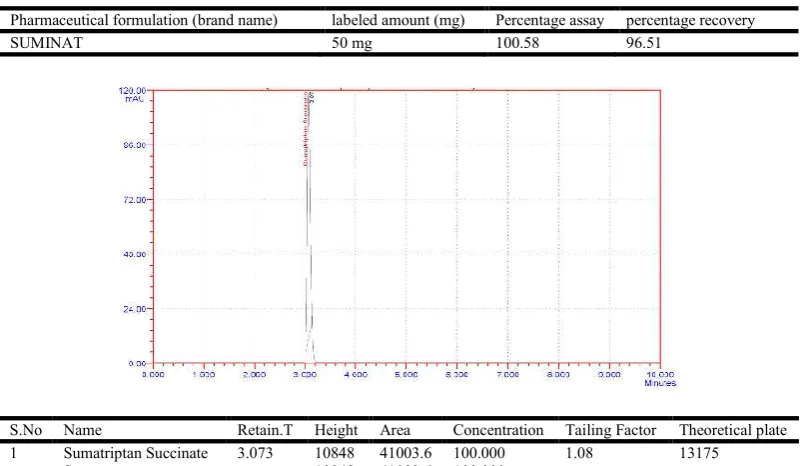
Pharmaceutical formulation (brand name) labeled amount (mg) Percentage assay percentage recovery
SUMINAT 50 mg 100.58 96.51
S.No Name Retain.T Height Area Concentration Tailing Factor Theoretical plate 1 Sumatriptan Succinate 3.073 10848 41003.6 100.000 1.08 13175
[image:3.595.99.503.547.780.2]Fig. 3. Chromatogram of sumatriptan succinate (accuracy) and their values
S.No Name Retain.T Height Area Concentration Tailing Factor Theoretical plate 1 Sumatriptan Succinate 3.073 10848 41003.6 100.000 1.08 13175
[image:4.595.78.518.470.692.2]Sum 10848 41003.6 100.000
Fig. 4. Chromatogram of sumatriptan succinate (formulation assay) and their values
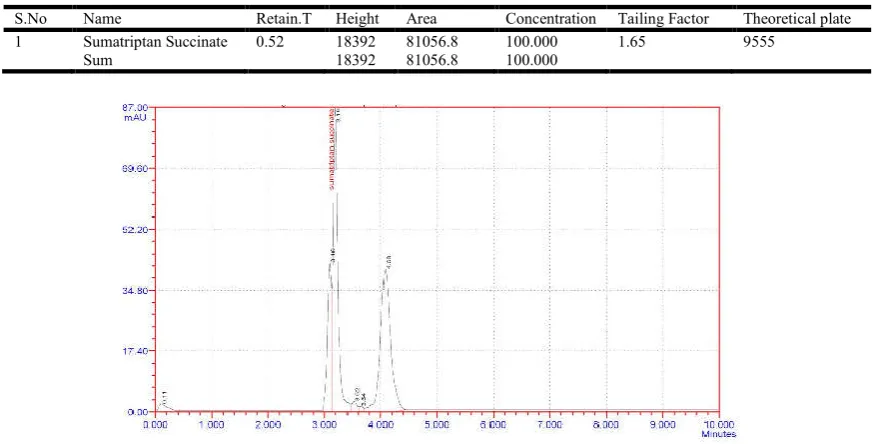
S.No Name Retain.T Height Area Concentration Tailing Factor Theoretical plate 1 Sumatriptan Succinate 0.52 18392 81056.8 100.000 1.65 9555
[image:4.595.76.516.722.803.2]Sum 18392 81056.8 100.000
Fig. 5. Chromatogram of sumatriptan succinate (serum) and their values
S.No Name Retain.T Height Area Concentration Tailing Factor Theoretical plate 1 Sumatriptan Succinate 0.110 227 2693.6 1.878 1.75 2
3.095 4592 25108.1 17.501 0.63 6386
3.193 8951 57320.4 39.955 2.68 4956
3.522 505 3723.9 2.596 1.20 4546
3.642 330 1869.6 1.303 1.41 8235
4.078 4122 52748.6 36.768 0.99 2024
Sum 18727 143464.1 100.000
Then retention time and tailing factor were calculated. Finally 1% Orthophosphoric acid and Acetonitrile and Methanol in the
ratio of 90:5:5 v/v (PH: 4.2) and Kromasil C18 analytical
column was selected which gave a sharp and symmetrical peak with 1.68 tailing. Calibration graph was found to be linear at range 0.2mg/ml to 1.0mg/ml. Five different concentrations of Sumatriptan succinate in range given above were prepared and 20µl of each concentration injected in HPLC as shown in the Figure 2. The slope (m) and intercept (c) obtained were found to be 199194.2 and -0.005728096.The correlation of
coefficient (r2) obtained was found to be 0.9996 as shown in
the Table 1. It was observed that the concentration range showed a good relationship. The limit of detection for Sumatriptan succinate was found to be 15µg/ml and the limit of quantification was found to be 40µg/ml. It proves the sensitivity of method. It proves the sensitivity of method. The Percentage assay of Silymarin in formulation was found to be 100.08%.as shown in the Table 1 and Figure no: 4. The relative standard deviation value obtained was below 1 which indicates the precession of the method. The validation of the proposed method was further verified by recovery studies. The data was presented by in the Table 2 and Figure 3. The percentage recovery was found to be 96.51% which shows a good index of accuracy of the developed method. The amount of drug present in the human serum sample was calculated from the linearity graph was found to be 0.287 mg/ ml as shown in Figure 5
Conclusion
The RP-high performance liquid chromatographic method for the analysis of Sumatriptan succinate from their formulations was found to be accurate and precise. Thus, the proposed HPLC method can be successfully applied for the routine quality control analysis of Sumatriptan succinate formulations. The reported method is precise, simple and could be better choice than the methods reported in the literature.
REFERENCES
"Patient bleeds dark green blood". BBC News. 8 June 2007. Retrieved 6 March 2010. U.S. Patent 4,785,016
Basaveswara Rao, M V., Nagendrakumar, AVD., M. Sivanadh, PV. Bramhachari; “Development of new Reverse phase -HPLC method for analysis and assay of
Zopiclone inFormulation”; Journal of Pharmacy Research
2011,4(1),248-249
Brandes, J.; Cady, R.; Freitag, F.; Smith, T.; Chandler, P.; Fox, A.; Linn, L.; Farr, S. 2009. "Needle-free subcutaneous sumatriptan (Sumavel DosePro): bioequivalence and ease of use.". Headache 49 (10): 1435–1444.
Brandes, J.L., Kudrow, D., Stark, S.R., et al. (April
2007). "Sumatriptan-naproxen for acute treatment of migraine: a randomized trial". JAMA 297 (13): 1443–54.
ClinicalTrials.gov NCT00724815. The Efficacy and
Tolerability of NP101 Patch in the Treatment of Acute Migraine (NP101-007)
Femenía-Font, A., V Merino, V Rodilla, A López-Castellano, High-performance liquid chromatographic determination of
sumatriptan after in vitro transdermal diffusion studies. J
Pharm Biomed Anal. 2003 Aug 21;32 (6):1123-33.
Fox, AW. 2004. "Onset of effect of 5-HT1B/1D agonists: a model with pharmacokinetic validation". Headache 44 (2): 142–7.
Freidank-Mueschenborn, E.; Fox, A. 2005. "Resolution of concentration-response differences in onset of effect
between subcutaneous and oral
sumatriptan". Headache 45(6): 632–637.
Hopkins S. J. Drugs Today 1992, 28, 15; Relevant patents: Dowle, M. D.; Coates, I. H., GB 2 124 210, 1983. Dowle, M. D.; Coates, I.H. US Patent 4, 816 470, 1989. Oxford, A. W., GB 2 162 522, 1984
María, J Nozal, José L Bernal, L Toribio, María T Martín, Francisco J Diez, Development and validation of an LC assay for sumatriptan succinate residues on surfaces in the
manufacture of pharmaceuticals. J Pharm Biomed Anal.
2001 ;26 (3):367-77.
Moira Dunne and Peter Andrew, the determination of sumatriptan in human serum using solid-phase extraction
and high-performance liquid chromatography with
electrochemical detection 1999.
Razzaque, Z., Heald, M.A., Pickard, J.D, et
al. (1999). "Vasoconstriction in human isolated middle
meningeal arteries: determining the contribution of
5-HT1B- and 5-HT1F-receptor activation". Br J Clin
Pharmacol 47 (1): 75–82.
Rochholz, G., B Ahrens, F König, H W Schütz, H Schütz, H Seno , Screening and identification of sumatriptan and its main metabolite by means of thin-layer chromatography, ultraviolet spectroscopy and gas chromatography/mass
spectrometry, Journal of Chromatography B,2004, 806
(2),299-303.
Sanz, A., A. M. G. Carril, M. P. Matía, J. L. Novella, and J. Alvarez-Builla ARKIVOC 2008 (ii) 53-58 and references cited therein.
Treatment of acute cluster headache with sumatriptan. The
Sumatriptan Cluster Headache Study Group. N Engl J Med
1991;325:322-6.