Efficient Computation of the Well-Founded Semantics
over Big Data
Ilias Tachmazidis, Grigoris Antoniou and Wolfgang Faber
University of Huddersfield, UK
(e-mail:{ilias.tachmazidis,g.antoniou,w.faber}@hud.ac.uk)
submitted 1 January 2003; revised 1 January 2003; accepted 1 January 2003
Abstract
Data originating from the Web, sensor readings and social media result in increasingly huge datasets. The so called Big Data comes with new scientific and technological challenges while creating new opportunities, hence the increasing interest in academia and industry. Traditionally, logic programming has focused on complex knowledge structures/programs, so the question arises whether and how it can work in the face of Big Data. In this paper, we examine how the well-founded semantics can process huge amounts of data through mass parallelization. More specifically, we propose and evaluate a parallel approach using the MapReduce framework. Our experimental results indicate that our approach is scalable and that well-founded semantics can be applied to billions of facts. To the best of our knowledge, this is the first work that addresses large scale nonmonotonic reasoning without the restriction of stratification for predicates of arbitrary arity.
KEYWORDS: Well-Founded Semantics, Big Data, MapReduce Framework
1 Introduction
Huge amounts of data are being generated at an increasing pace by sensor networks, govern-ment authorities and social media. Such data is heterogeneous, and often needs to be combined with other information, including database and web data, in order to become more useful. This big datachallenge is at the core of many contemporary scientific, technological and business developments.
The question arises whether the reasoning community, as found in the areas of knowledge representation, rule systems, logic programming and semantic web, can connect to the big data wave. On the one hand, there is a clear application scope, e.g. deriving higher-level knowledge, assisting decision support and data cleaning. But on the other hand, there are significant chal-lenges arising from the area’s traditional focus on rich knowledge structures instead of large amounts of data, and its reliance on in-memory methods. The best approach for enabling rea-soning with big data is parallelization, as established e.g. by the LarKC project (Fensel et al. (2008)).
As discussed in (Fensel et al. (2008)), reasoning on the large scale can be achieved through parallelization by distributing the computation among nodes. There are mainly two proposed approaches in the literature, namely rule partitioning and data partitioning (Soma and Prasanna (2008)).
Thus, the workload for each rule (and node) depends on the structure and the size of the given rule set, which could possibly prevent balanced work distribution and high scalability. On the other hand, for the case of data partitioning, data is divided in chunks with each chunk assigned to a node, allowing more balanced distribution of the computation among nodes.
Parallel reasoning, based on data partitioning, has been studied extensively. In particular, MARVIN (Oren et al. (2009)), follows the divide-conquer-swapstrategy in which triples are being swapped between nodes in the cluster in order to achieve balanced workload. MARVIN implements the SpeedDate method, presented in (Kotoulas et al. (2010)), where authors pointed out and addressed the scalability challenge posed by the highly uneven distribution of Semantic Web data.
WebPIE (Urbani et al. (2012)) implements forward reasoning under RDFS and OWLter Horst semantics over the MapReduce framework (Dean and Ghemawat (2004)) scaling up to 100 bil-lion triples. In (Goodman et al. (2011)) authors present RDFS inference scaling up to 512 pro-cessors with the ability to process, entirely in-memory, 20 billion triples.
FuzzyPD (Liu et al. (2011, 2012)) is a MapReduce based prototype system allowing fuzzy reasoning in OWL pD∗ with scalability of up to 128 process units and over 1 billion triples. Description logic in the form ofE L+have been studied in (Mutharaju et al. (2010)). The au-thors parallelize an existing algorithm forE L+classification by converting it into MapReduce algorithms, while experimental evaluation was deferred to future work.
(Tachmazidis et al. (2012)) deals with defeasible logic for unary predicates scaling up to bil-lions of facts, while authors extend their approach in (Tachmazidis et al. (2012)) for predicates of arbitrary arity, under the assumption of stratification, scaling up to millions of facts. Finally, the computation of stratified semantics of logic programming that can be applied to billions of facts is reported in (Tachmazidis and Antoniou (2013)).
In this paper, we propose a parallel approach for the well-founded semantics computation using the MapReduce framework. Specifically, we adapt and incorporate the computation of joins and anti-joins, initially described in (Tachmazidis and Antoniou (2013)). The crucial difference is that in this paper recursion through negation is allowed, meaning that the well-founded model can contain undefined atoms. A challenge in this respect is that materializing the Herbrand base is impractical in the context of big data. To overcome this scalability barrier we require programs to be safe and apply a reasoning procedure that allows closure calculation based on the consecutive computation of true and unknown literals, requiring significantly less information. Experimental results highlight the advantages of the applied optimizations, while showing that our approach can scale up to 1 billion facts even on a modest computational setup.
The rest of the paper is organized as follows. Section 2 introduces briefly the MapReduce framework, the well-founded semantics and the alternating fixpoint procedure. Join and anti-join operations for the well-founded semantics are described in Section 3. Section 4 provides a paral-lel implementation over the MapReduce framework, while experimental results are presented in Section 5. We conclude and discuss future directions in Section 6.
2 Preliminaries
2.1 MapReduce Framework
user-defined map and reduce functions are run in parallel. The former performs a user-user-defined op-eration over an arbitrary part of the input and partitions the data, while the latter performs a user-defined operation on each partition.
MapReduce is designed to operate over key/value pairs. Specifically, eachMapfunction re-ceives a key/value pair and emits a set of key/value pairs. Subsequently, all key/value pairs pro-duced during the map phase are grouped by their key and passed to reduce phase. During the reduce phase, aReducefunction is called for each unique key, processing the corresponding set of values.
Let us illustrate thewordcountexample. In this example, we take as input a large number of documents and calculate the frequency of each word.
Consider the following documents as input:
Doc1: “Hello world.” Doc2: “Hello MapReduce.”
During map phase, each map operation gets as input a line of a document.Mapfunction ex-tracts words from each line and emits pairs of the form<w, “1”>meaning that wordwoccurred once (“1”), namely the following pairs:
<Hello, 1> <world, 1> <Hello, 1> <MapReduce, 1>
MapReduce framework will perform grouping/sorting resulting in the following intermediate pairs:
<Hello,<1,1>> <world, 1> <MapReduce, 1>
During the reduce phase, theReducefunction sums up all occurrence values for each word emitting a pair containing the word and the frequency of the word. Thus, the reducer with key:
Hellowill emit<Hello, 2>
worldwill emit<world, 1>
MapReducewill emit<MapReduce, 1>
2.2 Well-Founded Semantics
In this section we provide the definition of thewell-founded semantics(WFS) as it was defined in (Gelder et al. (1991)).
Definition 2.1
(Gelder et al. (1991)) Ageneral logic programis a finite set ofgeneral rules, which may have both positive and negative subgoals. A general rule is written with itshead, or conclusion on the left, and its subgoal (body), if any to the right of the symbol “←”, which may be read “if”. For example,
p(X)←a(X),notb(X).
We use the following conventions. A logical variable starts with a capital letter while a constant or a predicate starts with a lowercase letter. Note that functions are not allowed. A predicate of arbitrary arity will be referred as aliteral. Constants, variables and literals areterms. Aground termis a term with no variables. TheHerbrand universeis the set of constants in a given program. TheHerbrand baseis the set of ground terms that are produced by the substitution of variables with constants in the Herbrand universe. In this paper, we will refer to Horn rules also asdefinite rules, likewise Horn programs will also be referred to asdefiniteprograms.
Definition 2.2
(Gelder et al. (1991)) Given a programP, apartial interpretation Iis a consistent set of literals whose atoms are in the Herbrand base ofP. Atotal interpretationis a partial interpretation that contains every atom of the Hebrand base or its negation. We say a ground (variable-free) literal istrue in Iwhen it is inIand say it isfalse in Iwhen its complement is inI. Similarly, we say a conjunction of ground literals istrueinIif all of the literals are true inI, and isfalseinIif any of its literals is false inI.
Definition 2.3
(Gelder et al. (1991)) Let a programP, its associated Herbrand baseHand a partial interpretation Ibe given. We sayA⊆His anunfounded set(ofP) with respect toIif each atomp∈Asatisfies the following condition: For each instantiated ruleRofPwhose head isp, (at least) one of the following holds:
1. Some (positive or negative) subgoal of the body is false inI. 2. Some positive subgoal of the body occurs inA.
A literal that makes (1) or (2) above true is called awitness of unusabilityfor ruleR(with respect toI).
Theorem 2.1
(Gelder et al. (1991)) The data complexity of the well-founded semantics for function-free pro-grams is polynomial time.
In this paper, we require each rule to be safe, that is, each variable in a rule must occur (also) in a positive subgoal. Safe programs consist of safe rules only. This safety criterion is an adaptation of range restriction (Nicolas (1982)), which guarantees the important concept of domain inde-pendence, originally studied in deductive databases (see for example (Abiteboul et al. (1995))). Apart from this semantic property, the safety condition implicitly also enforces a certain locality of computation, which is important for our proposed method, as we shall discuss in Section 4.2.
2.3 Alternating Fixpoint Procedure
In this section, we provide the definition of the alternating fixpoint procedure as it was defined in (Brass et al. (2001)).
Definition 2.4
(Brass et al. (2001)) For a setSof literals we define the following sets:
Definition 2.5
(Brass et al. (2001)) (Extended Immediate Consequence Operator)
LetPbe a normal logic program. LetIandJbe sets of ground atoms. The setTP,J(I)ofimmediate consequencesofIw.r.t.PandJis defined as follows:
TP,J(I) :={A|there isA←B∈ground(P) with pos(B)⊆Iand neg(B)∩J= /0}. IfPis definite, the setJis not needed and we obtain the standard immediate consequence oper-ator TPbyTP(I)=TP,/0(I).
For an operatorT we defineT ↑0 :=/0 andT ↑i:=T(T ↑i−1), fori>0. lfp(T) denotes the least fixpoint ofT, i.e. the smallest setSsuch thatT(S) =S.
Definition 2.6
(Brass et al. (2001)) (Alternating Fixpoint Procedure)
LetPbe a normal logic program. LetP+denote the subprogram consisting of the definite rules of P. Then the sequence (Ki,Ui)i≥0with setKiof true (known) facts andUiof possible (unknown) facts is defined by:
K0:=lfp(TP+) U0:=lfp(TP,K
0)
i>0 : Ki:=lfp(TP,Ui−1) Ui:=lfp(TP,Ki)
The computation terminates when the sequence becomes stationary, i.e., when a fixpoint is reached in the sense that (Ki,Ui) = (Ki+1,Ui+1). This computation schema is called the
Alter-nating Fixpoint Procedure(AFP).
We rely on the definition of thewell-founded partial model W∗pof P as given in (Gelder et al. (1991)).
Theorem 2.2
(Brass et al. (2001)) (Correctness ofAFP)
Let the sequence (Ki,Ui)i≥0 be defined as above. Then there is a j ≥0 such that (Kj,Uj)= (Kj+1,Uj+1). The well-founded modelW∗pofPcan be directly derived from the fixpoint (Kj,Uj), i.e.,
W∗p={L| L is a positive ground literal andL∈Kjor
L is a negative ground literalnotAandA∈BASE(P)−Uj}, where BASE(P) is the Herbrand base of program P.
Lemma 2.1
(Brass et al. (2001)) (Monotonicity)
Let the sequence (Ki,Ui)i≥0be defined as above. Then the following holds fori≥0 :
Ki⊆Ki+1, Ui⊇Ui+1, Ki⊆Ui.
3 ComputingTP,J(I)
Consider the following program:
Herep(X,Y)is ourfinal goal,a(X,Z)andb(Z,Y)are positive subgoals, whilec(X,Z)andd(Z,Y) are negative subgoals. In order to compute our final goalp(X,Y)we need to ensure that{a(X,Z), b(Z,Y)} ⊆Iand{c(X,Z),d(Z,Y)} ∩J= /0 (see Definition 2.5), namely botha(X,Z)andb(Z,Y)are inIwhile none ofc(X,Z)andd(Z,Y)is found inJ.
As positive subgoals depend on I we can group them into apositive goal. A positive goal consists of a new predicate (sayab) that contains as arguments the union of two sets: (a) all the arguments of the final goal (X,Y) and (b) all the common arguments between positive and nega-tive subgoals (X,Z,Y), namely we need to computeab(X,Z,Y). The final goal (p(X,Y)) consists of all values of the positive goal (ab(X,Z,Y)) that do not match any of the negative subgoals (c(X,Z) andd(Z,Y)) on their common arguments (X,Z and Z,Y respectively).
3.1 Positive goal calculation
Consider the following program:
p(X,Y)←a(X,Z), b(Z,Y),notc(X,Z),notd(Z,Y). where
I={a(1,2), a(1,3), b(2,4), b(3,5)}
J={c(1,2), d(2,3)}
A single join (Cluet and Moerkotte (1994)), calculating the positive goalab(X,Z,Y), can be performed as described below. Note that we use only literals fromI.
TheMapfunction will emit pairs of the form<Z,(a,X)>for predicateaand<Z,(b,Y)>for predicateb, namely the following pairs:
<2, (a,1)> <3, (a,1)> <2, (b,4)> <3, (b,5)>
MapReduce framework will perform grouping/sorting resulting in the following intermediate pairs:
<2,<(a,1), (b,4)>> <3,<(a,1), (b,5)>>
During the reduce phase we match predicatesa andbon their common argument (which is thekey) and use the values to emit positive goals. Thus, the reducer with key:
2will emitab(1,2,4) 3will emitab(1,3,5)
Note that we need to filter out possibly occurring duplicates as soon as possible because they will produce unnecessary duplicates as well, affecting the overall performance.
For rules with more than one join between positive subgoals we need to apply multi-joins (multi-way join).
Consider the following program:
q(X,Y)←a(X,Z), b(Z,W), c(W,Y),notd(X,W).
For details on single and multi-way join, readers are referred to literature. More specifically, multi-way join has been described and optimized in (Afrati and Ullman (2010)). In order to achieve an efficient implementation, optimizations in (Afrati and Ullman (2010)) should be taken into consideration.
3.2 Final goal calculation
Consider the program mentioned at the beginning of Section 3.1. By calculating the positive goal ab(X,Z,Y)we obtain the following knowledge:
ab(1,2,4) ab(1,3,5)
In order to calculate the final goal (p(X,Y)) we need to perform an anti-join (Cluet and Mo-erkotte (1994)) betweenab(X,Z,Y)and each negative subgoal (c(X,Z)andd(Z,Y)). Note that to perform an anti-join we use only the previously calculated positive goal (ab(X,Z,Y)) and literals fromJ.
We start by performing an anti-join betweenab(X,Z,Y)andc(X,Z)on their common arguments (X,Z), creating a new literal (sayabc(X,Z,Y)), which contains all the results fromab(X,Z,Y)that are not found inc(X,Z), as described below.
TheMapfunction will emit pairs of the form<(X,Z),(ab,Y)>for predicateaband<(X,Z),c>
for predicate c(while predicated will be taken into consideration during the next anti-join), namely the following pairs:
<(1,2), (ab,4)> <(1,3), (ab,5)> <(1,2), c>
MapReduce framework will perform grouping/sorting resulting in the following intermediate pairs:
<(1,2),<(ab,4), (c)>> <(1,3), (ab,5)>
During the reduce phase we output values of the predicate abonly if it is not matched by predicatecon their common arguments (which are contained in thekey) and emitabc(X,Z,Y). Thus, the reducer with key:
(1,2)will have no output (1,3)will emitabc(1,3,5)
In order to calculate the final goal (p(X,Y)), we need to perform an additional anti-join between abc(X,Z,Y)andd(Z,Y)on their common arguments (Z,Y). Here,abc(1,3,5) andd(2,3) do not match on their common arguments (Z,Y) as (3,5) 6=(2,3). Thus, our calculated final goal is p(1,5).
4 Computing the Well-Founded Semantics
4.1 Optimized implementation
A naive implementation would introduce unnecessary overhead to the overall computation since it comes with the overhead of reasoning over and storage of overlapping sets of knowledge. A more refined version of both WFS fixpoint and least fixpoint ofTP,J(I)is defined in Algorithm 1 and Algorithm 2 respectively.
Algorithm 1Optimized WFS fixpoint
opt WFS fixpoint(P): .input: programP
1: K0= opt lfp(P+, /0, /0); .output: set of literalsKi−1,Ui−1 2: i= 0;
3: repeat
4: Ui=Ki∪opt lfp(P,Ki,Ki);
5: i++; .next “inference step”
6: Ki=Ki−1∪opt lfp(P, Ki−1,Ui−1); 7: untilKi−1.size() ==Ki.size()
8: returnKi−1,Ui−1;
Algorithm 2Optimized least fixpoint ofTP,J(I)
opt lfp(P,I,J): .precondition:I⊆lfp(TP,J(/0))
1: S= /0; .input: programP, set of literalsIandJ
2: new= /0; .output: set of literalsS(lfp(TP,J(I)-I)
3: repeat
4: S=S∪new;
5: new= T(P, (I∪S),J);
6: new=new- (I∪S);
7: untilnew== /0
8: returnS;
Our first optimization is the changed calculation of the least fixpoint ofTP,J(I)(opt lfp), which is depicted in Algorithm 2. Instead of calculating the least fixpoint starting fromI=/0, for a given programPand a set of literalsJ, we allow the calculation to start from a givenI, provided thatI
⊆lfp(TP,J(/0)), and return only the newly inferred literals (S) that led us to the least fixpoint. Thus, the actual set of literals that the least fixpoint ofTP,J(I)consists of isI∪S. In order to reassure correctness we need to take into consideration bothIandSwhile calculating the least fixpoint, namely new literals are inferred by calculatingTP,J(I∪ S). However, we use a temporary set of inferred literals (new) in order to eliminate duplicates (new=new−(I∪S)) prior to adding newly inferred literals to the setS(S=S∪new). Note that the set of literalsIremains unchanged when the optimized least fixpoint is calculated.
The optimized version of the least fixpoint is used, in Algorithm 1, for the computation of each set of literalsKandU.K0is a special case where we start fromI=/0 andJ=/0, and thus, unable
to fully utilize the advantages of the optimized least fixpoint.
SinceKi⊆Ui, fori≥0 (see Lemma 2.1), the computation ofUican start fromKi, namelyI=
Ki. Thus, instead of recomputing all literals ofKiwhile calculatingUi, we can use them to speed up the process. Note that the actual least fixpoint ofUiis the union of setsKiandopt lfp(P, Ki, Ki), as the optimized least fixpoint computes only new literals (which are not included in given I).
Since Ki−1 ⊆ Ki, for i≥1 (see Lemma 2.1), the computation ofKi can start from Ki−1,
namelyI=Ki−1. Onceopt lfp(P, Ki−1, Ui−1)is computed, we append it to our previously stored
knowledgeKi−1, resulting inKi. In addition, a WFS fixpoint is reached whenKi−1=Ki, namely
whenKi−1andKihave the same number of literals. Proof
If Ki−1=Ki, fori≥1, then
Ui−1=Ki−1∪opt lfp(P, Ki−1, Ki−1)=Ki∪opt lfp(P, Ki, Ki)=Ui Thus, fixpoint is reached as (Ki−1,Ui−1) =(Ki,Ui).
According to Theorem 2.2, having reached WFS fixpoint at stepi, we can determine which literals are true, undefined and false as follows: (a)trueliterals, denoted by Ki, (b)undefined literals, denoted by Ui−Kiand (c)falseliterals, denoted by BASE(P)−Ui.
Although forKicalculation only new literals are inferred during each “inference step”, forUi we have to recalculate a subset of literals that can be found inUi−1, as literals inUi−1−Ki−1
are discarded prior to the computation ofUi. However, the computational overhead coming from the calculation ofopt lfp(P, Ki, Ki)reduces over time since the set of literals inUi−Kibecomes smaller after each “inference step” due toKi−1⊆KiandUi−1⊇Ui, fori≥1, (see Lemma 2.1).
We may further optimize our approach by minimizing the amount of stored literals. A naive implementation would require the storage of up to four overlapping sets of literals (Ki−1, Ui−1,
Ki, Ui). However, asKi⊆Ui, while calculatingUi, we need to store in our knowledge base only the setsKiandopt lfp(P, Ki, Ki), sinceUi=Ki∪opt lfp(P, Ki, Ki).
AsKi−1⊆Ki, for the calculation ofKi, we need to store in our knowledge base only three sets of literals, namely: (a) Ki−1, (b)Ui−1 −Ki−1 =opt lfp(P, Ki−1, Ki−1) and (c) currently
calculating least fixpointopt lfp(P, Ki−1, Ui−1). All newly inferred literals in opt lfp(P, Ki−1,
Ui−1), are added toKi(replacing our prior knowledge aboutKi−1), while literals inUi−1-Ki−1
=opt lfp(P, Ki−1, Ki−1)are deleted, if fixpoint is not reached, as they cannot be used for the
computation ofUi.
A WFS fixpoint is reached whenKi−1=Ki, namely when no new literals are derived during the calculation ofKi, which practically is the calculation ofopt lfp(P, Ki−1, Ui−1). Since (Ki−1,Ui−1)
=(Ki,Ui), we return the sets of literalsKi−1andUi−1, representing our fixpoint knowledge base.
In practice, the maximum amount of stored data occurs while calculatingKi, fori≥1, where we need to store three sets of literals, namely: (a)Ki−1, (b)Ui−1−Ki−1and (c)opt lfp(P, Ki−1,
Ui−1), requiring significantly less storage space compared to the naive implementation.
4.2 Computational Impact of Safety
In this paper, we follow the alternating fixpoint procedure, over safe WFS programs, in order to avoid full materialization of or reasoning over the Herbrand base for any predicate. Storing or performing reasoning over the entire Herbrand base may easily become prohibiting even for small datasets, and thus, not applicable to big data.
has considerable impact on the computational method followed in this paper. Recall that safety requires that each variable in a rule must occur (also) in a positive subgoal. If this safety condition is not met, an anti-join is no longer a single lookup between the positive goal and a negative subgoal, but a comparison between a subset of the Herbrand base and a given set of literalsJ. An efficient implementation for such computation is yet to be defined and problematic, as illustrated next.
Consider the following program:
p(X,Y)←a(X,Y),notb(Y,Z).
q(X,Y)←c(X,U),notd(W,U),note(U,Y).
For the first rule, each (X,Y) ina(X,Y)is included in the final goal (p(X,Y)) only if for a givenY, there is aZthe in Herbrand universe such thatb(Y,Z)does not belong toJ. For the second rule, for each (X,Y) that is included in the final goal (q(X,Y)) there should be a literalc(X,U)that does not match neitherd(W,U)onU, for anyW in Herbrand universe, nore(U,Y)onU, for anyYin Herbrand universe. Thus, we need to perform reasoning over a subset of the Herbrand base for b(Y,Z),d(W,U)ande(U,Y)in order to find the nonmatching literals.
5 Experimental results
Methodology.In order to evaluate our approach, we surveyed available benchmarks in the
lit-erature. In (Liang et al. (2009)), the authors evaluate the performance of several rule engines on data that fit in main memory. However, our approach is targeted on data that exceed the capacity of the main memory. Thus, we follow the proposed methodology in (Liang et al. (2009)) while adjusting several parameters. In (Liang et al. (2009))loadingandinferencetime are separated, focusing on inference time. However, for our approach such a separation is difficult as loading and inference time may overlap.
We evaluate our approach consideringdefault negationby applying thewin-not-wintest and merge large (anti-)join testswithdatalog recursionanddefault negation, creating a new test calledtransitive closure with negation. Other metrics in (Liang et al. (2009)), such asindexing, are not supported by the MapReduce framework, while all optimizations and cost-based analysis were performed manually.
Platform.We have implemented our experiments using the Hadoop MapReduce framework1,
version 1.2.1. We have performed experiments on a cluster of the University of Huddersfield. The cluster consists of 8 nodes (one node was allocated as “master” node), using a Gigabit Ethernet interconnect. Each node was equipped with 4 cores running at 2.5GHz, 8GB RAM and 250GB of storage space.
Evaluation tests.Thewin-not-wintest (Liang et al. (2009)) consists of a single rule, where
moveis the base relation:
win(X)←move(X,Y),notwin(Y). We test the following data distributions:
• the base facts form a cycle:{move(1,2), ..., move(i, i+1), ..., move(n-1,n), move(n,1)}.
• the data is tree-structured:{move(i, 2*i), move(i, 2*i+1)|1≤i≤n}.
We used four cyclic datasets and four tree-structured datasets with 125M, 250M, 500M and 1000M facts.
Thetransitive closure with negationtest consists of the following rule set, wherebis the base relation:
tc(X,Y)←par(X,Y). par(X,Y)←b(X,Y),notq(X,Y). tc(X,Y)←par(X,Z), tc(Z,Y). par(X,Y)←b(X,Y), b(Y,Z),notq(Y,Z). q(X,Y)←b(Z,X), b(X,Y),notq(Z,X).
We test the following data distribution:
• the base facts are chain-structured:{b(i, i+k)|1≤i≤n, k<n}. Intuitively, theivalues are distributed overdn/kelevels, allowingdn/ke −1 joins in the formed chain.
Thetransitive closure with negationtest allows for comparing the performance of the naive and the optimized WFS fixpoint calculation when the computation of lfp(TP,J(I)) starts fromI
=/0 andI6=/0 respectively. ForUiandKi+1, fori≥0, the optimized implementation speeds up
the process by using, as input, the previously computed transitive closure ofKi, while the naive implementation comes with the overhead of recomputing previously inferred literals. Intuitively, this test allows the subsequent computation of transitive closure that becomes larger after each “inference step”.
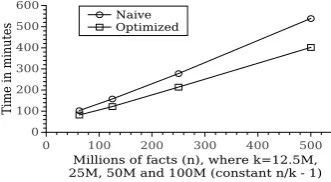
We used four chain-structured datasets for increasing number of joins in the initially formed chain (dn/ke − 1) with n = 125M, and k = 41.7M, 25M, 13.9M and 7.36M, and four chain-structured datasets for a constant number of joins in the initially formed chain (dn/ke −1) with n = 62.5M, 125M, 250M and 500M, and k = 12.5M, 25M, 50M and 100M respectively.
Results.We can identify four main factors that affect the performance of our approach: (a)
number of facts, affecting the input size, (b)number of rules, affecting the output size, (c)data distribution, affecting the number of required MapReduce jobs, and (d)rule set structure, affect-ing the number of required MapReduce jobs.
Figure 1 presents the runtimes of our system for thewin-not-wintest over cyclic datasets with input sizes up to 1 billion facts. In this case, our system scales linearly with respect to both dataset size and number of nodes. This is attributed to the fact that the runtime per MapReduce job scales linearly for increasing data sizes, while the number of jobs remains constant.
Figure 2 shows the runtimes of our system for thewin-not-wintest over tree-structured datasets with input sizes up to 1 billion facts. Our approach scales linearly for increasing data sizes and number of nodes.
Figure 3 depicts the scaling properties of our system for thetransitive closure with negation test over chain-structured datasets, when run on 7 nodes. Practically, transitive closure depends on the number of joins in the initially formed chain, which are equal todn/ke −1, namely 2, 4, 8 and 16, and thus, appropriate for scalability evaluation. The length of the chain affects both the size of the transitive closure and the number of “inference steps”, leading to polynomial com-plexity. Note that our results are in line with Theorem 2.1. Finally, the speedup of the optimized over the naive implementation is higher for longer chains, since the naive implementation has to recompute larger transitive closures.
T im e in m in u te s 0 20 40 60 80 100 120
Millions of facts
0 200 400 600 800 1,000
[image:12.595.118.293.120.228.2]1 node 2 nodes 4 nodes
Fig. 1. Win-not-wintest for cyclic datasets. Time in minutes as a function of dataset size, for various numbers of nodes.
T im e in m in u te s 0 500 1,000 1,500 2,000 2,500
Millions of facts
0 200 400 600 800 1,000
1 node 2 nodes 4 nodes
Fig. 2. Win-not-win test for tree-structured
datasets. Time in minutes as a function of dataset size, for various numbers of nodes.
T im e in m in u te s 0 100 200 300 400 500 600 700 800
Increasing n/k - 1, where n=125M and k=41.7M, 25M, 13.9M and 7.36M
0 2 4 6 8 10 12 14 16 18
Naive Optimized
Fig. 3. Transitive closure with negation test for chastructured datasets. Time in minutes for in-creasing dn/ke − 1, comparing naive and opti-mized WFS fixpoint calculation.
Ti m e in m in ut es 0 100 200 300 400 500 600
Millions of facts (n), where k=12.5M, 25M, 50M and 100M (constant n/k - 1)
0 100 200 300 400 500
[image:12.595.318.496.140.228.2]Naive Optimized
Fig. 4. Transitive closure with negation test for chain-structured datasets. Time in minutes for con-stantdn/ke − 1, comparing naive and optimized WFS fixpoint calculation.
6 Conclusion and Future Work
In this paper, we studied the feasibility of computing the well-founded semantics, while allowing recursion through negation, over large amounts of data. In particular, we proposed a parallel approach based on the MapReduce framework, ran experiments for various rule sets and data sizes, and showed the performance speedup coming from the optimized implementation when compared to a naive implementation. Our experimental results indicate that this method can be applied to billions of facts.
In future work, we plan to study more complex knowledge representation methods including Answer-Set programming (Gelfond (2008)), and RDF/S ontology evolution (Konstantinidis et al. (2008)) and repair (Roussakis et al. (2011)). We believe that these complex forms of reasoning do not fall under the category of “embarrassingly parallel” problems for which MapReduce is designed, and thus, a more complex computational model is required. Parallelization techniques such as OpenMP2and Message Passing Interface (MPI) may provide higher degree of flexibility than the MapReduce framework, giving the opportunity to overcome arising limitations. In fact, in Answer-Set programming, the system claspar (Gebser et al. (2011)) uses MPI, but it needs a preliminary grounding step, as it accepts only ground or propositional programs. (Perri et al. (2013)) uses POSIX threads on shared memory for parallelized grounding. Combining these two approaches and making them more data-driven would be an interesting challenge.
[image:12.595.317.483.291.382.2] [image:12.595.119.290.291.381.2]References
ABITEBOUL, S., HULL, R.,ANDVIANU, V. 1995.Foundations of Databases. Addison-Wesley. AFRATI, F. N.ANDULLMAN, J. D. 2010. Optimizing joins in a map-reduce environment. In EDBT, I. Manolescu, S. Spaccapietra, J. Teubner, M. Kitsuregawa, A. L´eger, F. Naumann, A. Ailamaki, and F. ¨Ozcan, Eds. ACM International Conference Proceeding Series, vol. 426. ACM, 99–110.
BRASS, S., DIX, J., FREITAG, B.,ANDZUKOWSKI, U. 2001. Transformation-based bottom-up computation of the well-founded model. Theory and Practice of Logic Programming 1,5, 497–538.
CLUET, S. AND MOERKOTTE, G. 1994. Classification and optimization of nested queries in object bases. Tech. rep.
DEAN, J. AND GHEMAWAT, S. 2004. MapReduce: simplified data processing on large clus-ters. InProceedings of the 6th conference on Symposium on Opearting Systems Design & Implementation - Volume 6. USENIX Association, Berkeley, CA, USA, 10–10.
FENSEL, D., VAN HARMELEN, F., ANDERSSON, B., BRENNAN, P., CUNNINGHAM, H., VALLE, E. D., FISCHER, F., HUANG, Z., KIRYAKOV, A.,IL LEE, T. K., SCHOOLER, L., TRESP, V., WESNER, S., WITBROCK, M.,ANDZHONG, N. 2008. Towards LarKC: A Plat-form for Web-Scale Reasoning. InICSC. 524–529.
GEBSER, M., KAMINSKI, R., KAUFMANN, B., SCHAUB, T.,ANDSCHNOR, B. 2011. Cluster-based asp solving withclaspar. InLogic Programming and Nonmonotonic Reasoning - 11th International Conference, LPNMR 2011, Vancouver, Canada, May 16-19, 2011. Proceedings, J. P. Delgrande and W. Faber, Eds. Lecture Notes in Computer Science, vol. 6645. 364–369. GELDER, A. V., ROSS, K. A., AND SCHLIPF, J. S. 1991. The well-founded semantics for
general logic programs.J. ACM 38,3, 620–650.
GELFOND, M. 2008. Chapter 7 answer sets. InHandbook of Knowledge Representation, V. L. F. van Harmelen and B. Porter, Eds. Foundations of Artificial Intelligence, vol. 3. Elsevier, 285–316.
GOODMAN, E. L., JIMENEZ, E., MIZELL, D., AL-SAFFAR, S., ADOLF, B., AND HAGLIN, D. J. 2011. High-performance computing applied to semantic databases. InESWC (2), G. An-toniou, M. Grobelnik, E. P. B. Simperl, B. Parsia, D. Plexousakis, P. D. Leenheer, and J. Z. Pan, Eds. Lecture Notes in Computer Science, vol. 6644. Springer, 31–45.
KONSTANTINIDIS, G., FLOURIS, G., ANTONIOU, G.,ANDCHRISTOPHIDES, V. 2008. A For-mal Approach for RDF/S Ontology Evolution. In ECAI, M. Ghallab, C. D. Spyropoulos, N. Fakotakis, and N. M. Avouris, Eds. Frontiers in Artificial Intelligence and Applications, vol. 178. IOS Press, 70–74.
KOTOULAS, S., OREN, E.,AND VAN HARMELEN, F. 2010. Mind the data skew: distributed inferencing by speeddating in elastic regions. InWWW, M. Rappa, P. Jones, J. Freire, and S. Chakrabarti, Eds. ACM, 531–540.
LIANG, S., FODOR, P., WAN, H.,AND KIFER, M. 2009. Openrulebench: an analysis of the performance of rule engines. InProceedings of the 18th international conference on World wide web. WWW ’09. ACM, New York, NY, USA, 601–610.
LIU, C., QI, G., WANG, H.,ANDYU, Y. 2011. Large scale fuzzy pD* reasoning using mapre-duce. InProceedings of the 10th international conference on The semantic web - Volume Part I. ISWC’11. Springer-Verlag, Berlin, Heidelberg, 405–420.
MUTHARAJU, R., MAIER, F., ANDHITZLER, P. 2010. A MapReduce Algorithm for EL+. In Description Logics.
NICOLAS, J.-M. 1982. Logic for improving integrity checking in relational data bases. Acta Informatica 18, 227–253.
OREN, E., KOTOULAS, S., ANADIOTIS, G., SIEBES, R.,TENTEIJE, A.,AND VAN HARME
-LEN, F. 2009. Marvin: Distributed reasoning over large-scale Semantic Web data. J. Web Sem. 7,4, 305–316.
PERRI, S., RICCA, F.,ANDSIRIANNI, M. 2013. Parallel instantiation of asp programs: tech-niques and experiments.Theory and Practice of Logic Programming 13,2, 253–278. ROUSSAKIS, Y., FLOURIS, G.,ANDCHRISTOPHIDES, V. 2011. Declarative Repairing Policies
for Curated KBs. InHDMS.
SOMA, R.AND PRASANNA, V. K. 2008. Parallel Inferencing for OWL Knowledge Bases. In ICPP. IEEE Computer Society, 75–82.
TACHMAZIDIS, I. AND ANTONIOU, G. 2013. Computing the Stratified Semantics of Logic Programs over Big Data through Mass Parallelization. In RuleML, L. Morgenstern, P. S. Stefaneas, F. L´evy, A. Wyner, and A. Paschke, Eds. Lecture Notes in Computer Science, vol. 8035. Springer, 188–202.
TACHMAZIDIS, I., ANTONIOU, G., FLOURIS, G.,AND KOTOULAS, S. 2012. Towards Paral-lel Nonmonotonic Reasoning with Billions of Facts. InKR, G. Brewka, T. Eiter, and S. A. McIlraith, Eds. AAAI Press.
TACHMAZIDIS, I., ANTONIOU, G., FLOURIS, G., KOTOULAS, S.,ANDMCCLUSKEY, L. 2012. Large-scale Parallel Stratified Defeasible Reasoning. In ECAI, L. D. Raedt, C. Bessi`ere, D. Dubois, P. Doherty, P. Frasconi, F. Heintz, and P. J. F. Lucas, Eds. Frontiers in Artificial Intelligence and Applications, vol. 242. IOS Press, 738–743.