Munich Personal RePEc Archive
A comparative content analysis of CSR
strategies oriented to environmental
issues between Greek and European CSR
practices
Metaxas, Theodore and Tsavdaridou, Maria
U. of Thessaly, Department of Economics, Greece
2011
Online at
https://mpra.ub.uni-muenchen.de/41022/
A COMPARATIVE CONTENT ANALYSIS OF CSR
STRATEGIES ORIENTED TO ENVIRONMENTAL ISSUES
BETWEEN GREEK AND EUROPEAN CSR PRACTICES
Theodore Metaxas Lecturer
Department of Economics, University of Thessaly, Korai Str. 43, 38 333, Volos, Greece
Tel: ++30 24210 74917 Fax: ++30 24210 74772 Email: [email protected]
(Corresponded author)
Maria Tsavdaridou
Environmental & GIS Engineer Urban and Regional Planning Msc.
PhD Candidate
ABSTRACT
The scope of this research is to examine the way Greek companies contribute to the protection
of the environment by investigating the CSR reports. In addition, there will be a comparative content analysis of Greek and European companies which will focus on the environmental aspect of the companies CSR strategy. Issues like recycling, environmental awareness, restoration of
abandon places like quarrying, energy conservation, environmental education, green buildings, appliance of environmental indexes are some of the CSR activities that companies adapt in order
to disclosure the company’s environmental policy. The publication of CSR reports as far as the environmental performance is an integral part of the CSR strategy for Greek companies especially on activities like recycling, energy saving and waste management. The results of this
research will reveal how companies from different sectors adapt environmental practices and whether Greek companies follow the European companies in terms of the environmental
dimension of CSR.
KEYWORDS: corporate social responsibility, environmental/sustainability strategy, green management
1. INTRODUCTION
Businesses are part of society and society penetrates far and often into businesses decisions. This relationship is separated and connected. Separated are because the goals of enterprises are usually different from the goals of local community. Enterprises seek profit and should according
to Freidman(1970)who claims that there is one and only one social responsibility of business—to use its resources and engage in activities designed to increase its profits. Local communities from
the other hand expect a responsible enterprise in means of being environmental friendly, paying taxes, offering charities etc. At the same time business and society are connected because enterprises operate in the heart of local communities, seek their employees from local
communities and society needs a successful enterprise as a factor for economic and social development. This relationship could be characterized as interactive in many ways either negative
or positive interactive. In order to have balance in this interactive relationship, enterprises adapt the principles of Corporate Social Responsibility as a way to enhance their role in to the society as an ethical and responsible enterprise in economic, environmental and social issues that
concern local communities and society in general.
Considering the fact that corporations are part of our communities, part of our natural environment and our lives it is obviously that their operation should ensure sound practices and
in other words operate within the terms of sustainable development. Basically, the tool of CSR offers the opportunity for firms to protect the environment without compromise their economic
development. The meaning of CSR focuses on the impacts of corporations on people, communities and the environment. The positive outcome of CSR like corporate reputation and goodwill would be enhanced through social endeavors (Holmes, 1976). Many academics and
organizations have tried to give a definition of CSR, to examine the tools of CSR and to analysis the way corporations act towards public interest (Husted et. al., 2007, Salzman et al 2005).
Caroll suggests that there are four social responsibilities included in the meaning of CSR, the economic, legal, ethical and philanthropic. These responsibilities are drawn in a pyramid where The economic responsibilities are in the bottom of the pyramid while the philanthropic
Figure 1. The Pyramid of Corporate Social Responsibility (Caroll, 1991)
In order to promote sustainable business practices a global effort is been made by the World Business Council for Sustainable Development. In 2003, the council was made up of about 165
companies, drawn from more than 30 countries and 20 industries. The goals of WBCSD are to encourage high standards of environmental management and promote closer cooperation among businesses, governments, and other organizations concerned with sustainable development.
Recently the World Business Council for Sustainable Development published a report in order to identify the opportunities that crisis brings and ways in which to leverage them as the world
addresses its challenges: infrastructure to build, medicine to discover, technology to develop, new strains of food to create and grow to feed a growing population. (WBCSD, 2010)
The scope of this paper is to examine the environmental CSR practices of three companies in Greece, UK and Portugal and their results and to compare them in order to reveal the similarities or differences between them. Also it will provide a general view of the kind of CSR practices
implemented in Europe that focus on the environmental dimension of CSR and whether the expertise of their companies contributes to a successful CSR practice.
description of the case studies. The third part is the analysis of the case studies and the last part is
the conclusions.
The methodology that was chosen in order to compare the three case studies is that of
comparative content analysis. The added value of this paper is that it adds to the existing bibliography on CSR by providing through the companies’ CSR practices the general CSR strategy that each company follows in environmental terms and how important is the fact that
whatever the expertise of the company is that they can implement a successful CSR practice in the environmental dimension. Finally it presents the effort of a specific Greek company in CSR
and compares it with other European companies. There are steps forward in CSR that are made by Greek companies but still the CSR strategy is not implemented by the majority of Greek companies, so it is important to present any successful example of purely Greek companies that
have integrated into their business strategy the CSR principles.
2. CORPORATE SOCIAL RESPONSIBILITY AND ENVIROMENTAL CONCERNS
The World Business Council for Sustainable Development defines CSR as “the continuing
commitment by business to behave ethically and contribute to economic development while
improving the quality of life of the workforce and their families as well as of the local community and society at large". The dimensions of CSR according to the Green paper published by the European Commission in 2001(COM, 2001, 366) are two: internal and external. The internal
dimension refers to the corporation and its environment. While the external dimension is about the way corporation behaves to the outer environment.
The activities related to the internal dimension of CSR are based on the following: Human resources (employees, stakeholders, etc).
Health and safety (employees, consumers).
Dealing with change (employees, stakeholders, consumers). Managing environmental impact (corporation).
The activities related to the external dimension of CSR are based on the following: Local communities (environnent, public issues, etc).
Human rights.
Global environmental concerns.
Some of the major environmental global problems are ozone depletion, global warming and
The consequences are the same for both, businesses and society. So, if a firm would try to put in
practice the meaning of sustainable development there are some key business practices to follow: 1. Life-cycle analysis
2. Industrial Ecology
3. Design for disassembly
The corporate environmental responsibility includes three steps. The first step is pollution
prevention, the second is product stewardship which means focus on the environmental impact of the life cycle of the product and the third and last step is clean technology which leads to
development of new technologies and innovation. All these steps comprise the so called “green management”. But the question for the managers might be “what is the cost for green management?” Several studies and surveys have proved that in the long run business leaders stated that the benefits outweighed the costs (Marcus, Anderson, 2006, Hart, 1996). Some of the
benefits of CSR for the business are: dedicated employees and loyal customers, reduce operating cost, satisfy stakeholders and investors, increase profits, improve brand name, differentiate
products, and be competitive and innovative. While the benefits from environmental management are: competitive advantage by saving money, attracting green customers, promoting innovation and developing skills in strategic planning. Yet for Siegel as far as green management
argues that firms should pursue green management only when it is in their self interest to do so
and not “for moral and social reasons,” regardless of whether it pays.(Siegel, 2009).
Many citizens, environmental organizations and leadership companies define corporate environmental responsibility as the duty to cover the environmental implications of the
company’s operations, products and facilities; eliminate waste and emissions; maximize the efficiency and productivity of its resources; and minimize practices that might adversely affect the
enjoyment of the country’s resources by future generations (Mazurkiewicz, 2004).
3. METHODOLOGY
Content analysis is the methodology chosen to analyze the CSR practices of three different companies as far as their operation sector concerns. The appliance of content analysis is used in
order to examine beliefs, organizations, attitudes, and human relations in sciences (Weber, 1990). Berelson (1952) defined content analysis as “a research technique for the objective, systematic, and quantitative description of manifest content of communications”. Another definition given
qualitative operations (Ross, 2008). There are two general categories of content analysis:
conceptual analysis and relational analysis. Traditionally, content analysis has been thought of in terms of conceptual analysis that begins with identifying research questions and choosing a sample or samples. Once chosen, the text is coded into manageable content categories. The
process of coding is one of selective reduction, which is the idea behind a conceptual analysis. In contrast, relational analysis builds on conceptual analysis by examining the relationships among
concepts in a text. In addition, as with other sorts of inquiry, initial choices with regard to what is being studied and coded often determines the possibilities of a particular study. Typically, three kinds of units are employed in content analysis: sampling units, context units, and recording units
(Ross, 2008, Krippendorff, 2004). The present article falls more within the framework of a relational analysis and the context units are chosen for the analysis. What makes the technique particularly rich and meaningful is its reliance on coding and categorizing of the data. Its major
benefit comes from the fact that it is a systematic, replicable technique for compressing many words of text into fewer content categories based on explicit rules of coding. It has the attractive
features of being unobtrusive, and being useful in dealing with large volumes of data (Stemler, 2001).
In the area of CSR a lot of researchers prefer content analysis as a tool to analyze CSR
attitudes and there is a debate whether the validity of content analysis (Vourvachis, 2007; Yongqiang Gao, 2008). Giannarakis et. al used the content analysis method to examine the
contents of CSR report from the telecommunication sector in Greece (Giannarakis, et al, 2011).
4. CASE STUDIES
S&B Industrial Minerals
S&B industrial minerals is a purely Greek company which mines and processes bentonite, perlite, bauxite, zeolite, wollastonite and produces continuous casting fluxes and a variety of specialty products for a wide range of industrial applications and markets. It is an international
group of more than 40 companies with sales in 76 countries across the globe. The total workforce of the company for 2010 was numbered 1,983 employees globally. Moreover, S&B
used the services of 544 contractors’ workers in Greece, Germany, the USA, Bulgaria, Italy, South Korea, and the Netherlands. The CSR strategy of the company is reflected through their strategic choice for sustainable development and is based on five axes which are:
1. The recognition of the value of S&B people
3. The minimization of the inevitable environmental footprint in all Group activities (from
mining operations to processing and transport) 4. The safeguarding of occupational Health & Safety
5. The respect and care for the local communities (mainly) where S&B is active.
The social CSR activities of S&B focus mainly on the local communities which are the place of
their production. The company takes part in the social and cultural activities of the local communities in order to contribute to a balanced economic, social and environmental
development without affecting the lives of local people. The environmental CSR strategy
according to the sustainability report is about waste, energy, water management, product responsibility and prevention of possible impacts to the environment, health & safety during
product processing, use and final disposal, management of dust emissions during processing, restoration of mines in order to minimize impacts to the natural environment associated with
changes to the land morphology and disturbance to the biodiversity of local ecosystems and rational management of mineral reserves, and management of large quantities of raw materials excavated, as well as of materials used during processing of products.
The CSR activity that will be analyzed in this paper is land reclamation or restoration which aims at minimizing visual disturbance, with the appropriate landscaping of the area, as at restoring a sustainable and self-supporting ecosystem over the long-term, in the areas reclaimed.
The message of the company “bring nature back to the mine” describes the efforts of the company to develop an environmental sound land reclamation methodology which will minimize
their impact to local ecosystem. One of the areas that the company implemented the land
reclamation is Fokis. S&B’s activity in Fokida is situated mainly on the mountain of Ghiona (2,150m.). The Ghiona mountain’s climate varies significantly depending on the altitude, so the
plant nursery in Fokida reproduces plant species that can be used from the sea level to the subalpine zone. The company gives emphasis on the reproduction of native plants best suited for planting at the most challenging areas of the subalpine zone, as well as the reproduction of the
black pine (Pinus negra). In 2006 the total number of plants produced in the Fokida plant nursery was 75.000 plants. The total surface “in use1” for S&B’s mining activities within protected areas
of high biodiversity value is located in Fokis (Greece) where bauxite is extracted and it covers 87,745 m2 in total, i.e. 3.23% of the total mining activity (active mines). The Ghiona Fauna Base Study, completed by the Thessaly University during 2005-2007 among other findings, concludes
that 7 out of the 22 species in Annex Ι of the European Council directive 79/409/EC “on the
conservation of wild birds” can be found at a distance of over 500m from the circumference of the company’s active mines.According to the company “a successful reclamation is measured not
only by good visual result, but mainly by the restoration of a self-sustained ecosystem with the
sufficient diversity of flora and fauna species.” The factors that ensure a successful result in the
restoration of the ecosystem are careful assessment of the ecosystem before mining, consideration of the specific climate and soil conditions of the area to be reclaimed, evaluation of
the area’s flora and fauna reference data and Know-how and experience of land reclamation techniques. In this sense, the company finances research programs in cooperation with academic institutions, specialized research centers and other public and private bodies in order to examine
biodiversity status at the company's extraction areas, the reproduction of endemic and rare flora species and the improvement of the reclamation techniques. Some of these programs were conducted by the University of Thessalia, Ecosystem Management and Biodiversity Laboratory,
Department of Agriculture, Crop Production and Rural Environment in Greece in 2006-2008 which aimed at recording and studying the fauna in the wider area of Ghiona Mountain in Fokis;
the “Ghiona Surveillance Program and in 2008 by Hellenic Ornithological Society in
collaboration with Birdlife International and the Royal Society for the Protection of Birds which aimed to Hellenic Ornithological Society in collaboration with Birdlife International and the
Royal Society for the Protection of Birds. Another similar CSR activity is the reclamation of an abounded underground gallery in the area of Fokida which concerns an environmental
restoration of an abounded surrounding and offers to the local community an infrastructure that will be attractive to visitors. The Fokis Mining Park-Vagonetto is a theme park which is located between mountains Ghiona and Parnassos, within the broader area of S&B Industrial Minerals
SA premises. The aim of this project is to present the operation areas of a mine and at the same time inform and educate young people about the history of the exploitation of bauxite, and promote the mining history of Fokis and the mine workers.
The results of these activities were two sided for the company and the local community. For the company the positive outcome of the specific activities which concerned the reclamation
were the trust of their workers and the local people and the creation and conservation of a monument close related to the history of bauxite. For the local community the results of the Vagonetto was the attraction of visitors, the educational entertainment for students and the locals
about the industrial heritage of Fokida and the restoration of the area by the reproduction of endemic and rare flora specie and reproduction of native plants.
In these examples of CSR practice there were no serious drawbacks or complaints by the
attitude had as a result the Fokida Initiative which is a non-profit Civil Company, founded in
December 2003 on the initiative of S&B and the Mayor of Amfissa, and with the participation of three more Municipalities, namely Gravia, Delphi and Lidoriki, and the Fokida Chamber of Industry and Commerce. The purpose of the Initiative is to support and promote the sustainable
economic and cultural development of the area for the benefit of the local communities.
British Land Company
British Land Company plc is the largest property investment company investing in modern
properties in Britain, with a current portfolio of £14.6 billion. The Company's portfolio focuses
on areas where the principles of supply and demand are strong over the long term. Approximately 41% is invested in out-of-town retail properties, including Meadowhall Shopping Centre in Sheffield, 88 supermarkets and 66 retail warehouses. A further 33% is invested in
central London offices, including Broadgate, a city office estate.
The environmental and social considerations of the company are integrated with everyday working practices and are embedded into its corporate values. The Group employs 186 staff at its
head office who are focused on the integrated core disciplines of strategic property investment, management, development and financing. Approximately 550 staff are employed on-site at the
Group's properties, principally Meadowhall Shopping Centre, Sheffield and Broadgate Estates, London. British Land’s aim is to construct sustainable buildings whilst maintaining commercial viability, long-term profitability and enhancement of the company’s reputation. The reasons
according to the company for engaging in CR were that CSR builds relationships with stakeholders, improves the company's reputation with analysts, investors, lenders, employees, local communities and tenants, and helps to reduce risk. In order to ensure the sustainability of
its operation the company used a check list approach to ensure the sustainability of projects. However, this procedure was not strictly enforced on all projects and since there was no process
it was a drawback for innovation in incorporating sustainability in design and construction. More over the suggestions for improvements were not filtered through to the appropriate departments so there was no use. These difficulties lead to the development of Sustainability Brief in order to
promote continuous improvement in the sustainability of developments. The Sustainability Brief, launched in 2004, facilitates the management of impacts on the environment and communities in
which British Land operates and is part of the Company’s Corporate Responsibility Management
System (CRMS).
i. Promoting the establishment of sustainability objectives and targets for design and
construction with the aim of continuous improvement
ii. Raising the sustainability awareness of the company’s staff, joint venture partners and suppliers
iii. Defining the processes, standards, guidance and responsibilities for managing sustainability issues at each stage in a development project.
The principles of sustainability according to the Sustainability Brief are included in the following headings: site and neighborhood, resource consumption, environmental quality, user and occupant satisfaction and stakeholder relations and dialogue. One of the projects that reflect
the purpose of Sustainability Brief is the Master Plan of Regent place which is located on the
Marylebone Road/Euston Road corridor, one of London’s main road arteries.
The estate comprises a distinctive and striking mix of buildings, providing offices and public
spaces with a range of facilities including a crèche, health and fitness club, supermarket, coffee and sandwich outlets and wine bar. The installation will be finished in mid 2013 but the delivery
of the North East Quadrand which faces onto Regents Place Plaza is a key component in completing the master plan for the estate. The key characteristics of Regent Place which reflect the effort of the company to reduce energy use are the following:
- High-performance glazing to significantly reduce solar heat gain whilst providing natural
light
- Energy efficient lighting with motion and daylight sensors so that lights are only on when
needed
- Ventilation system, which will gather and re-use waste heat
- Electronic monitoring of energy use so that building services can be controlled for
maximum efficiency.
Also the design of the green roofs is laid out in a ‘puzzle’ pattern, comprising several different
seed mixes and plant arrangements. The pattern was carefully selected according to sunlight and shading influences and will encourage biodiversity.
This CSR activity is designed in accordance to the external and internal environmental dimension since it combines both Global Environmental concerns and management of environmental impacts and natural resources. The benefits for British Land were the recognition from global
benchmarking groups for its sector leadership in sustainability, enhancing its reputation as a socially responsible company. Also the company and Regent’s Place recently won both the 'Built
positive contribution of British Land to the local communities. These achievements strengthened
the company’s corporate governance by improving transparency in decision-making, demonstrating its credentials in the bid process to secure new properties and delivering innovation.
Energias de Portugal
EDP Group is an electrical utility company with main activities the generation, supply and
distribution of electricity and supply distribution of gas. The company is present in Portugal, Spain, France, Belgium, Poland, Romania, United States and Brazil. In 2010, the workforce of the
company was 11,989. The principles that the company sets as far as their sustainability concerns
are the following: value creation, efficient resources’ utilization, environmental protection,
integrity, dialogue with the interested parties, human resources management, promoting access to
the electricity energy and support of social development.
The environmental policy of the company sets as guidelines the followings:
1. The incorporate respect for the environment and management of environmental aspects
in all phases of business processes
2. The relations with the authorities and other stakeholders are based on ethical principles
of transparency, honesty and integrity.
3. Constantly improve environmental performance, especially in the prevention of pollution and minimization of its impacts.
4. Comply with the requirements of applicable environmental legislation as well as other, voluntary commitments.
5. Manage environmental risks in order to eliminate or minimize the negative impacts of our
activities both in normal circumstances and in the event of emergencies, accidents or disasters.
6. Manage the impact on biodiversity of our business activities and seek an overall positive balance in this field.
7. Foster the use of renewable energy sources and the best technologies in order to preserve
natural resources and reduce and prevent pollution.
8. Promote energy efficiency and the rational use of energy as one of the main options
compatible with the sustainable use of resources.
9. Consider stakeholders expectations in environmentally relevant processes and their communication.
Each year the company distributes around 34 million paper invoices per year in Portugal, a
quantity that has non-negligible environmental impacts. To mitigage these impacts, EDP decided to reduce the number of invoices mailed out every month. In 2007, it started to promote on-line invoice services, and by the end of 2009, more than 500.000 clients had joined the initiative. The
company was willing to go further and to compensate all the impacts resulting from its paper invoicing process, through an innovative environmental compensation methodology. The
methodology was the “Life Cycle Assessment methodology” which assesses impacts on ecosystems. The approach was named “Zero Impact” and was developed at the Lisbon school of engineering – Instituto Superior Técnico. It goes beyond the offset of CO2 emissions in
voluntary markets (already common worldwide), as it aims to quantify and cover all negative environmental externalities of the life cycle of paper invoices. The software used for this Life Cycle Assessment (Sigma Pro 6.0) accounts for the resources, energy and equipment used for
generating invoices (paper, plastic and printing process), as well as for invoices delivery (fuel). The offset initiative consists mostly in agro-forestry good practices, which are implemented in
rural areas. The approach is as follows:
1) Compensation of environmental impacts is carried out in the same ecosystem service category and, whenever possible, in the same location.
2) When not possible, compensation is carried out in another ecosystem service category.
The compensation initiatives cover most of the impacts on ecosystem services, as for example:
water used for paper production, or soil protection provided by the agro-forestry good practices
implemented in the vicinity of EDP’s activities. The remaining negative impacts not covered by the agro-forestry initiative are compensated through the CO2 markets, representing
approximately 1120 tons of CO2 credits.( WBCSD, 2010)
This CSR practice is an external environmental activity which focuses on the life cycle of a product.
The results of this activity proved to have clear biodiversity conservation results. Compensation activities included not only 9.800 m3/year of water savings through irrigation process
optimization, 585 ha of agriculture best practice use, but also incorporated biodiversity conservation projects such as soil nest protection (691 ha) or protection of riverbed vegetation (2,1 km).It also helped reinforce relations with stakeholders and in particular local communities.
5.COMPARATIVE CONTENT ANALYSIS
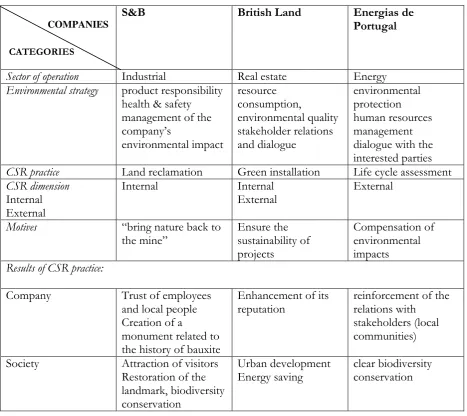
TABLE 1. Content analysis of environmental CSR practices
CATEGORIES
S&B British Land Energias de Portugal
Sector of operation Industrial Real estate Energy
Environmental strategy product responsibility
health & safety management of the
company’s environmental impact resource consumption, environmental quality stakeholder relations and dialogue environmental protection human resources management dialogue with the interested parties
CSR practice Land reclamation Green installation Life cycle assessment
CSR dimension
Internal External
Internal Internal External
External
Motives “bring nature back to
the mine” Ensure the sustainability of projects
Compensation of environmental impacts
Results of CSR practice:
Company Trust of employees and local people Creation of a
monument related to the history of bauxite
Enhancement of its reputation
reinforcement of the relations with stakeholders (local communities)
Society Attraction of visitors Restoration of the landmark, biodiversity conservation Urban development Energy saving clear biodiversity conservation
The categories presented in Table 1 were the results of an in depth research in the sustainability
reports and the companies’ websites. There are five categories that arise from the examination of the available data about the CSR practices of the three companies. The sector of operation which
concerns the main activity of the company, the sustainability strategy of each company which
contains the main principles that the company sets in order to base the company’s environmental
strategy, the corporate social responsibility practice which refers to the implementation of a specific
environmental CSR practice, the motives that led the company to implement CSR practice and the
results of this CSR practice.
The selection of these companies are the result of an in depth research through the lists
best CSR practices of CSR networks in Europe and Greece. It is important to point out that all the available data about the examined CSR practices are extracted by the sustainability reports of
each company, their official websites and the published information which was available in the
CSR networks which characterized the specific practices as successful CSR practices. The examined companies have one main element which led them to a successful CSR practice. The element is that of the environmental awareness that each of the examined companies has as a
guide in order to act as an environmental responsible entity in the society.
The sector of operation for S&B is the industrial sector; the British land is from the real
estate sector and Energias de Portugal from the energy sector. There is nothing in common as far as their sector of operation between the three companies which is interesting since it proves the fact that the application of environmental CSR practices does not need a specific kind of
companies and is feasible by all kind of companies. The category of sustainability strategy contains the main principles that each company sets for their environmental strategy. For S&B the key areas of their sustainability strategy are the waste, energy, water management, product
responsibility and prevention of possible impacts to the environment, health & safety, management of dust emissions during processing, restoration of mines and management of large
quantities of raw materials excavated, as well as of materials used during processing of products. The British Land sustainability strategy relies on the following principles: site and neighborhood, resource consumption, environmental quality, user and occupant satisfaction and
stakeholder relations and dialogue. Energias de Portugal sets as principles for their sustainability
strategy the value creation, efficient resources’ utilization, environmental protection, integrity,
dialogue with the interested parties, human resources management, promoting access to the electricity energy and support of social development. The sustainability strategy for each of the company may vary depending on their environmental impact. The environmental protection is
the one common commitment for the three companies whether it is noted as environmental quality for British Land or product responsibility for S&B as far as their environmental strategy
The successful CSR practice for S&B is land reclamation; British land is a green
installation and Energias de Portugal is life cycle assessment methodology. The application of each CSR practice is in different environmental areas and is based for S&B and British land in
their expertise while for Energias de Portugal it is their innovative thinking that led them to the Zero Impact.
The motives which led S&B to land reclamation was the message of the company “bring
nature back to the mine” which describes the efforts of the company to develop an
environmental sound land reclamation methodology which will minimize their impact to local ecosystem. The difficulties that arose when British land tried to develop a check list approach to
practice. Energias de Portugal motive was the negative environmental impact of the company
when distributing around 34 million paper invoices per year in Portugal.
The results for S&B are twofold, for the company the trust of their employee and the local people and the creation of a monument related to the history of bauxite while for the local
community the attraction of visitors and the restoration of the landmark.
The British land results focus mainly on the company side which is the gain of the
recognition from global benchmarking groups for its sector leadership in sustainability, enhancing its reputation as a socially responsible company. For the local area the application of this CSR practice is a project that changed the urban environment of the area by providing a
sustainable green installation to the citizens of the Regent neighbor.
The CSR activity of Energias de Portugal had as a result the reinforcement of the relations with stakeholders and in particular local communities and clear biodiversity conservation results
for the environment.
6. CONCLUSIONS
The implementation of a successful CSR practice can happen whatever is the sector of the company. In the case of S&B it seems that their expertise plays an important role in the
reclamation of the mine and it is essential to offer their scientific knowledge in order to mitigate the negative environmental impact of their operation. As far as the Energias de Portugal and British Land it is encouraging the fact that the two companies develop innovative environmental
practices proving which proves their environmental awareness.
The environmental aspect of the CSR activities has as a common element the mitigation of the environmental impact of the three companies. Another interesting point is the fact that the
application of a successful CSR practice that is related to the environmental concerns of each company seems to need the participation of external bodies like universities, local authorities or
institutes which means that a successful CSR practice needs strong partnerships.
As for the comparison between Greek companies and European in the CSR strategy it is obvious that the Greek company has nothing less in the application of a successful CSR practice and uses
to the max their CSR possibilities in order to provide a sustainable project to the local community and reduce as much as they can their environmental impact similar to the European
companies.
REFERENCES
Berelson, B. (1952). Content analysis in communication research. New York: Free Press.
European Commission (2001) Promoting a European Framework for Corporate Social Responsibility, Green Paper (Brussels: European Commission). Available online at: http://eur-lex.europa.eu/LexUriServ/site/en/com/2001/com2001_0366en01.pdf
Friedman, M. (1970, September 13) “The social responsibility of business is to increase its profits” The New York Times Magazine.
Hart, S. (1995). A natural resource-based view of the firm. Academy of Management Review, 20: 986-1014.
Holmes L.Sandra (1976) “Executive Perceptions of Corporate Social Responsibility” Business Horizons. 19 (3),34-40
Holsti, O. R. (1969) “Content analysis for the social sciences and humanities” Reading, MA:
Addison-Wesley.
Husted W Bryan, Allen B David (2007) “Strategic Corporate Social Responsibility and Value Creation among Large Firms- Lessons from the Spanish Experience” Long Range Planning Science Direct, Elsevier 40(6). 594-610
Giannarakis Grigoris, Nikolaos Sariannidis Alexandros E. Garefalakis (2011) “The Content of Corporate Social Responsibility Information: The Case of Greek Telecommunication Sector” International Business Research 4(3) 33-44
Marcus, A. A., & Anderson, M. (2006). A general dynamic capability: Does it propagate
business and social competencies in the retail food industry. Journal of Management Studies, 43, 19-46
Krippendorff Klaus (2004) “Content analysis. An introduction to its methodology” Sage Publication
Lee E. Ross (2008) “ Criminal justice pioneers: A content analysis of biographical data” Journal of Criminal Justice 36 182–189
Mazurkiewicz Piotr (2004) “Corporate Environmental Responsibility: Is a Common CSR
Framework Possible? “Paper presented with the IAIA Conference in Vancouver, May, 2004
Salzman Oliver, Ionescu-Somers Aileen, Steger Ulrich(2005) “The Business case for Corporate Sustainability: Literature Review and Research Options” European Management Journal, 23 (1), 27-36.
Siegel S. Donald (2009) Green Management Matters Only If It Yields More Green: An Economic/Strategic Perspective.Jerusalem Institute for Market Studies
Yongqiang Gao (2009) Corporate Social Performance in China: Evidence from Large Companies. Journal of Business Ethics, 89, pp.23–35
Vourvachis, Petros (2007) “On the use of content analysis (CA) in corporate social reporting (CSR): revisiting the debate on the units of analysis and the ways to define them”. In: British Accounting Association Annual Conference 2007; 3-5 April 2007, Egham, England. (Unpublished) Available online at: http://eprints.kingston.ac.uk/4129/
World Business Council for Sustainable Development (WBCSD) (2010) “Vision 2050 -The new agenda for business” available at: http://www.wbcsd.org/vision2050.aspx
World Business Council for Sustainable Development (WBCSD) (2010) “Responding to
the Biodiversity Challenge Business contributions to the Convention on Biological Diversity”