http://www.scirp.org/journal/jtts ISSN Online: 2160-0481
ISSN Print: 2160-0473
Touch-and-Go Mobile Payment System
Peter Rulić, Bojan
Kotnik, Saša
Klampfer, Amor Chowdhury
Margento R & D, Maribor, Slovenia
Abstract
Contactless mobile payment devices are fast, convenient and user friendly means for executing small value business transactions. This kind of transac-tions is preferred to be executed conveniently and on the fly by just tapping a mobile payment device to a mobile terminal. Mobility, convenience and fast transaction execution are very important payment system properties in poten-tially crowded places such as in public transportation. These properties are in practice causing transaction execution problems, such as: delays in offline transaction execution, transaction atomicity failures caused by mobile data communication drops, lack of central control on mobile transaction system components and increased vulnerability risk caused by easy physical access to the mobile transaction system components. This paper describes a holistic transaction processing model for resolving mentioned problems in micro-payment mobile touch-and-go transaction systems. Defined processing model was implemented on real public transportation mobile payment system where it was proven as a robust solution for execution of small value touch-and-go mobile ticketing transactions.
Keywords
Mobile Transaction System, Business Transaction, NFC, Mobile Payment
1. Introduction
Basic general requirements for an arbitrary transaction system are today known as ACID, which stands for atomicity, consistency, isolation and durability. ACID term was first used by [1], and it is widely used for describing transactions [2] [3] [4]. ACID properties of a mobile transaction system are often challenged, because of frequent disconnections on mobile data transmission channels. More-over, real mobile micropayment systems have to meet the following additional requirements:
How to cite this paper: Rulić, P., Kotnik, B., Klampfer, S. and Chowdhury, A. (2017) Touch-and-Go Mobile Payment System. Journal of Transportation Technologies, 7, 50-69.
http://dx.doi.org/10.4236/jtts.2017.71004
Received: November 7, 2016 Accepted: January 8, 2017 Published: January 11, 2017
Copyright © 2017 by authors and Scientific Research Publishing Inc. This work is licensed under the Creative Commons Attribution International License (CC BY 4.0).
• Fast business transaction execution by users. In practice, the so-called small value or micropayment touch and go transactions have to be executed in negligible time, where the user does not have to confirm the transaction ex-ecution or enter a pin number. Quick exex-ecution of business transactions re-duces congestions in crowded places and it is necessary in various cases, such as public transportation check-ins, where transactions are executed quickly with a single tap of contactless devices to the point of sale terminal.
• User-friendly and always available execution of business transactions. Busi-ness transaction system has to be available for transaction execution regard-less of various disconnections on mobile data transmission channels. Users have to be able to conveniently and autonomously execute business transac-tions on mobile terminals with various contactless devices, such as contact-less smartcards or smart phones [5] [6].
• Reliable automated central control on mobile transaction system compo-nents. Mobile terminals can temporary work in offline mode, during discon-nections on mobile data transmission channels. Offline operation makes va- rious transaction failures and failures on mobile transaction system equip- ment hard to detect, because of missing real-time operational data. Operator of mobile business transaction system has automated full control on mobile parts of transaction system such as mobile terminals.
• Enhanced transaction system security. Practical transaction system security has to be based on strong cryptographic techniques for data protection and maintained with appropriate transaction system security procedures. Such type of security has to provide automatic monitoring on business transaction system for potential security breaches based on business transaction rules. Therefore potential security breaches can be rapidly detected and rehabili-tated, which is essential for damage mitigation. Another practical aspect for enhanced security in mobile micropayment systems is transaction execution without confirmation with pin number.
We will abbreviate these special requirements as FUCS (F for fast transaction execution, U for user friendly execution of transactions, C for reliable control on the transaction system components and S for the enhanced security). In this pa-per we will present a processing model of the mobile micropayment near real- time business transaction system, based on ISO/IEC 14443 or its extension Near Field Communication (NFC) [7] compatible contactless devices, such as con-tactless smartcards, NFC enabled mobile phones or similar devices [8] [9] [10] with ACID and FUCS requirements.
1.1. Description of the Paper Structure
sec-tion.
We continue with the central processing system description in fourth section, where business account synchronization, managing NFC disconnections and enhanced control and security are defined. In fifth section the practical imple-mentation case of public transport City Card Urbana is presented, meanwhile sixth section concludes the paper.
1.2. Research Motivation
The motivation for this research was a gap between requirements and practical problems, which emerged with implementation of micropayment NFC mobile business transaction system called Urbana, which is Margento mobile payment system [11] [12] used for public transportation ticketing and mobile payments. Urbana is required to operate with intermittent mobile data transmission chan-nels with ACID and FUCS properties.
Special challenge represents resolving unverified commit operations caused by single tap NFC transactions (see third chapter, where mathematical model of terminal transaction processing is described) on a MTD (Mobile Transaction Device). Unverified MTD data commit operations lead to transaction atomicity failures. These failures in practice occur when data communication between terminal and MTD is disconnected during commit verification of a single tap transaction.
Additional challenge is ensuring security and control over mobile components of the transaction system. Terminals and MTDs are mobile components, which can operate offline and are therefore vulnerable for potential malfunctions or system intrusions.
1.3.
State of the Art
-Related Work
Our transaction system relates to three basic transaction system designs: trans-action processing systems, real-time systems and batch processing systems [2].
The transactions of transaction processing systems are initiated on terminals with terminal programs, where user requests are converted into executable trans-actions. Transactions are transferred to central processing system, where they are completed. Transaction data is finally stored in database system. Real-time systems are online systems, with limited time for transaction execution. Ideally, mobile transaction system is a real-time online system, where transactions are executed online and committed in negligible time. Unreliable mobile data trans- mission channels are preventing real-time transaction execution. In contrast to real-time systems, execution time is not critical for batch processing systems, where transactions are packed in batches and saved. Batches with transactions are processed at a later time.
between local and fixed hosts and processed. This concept is a base for various relaxed ACID transaction models such as: pro-motion [13], pre-commit [14], zippering [15], where with relaxing one or more ACID properties, the mobile transaction can be successfully executed, despite disconnections between mobile and fixed hosts. The same basic idea is used in our mobile transaction system, where disconnection problems between terminals and central processing system are solved with offline terminal operation where transactions are packed in batches on terminals. Fast transaction execution is required in our business transaction system, that’s the reason why our transactions are committed on MTDs immediately at the time of execution. Such transactions cannot be can-celed, which is similar as in the pre-commit transaction model.
Managing presented disconnections on NFC data transmission channel re-quires transaction failure recovery, similar to [16] [17], where different strategies for transaction repairing are used.
The presented related work is mainly focused at resolving ACID problems caused by intermittent connections in mobile transaction systems. Related work does not cover practical problems of mobile payment systems. Similar prototype transaction system for mobile payment, which was presented in [18] [19] is fo-cused mainly on user’s acceptance and opinion on convenience of NFC pay-ments. It does not cover ACID and FUCS problems in big mobile payment sys-tems. Our mobile payment system presents solution to FUCS requirements, which are not covered in surveyed literature on mobile transaction systems.
2. Transaction System Architecture
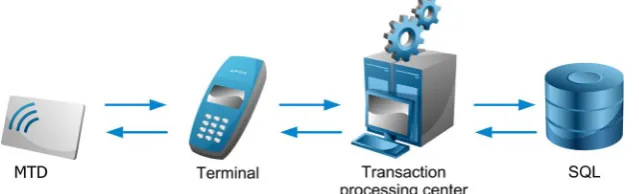
The basic architecture of our transaction system is shown in Figure 1.
[image:4.595.217.537.615.712.2]Business transactions represent interactions between businesses and users. Business transactions are initiated on mobile terminals with ISO/IEC 14,443 or NFC compatible devices referred as MTDs. MTDs are secured NFC hardware devices capable of secure data storing and communicating with terminals. In the following text business transactions will also be noted simply as transactions. Terminals are hardware devices capable of secured running of terminal pro-grams and storing the transaction data. Terminals are connected with the trans-action processing center over a mobile network, which supports internet proto-col [20] such as GPRS [21] [22], UMTS [23] or similar. Transaction processing center uses relational SQL database [24] [25] for transaction data storage.
Secure data storing on terminals and MTDs and encrypted data transmission between terminals and transaction processing center; allow transactions to be securely conveyed from terminals to the central processing system.
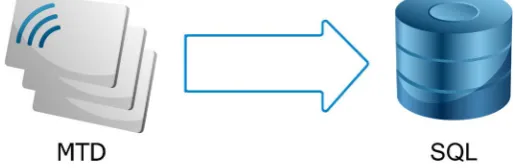
Transaction data is stored in the database system as presented in Figure 2. The first is a mobile spread database, where users’ accounts data is stored on their MTDs. The mobile database has the following properties: A single MTD contains the data of a single transaction system account. The data on a MTD can only be accessed by terminals during transaction execution.
These properties impede centralized and random transaction data access on terminals, because the data on MTDs is available only during transaction execu-tions on terminals.
The second database is central SQL database, which contains near-real time copy of the mobile spread database. User account copies in the central database are synchronized with user accounts on MTDs with transactions executed on terminals and transferred to the central side of the transaction system. Such da-tabase system provides centralized system control and random data access.
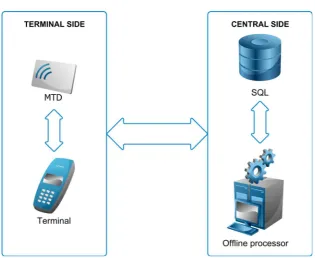
We can observe the whole mobile transaction system from the top layer where the transactions take place. In Figure 3 the similarity between the terminal side and the central side of the transaction system is presented in the sense of trans-action processing and data storage. Transtrans-actions on the terminal side are per-formed on multiple terminals, where user account data is stored on MTDs. While the central side uses single software component called offline-processor for transaction processing and SQL database for data storage. Such transaction architecture enables user-friendly and always available transaction execution.
Transactions can be executed on mobile terminals offline, without fixed con-nection to the central processing system. Executed transaction data is temporary stored on terminals in transaction batches. When mobile connection between a terminal and the central side is established, transaction batches are sent from a terminal to the central side of transaction system, where they are processed to synchronize the SQL database with the mobile spread MTD database.
3. Developed Mathematical Model of Terminal Transaction
Processing
[image:5.595.244.502.632.716.2]We will present basic business transaction logic with the definition of terminal transaction processing. Terminal transaction processing is executed when a us-er’s MTD is taped to a terminal.
Figure 3. Transaction processing and data storage on terminal and central side.
Every user has a business account stored on a MTD. We denote the business account, also called just the account, as Ai, where index i represents i-th user. Business account contains electronic wallet, which can be topped up with credit for cashless payments. The account also allows purchases and validations of var-ious products such as electronic tickets or vouchers. An arbitrary account con-tains the following data:
(
I W P L Z H, , , , ,)
∈A (1)where I represents a unique identification number of the account A, which cor-responds to i-th user. W is the account wallet balance credit. P represents details of purchased products available for use to the user. P is a set of purchased prod-ucts
(
p p1, 2,pN)
∈P, where index N represents the number of products. Thetime of last transaction execution in the account A is represented by L. Identifi-cation of the terminal on which last transaction was executed is represented by Z. All executed transactions on the account A are collected in a set of transac-tions H,
(
B B1, 2,BM)
∈H. Index M represents the number of executed trans-actions.When transaction is successfully executed, the account data is changed. We denote the states of an account between two successive transactions with succes-sive upper script index integers such as Am and Am+1. Similarly we denote the execution order of successive transactions with notations: Bm and Bm+1.
A transaction of i-th user account in m-th state is executed in a logical order, where the account state m
i
A is changed to m1
i
A + with the transaction m i
B . The
(
f c t l y z a w p s, , , , , , , , n,)
∈B (2)Symbols representing the transaction elements are described as:
• f—Transaction type is used for classification of transactions; We use four transaction types: f = {refill, debit, purchase, validation}. The transaction type is set on a terminal during transaction execution, according to the purpose of the transaction.
• c—MTD identification number is used for identification of user accounts. It is unique for each MTD device and used for the identification of the accounts. • t—Time of transaction execution is current time on a terminal.
• l—Time of the last successfully executed transaction is stored on account from previous successful transaction execution.
• y—Unique terminal identification number on which a transaction was ex-ecuted.
• z—Terminal identification of the last successfully executed transaction is stored on account from previous successful transaction execution.
• a—Transaction amount is set on a terminal according to a business price. It can take positive or negative value.
• w—Wallet balance after an executed transaction is taken from the account. • pn—Details of n-th purchased product where n = 1… N are chosen on a
ter-minal, if transaction type f = purchase. • s—Data commit status on a MTD.
With transaction execution the following account values are modified:
Wallet credit Wi∈Ai can be increased or decreased by the value ai∈Bi, or left unchanged:
1
m m m
i i i
W + =W +a (3)
New n-th purchased product element pn is added to user’s purchased products set Pi∈Ai with the transaction type purchase. This is expressed with equation
1
purchase im im nm
f = ⇒P + = P ← P (4)
where the symbol ← represents insertion of purchased product details pn into the set Pi.
Last successful time Li∈Ai is set as the current time t∈Bi and last ter-minal identification Zi∈Ai is set as a current terminal identification:
1
m m
i i
L + =t (5)
1
m m
i i
Z + =y (6)
New transaction is added to the set of transactions H:
1 .
m m m
i i i
H + =H ←B (7)
The success of a transaction depends on the success of a MTD data commit operation. When a transaction B is executed, equations from (3) to (7) change the account state, only if data commit operation on a MTD is successful. Data commit operation on a MTD can be either successful or unsuccessful; therefore a transaction is successful or unsuccessful.
transac-tion executransac-tion. The commit operatransac-tion result is represented with the MTD data commit status m
i
s .
{
successful, unsuccessful, unverified}
mi
s = (8)
Verified data commit operation yields successful or unsuccessful data commit result. The unverified data commit result was introduced because in practice a terminal cannot always verify the success of data commit operation on a MTD. Disconnection can occur before a terminal verifies the commit operation. Failed reconnection or timeout enables a terminal to set unverified data commit status
m i
s = unverified and continue executing next transaction.
The unverified data commit result causes atomicity failure. Meanwhile con-sistency and durability are assured with data commit operation on a MTD. Al-though the commit result in transaction B is set as unverified as presented with Equation (8), the actual state of an account A on a MTD is only changed with successful commit operation, so account A on a MTD remains consistent after executed transaction. The isolation transaction property is assured with a logical terminal rule, where only one transaction can be executed on one terminal at a time. Transaction executions are independent of each other, thus multiple trans- actions can be executed simultaneously on multiple terminals with isolation property.
The presented terminal transaction processing logic provides always available, fast and user friendly execution of transactions. But the defined transaction pro- cessing on terminals alone, cannot provide atomic transaction execution. More-over, transaction processing logic on terminals does not provide central control on executed transactions or random user account data access. The solution to these drawbacks is provided in the next sections, where details of the central processing system are described.
4. Developed Mathematical Model of Central Processing
System
After execution the transaction data B is temporary stored in batches on termin-als. When mobile connection is available, transaction batches are sent to central processing system where they are processed by the offline-processor interacting with the SQL database. SQL database contains copies of all user accounts on MTDs. Central side processing mechanisms synchronize the original business accounts on MTDs with the central side copies.
Similarly as on the terminal side, the central processing system also uses the equations from (3) to (7) for transaction processing. The elements of an arbi-trary account Ai has to have the same values on the terminal and on the central side after every transaction Bi has been processed. To make further formulation more understandable, we denote central account values with a right upper script dash line, e.g. (I/,W/,P/,L/,Z/,H/)∈A/. Ideally, an account on the central side is processed the same way as on the terminal side.
on the terminal side are always executed in an incremental order. The time of every executed transaction on a terminal m m
i i
t ∈B is always greater than the
time of the previously last executed transaction m1 m1
i i
t − ∈B − , and smaller than
the time of the first next execution time m1 m1
i i
t + ∈B + . For sequential states of an
arbitrary account on MTD 1 1 , ,
m m m
i i i
A − A A +
, the respective sequential trans- actions are generated m 2, m1, m
i i i
B − B − B
always in an incremental relation:
2 1
m m m
i i i
t − < t − <t (9)
This is in practice achieved by terminal real-time clock synchronization with central database time.
Problems with central transaction processing emerge because transactions cannot be processed in the same time sequential order as on the terminals. Transactions on terminals are stored in batches, before they are transferred to the central processing system. Time delays between transaction initiations on terminals and central processing can cause a transaction m
i
B to arrive to the
central side before transaction m 1
i
B − . These problems are managed with
algo-rithms for synchronization of user accounts in central processing system. Transaction parameter chaining is useful transaction property obtained from Equations (5) and (6). We are using two parameters: t-time of transaction execu-tion and y-unique terminal identificaexecu-tion number for chaining two sequential successful transactions on the MTD as shown in Figure 4.
Transaction chaining mechanism confines successful transaction execution on a MTD and enables central processing system to effectively verify consistency of transactions executed on mobile terminals.
In the following section we will present algorithms for transaction processing in the central processing system.
4.1.
Business Account Synchronization Mathematical Model
Two approaches are possible for account synchronization in central SQL data-base. First is based on a delayed synchronization, where transactions are pro- cessed after enough time has passed since their execution on terminals. This de-lay time assures us that all executed transactions of i-th user have reached the central processing system and transactions can be processed in execution-se- quential order as on terminals. Such approach yields simple synchronization, but it has a drawback. The central accounts are not synchronized fast or near real- time. To achieve near real-time synchronizations, we have chosen the approach, where transactions are processed near real-time or just after they are transferred to the central processing system.
With this approach central accounts are synchronized regardless of the ter-minal sequential order of transactions. These way transactions can be processed as soon as they are transferred to the central processing system. Elements of an account are synchronized in the following way:
Figure 4. Sequential successful transaction chaining.
H/, which are just copies of transactions H sent from terminals in batches. Ac-count elements L/ (the time) and Z/ (the terminal identification) of last success-fully executed transaction are also easily synchronized, by just taking values from the last successful transaction transferred to the central processing system.
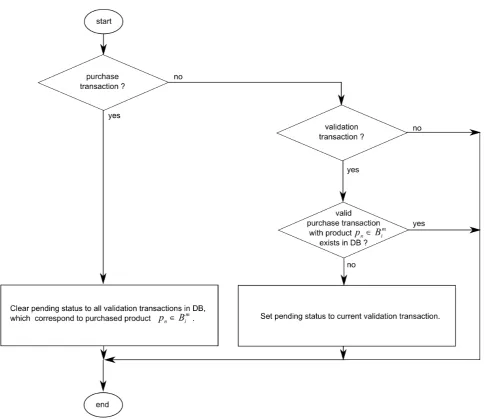
Synchronization of purchased products P/ is straightforward. User can pur-chase a product pn∈P for a use within its predefined time period. Every product has to be validated before it is used. Therefore product purchase trans-action on a terminal is executed first and validations latter. Disconnection be-tween the terminal and the central processing system might cause product pur-chase transaction to be delayed and product validations might arrive to the cen-tral processing system before purchase. In this case processing conflict occurs in the central processing system-validation cannot be processed, because there is no referenced product purchase. To deal with delayed product purchases, special pending status to product validations is introduced (see Section 4.2.).
4.2.
Algorithm for Managing Pending Validation
The algorithm for managing pending validations is presented with flowchart on Figure 5. Pending validation status can be set only for arbitrary limited time. If this time has expired, the transaction system alert is set. Alert notifies transac-tion system administrators that validatransac-tion without purchased product was ex-ecuted. This indicates either a potential security breach or a system malfunction.
4.3.
Algorithm for Wallet Credit Synchronization
The remaining account element to be synchronized is wallet credit. Synchroni-zation of the wallet credit is performed with help of the auxiliary-element set Xi/, which completes the account Ai/ on the central side of the transaction system. The auxiliary set Xi/ is presented as a record in the central database table used for synchronization. The auxiliary set contains the following elements:
(
/ / /)
/, ,
I U D ∈X (10)
The first element denoted as I/ is used for identification of the account being synchronized / / / /
I ∈X = ∈I A = ∈I A. The second element represents time
and is denoted U/. It represents the synchronization time. The last element is synchronization amount denoted D/.
Figure 5. Algorithm for processing pending validations.
Figure 6. Algorithm for wallet credit synchronization.
4.4.
Managing Disconnections on NFC Data Transmission Channel
Transaction execution between a terminal and a MTD is not always atomic be-cause of disconnections on NFC data transmission channel, as described earlier in text. To overcome this problem we use the time of the last successfully ex-ecuted transaction L.
Transaction m i
B can arrive to the central side of the transaction system with
the MTD commit status m m
i i
S ∈B set to unverified. In this case central pro-
cessing system has to verify if transaction m i
B was executed successfully or
un-successfully. Successful transaction m i
B can be verified with the parameter
i i
l ∈B-time of last successfully executed transaction using the transaction time
chaining relations:
{
}
1 1
, successful, ,
m m m m
i i i i
t =l + s = s + = successful unverified (11)
where any couple of successive transactions m i
B and m1
i
B + (executed by i-th
user) are connected with time stamp values m i
t and lim1
+ . Start time of previ-
ously executed successful transaction m i
t is always equal to the next
transac-tions last successful time m1
i
l + , if the next transactions execution status m 1
i
s + is
7 represents the algorithm based on the transaction time chaining, which is used for managing disconnections on NFC data transmission channel.
When i-th user opens an account, a MTD is initialized. With MTD initializa-tion, the time of the last change in an account state Li∈Ai is set to the current initialization time. This enables the first transaction to be verified. By tracking the chained sequence of successful transactions, we can effectively verify the MTD commit operation. The presented algorithm assures atomic transaction execution even in the cases of unverified MTD data commit status on terminals.
The drawback of described method for preserving atomicity is non-real-time verification. Unverified transactions can only be verified with the next executed transaction by a user. This represents a relaxation of atomicity in the transaction system, where atomicity of disconnected transactions is preserved for the cost of transaction execution delay.
The atomicity drawback is in practice reduced to minimal occurrence with terminal feedback prompting the user to re-tap MTD when commit operation is unverified. However, the user can ignore the terminal feedback, refuse or fail to re-tap the MTD to the terminal. In this case we are relaxing the atomicity prop-erty and allow the transaction execution to be delayed until the user executes next transaction.
4.5.
Control and Security
Transaction time chaining was utilized for managing disconnections on NFC data transmission channel. It is also used for control and security purpose, in combination with the terminal identification chaining.
Practical concern in the mobile transaction system is random malfunction, when some random terminal didn’t send an executed transaction to the central processing system. To verify the transaction execution, we need reliable central control on such failures. This is achieved with transaction time chaining and terminal identification chaining.
A transaction contains the element of terminal identification y∈B and the
element of terminal identification of the last successfully executed transaction
z∈B. Any couple of successive transactions m i
B and m1
i
B + executed by i-th
user are chained with terminal identifications as:
{
}
1 1
, , ,
m m m m
i i i i
y =z + s =successful s + = successful unverified (12)
where terminal identification of previous successful transaction m i
y is always
equal to the next transactions last terminal identification m1
i
z + , if the next
transactions execution status m 1
i
s + is successful or unverified.
Automated central control on transaction system is based on detection of consistency failures during transaction processing such as:
• missing transactions during account synchronizations,
• missing or invalid timestamps in transaction time chaining defined with Eq-uation (11),
• other invalid transaction parameters.
malfunctioned terminal can be rapidly detected, even if the terminal is discon-nected from the central processing system.
Security is another important concern in the mobile transaction system. Mo-bile transaction system components such as terminals and MTD’s are particu-larly vulnerable, because mobility enables offline transaction execution without connection to the central processing system. Moreover, potential attackers have easy physical access to these mobile components. Generally it is hard to predict all possible attack methods on MTDs [26] [27] therefore we are proposing a consistency verification method for fraud detection. Comprehensive transaction system security is the topic beyond the scope of this text. We are presenting a basic approach for security hardening in the mobile payment system.
Encryption represents the basic defense against attacks on mobile transaction system. Mobile transaction system data is protected with encryption of accounts on MTDs, secured transaction execution on terminals and encrypted data trans-fer between terminals and central processing system. If an attacker manages to break the encryption, it would be trivial to execute unauthorized transactions. Breaking encryption on a MTD or terminal could lead to:
• unauthorized electronic wallet credit modifications, • unauthorized electronic product purchases,
• copying and duplication of a MTD account.
Presented central transaction processing mechanisms offer enhanced security with rapid detection of potential data breaches on the terminal side of the trans-action system. Security breach on the terminal side can be detected with defined consistency verification during account synchronization or managing NFC dis-connections on the central side. Every inconsistency between terminal and cen-tral side of an arbitrary account represents potential security breach. For exam-ple: unauthorized product purchases can be detected with defined synchroniza-tion of purchased products, unauthorized wallet balance modificasynchroniza-tion can be detected with the wallet credit synchronization. Copying or duplication of a MTD account can be detected with the following transaction consistency rela-tion:
, , successful, successful
u m m m u u
i i i i i i
l ≠l u≠m s ∈B = s ∈B = (13)
where any couple of successful transactions u i
B and m i
B , executed by i-th user,
5. Implementation Case City Card Urbana
In this section we will present practical operational data of the defined transac-tion processing model. The presented processing model was implemented in real big mobile transaction system called “City card Urbana” or simply Urbana. Re-sults are obtained from real transaction data gathered from Urbana in December 2015, which represents typical operation. Urbana is used in the city of Ljubljana as a stored value card business transaction system for purchasing small value public city transportation services, city parking services, public library services, city tourist services, etc. Urbana contains approximately 860,000 active user ac-counts and 1600 mobile terminals.
The chart in Figure 8 shows daily number of successful transactions. On a typical work day Urbana exceeds 200,000 successful transactions. While on weekends, national holidays, school holidays there are notably smaller number of transactions. This is expected daily distribution, since city services are used more frequently during work days.
We performed the measurements on the transaction system operational data in December 2015, which are presented in Table 1.
These measurements are:
• Average frequency of disconnections between terminals and central pro- cessing system during transmission of transaction batches.
• Average daily number of disconnections on NFC data transmission channel. • Averagetime for transaction execution on terminals for contactless
smart-cards.
• Average time for transaction execution on terminals for NFC compatible mobile phones.
Urbana terminals use GPRS mobile data transmission channel for transferring transaction data to the central processing system. Frequency of disconnections in Table 1 is calculated as a ratio between number of disconnected and number of successfully transmitted transaction batches from terminals to the central processing system. In December 2015 there were 1,319,516 successfully trans-mitted transaction batches and 26,015 disconnections. The measurement of 0.02 represents approximately one disconnection on 50 successfully transmitted transaction batches. Defined algorithms for business account synchronization successfully managed all disconnected transactions assuring ACID and FUCS properties.
Figure 8. Daily number of successful transactions in December 2015.
Table 1. Measurements in Urbana for December 2015.
Average frequency of batch transmission disconnections 0.02 Average daily number of NFC disconnections 226 Average time for transaction execution with contactless smartcards (in seconds) 0.35
Average time for transaction execution with NFC compatible
mobile phones (in seconds) 1.0
[image:17.595.208.538.413.612.2](Measurements were performed on work week days-without weekends and national holidays).
Table 2. Delays for managing disconnections on NFC during December 2015.
Number of disconnected
transactions Verification time in days (24 hours) since transaction execution
3953 less than 1 day
305 from 1 to 2 days
69 from 2 to 3 days
56 from 3 to 4 days
38 from 4 to 5 days
28 from 5 to 6 days
17 from 6 to 7 days
30 from 7 to 8 days
18 from 8 to 9 days
4 from 9 to 10 days
257 more than 10 days
(Number of all disconnected transactions = 4775).
verified or verification time will be very long. In the worst case scenario, some transaction on a MTD gets disconnected and the same MTD is never used again. Such transaction will never be verified.
FUCS requirements in Urbana are ensured with the defined processing archi-tecture. Transaction execution is available on mobile terminals regardless of the availability of mobile transmission channel. Transactions are executed fast and user friendly. Generally a transaction is executed in a short time after the user just puts a MTD in front of a terminal: currently in approximately one third of a second for contactless smartcards and one second for NFC compatible mobile phones.
6. Conclusion
s
We have defined a holistic transaction processing model, with algorithms for mobile account synchronization, verification of transactions, establishing en-hanced transaction system control and security. Defined processing model is capable of resolving common problems in mobile micro payment touch-and-go transaction systems. These problems are offline transaction executions, transac-tion atomicity failures, central control on mobile transactransac-tion system compo-nents, and supervision on potential security risks.
The processing model was tested in real mobile transaction system environ-ment, where it operates very well. Presented transaction chaining mechanism was in practice proven as a good solution for ensuring requirements in real mo-bile payment system. FUCS properties of the payment processing system can be further improved in the future, by adding additional parameters for transaction chaining such as: transaction serial number on a terminal or transaction serial number on a MTD. A challenge remains in further reduction of NFC transaction disconnections and in decreasing delays for managing these disconnections.
References
[1] Haerder, T. and Reuter, A. (1983) Principles of Transaction Oriented Database Re-covery. ACM Computing Surveys, 15, 287-317. https://doi.org/10.1145/289.291
[2] Bernstein, P.A. and Newcomer, E. (2009) Principles of Transaction Processing 2nd Edition, Morgan Kaufmann,Burlington.
[3] Le, H.N. (2006) A Transaction Processing System for Supporting Mobile Collabora-tive Works. Doctoral Dissertation, Department of Computer and Information Science, Norwegian University of Science and Technology, Trondheim.
[4] Weikum, G. and Vossen, G. (2002) Transactional Information Systems, Theory, Algorithms, and the Practice of Concurrency Control and Recovery. Morgan Kaufmann, Burlington.
[5] Chen, J.J. and Adams, C. (2004) Short-Range Wireless Technologies with Mobile Payments Systems. 6th International Conference on Electronic Commerce, Delft, 25-27 October 2004,649-656. https://doi.org/10.1145/1052220.1052302
[6] Dewan, S.G. and Chen, L.-D. (2005) Mobile Payment Adoption in the USA: A Cross-Industry, Cross-Platform Solution. Journal of Information Privacy & Securi-ty, 1, 4-28. https://doi.org/10.1080/15536548.2005.10855765
Con-tactless Smart Cards, Radio Frequency Identification and Near Field Communica-tion. 3rd Edition, John Wiley & Sons,Hoboken.
https://doi.org/10.1002/9780470665121
[8] Carr, M. (2007) Mobile Payment Systems and Services: An Introduction. Mobile Payment Forum.
[9] Ondrus, J. and Pigneur, Y. (2007) An Assessment of NFC for Future Mobile Pay-ment Systems. ICMB International Conference on the Management of Mobile Business, Toronto, 9-11 July 2007, 43-53. https://doi.org/10.1109/ICMB.2007.9
[10] Ondrus, J. and Pigneur, Y. (2006) Towards a Holistic Analysis of Mobile Payments: A Multiple Perspectives Approach. Electronic Commerce Research and Applica-tions, 5, 246–257. https://doi.org/10.1016/j.elerap.2005.09.003
[11] Klampfer, S. and Chowdhury, A. (2015) The Proposed Planning Method as a Paral-lel Element to a Real Service System for Dynamic Sharing of Service Lines. ISA Transactions, 57, 403-417. https://doi.org/10.1016/j.isatra.2015.02.010
[12] Svečko, J., Kotnik, B., Mezgec, Z. and Chowdhury, A. (2010) The Margento Auto-mated Fare Collection System Solution for Public Transport. Proceedings of the 7th International Conference on Logistics & Sustainable Transport, Maribor, 24-26 June 2010.
[13] Walborn, G.D. and Chrysanthis, P.K. (1997) Pro-Motion: Management of Mobile Transactions.11th ACM Annual Symposium on Applied Computing,San Jose, 28 February-2 March 1997, 101-108. https://doi.org/10.1145/331697.331718
[14] Madria, S.K. and Bhargava, B. (1998) A Transaction Model for Mobile Computing.
Proceedings of the International Database Engineering and Applications Sympo-sium, Cardiff, 8-10 July 1998.
[15] Keller, A.M., Densmore, O., Huang, W. and Razavi, B. (1998) Zippering: Managing Intermittent Connectivity in DIANA. ACM/Kluwer Journal on Mobile Networks and Applications, 2, 357-364. https://doi.org/10.1023/A:1013661523328
[16] Pedregal-Martin, C. and Ramamritham, K. (2002) Support for Recovery in Mobile Systems. IEEE Transactions on Computers, 51, 1219-1224.
https://doi.org/10.1109/TC.2002.1039847
[17] VanderMeer, D., Datta, A., Dutta, K., Ramamritham, K. and Navathe, S.B. (2003) Mobile User Recovery in the Context of Internet Transactions. IEEE Transactions on Mobile Computing, 2, 132-146. https://doi.org/10.1109/TMC.2003.1217233
[18] Ferreira, M.C., Dias, T.G. and Falcao e Cunha, J. (2014) Design and Evaluation of a Mobile Payment System for Public Transport: The MobiPag STCP Prototype. 4th International Conference on Mobile Services, Resources, and Users, Paris, 20-24 July 2014.
[19] Rodrigues, H., José, R., Coelho, A. and Melro, A., Campos Ferreira, M., Falcao e Cunha, J., Pimenta Monteiro, M. and Ribeiro, C. (2014) MobiPag: Integrated Mo-bile Payment, Ticketing and Couponing Solution Based on NFC. Sensors, 14, 13389- 13415. https://doi.org/10.3390/s140813389
[20] Stevens, W.R. (1994) TCP/IP Illustrated, Volume 1: The Protocols. Addison-Wes- ley, Upper Saddle River.
[21] Halonen, T., Romero, J. and Melero, J. (2003) GSM, GPRS and EDGE Performance Evolution towards 3G/UMTS. 2nd Edition, John Wiley & Sons, Hoboken.
https://doi.org/10.1002/0470866969
[22] Heine, G. and Sagkob, H. (2003) GPRS: Gateway to Third Generation Mobile Net-works. Artech House Publishers, Norwood.
[24] Codd, E.F. (1970) A Relational Model of Data for Large Shared Data Banks. Com-munications of the ACM, 13, 377-387. https://doi.org/10.1145/362384.362685
[25] Date, C.J. (1995) An Introduction to Database Systems. 6th Edition, Addison Wes-ley, Upper Saddle River.
[26] Đurić, Z., Marić, O. and Gašević, D. (2007) Internet Payment System: A New Pay-ment System for Internet Transactions. Journal of Universal Computer Science, 13, 479-503.
[27] Pasquet, M., Reynaud, J. and Rosenberger, C. (2008) Secure Payment with NFC Mobile Phone in the Smart Touch Project. Proceedings of International Symposium on Collaborative Technologies and Systems CTS, Irvine, 19-23 May 2008.
Submit or recommend next manuscript to SCIRP and we will provide best service for you:
Accepting pre-submission inquiries through Email, Facebook, LinkedIn, Twitter, etc. A wide selection of journals (inclusive of 9 subjects, more than 200 journals)
Providing 24-hour high-quality service User-friendly online submission system Fair and swift peer-review system
Efficient typesetting and proofreading procedure
Display of the result of downloads and visits, as well as the number of cited articles Maximum dissemination of your research work